
Medical Component Manufacturing Market Summary:
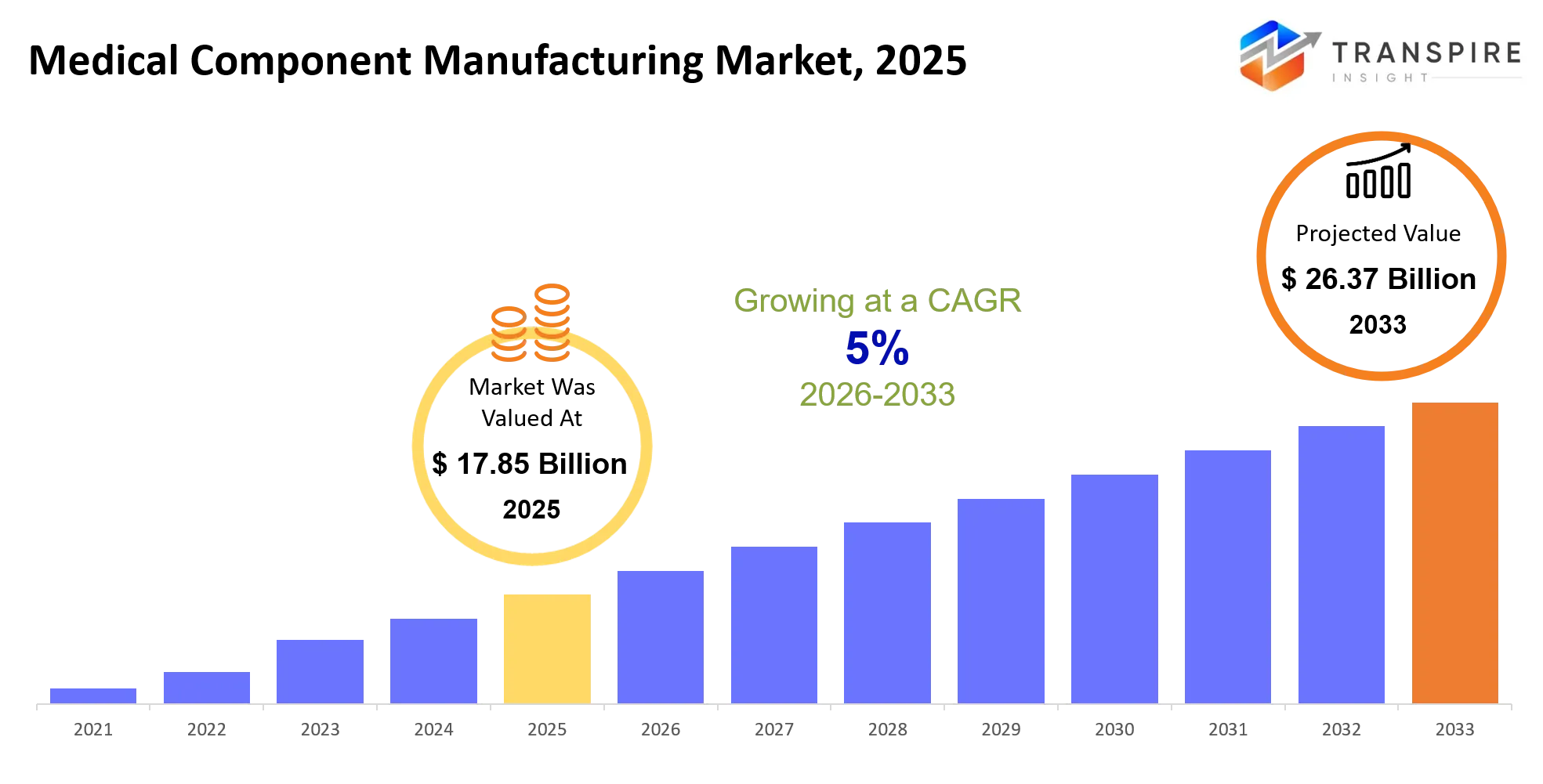
As per the Transpire Insight Analysis, The Medical Component Manufacturing Market size is estimated at USD 17.85 billion in 2025 and is anticipated to reach USD 26.37 billion by 2033, growing at a CAGR of 5% from 2026 to 2033.
The Medical Component Manufacturing Market is comprised of precision plastics, metals, electronics, machined components, and surgical components that are used in medical devices, diagnostics, implants, and drug-delivery products. Rather than finished devices, manufacturers utilize it in the form of regulated materials to develop validated and traceable components that can be assembled on a scale by original equipment manufacturers (OEMs). Over the past three to five years, the market has evolved from offshore, cost-led sourcing to qualified, regionally resilient supply networks. OEMs are increasingly dual-sourcing critical components and advancing nearshoring efforts to regions such as Mexico and Eastern Europe. A clear structural shift within the industry relates to digital and connected functions embedded in devices, which is putting upward pressure on the requirements for electronics, cybersecurity documentation, and software traceability - the FDA's cybersecurity guidance (security-by-design controls and software bills of materials for cyber devices) is a prime example. Devices are becoming smaller, smarter, and patient-specific, requiring tighter tolerances, biocompatible materials, and validated processes, and are increasingly outsourcing more complex component work to specialist manufacturers.
Medical Component Manufacturing Market Size & Forecast:
- Market Size 2025: USD 104.86 Billion
- Expected Market Value (2033): USD 199.13 Billion
- Forecast CAGR (2026–2033): 8.35%
- Leading Region in 2025: North America
- Fastest Growing Region: Asia Pacific
- Key Company Profiles: Jabil, Flex, TE Connectivity, Integer Holdings, Sanmina, Celestica, Phillips Medisize, Nordson Corporation, TE Connectivity Medical, Viant Medical, Cadence Inc., Nortech Systems, Resonetics, Tegra Medical, Integer.
Key Medical Component Manufacturing Market Insights:
The market is evolving from low-cost components and parts to regulated, technology-focused manufacturing alliances, where supplier selection is based on traceability, cybersecurity, and process control.
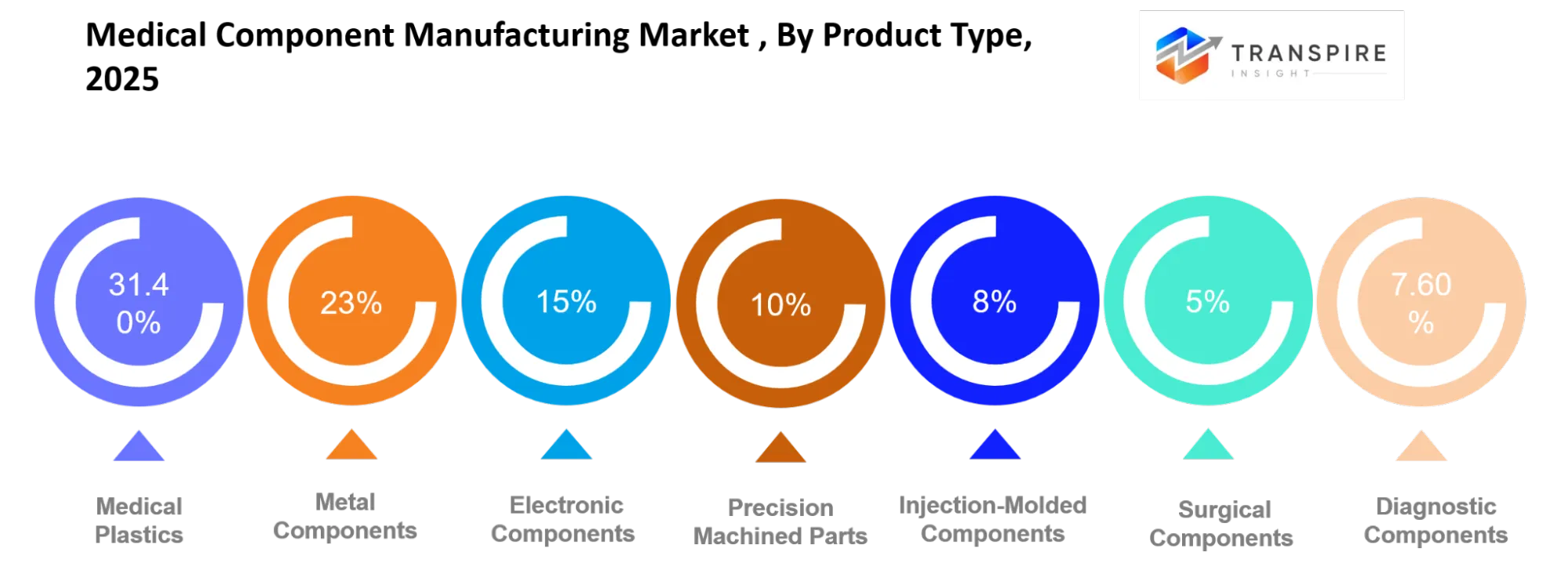
- Medical plastics components are leading with a 31.40% share, while Jabil's investment in in-house sterilization and catheter-development capabilities is supporting the growth.
- Metal parts make up 23.00%, with Jabil's Swiss Le Locle site making precision spinal implants and surgical instruments.
- Electronic components accounted for 15.00%, which indicates that demand for secure sensors, boards, and connected-device modules was strong from the OEMs.
- Precision machined parts account for 10.00%, leveraging Swiss-style micro-machining, cleanroom assembly and automated inspection.
- High-volume drug delivery and diagnostic consumable manufacturing drive injection-moulded parts, with an 8.00% share of the total.
- Surgical components make up 5.00%, while minimally invasive catheter development is climbing the ranks, thanks to Jabil's MIS partnership.
- The diagnostic components segment accounts for 4.00%, with molecular diagnostics suppliers becoming more involved in co-developing components from concept to commercialisation.
- The share of implant components is 3.60%, and 3D-printed components are expected to grow at a 15.30% CAGR, due to patient-specific and complex geometry applications.
- North America is the largest market with a 43.70% share and the fastest-growing market with a 10.80% CAGR in Asia Pacific.
What are the Key Drivers, Restraints, and Opportunities in the Medical Component Manufacturing Market?
Driver:
Demand is being driven by increasingly complex medical devices, tighter component tolerances, and the need for dependable production at commercial scale. Miniaturised sensors, wearable monitors and minimally invasive instruments require components that combine precision with material compatibility. As OEMs introduce more sophisticated products, they increasingly outsource specialised machining, moulding and assembly, creating opportunities for manufacturers to secure longer-term supply contracts and higher-value engineering work.
Restraint:
High validation costs, expensive tooling and stringent quality requirements limit entry and capacity expansion. Manufacturers must demonstrate repeatable processes, maintain documentation, and control material variability. These obligations persist because component defects can compromise device performance or patient safety. Smaller suppliers may struggle to fund inspection equipment, cleanroom facilities and quality-management upgrades, delaying qualification and limiting access to regulated OEM contracts.
Opportunity:
Additive manufacturing and advanced micro-moulding offer opportunities to produce complex geometries, lightweight structures and customised components with less dependence on conventional tooling. For example, medical manufacturers can use metal 3D printing to develop patient-specific implant components and optimise designs before scaling production. Regional investment in medical-device manufacturing across Asia-Pacific could also create opportunities for qualified local suppliers. The FDA’s QMSR effectively reinforces the commercial value of robust quality systems and documented risk management. Suppliers that combine engineering support, validated processes, and traceable production can improve customer retention and compete for higher-value programmes.
Driver Impact Analysis – Medical Component Manufacturing Market
|
Driver |
Relative Impact on Growth (%) |
Geographic Relevance |
Impact Timeline |
Demand Strength |
Growth Mechanism |
Key Beneficiaries |
Major Constraint |
|
Rising demand for advanced medical devices and minimally invasive procedures |
28% |
North America, Europe, Asia-Pacific |
Short-term (≤2 years) |
High |
Increases demand for precision components and miniaturised assemblies |
Precision machining firms, OEMs, implant manufacturers |
Complex designs increase validation costs |
|
Growing adoption of automation, robotics, and precision manufacturing |
23% |
North America, Germany, Japan, China |
Medium-term (2–4 years) |
High |
Improves production consistency, throughput, and component tolerances |
Contract manufacturers, automation vendors, medical OEMs |
High capital expenditure and integration complexity |
|
Stringent medical device quality and regulatory compliance requirements |
19% |
North America, Europe, Asia-Pacific |
Short-term (≤2 years) |
High |
Drives investment in traceability, validation, and quality-controlled production |
Certified component suppliers, testing laboratories, quality software providers |
Compliance costs burden smaller manufacturers |
|
Expansion of diagnostic, monitoring, and wearable medical technologies |
17% |
North America, Asia-Pacific, Europe |
Medium-term (2–4 years) |
High |
Expands demand for sensors, microelectronics, connectors, and enclosures |
Sensor suppliers, electronics manufacturers, wearable-device OEMs |
Rapid technology changes shorten product lifecycles |
|
Medical supply-chain localisation and sustainable manufacturing investment |
13% |
North America, Europe, India, China |
Long-term (≥4 years) |
Medium |
Encourages regional sourcing, capacity expansion, and material efficiency |
Regional suppliers, contract manufacturers, sustainable-material vendors |
Supplier qualification delays and higher operating costs |
Total relative impact: 100%
What Has the Impact of Artificial Intelligence Been on the Medical Component Manufacturing Market?
Artificial intelligence is enabling manufacturers to adopt a closed-loop production methodology instead of inspecting products after they are made. Computer-vision techniques are used for on-line inspection of injection-moulded components, catheter tips, printed circuit boards, and machined surfaces for micro-defects, significantly decreasing variance and scrap. Data from sensors mounted on injection-moulding machines, CNC centres, and sterilisation equipment is being used to develop models to make predictions about tool wear, temperature drift, and machine breakdowns. AI enables predictive maintenance and process optimisation. Sensor-based systems can detect excessive spindle loads or mould conditions, make adjustments on the fly, and minimise unplanned downtime. For instance, predictive maintenance improved downtime by 41%, as well as overall equipment effectiveness from 73% to 89%, which in turn improves yield, batch consistency, and delivery performance for OEM customers. AI inspection and maintenance systems require clean production data, validated models, connectivity, and cybersecurity controls. In regulatory situations, a false negative or an unexplained model change can be a compliance risk. Costly capital investment and aligning AI outputs with ISO 13485 quality systems can explain why smaller component manufacturers are moving to AI more slowly.
In April 2026, Novo Nordisk formed a strategic partnership with OpenAI to integrate advanced artificial intelligence capabilities across its value chain, moving explicitly from early-stage discovery into its production systems.
Key Medical Component Manufacturing Market Trends:
Manufacturers are moving from providing individual components to application-specific and application-validated components, backed by more engineering and quality support. As technology becomes more important, the focus is on defect reduction, faster qualification cycles, and greater supply reliability.
- To mitigate the risk of shortages, OEMs are moving from single offshore sourcing to dual sourcing and regional buffers.
- As OEMs look for shorter lead times and a more direct quality check, nearshoring is becoming more popular in Mexico and Eastern Europe.
- Suppliers are being forced to offer cybersecurity-ready electronics, software documents, and SBOM support as connected devices come into play.
- Manual visual inspection for surface defects, dimensional variation, and assembly errors is being replaced by AI-based visual inspection.
- Maintenance is becoming a buying requirement, and OEMs are increasingly looking for suppliers who can provide consistent throughput and reduced batch-risk exposure.
- The 3D printing technologies are shifting focus from prototypes to validated surgical guides, dental devices and patient-specific implants.
- Medical plastics are no longer limited to disposable applications but are also finding their way into high-performance polymers for drug delivery, diagnostics and implant-adjacent applications.
- Supplier traceability, technical documentation and post-market surveillance are becoming key considerations in supplier selection, as required by EU MDR and FDA.
- OEMs are outsourcing micro-components and combination-device components because they require special cleanroom, machining, and electronics capabilities.
Medical Component Manufacturing Market Segmentation
Component Type:
Medical plastics components own the dominant share of 31.40% because of their low weight, excellent sterilization ability, design freedom, and viability of large-scale production of disposables and diagnostics. Medical plastics components are followed by metal components, which have a share of 23.00%, including surgical instruments, orthopaedic, and precision enclosures. The electronic component holds 15.00% as the demand for monitor imaging equipment connectivity increased. Precision machine parts have 10.00%, injection moulded components have 8.00%, the surgical components have 5.00%, diagnostic components have 4.00%, and implant components have 3.60%. The growing 3d medical components CAGR is 15.30% during the forecast period.
Material:
Stainless steel remains central for reusable instruments and corrosion-resistant hardware, while titanium is favoured in implants and orthopaedic devices because of biocompatibility and strength-to-weight performance. Plastics dominate disposable and diagnostic applications; silicone supports sealing, tubing, and drug-delivery interfaces; ceramics, aluminium, carbon fibre, and speciality alloys serve imaging, lightweight structural, and high-wear applications. Material selection is increasingly shaped by sterilisation cycles, regulatory documentation, and device-miniaturisation needs.
Application:
Medical devices and surgical instruments remain the primary demand centres, supported by the need for reliable, precision-engineered components. Diagnostic equipment, imaging systems and patient-monitoring devices expand opportunities for electronic assemblies, sensors and specialised housings. Drug-delivery systems require accurate fluid-control components, while orthopaedic and dental devices rely on durable materials and application-specific designs. The shift towards home healthcare and remote monitoring is increasing demand for compact, lightweight components. Manufacturers that support miniaturisation and integrated device designs are better positioned to secure long-term OEM contracts.
Manufacturing Process:
Injection moulding remains central to high-volume production of medical plastics, disposable components and device housings, while CNC machining supports tight-tolerance metal and polymer parts. Die casting, extrusion, stamping and forging serve structural and fluid-handling applications, whereas laser processing enables precise cutting and joining. Three-dimensional printing supports complex geometries, rapid prototyping and customised components without extensive tooling. As OEMs seek shorter development cycles and greater design flexibility, manufacturers combining conventional processes with additive manufacturing can improve responsiveness and expand specialised production capabilities.
End User:
Medical device OEMs represent the principal customer group, followed by hospitals, diagnostic centres, pharmaceutical and biotechnology companies, research institutes and dental manufacturers. OEMs increasingly outsource specialised component production to access established engineering capabilities, validated processes and manufacturing infrastructure without expanding internal capacity. Hospitals and diagnostic centres influence demand through equipment requirements, while pharmaceutical and biotechnology companies need components for drug-delivery and laboratory systems. Research institutes support early-stage development. Suppliers offering design assistance, regulatory documentation, and scalable production can strengthen customer relationships and improve opportunities for repeat business.
Component Complexity:
Standard and disposable components support repeatable, high-volume manufacturing, whereas precision, micro, custom, implantable and high-performance components require specialised engineering and stricter process control. Increasing device miniaturisation is driving demand for components with tighter tolerances and more complex geometries. Implantable products also require appropriate material selection, biocompatibility assessment and reliable manufacturing controls. As mechanical, electronic and software-enabled functions converge within smaller devices, component integration becomes more demanding. Manufacturers with advanced inspection, traceability and custom-engineering capabilities can differentiate themselves and compete for higher-value programmes.
What are the Key Use Cases Driving the Medical Component Manufacturing Market?
Medical plastics components, representing 31.40%, support housings, fluid-management parts, disposable medical products, and diagnostic consumables. Their mouldability and lightweight construction enable economical production at scale, while metal components serve surgical instruments and durable device structures.
Expanding applications include electronic components for patient monitoring, diagnostic equipment and imaging systems, where miniaturised sensors and precision assemblies improve measurement and device functionality. Drug-delivery and dental devices also require reliable, application-specific components.
Emerging use cases include 3D-printed medical components, growing at a 15.30% CAGR, for customised implant geometries, specialised surgical tools and complex prototypes. Additive manufacturing can accelerate design iteration and reduce tooling dependence, while advanced micro-machining supports compact wearable devices and minimally invasive instruments.
|
Report Metrics |
Details |
|
Market size value in 2025 |
USD 17.85 Billion |
|
Market size value in 2026 |
USD 18.74 Billion |
|
Revenue forecast in 2033 |
USD 26.37 Billion |
|
Growth rate |
CAGR of 5% from 2026 to 2033 |
|
Base year |
2025 |
|
Historical data |
2021 - 2024 |
|
Forecast period |
2026 - 2033 |
|
Report coverage |
Revenue forecast, competitive landscape, growth factors, and trends |
|
Regional scope |
United States; Canada; Mexico; United Kingdom; Germany; France; Italy; Spain; Denmark; Sweden; Norway; China; Japan; India; Australia; South Korea; Thailand; Brazil; Argentina; South Africa; Saudi Arabia; United Arab Emirates |
|
Key companies profiled |
Jabil, Flex, TE Connectivity, Integer Holdings, Sanmina, Celestica, Phillips Medisize, Nordson Corporation, TE Connectivity Medical, Viant Medical, Cadence Inc., Nortech Systems, Resonetics, Tegra Medical, Integer |
|
Customization scope |
Free report customization (country, regional & segment scope). Available customized purchase options to meet your exact research needs. |
|
Report Segmentation |
Component Type (Medical Plastics, Metal Components, Electronic Components, Precision Machined Parts, Injection-Molded Components, Surgical Components, Diagnostic Components, Implant Components); Material (Stainless Steel, Titanium, Aluminum, Plastics, Ceramics, Silicone, Carbon Fiber, Specialty Alloys); Application (Medical Devices, Surgical Instruments, Diagnostic Equipment, Imaging Systems, Patient Monitoring, Drug Delivery, Orthopedic Devices, Dental Devices); and Manufacturing Process (Injection Molding, CNC Machining, Die Casting, 3D Printing, Extrusion, Stamping, Forging, Laser Processing); End User (Medical Device OEMs, Hospitals, Diagnostic Centers, Pharmaceutical Companies, Biotechnology Companies, Research Institutes, Dental Manufacturers); Component Complexity (Standard Components, Precision Components, Micro Components, Custom Components, Disposable Components, Implantable Components, High-Performance Components) |
Which Regions are Driving the Medical Component Manufacturing Market Growth?
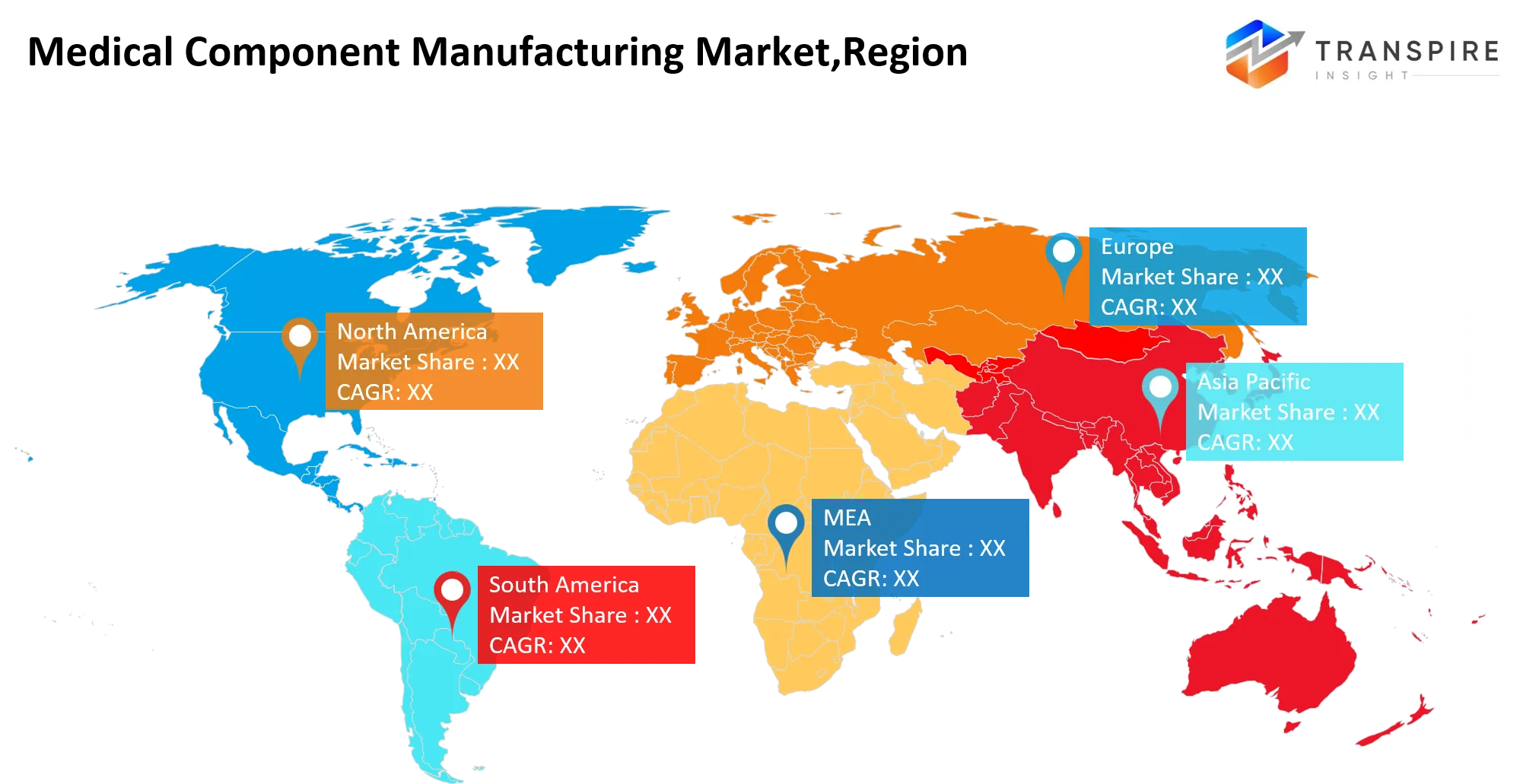
North America dominates with a 43.70% share, thanks to its highly concentrated base of medical-device OEMs, advanced precision manufacturing capability, and regulatory credibility. Quality expectations from the Food and Drug Administration, hospitals' demand for high-tech diagnostic, monitoring, and positioning equipment, and the re-shoring of strategically important components are all helping North America. Its ecosystem of high-value work in electronics and precision machining, sterilisation, and device parts designed for cyber-readiness underpins high-end work.
In January 2026, Boston Scientific Corp. announced a definitive agreement to acquire Penumbra Inc. This blockbuster $14.5 billion transaction secures a highly advanced mechanical thrombectomy portfolio for peripheral vascular procedures, meeting hospitals' intense demands for precision positioning and high-tech surgical solutions.
https://www.modernhealthcare.com/medical-devices/mh-medtronic-boston-scientific-medtech-deals-2026/
Europe has a 28.00% market share and competes on its engineering depth rather than scale. Germany, Switzerland, Ireland and the Nordic regions have capability in precision machining, implant manufacturing, cleanroom production and regulatory expertise. The higher the EU MDR conformance costs a supplier, the greater the stability benefit – original equipment manufacturers with existing quality systems and technical documentation are more likely to win long-cycle OEMs.
In March 2026, the European Union and Switzerland signed a renewed package of bilateral agreements that officially updated their Mutual Recognition Agreement (MRA). This strategic regulatory partnership directly restores the mutual acceptance of medical device conformity assessment certificates between the two regions.
https://meddeviceguide.com/blog/eu-switzerland-mra-update-2026-medical-device-market-access-guide
Asia-Pacific accounts for 22.00% of the market, and the fastest-growing market segment is Asia-Pacific with a CAGR of 10.80%. Investment in local production of medical devices, the growth of healthcare infrastructure, and supply chain diversification open markets for select component suppliers. The debates in India over ensuring production of medical and dental devices are a prime example of these regional shifts. The future of the market depends on technical expertise, regulatory readiness, and the capacity to achieve consistent quality at scale.
In October 2026, GenElek Technologies won the MedTech RoboSprint 2026 program hosted by the Andhra Pradesh MedTech Zone (AMTZ) for its advanced Robotic Gait Trainer solution.
https://www.pib.gov.in/PressReleasePage.aspx?PRID=2239576
Who are the Key Players in the Medical Component Manufacturing Market and how do they Compete?
Manufacturing competition is changing from price to capability, with strategic engagement in regulated design, sterilisation, electronics, and combination product contract manufacturing. OEMs are using customers with the ability to accelerate development cycles, maintain traceability and ramp production across regions.
Jabil is focused on a strategy of innovation and integration, with differentiated capabilities in drug-delivery, diagnostics, catheter and pharmaceutical manufacturing. Its acquisition of Pii has added aseptic filling, lyophilisation and oral solid-dose capabilities and a $70 million Mississippi facility that is set to add X-ray sterilisation by 2027. Integer stands out with niche capabilities in energy storage, micro-electronics and catheter-based components while bringing its large, highly experienced engineering community to OEMs with high-complexity needs. TE Connectivity focuses on connectivity, sensors, and secure electronic components and plans to grow with design-in relationships across monitoring and diagnostic platforms. Phillips Medisize, Viant Medical, Cadence, Nortech, Resonetics and Tegra Medical bring micro-moulding, laser processing, contract development and precision components expertise to compete for customers and enter new segments. A core part of their expansion plans is to look upstream for design input and downstream for finished-device assembly in order to lock in more customer switching costs.
Key Players are:
- Jabil
- Flex
- TE Connectivity
- Integer Holdings
- Sanmina
- Celestica
- Phillips Medisize
- Nordson Corporation
- TE Connectivity Medical
- Viant Medical
- Cadence Inc.
- Nortech Systems
- Resonetics
- Tegra Medical
- Integer
Medical Component Manufacturing Market — Enhanced Competitive Benchmarking
|
Company |
Est. Revenue Share Range |
Key Offerings |
Strategic Positioning |
Geographic Strength |
Technology Focus |
|
Jabil Inc. |
Estimated 4–7% |
Medical device assemblies, precision plastics, catheter systems, medical electronics |
Global-scale integrated manufacturing and design-to-production services |
North America, Europe, Asia Pacific |
Automated assembly, precision molding, connected medical electronics |
|
TE Connectivity Ltd. |
Estimated 3–6% |
Catheter components, metal hypotubes, medical connectors, sensors |
Premium engineered components for minimally invasive devices |
North America, Europe, Asia Pacific |
Miniaturised sensors, precision tubing, advanced catheter engineering |
|
Integer Holdings Corporation |
Estimated 3–5% |
Cardiac components, implantable device assemblies, neurostimulation components |
Specialised high-reliability components for implantable medical devices |
North America, Europe, Asia Pacific |
Implantable device engineering, precision metals, advanced coatings |
|
Flex Ltd. (Flex Health Solutions) |
Estimated 2–5% |
Medical electronics, device assemblies, precision plastics, diagnostic equipment components |
Scalable manufacturing with integrated engineering and supply-chain capabilities |
North America, Asia Pacific, Europe |
Electronics integration, automated manufacturing, digital quality systems |
|
Phillips-Medisize (Molex) |
Estimated 2–4% |
Drug-delivery components, injection-molded parts, complex cable assemblies, diagnostic-device components |
Design-led CDMO specializing in complex drug delivery and connected devices |
North America, Europe, Asia Pacific |
Micro-molding, device connectivity, precision electromechanical integration |
|
Viant Medical |
Estimated 2–4% |
Catheter assemblies, surgical components, orthopedic components, drug-delivery devices |
Vertically integrated medical device development and contract manufacturing |
North America, Europe, Asia Pacific |
Precision machining, polymer processing, cleanroom assembly |
|
Nordson Corporation (Nordson MEDICAL) |
Estimated 1–3% |
Catheter components, medical tubing, fluid-management components, connectors |
Specialist supplier of precision fluid-management and interventional components |
North America, Europe, Asia Pacific |
Microfluidics, precision extrusion, advanced catheter technologies |
|
Gerresheimer AG |
Estimated 1–3% |
Glass syringes, polymer syringes, cartridges, diagnostic and medical-device components |
Integrated primary packaging and drug-delivery component specialist |
Europe, North America, Asia Pacific |
Pharmaceutical glass forming, polymer molding, drug-delivery engineering |
|
West Pharmaceutical Services, Inc. |
Estimated 1–3% |
Elastomeric closures, injectable-drug packaging components, delivery-system components |
High-quality containment and delivery components for injectable medicines |
North America, Europe, Asia Pacific |
Elastomer formulation, container-closure integrity, delivery-system engineering |
|
Sanmina Corporation |
Estimated 1–3% |
Medical electronics assemblies, diagnostic equipment components, precision electromechanical assemblies |
High-complexity electronics and precision manufacturing for medical OEMs |
North America, Europe, Asia Pacific |
High-reliability electronics, precision assembly, manufacturing automation |
Recent Development News
In June 2026, Cordica Medical acquired RapidWerks’ micro-molding capabilities, strengthening its precision manufacturing platform for miniaturised medical device components. The acquisition supports tighter manufacturing tolerances and integrates micro-molding with device development and commercial-scale production, particularly for orthopaedic, cardiovascular, and neurological applications.
In August 2026, Knowles Corporation partnered with Elucent Medical to manufacture an advanced surgical guidance device, leveraging micro-molding, design-for-manufacturability expertise, and integrated assembly. The collaboration improves production readiness, manufacturing scalability, and time to market for specialised surgical technology.
In September 2026, Precera Medical acquired Additive Metal Services (AMS), expanding its capabilities in metal injection molding and metal additive manufacturing for complex medical device components. The acquisition strengthens its ability to support medical device manufacturers from prototyping through automated production.
https://ebs.publicnow.com/view/2B17CE2912F1D81467D302D95BB2074F84888687
What Strategic Insights Define the Future of the Medical Component Manufacturing Market?
The industry is trending toward smaller, deeper relationships with the supplier community built on regulatory traceability, cybersecurity, sterilisation, and multi-process capability. North America will be the bigger market - at 43.70% share - based on high-compliance manufacturing, but the APAC region, at 10.80% CAGR, will draw capacity as new device OEMs seek to spread manufacturing capacity to manufacturing-capable regions. There are risks of overreliance on a handful of qualified suppliers for micro-electronics, speciality polymers, and precision machining-a single validation or logistics hiccup can hold up entire device programs. The rising tide of integrated drug-device manufacturing is an opportunity-suppliers who combine component manufacturing, aseptic filling, and packaging with registration support have clinched higher-margin, lifecycle-duration contracts, exemplified by Pii's acquisition by Jabil and teaming with Kymanox. From a strategic standpoint, upstream manufacturers should look at investing in validated additive manufacturing, AI-powered quality control, and regional dual-sourcing rather than reducing unit costs.
Key Segmentations are:
Component Type
- Medical Plastics
- Metal Components
- Electronic Components
- Precision Machined Parts
- Injection-Molded Components
- Surgical Components
- Diagnostic Components
- Implant Components
Material
- Stainless Steel
- Titanium
- Aluminium
- Plastics
- Ceramics
- Silicone
- Carbon Fibre
- Speciality Alloys
Application
- Medical Devices
- Surgical Instruments
- Diagnostic Equipment
- Imaging Systems
- Patient Monitoring
- Drug Delivery
- Orthopaedic Devices
- Dental Devices
Manufacturing Process
- Injection Moulding
- CNC Machining
- Die Casting
- 3D Printing
- Extrusion
- Stamping
- Forging
- Laser Processing
End User
- Medical Device OEMs
- Hospitals
- Diagnostic Centres
- Pharmaceutical Companies
- Biotechnology Companies
- Research Institutes
- Dental Manufacturers
Component Complexity
- Standard Components
- Precision Components
- Micro Components
- Custom Components
- Disposable Components
- Implantable Components
- High-Performance Components
Frequently Asked Questions
Find quick answers to common questions.
The medical component manufacturing market size was valued at USD 17.85 billion in 2025 and is poised to reach USD 26.37 billion by 2033, expanding at a 5% CAGR
Key segments for the medical component manufacturing market are Component Type (Medical Plastics, Metal Components, Electronic Components, Precision Machined Parts, Injection-Molded Components, Surgical Components, Diagnostic Components, Implant Components); Material (Stainless Steel, Titanium, Aluminum, Plastics, Ceramics, Silicone, Carbon Fiber, Specialty Alloys); Application (Medical Devices, Surgical Instruments, Diagnostic Equipment, Imaging Systems, Patient Monitoring, Drug Delivery, Orthopedic Devices, Dental Devices); and Manufacturing Process (Injection Molding, CNC Machining, Die Casting, 3D Printing, Extrusion, Stamping, Forging, Laser Processing); End User (Medical Device OEMs, Hospitals, Diagnostic Centers, Pharmaceutical Companies, Biotechnology Companies, Research Institutes, Dental Manufacturers); Component Complexity (Standard Components, Precision Components, Micro Components, Custom Components, Disposable Components, Implantable Components, High-Performance Components)
Growth is primarily driven by increasing demand for precision-engineered medical devices, minimally invasive surgical instruments, advanced diagnostic equipment, miniaturised components, and outsourced medical-device manufacturing.
The market is led by major manufacturers, including Jabil, Flex, TE Connectivity, Integer Holdings, Sanmina, Celestica, Phillips Medisize, Nordson Corporation, TE Connectivity Medical, Viant Medical, Cadence Inc., Nortech Systems, Resonetics, Tegra Medical, Integer.
North America holds a 43.70% market share, supported by established medical-device OEMs, advanced manufacturing infrastructure, strong R&D investment, and stringent quality and regulatory requirements
Key opportunities include 3D-printed customised components, AI-enabled quality inspection, advanced micro-moulding, precision manufacturing, and expanding medical-device production across Asia-Pacific.
- Jabil
- Flex
- TE Connectivity
- Integer Holdings
- Sanmina
- Celestica
- Phillips Medisize
- Nordson Corporation
- TE Connectivity Medical
- Viant Medical
- Cadence Inc.
- Nortech Systems
- Resonetics
- Tegra Medical
- Integer
About the Authors

Kartik bhong
I am Kartik Bhong, a Senior Research Analyst at Transpire Insight, specializing in the Packaging, Manufacturing, and Construction industry. My work focuses on analyzing market trends, emerging technologies, industry regulations, and competitive landscapes to deliver accurate, data-driven insights. I am passionate about transforming complex industry information into clear, practical content that helps businesses, professionals, and decision-makers stay informed and make confident strategic decisions. Through continuous research and a strong commitment to accuracy, I strive to create reliable, well-researched content that reflects the latest developments across these dynamic industries and supports the vision of Transpire Insight in delivering valuable market intelligence.

Chakradhar Khansole
Chakradhar serves as the Research Director at Transpire Insight, bringing over 8 years of experience in technology, innovation, and strategic market intelligence. He specializes in transforming complex market data into actionable business insights that enable organizations to make informed, growth-oriented decisions. Recognized for his strategic vision and analytical expertise, Chakradhar leads high-impact research initiatives, delivering comprehensive market assessments, competitive intelligence, and forward-looking industry analysis.
Recently Published Reports
-
Apr 2026
Handling and Lifting Equipment Market
Handling and Lifting Equipment Market Size, Share & Analysis Report By Product (Cranes and Hoists, Forklifts, Conveyor Systems, Aerial Work Platforms, Others), By Application (E-Commerce, Automotive and Railway, Food and Beverages, Aviation, Others), and Geography (North America, Europe, Asia-Pacific, Middle East and Africa, South and Central America), 2021 - 2031
-
Nov 2026
HVAC Equipment Market
HVAC Equipment Market Size, Share & Analysis Report By Heating Equipment Type (Boilers and Furnaces, Heat Pumps, and Unitary Heaters), By Ventilation Equipment (Air Handling Units, Humidifiers and Dehumidifiers, Air Filters, and Fan Coiling Units), By Air Conditioning Equipment (Unitary Air Conditioners, Room Air Conditioners, Packaged Terminal Air Conditioners, and Chillers), By End User (Commercial, Residential, Industrial, and others), and Geography (North America, Europe, Asia-Pacific, Middle East and Africa, South and Central America), 2021 – 2031
-
Apr 2026
Refrigeration Valves Market
Refrigeration Valves Market Size, Share & Analysis Report By Type (Solenoid Valves, Expansion Valves, Check Valves, Service Valves, Others), By Application (Commercial Refrigeration, Industrial Refrigeration, Transport Refrigeration, Residential Refrigeration, Air Conditioning Systems), By End User (Food and Beverage Industry, Pharmaceutical Industry, HVAC Industry, Chemical Industry, Others), and Geography (North America, Europe, Asia-Pacific, Middle East and Africa, South and Central America), 2021 – 2031
-
Apr 2026
E-Commerce Packaging Materials Market
E-Commerce Packaging Materials Market By Material Type (Corrugated Boxes, Paper & Paperboard, Foam & Cushioning Materials, Plastic Packaging, Flexible Packaging, Protective Packaging, Others), By Product(Primary Packaging, Secondary Packaging, Tertiary Packaging), By Packaging Function (Protective Packaging, Branding & Presentation Packaging, Transit & Logistic Packaging, Sustainable Packaging, Tamper Evidence Packaging), By End-User (Retail & Consumer Goods, Electronic Appliances, Food & Beverages, Healthcare & Pharmaceutical, Fashion & Apparel, Home & Furnishing, Others); By Industry Analysis, Size, Share, Growth, Trends, and Forecasts 2021-2033