

Stainless Steel 400 Series Market Summary:
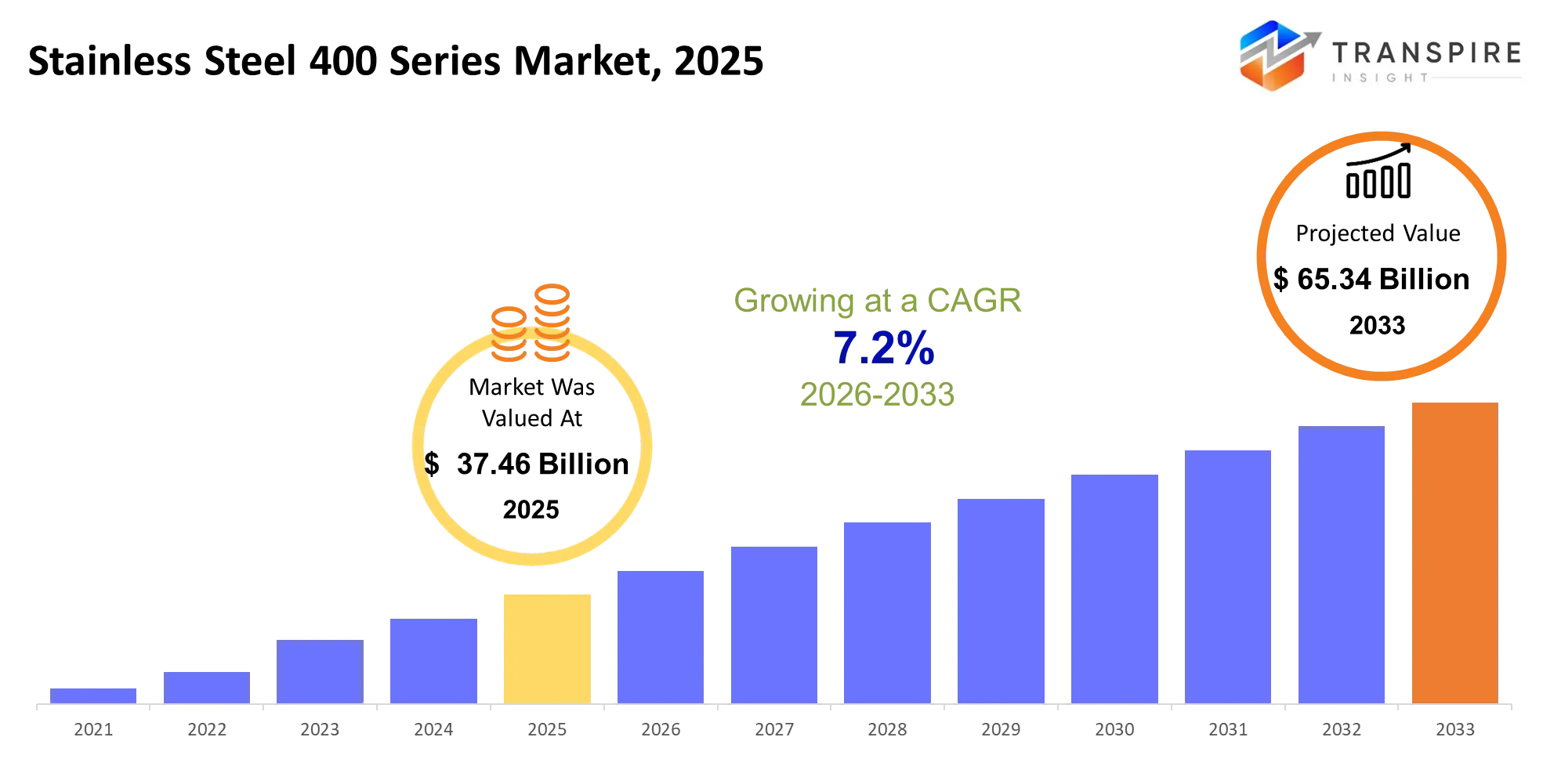
As per Transpire Insight Analysis, the Stainless Steel 400 Series Market size is estimated at USD 37.46 billion in 2025 and is anticipated to reach USD 65.34 billion by 2033, growing at a CAGR of 7.2% from 2026 to 2033.
The stainless steel 400 series market provides materials that resist corrosion, handle heat and are cost-friendly for use in exhaust systems, appliances, kitchen equipment, industrial parts and construction products. In the past three to five years, people who buy these materials have started to look at material cost, nickel exposure, how long the material lasts and the impact on the environment all together when choosing which grade to use. A big change has been the increased use of grades because they are good options when less nickel is needed, which helps lower the cost of the alloy. A real reason for this change is rules about reducing carbon emissions in industry, which is making factories and customers check how much recycled material is used and how much pollution is created during production. This growth is happening because there are grades to choose from, old types of steel are being replaced in some uses, and there is more money going into better ways to make the steel. Energy-related equipment is also creating demand because companies want materials that can deal with heat, rust and many times of use.
Stainless Steel 400 Series Market Size & Forecast:
- Market Size 2025: USD 37.46 Billion
- Expected Market Value (2033): USD 65.34 Billion
- Forecast CAGR (2026–2033): 7.2%
- Leading Region in 2025: Asia-Pacific
- Fastest Growing Region: North America
- Key Company Profiles: Acerinox, Outokumpu, Aperam, Jindal Stainless, POSCO, Nippon Steel, YUSCO, Tsingshan Holding, Baosteel, TISCO, North American Stainless, AK Steel, ATI, Cleveland-Cliffs, Guangxi Chengde.
Key Market Insights
The market is moving towards intelligent manufacturing and stainless steel solutions of high value addition. Cost efficiency, specialised grades and environmentally friendly production are growing increasingly significant
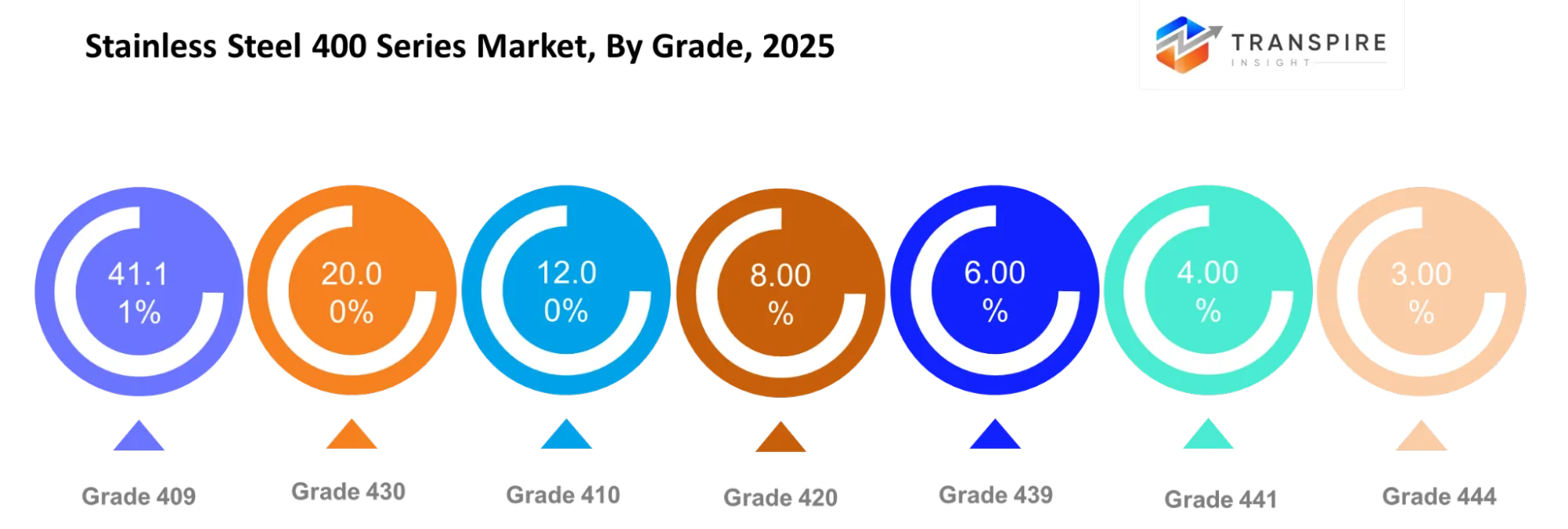
- Grade 409 accounts for 41.11% and therefore is the dominant grade in the provided market segmentation. Its already-established presence in automotive exhausts ensures future demand.
- Grade 430 accounts for 20.00%, owing to its applications in kitchen utensils, household equipment, sinks and decor components. Outokumpu and Aperam continue manufacturing 430-based products for those applications.
- Grade 410 accounts for 12.00% due to the need for strength and corrosion resistance in applications that require high-wear resistance.
- Grade 420 accounts for 8.00%, owing to its importance in applications that require hardness and good mechanical properties.
- Grade 439 accounts for 6.00%, whereas Grade 441 accounts for 4.00%. These numbers show that the industry is gradually moving towards ferritic grades that provide better performance in more challenging applications.
What are the Key Drivers, Restraints, and Opportunities in the Stainless Steel 400 Series Market?
Drivers
The market for 400 series stainless steel is being driven by the increased use of ferritic and martensitic grades of this product in automotive parts, home appliances, cooking utensils, machinery, and construction material. More and more manufacturers are on the lookout for products that can offer durability, heat resistance, corrosion resistance, and performance, while still maintaining low production costs. The volatile prices of nickel and other alloying materials have prompted manufacturers to find appropriate grades of 400 series for such applications.
Restraints
limitation is that the existing 400 series grades will not offer sufficient levels of corrosion resistance and formability that would be demanded by highly specialised environments. The limitation is structural, as changing an already-existing material specification will need to undertake a number of activities, including testing, product qualification, and modification of tooling, as well as customer approvals.
Opportunities
There are opportunities for the future development of 400 series stainless steel. Manufacturers can design application-specific grades of the material that will be characterised by better durability and processing qualities. Manufacturers can start using lower-carbon production techniques in their products. This will allow them to adapt to the changing demands of the customers.
What Has the Impact of Artificial Intelligence Been on the Stainless Steel 400 Series Market?
The use of AI in stainless steel manufacturing includes inspection, process control, maintenance scheduling and quality management. Using computer vision systems to assess surfaces for defects, artificial intelligence technologies could help operators detect patterns that might be unnoticed during human inspection in rolling and finishing operations. Moreover, predictive modelling software may integrate readings from the equipment, manufacturing records, and other parameters to alert potential maintenance before an unscheduled shutdown. In the case of 400-series grades, these tools would facilitate tighter monitoring of such parameters as thickness, surface finish, temperature and forming-related parameters that would help mills lower waste rates. The use of artificial intelligence may also expedite production planning by matching grade requirements to capacity and customer specifications. AI may prove very helpful where several grades and products are manufactured at one plant. However, this technology cannot be implemented without any problems. Implementation of AI at old plants would require significant investments, high-quality production data, cybersecurity measures and personnel who will validate the output of AI models.
Instance
In May 2025, Project Pragati was initiated by Jindal Stainless at the company’s Hisar plant for AI-based planning, automation, and analytics in stainless steel production. This project is making use of AI surface inspection and predictive analytics, which show that AI technology can be used in the stainless steel 400 series value chain.https://www.jindalstainless.com/press-releases/jindal-stainless-launches-industry-first-supply-chain-digitalisation-project/
Key Market Trends:
The market for the 400 series is evolving from traditional grading to one that is based on efficiency, functionality, digital fabrication, and sustainability. Manufacturers and consumers are considering the whole lifecycle of the material, rather than just looking at its initial cost.
- Volatility in raw material pricing has raised interest in ferritic products, which could decrease reliance on nickel-based stainless steel.
- The automotive industry continues to move towards materials which have properties allowing use at higher temperatures and are durable, as well as having controlled cost of manufacture.
- The appliance industry is focusing more on surface finish and formability characteristics and on avoiding formability defects.
- Stainless steel with lower carbon content has become increasingly important for customers who introduce environmental aspects into their purchasing.
- Digital inspection is moving forward from simple defect detection to data-driven quality management throughout the production process.
- The concept of regional sourcing becomes more important due to trade restrictions and logistics uncertainty affecting stainless steel procurement.
Stainless Steel 400 Series Market Segmentation
By Grade
Grade 409 accounts for 41.11% in the presented segmentation, considering its prominent position in automobiles and automotive exhausts and other high-temperature applications. Grade 430 comes second, with 20.00%, due to the presence of applications such as appliances and decorative items. Grade 410 makes up 12.00%, while Grade 420 makes up 8.00% for applications where strength, hardness, and wear resistance play an important role. Grades 439 and 441 make up 6.00% and 4.00%, respectively, while Grade 444 makes up 3.00%, and others contribute 5.89%.
By Product Type
The market includes Sheets & Plates, Bars & Rods, Tubes & Pipes, Wires, Foils, Strips, Coils and Others. Sheets, plates and coils continue to be significant, as these materials can be converted into automotive parts, appliance parts, kitchenware and industrial parts. Tubes and pipes find uses in fluid transport, structural and heating/cooling functions. Bars and rods are used for fabricated parts, while wires and foils are used for special applications. The strips find special significance for precision and formed products. Growth in future would be driven by accuracy, surface quality, and other processing needs.
By application
the market includes Automotive Exhaust Systems, Kitchen Equipment, Appliances, Building & Construction, Industrial Machinery, Energy Generation, Cutlery, and Others. Applications related to automotive exhaust systems continue to be tied closely with Grade 409, whereas kitchen equipment and appliances form the main demand for Grade 430. Fastest growing among all the identified applications is Energy Generation, which accounts for the growth rate of 5.81%. It will be interesting to see how the future mix of applications develops due to manufacturers' efforts to find low-cost options among stainless grades for particular applications.
By end-use industry
the market involves Automotive & Transportation, Consumer Goods, Construction, Energy & Power, Industrial Equipment, Food Processing, Chemical Processing, and Others. Applications related to the automotive and transportation industries will continue to benefit from the demand created by exhaust systems, while consumer goods will comprise appliances and kitchen equipment. Construction and industrial equipment will create the need for durable stainless components to be used in fabrication. Food and chemical processing applications will involve proper use of particular properties of grades.
By finish
the market has 2B, BA, No.1, No.4, Hairline, Polished, Brushed, and Others as different varieties of surface finishes. The choice of finish depends on the appearance needed, the nature of cleaning, formability, and the environment that the product is supposed to be used in. Surface finishes such as BA and polished finishes depend on applications that require visual appeal, whereas the 2B and others depend on industrial uses of the metal.
What are the Key Use Cases Driving the Stainless Steel 400 Series Market?
The Grade 409 use case as its heat and oxidation resistance properties are appropriate for applications where there is a requirement for durable materials that do not cost too much. Grade 430 is used for kitchen utensils, appliances, sinks, decorative parts and other end-use applications where aesthetics, formability and adequate corrosion resistance properties are important. Energy production is also becoming an area of increasing usage, as mentioned in the dataset provided, as one of the uses for the product. Building parts, chemical processing equipment, cutlery, and special heat applications are adding new markets for the products.
|
Report Metrics |
Details |
|
Market size value in 2025 |
USD 37.46 Billion |
|
Market size value in 2026 |
USD 40.16 Billion |
|
Revenue forecast in 2033 |
USD 65.34 Billion |
|
Growth rate |
CAGR of 7.2% from 2026 to 2033 |
|
Base year |
2025 |
|
Historical data |
2021 - 2024 |
|
Forecast period |
2026 - 2033 |
|
Report coverage |
Revenue forecast, competitive landscape, growth factors, and trends |
|
Regional scope |
United States; Canada; Mexico; United Kingdom; Germany; France; Italy; Spain; Denmark; Sweden; Norway; China; Japan; India; Australia; South Korea; Thailand; Brazil; Argentina; South Africa; Saudi Arabia; United Arab Emirates |
|
Key company profiled |
Acerinox, Outokumpu, Aperam, Jindal Stainless, POSCO, Nippon Steel, YUSCO, Tsingshan Holding, Baosteel, TISCO, North American Stainless, AK Steel, ATI, Cleveland-Cliffs, Guangxi Chengde |
|
Customization scope |
Free report customization (country, regional & segment scope). Avail customized purchase options to meet your exact research needs. |
|
Report Segmentation |
Grade (409, 430, 410, 420, 439, 441, 444, Others); Product Type (Sheets & Plates, Bars & Rods, Tubes & Pipes, Wires, Foils, Strips, Coils, Others); Application (Automotive Exhaust Systems, Kitchen Equipment, Appliances, Building & Construction, Industrial Machinery, Energy Generation, Cutlery, Others); End-Use Industry (Automotive & Transportation, Consumer Goods, Construction, Energy & Power, Industrial Equipment, Food Processing, Chemical Processing, Others); Finish (2B, BA, No.1, No.4, Hairline, Polished, Brushed, Others) |
Which Regions are Driving the Stainless Steel 400 Series Market Growth?
North America
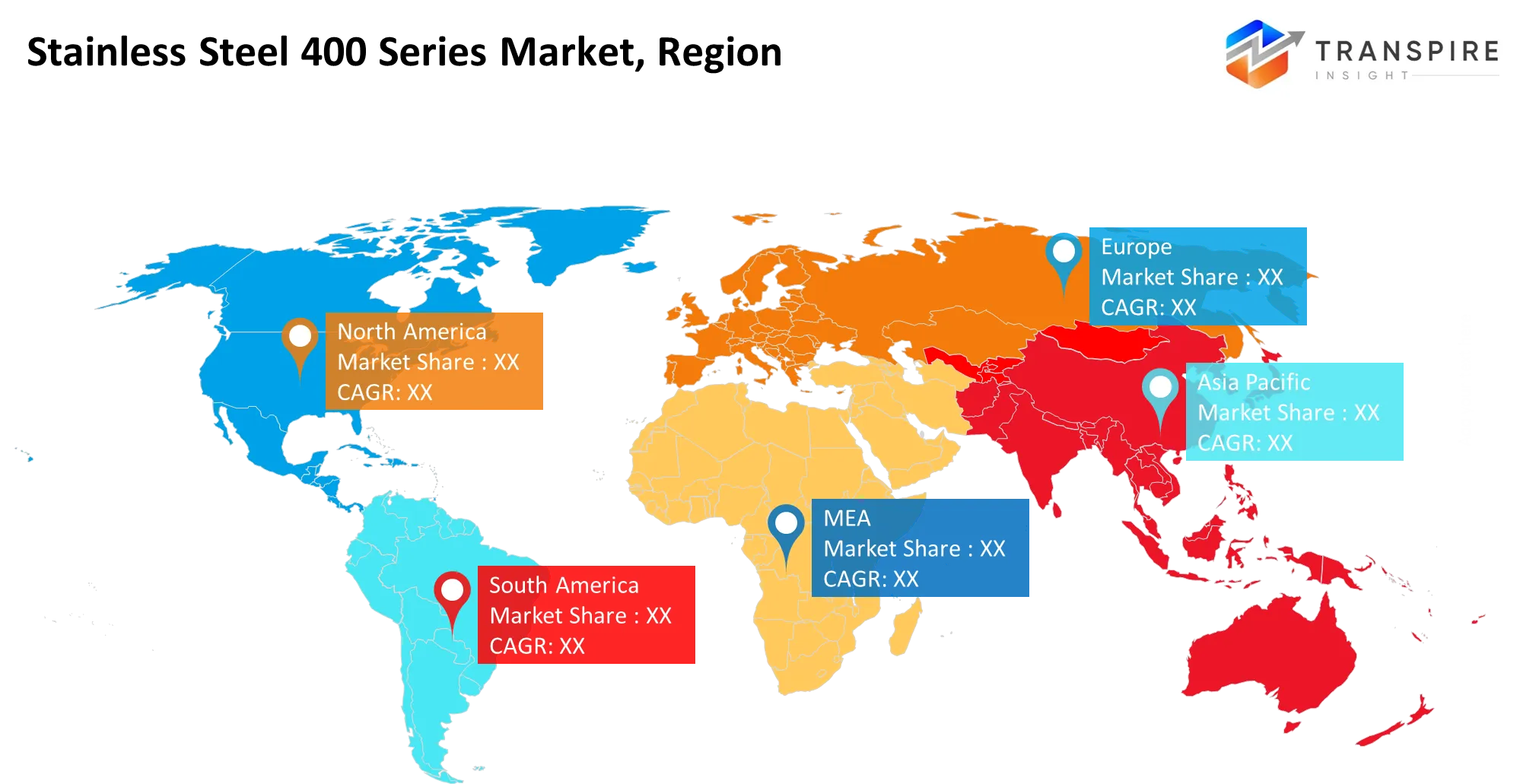
The North American region constitutes a 17.00% share of the market and is considered the most rapidly developing market with a 5.10% CAGR. This growth is backed up by automotive manufacturing, industrial equipment, energy spending and demand for locally sourced steel. Also, the changing dynamics of trading and sustainability demands push regional companies to focus on domestic production and efficiency. Thus, there are new prospects for the use of 400 series stainless steel due to these factors.
In July 2025, Cleveland-Cliffs has completed the construction of a Stainless Steel Bright Anneal Line at its Coshocton Works plant in Ohio. The bright annealing line will ensure the provision of premium-grade stainless steel, which is required in the manufacture of high-quality automobiles and appliances. The company utilises hydrogen annealing technology and a hydrogen recovery system in this process.https://www.clevelandcliffs.com/investors/news-events/press-releases/detail/675/cleveland-cliffs-celebrates-the-start-up-of-new-150
Europe
Europe constitutes 20.00% of the market and has well-established industries related to automobiles, appliances, construction, and industrial manufacturing. The European region has been affected by regulatory frameworks associated with carbon emissions, and therefore producers and buyers have been encouraged to produce lower-emission stainless steels. Manufacturers such as Outokumpu have produced low-carbon stainless steels along with traditional stainless steel as European procurement trends change.
In June 2025, Outokumpu and Alstom have formed a strategic partnership to manufacture low-emission stainless steel that will be used in the manufacture of next-generation Metropolis metro cars. Outokumpu has claimed that its Circle Green stainless steel can reduce carbon footprint when compared with the industry averagehttps://www.outokumpu.com/en/news/2025/outokumpu-and-alstom-in-partnership-for-the-supply-of-lowemission-stainless-steel-for-metro-cars-3596933
Asia-Pacific
The Asia-Pacific region is the dominant player in the market, holding a 52.34% share. This can be attributed to the large manufacturing industry and the presence of auto, appliance, construction, and other industrial applications in the region. High production capabilities and downstream manufacturing growth offer a wide customer base for 400 series stainless steel. Jindal Stainless, for instance, is investing in integrated capacity for the automotive, railway, consumer durable and construction industries.
In August 2026, Jindal Stainless and JFE Steel have signed an agreement regarding technical assistance services in selected grades of ferritic stainless steel. In the agreement, JFE Steel will provide technical assistance to Jindal Stainless in order to improve the quality of products and manufacturing processes. Since ferritic stainless steels belong to the 400 series, the development is directly related to the market.https://www.jindalstainless.com/press-releases/jindal-stainless-signs-technical-assistance-agreement-with-japans-jfe-steel-for-ferritic-stainless-steel-grades/
Who are the Key Players in the Stainless Steel 400 Series Market and how do they compete?
Competition in the international stainless steel market of 400 series is driven by integrated manufacturers, a diverse range of grades, regional manufacturing capabilities, and growing focus on low-emission production processes. Outokumpu competes based on ferritic steels like 409, 430 and 410L steels, blending application-oriented materials with its green Circle Low-Carbon Steel. Differentiation of this company is provided by its material engineering and sustainability approach, while its strategy encompasses special materials and regional capability expansion. Aperam makes focus on ferritic KARA grades of 409, 430, 439, 441 and 444 steels, with its strategy being based on grade development and application engineering for automotive, appliances, construction, and industrial segments. Acerinox seeks to provide high-end solutions and has increased its portfolio via the Haynes International acquisition. Jindal Stainless uses size, a wide range of steel grades, and vertical integration while expanding its capabilities in India and Indonesia and focusing on value-added products. Strategy of POSCO includes advanced process technology and smart manufacturing with the use of AI, sensors, and automation. For all the above companies, competition is changing from mere volumes to product performance, cost efficiency, carbon intensity, regional availability, and customisation.
Stainless Steel 400 Series Market companies
- Acerinox
- Outokumpu
- Aperam
- Jindal Stainless
- POSCO
- Nippon Steel
- YUSCO
- Tsingshan Holding
- Baosteel
- TISCO
- North American Stainless
- AK Steel
- ATI
- Cleveland-Cliffs
- Guangxi Chengde
Recent Development News
In August 2026, Jindal Stainless entered into a Technical Assistance Agreement with JFE Steel with regard to manufacturing capability for certain ferritic stainless steel grades. This will help enhance the quality and manufacturing processes of the company, thereby allowing the company to be well positioned for value-added ferritic stainless steels.https://www.jindalstainless.com/press-releases/jindal-stainless-signs-technical-assistance-agreement-with-japans-jfe-steel-for-ferritic-stainless-steel-grades/
In January 2025, Aperam completed its acquisition of Universal Stainless & Alloy Products, thus strengthening itself in speciality steels and high-value alloys in the United States market.https://www.aperam.com/press/aperam-completes-acquisition-of-universal-stainless-alloy-products/
What Strategic Insights Define the Future of the Stainless Steel 400 Series Market?
The future for the stainless steel 400 series market is moving toward a greater variety of economically efficient ferritic grades and application-tailored products, as well as environmentally responsible production methods. This is because, more and more, selection of grades will be based on lifecycle costing, corrosion considerations, processing efficiency and carbon emissions rather than solely on cost. One risk factor here may be that fluctuating raw material prices, trade policies and varying demand in regions may reduce profit margins, even in situations where end-use consumption increases. Another risk factor is the fact that switching grades in safety-critical or highly heated applications may require requalification. Opportunities lie in equipment for energy, automotive parts, consumer appliances and infrastructure applications where durability and alloy cost-controlled products are required. Such opportunities can be seized by producing low-carbon melting practices, recycling and advanced digital control as well as special finishes.
Grade
- 409
- 430
- 410
- 420
- 439
- 441
- 444
- Others
Product Type
- Sheets & Plates
- Bars & Rods
- Tubes & Pipes
- Wires
- Foils
- Strips
- Coils
- Others
Application
- Automotive Exhaust Systems
- Kitchen Equipment
- Appliances
- Building & Construction
- Industrial Machinery
- Energy Generation
- Cutlery
- Others
End-Use Industry
- Automotive & Transportation
- Consumer Goods
- Construction
- Energy & Power
- Industrial Equipment
- Food Processing
- Chemical Processing
- Others
Finish
- 2B
- BA
- No.1
- No.4
- Hairline
- Polished
- Brushed
- Others
By Regional Analysis
North America
- US
- Canada
- Mexico
Europe
- Germany
- UK
- France
- Italy
- Spain
- Russia
- Rest of Europe
Asia Pacific
- China
- Japan
- India
- South Korea
- Australia
- Rest of Asia Pacific
South America
- Brazil
- Argentina
- Rest of South America
Middle East & Africa
- UAE
- Saudi Arabia
- Qatar
- South Africa
- Rest of the Middle East & Africa
Frequently Asked Questions
Find quick answers to common questions.
The stainless steel 400 series market size was valued at USD 37.46 billion in 2025 and is poised to reach USD 65.34 billion by 2033, expanding at a 7.2% CAGR.
Key segments for the stainless steel 400 series market are Grade (409, 430, 410, 420, 439, 441, 444, Others); Product Type (Sheets & Plates, Bars & Rods, Tubes & Pipes, Wires, Foils, Strips, Coils, Others); Application (Automotive Exhaust Systems, Kitchen Equipment, Appliances, Building & Construction, Industrial Machinery, Energy Generation, Cutlery, Others); End-Use Industry (Automotive & Transportation, Consumer Goods, Construction, Energy & Power, Industrial Equipment, Food Processing, Chemical Processing, Others); Finish (2B, BA, No.1, No.4, Hairline, Polished, Brushed, Others)
Growth is primarily driven by Increasing demand due to production of automotive and appliances, increased construction and industrial activity, rising demand for corrosion-resistant metals, and increased use of stainless steel 400 series in cost-sensitive industries.
The market is led by major manufacturers including Acerinox, Outokumpu, Aperam, Jindal Stainless, POSCO, Nippon Steel, YUSCO, Tsingshan Holding, Baosteel, TISCO, North American Stainless, AK Steel, ATI, Cleveland-Cliffs, Guangxi Chengde
Asia-Pacific accounts for 52.34% of the stainless steel 400 series market because of its robust automobile and appliances industry, increasing construction work, increasing industrial production, and increasing demand for affordable corrosion-resistant stainless steel products.
Commercial opportunities within the international market for the 400 series stainless steel include an increase in demand in automotive and appliances, expanding applications in construction and industries, improved performance of stainless steel alloys, and increasing demand for affordable and corrosion-resistant stainless steels in emerging markets.
- Acerinox
- Outokumpu
- Aperam
- Jindal Stainless
- POSCO
- Nippon Steel
- YUSCO
- Tsingshan Holding
- Baosteel
- TISCO
- North American Stainless
- AK Steel
- ATI
- Cleveland-Cliffs
- Guangxi Chengde
About the Authors

Pankaj Ghogare Patil
I am Pankaj Ghogare Patil, a Senior Research Analyst at Transpire Insight, specializing in the Pharmaceutical, Chemicals & Materials, Healthcare IT, and Biotechnology industry. My expertise lies in conducting comprehensive market research, analyzing industry trends, evaluating competitive landscapes, and translating complex data into actionable insights. At Transpire Insight, I closely follow emerging technologies, regulatory developments, and market innovations to create accurate, well-researched, and informative content that helps businesses and professionals make informed decisions. I am committed to producing credible, evidence-based articles that reflect industry best practices while making technical topics accessible and valuable for a broad audience.

Chakradhar Khansole
Chakradhar serves as the Research Director at Transpire Insight, bringing over 8 years of experience in technology, innovation, and strategic market intelligence. He specializes in transforming complex market data into actionable business insights that enable organizations to make informed, growth-oriented decisions. Recognized for his strategic vision and analytical expertise, Chakradhar leads high-impact research initiatives, delivering comprehensive market assessments, competitive intelligence, and forward-looking industry analysis.
Recently Published Reports
-
May 2026
Healthcare Polymer Packaging Market
Healthcare Polymer Packaging Market Size, Share & Analysis Report By Packaging Type (Syringes, IV Bottles and Pouches, Clamshells, Blisters, Bottles & Jars, Containers, Tubes, IV Parental Packaging, Others), By Type (Regulated, Non-regulated), By Polymer Type (LDPE (Low-Density Polyethylene), HDPE (High-Density Polyethylene), Homo-polymer (Homo), Random Copolymer (Random), Block Copolymer (Block), PET, Polystyrene, Polyvinyl Chloride, Polyamide/EVOH, Others), and Geography (North America, Europe, Asia-Pacific, Middle East and Africa, South and Central America), 2021 - 2031
-
Apr 2026
Hydrophilic Tape (Waterstop) Market
Hydrophilic Tape (Waterstop) Market Size, Share & Analysis Report By Type (Bentonite-Based Hydrophilic Tape, Rubber-Based Hydrophilic Tape), By Application (Residential Buildings, Commercial Buildings, Infrastructure Projects), and Geography (North America, Europe, Asia-Pacific, Middle East and Africa, South and Central America), 2021 - 2031
-
Apr 2026
Metalens Market
Metalens Market Size, Share & Analysis Report By Type (Visible Light Metalens, and Infrared Metalens), By Application (Consumer Electronics, Automotive Electronics, Industrial, Medical, and Others), and Geography (North America, Europe, Asia-Pacific, Middle East and Africa, South and Central America), 2021 - 2031
-
Apr 2026
PBT Resin Market
PBT Resin Market Size, Share & Analysis Report By Type (Reinforced PBT Resin, Unreinforced PBT Resin), By Processing Method (Injection Molding, Extrusion, Blow Molding, Others), By End-User (Automotive, Electrical & Electronics, Consumer Appliances, Industrial Machinery, Medical Devices, Packaging, Others), and Geography (North America, Europe, Asia-Pacific, Middle East and Africa, South and Central America), 2021 - 2031