
Automotive Safety Systems Market Summary:
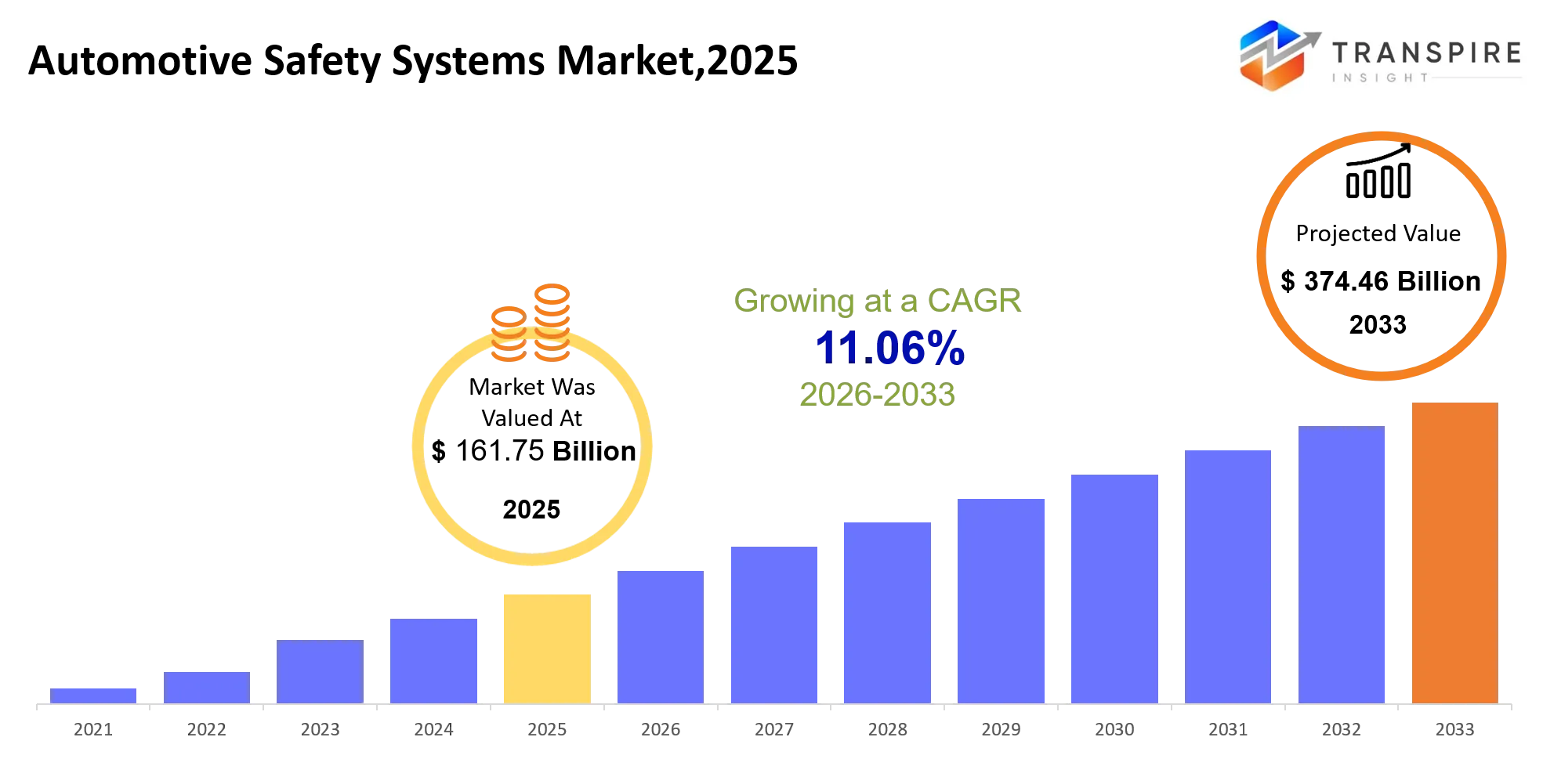
As per Transpire Insight Analysis, the Automotive Safety Systems Market size is estimated at USD 161.75 billion in 2025 and is anticipated to reach USD 374.46 billion by 2033, growing at a CAGR of 11.06% from 2026 to 2033.
The automotive safety system industry has new techniques for crash protection. industry is now shifting towards technologies that are capable of identifying risks before a crash occurs. The expenditure on safety and monitoring devices for drivers to aid in automatic driving has increased. This has been done by automakers due to more stringent safety regulations and consumer preference for safety. In the past three to five years, combining cameras and radar better driving help and watching inside the car has changed from something only fancy cars had to something many cars use. A big reason is safety rules in Europe. These rules include speed help, watching if the driver is paying attention, checking when the car is going backwards, and stopping automatically. These rules are making car makers and the people who make parts for cars add safety features to new cars. At the same time using artificial intelligence is making it better to see things stay in the lane and react quickly. These changes are helping car makers add safety features to both cars people ride in and trucks used for work. This is making it easier to use all the parts that work together, like hardware, software and sensors.
Automotive Safety Systems Market Size & Forecast:
- Market Size 2025: USD 161.75 Billion
- Expected Market Value (2033): USD 374.46 Billion
- Forecast CAGR (2026–2033): 11.06%
- Leading Region in 2025: Asia Pacific
- Fastest Growing Region: South America
- Key Company Profiles: Autoliv, Bosch, Continental, ZF, Denso, Aptiv, Magna, Valeo, Mobileye, Hyundai Mobis, Joyson Safety Systems, Toyoda Gosei, Aisin, Veoneer, Panasonic Automotive
Key Market Insights:
There is an increasing trend towards integration of safety features, with the firms merging their sensors, software, and car controls to enhance safety measures.
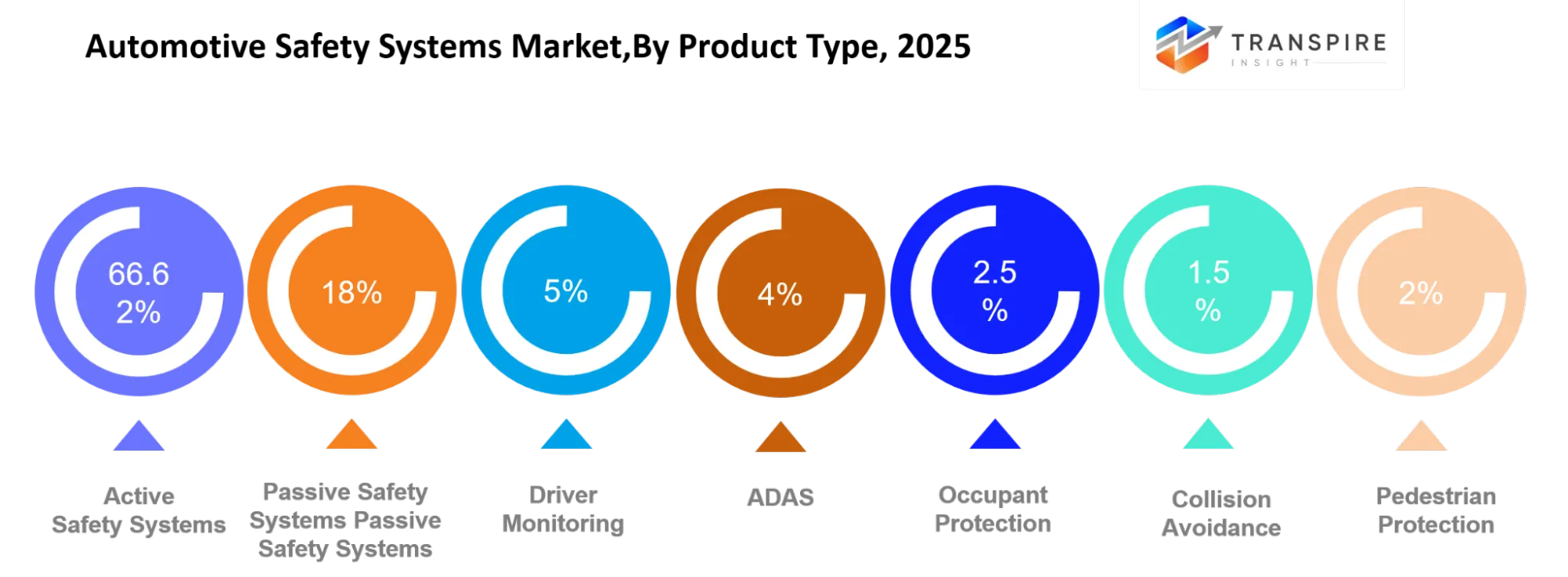
- Active Safety Systems constitute 66.62%, where Bosch has been working on ADAS capabilities for proactive safety.
- Passive Safety Systems make up 18%, where suppliers have been making improvements in airbag and seatbelt technologies to enhance occupant safety.
- Driver Monitoring makes up 5%, where companies are developing technologies to monitor the attention of drivers as automated driving technologies increase.
- ADAS constitutes 4%, where ZF has been working on scalable driver assistance software technologies.
- Occupant Protection is 2.5%, where suppliers have been integrating restraint systems with vehicle sensing technologies.
- Collision Avoidance makes up 1.5%, where Continental has been extending its use of radar technology in emergency braking and blind spots.
What are the Key Drivers, Restraints, and Opportunities in the Automotive Safety Systems Market?
Drivers
The growth drivers include increased deployment of active safety systems, rising vehicle safety standards and advancements in sensing and computing technologies. The regulatory drivers play an important role as systems like emergency braking, lane assist, driver monitoring and reversing detection have become mandatory in many markets. This forces OEMs to buy components like cameras, radars, electronic control units and software for safety in more vehicle models. Another factor that aids in deployment is customer awareness, as more people now compare cars based on their driver assistance and crash avoidance capabilities.
Restraints
The cost and integration challenges of safety systems. Hardware, sensors, software validation, and calibration may increase costs, and integrating suppliers into the same electronic platform requires testing. This happens because safety systems have to operate effectively in different weather and complex traffic conditions without any false alarms or detections.
Opportunities
The opportunity is the scalability of advanced safety ultrasonic sensor systems in mid-level cars and trucks. Platforms, central computing, and software-defined functionalities will help to reduce hardware development duplication and allow OEMs to implement new capabilities based on vehicle classes. Bosch provides a good example of scalable ADAS systems that use radar, cameras, ultrasonics, and AI-based processing.
What Has the Impact of Artificial Intelligence Been on the Automotive Safety Systems Market?
The use of artificial intelligence is revolutionising automotive safety systems because they will now be able to understand their surroundings and perform actions in response to the dynamic situations on the road. The use of AI models will enable the system to use input from sensors such as cameras and radar to detect other vehicles, pedestrians, lane boundaries, road signs and even paths that may lead to collisions. Through the use of AI, the system will also have predictive capabilities that will enable the system to assess the movement and predict whether another road user is on a dangerous path. Through driver monitoring, AI will also be able to detect drowsiness or distraction through the use of eye gaze and other behavioural measures. For the manufacturers, the use of AI can assist with operational improvements through the use of sensor fusion, central computing and software updates. According to Bosch, AI-based radar and video fusion is an environmental sensing solution that reduces development costs, while the company's cameras combine the use of AI technology with traditional vision techniques. There are challenges of high computing costs, validation and ensuring reliable accuracy.
Instance
In July 2026, The company Mobileye declared that their Cloud-Enhanced ADAS technology would be incorporated into select Stellantis vehicles in the future, with the use of AI and road intelligence crowdsourced through users to make it better at lane keeping and hands-free driving. This is one example of how AI makes auto safety systems smarter.
Key Market Trends:
Market trends are moving away from individual safety modules to connected technologies that integrate sensors, software and controls. In new vehicle programs, safety is becoming an ongoing capability of software rather than a static configuration of capabilities.
- Active safety has transitioned from high-end cars towards broader model lines, due to increasing regulation and the growing awareness of driver aids.
- There is a trend in sensor fusion as cameras, radar and ultrasonics are being used together to enhance situational awareness and avoid reliance on a single type of sensor.
- Driver monitoring is gaining importance due to the increased need to focus on the interaction between the assisted-driving technology and the driver.
- There is an increased focus on LiDAR technology as carmakers look for better perception capabilities for automated/semi-automated driving functions.
- Commercial vehicle safety features are moving away from basic functions of braking and lane warning towards blind-spot detection and emergency assistance.
Automotive Safety Systems MarketSegmentation
By System Type
Active Safety Systems lead the market share at 66.62% due to the increasing focus on crash prevention technologies. Meanwhile, the passive safety systems have a market share of 18%, driver monitoring of 5%, ADAS at 4%, occupant protection at 2.5%, collision avoidance at 1.5%, pedestrian protection at 1% and others at 1.38%. Active safety systems will continue to grow owing to higher usage of braking, lane and speed assistance. Meanwhile, driver monitoring and ADAS will increase as cars become increasingly automated.
By Technology Component
Radar and cameras will continue to hold relevance owing to the fact that they form the basic components of perceptive features such as braking, lane support, blind spot assistance, and adaptive cruise control. LiDAR is one of the fastest-growing technology segments with a CAGR of 8.49%. As the resolution of environmental perception becomes increasingly relevant for the application of advanced automated driver assistance systems, LiDAR is growing in importance. Ultrasonics will continue to offer short range detection and parking assistance, while ECUs, airbag modules, and seat belt systems form integral parts of the control and protection segments.
By Vehicle Type
Passenger Cars offer a broad base of potential users for automotive safety systems since OEMs can implement active and passive safety systems for high-volume cars. Light Commercial Vehicles, Heavy Commercial Vehicles and Buses & Coaches benefit from safety standards for braking, blind-spot detection, and vulnerable road user protection. SUVs and Electric Vehicles also contribute to safety system demand as car manufacturers implement advanced electronics and occupant protection systems. Luxury Cars will keep developing high-end sensing technology and automated functions, while other types of vehicles will provide chances for scalable and economical safety solutions.
By Propulsion
ICE cars still provide an important existing base for safety systems, but Hybrid, Battery Electric and Plug-in Hybrid vehicles increase the need for electronically controlled safety architectures. Electric cars may have specific packaging and occupant protection systems due to the installation location and layout of the battery. Fuel Cell, CNG and LPG vehicles will also contribute to safety system development based on particular vehicle type and operating conditions. The implication of this trend in the future is increased synergy between electronics of propulsion systems and safety controllers.
By End User
OEM Factory-fit is important since there is an increase in the design of safety technologies in vehicles before production instead of during production. Aftermarket will cater for older vehicles, whereas Fleet Operators and Commercial Operators have increasing incentives to use technologies such as driver monitoring and collision warnings to enhance safety. Government Fleets and Rental Fleets can facilitate implementation of technologies using their procurement procedures and fleet upgrading programs, whereas Luxury Vehicles are also important in this case. The emerging market opportunity includes standardised safety kits that can be adopted in large fleets and individual cars.
By Offering
Hardware is important, such as sensors, control units and protection units; however, Software and Integrated Systems are increasingly important as vehicle functions are becoming interconnected. Sensors give the data required for perception, whereas control units process the information and give responses based on the information. Software Platforms give the manufacturer the ability to handle many assistance functions and update capabilities when the vehicle architecture changes, whereas Services include testing, calibration, maintenance and system integration.
By Application
Collision Avoidance is still a key application since it covers the very purpose of collision risk mitigation through automatic emergency braking, radar and cameras. Lane Departure Applications, Adaptive Cruise Control, Parking Assist, Blind Spot Detection and Driver Monitoring have grown as people are becoming more acquainted with driver assistive technologies. There is increasing focus on the implementation and regulation of Emergency Braking, while connected sensing opens new opportunities for predictive safety applications. The application sphere is shifting to system integration, where multiple applications will use the same sensors, computing and vehicle control capabilities.
What are the Key Use Cases Driving the Automotive Safety Systems Market?
The use case is collision avoidance, associated with the leading segment of active safety systems. Sensors such as radar, cameras, electronic control units, and software help with automatic emergency braking, lane-keeping assistance, adaptive cruise control, and other features that alert a driver or automatically intervene if there is a risk of collision. Other use cases include blind spot detection, parking assist, pedestrian detection and protection, and driver monitoring. These use cases are becoming more and more applicable in passenger cars, SUVs, commercial vehicles, and connected fleets due to safety bundles that carmakers install. New use cases are becoming more advanced, shifting to predictive and semi-autonomous driving. For instance, LiDAR sensors, sensor fusion, and artificial intelligence-based perception can be used to improve environmental understanding, while in-cabin sensing can provide assistance based on a driver's attentiveness level.
|
Report Metrics |
Details |
|
Market size value in 2025 |
USD 161.75 Billion |
|
Market size value in 2026 |
USD 179.63 Billion |
|
Revenue forecast in 2033 |
USD 374.46 Billion |
|
Growth rate |
CAGR of 11.06% from 2026 to 2033 |
|
Base year |
2025 |
|
Historical data |
2021 - 2024 |
|
Forecast period |
2026 - 2033 |
|
Report coverage |
Revenue forecast, competitive landscape, growth factors, and trends |
|
Regional scope |
United States; Canada; Mexico; United Kingdom; Germany; France; Italy; Spain; Denmark; Sweden; Norway; China; Japan; India; Australia; South Korea; Thailand; Brazil; Argentina; South Africa; Saudi Arabia; United Arab Emirates |
|
Key company profiled |
Autoliv, Bosch, Continental, ZF, Denso, Aptiv, Magna, Valeo, Mobileye, Hyundai Mobis, Joyson Safety Systems, Toyoda Gosei, Aisin, Veoneer, Panasonic Automotive |
|
Customization scope |
Free report customization (country, regional & segment scope). Avail customized purchase options to meet your exact research needs. |
|
Report Segmentation |
By System Type (Active Safety Systems, Passive Safety Systems, Driver Monitoring, ADAS, Occupant Protection, Collision Avoidance, Pedestrian Protection, Others); By Technology Component (Radar, Camera, LiDAR, Ultrasonic Sensors, ECU, Airbag Module, Seatbelt Systems, Others); By Vehicle Type (Passenger Cars, Light Commercial Vehicles, Heavy Commercial Vehicles, Buses & Coaches, SUVs, Electric Vehicles, Luxury Vehicles, Others); By Propulsion (ICE, Hybrid, Battery Electric, Plug-in Hybrid, Fuel Cell, CNG, LPG, Others); By End User (OEM Factory-fit, Aftermarket, Fleet Operators, Commercial Operators, Government, Rental Fleets, Luxury Vehicles, Others); By Offering (Hardware, Software, Integrated Systems, Sensors, Control Units, Software Platforms, Services, Others); By Application (Collision Avoidance, Lane Departure, Adaptive Cruise Control, Parking Assistance, Blind Spot Detection, Driver Monitoring, Emergency Braking, Others) |
Which Regions are Driving the Automotive Safety Systems Market Growth?
North America
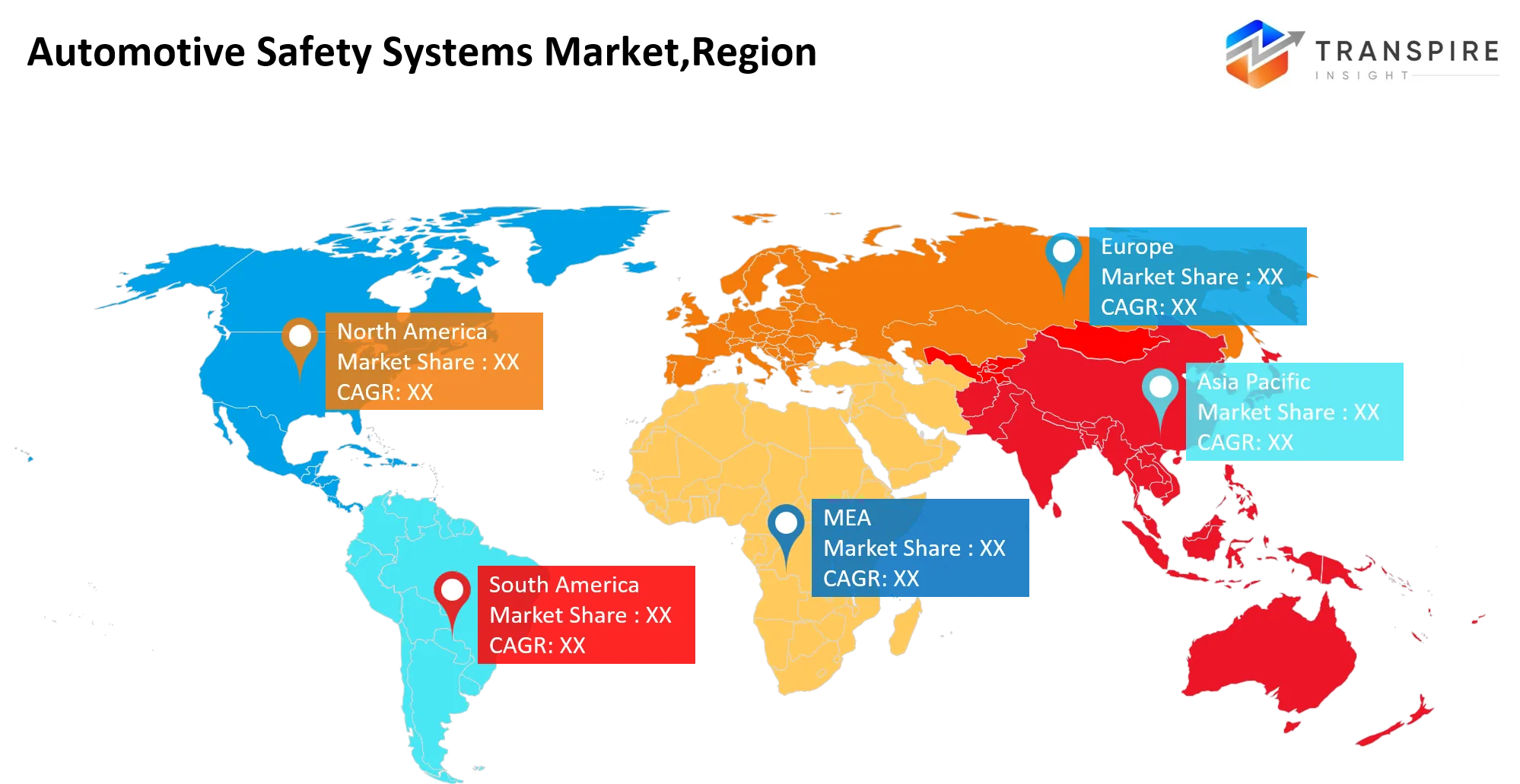
North America constitutes 25% of the world market for automotive safety systems and has a mature automotive technology infrastructure. The region has developed expertise in vehicle electronics and advanced safety testing. Increasing trends towards adoption of connected vehicles and advanced driver assistance are aiding the regional market development. The mature automotive infrastructure of the region acts as the foundation for continued integration of safety systems in vehicles.
In May 2026, according to the NHTSA, the 2026 Tesla Model Y met the standards of the new ADAS Benchmark test, which includes pedestrian automatic emergency braking, lane-keeping assistance, and blind-spot safety systems.
Europe
Europe constitutes 23% of the world market for automotive safety systems and has strong vehicle safety regulations and developed automotive companies. In comparison to North America, regulatory needs become an especially significant factor in the encouragement of use of advanced safety systems. The need for vehicle safety testing and regulations continues to be supportive of driver assistance and collision prevention systems.
In July 2026, the BMW iX3 and ZEEKR 7GT were tested for their safety features by the Euro NCAP according to the revised guidelines. The guidelines emphasise crash prevention, driver assistance, and occupant safety measures. Both vehicles got a five-star rating for their safety features.
Asia Pacific
The Asia Pacific region accounts for 39.42% of the market for automotive safety systems due to its huge manufacturing capabilities for vehicles and increasing technological penetration in automobiles. The region is witnessing growth in the manufacture of electric vehicles as well as vehicle ownership and investments in advanced electronics. The South American region contributes only 7% to the market but is recognised as the fastest-growing region with a CAGR of 8.51%.
In March 2026, Hyundai Motor India announced that the VENUE and VENUE N Line have been rated five-star safety in Bharat NCAP and come with Level 2 ADAS and 21 driver assistance features.
Who are the Key Players in the Automotive Safety Systems Marketand how do they compete?
The competition in the market for automotive safety systems is becoming more about how broad a range of technology each supplier offers, its software capability, sensors and scalability of safety functions on vehicle platforms. The competition involves the use of various technologies including hardware, artificial intelligence perception capabilities, computing, passive safety and software modularity and not based on one particular safety function. Bosch is scaling up its sensor fusion and scalable ADAS capabilities, which include radars, cameras, ultrasonics and AI processing for various types of vehicles. The differentiation of Bosch lies in its capability to integrate sensing, computing and assistance functions into a mobility portfolio. Continental is leveraging its strength in sensing through radars and mass production capabilities to support OEM programs that require object detection for ADAS and automated driving. ZF is using modularity in software to offer ADAS and parking functions in the form of software products to be selected and scaled depending on vehicle series.
Automotive Safety Systems Market companies
- Autoliv
- Bosch
- Continental
- ZF
- Denso
- Aptiv
- Magna
- Valeo
- Mobileye
- Hyundai Mobis
- Joyson Safety Systems
- Toyoda Gosei
- Aisin
- Veoneer
- Panasonic Automotive
Recent Development News
In January 2026, Mobileye revealed that a carmaker from America picked its EyeQ6H-based Surround ADAS for use in its next generation of automobiles, making hands-free driving an advanced system to be featured on both mainstream and luxury cars. This is yet another piece of evidence of the trend of ECU consolidation and ADAS software integration.
In August 2025, Aptiv has established a brand-new Software, Advanced Safety & User Experience Technical Centre in Chennai, India, which will help the company conduct more research in AI, machine learning, ADAS and cabin perception.
What Strategic Insights Define the Future of the Automotive Safety Systems Market?
In the market for automotive safety systems, the future will be toward software-defined vehicle platforms where sensing, computing and safety functionalities are integrated rather than being treated independently. For OEMs, scalable platforms for all kinds of vehicles with possibilities for software upgrades and development of assistance functions are expected. One of the risks that may not be obvious enough is the complexity of the system that involves cameras, radar, LiDAR, ECUs, and software, which may require additional validation work and supplier dependence. One of the opportunities in the future could be more widespread implementation of advanced safety functions in mid-segment cars and commercial vehicle fleets, where modular sensing and computing platforms could facilitate implementation. In addition, strategic alliances between car manufacturers, semiconductor producers, and safety function providers are becoming a crucial element of success. Strategic investments in sensor fusion, perception through artificial intelligence algorithms, centralised computing and cybersecurity are to be considered.
By System Type
- Active Safety Systems
- Passive Safety Systems
- Driver Monitoring
- ADAS
- Occupant Protection
- Collision Avoidance
- Pedestrian Protection
- Others
By Technology Component
- Radar
- Camera
- LiDAR
- Ultrasonic Sensors
- ECU
- Airbag Module
- Seatbelt Systems
- Others
By Vehicle Type
- Passenger Cars
- Light Commercial Vehicles
- Heavy Commercial Vehicles
- Buses & Coaches
- SUVs
- Electric Vehicles
- Luxury Vehicles
- Others
By Propulsion
- ICE
- Hybrid
- Battery Electric
- Plug-in Hybrid
- Fuel Cell
- CNG
- LPG
- Others
By End User
- OEM Factory-fit
- Aftermarket
- Fleet Operators
- Commercial Operators
- Government
- Rental Fleets
- Luxury Vehicles
- Others
By Offering
- Hardware
- Software
- Integrated Systems
- Sensors
- Control Units
- Software Platforms
- Services
- Others
By Application
- Collision Avoidance
- Lane Departure
- Adaptive Cruise Control
- Parking Assistance
- Blind Spot Detection
- Driver Monitoring
- Emergency Braking
Frequently Asked Questions
Find quick answers to common questions.
The automotive safety systems market size was valued at USD 161.75 Billion in 2025 and is poised to reach USD 374.46 Billion by 2033, expanding at a 11.06% CAGR
Key segments for the automotive safety systems market are By System Type (Active Safety Systems, Passive Safety Systems, Driver Monitoring, ADAS, Occupant Protection, Collision Avoidance, Pedestrian Protection, Others); By Technology Component (Radar, Camera, LiDAR, Ultrasonic Sensors, ECU, Airbag Module, Seatbelt Systems, Others); By Vehicle Type (Passenger Cars, Light Commercial Vehicles, Heavy Commercial Vehicles, Buses & Coaches, SUVs, Electric Vehicles, Luxury Vehicles, Others); By Propulsion (ICE, Hybrid, Battery Electric, Plug-in Hybrid, Fuel Cell, CNG, LPG, Others); By End User (OEM Factory-fit, Aftermarket, Fleet Operators, Commercial Operators, Government, Rental Fleets, Luxury Vehicles, Others); By Offering (Hardware, Software, Integrated Systems, Sensors, Control Units, Software Platforms, Services, Others); By Application (Collision Avoidance, Lane Departure, Adaptive Cruise Control, Parking Assistance, Blind Spot Detection, Driver Monitoring, Emergency Braking, Others)
Growth is primarily driven by an increase in ADAS demand, increased vehicle manufacturing of vehicles, the popularity of connected and electric vehicles, and more importance being placed by consumers on road safety.
The market is led by major manufacturers including Autoliv, Bosch, Continental, ZF, Denso, Aptiv, Magna, Valeo, Mobileye, Hyundai Mobis, Joyson Safety Systems, Toyoda Gosei, Aisin, Veoneer, Panasonic Automotive
Asia Pacific holds a 39.42% market share for automotive safety systems due to high automobile manufacturing, rising awareness regarding safety, and adoption of technological safety features. Regulatory demands, rising electric vehicle manufacturing, and investments from auto manufacturers and technology providers will help enhance the influence of the regional market.
Opportunities for business are in the use of ADAS, the application of AI safety technologies, the increase in electric and connected cars, the need for more driver monitoring systems, and safety solutions in developing countries.
- Autoliv
- Bosch
- Continental
- ZF
- Denso
- Aptiv
- Magna
- Valeo
- Mobileye
- Hyundai Mobis
- Joyson Safety Systems
- Toyoda Gosei
- Aisin
- Veoneer
- Panasonic Automotive
About the Authors

Mayur Shinde
I am Mayur Shinde, a Senior Research Analyst at Transpire Insight, specializing in the Automotive & Transportation and Information & Communication Technology (ICT) Industry. My work focuses on analyzing emerging market trends, technological advancements, competitive landscapes, and industry developments to deliver accurate, data-driven insights. I am passionate about transforming complex market information into clear, actionable content that helps businesses, professionals, and decision-makers stay informed and make confident strategic decisions.

Chakradhar Khansole
Chakradhar serves as the Research Director at Transpire Insight, bringing over 8 years of experience in technology, innovation, and strategic market intelligence. He specializes in transforming complex market data into actionable business insights that enable organizations to make informed, growth-oriented decisions. Recognized for his strategic vision and analytical expertise, Chakradhar leads high-impact research initiatives, delivering comprehensive market assessments, competitive intelligence, and forward-looking industry analysis.
Recently Published Reports
-
Apr 2026
ATV & UTV Market
ATV & UTV Market Size, Share & Analysis Report By Type (ATV, and UTV), By Variants (Less Than 400 CC, 400 CC To 800 CC, and More Than 800 CC), and Geography (North America, Europe, Asia-Pacific, Middle East and Africa, South and Central America), 2021 - 2031
-
Apr 2026
Automotive Central Gateway Module Market
Automotive Central Gateway Module Market Size, Share & Analysis Report By Type (Ethernet Central Gateway Module, CAN Central Gateway Module, LIN Central Gateway Module, and FlexRay), By Application (Powertrain Control, Body Control, Infotainment System, Advanced Driver Assistance Systems (ADAS), and Others), By End User (Passenger Vehicles, and Commercial Vehicles), and Geography (North America, Europe, Asia-Pacific, Middle East and Africa, South and Central America), 2021 - 2031
-
Apr 2026
Automotive Engine Oil Filter Market
Automotive Engine Oil Filter Market Size, Share & Analysis Report By Filter Type (Fuel Filter, Engine Oil Filter, Hydraulic Oil Filter, and Others), By Filter Media (Cellulose, Synthetic, and Micro), By Sales Channel (OEMs, and Aftermarket), By Vehicle Type (Passenger Cars, Light Commercial Vehicles, Heavy Duty Trucks, Buses and Coaches, and Off-road Vehicles), and Geography (North America, Europe, Asia-Pacific, Middle East and Africa, South and Central America), 2021 - 2031
-
Apr 2026
Automotive Parts Aluminium Die Casting Market
Automotive Parts Aluminium Die Casting Market Size, Share & Analysis Report By Production Process (Pressure Die Casting, Vacuum Die Casting, Squeeze Die Casting, Gravity Die Casting), By Application (Body Parts, Engine Parts, Transmission Parts, Battery And Related Components, Other Application Types), and Geography (North America, Europe, Asia-Pacific, Middle East and Africa, South and Central America), 2021 - 2031
Our Clients



