

LED Grow Lights Market Summary:
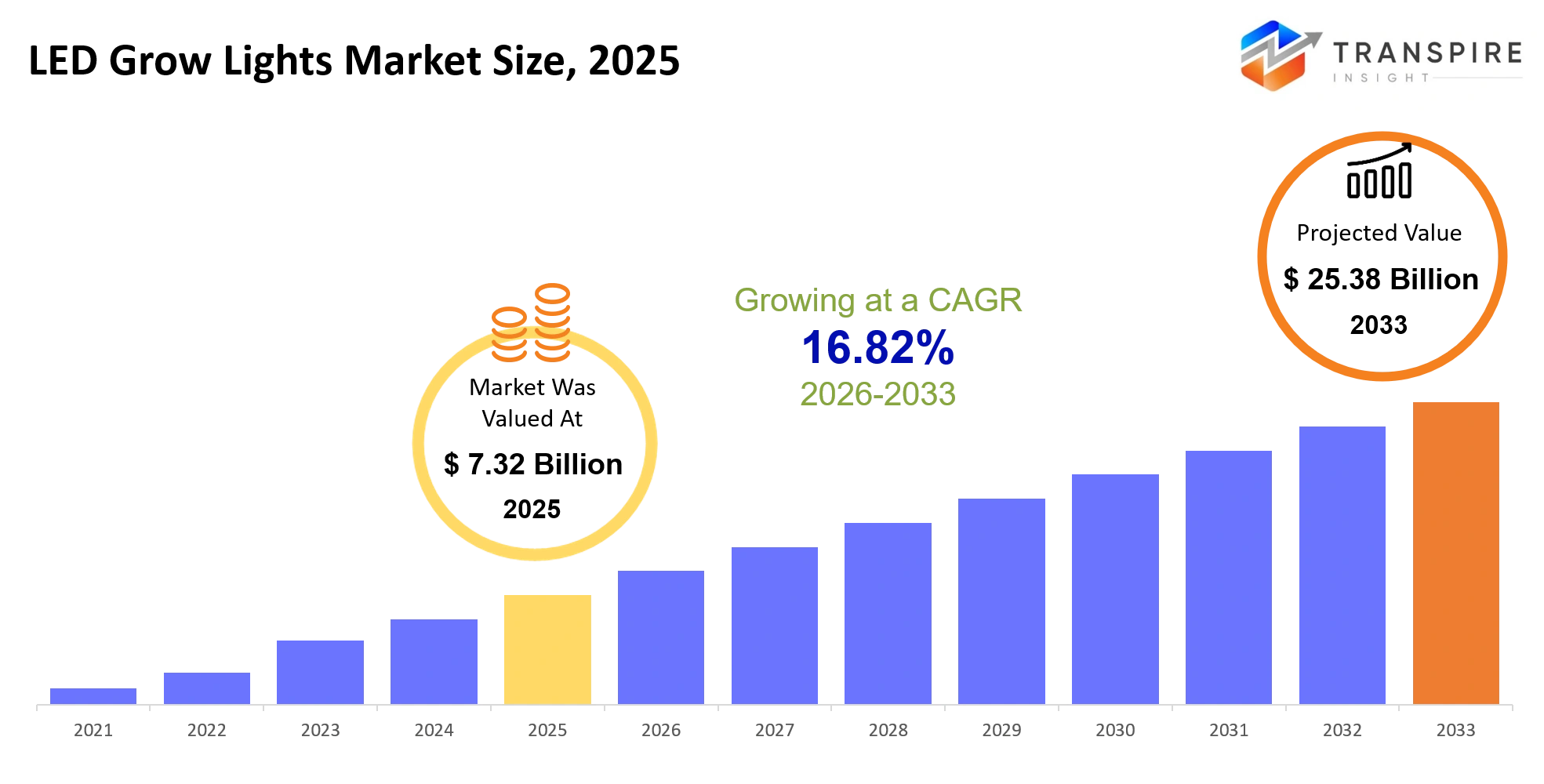
As per Transpire Insight Analysis, the LED Grow Lights Market size is estimated at USD 7.32 Billion in 2025 and is anticipated to reach USD 25.38 Billion by 2033, growing at a CAGR of 16.82% from 2026 to 2033. The growth is being brought about by increased indoor agriculture, greenhouses, and energy-efficient LED lighting.
The LED grow light market is of great significance for the farms and greenhouses that are concerned about regulating the plant growth process. Such lights make it possible for farms to grow their products on a continuous basis. This technology provides the right light for optimal plant growth while being more energy-efficient than conventional solutions.
Recently, farmers started to employ intelligent LED grow lights that come equipped with sensors and can be controlled remotely. This is due to the increasing tendency towards the indoor agriculture development as well as investments in food production. At present, farmers need to grow food in a cost-effective manner; therefore, they use LED grow lights for this purpose. The opportunities in the LED grow lights market include innovative products and intelligent controls that promote the usage of this technology for controlled plant growing. This is the opportunity for those who are interested in growing crops using modern techniques. The LED grow lights market is facilitating this tendency. It will be having a great influence on agriculture in the future.
LED Grow Lights Market Size & Forecast:
- Market Size 2025: USD 7.32 Billion
- Expected Market Value (2033): USD 25.38 Billion
- Forecast CAGR (2026–2033): 16.82%
- Leading Region in 2025: North America
- Fastest Growing Region: Asia Pacific
- Key Company Profiles: Signify, ams-OSRAM, Gavita, Fluence, Valoya, Heliospectra, California LightWorks, Mars Hydro, ViparSpectra, Lumatek, SANlight, Kind LED, Black Dog LED, Hortilux, Agrolux.
Key Market Insights:
The market will advance beyond traditional horticultural lighting with the increasing implementation of intelligent and energy-saving systems that enhance crop quality and reduce operational expenses while allowing year-round crop cultivation.
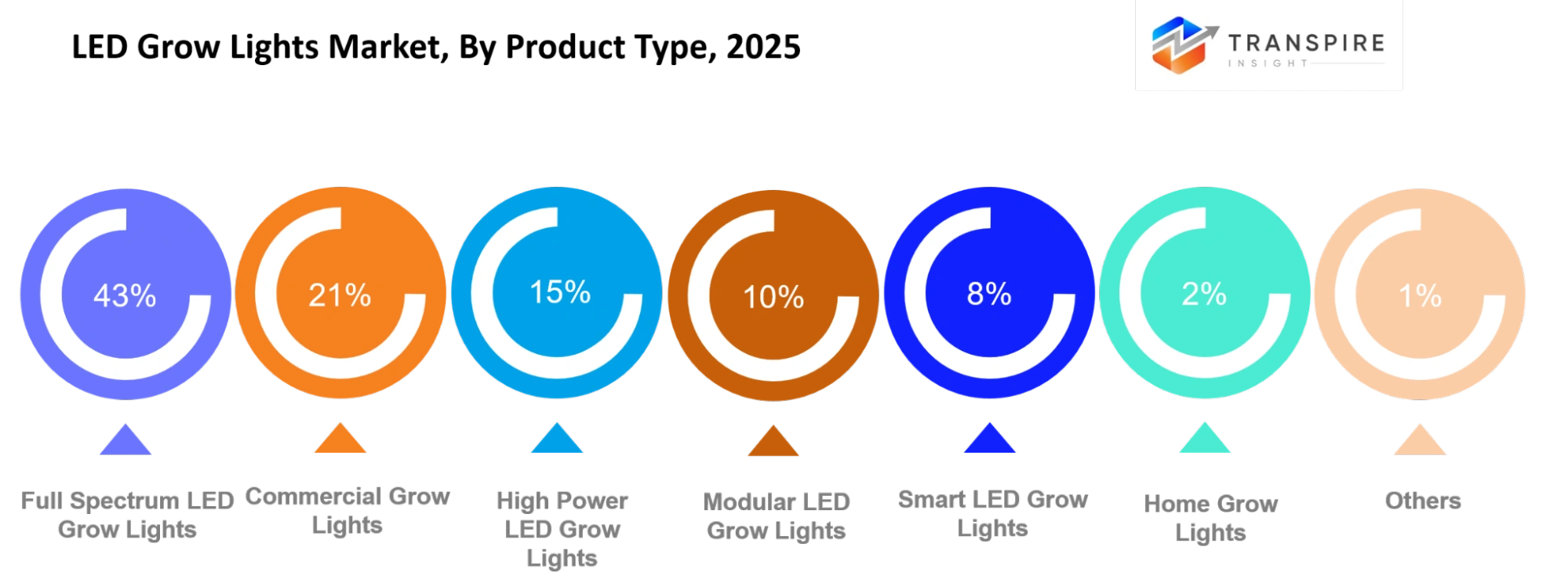
- Full Spectrum LED Grow Lights are estimated at 43% and involve improvement of accuracy in light spectrum for better plant development for various types of crops.
- Commercial Grow Lights constitute 21% of the market share because of the development of efficient lighting systems used in large greenhouse and indoor farming projects.
- High Power LED Grow Lights take 15% of the market and are characterised by the introduction of more efficient lighting fixtures suitable for commercial agriculture.
- Modular LED Grow Lights take 10% of the market share and represent the increased need for scalable lighting systems due to growing cultivation areas.
- Smart LED Grow Lights take 8% of the market and are the fastest-growing segment because of AI-controlled and automated light schedules for precision agriculture.
- Home Grow Lights make up only 2% of the market because of the development of the demand for indoor gardens, herbs, and hydroponics at home.
- The remaining 1% represents unique lighting systems created for research facilities and experimental crop production.
What are the Key Drivers, Restraints, and Opportunities in the LED Grow Lights Market ?
Drivers
This growth is primarily being fueled by the fast development of Controlled Environment Agriculture, which necessitates efficient lighting technology for optimal output of crops on a round-the-year basis. In addition, increasing demand for food production, reducing arable land area, and changing weather patterns have prompted agricultural farms and greenhouses to switch to energy-saving LED lights. The growing trend towards sustainable farming, along with reduced electricity costs, has further boosted investments in horticultural lighting technology.
Restraints
The primary constraint is the expensive initial cost associated with advanced LED grow light systems. In commercial applications, the installation may necessitate considerable expenditure on the lighting system along with automation and climate control, which can also be integrated into existing farm operations. This could pose a constraint for smaller and mid-sized farmers who would need time to purchase due to the initial cost but the eventual savings. Moreover, incompatibility with traditional cultivation methods poses another constraint in some parts of the world.
Opportunities
An opportunity for the market exists in the adoption of technology in agriculture. The usage of artificial intelligence and the Internet of Things to regulate light intensity in accordance with the stage of development of the crop is becoming increasingly common. With increased investments being made in vertical farming in the Asia-Pacific and Middle Eastern regions, the potential for sales is vast.
What Has the Impact of Artificial Intelligence Been on the LED Grow Lights Market?
The use of artificial intelligence in LED grow lights is revolutionising how the process of growing plants is conducted by helping farmers regulate their lighting in an efficient manner. The AI helps farmers gather data through sensors that will check the health of the crops and help the farmers adjust the lighting based on the growth stage of each plant. This helps to reduce energy consumption while improving the health of the crops as well. With AI, the farmer can also predict any problems with the planting even before they occur, which prevents losses and helps them plan better.
One of the major applications of the technology is the automation of farming, whereby the planting process is coordinated with the irrigation and other processes. In this way, the farmers can save their resources by optimising their use while keeping the conditions for growing the plants constant. However, the adoption of the technology is hindered by its high cost of implementation as well as the complexity associated with integrating the intelligent lighting platform into the existing farming equipment. Nevertheless, the importance of such a solution makes the technology more affordable. In September 2025, Sollum Technologies reported that its AI-enabled dynamic LED lighting system has been installed at Ferme d’Hiver for controlling light levels and spectra according to the needs of the crops and greenhouse environment. Through AI-controlled lighting management, growers can enhance plant growth and increase energy efficiency.
Key Market Trends:
LED grow lights are becoming smarter and more energy efficient since modern commercial growers strive to produce crops with maximum yields while keeping operating costs minimal. Automation technologies, intelligent controls, and advanced techniques of precision farming are reshaping the way in which horticultural lighting systems are developed and implemented.
- Commercial growing has become completely based on full-spectrum LED systems, thus providing an opportunity for the same light to be used for various crops.
- Modern growers prefer smart lighting solutions; therefore, they utilise automation with the help of sensors to regulate light intensity and operation of such systems.
- Projects related to vertical farming become popular; consequently, lighting systems should become more energy efficient and reliable.
- Manufacturers introduce new LED lighting models, which can be easily integrated into the current lighting system during facility extension.
- Nowadays, remote monitoring becomes an integral part of the best lighting systems as the operator can control the greenhouse or indoor farm from the central digital system.
- Growers pay more attention to electricity saving by using LEDs, which work more efficiently.
LED Grow Lights Market Segmentation
By Product Type
Full Spectrum LED Grow Lights have a market share of 43% and are highly popular due to their suitability for all phases of plant development owing to the provision of a balanced light spectrum. Commercial Grow Lights occupy 21% of the market share owing to rising spending on indoor farming. High Power LED Grow Lights have a 15% market share and are sought after by farmers who want to cultivate more light-intensive crops. Modular LED Grow Lights occupy a market share of 10% and are gaining popularity owing to their flexibility in installation and scalability. Smart LED Grow Lights make up 8% of the market share and are experiencing rapid growth with a CAGR of 19.4% owing to increased automation in agriculture. Home Grow Lights occupy 2% of the market share, while the remaining 1% of the market share is taken up by special lighting products.
By End User
Commercial growers constitute the largest end user category due to sustained investments in productive and profitable crop cultivation methods. Growers working in greenhouses are increasingly switching from regular lights to LED lights in order to reduce operational expenses and enhance production efficiency. Indoor farms engaged in vertical farming operations are increasingly adopting LEDs as they construct more automation-based indoor farm facilities in cities. Research centres need to use LEDs to conduct studies on crops. Similarly, growers of cannabis also rely on LEDs to maintain consistency in their products. Consumers growing plants indoors form a relatively small yet growing market end-user category.
By Installations
New installations account for a substantial share of demand, as the number of indoor farms and greenhouses using LED lighting at the outset of construction rises. Retrofit installations are on the rise as farmers opt to switch to energy-saving lights to cut down on power expenses. The installation of smart lighting that provides automated scheduling and remote energy management is getting more popular. There is an increase in automated lighting installation, which is integrated into irrigation and climate control systems. IoT-based lighting solutions are also being adopted, providing real-time performance monitoring capabilities.
By Distribution Channels
Direct Sales continue to be favoured for large-scale business ventures that need customised solutions. Agricultural equipment distributors have played a crucial role in increasing the reach of products in regional farming markets. Online retailing is gradually increasing owing to the easy accessibility for small-scale businesses and home growers. OEMs have helped increase market penetration through their supply of complete lighting solutions for greenhouse/indoor farming equipment producers, whereas wholesalers help with better availability in a larger distribution network. The market structure follows the product segmentation, which sees Full Spectrum LED Grow Lights accounting for 43%, Commercial Grow Lights (21%), High Power LED Grow Lights (15%), Modular LED Grow Lights (10%), Smart LED Grow Lights (8%), Home Grow Lights (2%), and Others (1%).
What are the Key Use Cases Driving the LED Grow Lights Market?
Commercial indoor farming still serves as the major factor behind the development of the LED grow light market, with Full Spectrum LED Grow Lights taking a share. In this way, it becomes possible for growers to give crops proper lighting throughout all growth stages with higher efficiency and stable production in a controlled environment.
The market continues to evolve in the field of greenhouse, hydroponic farm, vertical farming facility, and horticulture industries, providing year-round farming, higher quality of crops, and reduction of the season-dependent conditions. Research and commercial cultivation use advanced lighting systems to achieve ideal growing conditions. The upcoming applications for LED grow lights include AI-based smart farms, urban farming, and automated cultivation facilities.
|
Report Metrics |
Details |
|
Market size value in 2025 |
USD 7.32 Billion |
|
Market size value in 2026 |
USD 8.55 Billion |
|
Revenue forecast in 2033 |
USD 25.38 Billion |
|
Growth rate |
CAGR of 16.82% from 2026 to 2033 |
|
Base year |
2025 |
|
Historical data |
2021 - 2024 |
|
Forecast period |
2026 - 2033 |
|
Report coverage |
Revenue forecast, competitive landscape, growth factors, and trends |
|
Regional scope |
United States; Canada; Mexico; United Kingdom; Germany; France; Italy; Spain; Denmark; Sweden; Norway; China; Japan; India; Australia; South Korea; Thailand; Brazil; Argentina; South Africa; Saudi Arabia; United Arab Emirates |
|
Key company profiled |
Signify, ams-OSRAM, Gavita, Fluence, Valoya, Heliospectra, California LightWorks, Mars Hydro, ViparSpectra, Lumatek, SANlight, Kind LED, Black Dog LED, Hortilux, Agrolux. |
|
Customization scope |
Free report customization (country, regional & segment scope). Avail customized purchase options to meet your exact research needs. |
|
Report Segmentation |
By Product Type (Full Spectrum LED Grow Lights, Red & Blue LED Grow Lights, High Power LED Grow Lights, Modular LED Grow Lights, Smart LED Grow Lights, Commercial Grow Lights, Home Grow Lights, Others); By Application (Indoor Farming, Greenhouses, Vertical Farming, Research Facilities, Cannabis Cultivation, Hydroponics, Horticulture, Others); By End User (Commercial Growers, Research Institutes, Home Growers, Greenhouse Operators, Vertical Farming Companies, Cannabis Producers, Others); By Installation (New Installations, Retrofit Installations, Smart Lighting Systems, Automated Lighting Systems, IoT-enabled Lighting, Others); By Distribution Channel (Direct Sales, Agricultural Equipment Distributors, Online Retail, OEM Suppliers, Wholesalers, Others). |
Which Regions are Driving the LED Grow Lights Market Growth?
North America
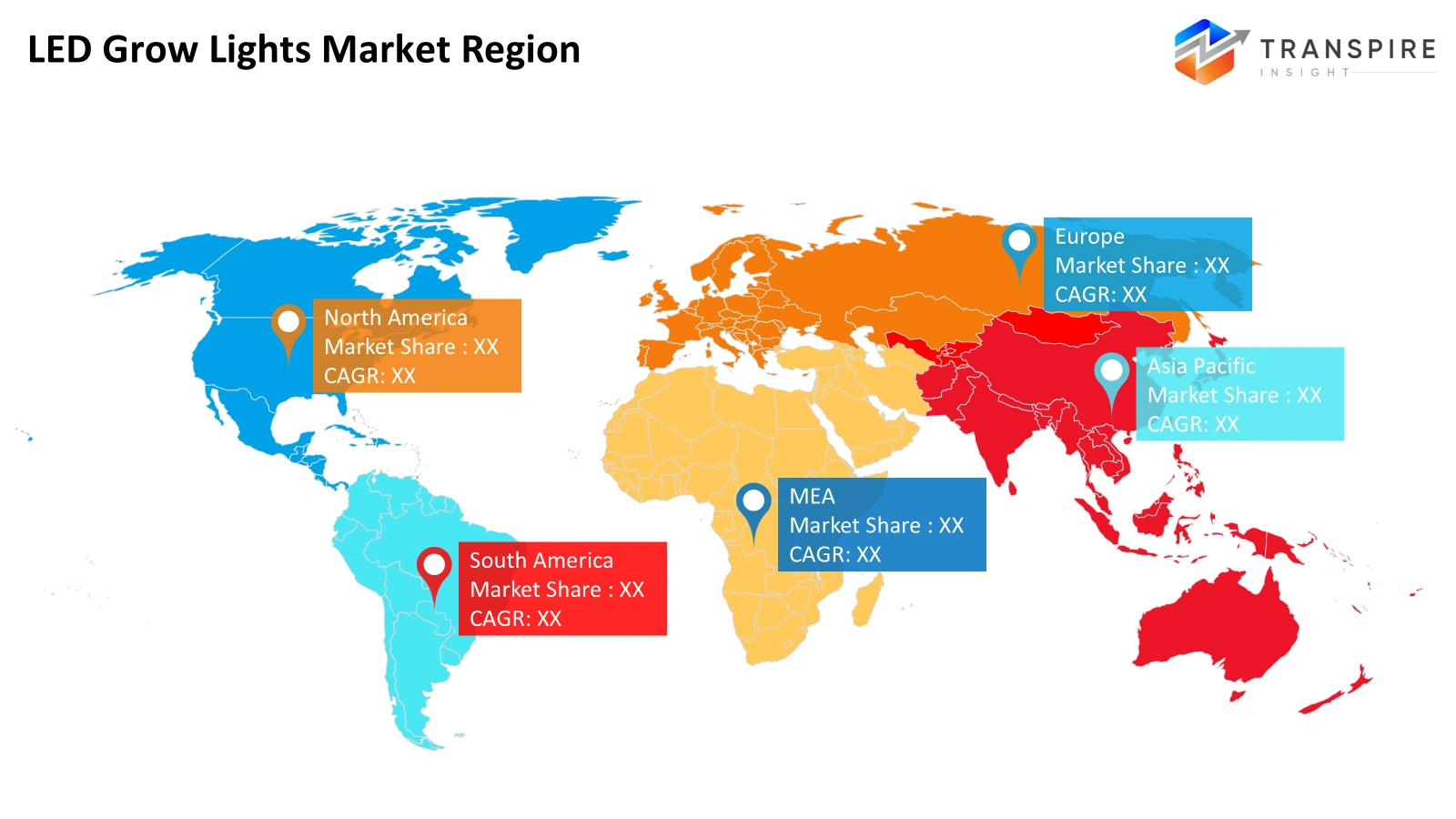
North America dominates the LED grow lights market with a share of 36%. This can be attributed to its already mature controlled-environment agriculture sector and high implementation of advanced cultivation techniques. The region enjoys large-scale implementation of indoor cultivation, commercial greenhouses, and vertical farm operations that utilise energy-efficient lighting. Continuous innovations and investments in automation and precision farming have increased market demand. Favourable financing for agri-tech projects and availability of lighting manufacturing firms add to the strength of the region.
Europe
Europe has 28% of the market share and shows stable growth owing to its sustainable agriculture and energy-efficient farming practices. In contrast to North America, Europe is more concerned about minimizing carbon footprint through advanced horticultural technology. Government-led efforts to modernise greenhouses and develop controlled-environment farming practices promote adoption of LED grow lights. Demand for local production of high-quality crops in the region has been driving market growth.In June 2026, Signify launched its new Philips GreenPower LED toplighting force offering with new Performance and Elite series for professional greenhouse growers in Europe. It aims at improving energy efficiency, accommodate growers' investment strategy, and boost sustainable horticulture.
Asia Pacific
The Asia Pacific region constitutes 29% of the world market and is anticipated to record the highest growth, with a CAGR of 20.2% through the forecast period. The growing urbanisation, investment in vertical farming, and growing food security concerns have resulted in the increasing adoption of advanced agricultural techniques. Countries like China, Japan, Singapore, and South Korea are implementing more and more smart farming initiatives and indoor farming. Growing government efforts towards modernisation of agriculture and increasing private investment in controlled environment farming are anticipated to offer ample growth opportunities in the Asia Pacific region.
Who are the Key Players in the LED Grow Lights Marketand how do they Compete?
The competition in the market of LED grow light bulbs is based not only on pricing but also on innovations, energy efficiency, and intelligent crop cultivation technologies. The manufacturers strive to create lighting products that will provide increased harvest, energy savings, and easy integration into the automated farming platform. With the development of controlled environment agriculture, the competitors gain advantages by enhancing their technological capabilities, expanding geographically, and forming strategic alliances.
Signify distinguishes itself with innovative full-spectrum LED lighting systems used in commercial greenhouses and indoor farming facilities. The company keeps investing in connected lighting products and precision horticulture solutions that allow growers to increase production and decrease expenses. Gavita, which is one of the Signify brands, stays true to its core specialisation of professional horticulture and provides high-end lighting systems for cultivation facilities.
LED Grow Lights Marketcompanies
- Signify
- ams-OSRAM
- Gavita
- Fluence
- Valoya
- Heliospectra
- California LightWorks
- Mars Hydr
- ViparSpectra
- Lumatek
- SANlight
- Kind LED
- Black Dog LED
- Hortilux
- Agrolux
Recent Development News
In June 2026, Signify added new Product Lines to its Philips GreenPower LED toplighting force range, namely Performance and Elite lines. The move provides professional growers with additional options to choose from when it comes to choosing either low initial costs or maximum efficiency in energy consumption.
Source: https://www.lighting.philips.com
In June 2025, Fluence Bioengineering introduced SPYDR 3, which was an updated version of the LED grow lights used for commercial cannabis production. This fixture had several benefits, including increased light intensity, improved energy efficiency, flexible installation and many others that enabled cultivators to increase their yields while reducing operational costs.
Source: https://fluence-led.com
What Strategic Insights Define the Future of the LED Grow Lights Market?
The future development of the market for LED grow lights around the world is likely to depend on the increased adoption of controlled environment agriculture and the need for productivity with reduced energy costs. The future development of the market is likely to be driven by the implementation of smart lights, automated and data-driven cultivation technologies allowing growers to control the cultivation process in precise ways. However, one of the issues not always taken into account is the high rate of technological innovation, which might reduce the product replacement period and require growers to buy new lighting solutions more often than usual. On the other hand, the increased investment in vertical farming and urban agriculture represents a promising opportunity for manufacturers of intelligent and efficient light sources.
Key Segmentations are:
By Product Type
- Full Spectrum LED Grow Lights
- Red & Blue LED Grow Lights
- High Power LED Grow Lights
- Modular LED Grow Lights
- Smart LED Grow Lights
- Commercial Grow Lights
- Home Grow Lights
By Application
- Indoor Farming
- Greenhouses
- Vertical Farming
- Research Facilities
- Cannabis Cultivation
- Hydroponics
- Horticulture
By End User
- Commercial Growers
- Research Institutes
- Home Growers
- Greenhouse Operator
- Vertical Farming Companies
- Cannabis Producers
By Installation
- New Installations
- Retrofit Installations
- Smart Lighting Systems
- Automated Lighting Systems
- IoT-enabled Lighting
By Distribution Channel
- Direct Sales
- Agricultural Equipment Distributors
- Online Retail
- OEM Suppliers
- Wholesale
Regional Outlook
North America
- United States
- Canada
- Mexico
Europe
- Germany
- United Kingdom
- France
- Spain
- Italy
- Rest of Europe
Asia Pacific
- Japan
- China
- Australia & New Zealand
- South Korea
- India
- Rest of Asia Pacific
South America
- Brazil
- Argentina
- Rest of South America
Middle East & Africa
- Saudi Arabia
- United Arab Emirates
- South Africa
- Rest of the Middle East & Africa
Frequently Asked Questions
Find quick answers to common questions.
The LED grow lights market size was valued at USD 7.32 Billion in 2025 and is poised to reach USD 25.38 Billion by 2033, expanding at a 16.82% CAGR.
Key segments for the LED grow lights market are By Product Type (Full Spectrum LED Grow Lights, Red & Blue LED Grow Lights, High Power LED Grow Lights, Modular LED Grow Lights, Smart LED Grow Lights, Commercial Grow Lights, Home Grow Lights, Others); By Application (Indoor Farming, Greenhouses, Vertical Farming, Research Facilities, Cannabis Cultivation, Hydroponics, Horticulture, Others); By End User (Commercial Growers, Research Institutes, Home Growers, Greenhouse Operators, Vertical Farming Companies, Cannabis Producers, Others); By Installation (New Installations, Retrofit Installations, Smart Lighting Systems, Automated Lighting Systems, IoT-enabled Lighting, Others); By Distribution Channel (Direct Sales, Agricultural Equipment Distributors, Online Retail, OEM Suppliers, Wholesalers, Others).
Growth is primarily driven by increased use of indoor and vertical farming, increased demand for crop cultivation all year round, increasing emphasis on energy-efficient lighting techniques, advancement in LED technology, and government policies for sustainable farming.
The market is led by major manufacturers including Signify, ams-OSRAM, Gavita, Fluence, Valoya, Heliospectra, California LightWorks, Mars Hydro, ViparSpectra, Lumatek, SANlight, Kind LED, Black Dog LED, Hortilux, Agrolux.
The North American region has a share of 36% in the market of LED grow lights owing to controlled environment agriculture, substantial investments in indoor and vertical farms, development of horticulture technology, and growing need for energy-efficient crops.
Opportunities available in the LED grow lights industry include growth in vertical farming, increase in greenhouse farming, increasing demand for energy-efficient lighting, increased adoption of smart lighting technologies, and government initiatives towards sustainable agriculture.
- Signify
- ams-OSRAM
- Gavita
- Fluence
- Valoya
- Heliospectra
- California LightWorks
- Mars Hydr
- ViparSpectra
- Lumatek
- SANlight
- Kind LED
- Black Dog LED
- Hortilux
- Agrolux
About the Authors

Avinash Kumar
I’m Avinash Kumar, a Senior Research Analyst at Transpire Insight, with expertise in the Electronics and Semiconductor and Energy & Power industry. My work focuses on analyzing emerging technologies, market trends, industry developments, and innovation across these sectors. I specialize in transforming complex technical and market insights into clear, research-backed content that helps professionals, businesses, and decision-makers stay informed. Through continuous industry research and data-driven analysis, I strive to deliver accurate, reliable, and practical perspectives on the latest advancements shaping the semiconductor and energy landscape.

Chakradhar Khansole
Chakradhar serves as the Research Director at Transpire Insight, bringing over 8 years of experience in technology, innovation, and strategic market intelligence. He specializes in transforming complex market data into actionable business insights that enable organizations to make informed, growth-oriented decisions. Recognized for his strategic vision and analytical expertise, Chakradhar leads high-impact research initiatives, delivering comprehensive market assessments, competitive intelligence, and forward-looking industry analysis.
Recently Published Reports
-
Apr 2026
Fiber Optic Faceplates Market
Fiber Optic Faceplates Market Size, Share & Analysis Report By Type (< 300 mm2, 300-350 mm2, and > 350 mm2, By Application (Night Vision, Holographic Imaging, Medical, and Others), and Geography (North America, Europe, Asia-Pacific, Middle East and Africa, South and Central America), 2021 - 2031
-
Apr 2026
High Temperature Superconductors Market
High Temperature Superconductors Market Size, Share & Analysis Report By Type (1G HTS, and 2G HTS), By Application (Power Cable, Fault Current Limiter, and Transformer), and Geography (North America, Europe, Asia-Pacific, Middle East and Africa, South and Central America), 2021 - 2031
-
Apr 2026
Industrial Plugs and Socket Market
Industrial Plugs and Socket Market Size, Share & Analysis Report By Type (Industrial Plugs, Industrial Sockets), By Current (Up to 32 A, 32 to 125 A, Above 125 A), By Protection (Dustproof and Splash Proof, Waterproof, Explosion Proof), By End User (Heavy Industries, Oil and Gas, Chemicals and Pharmaceuticals, Power Generation, Others), and Geography (North America, Europe, Asia-Pacific, Middle East and Africa, South and Central America), 2021 - 2031
-
Apr 2026
InGaAs Avalanche Photodiodes Market
InGaAs Avalanche Photodiodes Market Size, Share & Analysis Report By Type (1100 - 1700 nm, and 1000 - 1600 nm), By Application (Missile Warning System, Muzzle Flash Detection, Wafer Defect Inspection, Laser Rangefinders, and Others), and Geography (North America, Europe, Asia-Pacific, Middle East and Africa, South and Central America), 2021 - 2031