

Japan Transarterial Chemoembolization (TACE) Market Size & Forecast:
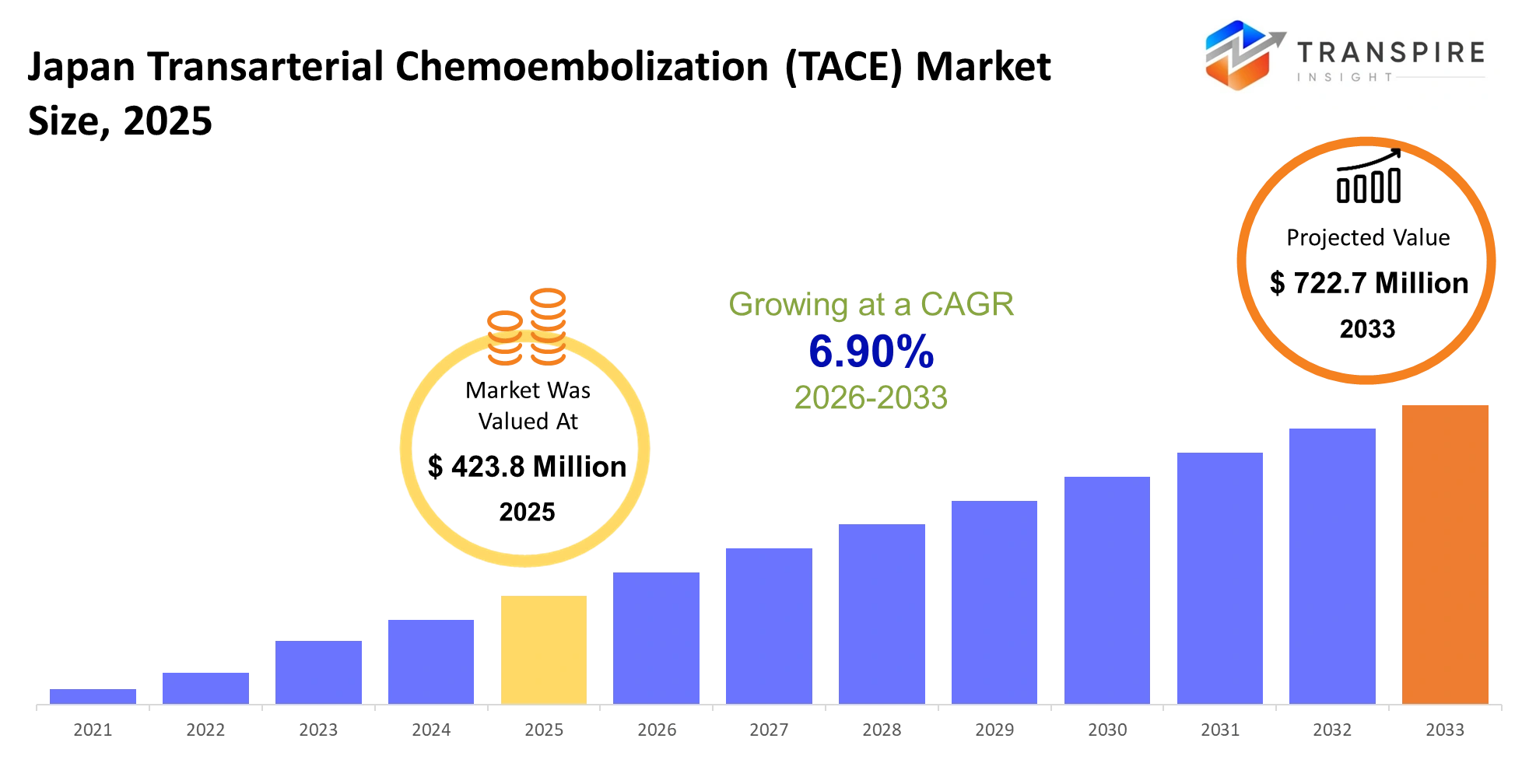
- Japan Transarterial Chemoembolization (TACE) Market Size 2025: USD 423.8 Million
- Japan Transarterial Chemoembolization (TACE) Market Size 2033: USD 722.7 Million
- Japan Transarterial Chemoembolization (TACE) Market CAGR: 6.90%
- Japan Transarterial Chemoembolization (TACE) Market Segments: By Product (Drug-eluting beads, Conventional TACE, Radioembolization, Combination therapy), By Application (Liver Cancer, Metastatic Cancer, HCC, Others), By End-User (Hospitals, Cancer Centers, Specialty Clinics, Research Institutes).
To learn more about this report,  Download Free Sample Report
Japan Transarterial Chemoembolization (TACE) Market Summary:
The Japan Transarterial Chemoembolization (TACE) Market size is estimated at USD 423.8 Million in 2025 and is anticipated to reach USD 722.7 Million by 2033, growing at a CAGR of 6.90% from 2026 to 2033. The Japan Transarterial Chemoembolization (TACE) market forms a significant part of the broader Asia-Pacific interventional oncology landscape, driven by the country’s advanced healthcare infrastructure, aging population, and high incidence of liver cancer. TACE serves as the primary treatment method in Japan which medical professionals use to treat patients with intermediate-stage hepatocellular carcinoma (HCC) who cannot undergo surgical or transplant procedures.
Market growth occurs because liver diseases that result from hepatitis infections and lifestyle choices have become more common and patients prefer minimally invasive treatments which deliver better survival rates and lower treatment-related health risks. Technological improvements through drug-eluting bead TACE (DEB-TACE) AI-based imaging systems and precise catheter technology developments help medical professionals provide better treatments which improve patient care.
Japan maintains a strong research and development environment because hospitals and academic institutions conduct clinical trials while they create new interventional oncology treatment methods. The market experiences continuous growth because government support, reimbursement policies which benefit medical professionals, and the presence of top pharmaceutical and medical device organizations create a favorable business environment.
Key Market Trends & Insights:
- The rising incidence of hepatocellular carcinoma (HCC) in Japan, which results from chronic liver diseases that include hepatitis B and C, continues to drive the need for TACE procedures. The increasing number of elderly patients requires TACE because it serves as an essential treatment method for liver cancer management.
- Drug-eluting bead TACE (DEB-TACE) implementation as an advanced method is helping patients achieve better results through its ability to manage medication distribution while minimizing adverse reactions throughout their bodies. These innovations are encouraging physicians to prefer TACE over conventional therapies for intermediate-stage liver cancer treatment.
- The combination of imaging technologies with AI-assisted diagnostic systems is improving the accuracy of TACE procedures. Clinicians use real-time imaging guidance to enhance their ability to target tumors, which results in higher treatment success rates and fewer complications, thus building trust among doctors who use the system at various medical facilities.
- The Japanese government offers strong support through its favorable reimbursement policies, which make interventional oncology procedures more accessible to patients. The public healthcare system provides coverage for liver cancer treatments, which results in increased TACE utilization at major hospitals and cancer research centers throughout the nation.
- Academic institutions and medical device companies are working together on research projects that will create new catheter designs and embolic materials. The new developments will improve procedural efficiency and safety, which will establish Japan as a major force in developing minimally invasive cancer treatment technologies.
Japan Transarterial Chemoembolization (TACE) Market Segmentation
By Product
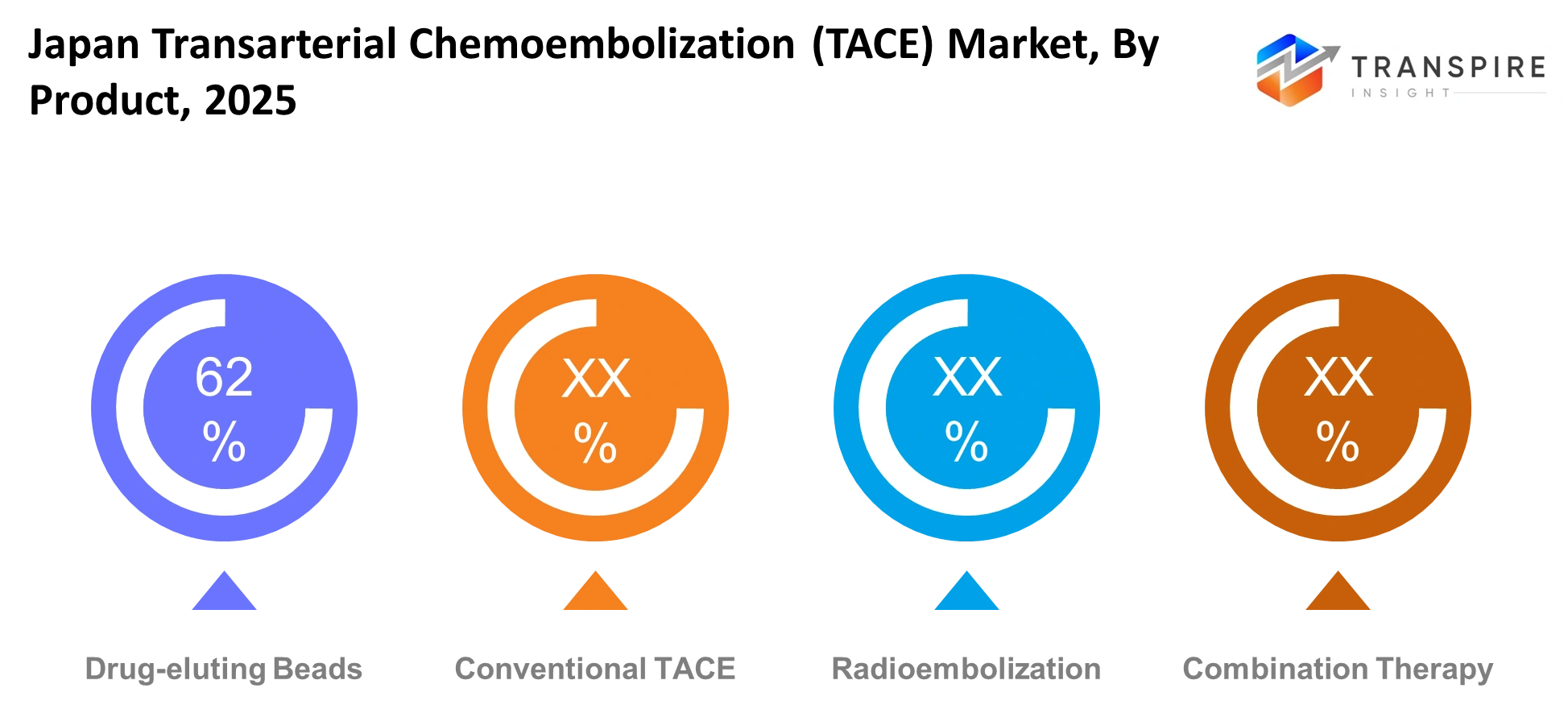
- Drug-eluting Beads: The use of drug-eluting beads has become increasingly popular in Japan because these beads provide controlled delivery of chemotherapy drugs directly to tumors. The procedure helps to reduce overall body exposure while it improves treatment results which makes it the most effective method used by interventional radiologists who treat patients with liver cancer.
- Conventional TACE: The medical field continues to use conventional TACE because it demonstrates both clinical effectiveness and cost-efficiency. Hospitals throughout the world maintain this method as their standard treatment because it requires doctors to inject chemotherapeutic drugs that doctors mix with embolic substances.
- Radioembolization: The treatment has become a new option for patients who cannot receive standard TACE. The treatment uses radioactive particles that specifically attack tumors while providing doctors with complete control over the tumor destruction process. The system has developed interest at specialised centres even though people find it difficult to understand because of its expensive nature.
- Combination Therapy: The medical field in Japan shows increasing adoption of combination therapy which combines TACE with systemic treatments that include immunotherapy and targeted drugs. The method aims to enhance patient results by treating both local tumors and possible metastatic disease which demonstrates the move toward customized multimodal cancer treatment.
To learn more about this report, Download Free Sample Report
By Application
- Liver Cancer: Liver cancer serves as the main treatment area which Japanese medical facilities use to handle their extensive disease burden. Physicians utilize TACE as their first-line treatment method when dealing with patients who have tumors that cannot be surgically removed because it provides them with a procedure that requires less invasive methods while helping them live longer and better their health in their middle stage of the illness.
- Metastatic Cancer: TACE treatment shows rising usage for treating metastatic cancers because of its effectiveness in treating cancers that have spread to the liver. Advanced-stage cancer patients use this treatment method to control their tumor development while their doctors use it to relieve their illness-related suffering.
- HCC (Hepatocellular Carcinoma): The main medical application of TACE in Japan exists for the treatment of Hepatocellular carcinoma (HCC) cases. The clinical guidelines consider TACE as the most suitable treatment for HCC patients who are at intermediate disease stages which results in high treatment demand and medical facilities to need advanced embolization equipment.
- Others: The "Others" segment includes rare liver tumors and off-label uses where TACE may be applied. This segment maintains its market position despite having a small market share because ongoing medical studies and new treatment methods create additional research opportunities.
By End-User
- Hospitals: The end-user segment of hospitals exists as the primary market segment because their advanced infrastructure together with their skilled interventional radiologists enables them to deliver better services. TACE procedures find their most common execution at large tertiary care hospitals which operate imaging systems and oncology departments.
- Cancer Centers: The dedicated cancer centers that exist in the United States play a crucial role in TACE adoption because they provide specialized oncology care together with access to advanced treatment options. These centers maintain their commitment to clinical trials which leads to progress and quick acceptance of fresh TACE technologies.
- Specialty Clinics: Speciality clinics are gradually adopting TACE procedures which shows their growing acceptance of this treatment in urban locations. The infrastructure limitations of these facilities prevent them from reaching hospital standards yet they deliver specialized treatment which enhances patient access to minimally invasive cancer therapies.
- Research Institutes: Research institutes advance the market through their clinical studies which develop innovative TACE techniques and materials. The organization plays a fundamental role to develop new therapies which will boost clinical results for patients and secure market growth in coming years.
Country Insights
The Japanese market is a leading international market for TACE procedures because its advanced healthcare system and comprehensive cancer detection and treatment methods are supported by its medical facilities. The country experiences high demand for TACE therapies because its population faces multiple liver diseases which include hepatocellular carcinoma (HCC) that stems from hepatitis infections and its growing elderly demographic.
The combination of advanced hospital facilities and qualified interventional radiologists together with the availability of imaging systems enables medical procedures to achieve high success rates while being adopted throughout both urban and semi-urban areas. The universal healthcare system of Japan combined with its reimbursement system generates affordable access to TACE treatments for various patients.
The three major metropolitan regions of Tokyo Osaka and Yokohama perform the highest number of medical procedures because these areas contain numerous advanced medical facilities and research centers. Healthcare modernization initiatives combined with telemedicine infrastructure development work towards increasing healthcare accessibility for underserved rural communities.
Japan participates in clinical research activities while developing interventional oncology technologies through its research initiatives which create new embolic materials and combination treatment methods. Japan dedicates strong research efforts to academic and industry partnerships which enable the country to drive worldwide progress in TACE technology development.
Recent Development News
In 2025, a major clinical advancement showed that TACE worked best when combined with targeted and immunotherapy drugs which included lenvatinib and pembrolizumab. The studies demonstrated that patients who received combination treatment showed better progression-free survival outcomes than those who received TACE alone, which supported Japan's transition to using combination treatments for liver cancer.
Japanese clinical research during the period from 2025 to 2026 concentrated on improving TACE procedures and their effects on patients. The multicenter studies proved that selective TACE treatments preserved liver function while enhancing tumor response, and the new TILA-TACE techniques showed much better tumor reduction outcomes.
|
Report Metrics |
Details |
|
Market size value in 2025 |
USD 423.8 Million |
|
Market size value in 2026 |
USD 452.9 Million |
|
Revenue forecast in 2033 |
USD 722.7 Million |
|
Growth rate |
CAGR of 6.90% from 2026 to 2033 |
|
Base year |
2025 |
|
Historical data |
2021 – 2024 |
|
Forecast period |
2026 – 2033 |
|
Report coverage |
Revenue forecast, competitive landscape, growth factors, and trends |
|
Country scope |
Japan |
|
Key company profiled |
Terumo, Boston Scientific, Merit Medical, Medtronic, Cook Medical, BTG International, AngioDynamics, Teleflex, Abbott, Johnson & Johnson, Siemens Healthineers, GE Healthcare, Philips, Canon Medical, Shimadzu. |
|
Customization scope |
Free report customization (country, regional & segment scope). Avail customized purchase options to meet your exact research needs. |
|
Report Segmentation |
By Product (Drug-eluting beads, Conventional TACE, Radioembolization, Combination therapy), By Application (Liver Cancer, Metastatic Cancer, HCC, Others), By End-User (Hospitals, Cancer Centers, Specialty Clinics, Research Institutes). |
Key Japan Transarterial Chemoembolization (TACE) Market Company Insights
The Japan TACE market features intense competition, which is controlled by leading international medical device manufacturers Terumo, Boston Scientific Medtronic and Merit Medical. The companies develop new embolization materials together with microcatheters and drug-delivery systems which enhance both procedural accuracy and patient treatment results. The company expands its interventional oncology portfolio through strategic acquisition partnerships and ongoing research and development, while building its presence in Japan's advanced healthcare sector.
The Cook Medical and BTG International which now operates under Boston Scientific and AngioDynamics, both make important contributions through their development of new embolization and radioembolization technologies. The competitive environment relies on product innovation together with regulatory approvals and growing interest in noninvasive cancer treatments which drives companies to establish clinical partnerships while developing targeted approaches for increased market penetration throughout Japan.
Company List
- Terumo
- Boston Scientific
- Merit Medical
- Medtronic
- Cook Medical
- BTG International
- AngioDynamics
- Teleflex
- Abbott
- Johnson & Johnson
- Siemens Healthineers
- GE Healthcare
- Philips
- Canon Medical
- Shimadzu
Japan Transarterial Chemoembolization (TACE) Market Report Segmentation
By Product
- Drug-eluting beads
- Conventional TACE
- Radioembolization
- Combination therapy
By Application
- Liver Cancer
- Metastatic Cancer
- HCC
- Others
By End-User
- Hospitals
- Cancer Centers
- Specialty Clinics
- Research Institutes
Frequently Asked Questions
Find quick answers to common questions.
The approximate Japan Transarterial Chemoembolization (TACE) Market size will be USD 722.7 Million in 2033.
Key segments for the Japan Transarterial Chemoembolization (TACE) Market are By Product (Drug-eluting beads, Conventional TACE, Radioembolization, Combination therapy), By Application (Liver Cancer, Metastatic Cancer, HCC, Others), By End-User (Hospitals, Cancer Centers, Specialty Clinics, Research Institutes).
Major Japan Transarterial Chemoembolization (TACE) Market players are Terumo, Boston Scientific, Merit Medical, Medtronic, Cook Medical, BTG International, AngioDynamics, Teleflex, Abbott, Johnson & Johnson, Siemens Healthineers, GE Healthcare, Philips, Canon Medical, Shimadzu.
The Japan Transarterial Chemoembolization (TACE) Market size is USD 423.8 Million in 2025.
The Japan Transarterial Chemoembolization (TACE) Market CAGR is 6.90%.
- Terumo
- Boston Scientific
- Merit Medical
- Medtronic
- Cook Medical
- BTG International
- AngioDynamics
- Teleflex
- Abbott
- Johnson & Johnson
- Siemens Healthineers
- GE Healthcare
- Philips
- Canon Medical
- Shimadzu
Recently Published Reports
-
May 2026
Biosimilars Market
Biosimilars Market By Product Type (Monoclonal Antibodies, Recombinant Hormones, Erythropoietin, G-CSF, Others), By Indication (Oncology, Autoimmune Diseases, Blood Disorders, Diabetes, Others), By Manufacturing Type (In-House Manufacturing, Contract Manufacturing), By Distribution Channel (Hospital Pharmacies, Retail Pharmacies, Online Pharmacies), By Industry Analysis, Size, Share, Growth, Trends, and Forecasts 2021-2033
-
Apr 2026
Gastrointestinal Endoscopy Market
Gastrointestinal Endoscopy Market By Type (Rigid Gastrointestinal Endoscope, Flexible Gastrointestinal Endoscopes, Disposable Gastrointestinal Endoscope), By Procedure Type (Colonoscopy, Gastroscopy, Duodenoscopy, Enteroscopy, Flexible Sigmoidoscopy, Others), By Application (Diagnosis, Treatment), By End-Users (Hospitals, Ambulatory Surgical Centers, Specialty Clinics, Laboratories, Others), By Industry Analysis, Size, Share, Growth, Trends, and Forecasts 2021-2033
-
Apr 2026
Rare Inherited Metabolic Disorder Drug Market
Rare Inherited Metabolic Disorder Drug Market By Drug Class (Enzyme Replacement Drugs, Gene Therapy Drugs, Substrate Reduction Drugs, Small Module Drugs, Protein Drugs), By Route of Administration(Parenteral, Oral, Intrathecal), By Clinical Development (Marketed Drugs, Late Stage Clinical Phase III, Early Stage Clinical Phase I-II, Preclinical Candidates), By Indication (Lysosomal Storage Disorders, Urea Cycle Disorders, Amino Acid Metabolic Disorders, organic Acidemias, Peroximal Disorders), By Industry Analysis, Size, Share, Growth, Trends, and Forecasts 2021-2033
-
Jan 2026
Pharmaceutical Cleanroom Technology Market
Pharmaceutical Cleanroom Technology Market By Product (Equipment, Consumables, Services); By Cleanroom Type (Standard Cleanrooms, Modular Cleanrooms); By End Use (Pharmaceutical Companies, Biotechnology Companies), By Industry Analysis, Size, Share, Growth, Trends, and Forecasts 2021-2033