

Japan Food Grade Maltodextrin Market Summary:
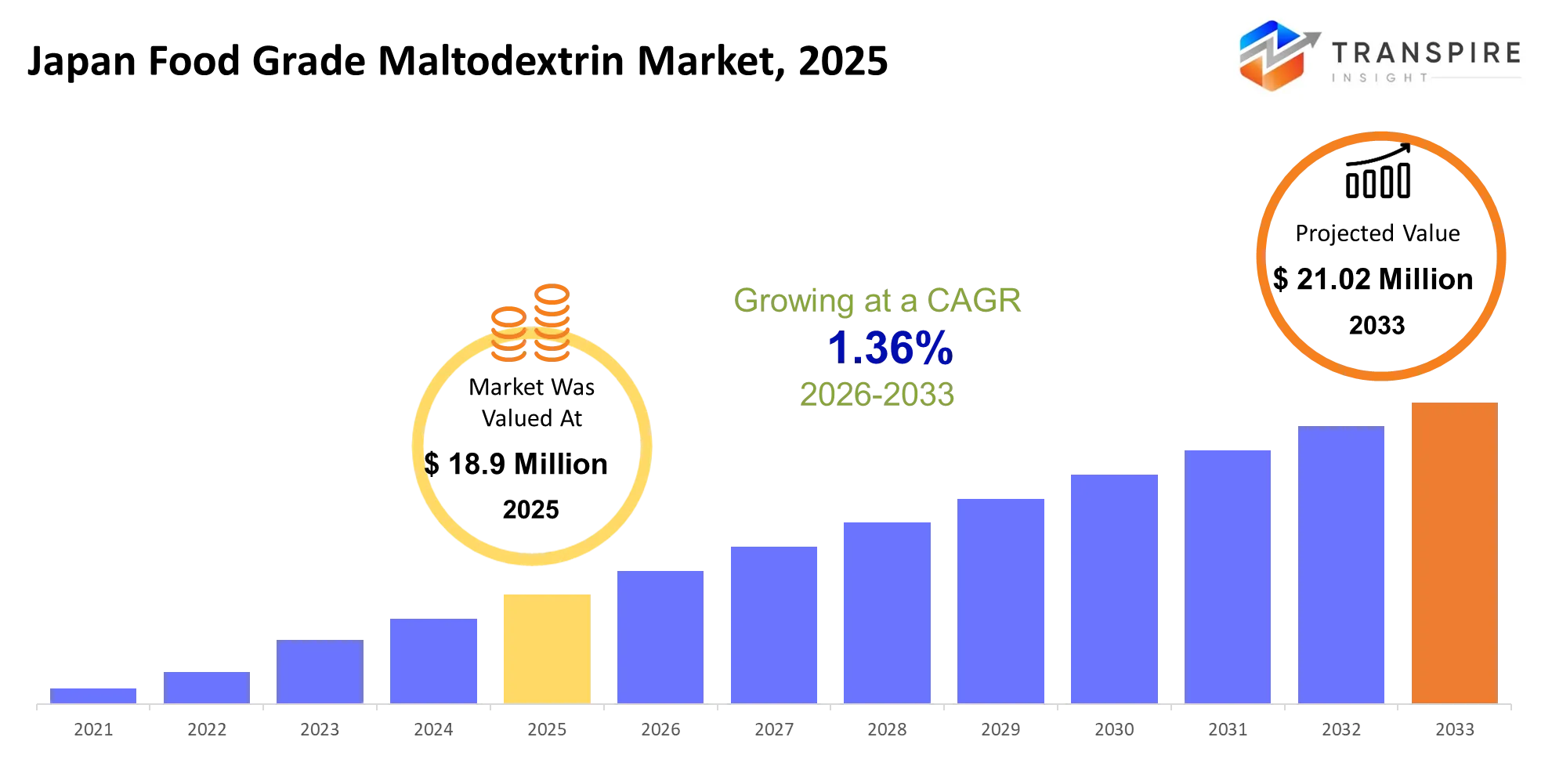
According to Transpire Insight, a detailed research report on the Japan Food Grade Maltodextrin Market reflects that the market was valued at approximately USD 18.9 million in 2025, is expected to reach USD 19.1 million in 2026, and is estimated to attain USD 21.02 million by 2033, registering a forecast CAGR of 1.36% during 2026–2033, highlighting steady market development, product innovation, expanding food and beverage applications, manufacturing capabilities, and evolving growth dynamics in Japan.
Market Snapshot
- Market Value (2025): USD 18.9 Million.
- Expected Market Value (2026): USD 19.1 Million.
- Estimated Market Value (2033): USD 21.02 Million.
- Forecast CAGR (2026–2033): 1.36%
Introduction
The Japan Food Grade Maltodextrin Market is segmented based on manufacturing, processing, distribution and consumption of food-grade maltodextrin manufactured from starch sources such as corn, wheat, potato and tapioca. Maltodextrin is appreciated for its good solubility, neutral to slightly sweet taste, rapid dispersibility, bulking properties, and ability to improve texture, mouthfeel, stability, and ingredient delivery. It is used in beverages, bakery & confectionery products, processed & convenience foods, nutritional formulations, sauces, seasonings & powdered food mixes in Japan. Japan’s sophisticated food-processing infrastructure and strict expectations for ingredient quality, along with demand for convenient food formats and a growing focus on consistent functional performance, support the market. Manufacturers are increasing their investments in formulation precision, clean processing, application-specific grades and efficient production systems to meet the shifting demands of Japan’s diverse food and beverage sector.
Key Market Highlights: -
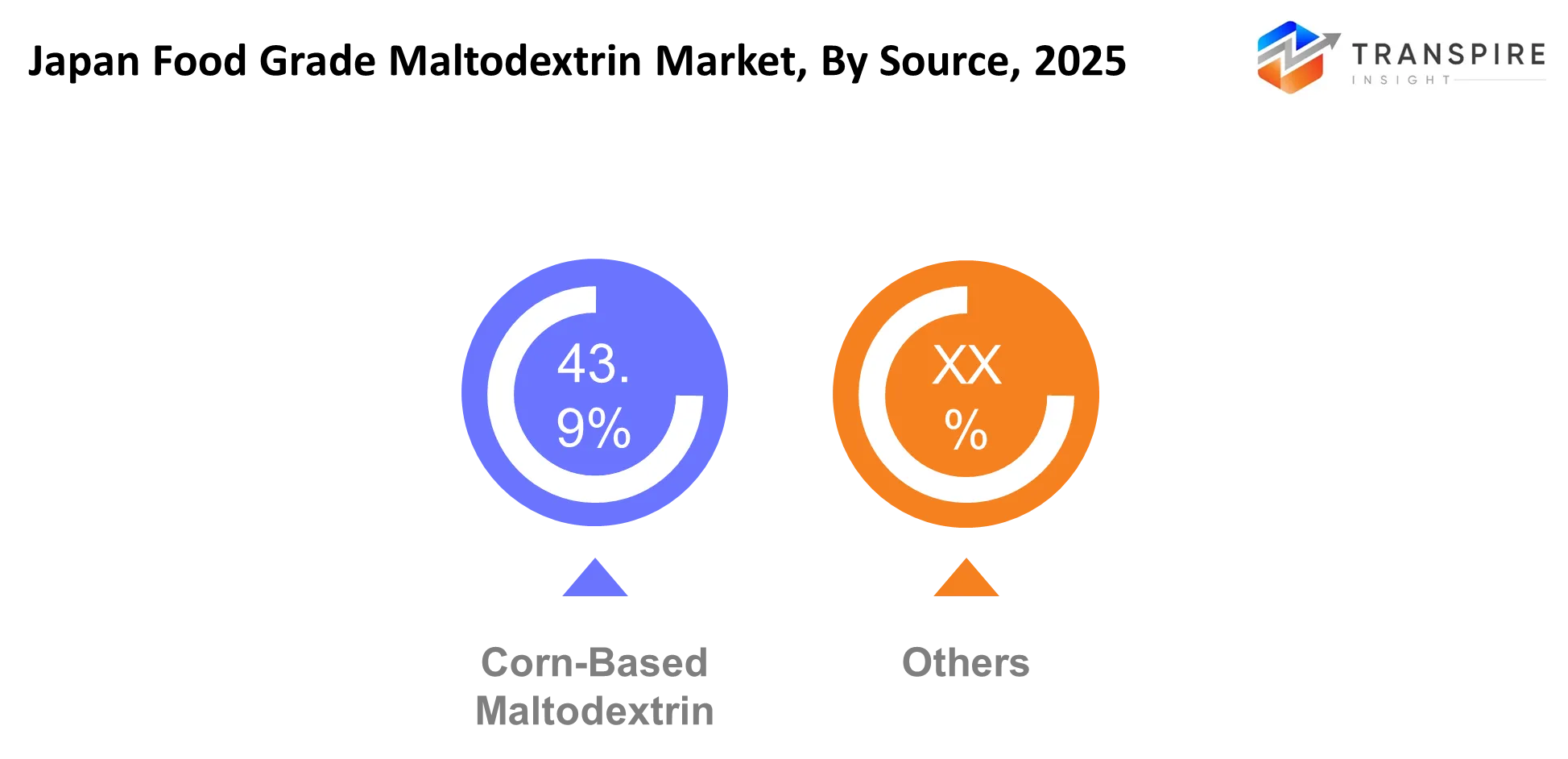
- By Source, the Corn (maize) dominated the market and holds approximately 77% share in 2025 and is projected to grow at a substantial CAGR during the forecast period.
- By DE Value, the MEDIUM DE SEGMENT dominated the market and holds approximately 51% share in 2025 and is projected to grow at a substantial CAGR during the forecast period.
- By Form, the Powder form Manufacturers segment dominated the market and holds approximately 75% share in 2025 and is projected to grow at a substantial CAGR during the forecast period.
- Japan’s food-grade maltodextrin market is bolstered by food-tech investments, functional-food innovation, stable starch supply chains, and intelligent manufacturing, enhancing product quality, formulation efficiency, automation, and domestic production capacities.
How is Technology Driving Growth in the Japan Food Grade Maltodextrin Market?
In Japan Food Grade Maltodextrin market, technology is improving the market with automated starch processing, precise enzymatic hydrolysis, AI-based process monitoring, and advanced spray-drying systems. Automation enhances batch consistency and production efficiency and hygienic handling and process-control technologies help manufacturers maintain targeted dextrose equivalent levels and functional properties. AI and predictive analytics allow for real-time monitoring of temperature, moisture and equipment performance, minimizing production variability and energy consumption. Digital traceability systems also improve the tracking of raw materials, quality assurance and regulation compliance. These innovations allow Japanese producers to develop maltodextrin grades specific to the application in beverages, convenience foods, confectionery, bakery products and nutritional formulations.
Market Drivers
The Japan Food Grade Maltodextrin Market is driven by continuous demand for processed and convenience foods, where maltodextrin is used for texture, bulk, stability and consistency in formulation. The expanding aging population in Japan and growing interest in nutritional products are prompting manufacturers to develop specialized food formulations that require functional carbohydrate ingredients and custom maltodextrin grades. At the same time state of the art food processing technologies such as precision enzymatic hydrolysis, automated production and sophisticated drying systems are enhancing product consistency and manufacturing efficiency. Demand for high quality, application-specific ingredients across beverages, bakery, confectionery, nutritional products and ready-to-eat foods further drives maltodextrin adoption among Japanese food manufacturers.
Restrain
However, strict food-safety compliance, extensive quality documentation, and higher manufacturing and energy costs are hindering the growth of the Japan Food Grade Maltodextrin Market. Reliance on imported starch feedstocks exposes producers to commodity-price volatility, logistics interruptions and supply-chain uncertainty. Health-conscious consumers are also looking more closely at fast-digesting carbohydrates and highly processed ingredients, which is driving demand for alternative sweeteners, functional fibers, resistant starches, and clean-label formulations. These issues may limit the application of traditional maltodextrin and increase the costs of formulation and procurement for Japanese food manufacturers.
Analysis of Prices and Consumer Behaviour
Japan Food Grade Maltodextrin Market is estimated to be worth USD 18.9 million in 2025, and is projected to reach USD 19.1 million in 2026, as demand continues to grow in the food and beverage processing industries of Japan. The market is anticipated to reach USD 21.02 million by 2033, with a projected CAGR of 1.36% during the forecast period of 2026-2033. Food-grade maltodextrin as a bulking, texturizing, stabilizing, and carrier ingredient has the potential to be adapted in beverages, bakery products, confectionery, processed foods, nutritional formulations, and powdered mixes, which is favorable for market development. The focus on high-quality ingredients, formulation consistency, convenience foods, and application specific carbohydrate solutions in Japan are also fueling the demand. Manufacturers are more concerned about efficient processing, reliable supply, and stringent quality standards.
Top Companies in the Japan Food Grade Maltodextrin Market
- Cargill
- Ingredion
- Tate & Lyle
- ADM
- Roquette
- Matsutani Chemical Industry
- Sanwa Starch
- Hayashibara
- Tereos
- Agrana
- Emsland Group
- Japan Corn Starch
- Nihon Shokuhin Kako
- Showa Sangyo
- San-Ei Gen F.F.I.
Japan Food Grade Maltodextrin Market Segmentation
The Japan Food Grade Maltodextrin Market share is divided into six categories: By Source, By DE Value, By Form, By Application, By End User, By Distribution Channel.
The Corn (maize) dominated the market, accounting for nearly 77% in 2025 and is expected to rise at a significant CAGR during the forecast period.
The Japan Food Grade Maltodextrin Market is segmented by source into corn, potato, rice, wheat, tapioca, cassava, barley, other starches. Among these, the Corn (maize) segment dominated the market, accounting for nearly 77% in 2025 and expected to increase at a significant CAGR during the forecast period. In 2025, Corn (maize) dominated the Japan Food Grade Maltodextrin Market due to the abundant availability of starch, consistent functionality, cost efficiency, well-established processing infrastructure and wide acceptance in the food industry.
The medium de segment dominated the market, accounting for nearly 51% in 2025, and is expected to rise at a significant CAGR during the forecast period.
The Japan Food Grade Maltodextrin Market is segmented by de value into low de, medium de, high de, de 5–10, de 10–15, de 15–20, de 20–25, specialty de. Among these, the MEDIUM DE SEGMENT dominated the market, accounting for nearly 51% in 2025 and expected to increase at a significant CAGR during the forecast period. Japan Food Grade Maltodextrin Market: Product Medium-DE maltodextrin dominated the market, owing to balanced sweetness, solubility, texture enhancement, stability and wide applicability across processed foods.
The Powder form dominated the market, accounting for nearly 75% in 2025 and is expected to rise at a significant CAGR during the forecast period.
The Japan Food Grade Maltodextrin Market is segmentedby form into powder, granules, liquid, syrup, instantized powder, agglomerated powder, spray-dried powder, specialty blends. Among these, the Powder form dominated the market, accounting for nearly 75% in 2025 and expected to increase at a significant CAGR during the forecast period. Japan Food Grade Maltodextrin Market was led by powder maltodextrin owing to its high storage stability, easy handling, quick dispersion, accurate dosing, and compatibility with versatile food formulation.
Future Market Trends for the Japan Food Grade Maltodextrin Market: -
- Functional and Specialized Formulations: The trend toward functional foods is gaining traction and will drive demand for digestion-resistant, low-DE, and application-specific maltodextrin grades that enable differentiated nutritional and formulation requirements.
- Clean Label Ingredient Innovation: Japanese food manufacturers are placing greater emphasis on transparent formulations, plant-based ingredients and recognizable processing attributes, which is promising for refined maltodextrin solutions that deliver consistent functional performance.
- Smart and Sustainable Manufacturing: Automation, precision enzymatic processing, energy-efficient drying, and digital quality monitoring will increasingly enhance production efficiency, traceability, consistency and sustainability across Japan’s maltodextrin supply chain.
Recent Development
- In September 1, 2026: Industry suppliers launched specialty low-DE food-grade maltodextrin solutions for functional, nutritional and clinical food applications in Japan.
- In June 12, 2026: Food ingredient companies have introduced application-specific food-grade maltodextrin formulations to improve texture, stability and processing performance in functional and plant-based foods.
Market Segmentation
This study forecasts revenue at Japan, regional and country levels from 2020 to 2033. Transpire Insight has segmented the Japan Food Grade Maltodextrin Market based on the below-mentioned segments:
Japan Food Grade Maltodextrin Market, By Source
- Corn
- Potato
- Rice
- Wheat
- Tapioca
- Cassava
- Barley
- Other Starches
Japan Food Grade Maltodextrin Market, By DE Value
- Low DE
- Medium DE
- High DE
- DE 5–10
- DE 10–15
- DE 15–20
- DE 20–25
- Specialty DE
Japan Food Grade Maltodextrin Market, By Form
- Powder
- Granules
- Liquid
- Syrup
- Instantized Powder
- Agglomerated Powder
- Spray-Dried Powder
- Specialty Blends
Japan Food Grade Maltodextrin Market, By Application
- Beverages
- Bakery
- Confectionery
- Dairy
- Sports Nutrition
- Infant Nutrition
- Processed Foods
- Pharmaceuticals
Japan Food Grade Maltodextrin Market, By End User
- Food Manufacturers
- Beverage Companies
- Dairy Producers
- Sports Nutrition Companies
- Infant Food Manufacturers
- Confectionery Companies
- Bakeries
- Pharmaceutical Companies
Japan Food Grade Maltodextrin Market, By Distribution Channel
- Direct Sales
- Food Ingredient Distributors
- Wholesale
- Specialty Distributors
- Online B2B
- Retail
- Importers
- Contract Supply
Frequently Asked Questions
Find quick answers to common questions.
Demand for processed foods, nutritional formulations, application-specific ingredients, advanced processing technologies, and convenience food formats is driving market development.
Corn dominates due to abundant starch availability, consistent functionality, cost efficiency, established processing infrastructure, and widespread food-industry acceptance.
Powder dominates because of high storage stability, convenient handling, rapid dispersion, accurate dosing, and compatibility with diverse food formulations.
Automation, enzymatic hydrolysis, AI monitoring, spray-drying, predictive analytics, and digital traceability improve efficiency, consistency, quality, and regulatory compliance.
Functional formulations, clean-label innovation, specialized maltodextrin grades, automation, sustainable manufacturing, and digital quality monitoring are expected to shape growth.
- Cargill
- Ingredion
- Tate & Lyle
- ADM
- Roquette
- Matsutani Chemical Industry
- Sanwa Starch
- Hayashibara
- Tereos
- Agrana
- Emsland Group
- Japan Corn Starch
- Nihon Shokuhin Kako
- Showa Sangyo
- San-Ei Gen F.F.I.
About the Authors

Chetan Dhatrak
I’m Chetan Dhatrak, a Senior Research Analyst at Transpire Insight, specializing in the Consumer Goods, Foods and Beverages industry. I focus on analyzing market trends, consumer behavior, competitive landscapes, and industry developments to deliver accurate, data-driven insights. My research at Transpire Insight is built on credible sources and in-depth analysis, helping businesses and readers better understand market dynamics, emerging opportunities, and evolving consumer preferences. I’m committed to creating reliable, well-researched content that supports informed decision-making and reflects the latest developments in the consumer goods and food & beverage sectors.

Chakradhar Khansole
Chakradhar serves as the Research Director at Transpire Insight, bringing over 8 years of experience in technology, innovation, and strategic market intelligence. He specializes in transforming complex market data into actionable business insights that enable organizations to make informed, growth-oriented decisions. Recognized for his strategic vision and analytical expertise, Chakradhar leads high-impact research initiatives, delivering comprehensive market assessments, competitive intelligence, and forward-looking industry analysis.
Recently Published Reports
-
Apr 2026
Baby Infant Formula Market
Baby Infant Formula Market Size, Share & Analysis Report By ype (Infant Milk, Follow On Milk, Specialty Baby Milk, Growing-Up Milk), By Ingredient (Carbohydrate, Fat, Protein, Minerals, Vitamins, and Others), By Product Form (Powder, Liquid, and Ready-to-feed), By Distribution Channels (Supermarket/Hypermarket, Specialty Store, Pharmacies, Online Retail, and Others), and Geography (North America, Europe, Asia-Pacific, Middle East and Africa, South and Central America), 2021 - 2031
-
Apr 2026
Edible Insects for Animal Feed Market
Edible Insects for Animal Feed Market Size, Share & Analysis Report By Type (Insect Powder, Insect Meal, Insect Bar, Insect Paste, Insect Oil, and Others), By Insect Type (Beetles, Cricket, Caterpillar, Hymenoptera, Orthoptera, Tree Bugs, and Others), By Application (Livestock, Pet Food, and Aquaculture), By Livestock Type (Poultry, Swine, and Others), and Geography (North America, Europe, Asia-Pacific, Middle East and Africa, South and Central America), 2021 - 2031
-
Apr 2026
Food Industry Disinfection and Bacterial Control Market
Food Industry Disinfection and Bacterial Control Market Size, Share & Analysis Report By Type (Chemical Disinfectants, Physical Disinfectants, and Biocides and Antimicrobials), By Application (Food Processing Equipment Surface Disinfection, Food Preparation Areas Surface Disinfection, Storage Areas Surface Disinfection, Anti-microbial Coatings Food Preservation, and Preservative Solutions Food Preservation), By End User (Meat and Poultry Processing, Dairy Processing, Seafood Processing, Bakery and Confectionery, Restaurants and Commercial Kitchens, and Food Service Providers), By Sales Channel (Online, Offline), and Geography (North America, Europe, Asia-Pacific, Middle East and Africa, South and Central America), 2021 - 2031
-
May 2026
Freeze Dried Food Market
Freeze Dried Food Market Size, Share & Analysis Report By Product Type (Fruits, Vegetables, Freeze-Dried Dairy Products, Freeze-Dried Meat and Seafood, Freeze-Dried Pet Food, and Prepared Meal), By Nature (Organic, and Conventional), By Form (Powdered, Granules, and Diced), By End Use (Breakfast Cereals, Dairy Products, Bakery & Confectionery, Nutritional Bars & Supplements, Powdered Beverages, Snacks, and Retail (Household)), and Geography (North America, Europe, Asia-Pacific, Middle East and Africa, South and Central America), 2021 - 2031