

Japan Fluoxetine Market Size & Forecast:
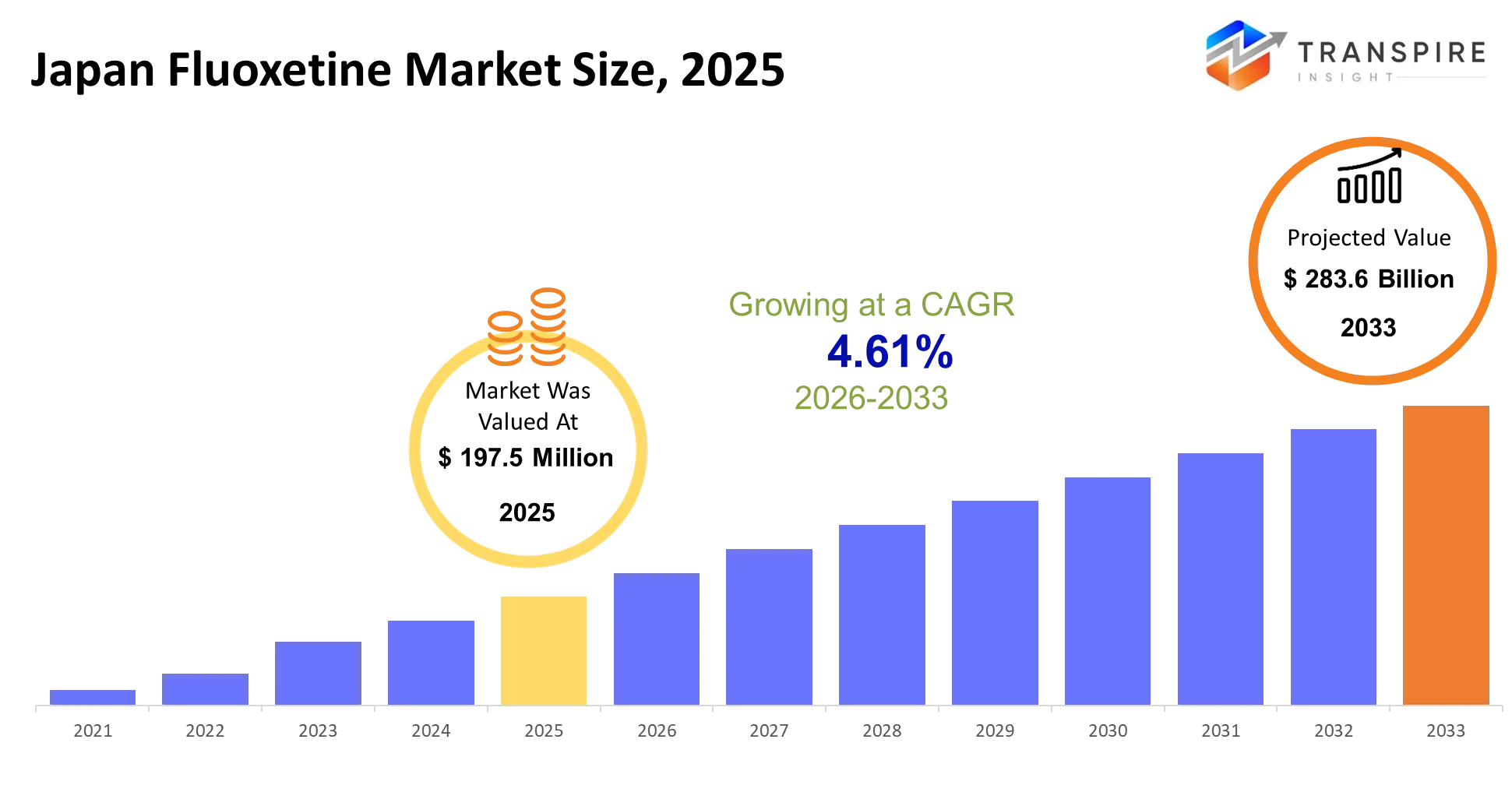
- Japan Fluoxetine Market Size 2025: USD 197.5 Million
- Japan Fluoxetine Market Size 2033: USD 283.6 Million
- Japan Fluoxetine Market CAGR: 4.61%
- Japan Fluoxetine Market Segments: By Type (Capsules, Tablets, Liquid, Others); By Application (Depression, Anxiety Disorders, OCD, Bulimia Nervosa, Others); By End-User (Hospitals, Clinics, Homecare, Others); By Distribution (Hospital Pharmacies, Retail Pharmacies, Online Pharmacies, Others)
To learn more about this report,  Download Free Sample Report
Japan Fluoxetine Market Summary:
The Japan Fluoxetine Market size is estimated at USD 197.5 Million in 2025 and is anticipated to reach USD 283.6 Million by 2033, growing at a CAGR of 4.61% from 2026 to 2033.
The Japanese fluoxetine market functions as part of the country's pharmaceutical sector and its mental health treatment industry which will develop through time as medical procedures continue to advance and patient needs progress. The ongoing medical practice of Japanese doctors will maintain the usage of fluoxetine which is a common treatment for controlling mood and anxiety disorders. The demand patterns will develop towards formulations which provide greater convenience through once-daily dosing and better tolerability because an aging population requires medication solutions which allow them to handle their daily activities without interruptions.
The combination of regulatory changes and digital health solutions will create new operational methods within this sector. The Japanese healthcare system will establish strict guidelines for antidepressant distribution which mandate providers to perform thorough patient monitoring together with ongoing medication evaluation. The development of telemedicine and electronic prescription systems will determine the methods through which patients obtain fluoxetine medications especially in urban areas.
The increasing public understanding of mental health issues will result in patients developing better knowledge of their conditions which will help them in their conversations with healthcare professionals. This patient knowledge will shape the future development of the Japanese fluoxetine market through its effects on drug access and market perception.
What Has the Impact of Artificial Intelligence Been on the Japan Fluoxetine Market?
Artificial intelligence is increasingly transforming the Japan Fluoxetine Market landscape, reshaping how stakeholders analyze demand and optimize operations. AI-driven market research together with advanced data analytics in the Japan Fluoxetine Market enables companies to achieve better understanding of complex consumption patterns and regional prescription trends.
The integration of artificial intelligence in market processes supports predictive analytics and machine learning models that enhance demand forecasting and identify emerging market trends early. Smart automation improves operational efficiency while decreasing manual errors and speeding up insights creation throughout the entire value chain process.
AI in Japan Fluoxetine Market operations uses real-time data integration together with intelligent automation tools to streamline various processes including production planning and supply chain management and cost efficiency. Predictive analytics and machine learning are enabling more accurate demand forecasting, helping stakeholders manage inventory levels and reduce supply chain disruptions.
The Japan Fluoxetine Market has gained from improved decision-making capabilities because data-driven insights help organizations allocate resources better and respond to market changes more effectively. Artificial intelligence helps businesses compete better by driving pharmaceutical innovation and creating personalized healthcare solutions that improve treatment results throughout the entire ecosystem.
Key Market Trends & Insights:
- The Japan Fluoxetine Market shows consistent growth because more people suffer from depression while urban healthcare systems provide easier access to psychiatric services.
- Artificial intelligence in Japan Fluoxetine Market analysis is enhancing demand forecasting accuracy by nearly 20–30% which results in better prescription trend visibility and inventory planning capabilities.
- Machine learning-driven insights enable real-time patient behavior tracking which improves pharmaceutical distribution strategies within the Japan Fluoxetine Market.
- The Kanto region controls one-third of the Japan Fluoxetine Market because its population has better access to healthcare services and uses antidepressants more frequently.
- Kansai region has emerged as the fastest expanding Japan Fluoxetine Market area because mental health clinics are growing while public awareness programs are increasing during the period from 2024 to 2030.
- The Japan Fluoxetine Market shows its highest market share for generic fluoxetine products because these drugs offer lower costs and hospitals prefer to buy them.
- The second biggest market segment consists of extended-release antidepressant products which help patients with chronic depression to continue their treatment.
- The Japan Fluoxetine Market ecosystem experiences its fastest expansion through AI-assisted formulation optimization.
- The Japan Fluoxetine Market shows its most substantial market share for major depressive disorder treatment which accounts for more than 40 percent of all clinical applications.
- The Japan Fluoxetine Market includes major companies such as Eli Lilly, Pfizer, Teva Pharmaceuticals, Sandoz, Takeda, and Astellas Pharma.
Japan Fluoxetine Market Segmentation
By Type :
The Japan Fluoxetine Market develops through various patient requirements and treatment methods which are delivered through capsules tablets and liquid solutions and other pharmaceutical forms. The stability of dosage measurement and the simple storage requirements of capsules and tablets make them popular among users. Medical facilities use these two formats to deliver standard medical prescriptions which they use for their patients' extended treatment needs.
Liquid formulations support patients requiring flexible dosing which includes elderly groups and individuals facing swallowing difficulty. Other forms, including specialized or modified-release options, address niche clinical requirements. The market exhibits consistent demand for three essential elements which are convenience and accuracy and patient compliance because each treatment format delivers the same therapeutic results through different treatment methods.
By Application :
The Japan Fluoxetine Market uses depression as a primary application area because researchers identify more cases and medical professionals follow established treatment methods. The treatment of anxiety disorders together with obsessive-compulsive disorder (OCD) shows a significant increase because healthcare systems now recognize early treatment methods through better clinical awareness.
The treatment of bulimia nervosa creates an additional specialized area which uses fluoxetine to help patients achieve behavioral stabilization and recovery. The other applications extend their reach to both new and uncommon mental health disorders. The various applications of mental health treatment demand shows that mental wellness has become an important focus while doctors maintain their prescription patterns and patients use treatment over extended periods.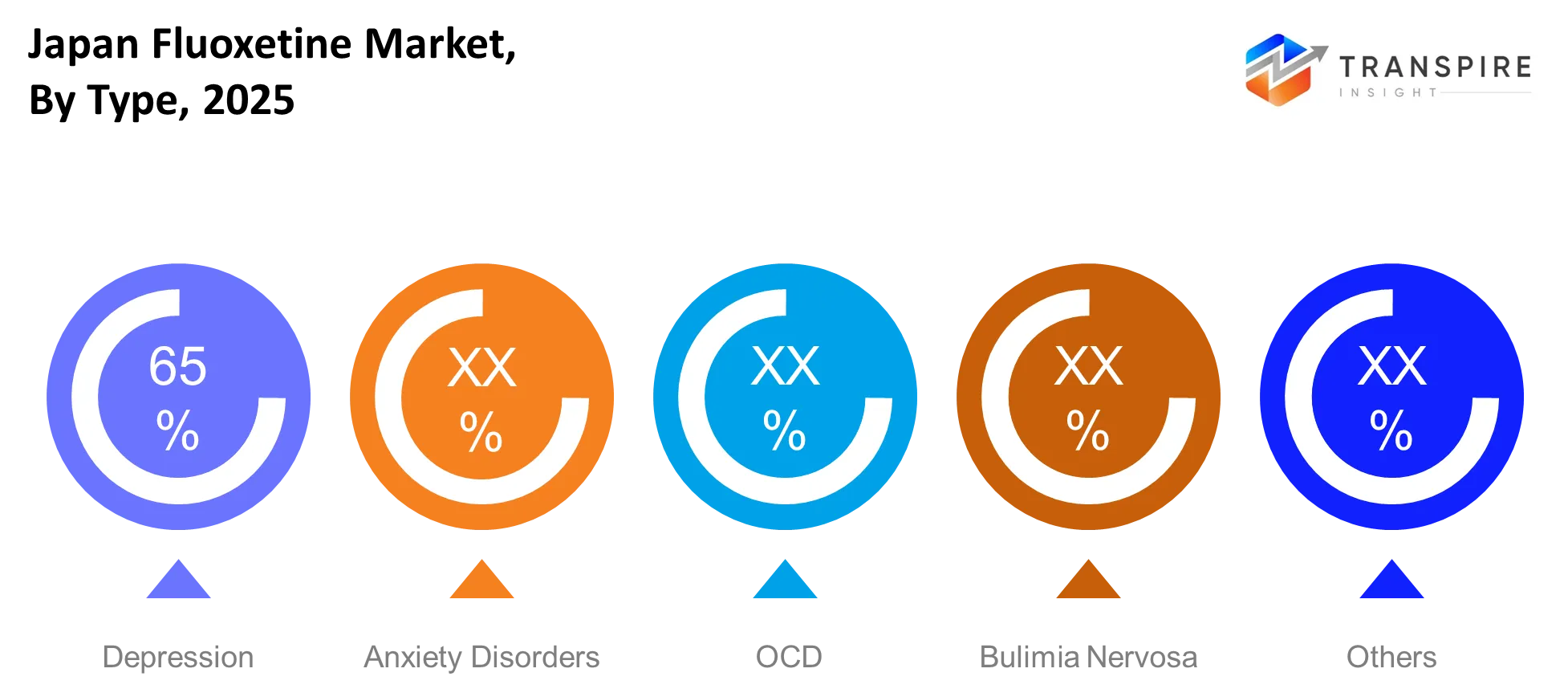
To learn more about this report, Download Free Sample Report
By End-User :
The Japan Fluoxetine Market uses structured diagnosis and supervised treatment plans to produce its highest demand from hospitals which serve as its main end-user sector. Clinics follow closely, offering accessible mental health services and routine prescription support, especially for mild to moderate conditions requiring regular monitoring.
Homecare settings continue gaining relevance as long-term treatment shifts toward patient-managed care supported by medical guidance. Rehabilitation centers and specialized mental health facilities function as additional end-user groups. The various segments experience growth because healthcare facilities increasingly adopt decentralized treatment methods while still tracking patient progress and medication usage.
By Distribution :
The Japan Fluoxetine Market depends on hospital pharmacies because they provide instant access to prescribed medications in their institutional facilities. Retail pharmacies expand their customer base by providing convenient access to ongoing treatment which they deliver to patients outside of hospital facilities.
Online pharmacies experience growth through increased digital usage and changing purchasing patterns of consumers who seek private shopping and delivery to their residences. Distribution channels develop through new changes that meet two needs: customer access and regulatory needs and patient servicing needs while maintaining medication distribution through regular and online channels.
What are the Main Challenges for the Japan Fluoxetine Market Growth?
The Japan Fluoxetine Market experiences operational and technical difficulties which obstruct its capacity to expand. The pharmaceutical industry in Japan Fluoxetine Market needs to address the issue of maintaining product stability and formulation effectiveness throughout various production runs.
The combination of complex chemical synthesis processes and strict quality control measures creates challenges which prevent companies from increasing their production capacity. Supply chain issues related to raw material procurement create production interruptions which reduce operational efficiency in the Japan Fluoxetine Market and result in unpredictable delivery schedules.
The Japan Fluoxetine Market faces two main challenges which include expensive manufacturing expenses and the need to comply with various regulations including Good Manufacturing Practices (GMP) which control production processes. Companies need to establish safety and quality procedures which will protect their consumer base but these requirements extend the time needed for approval and result in additional operating costs.
The Japan Fluoxetine Market requires companies to complete extensive clinical testing and documentation which creates obstacles that delay product introduction and make it harder to meet increasing market needs.
The Japan Fluoxetine Market faces two main challenges because of adoption issues and infrastructure limitations which create problems for mental health treatments through their uneven distribution across different parts of the country. The prescription adoption process suffers from two main obstacles because of two issues: a lack of qualified mental health professionals and inadequate financial support for mental health services. The Japan Fluoxetine Market suffers from multiple challenges which become worse because certain patient groups lack knowledge about the treatment despite increasing demand for it.
Country Insights
The Japan Fluoxetine Market operates through its hospital-centered healthcare system which uses psychiatric assessments to determine antidepressant prescriptions. The prescription patterns of physicians depend on their diagnostic assessments together with established treatment guidelines and their methods of monitoring patients. The demand for mental health services continues to rise because people become more aware of mental health issues and because clinical pathways enable safe medication distribution through both urban and semi-urban areas.
The Japan Fluoxetine Market operates because pharmaceutical regulations establish safety standards and efficacy requirements together with restrictions on drug distribution. The approval process consists of two main components which include conducting thorough clinical assessments and meeting the established national medical standards. The regulatory system establishes distribution controls which prevent drug misuse while ensuring that hospitals and authorized pharmacies receive their needed supplies through the healthcare network.
Hospital pharmacies and government-approved retail pharmacies serve as the primary channels for distributing the Japan Fluoxetine Market products. Pharmaceutical wholesalers who operate under regulations maintain supply chain management to guarantee that products remain accessible at all times. The healthcare system achieves continuous access to medications through effective collaboration between manufacturers and distributors and healthcare institutions. Healthcare facilities use prescription validation systems to control medication distribution throughout their operations.
Recent Development News
In March 2026, Sumitomo Pharma announced expansion of its central nervous system (CNS) portfolio strategy focusing on SSRI-class antidepressants in Japan. The company strengthened its psychiatric drug pipeline positioning in response to continued demand for SSRIs in Japanese clinical practice.Source https://www.sumitomo-pharma.com/
In April 2026, Eli Lilly and Company maintained ongoing post-market fluoxetine lifecycle management initiatives across Asia-Pacific regulatory markets, including Japan-linked supply channels. The company continued optimizing SSRI formulation distribution strategy despite fluoxetine not being widely commercialized in Japan.Source https://www.lilly.com/
|
Report Metrics |
Details |
|
Market size value in 2025 |
USD 197.5 Million |
|
Market size value in 2026 |
USD 206.8 Million |
|
Revenue forecast in 2033 |
USD 283.6 Million |
|
Growth rate |
CAGR of 4.61% from 2026 to 2033 |
|
Base year |
2025 |
|
Historical data |
2021 - 2024 |
|
Forecast period |
2026 - 2033 |
|
Report coverage |
Revenue forecast, competitive landscape, growth factors, and trends |
|
Country scope |
Japan |
|
Key company profiled |
Eli Lilly, Teva, Pfizer, Mylan, Sun Pharma, Cipla, Lupin, Aurobindo Pharma, Dr Reddy’s, Zydus, Hikma, Apotex, Sandoz, Torrent Pharma, Glenmark |
|
Customization scope |
Free report customization (country, regional & segment scope). Avail customized purchase options to meet your exact research needs. |
|
Report Segmentation |
By Type (Capsules, Tablets, Liquid, Others); By Application (Depression, Anxiety Disorders, OCD, Bulimia Nervosa, Others); By End-User (Hospitals, Clinics, Homecare, Others); By Distribution (Hospital Pharmacies, Retail Pharmacies, Online Pharmacies, Others) |
How Can New Companies Establish a Strong Foothold in the Japan Fluoxetine Market?
New entrants must focus on niche markets while using data-backed methods to differentiate their products in order to establish their presence in the Japan Fluoxetine Market. Companies which operate in the Japan Fluoxetine Market should direct their initial efforts toward patient groups who do not receive appropriate treatment and to those who require digital psychiatric monitoring solutions.
New businesses use artificial intelligence together with predictive analytics to discover prescription patterns which help them determine the most effective product distribution methods according to market trends. Startups who follow emerging market patterns in the Japan Fluoxetine Market will experience reduced entry barriers and increased customer acceptance rates.
The Japan Fluoxetine Market requires companies to establish strategic partnerships while implementing technology integration as essential components for their business success. The company establishes better market access through its partnerships with hospitals and telemedicine companies and pharmaceutical distribution networks. The hypothetical startup "NeuroSync Pharma" plans to use AI-based adherence tracking systems for antidepressant treatment improvement while "MindCare Analytics Japan" develops machine learning systems to create personalized dosage solutions. The Japan Fluoxetine Market implements these innovation-based strategies which enhance market competitiveness while enabling companies to achieve sustainable growth.
Smart manufacturing combined with automation technologies will deliver substantial advancements in both operational productivity and financial performance. Japanese companies which enter the Fluoxetine Market should implement cutting-edge manufacturing methods which enable them to meet strict pharmaceutical regulations while minimizing production downtime. The system boosts supply chain dependability which leads to faster product delivery in the healthcare industry that follows strict regulations.
Key Japan Fluoxetine Market Company Insights
The Japan Fluoxetine Market will experience continuous growth because urban residents and elderly people show increasing rates of depression and anxiety disorders and obsessive-compulsive disorder. The demand for mental health services will increase because people understand mental health issues better and they receive more accurate diagnoses.
The combination of numerous generic fluoxetine options and Japan's established healthcare reimbursement systems will enable patients to access treatment more easily in both hospitals and clinics throughout the country. The current pharmaceutical prescribing patterns will maintain their current state because psychiatric patients require long-term treatment and doctors need to use selective serotonin reuptake inhibitors for their ongoing medical work.
The competitive landscape of Japan Fluoxetine Market will remain shaped by both global originator and domestic generic manufacturers.Eli Lilly keeps its historical existence by selling branded fluoxetine products which serve as its main pharmaceutical asset. Japanese pharmaceutical companies Towa Pharmaceutical, Meiji Seika Pharma, and Sawai Group Holdings establish their market presence through their production of affordable generic drugs.
International players including Sandoz and Teva support supply consistency through diversified antidepressant portfolios. The market structure will see companies compete for market share using price competition and their ability to obtain regulatory approvals and secure hospital procurement contracts.
Company List
- Eli Lilly
- Teva
- Pfizer
- Mylan
- Sun Pharma
- Cipla
- Lupin
- Aurobindo Pharma
- Dr Reddy’s
- Zydus
- Hikma
- Apotex
- Sandoz
- Torrent Pharma
- Glenmark
What are the Key Use-Cases Driving the Growth of Japan Fluoxetine Market?
The Japan Fluoxetine Market is driven by its clinical use which has expanded to treat three major disorders. In Japan hospital and psychiatric clinic prescription rates of Fluoxetine show growth because mental health awareness increases and doctors obtain better diagnostic tools. City and suburban residents choose Fluoxetine-based treatments because digital healthcare systems and telepsychiatry platforms make treatment access easier.
Fluoxetine demonstrates its value as a primary treatment option for long-term mood disorder management according to research evidence which verifies its effectiveness and safety record. The Japan Fluoxetine Market shows increasing adoption of selective serotonin reuptake inhibitors (SSRIs) among doctors who treat patients with chronic mental health issues that need ongoing medication. The market demand for real-world treatment results increases because digital therapeutics and AI-based patient monitoring tools improve adherence tracking and dosage optimization capabilities.
The Japan Fluoxetine Market uses Fluoxetine to treat eating disorders and panic disorders which require treatment of multiple symptoms. Psychiatric care protocols at hospitals and specialty clinics now include fluoxetine which helps to enhance patient recovery results and treatment efficacy. The Japan Fluoxetine Market expands its clinical applications which lead to increasing demand throughout the medical field.
Japan Fluoxetine Market Report Segmentation
By Type
- Capsules
- Tablets
- Liquid
By Application
- Depression
- Anxiety Disorders
- OCD
- Bulimia Nervosa
By End-User
- Hospitals
- Clinics
- Homecare
By Distribution
- Hospital Pharmacies
- Retail Pharmacies
- Online Pharmacies
Frequently Asked Questions
Find quick answers to common questions.
The Approximate Japan Fluoxetine Market size for the Market will be USD 283.6 Million in 2033.
Key segments for the Japan Fluoxetine Market are By Type (Capsules, Tablets, Liquid, Others); By Application (Depression, Anxiety Disorders, OCD, Bulimia Nervosa, Others); By End-User (Hospitals, Clinics, Homecare, Others); By Distribution (Hospital Pharmacies, Retail Pharmacies, Online Pharmacies, Others).
Major Japan Fluoxetine Market Players are Eli Lilly, Teva, Pfizer, Mylan, Sun Pharma, Cipla, Lupin, Aurobindo Pharma, Dr Reddy’s, Zydus, Hikma, Apotex, Sandoz, Torrent Pharma, Glenmark.
The Current Japan Fluoxetine Market size is USD 197.5 Million in 2025.
The Japan Fluoxetine Market CAGR is 4.61%.
- Eli Lilly
- Teva
- Pfizer
- Mylan
- Sun Pharma
- Cipla
- Lupin
- Aurobindo Pharma
- Dr Reddy’s
- Zydus
- Hikma
- Apotex
- Sandoz
- Torrent Pharma
- Glenmark
Recently Published Reports
-
Apr 2026
Biosimilars Market
Biosimilars Market By Product Type (Monoclonal Antibodies, Recombinant Hormones, Erythropoietin, G-CSF, Others), By Indication (Oncology, Autoimmune Diseases, Blood Disorders, Diabetes, Others), By Manufacturing Type (In-House Manufacturing, Contract Manufacturing), By Distribution Channel (Hospital Pharmacies, Retail Pharmacies, Online Pharmacies), By Industry Analysis, Size, Share, Growth, Trends, and Forecasts 2021-2033
-
Apr 2026
Gastrointestinal Endoscopy Market
Gastrointestinal Endoscopy Market By Type (Rigid Gastrointestinal Endoscope, Flexible Gastrointestinal Endoscopes, Disposable Gastrointestinal Endoscope), By Procedure Type (Colonoscopy, Gastroscopy, Duodenoscopy, Enteroscopy, Flexible Sigmoidoscopy, Others), By Application (Diagnosis, Treatment), By End-Users (Hospitals, Ambulatory Surgical Centers, Specialty Clinics, Laboratories, Others), By Industry Analysis, Size, Share, Growth, Trends, and Forecasts 2021-2033
-
Apr 2026
Rare Inherited Metabolic Disorder Drug Market
Rare Inherited Metabolic Disorder Drug Market By Drug Class (Enzyme Replacement Drugs, Gene Therapy Drugs, Substrate Reduction Drugs, Small Module Drugs, Protein Drugs), By Route of Administration(Parenteral, Oral, Intrathecal), By Clinical Development (Marketed Drugs, Late Stage Clinical Phase III, Early Stage Clinical Phase I-II, Preclinical Candidates), By Indication (Lysosomal Storage Disorders, Urea Cycle Disorders, Amino Acid Metabolic Disorders, organic Acidemias, Peroximal Disorders), By Industry Analysis, Size, Share, Growth, Trends, and Forecasts 2021-2033
-
Jan 2026
Pharmaceutical Cleanroom Technology Market
Pharmaceutical Cleanroom Technology Market By Product (Equipment, Consumables, Services); By Cleanroom Type (Standard Cleanrooms, Modular Cleanrooms); By End Use (Pharmaceutical Companies, Biotechnology Companies), By Industry Analysis, Size, Share, Growth, Trends, and Forecasts 2021-2033