

Hospitality Industry Market Summary:
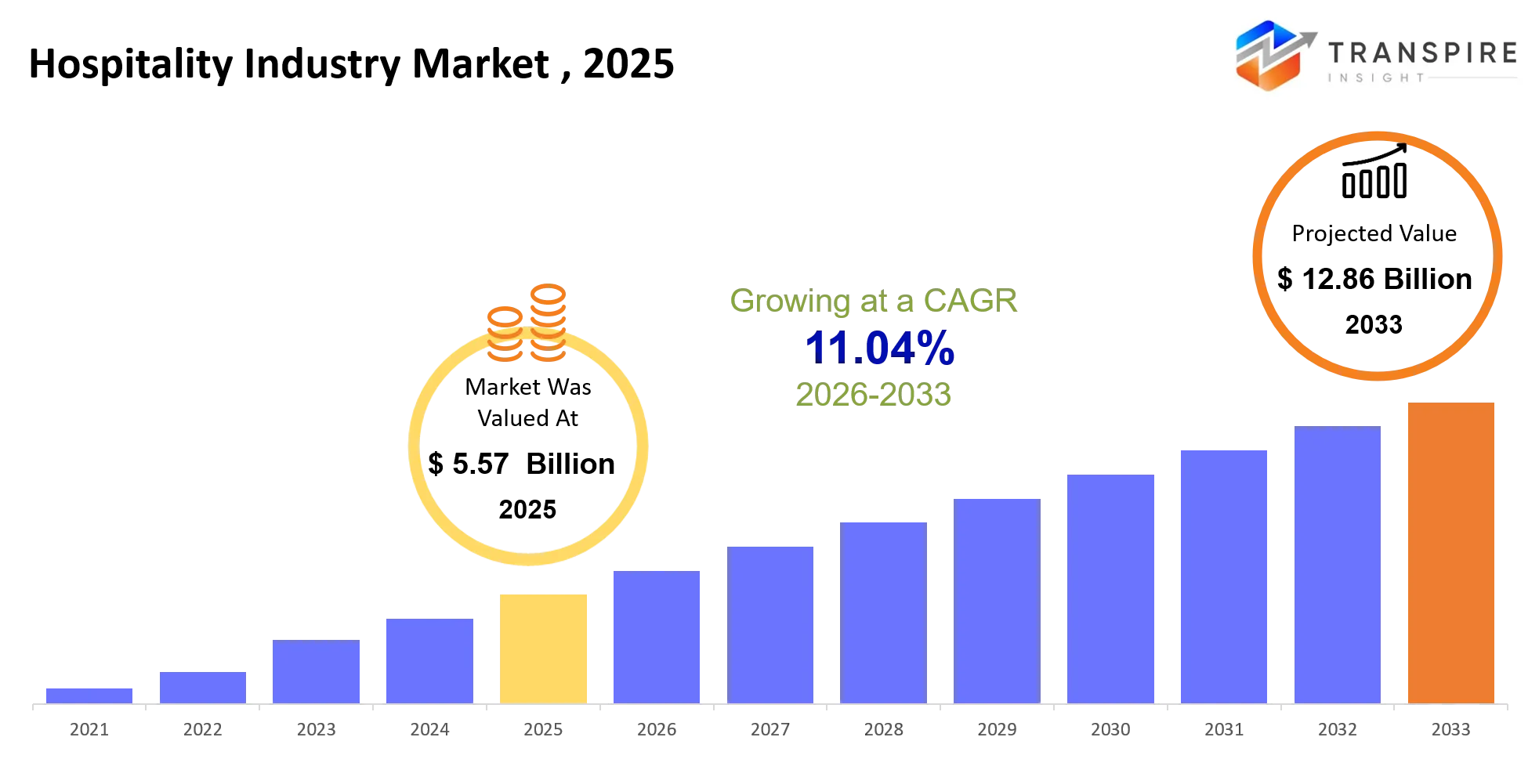
As per the Transpire Insight Analysis, The Hospitality Industry Market size is estimated at USD 5.57 trillion in 2025 and is anticipated to reach USD 12.86 trillion by 2033, growing at a CAGR of 11.04% from 2026 to 2033.
The hospitality marketplace is ultimately about enabling the conversion of consumer intent to travel into paid stays, dining, events, wellness and other on-property amenities. The nature of hospitality is shifting away from room availability and rates to seamless journeys, price intelligence and differentiated experiences. Hospitality is shifting from post-pandemic recovery to elevated tech-enabled operating models, including AI-assisted pricing, contactless check-in, digital keys and automated guest communication, which have become mainstream over the past three to five years. One of the key structural shifts is evolving discovery and booking into AI-enabled search and direct digital channels, eliminating intermediaries. The chronic shortage of labour and inflation has forced operators to automate all functions related to front desk, housekeeping and revenue management. There is a cause and effect: automation minimises the cost of service delivery, and personalisation plus pricing transformation creates capacity which can be leveraged to increase ancillary revenues, boost repeat bookings and enhance revenue yield from direct channels.
Hospitality Industry Market Size & Forecast:
- Market Size 2025: USD 5.57 Billion
- Expected Market Value (2033): USD 12.86 Billion
- Forecast CAGR (2026–2033): 11.04%
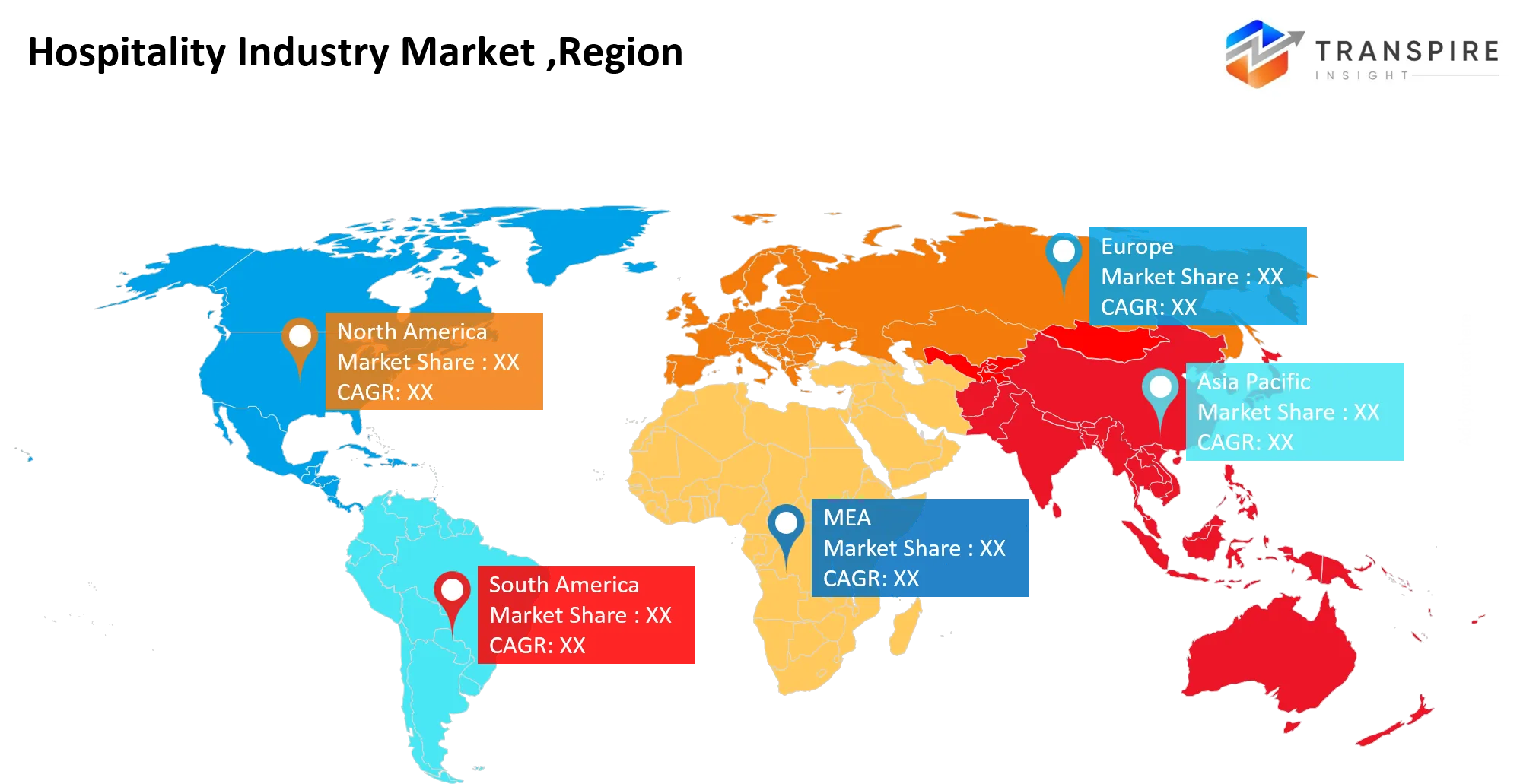
- Leading Region in 2025: North America
- Fastest Growing Region: Asia Pacific
- Key Company Profiles: Marriott International, Hilton Worldwide, Hyatt Hotels, Accor, IHG Hotels & Resorts, Wyndham Hotels, Choice Hotels, Radisson Hotel Group, Four Seasons, Shangri-La, Minor International, MGM Resorts, Airbnb, OYO, Jin Jiang International.
Key Hospitality Industry Market Insights:
Market dynamics are shifting from competing for room sales to delivering integrated guest experiences, greater control of distribution, and technology-driven profitability. To gain a competitive advantage, turn customer data and property assets into repeat bookings and diversified revenue.
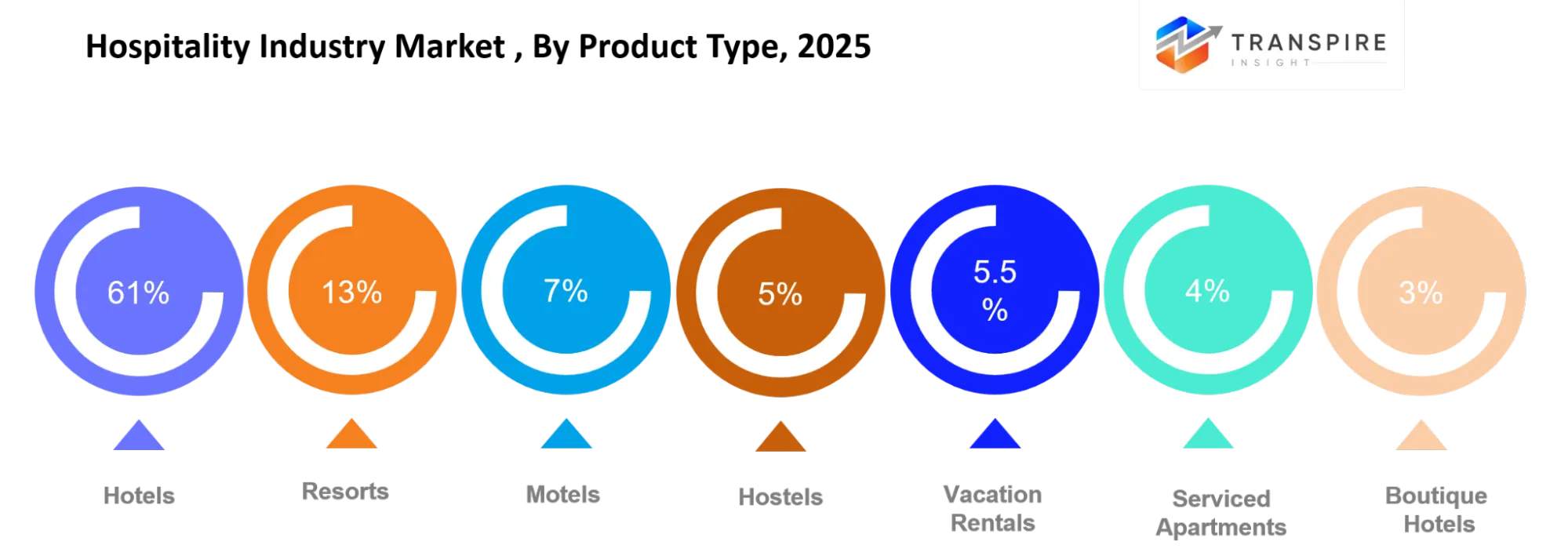
- Hotels account for 61.0% of all properties, and the Ask Bonvoy initiative by Marriott brings conversational discovery to approximately 10,000 hotels.
- Vacation rentals represent 5.5% of the market with a projected CAGR of 10.8%, as industry professionals use tools and technology to automate the pricing, screening, and compliance process.
- Resorts make up 13.0%, and wellness, destination experiences, and all-inclusive packages are contributing to longer stays and increased on-property expenditures.
- IHG's 160 million loyalty members accounted for 67% of bookings in H1 2026, continuing to solidify the direct-channel economics.
- Hilton's AI Planner, which opened in March 2026, is helping with discovery across its 9,100-property portfolio and is accelerating its conversion rate at a few points over average flow.
- Accor's integration with ChatGPT enables discovery across more than 20 languages and takes Accor's lifestyle-led ALL ecosystem beyond the room.
- To boost group-sales conversion, Hyatt is using AI opportunity scoring and RFP routing at over 500 properties.
- Asia Pacific is growing at 9.4% CAGR, with intra-regional travel driving this growth, and MICE infrastructure improving the landscape.
- North America holds the highest share at 36.5%, followed by Europe, which benefits from well-developed urban leisure and MICE networks and cross-border travel.
What are the Key Drivers, Restraints, and Opportunities in the Hospitality Industry Market?
Driver:
AI-enabled commercial and operational automation. The driving force here is the confluence of two factors: labour shortages and changing demand, and sophisticated cloud-enabled hotel technology. Hotels today are using AI to forecast occupancy, dynamically change pricing based on booking patterns, pricing of competitors, events, sentiment analysis, and, by removing engagement, to automate communication with the guest. These directly affect revenue: AI-enabled revenue management has been associated with a 10-15% uplift in RevPAR, while autonomous engagement is said to help improve conversion rates and ancillary upselling.
Restraint:
High labour, insurance, utilities, and maintenance costs continue to restrict profitability. These expenses persist because hotels require continuous on-site staffing and physical asset upkeep, even when occupancy fluctuates. Smaller operators also face technology integration costs and commission payments to online travel agencies, limiting the revenue retained from each reservation.
Opportunity:
The next step will be connecting AI-native, interoperable hospitality platforms with the regulated professionalism of alternative accommodations. Vacation rentals are gradually becoming more institutionalised as cities strengthen registration, tax, zoning and safety policies, with professional operators playing by the rules perhaps gaining a bigger share of the market as the unauthorised providers drop out. In the Asia-Pacific region, where 62% of surveyed operators are exploring or deploying artificial intelligence, smart-room investments, predictive maintenance and AI concierge services can set up a flexible scale of premium offerings for hotels and vacation rentals alike.
Driver Impact Analysis – Hospitality Industry Market
|
Driver |
Relative Impact on Growth (%) |
Geographic Relevance |
Impact Timeline |
Demand Strength |
Growth Mechanism |
Key Beneficiaries |
Major Constraint |
|
Rising International and Domestic Tourism Demand |
30% |
Asia Pacific, Europe, Middle East, North America |
Short-term (≤2 years) |
High |
Higher tourist arrivals increase accommodation and dining expenditure |
Hotels, resorts, airlines, restaurants, travel operators |
Inflation, geopolitical instability, and high travel costs |
|
Increasing Investments in Hotels, Resorts and Hospitality Infrastructure |
23% |
North America, Asia Pacific, Middle East |
Medium-term (2–4 years) |
High |
New properties expand accommodation capacity and premium service offerings |
Hotel chains, property developers, investors, construction companies |
High capital expenditure and lengthy project payback |
|
Digital Transformation and AI-Enabled Hospitality Services |
19% |
North America, Europe, Asia Pacific |
Medium-term (2–4 years) |
High |
Automation improves bookings, personalization, and operational efficiency |
Hotel operators, technology vendors, booking platforms, customers |
Integration costs, cybersecurity risks, and workforce resistance |
|
Growing Demand for Experiential Tourism, Luxury Stays and MICE Travel |
16% |
Europe, Asia Pacific, Middle East, North America |
Short-term (≤2 years) |
High |
Premium experiences increase occupancy and average guest spending |
Luxury hotels, resorts, restaurants, event management companies |
Discretionary spending constraints and seasonal demand |
|
Sustainability Initiatives and Green Hospitality Investments |
12% |
Europe, North America, Asia Pacific |
Long-term (≥4 years) |
Medium |
Energy-efficient properties reduce operating costs and attract conscious travellers |
Hotel groups, green technology providers, property owners |
High retrofit costs and inconsistent sustainability standards |
|
Total |
100% |
Global |
— |
— |
— |
— |
— |
What Has the Impact of Artificial Intelligence Been on the Hospitality Industry Market?
AI has shifted to become an add-on layer that can be integrated into the hotel operating system rather than a guest-facing, stand-alone feature. In automation, hotels use chatbots, multilingual virtual concierges, mobile check-in, digital keys, and automated messaging to respond to typical requests for late checkouts, Wi-Fi, changing rooms, and other functionality. In optimisation, machine-learning revenue systems are constantly updating rate levels based on demand indicators, competitor rates, local events, booking pace, weather and review sentiment. Predictive functions include occupancy forecasts, labour schedules, housekeeper scheduling, and food, laundry, and energy levels management to match resources to current demand.
AI-driven pricing optimisation has led to around 10-15% RevPAR uplift in some hotels. AI assistants can also lead to faster responses and shift staff to higher-value interactions, and personalisation can drive upgrades, early check-in, late check-out, cross-sell dinner and experience opportunities. Barriers to adoption include complexity of integrating new systems, customer privacy concerns, and incomplete accuracy. Many hotels are deploying generative AI, but few are reducing time and effort significantly, because these systems are often not yet integrated or trusted to work without hand-holding.
In September 2026, Accor launched ALL Concierge, an end-to-end conversational AI travel assistant deployed globally across its primary digital channels, including its website, mobile app, WhatsApp, and iMessage. Crucially, the rollout was paired with the launch of "The Butler," an internal AI companion designed specifically to streamline back-of-house operations and give on-property hotel teams instant access to the coordinated data needed to execute guest requests.
Key Hospitality Industry Market Trends:
The shift toward room-led transactions to connected guest experiences, diversified revenue, and measurable operating efficiency is the hallmark of hospitality. Investing in technology with the aim of turning guest information into more effective business choices without compromising service levels.
- AI-driven travel planning is shifting hotels from search pages to recommendation and booking travel pages.
- Direct-booking tools are getting more refined, but online travel agencies still have a lot of influence when it comes to customer acquisition.
- Isolated applications like reservations, housekeeping, and finance are being replaced by cloud-based property systems, improving coordination between these departments.
- The flexibility of demand is driving operators to be flexible with room layouts and services, as well as how they are configured and used to accommodate remote workers and extended stays.
- While some resorts are building out standardized amenities, others are placing greater emphasis on what makes them unique, their local culture, and wellness.
- Sustainability is shifting from voluntary brand communications to self-assessed performance and increased accountability.
- Labour shortage is hastening investment in self-service check-in, automated reporting, and staff productivity solutions.
- Smart-room controls and predictive maintenance are contributing to the control of energy, equipment reliability, and operating costs of properties.
Hospitality Industry Market Segmentation
Accommodation Type:
Hotels remain the critical anchor of the market, comprising 61.0% of the accommodation market, driven by brand distribution, corporate demand, meeting infrastructure, and loyalty ecosystems. Resorts make up 13.0% of the market, with destination-led leisure, wellness and all-inclusive spending as demand drivers. Motels form 7.0% of the market, maintaining value through roadside and budget travel. Hostels command 5.0% of the market. Vacation rentals account for 5.5%, the fastest-growing accommodation type with 10.8% compound annual growth over 2003-23, as consumers eschew space, privacy, kitchens and localised experiences. Serviced apartments make up 4.0%, with demand from the extended-stay and corporate-housing segments. Boutique hotels account for 3.0% through design-led branding, while other accommodation types account for 1.5%.
Service Type:
Accommodation is the main source of income, while the food and beverage facilities offer added spending, with restaurants, bars, room service, and catering. Events and conferences make use of group bookings and demand for weekdays, while wellness and spa services can further promote a property's prestige. Activities and transportation can further add to the guest experience, while business services and other facilities (such as safety deposit boxes) can provide additional, specific revenue streams. If these services can be successfully implemented (depending on the level of use and expenditure), they can diversify revenue streams, apart from room sales.
Hotel Class:
Luxury and upper-upscale hotels target the luxury traveller with differentiated amenities and experiences. Upscale and upper-midscale hotels aim to deliver the right mix of service, amenities, and value. Midscale, economy, and budget hotels focus on providing standardized experiences at a low price. Other segments cater to niche travellers and their specific accommodation requirements. Real future demand growth will require operators to keep pricing in check while providing comparable service and amenities, because consumers rate the value of stays on an entire experience.
Booking Channel:
Direct booking gets better revenues for a hotel, improves the linkages with the customer base, and helps reinforce the benefits of the loyalty program. Online travel agencies provide exposure and reach to the international market; travel agency/tour operator deliver packaged deals; mobile applications bring booking convenience, corporate booking channels provide direct access for a business customers, walk-in transaction and other channels all serve an emergency need. The future channel approach for a hotel would focus on integrated booking, special promotion and reducing customer acquisition costs.
Customer Type:
Leisure visitors generate demand for holiday and experience products in special places, but are supplemented by business visitors who generate demand for weekday hotel occupancy. Business travellers balance leisure demand and create extra revenue by visiting a workplace and conducting business. Families and groups desire space and comprehensive amenities, but couples and individual leisure visitors prefer flexible products and a high level of customised service. MICE visitors generate additional revenue through conferences, exhibitions and corporate events. Several other customer groups diversify demand. Future operators will customise products for particular types of travellers.
Property Size:
Small hotels/boutique properties are characterised by personal service, local flavour and flexible operations. Medium and large hotels benefit from larger property amenities, a known management structure and more capacity to focus on groups. Mega hotels and complex resorts are a self-sustaining combination of accommodations, food and beverage service, entertainment, golf and conference amenities. Long-stay properties, focused on guests seeking prolonged stays in one location, will provide residential-type amenities and functional service. Investment in the future will focus over time on the balance of property size, operational costs, infrastructure costs, and attractiveness to occupancy in the destination.
What are the Key Use Cases Driving the Hospitality Industry Market?
The core use case is providing accommodation for leisure and business travel, led by hotels, which account for 61.0% of the market. Reservations, housekeeping, food services, and revenue-management systems work together to improve occupancy, guest satisfaction, and room profitability.
Expanding applications include resort holidays, conference hosting, wellness packages, and extended-stay accommodation. Resorts benefit from combining lodging with recreation and dining, while serviced apartments support longer business assignments and flexible stays. Mobile booking and integrated property systems simplify guest management across these services.
Emerging use cases include AI-assisted travel planning, predictive maintenance, smart-room energy controls, and independently verified sustainability programmes. These applications help operators personalise experiences, manage costs, and strengthen environmental accountability.
|
Report Metrics |
Details |
|
Market size value in 2025 |
USD 5.57 Trillion |
|
Market size value in 2026 |
USD 6.18 Trillion |
|
Revenue forecast in 2033 |
USD 12.86 Trillion |
|
Growth rate |
CAGR of 11.04% from 2026 to 2033 |
|
Base year |
2025 |
|
Historical data |
2021 - 2024 |
|
Forecast period |
2026 - 2033 |
|
Report coverage |
Revenue forecast, competitive landscape, growth factors, and trends |
|
Regional scope |
United States; Canada; Mexico; United Kingdom; Germany; France; Italy; Spain; Denmark; Sweden; Norway; China; Japan; India; Australia; South Korea; Thailand; Brazil; Argentina; South Africa; Saudi Arabia; United Arab Emirates |
|
Key companies profiled |
Marriott International, Hilton Worldwide, Hyatt Hotels, Accor, IHG Hotels & Resorts, Wyndham Hotels, Choice Hotels, Radisson Hotel Group, Four Seasons, Shangri-La, Minor International, MGM Resorts, Airbnb, OYO, Jin Jiang International |
|
Customization scope |
Free report customization (country, regional & segment scope). Available customized purchase options to meet your exact research needs. |
|
Report Segmentation |
Accommodation Type (Hotels, Resorts, Motels, Hostels, Vacation Rentals, Serviced Apartments, Boutique Hotels, Others)Service Type (Accommodation, Food & Beverage, Events & Conferences, Wellness & Spa, Recreation, Transportation, Business Services, Others)Hotel Class (Luxury, Upper-Upscale, Upscale, Upper-Midscale, Midscale, Economy, Budget, Others)Booking Channel (Direct Booking, Online Travel Agencies, Travel Agencies, Mobile Apps, Corporate Booking, Tour Operators, Walk-In, Others)Customer Type (Leisure Travelers, Business Travelers, Families, Groups, Couples, Solo Travelers, MICE Travelers, Others)Property Size (Small, Medium, Large, Mega Hotels, Resort Complexes, Boutique Properties, Extended-Stay Properties, Others) |
Which Regions are Driving the Hospitality Industry Market Growth?
North America dominates the hospitality market at 36.5% of market share due to the confluence of high disposable income, high levels of corporate travel demand, high airline density, and advanced loyalty and direct booking systems. Market competitiveness is increasingly based on commercial factors rather than physical assets. Marriott, Hilton, IHG, and Hyatt, for example, monetize first-party guest data, pricing based on AI, and co-branded payments ecosystems to defend margins and increase the frequency of stays. Active convention venues provide weekday occupancy support for leading gateways, while domestic road and air travel temper international market volatility.
In October 2026, Hilton launched a first-of-its-kind "Pay with Points" digital feature. By directly integrating this loyalty system into the Hilton Honours mobile application during digital check-out, the company allows elite members to apply points flexibly toward their final property folio charges without requiring front-desk staff intervention. This product launch reduces travel friction and directly drives guest retention within their direct-booking tech stack.
Europe at 30.0% and differs from North America due to a reliance on pan-regional leisure traveller flows, rail and short-haul air connectivity, cultural tourism and a high proportion of independent hotels. Its resilience stems from many source markets, mature Meetings, Incentives, Conferences and Exhibitions (MICE) centres and policies which promote sustainable tourism and higher consumer rights. However, the relative fragmentation of independent operators coupled with conservative adoption of new technology presents opportunities for platform providers and branded management contracts.
In October 2026, Berlin-based travel tech startup YGO raised €8 million in a Series A funding round. This capital injection allows the platform provider to scale its neutral AI infrastructure layer across Europe's fragmented landscape, enabling independent travel suppliers and operators to integrate their inventories directly into next-generation AI booking systems without relying on traditional heavy intermediaries.
Asia Pacific is the fastest-growing region with a 9.4% CAGR and market share of 21.5%. Recovery of intra-regional mobility, the growing middle-class travel segment, visa facilitation, and increased investment in airport infrastructure, biometric border processes, and MICE facilities have resulted in recent developments. In 1Q 2026, Asia-Pacific destinations recorded 239 million international arrivals, up by 2.9% YoY, with destinations in Asia-Pacific accounting for 44% of arrivals across the globe. Opportunities are expected to come from premiumisation and regional brand expansion, particularly in India, Southeast Asia, and secondary cities in China, with digital-led products for evolving digital service and experience-driven demand.
In October 2026, Bangalore International Airport Limited (BIAL) launched its international passenger trials for the facial recognition-based Digi Yatra platform. This deployment expands secure digital travel credentials and biometric authentication to international departures for select flights, eliminating repetitive document checks and creating a more seamless, paperless airport experience across major touchpoints.
Who are the Key Players in the Hospitality Industry Market, and how do they compete?
The hospitality industry sees segmented competition among hotel chains, luxury specialists, regional operators, and platform accommodation providers. Marriott International, Hilton Worldwide, Hyatt Hotels, Accor, and IHG Hotels & Resorts use brand groups, loyalty ecosystems, management contracts, and franchising to expand without owning every property. Each strives to differentiate, with Marriott offering its Bonvoy program; Hilton providing a unified booking and loyalty experience; Hyatt providing premium hospitality; Accor offering multiple lifestyle brands; and IHG providing a wide mix of brands.
Wyndham Hotels, Choice Hotels, Radisson Hotel Group, Jin Jiang International, and OYO rely on distribution power, franchising, regional presence, or budget accommodation. Each company's competitive advantage depends on garnering property owner loyalty, standard operating procedures, and minimal conversion costs. Four Seasons and Shangri-La set themselves apart through luxury service, personalized experiences, and prestigious properties; Minor International combines destination hotels with lifestyle brands. MGM Resorts delivers integrated gaming, entertainment, events, and lodgings. Airbnb offers one-of-a-kind homes and flexible stays. The organisations each compete through a business model centred on asset-light contractual relationships, technology-enabled distribution, consumer loyalty, and investments in markets with potential for sustainable gains.
Key Players are:
- Marriott International
- Hilton Worldwide
- Hyatt Hotels
- Accor
- IHG Hotels & Resorts
- Wyndham Hotels
- Choice Hotels
- Radisson Hotel Group
- Four Seasons
- Shangri-La
- Minor International
- MGM Resorts
- Airbnb
- OYO
- Jin Jiang International
Hospitality Industry Market — Enhanced Competitive Benchmarking
|
Company |
Est. Revenue Share Range |
Key Offerings |
Strategic Positioning |
Geographic Strength |
Technology Focus |
|
Marriott International |
3.0–5.0% |
Luxury hotels, premium resorts, select-service hotels, Marriott Bonvoy |
leadership through diversified brands and franchising |
North America, Europe, Asia Pacific |
AI personalization, cloud reservations, loyalty analytics, revenue management |
|
Hilton Worldwide |
2.0–3.5% |
Luxury accommodation, full-service hotels, extended-stay brands, Hilton Honors |
Premium brand portfolio with asset-light expansion |
North America, Europe, Middle East |
Digital check-in, Digital Key, AI pricing, cloud-based guest platforms |
|
Jin Jiang International |
1.5–2.5% |
Economy hotels, midscale accommodation, luxury hotels, international hotel brands |
Large-scale portfolio expansion and China-led market leadership |
Asia Pacific, Europe |
Digital booking platforms, centralized operations, customer data analytics |
|
H World Group |
1.0–2.0% |
HanTing, JI Hotel, Orange Hotel, Steigenberger Hotels |
Technology-enabled budget and midscale network expansion |
Asia Pacific, Europe |
AI-assisted operations, mobile booking, automated hotel management |
|
InterContinental Hotels Group (IHG) |
1.0–2.0% |
Holiday Inn, InterContinental, Crowne Plaza, Hotel Indigo |
Multi-brand franchising and international loyalty ecosystem |
North America, Europe, Asia Pacific |
Cloud-based reservations, IHG One Rewards, AI revenue optimization |
|
Accor |
1.0–2.0% |
Raffles, Fairmont, Sofitel, Novotel, ibis |
Luxury-to-economy diversification and brand-led differentiation |
Europe, Asia Pacific, Middle East |
Digital guest engagement, AI personalization, loyalty technology |
|
Hyatt Hotels Corporation |
0.8–1.5% |
Park Hyatt, Grand Hyatt, Hyatt Regency, Inclusive Collection |
Luxury positioning and premium experiential hospitality |
North America, Asia Pacific, Europe |
Digital guest experience, loyalty analytics, revenue optimization |
|
Wyndham Hotels & Resorts |
0.7–1.2% |
Wyndham Grand, Ramada, Days Inn, Super 8 |
Franchise-led expansion and value-focused accommodation |
North America, Asia Pacific, Latin America |
Cloud distribution, reservation systems, revenue management |
|
Choice Hotels International |
0.5–1.0% |
Comfort, Quality Inn, Clarion, Cambria Hotels |
Midscale franchising and cost-efficient hotel operations |
North America, Europe |
Cloud booking, franchise analytics, automated distribution |
|
BTG Hotels |
0.5–1.0% |
Homeinn, Jianguo Hotels, economy and midscale accommodation |
China-focused scale expansion and diversified hotel formats |
Asia Pacific |
Digital reservations, smart hotel operations, centralized management |
Recent Development News
In August 2026, EIH Limited and the Bhartiya Group announced a strategic partnership to develop 20 ultra-luxury lifestyle resorts across India and selected international destinations, with initial locations identified in Coorg, Kabini and Hampi. The initiative combines premium hospitality management with wellness-focused design and experiential resort offerings, with the first developments planned to open.
In September 2026, Juniper Hotels signed a binding memorandum of understanding with Imagicaaworld Entertainment to acquire Novotel Imagicaa for ₹248 crore. The proposed acquisition supports Juniper Hotels’ strategy of expanding its portfolio of established hospitality assets in leisure and destination-driven locations, subject to definitive agreements and applicable approvals.
In October 2026,e launched Scout, a personalized conversational AI digital concierge platform designed specifically for hospitality providers. The system integrates seamlessly into resort, lodge, and vacation rental websites to connect lodging guests with bookable, curated local outdoor experiences.
What Strategic Insights Define the Future of the Hospitality Industry Market?
The industry will move towards an AI-mediated distribution economy, where discovery might be happening from 'outside' but conversion will depend on loyalty data, real-time inventory and payment engines. Operators who see the loyalty platform as a platform infrastructure rather than a direct marketing database will sustain pricing power-even if guests are searching through ChatGPT, Google AI, and similar. The threat of AI travel agents is being able to negate brand visibility, ramp up distribution costs, and weaken the distribution economics that hotel chains have built over the past ten years. Hotels that give trusted AI agents accurate availability, rates, loyalty reward entitlements, and booking API signals will be able to win at intent-just as IHG's agentic booking and Google's AI pilot are doing. Don't bet on the intermediaries setting the standards-"start putting your revenue, distribution, CRM, and service data in an integrated commercial tech stack and focus on first-party data quality.
Key Segmentations are:
Accommodation Type
- Hotels
- Resorts
- Motels
- Hostels
- Vacation Rentals
- Serviced Apartments
- Boutique Hotels
- Others
Service Type
- Accommodation
- Food & Beverage
- Events & Conferences
- Wellness & Spa
- Recreation
- Transportation
- Business Services
- Others
Hotel Class
- Luxury
- Upper-Upscale
- Upscale
- Upper-Midscale
- Midscale
- Economy
- Budget
- Others
Booking Channel
- Direct Booking
- Online Travel Agencies
- Travel Agencies
- Mobile Apps
- Corporate Booking
- Tour Operators
- Walk-In
- Others
Customer Type
- Leisure Travelers
- Business Travelers
- Families
- Groups
- Couples
- Solo Travelers
- MICE Travelers
- Others
Property Size
- Small
- Medium
- Large
- Mega Hotels
- Resort Complexes
- Boutique Properties
- Extended-Stay Properties
- Others
Frequently Asked Questions
Find quick answers to common questions.
The hospitality industry market size was valued at USD 5.57 trillion in 2025 and is poised to reach USD 12.86 trillion by 2033, expanding at a 11.04% CAGR.
Key segments for the hospitality industry market are Accommodation Type (Hotels, Resorts, Motels, Hostels, Vacation Rentals, Serviced Apartments, Boutique Hotels, Others)Service Type (Accommodation, Food & Beverage, Events & Conferences, Wellness & Spa, Recreation, Transportation, Business Services, Others)Hotel Class (Luxury, Upper-Upscale, Upscale, Upper-Midscale, Midscale, Economy, Budget, Others)Booking Channel (Direct Booking, Online Travel Agencies, Travel Agencies, Mobile Apps, Corporate Booking, Tour Operators, Walk-In, Others)Customer Type (Leisure Travelers, Business Travelers, Families, Groups, Couples, Solo Travelers, MICE Travelers, Others)Property Size (Small, Medium, Large, Mega Hotels, Resort Complexes, Boutique Properties, Extended-Stay Properties, Others).
Growth is primarily driven by international travel recovery, rising premium leisure spending, expansion of business tourism and MICE activities, digital booking adoption, hotel infrastructure investments, and demand for personalised accommodation and experience-led services.
The hospitality industry market is led by major manufacturers including Marriott International, Hilton Worldwide, Hyatt Hotels, Accor, IHG Hotels & Resorts, Wyndham Hotels, Choice Hotels, Radisson Hotel Group, Four Seasons, Shangri-La, Minor International, MGM Resorts, Airbnb, OYO, Jin Jiang International.
North America dominates the hospitality industry market with a 36.5% share, supported by established hotel infrastructure, strong domestic and international tourism, corporate travel, major convention centres, extensive airline connectivity, and well-developed digital booking and loyalty ecosystems.
Key opportunities include AI-enabled hotel operations, vacation rental expansion, direct-booking platforms, sustainable hospitality investments, wellness tourism, extended-stay accommodation, and premium experience-led resorts.
- Marriott International
- Hilton Worldwide
- Hyatt Hotels
- Accor
- IHG Hotels & Resorts
- Wyndham Hotels
- Choice Hotels
- Radisson Hotel Group
- Four Seasons
- Shangri-La
- Minor International
- MGM Resorts
- Airbnb
- OYO
- Jin Jiang International
About the Authors

Chetan Dhatrak
I’m Chetan Dhatrak, a Senior Research Analyst at Transpire Insight, specializing in the Consumer Goods, Foods and Beverages industry. I focus on analyzing market trends, consumer behavior, competitive landscapes, and industry developments to deliver accurate, data-driven insights. My research at Transpire Insight is built on credible sources and in-depth analysis, helping businesses and readers better understand market dynamics, emerging opportunities, and evolving consumer preferences. I’m committed to creating reliable, well-researched content that supports informed decision-making and reflects the latest developments in the consumer goods and food & beverage sectors.

Chakradhar Khansole
Chakradhar serves as the Research Director at Transpire Insight, bringing over 8 years of experience in technology, innovation, and strategic market intelligence. He specializes in transforming complex market data into actionable business insights that enable organizations to make informed, growth-oriented decisions. Recognized for his strategic vision and analytical expertise, Chakradhar leads high-impact research initiatives, delivering comprehensive market assessments, competitive intelligence, and forward-looking industry analysis.
Recently Published Reports
-
Apr 2026
Bottled Water Market
Bottled Water Market Size, Share & Analysis Report By Product Type (Still Bottled Water, Carbonated Bottled Water, Functional Bottled Water, and Others), By Packaging (PET, Cans, and Others), By Sales Channel (Supermarkets/Hypermarkets, Convenience Stores/Drug Stores, Grocery Stores/Club Stores, Foodservice, and Others) and Geography (North America, Europe, Asia-Pacific, Middle East and Africa, South and Central America), 2021 - 2032
-
Apr 2026
Color Cosmetic Packaging Market
Color Cosmetic Packaging Market Size, Share & Analysis Report By Application (Mascara Packaging, Liquid Packaging, and Liquid Face), By Type (Tubes & Bottles, Pens & Markers, Compacts & Containers, and Droppers & Pumps), and Geography (North America, Europe, Asia-Pacific, Middle East and Africa, South and Central America), 2021 - 2031
-
Apr 2026
External Microphone For Camera Market
External Microphone For Camera Market Size, Share & Analysis Report By Type (Shotgun Microphone, Lavalier Microphone, and Others), By Application (Digital Camera, Professional Video Camera, and Others), and Geography (North America, Europe, Asia-Pacific, Middle East and Africa, South and Central America), 2021 - 2031
-
Apr 2026
Foot Orthotic Insoles Market
Foot Orthotic Insoles Market Size, Share & Analysis Report By Type (Pre-fabricated, and Custom-made), By Material (Thermoplastic, Composite Carbon Fiber, and Others), By Distribution Channel (Drug Stores, Hospitals & Clinics, and Others), and Geography (North America, Europe, Asia-Pacific, Middle East and Africa, South and Central America), 2021 - 2031