

Online Accommodation Booking Market Summary:
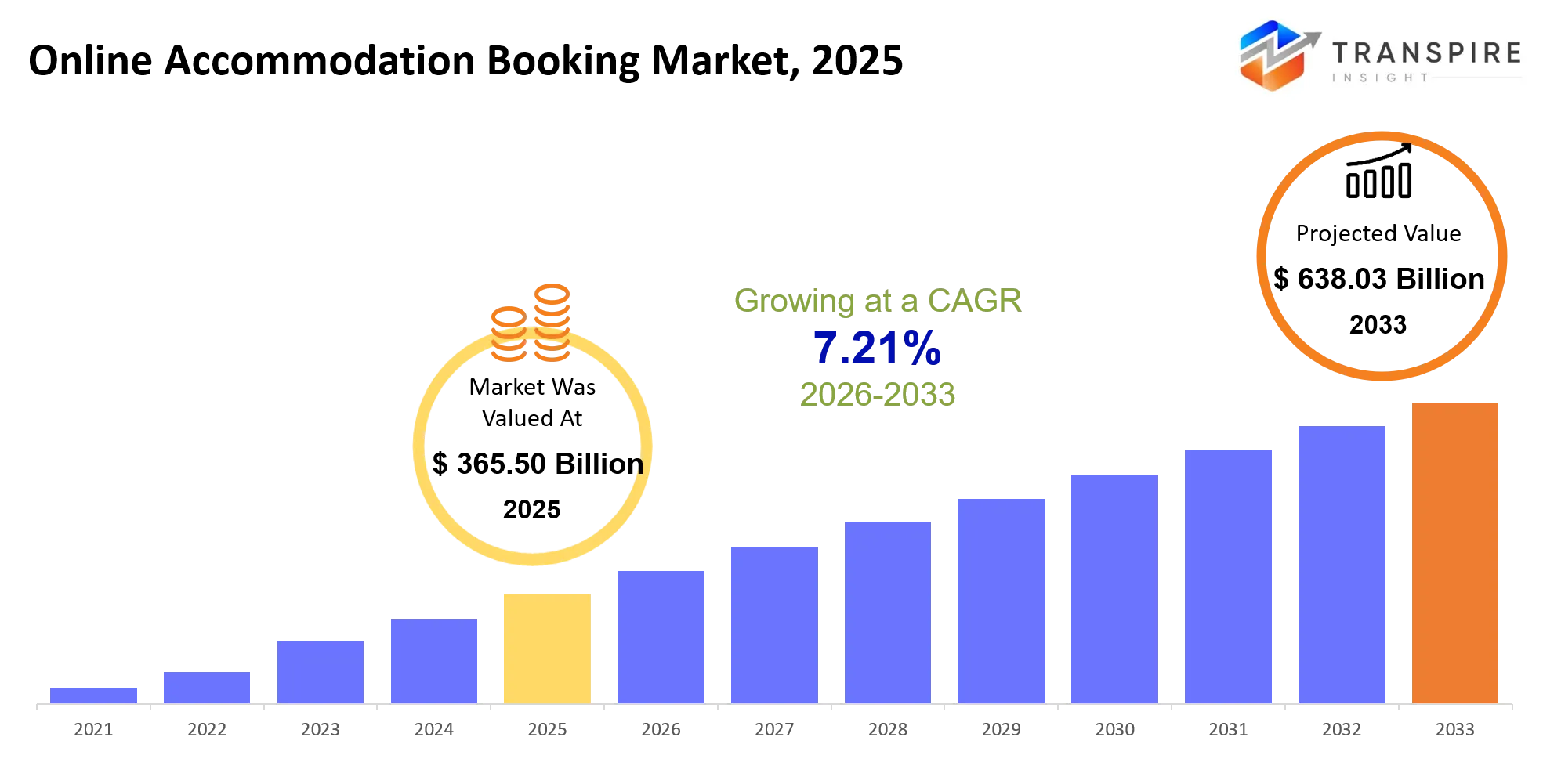
As per the Transpire Insight Analysis, The Online Accommodation Booking Market size is estimated at USD 365.50 billion in 2025 and is anticipated to reach USD 638.03 billion by 2033, growing at a CAGR of 7.21% from 2026 to 2033.
The traditional online room-search infrastructure has matured into a full trip-commerce ecosystem connecting consumers to hotel, rental, apartment, and other accommodations providers to an ever-expanding array of ancillary products and services. In the past three to five years, technology innovations such as mobile-first discovery, digital payment, no-cancellation flexibility, and algorithmic recommendation have shifted times-to-book downward, approaching hours or even minutes. There's been a tectonic shift in discovery modality-from keyword search to natural language chat-and from booking only traditional hotels to algorithmic recommendation and activity integration, from which the connected booking equivalent has emerged.
This revolution's explosion speed-powered by the rapid and ubiquitous travel and tourism deployment of AI-enabled travel planning and AI-enabled connected booking-has smoothened the experience for accommodation discovery. Theories of cause and effect are at work: immersive digital inventory and broad offering skew search friction downward; integrated payment skew conversion upward; rich property data skew confidence upward; and digital trust and platform convenience skew conversion upward.
Online Accommodation Booking Market Size & Forecast:
- Market Size 2025: USD 365.50 Billion
- Expected Market Value (2033): USD 638.03 Billion
- Forecast CAGR (2026–2033): 7.21%
- Leading Region in 2025: Europe
- Fastest Growing Region: Asia Pacific
- Key Company Profiles: Booking Holdings, Expedia Group, Airbnb, Trip.com Group, Agoda, MakeMyTrip, Tripadvisor, eDreams ODIGEO, Despegar, Traveloka, Hopper, Hotelbeds, Hostelworld, OYO, Rakuten Travel.
Key Online Accommodation Booking Market Insights:
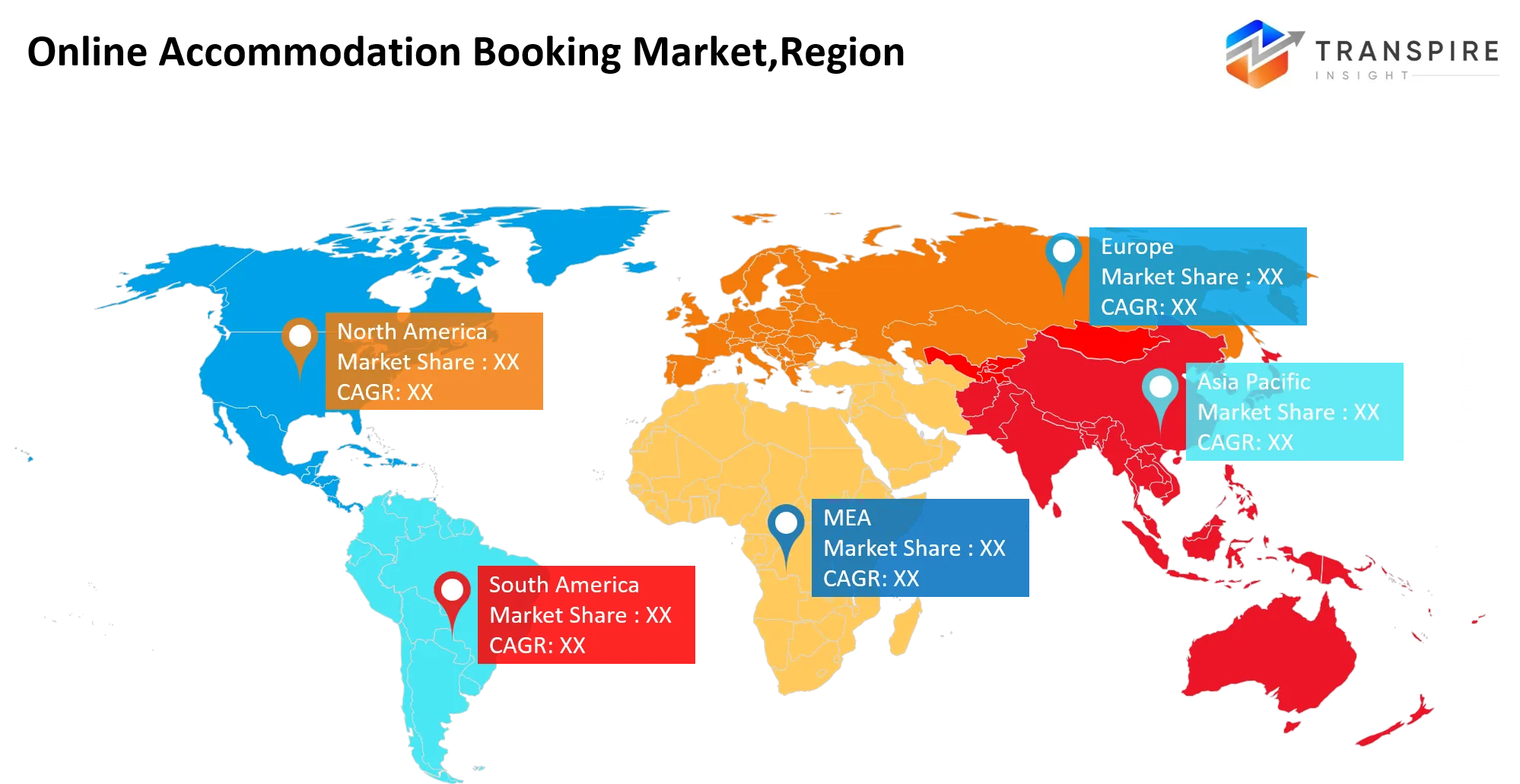
This shows that Europe has a higher percentage of 31.80%, indicating its advanced infrastructure, whereas Asia Pacific has a CAGR of 10.20%, indicating its swift behavioural shift. Competition is shifting from inventory breadth to AI discovery, loyalty integration, trusted content, and compliant supply.
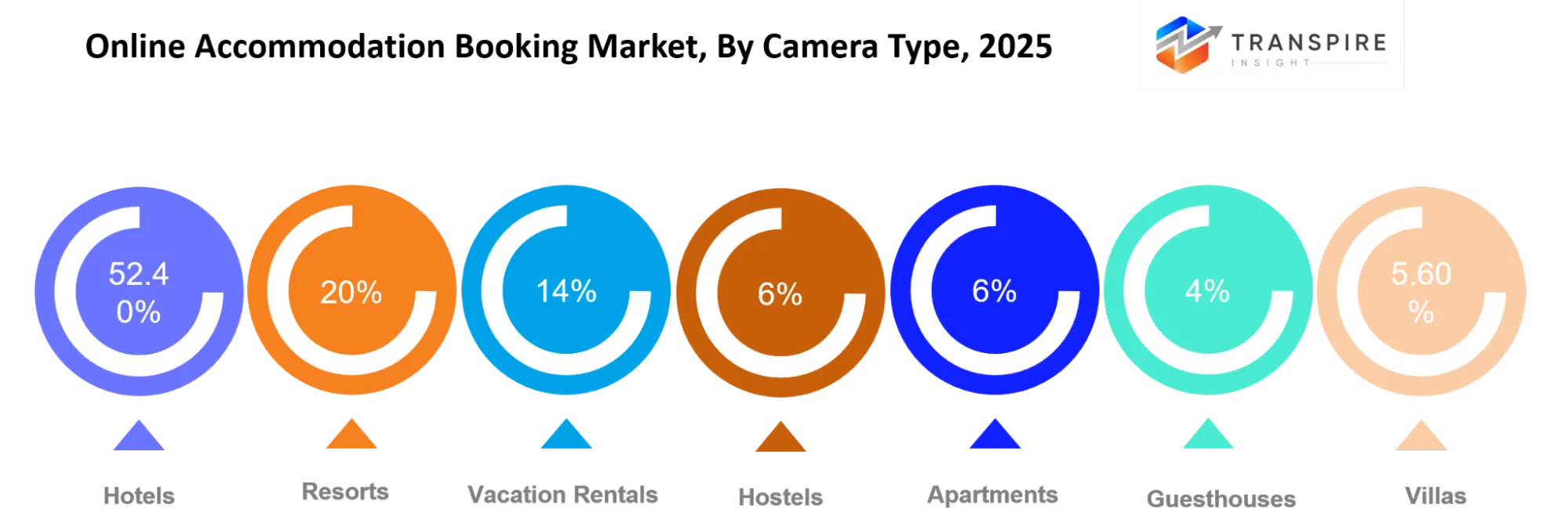
- Hotels account for 52.40% of the market, and Booking Holdings is developing a Connected Trip that unifies rooms, payments, flights and attractions via AI-powered journeys.
- Vacation rentals are expanding at 14.00% CAGR, as Airbnb expands its business from accommodation to experiences, services and longer-stay use cases.
- Resorts account for 12.00% of the market and are driving package-led travel over just room transactions for Expedia and other OTAs.
- North America accounts for 29.00%, but mature demand is driving a shift in competition towards loyalty, direct bookings and reduced customer-acquisition costs.
- Asia Pacific accounts for 25.00% of the mobile-first travellers captured with localised language, payment systems and social discovery by the likes of Trip.com and Agoda.
- Latin America represents 7.00%, and local platforms such as Despegar are making improvements in inventory, instalment payments and access to local travel.
- The Middle East and Africa region accounts for 7.20%, offering opportunities for multilingual bookings, religious tourism, luxury travel and cross-border payment options.
- Booking Holdings, Expedia, Airbnb and Trip.com together increased spending on marketing, while AI and social media change the way customers are acquired.
- Hotel applications are becoming influential, with Booking.com's app share climbing into the mid-50 % of room nights, boosting personalisation and repeat conversions.
What are the Key Drivers, Restraints, and Opportunities in the Online Accommodation Booking Market?
Driver:
Mobile travel ecosystems, integrated payments, and personalized discovery are improving accommodation booking conversion. Travel planning has shifted toward apps and social channels, where travellers can discover stays alongside flights, maps, and loyalty benefits. Air India’s 2026 partnership with Booking.com integrates accommodation options into the airline’s digital ecosystem, connecting hotel bookings with rewards. This reduces search steps and simplifies trip planning, encouraging users to complete more bookings within familiar platforms. For accommodation providers and booking platforms, integrated journeys also increase cross-selling opportunities, strengthen customer retention, and create additional transaction value through connected travel services.
Restraint:
Regulatory fragmentation and listing-compliance requirements constrain short-term rental supply. The structural issue is that cities apply different registration, reporting, and housing rules, forcing platforms and hosts to adapt inventory market by market. EU short-term-rental rules applying from May 2026 require registration and booking-data sharing in relevant markets, increasing compliance workloads and potentially removing non-compliant listings.
Opportunity:
Agentic AI is shifting accommodation search toward outcome-based booking, allowing travellers to describe budgets, locations, amenities and trip purposes conversationally instead of manually filtering properties. AI can rank suitable stays, compare options, summarise reviews and support follow-up tasks, reducing decision time and booking friction. Airbnb’s 2026 AI search, comparison and customer-support tools demonstrate this transition. Wider adoption across Asia Pacific, supported by mobile payments and digitally native travellers, could improve conversion rates while lowering service costs. For platforms, agentic workflows also create opportunities to personalise offers, automate service interactions and generate additional revenue through integrated travel services.
What Has the Impact of Artificial Intelligence Been on the Online Accommodation Booking Market?
AI has shifted the search process for online accommodation booking from keyword-based searches to an intent-based travel planning system. Recommendation algorithms can more precisely rank properties based on browsing history, budget, context of destination, reviews, and purpose of trip. Generative AI assistants can follow requests like "Find me a peaceful family hotel close to public transportation," compare different policies, and generate accommodation recommendations linked to itineraries. Predictive models can forecast demand, cancellations, and prices for dynamic pricing, helping online booking platforms adjust offers and letting hotels fine-tune room rates, availability, and promotion timing.
AI-powered chatbots can automate repetitive questions on check-in, amenities, refunds, and availability, reducing call-centre workloads and response time. Computer vision and language models can tag images of rooms, brief reviews, and flag incorrect listings. With more relevant recommendations presented with less effort, these advances might improve conversion rates. Implementation challenges include high integration costs, fragmented property-management systems, privacy responsibilities, and inaccuracy, describing the wrong rooms, showing lacking inventory, or recommending biased choices, leading to frustration, service recovery costs, and negative reviews. Consumer adoption remains incomplete, as most travellers research with AI but prefer to book on their own.
In September 2026, Expedia Group partnered with Meta to integrate a new personal AI agent called Muse, which allows travellers to search, discover, and plan hotel accommodations directly through natural language conversations within Meta's platform.
https://www.expedia.com/newsroom/find-your-next-stay-with-the-help-of-your-personal-ai-agent-muse/
Key Online Accommodation Booking Market Trends:
The market is shifting from transactional booking to intelligent, connected travel experiences, and platforms are now competing on discovery quality, trust, integration, and post-booking support, and not just on inventory. AI, along with loyalty ecosystems and regulatory data standards, is changing the way people find, verify, price, and manage their accommodation across digital channels.
- Booking journeys that were previously done on a desktop are now mobile-only, and push notifications, digital wallets, and app-exclusive offers are driving repeat engagement.
- Generative AI has transitioned from experimentation to itinerary-related discovery, enabling travellers to search by intent, not by property name.
- TOA commissions are being cut, and control of customer data is being taken back by hotel websites as they reinforce direct booking capabilities.
- Vacation-rental websites are subject to stricter registration, tax, and safety regulations, which will encourage operators to go verified and professional.
- Travellers are still prioritising reduced financial risk, making flexible cancellation a competitive service feature.
- Dynamic pricing is now more granular, with demand signals, events, weather, and booking lead time influencing room rates.
- Reviews are changing from just a star rating to AI-summarised reviews and verified stays and recommendations by issue.
- Payment security and confirmation reliability are holding back the adoption of voice, chat, and social-media booking, which are growing in popularity.
- Sustainability information is increasingly on the agenda, and travellers are more likely to look at the energy used, certifications and local impact practices.
- To date, hotels have been consolidating technology platforms before implementing advanced AI, driven by concerns around integration complexity, data residency and ROI.
Online Accommodation Booking Market Segmentation
Accommodation Type:
Hotels hold the largest share at 52.40%, driven by their consistency of service, greater scale and reach, and greater integration with corporate and leisure booking engines. Continued future growth will depend on a more customised hotel room experience and greater engagement via direct digital channels. Resorts at 12.00% benefit from destination-bound travel and aggregators of bundled experiences. Vacation rentals are the fastest growing at a 14.00% compound annual growth rate as travellers and parents increasingly seek space, kitchens, and longer-term travel.
Apartments have a 6.00% appeal and hostels have a 6.00% appeal to extended-stay or budget-conscious travellers, respectively, while guesthouses have a 4.00%, villas have a 3.00%, and homestays have a 2.60% offer more experience-led, personalised, and local options and hence, differentiated inventory.
Booking Platform:
Online travel agencies remain the core transaction layer because they aggregate broad accommodation inventories and simplify comparison. Hotel websites strengthen direct relationships through loyalty benefits, exclusive rates, and personalized offers. Vacation-rental platforms differentiate through unique properties and flexible stay options, while metasearch platforms and travel aggregators influence discovery before redirecting users to booking channels. Mobile apps and direct booking portals increasingly support repeat transactions, with integrated payments, real-time availability and personalized recommendations improving conversion across interconnected digital journeys.
Traveler Type:
Leisure travellers remain important, supported by flexible trip planning and experience-led accommodation selection, while business travellers prioritise reliable inventory, digital receipts and policy-compliant bookings. Solo travellers increasingly use mobile discovery and personalized recommendations, whereas families favour larger rooms, apartments and vacation rentals. Couples seek differentiated stays and destination experiences, while group travellers require coordinated inventory and flexible cancellation. Backpackers increasingly depend on hostel platforms, social reviews and mobile-first booking tools for spontaneous trips.
Price Category:
Budget and economy accommodation remain relevant for price-sensitive travellers, while mid-range properties benefit from balancing comfort with affordability. Premium and luxury bookings increasingly rely on personalised service, curated experiences and loyalty privileges rather than price alone. Ultra-luxury properties use exclusive inventory and concierge-style digital services to protect differentiation. Boutique accommodation is gaining attention through distinctive design, local identity and experience-led positioning. Platforms increasingly use AI recommendations and dynamic pricing to match travellers with suitable options across these categories.
Booking Mode:
Desktop booking is gradually giving way to mobile websites and dedicated apps as travellers increasingly manage searches, payments and reservations through smartphones. Mobile apps support faster repeat booking through stored preferences, loyalty accounts and personalised notifications. Voice booking remains an emerging interface, while social media increasingly influences accommodation discovery through visual content and creator recommendations. Chat-based booking is gaining relevance as conversational AI enables travellers to compare properties, clarify amenities, and receive assistance without navigating multiple conventional search pages.
Stay Duration:
Short and weekend stays remain suited to spontaneous leisure trips and event-driven travel, while one-week and one-to-two-week bookings support conventional holidays. Long and monthly stays are gaining strategic importance as remote work, relocation and extended travel create demand for flexible accommodation. Extended-stay customers typically value kitchens, workspace, laundry and discounted rates, encouraging platforms to develop specialised inventory. Dynamic pricing, loyalty incentives and tailored long-stay packages allow providers to improve occupancy while increasing booking value and customer retention across different trip durations.
What are the Key Use Cases Driving the Online Accommodation Booking Market?
The core use case is fast accommodation discovery and reservation, anchored by hotels, which hold 52.40% of the accommodation mix. Online platforms help travellers compare location, price, amenities, cancellation conditions, and reviews in one workflow, reducing booking friction for leisure and business trips.
Expanding applications include family and group planning, vacation-rental selection, corporate travel, loyalty-led hotel booking and mobile itinerary management. Air India’s 2026 Booking.com integration demonstrates how accommodation can be embedded into airline journeys, allowing travellers to reserve stays and earn loyalty rewards within the same ecosystem.
AI assistants can interpret trip intent, compare properties, summarise reviews and support changes after booking. Dynamic pricing and predictive recommendations also help hosts optimise availability and rates, while chat- and social-led booking can convert inspiration directly into accommodation transactions.
|
Report Metrics |
Details |
|
Market size value in 2025 |
USD 365.50 Billion |
|
Market size value in 2026 |
USD 391.85 Billion |
|
Revenue forecast in 2033 |
USD 638.03 Billion |
|
Growth rate |
CAGR of 7.21% from 2026 to 2033 |
|
Base year |
2025 |
|
Historical data |
2021 - 2024 |
|
Forecast period |
2026 - 2033 |
|
Report coverage |
Revenue forecast, competitive landscape, growth factors, and trends |
|
Regional scope |
United States; Canada; Mexico; United Kingdom; Germany; France; Italy; Spain; Denmark; Sweden; Norway; China; Japan; India; Australia; South Korea; Thailand; Brazil; Argentina; South Africa; Saudi Arabia; United Arab Emirates |
|
Key companies profiled |
Booking Holdings, Expedia Group, Airbnb, Trip.com Group, Agoda, MakeMyTrip, Tripadvisor, eDreams ODIGEO, Despegar, Traveloka, Hopper, Hotelbeds, Hostelworld, OYO, Rakuten Travel |
|
Customization scope |
Free report customization (country, regional & segment scope). Available customized purchase options to meet your exact research needs. |
|
Report Segmentation |
Accommodation Type (Hotels, Resorts, Vacation Rentals, Hostels, Guesthouses, Apartments, Villas, Homestays); Booking Platform (Online Travel Agencies, Hotel Websites, Vacation Rental Platforms, Metasearch Platforms, Mobile Apps, Direct Booking Portals, Travel Aggregators); Traveler Type (Leisure Travelers, Business Travelers, Solo Travelers, Families, Couples, Group Travelers, Backpackers); Price Category (Budget, Economy, Mid-Range, Premium, Luxury, Ultra-Luxury, Boutique); Booking Mode (Desktop, Mobile Website, Mobile App, Voice Booking, Social Media, Chat-Based Booking); Stay Duration (Short Stay, Weekend Stay, 1 Week, 1–2 Weeks, Long Stay, Monthly Stay, Extended Stay). |
Which Regions are Driving the Online Accommodation Booking Market Growth?
Europe accounts for 31.80% of the market and drives it through cross-border travel, a high hotel supply density, and online payment penetration, leading to more digital bookings frequently made across borders. Well-developed rail and air connections allow consumers to compare hotels across multiple countries with one search. Regulatory pressures around privacy, consumer rights, short-term rentals and planning regulation push platforms to offer verified listings, transparent prices and informed inventory. Sustainability disclosures and city tourism regulations impact listings and how they are promoted by platforms.
In June 2026, Trainline Partner Solutions integrated Spanish rail operators Renfe and Iryo into Concur Travel. This allows corporate travellers to search, compare, and manage cross-border European rail bookings seamlessly through a unified digital platform.
https://www.trainlinegroup.com/media/news
North America has a large 29.00% share with large signatory hotel groups, widespread credit card penetration, and strong ecosystems rendering the market relatively stable. Brand technology, local corporate travel, vacation homes and direct app engagement, rather than cross-border density, are key drivers of growth compared to Europe. Leading brands take advantage of existing payments infrastructure, sophisticated cloud platforms and large marketing budgets. Market maturity now requires focus on retention, personalisation and commission efficiency rather than implementation.
In September 2026, Hopper Technology Solutions (HTS) launched its Cancel for Any Reason (CFAR) flexible payment solution on the Aven Hospitality booking engine. This deployment provides direct booking channels with automated cancellation flexibility, driving guest retention and higher conversions while bypassing high third-party commissions.
Asia Pacific accounts for 25.00% of the market and is the most rapidly developing strategic region, with a CAGR of 10.20%. The rapid growth of mobile wallets, increasing middle-class travel, low-cost aviation, and growing domestic travel has greatly extended the overall online consumer segment. The channels are localising language, payment, social discovery, and customer support across India, China, Japan, Southeast Asia, and South Korea. Secondary cities, fragmented independent properties, long-stay travellers, and digitally empowered international inbound markets all provide emerging potential.
In September 2026, Klook and Visa signed a strategic partnership across six Southeast Asian markets including Singapore, Malaysia, Thailand, Indonesia, the Philippines, and Vietnam.
https://www.ttgasia.com/2026/09/24/klook-visa-team-up-across-six-south-east-asian-markets/
Who are the Key Players in the Online Accommodation Booking Market, and how do they compete?
The battle for markets is shifting from room aggregation to owning the complete traveller journey. Google and Facebook face off against Alibaba and WeChat, among Western and Eastern incumbents, in artificial intelligence personalisation, loyalty, mobile, payments and cross-selling, while regional experts fight to protect local expertise, supply and cross-border inventory. Our high marketing costs highlight the importance of brand, but rising customer acquisition costs make direct traffic, first-party data and repeat business increasingly valuable. Customers will increasingly gravitate to providers with a critical mass of user demand on their platform.
Booking Holdings has claimed the biggest share of the customer relationship by integrating its brands with scale, discovery and brand-level loyalty through Genius, while Connected Trip offers personalised, multi-destination trips with AI and payment solutions that increase transactions per customer. Expedia Group, with its range of brands and ecosystem, brings a social commerce dimension to discovery with AI-created itineraries, discovered through Instagram. Airbnb remains entrenched in its core home share niche, expanding experiences, small-business stays and longer-term rentals. Trip.com and Agoda focus on Asian localisation, mobile conversion, and cross-border supply.
Key Players are:
- Booking Holdings
- Expedia Group
- Airbnb
- Trip.com Group
- Agoda
- MakeMyTrip
- Tripadvisor
- eDreams ODIGEO
- Despegar
- Traveloka
- Hopper
- Hotelbeds
- Hostelworld
- OYO
- Rakuten Travel
Recent Development News
In May 2026, Airbnb launched boutique and independent hotel booking on its platform, alongside AI-powered tools for accommodation discovery and comparison. The expansion broadens Airbnb’s bookable accommodation supply and supports a more integrated, AI-assisted booking journey for travellers.
https://news.airbnb.com/en-in/2026-summer-release-now-theres-even-more-to-airbnb
In July 2026, Navan partnered with Hilton to develop a direct hotel–travel management company connection using APIs for real-time availability, rates, booking, and hotel content. The integration is designed to streamline corporate accommodation booking, improve content accuracy, and reduce friction across the reservation process.
https://stories.hilton.com/releases/navan-and-hilton-to-co-create-hotel-tmc-direct-connect
In October 2026, Expedia Group introduced a major update to its One Key loyalty program by adding instant value-driven features like automated Price Drop Protection. This product enhancement automatically returns the fare difference as digital rewards if a booked flight price declines before departure, improving ecosystem stickiness for accommodation and transit packages.
What Strategic Insights Define the Future of the Online Accommodation Booking Market?
The market will move towards AI-mediated booking, where travellers will specify the outcomes they want to achieve rather than sift through inventory manually. Platforms using proprietary behavioural data, validated property content, and availability will have the capabilities to turn AI-driven discovery into transactions while retaining trust. However, there is a risk of reducing product differentiation as AI agents will funnel travellers to commoditised inventory. Short-term rental data regulations implemented by the European Union will bring more transparency but could reduce non-compliant supply and lead to higher costs. An emerging opportunity lies in agentic, multilingual planning covering flights, hotel stays, loyalty programs, ground transportation and on-trip services. APAC is a promising landscape for innovation as mobile-centric user behaviour and digital payments accelerate time-to-market. Platforms should focus on investments in proprietary data, open APIs, and algorithms that foster conversion without obfuscating prices, fees, or properties. Partnering with airlines, payment providers and tourism boards can increase reach and de-risk customer acquisition and retention. Data governance is critical at board level.
Key Segmentations are:
Accommodation Type
- Hotels
- Resorts
- Vacation Rentals
- Hostels
- Guesthouses
- Apartments
- Villas
- Homestays
Booking Platform
- Online Travel Agencies
- Hotel Websites
- Vacation Rental Platforms
- Metasearch Platforms
- Mobile Apps
- Direct Booking Portals
- Travel Aggregators
Traveler Type
- Leisure Travelers
- Business Travelers
- Solo Travelers
- Families
- Couples
- Group Travelers
- Backpackers
Price Category
- Budget
- Economy
- Mid-Range
- Premium
- Luxury
- Ultra-Luxury
- Boutique
Booking Mode
- Desktop
- Mobile Website
- Mobile App
- Voice Booking
- Social Media
- Chat-Based Booking
Stay Duration
- Short Stay
- Weekend Stay
- 1 Week
- 1–2 Weeks
- Long Stay
- Monthly Stay
- Extended Stay
Frequently Asked Questions
Find quick answers to common questions.
The online accommodation booking market size was valued at USD 365.50 billion in 2025 and is poised to reach USD 638.03 billion by 2033, expanding at a 7.21% CAGR.
Key segments for the online accommodation booking market are Accommodation Type (Hotels, Resorts, Vacation Rentals, Hostels, Guesthouses, Apartments, Villas, Homestays); Booking Platform (Online Travel Agencies, Hotel Websites, Vacation Rental Platforms, Metasearch Platforms, Mobile Apps, Direct Booking Portals, Travel Aggregators); Traveler Type (Leisure Travelers, Business Travelers, Solo Travelers, Families, Couples, Group Travelers, Backpackers); Price Category (Budget, Economy, Mid-Range, Premium, Luxury, Ultra-Luxury, Boutique); Booking Mode (Desktop, Mobile Website, Mobile App, Voice Booking, Social Media, Chat-Based Booking); Stay Duration (Short Stay, Weekend Stay, 1 Week, 1–2 Weeks, Long Stay, Monthly Stay, Extended Stay)
Growth is primarily driven by mobile-first travel booking, integrated digital payments, AI-powered personalised recommendations, expanding online accommodation inventory, rising international travel, and seamless integration of flights, hotels, loyalty programs, and other travel services.
The online accommodation booking market is led by major manufacturers, including Booking Holdings, Expedia Group, Airbnb, Trip.com Group, Agoda, MakeMyTrip, Tripadvisor, eDreams ODIGEO, Despegar, Traveloka, Hopper, Hotelbeds, Hostelworld, OYO, Rakuten Travel.
Europe holds 31.80% of the market, supported by mature tourism infrastructure, dense hotel networks, strong cross-border travel, established digital booking adoption, and regulatory frameworks improving transparency across accommodation platform
Opportunities include agentic AI travel planning, conversational booking, personalized accommodation recommendations, integrated airline-hotel loyalty ecosystems, and expansion of mobile-first booking services across Asia Pacific.
- Booking Holdings
- Expedia Group
- Airbnb
- Trip.com Group
- Agoda
- MakeMyTrip
- Tripadvisor
- eDreams ODIGEO
- Despegar
- Traveloka
- Hopper
- Hotelbeds
- Hostelworld
- OYO
- Rakuten Travel
About the Authors

Mayur Shinde
I am Mayur Shinde, a Senior Research Analyst at Transpire Insight, specializing in the Automotive & Transportation and Information & Communication Technology (ICT) Industry. My work focuses on analyzing emerging market trends, technological advancements, competitive landscapes, and industry developments to deliver accurate, data-driven insights. I am passionate about transforming complex market information into clear, actionable content that helps businesses, professionals, and decision-makers stay informed and make confident strategic decisions.

Chakradhar Khansole
Chakradhar serves as the Research Director at Transpire Insight, bringing over 8 years of experience in technology, innovation, and strategic market intelligence. He specializes in transforming complex market data into actionable business insights that enable organizations to make informed, growth-oriented decisions. Recognized for his strategic vision and analytical expertise, Chakradhar leads high-impact research initiatives, delivering comprehensive market assessments, competitive intelligence, and forward-looking industry analysis.
Recently Published Reports
-
Apr 2026
3D Optical Profiler Market
3D Optical Profiler Market Size, Share & Analysis Report By Type (Desktop 3D Optical Profiler, and Portable 3D Optical Profiler), By Technology (Confocal Technology, and White Light Interference), By End-Use Industry (Manufacturing, Research Institutions, Automotive, Aerospace and Defense, Medical Devices, and Other), and Geography (North America, Europe, Asia-Pacific, Middle East and Africa, South and Central America), 2021 - 2031
-
Apr 2026
Depth Sensor Market
Depth Sensor Market Size, Share & Analysis Report By Type (Infrared Depth Sensors, Time-of-Flight (ToF) Sensors, Stereo Vision Sensors, Structured Light Sensors, Ultrasonic Depth Sensors), By Application (Automotive, Robotics, Gaming, Consumer Electronics, Industrial Automation, Healthcare, Security & Surveillance, Others), By End Users (Automotive Manufacturers, Consumer Electronics Companies, Healthcare Providers, Industrial Companies, Security Agencies, Gaming Companies, Robotics Companies, Others), and Geography (North America, Europe, Asia-Pacific, Middle East and Africa, South and Central America), 2021 – 2031
-
Apr 2026
Digital Manufacturing Market
Digital Manufacturing Market Size, Share & Analysis Report By Component (Hardware, Software, and Services), By Technology (Robotics, 3D Printing, Internet of Things (IoT), and Others), By Application (Automotive and Transportation, Aerospace and Defense, Consumer Electronics, Industrial Machinery, and Others), By Process Type (Computer-Based Designing, Computer-Based Simulation, Computer 3D Visualization, Analytics, and Others), and Geography (North America, Europe, Asia-Pacific, Middle East and Africa, South and Central America), 2021 – 2031
-
Apr 2026
Digital Visa Services Market
Digital Visa Services Market Size, Share & Analysis Report By Type (Individual Travelers, Group Travelers), By Application (Tourism, Business Travel, Others), and Geography (North America, Europe, Asia-Pacific, Middle East and Africa, South and Central America), 2021 – 2031