

Asia Pacific Hotels, Resorts And Cruise Lines Market Summary
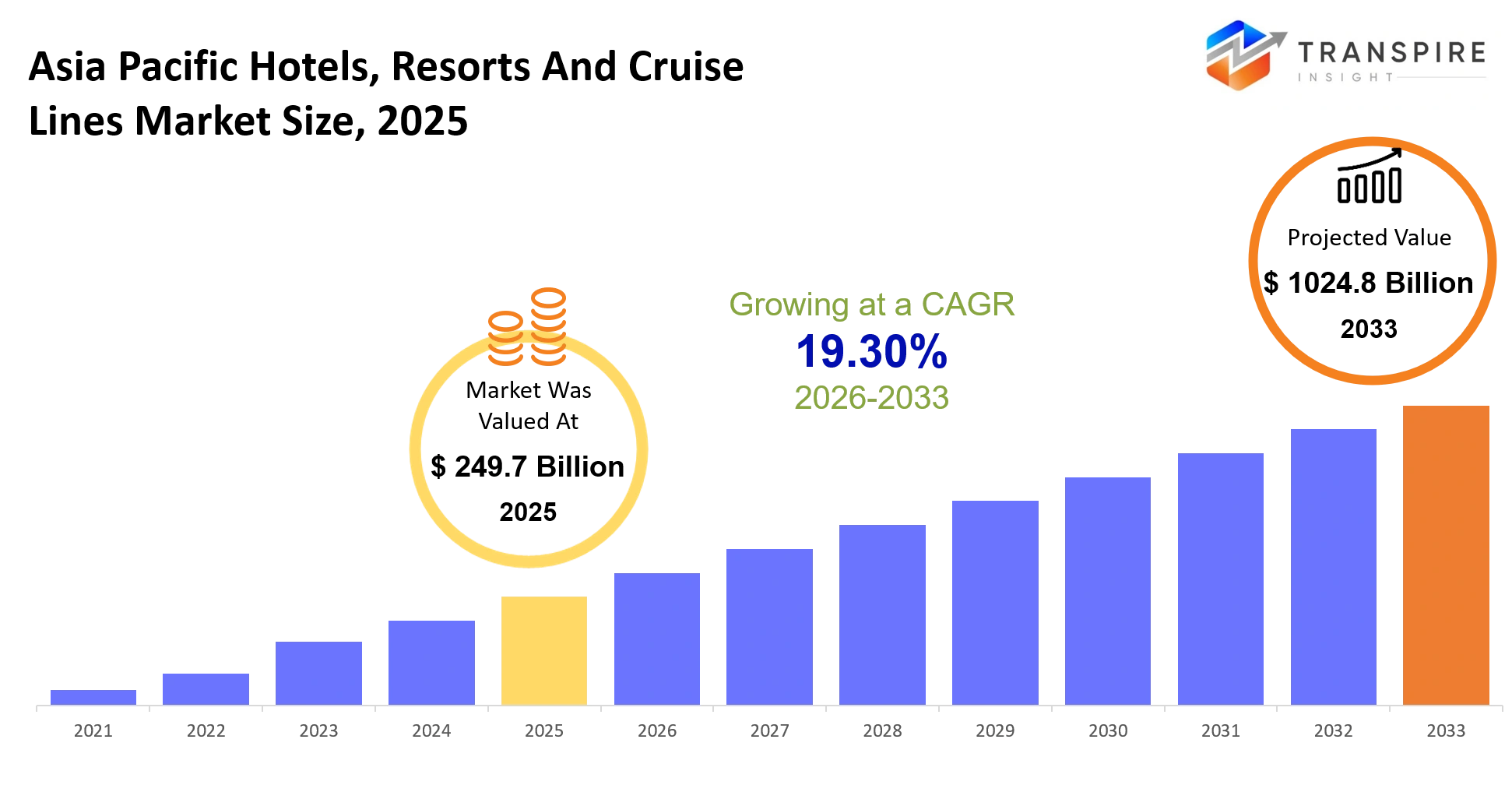
As per Transpire Insight Analysis the Asia Pacific Hotels, Resorts And Cruise Lines Market size is estimated at USD 249.7 Billion in 2025 and is anticipated to reach USD 1024.8 Billion by 2033, growing at a CAGR of 19.30% from 2026 to 2033.
The Asia Pacific Hotels, Resorts And Cruise Lines Market kinda supports tourism, business travel and those more laid back leisure moments by offering lodging, hospitality services , and cruise style routes that link up destinations across the region. More than just helping guests get from A to B, the whole market also boosts local economies through hiring people, working with transportation partners , feeding operations with steady food supply networks, plus destination development that keeps things moving. In the last three to five years, the industry has been shifting toward digitally integrated ways of working, so hotels, resorts and cruise operators are investing in contactless services, data guided guest management, and booking platforms that feel more tailored.
When international borders reopened after pandemic related travel limits, that really became a major trigger. It reshaped travel patterns and pushed operators to modernize how they deliver service, while also expanding premium and experience centered offerings. Because of that, you’re seeing longer guest stays, more spending on value added services, and a steadier recovery in occupancy. Even with all these changes, operators are diversifying income via wellness, luxury, and destination focused activities, and investment keeps flowing into new properties as well as cruise infrastructure around key Asia Pacific tourism hubs.
Asia Pacific Hotels, Resorts And Cruise Lines Market Size & Forecast:
- Asia Pacific Hotels, Resorts And Cruise Lines Market Size 2025: USD 249.7 Billion
- Expected Market Value 2033: USD 1024.8 Billion
- Forecast CAGR: 19.30%
- Leading region in 2025: East Asia
- Fastest Growing region: Southeast Asia
- Key Profile: Marriott International, Hilton Worldwide, Hyatt Hotels, Accor, IHG Hotels & Resorts, Shangri-La Hotels, Minor Hotels, Genting Group, Carnival Corporation, Royal Caribbean Group, Norwegian Cruise Line Holdings, MSC Cruises, Wyndham Hotels, Radisson Hotel Group, The Indian Hotels Company
Key Market Insights
- East Asia pretty much owned the market in 2025 with around 43% share ,mainly because it has mature tourism infrastructure, strong hotel capacity, and cruise terminals already in place.
- Southeast Asia should turn out to be the fastest-advancing regional space from 2025 to 2033, with tourism investments, visa reforms ,and more international flight routes steadily coming online.
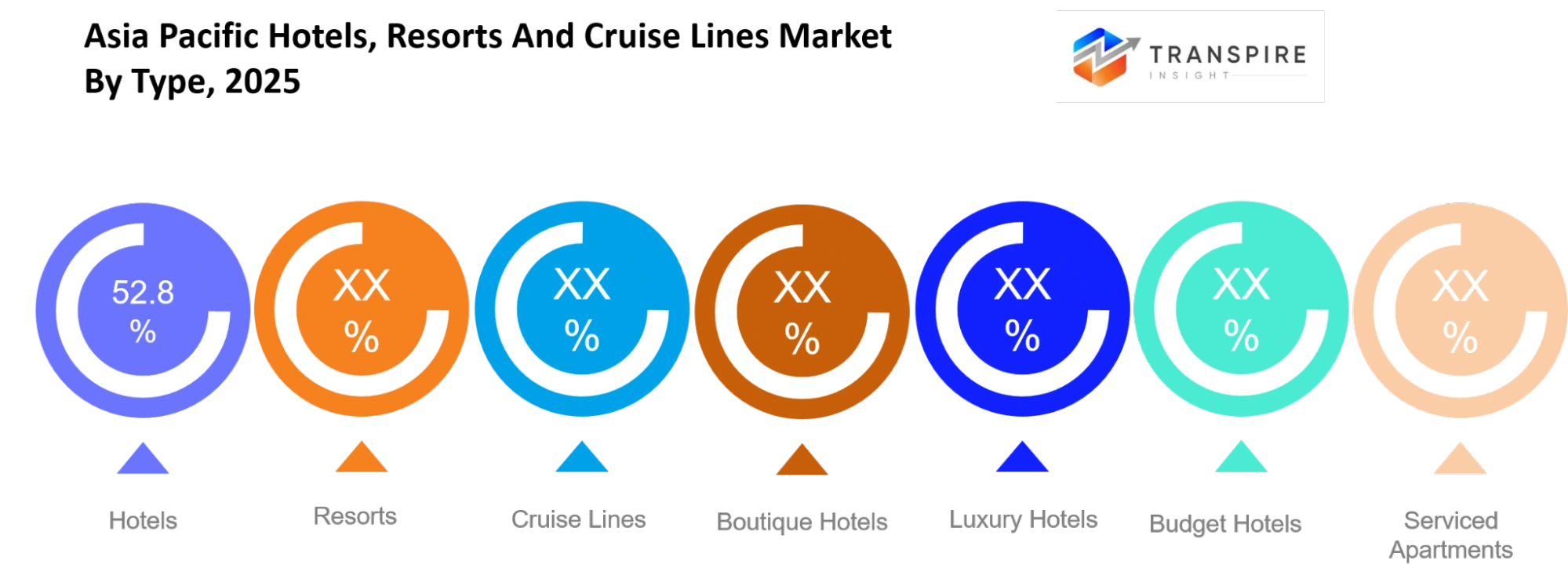
- On the service side ,hotels stayed at the top, holding nearly 58% of revenue in 2025 ,aided by different lodging formats plus a solid rebound in business trips.
- Resorts were ranked second ,as larger integrated leisure settings grew across Thailand, Indonesia, Vietnam and the Maldives, pulling in travelers that spend more.
- For cruise operators ,the expectation is the quickest expansion by 2033, supported by adding ships, launching fresh regional itineraries, and improving port infrastructure modernization.
- Leisure travel made up about 68% of market revenue in 2025, because experiential tourism tends to lift occupancy ,and also increases average guest spending.
- Luxury mixed with experience driven tourism is expected to grow the fastest through 2033, supported by wellness getaways , premium ocean voyages, and stay environments that feel very place-focused.
- Independent travelers made up about 72% of bookings in 2025, with much of that growth made easy by online booking platforms and adaptable trip planning.
- Meanwhile, corporate and MICE travelers are likely to show the fastest growth by 2033 ,as international conferences return and regional business expansion accelerates.
What are the Key Drivers, Restraints, and Opportunities in the Asia Pacific Hotels, Resorts And Cruise Lines Market?
The most potent force pushing the hospitality and cruise industry across Asia Pacific is this quick rebound in international mobility , backed by border reopening, aircraft and routes coming back online, plus government tourism spending programs . In practice , digital booking systems, easier visa rules , and modernized airports chipped away at travel friction and they also boosted total visitor numbers. Premium experiences became less guarded, more reachable. Hotel operators reacted with better value add services, and cruise companies rolled out regional schedules that stitch together several ports in one run. When occupancy rose, it fed straight into room earnings , onboard outlays, and further capital put into new hospitality assets .
Still , the biggest structural wall is the uneven readiness of infrastructure across newer destinations. Cruise terminals, local transport connections, trained hospitality labor, and even utilities need multi year funding before they can handle big visitor loads. From a Transpire Insight look at regional purchasing announcements and go live timelines, supply chain concentration stays the main execution risk . Construction delays and limitations in equipment procurement can stretch timelines, which in turn postpones hotel openings, reduces the amount of room inventory that can actually sell , and also slows cruise terminal buildouts. Altogether, these issues postpone revenue generation , even if travel conditions are otherwise favorable.
A major opportunity kind of sits in the integrated smart tourism ecosystems, mixing AI-enabled hospitality platforms , digital payments and sustainable destination infrastructure, all together. In Southeast Asia it feels especially favorable, because governments keep putting money into airports, ports, and tourism corridors. Investors too are shifting capital toward mixed-use resorts, as well as wellness destinations, that kind of thing. Taken as a whole, these moves generate new revenue streams, while also improving visitor retention and nudging people into longer average stays.
What Has the Impact of Artificial Intelligence Been on the Asia Pacific Hotels, Resorts And Cruise Lines Market?
Artificial intelligence together with digital tech is now shifting how hospitality feels in hotels, resorts, and cruise services, sort of nudging automation into guest engagement, pricing decisions , housekeeping timing, and energy management a little more each day . It’s like the systems learn, and then they quietly steer the experience, even when people don't notice right away. AI-enabled chatbots handle reservations 24/7 and in a lot of cases they do it with no fuss, while smarter property management platforms coordinate room distribution and even staffing plans with very little manual meddling. On the cruise side, operators are starting to use automated monitoring systems that watch fuel efficiency, check onboard equipment health, and judge passenger service quality in real time.
Also, machine learning has boosted predictive abilities across much of the hospitality region. Hotels often study booking behavior, seasonal travel rhythms, and nearby events to guess occupancy levels and adjust room pricing, sometimes several times a day. Cruise companies, for their part, rely on predictive maintenance to flag equipment concerns before they turn into failures , so voyages are less disrupted and maintenance spending goes down which also helps operational reliability. Taken together these tools improve asset use, cut energy consumption, speed up guest responses, and make service more consistent across multiple destinations. Even scheduling based on data plays a role, helping operators distribute labor more sensibly during high-demand travel windows.
Still, AI adoption isn’t all smooth. Implementation expenses stay pretty high, especially for independent hotels and smaller resort operators that still lean on legacy management setups. Data quality can differ from one market to another, and that makes forecasting less precise in places with chaotic travel patterns. And for remote island resorts, connectivity gaps can limit real time analytics , which slows down the broad rollout of advanced digital hospitality solutions.
Key Market Trends
- From 2023 to 2026, contactless check-in and AI guest services sort of became the usual thing across most major international hotel brands working in Asia Pacific, and it felt like everyone was doing it.
- After 2024, cruise operators sped up regional fleet rollouts, then rolled out smaller, shorter itineraries , which helped vessels stay in motion more often and made access easier for a wider group of customers.
- During 2024–2026 governments pushed up spending on airports and cruise terminals , so destination connectivity improved and more international visitors could realistically be handled.
- Sustainability reporting also moved away from just voluntary pledges , toward operational targets that could actually be measured. Because of that hotels started putting money into energy-efficient buildings , and better water management tech, sort of the practical side of it.
- Marriott International and Accor, expanded branded residences and lifestyle hotels after 2024. This kind of strategy helps them branch out revenues beyond the usual room sales.
- In 2025 wellness tourism got a stronger commercial push, with integrated resorts bringing in medical wellness, fitness, and more individualized health journeys, not just quick spa appointments, kinda thing.
- By 2025 digital payment networks were widely stitched into hospitality systems, so for international travelers there was less payment friction, and operations ran smoother as well, overall.
- Regional developers leaned more into modular construction after 2024, which shortened project timelines and improved how quickly capital could be deployed.
- Finally, cruise firms tightened partnerships with local tourism agencies during 2025–2026, producing destination-centered experiences. Those efforts tended to raise passenger spending even beyond onboard services, which is kind of the goal.
Asia Pacific Hotels, Resorts And Cruise Lines Market Segmentation
By Type :
Hotels take the biggest share, mostly because the whole broad accommodation options work well for business trips, holidays, conferences, and even quick transit stays across major destinations. Big hotel groups keep pushing forward by adding more properties, plus digital services, loyalty schemes, and upgraded guest experiences that tend to boost occupancy and also revenue, not always evenly but overall yes. Resorts still pull in steady demand in seaside, alpine, and wellness areas, where longer stays basically mean more time to spend on hospitality services. Cruise operators, meanwhile, are also expanding regional itineraries, and with improved ports and a growing interest in destination-led vacations, more travelers are jumping on board.
Boutique hotels also help diversify the market, since they do personalized experiences and locally inspired design details that fit guests who want something more “real” or carefully curated. Luxury hotels live off premium tourism , corporate happenings and international visitors, all kind of searching for high end services and that extra smoother comfort . At the more budget side you have hotels that stay pretty strict on price and serviced apartments, they cover the affordable end of the spectrum for students, working professionals , and families , usually for longer stretches and somehow, quietly, they end up being the default option.Other lodging types keep stepping in for those niche travel needs, and in turn they widen hospitality choices across emerging tourism destinations.
By Booking Channel :
Online Travel Agencies really take the lead in booking share since they offer a broad catalogue of places, pricing that feels more transparent, and instant reservation features that makes travel planning easier. At the same time, direct booking keeps growing as hotel operators nudge travelers toward their own websites using loyalty rewards, special deals, and looser cancellation terms… mostly that flexible part. Travel agents still matter especially for international trips, high-end packages , and group travel that needs careful coordination because everything is more detailed. Corporate booking helps with business journeys too, using agreed rates and centralized reservation control for companies that run operations across multiple countries.
Meanwhile mobile apps are seeing the quickest expansion, mainly because smartphones are everywhere, plus digital payments allow reservations to move faster and feel less annoying. Walk-in booking still shows up in a few domestic destinations, and in those last-minute moments where someone needs a room right now, even if most people already switched to digital. Other channels, like specialized tour arrangements or event driven reservations, also stay useful for more particular needs such as educational excursions. Overall, ongoing investment in digital booking systems keeps pushing customer ease upward and improves how efficiently reservations get handled.
By Traveler Type :
Leisure travelers are kind of the top revenue drivers, because holidays and those seasonal getaways, plus destination tourism still keep hotel occupancy humming across the whole region. Business travelers also hold things up with steady demand tied to conferences, trade exhibitions and cross-border commerce. Meanwhile, family travelers bring in a lot of bookings when school holidays roll around, and during the festive seasons too, so resorts and hotels tend to grow family focused services, not just room types. Solo travelers keep picking flexible stays, and a big part of that is fueled by digital booking platforms, and personalized travel moments.
Group travelers meanwhile feed reliable business into hotels, resorts, and cruise operators via tour packages, corporate events and educational trips. Travel providers continue crafting tailored experiences that fit different traveler tastes, plus spending habits that vary, sometimes a lot. Then the other traveler categories support more specialized tourism such as medical, religious, and sports related journeys. Service diversification helps widen revenue chances across several customer groups, even when one segment slows down a bit.
By Star Rating :
Luxury 5-star properties tend to drive revenue, mostly because premium facilities, exclusive experiences, and that recognizable international brand vibe pull in high-value travelers. Meanwhile, upscale 4-star hotels keep pushing forward by using a careful mix of pricing and reliable services, which suits both business guests and leisure guests. Midscale 3-star hotels still matter a lot too, since they offer comfortable stays at competitive rates, not only in big cities but also in regional areas. Economy hotels backstop budget-conscious travelers who just want practical lodging, with no extra frills or unnecessary costs.
Boutique properties, on the other hand , keep drawing visitors who want hospitality that feels different, with cultural themes, and more tailored experiences. Hospitality operators also put money into renovations and digital services across every star category, to improve guest satisfaction, and make everything run smoother. Other types of accommodation exist as well, to meet specialized customer needs and local tourism patterns that vary from place to place. When the market has balanced offerings across each rating level, it usually helps keep wider coverage overall.
By End User :
Domestic tourists are basically the biggest end user segment because short distance travel, holiday tourism and weekend trips keep rooms occupied, pretty steady all year. International visitors bring in a lot of money too, since their stays tend to last longer, and they spend more on lodging, food and recreational services. Corporate clients still matter a great deal as business meetings, conferences, and even regional expansion keep hotel demand moving forward. Meanwhile government travelers also help with dependable bookings, from official visits, training programs, and various public sector events.
At the same time hospitality operators keep rolling out customized packages that fit the various needs across each customer category. They also keep investing in digital guest services, offering flexible booking options, and adding premium experiences, which helps keep customers coming back in both domestic and international markets. Other end users contribute as well—like educational groups, healthcare related journeys, and special occasion tourism. When you combine all these different customer groups, the regional hospitality industry ends up with more stable income opportunities, even when demand shifts around.
What are the Key Use Cases Driving the Asia Pacific Hotels, Resorts And Cruise Lines Market?
The main use case kind of revolves around staying places for both leisure and business movement, where hotels end up taking the biggest slice of bookings. Corporate organizations , domestic tourists, and international visitors go for these kinds of facilities because steady service norms, handy locations, and bundled business amenities help for both brief and longer stays. That, in turn, supports higher occupancy and revenue.
Resorts are also pushing outward, boosted by wellness tourism, and more destination centered getaways, bringing in family travelers, as well as premium vacationers. Cruise lines are gaining steam too, especially for international tourists who want multi-country routes, and corporate groups often pick cruise venues for incentive events and executive gatherings, you know the kind.
New use cases are starting to show up, like medical wellness retreats that are blended with hospitality offerings, and smarter cruise experiences supported by AI based guest personalization. Government tourism pushes, digital visa programs, and investment aimed at regional port infrastructure will likely widen the uptake of these specialized services. So, during the forecast period, it creates fresh commercial angles , without leaning on the usual lodging model so much.
|
Report Metrics |
Details |
|
Market size value in 2025 |
USD 249.7 Billion |
|
Market size value in 2026 |
USD 297.9 Billion |
|
Revenue forecast in 2033 |
USD 1024.8 Billion |
|
Growth rate |
CAGR of 19.30% from 2026 to 2033 |
|
Base year |
2025 |
|
Historical data |
2021 - 2024 |
|
Forecast period |
2026 - 2033 |
|
Report coverage |
Revenue forecast, competitive landscape, growth factors, and trends |
|
Regional scope |
Asia Pacific (India, China, Japan, Australia, South Korea, Rest of Asia Pacific) |
|
Key company profiled |
Marriott International, Hilton Worldwide, Hyatt Hotels, Accor, IHG Hotels & Resorts, Shangri-La Hotels, Minor Hotels, Genting Group, Carnival Corporation, Royal Caribbean Group, Norwegian Cruise Line Holdings, MSC Cruises, Wyndham Hotels, Radisson Hotel Group, The Indian Hotels Company . |
|
Customization scope |
Free report customization (country, regional & segment scope). Avail customized purchase options to meet your exact research needs. |
|
Report Segmentation |
By Type (Hotels, Resorts, Cruise Lines, Boutique Hotels, Luxury Hotels, Budget Hotels, Serviced Apartments, Others); By Booking Channel (Online Travel Agencies, Direct Booking, Travel Agents, Corporate Booking, Mobile Apps, Walk-in Booking, Others); By Traveler Type (Leisure Travelers, Business Travelers, Family Travelers, Solo Travelers, Group Travelers, Others); By Star Rating (Luxury (5-Star), Upscale (4-Star), Midscale (3-Star), Economy (1–2 Star), Boutique, Others); By End User (Domestic Tourists, International Tourists, Corporate Clients, Government Travelers, Others) |
Which Regions are Driving the Asia Pacific Hotels, Resorts And Cruise Lines Market Growth?
In 2025, East Asia was responsible for about 43% of the regional market, so it ended up as the most dominant regional contributor, kinda straightforward. A lot of that comes from solid transport infrastructure, supportive tourism policies, easier visa processing, and a steady stream of investment going into airports plus cruise terminals. In practice, global hotel brands, domestic hospitality groups, cruise operators, and wide supplier connections form one integrated ecosystem. That combination backs large-scale tourism activity and keeps things moving. Looking ahead, continued funding into premium hospitality properties, digital guest services, and city-based tourism projects should help keep the regional leadership strong across the forecast window.
Oceania comes in as the second biggest regional contributor, mainly because hospitality demand is steadier, with economic conditions staying stable and tourism policies remaining consistent. It is less about quick capacity expansion, more about careful build-out and patience. Mature regulatory structures usually make investors more comfortable with long-term bets in hotels, resorts, and cruise-related infrastructure, while still holding high service standards. At the same time, strong domestic travel, solid international visitor spend, and established business travel networks support dependable occupancy in the key destinations. Because this is a balanced investment environment, Oceania can act as a dependable recurring revenue source even though its expansion is a bit more measured than in some fast-rising tourism markets.
Southeast Asia is expected to keep growing at the quickest pace, as governments continue putting money into airports, cruise terminals, tourism corridors, and those more streamlined entry rules. In the last few years, big hospitality projects, integrated resorts, and better international flight links have actually made destinations feel way more reachable. Also, private capital is rising in Vietnam, Indonesia, Thailand, and the Philippines, and that is opening doorways for hotels, resorts, and cruise operators. If this keeps going, it should create solid chances for new market entrants and for longer-term investors during 2026–2033, mainly because tourism capacity is expanding while hospitality offerings get more varied, and yes, that matters.
Who are the Key Players in the Asia Pacific Hotels, Resorts And Cruise Lines Market and How Do They Compete?
Competition is still kinda moderately fragmented since global hospitality brands share the stage with regional operators, standalone hotel companies, and even cruise players. In general, service quality, digital guest experience, brand loyalty, and how far the geographic reach goes are the key competitive things, not just price by itself. Most established operators are still pushing customer retention by putting more into technology and by building those premium experiences, whereas regional brands are moving into fast growing destinations, often with more flexible business models that fit.
Marriott International , for example, separates itself with a wide span collection of luxury , premium , and select service brands, all backed by a strong loyalty ecosystem that makes repeat bookings feel more natural across multiple countries. Hilton Worldwide leans heavily into digital innovation, like mobile check-in and connected room technologies, so guest convenience increases and operational costs can drop too. Accor, meanwhile, grows using lifestyle brands and management partnerships that support a quick arrival into emerging tourism locations, with lower capital requirements, which is also why they can move so fast.
Hyatt Hotels Corporation tends to concentrate on premium resorts and wellness centered hospitality, creating a somewhat distinctive position in higher value leisure travel. Royal Caribbean Group pushes additional regional cruise deployment by rolling out destination focused itineraries and working with port authorities, aiming to improve passenger experiences in a more practical way. Carnival Corporation keeps strengthening competitiveness through a mix of cruise brands, operational efficiency efforts, plus bigger Asia Pacific voyage offerings, so it can speak to multiple traveler segments, while also improving fleet utilization over time.
Company List
- Marriott International
- Hilton Worldwide
- Hyatt Hotels
- Accor
- IHG Hotels & Resorts
- Shangri-La Hotels
- Minor Hotels
- Genting Group
- Carnival Corporation
- Royal Caribbean Group
- Norwegian Cruise Line Holdings
- MSC Cruises
- Wyndham Hotels
- Radisson Hotel Group
- The Indian Hotels Company
Recent Development News
In December 2025, Accor unveiled its 2026 global expansion pipeline, including major hotel, resort, and luxury hospitality developments across Asia Pacific. The investment program supports regional capacity expansion, premium tourism growth, and new hospitality offerings across established and emerging destinations. Sourcehttps://press.accor.com/
In June 2026, Accor signed a strategic agreement with Yavu Collective to manage three new resort properties in Fiji. The partnership expands Accor's Pacific footprint, increases premium resort capacity, and reinforces long-term investment in regional tourism infrastructure.
Source https://www.theaustralian.com.au/
What Strategic Insights Define the Future of the Asia Pacific Hotels, Resorts And Cruise Lines Market?
The Asia Pacific Hotels, Resorts And Cruise Lines Market is heading toward a kind of integrated hospitality ecosystem where digital guest engagement, elevated travel experiences and multi-destination tourism sort of become the base for long-term value making. The whole direction is being pushed by steady funding into transport infrastructure, regional tourism agreements, and also by the increasing blending of AI into hotel and cruise day-to-day operations. There is also a risk that’s less obvious , like how hospitality investment is clumping around a small number of tourism hubs. That could leave operators exposed to local regulatory shifts, climate related disruptions, or even infrastructure choke points that end up hurting occupancy and margin.
At the same time, there is an opportunity that’s starting to show up, especially in secondary coastal cities and island destinations. If they keep installing smart tourism infrastructure, it makes room for mid sized operators and technology enabled hospitality concepts before the competition really heats up. Market players should focus on collaborations with regional governments, airport operators, and digital travel platforms while also growing flexible, data led service frameworks, these can adjust fast when travel patterns move or when destination preferences shift.
Asia Pacific Hotels, Resorts And Cruise Lines Market Report Segmentation
By Type
- Hotels
- Resorts
- Cruise Lines
- Boutique Hotels
- Luxury Hotels
- Budget Hotels
- Serviced Apartments
By Booking Channel
- Online Travel Agencies
- Direct Booking
- Travel Agents
- Corporate Booking
- Mobile Apps
- Walk-in Booking
By Traveler Type
- Leisure Travelers
- Business Travelers
- Family Travelers
- Solo Travelers
- Group Travelers
By Star Rating
- Luxury (5-Star)
- Upscale (4-Star)
- Midscale (3-Star)
- Economy (1–2 Star)
- Boutique
By End User
- Domestic Tourists
- International Tourists
- Corporate Clients
- Government Travelers
Frequently Asked Questions
Find quick answers to common questions.
The expected Asia Pacific Hotels, Resorts And Cruise Lines Market size for the market will be USD 1024.8 Billion in 2033.
Key segments for the Asia Pacific Hotels, Resorts And Cruise Lines Market are By Type (Hotels, Resorts, Cruise Lines, Boutique Hotels, Luxury Hotels, Budget Hotels, Serviced Apartments, Others); By Booking Channel (Online Travel Agencies, Direct Booking, Travel Agents, Corporate Booking, Mobile Apps, Walk-in Booking, Others); By Traveler Type (Leisure Travelers, Business Travelers, Family Travelers, Solo Travelers, Group Travelers, Others); By Star Rating (Luxury (5-Star), Upscale (4-Star), Midscale (3-Star), Economy (1–2 Star), Boutique, Others); By End User (Domestic Tourists, International Tourists, Corporate Clients, Government Travelers, Others).
Major Asia Pacific Hotels, Resorts And Cruise Lines Market players are Marriott International, Hilton Worldwide, Hyatt Hotels, Accor, IHG Hotels & Resorts, Shangri-La Hotels, Minor Hotels, Genting Group, Carnival Corporation, Royal Caribbean Group, Norwegian Cruise Line Holdings, MSC Cruises, Wyndham Hotels, Radisson Hotel Group, The Indian Hotels Company.
The Asia Pacific Hotels, Resorts And Cruise Lines Market size is USD 249.7 Billion in 2025.
The Asia Pacific Hotels, Resorts And Cruise Lines Market CAGR is 19.30% from 2026 to 2033.
- Marriott International
- Hilton Worldwide
- Hyatt Hotels
- Accor
- IHG Hotels & Resorts
- Shangri-La Hotels
- Minor Hotels
- Genting Group
- Carnival Corporation
- Royal Caribbean Group
- Norwegian Cruise Line Holdings
- MSC Cruises
- Wyndham Hotels
- Radisson Hotel Group
- The Indian Hotels Company
About the Authors

Chetan Dhatrak
I’m Chetan Dhatrak, a Senior Research Analyst at Transpire Insight, specializing in the Consumer Goods, Foods and Beverages industry. I focus on analyzing market trends, consumer behavior, competitive landscapes, and industry developments to deliver accurate, data-driven insights. My research at Transpire Insight is built on credible sources and in-depth analysis, helping businesses and readers better understand market dynamics, emerging opportunities, and evolving consumer preferences. I’m committed to creating reliable, well-researched content that supports informed decision-making and reflects the latest developments in the consumer goods and food & beverage sectors.

Chakradhar Khansole
Chakradhar serves as the Research Director at Transpire Insight, bringing over 8 years of experience in technology, innovation, and strategic market intelligence. He specializes in transforming complex market data into actionable business insights that enable organizations to make informed, growth-oriented decisions. Recognized for his strategic vision and analytical expertise, Chakradhar leads high-impact research initiatives, delivering comprehensive market assessments, competitive intelligence, and forward-looking industry analysis.
Recently Published Reports
-
Apr 2026
Bottled Water Market
Bottled Water Market Size, Share & Analysis Report By Product Type (Still Bottled Water, Carbonated Bottled Water, Functional Bottled Water, and Others), By Packaging (PET, Cans, and Others), By Sales Channel (Supermarkets/Hypermarkets, Convenience Stores/Drug Stores, Grocery Stores/Club Stores, Foodservice, and Others) and Geography (North America, Europe, Asia-Pacific, Middle East and Africa, South and Central America), 2021 - 2032
-
Apr 2026
Color Cosmetic Packaging Market
Color Cosmetic Packaging Market Size, Share & Analysis Report By Application (Mascara Packaging, Liquid Packaging, and Liquid Face), By Type (Tubes & Bottles, Pens & Markers, Compacts & Containers, and Droppers & Pumps), and Geography (North America, Europe, Asia-Pacific, Middle East and Africa, South and Central America), 2021 - 2031
-
Apr 2026
External Microphone For Camera Market
External Microphone For Camera Market Size, Share & Analysis Report By Type (Shotgun Microphone, Lavalier Microphone, and Others), By Application (Digital Camera, Professional Video Camera, and Others), and Geography (North America, Europe, Asia-Pacific, Middle East and Africa, South and Central America), 2021 - 2031
-
Apr 2026
Foot Orthotic Insoles Market
Foot Orthotic Insoles Market Size, Share & Analysis Report By Type (Pre-fabricated, and Custom-made), By Material (Thermoplastic, Composite Carbon Fiber, and Others), By Distribution Channel (Drug Stores, Hospitals & Clinics, and Others), and Geography (North America, Europe, Asia-Pacific, Middle East and Africa, South and Central America), 2021 - 2031