

Global Vacuum Pumps Market Size & Forecast:
- Global Vacuum Pumps Market Size 2025: USD 6.47 Billion
- Global Vacuum Pumps Market Size 2033: USD 10.21 Billion
- Global Vacuum Pumps Market CAGR: 5.93%
- Global Vacuum Pumps Market Segments: By Type (Rotary Vane, Dry Vacuum, Liquid Ring, Scroll, Diaphragm, Turbomolecular, Diffusion, Others); By Pressure (Low, Medium, High, Ultra-high, Others); By Lubrication (Oil-sealed, Dry-running, Others); By End User (Semiconductor, Chemical, Healthcare, Food & Beverage, Oil & Gas, Others); By Distribution Channel (Direct Sales, Distributors, OEMs, Others).

Global Vacuum Pumps Market Summary:
As per Transpire Insight Analysis, the Global Vacuum Pumps Market size is estimated at USD 6.47 Billion in 2025 and is anticipated to reach USD 10.21 Billion by 2033, growing at a CAGR of 5.93% from 2026 to 2033.
The global vacuum pumps market is getting bigger because companies need vacuum technology to make products and work more efficiently. Vacuum pumps are very important in industries like making computer chips, producing medicine, processing food, making chemicals and automating factories, where they need to control the pressure to get good results. In recent years, companies that make vacuum pumps have been working on systems that use less energy, do not need oil and can be monitored digitally to reduce costs and meet new rules that help the environment.
One big change in the vacuum pumps market is that companies are moving away from oil-sealed pumps and towards dry vacuum technologies that are cleaner and cost less to maintain. This change is happening because more companies are making computer chips, electric vehicle batteries and advanced electronics, which all need good vacuum systems. At the time, companies are investing in new manufacturing technologies and maintenance systems that use sensors and remote monitoring to make vacuum systems better. These new systems help reduce the time that equipment is not working, making companies work efficiently and use less energy. As companies keep getting better at making things and more countries need manufacturing, the use of advanced vacuum pumps will become more common in many industries. The vacuum pumps market will keep growing because vacuum pumps are very important for companies to work well.
Key Market Insights:
The global vacuum pumps market is changing because of the demand for energy-saving equipment, more environmentally friendly ways of production, and automation in manufacturing processes. The increasing number of investments in the development of semiconductors, healthcare, and industrial manufacturing pushes the manufacturers of vacuum pumps to offer efficient and easy-to-maintain equipment.
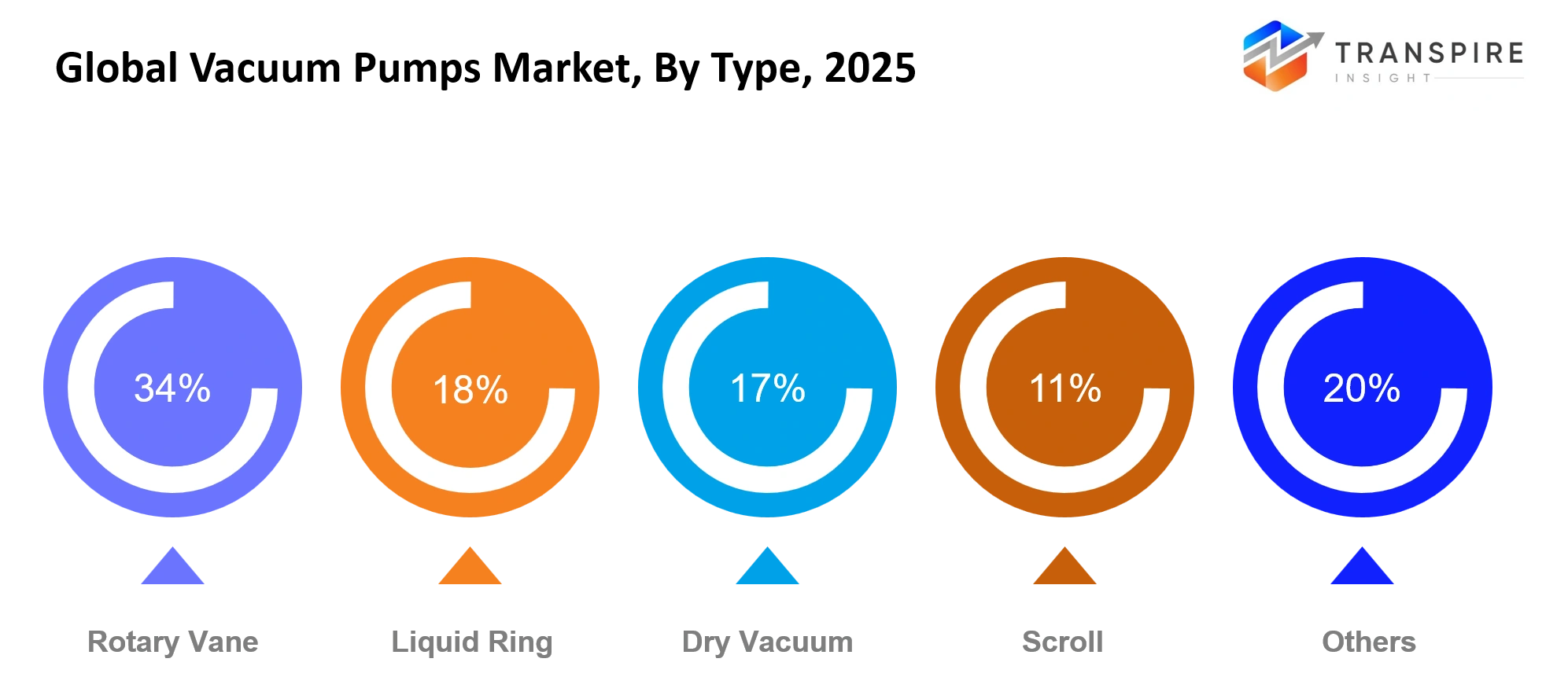
- Rotary vane vacuum pumps have 34% of the worldwide market share because of their reliable performance, cost-effectiveness, and capability to be used in different industrial applications.
- Dry vacuum pumps are the fastest-growing products on the market with a 12.9% CAGR because manufacturers create the oil-free vacuum technology to minimise contamination and decrease the need for maintenance.
- The leading manufacturers offer their customers vacuum technologies with digital monitoring and remote diagnostics features.
- Semiconductor producers increase their investments in high-vacuum equipment because of their need to produce advanced chips, which opens up new opportunities for the manufacturers of vacuum pumps.
- Energy efficiency became one of the major factors when buying vacuum technology; therefore, the manufacturers started to offer pumps with an optimal motor design.
- Industrial automation increases the demand for vacuum technology to be used in robotic assembly lines and packaging machines.
What are the Key Drivers, Restraints, and Opportunities in the Global Vacuum Pumps Market?
Drivers
The growth of the global vacuum pumps industry can be attributed to the fast-paced development of the semiconductor manufacturing industry, the pharmaceutical industry, and industrial automation. The industries are highly dependent on the creation of vacuum conditions for their activities. Increasing the share of automated manufacturing lines results in the need for efficient vacuum pumps capable of working continuously. Manufacturers are constantly trying to replace outdated pumps with new systems that are energy efficient and digitalised, in order to cut costs and meet the environmental requirements of today.
Restraints
Even though the global market has a lot of opportunities, it is facing some threats associated with the high cost of advanced vacuum pumps and difficulties in installing and maintaining them. For example, oil-free and high-vacuum systems require special parts, qualified personnel, and regular service for their proper functioning. Many small and medium-sized companies cannot afford to update their equipment, especially in developing countries. Another problem that can influence equipment purchases is price changes in raw materials and disruptions in the supply chain.
Opportunities
The use of dry vacuum pumps along with intelligent sensing technologies is becoming a key opportunity in growing industry segments. With the growth of production capacities in semiconductor factories, electric vehicle batteries, and biotechnology firms, there will be an increased need for efficient vacuum pumps that do not consume much energy. The use of IoT sensors, predictive maintenance systems, and AI-based performance analysis will enable users to ensure reliability and cut down on maintenance costs. In addition, growing investments by the industrial sector in countries such as those in Asia-Pacific and North America present opportunities for vacuum pump makers.
What Has the Impact of Artificial Intelligence Been on the Global Vacuum Pumps Market?
Artificial intelligence will revolutionise the global market of vacuum pumps by boosting the efficiency of devices, reducing their maintenance costs, and increasing process reliability. Nowadays, modern vacuum pumps are usually equipped with monitoring systems that use artificial intelligence technologies to continuously analyse performance indicators like pressure, temperature, vibration, energy consumption, and flow rate. This allows detecting performance deviations before the formation of equipment breakdowns and scheduling maintenance services to prevent device failures.
Moreover, artificial intelligence contributes to increased automation in semiconductor manufacturing, the pharmaceutical industry, chemicals manufacturing and electronics assembly industries, where the stability of vacuum conditions is crucial to maintaining the high quality of goods. Algorithms of machine learning optimise the work of pumps according to the needs of manufacturing processes, making automatic adjustments to maximise energy efficiency and prolong the service life of equipment. In March 2025, Atlas Copco launched AI-assisted smart monitoring features via connected vacuum solutions that allow predicting maintenance requirements, optimising pumps' efficiency, and reducing unexpected downtime for the industry.
Key Market Trends
The global market for vacuum pumps is experiencing substantial changes driven by the need for cleaner production, digital monitoring, and energy-efficient equipment. Manufacturers are actively investing in advanced vacuum pump technologies, providing reliable operation and ensuring that vacuum pumps are appropriate for automated and highly precise manufacturing environments.
- Oil-sealed systems are gradually being substituted with dry vacuum pumps due to contamination risk reduction, decrease in maintenance needs, and increased adherence to environmental standards.
- Real-time monitoring and diagnostics are standard elements in modern vacuum pumping systems used for performance tracking, prevention of unplanned downtimes, and maintenance.
- Development of vacuum pumps is influenced by the demands of the semiconductor industry, where the need for equipment capable of creating high-vacuum conditions arises.
- Efficiency in terms of energy consumption is no longer a feature that allows the manufacturer to differentiate itself, but a mandatory requirement, which prompts developers to work on vacuum pumps' motor optimisation.
- Vacuum pumps are becoming more and more integrated into the production lines involving automation processes such as automated packaging and precision manufacturing.
- Manufacturers are broadening their service range through introducing condition-based maintenance programs and long-term service contracts.
Global Vacuum Pumps MarketSegmentation
By Type
The vacuum pumps market is led by rotary vane pumps, which represent 34% of the total market and are widely used in industrial manufacturing, packaging, chemical processes, and laboratories. The reliability, easy maintenance, and low costs make rotary vane pumps the top choice for constant duty work. Liquid ring pumps are 18% of the market and have been gaining popularity as a perfect choice for handling wet gases in the chemical industry and oil & gas sector. Dry vacuum pumps occupy 17% of the market and have the highest growth rate among all vacuum pumps, and are expected to grow at a CAGR of 12.9%. Scroll pumps occupy 11% of the total market and are used mostly in laboratories and for medical purposes because of their noiseless operation and high performance. Other vacuum pumps are 20% of the market and are applied to various industrial purposes.
By Pressure
There is still high demand for medium-pressure vacuum pumps because of their wide range of applications in different industries, like manufacturing, the food industry, and the packaging industry. There is high demand for high-pressure and ultra-high vacuum pumps in semiconductor manufacturing and scientific research, where high levels of vacuum control are needed. Low-pressure vacuum pumps are needed in ordinary industrial applications where moderate vacuum performance is required. With the expansion of the precision manufacturing industry on the global level, the demand for all kinds of pumps is projected to grow.
By Lubrication
There is still high demand for oil-sealed vacuum pumps because of their robustness, stable performance, and ability to operate in heavy industrial conditions. On the other hand, dry-running vacuum pumps become more popular because of clean manufacturing, low maintenance, and an environmentally friendly process. The increasing demand for oil-free technology can be observed in pharmaceutical, biotechnology, food processing, and semiconductor manufacturing industries.
By End Users
The semiconductor industry is among the top end users for the vacuum pumps because of the requirement of super clean environment when making wafers and chips. The chemical processes, healthcare, and pharmaceutical sectors require vacuum pump systems for filtration, drying, sterilisation, and material handling. There has been an increase in the usage of vacuum pumps in food and beverages in their packaging and preserving applications. The Oil & Gas segment uses vacuum pump systems for refining, gas recovery, and optimising the processes. Industrial modernisation in all these sectors will continue to drive market growth in the coming years.
By Distribution Channel
Direct sales are the preferred route of sales for customised engineering and installation needs of the big industrial clients. The distributors help broaden the regional market footprint by providing standardized products. Original Equipment Manufacturer (OEM) customers have been using vacuum pumps in automation machines and industrial machines. In addition, there has been integration of vacuum pumps in specialised manufacturing systems. With the development of digital procurement and automation in industries, manufacturers are developing strong distribution channels.
What are the Key Use Cases Driving the Global Vacuum Pumps Market?
The significance of vacuum pumps in semiconductor manufacturing, one of the largest application markets, cannot be overstated. Vacuum pumps ensure that wafer manufacturing, chip packaging, material handling, and vacuum coating processes run smoothly. The reliability and stable performance of the equipment allow manufacturers to keep production accuracy and minimise equipment downtimes in high-volume manufacturing facilities.
Outside of semiconductors, vacuum pumps find extensive applications in pharmaceuticals, chemicals, healthcare, and food & beverages sectors. Such applications include filtration, sterilisation, vacuum drying, distillation, packaging, and product preservation, among others. With increased investments into automated and cleaner manufacturing lines from the manufacturers, the demand for reliable and energy-efficient vacuum solutions is expected to grow across all these industries.
The emergence of new applications creates further growth opportunities for the market. The growing production of batteries for electric vehicles and renewable energy equipment, as well as the development of biotechnology and advanced electronics manufacturing, requires high-performance oil-free vacuum pumps. In addition, the introduction of smart factories, where vacuum pumps have to be monitored using AI technology and perform predictive maintenance, is expected to create further demand for vacuum pumps.
|
Report Metrics |
Details |
|
Market size value in 2025 |
USD 6.47 Billion |
|
Market size value in 2026 |
USD 6.82 Billion |
|
Revenue forecast in 2033 |
USD 10.21 Billion |
|
Growth rate |
CAGR of 5.93% from 2026 to 2033 |
|
Base year |
2025 |
|
Historical data |
2021 - 2024 |
|
Forecast period |
2026 - 2033 |
|
Report coverage |
Revenue forecast, competitive landscape, growth factors, and trends |
|
Regional scope |
United States; Canada; Mexico; United Kingdom; Germany; France; Italy; Spain; Denmark; Sweden; Norway; China; Japan; India; Australia; South Korea; Thailand; Brazil; Argentina; South Africa; Saudi Arabia; United Arab Emirates |
|
Key company profiled |
Atlas Copco, Edwards Vacuum, Busch Vacuum Solutions, Pfeiffer Vacuum, ULVAC, Ebara, Gardner Denver, KNF, Leybold, Becker Pumps, Agilent Technologies, Flowserve, Tuthill, Gast Manufacturing, Anest Iwata. |
|
Customization scope |
Free report customization (country, regional & segment scope). Avail customized purchase options to meet your exact research needs. |
|
Report Segmentation |
By Type (Rotary Vane, Dry Vacuum, Liquid Ring, Scroll, Diaphragm, Turbomolecular, Diffusion, Others); By Pressure (Low, Medium, High, Ultra-high, Others); By Lubrication (Oil-sealed, Dry-running, Others); By End User (Semiconductor, Chemical, Healthcare, Food & Beverage, Oil & Gas, Others); By Distribution Channel (Direct Sales, Distributors, OEMs, Others). |
Which Regions are Driving the Global Vacuum Pumps Market Growth?
North America
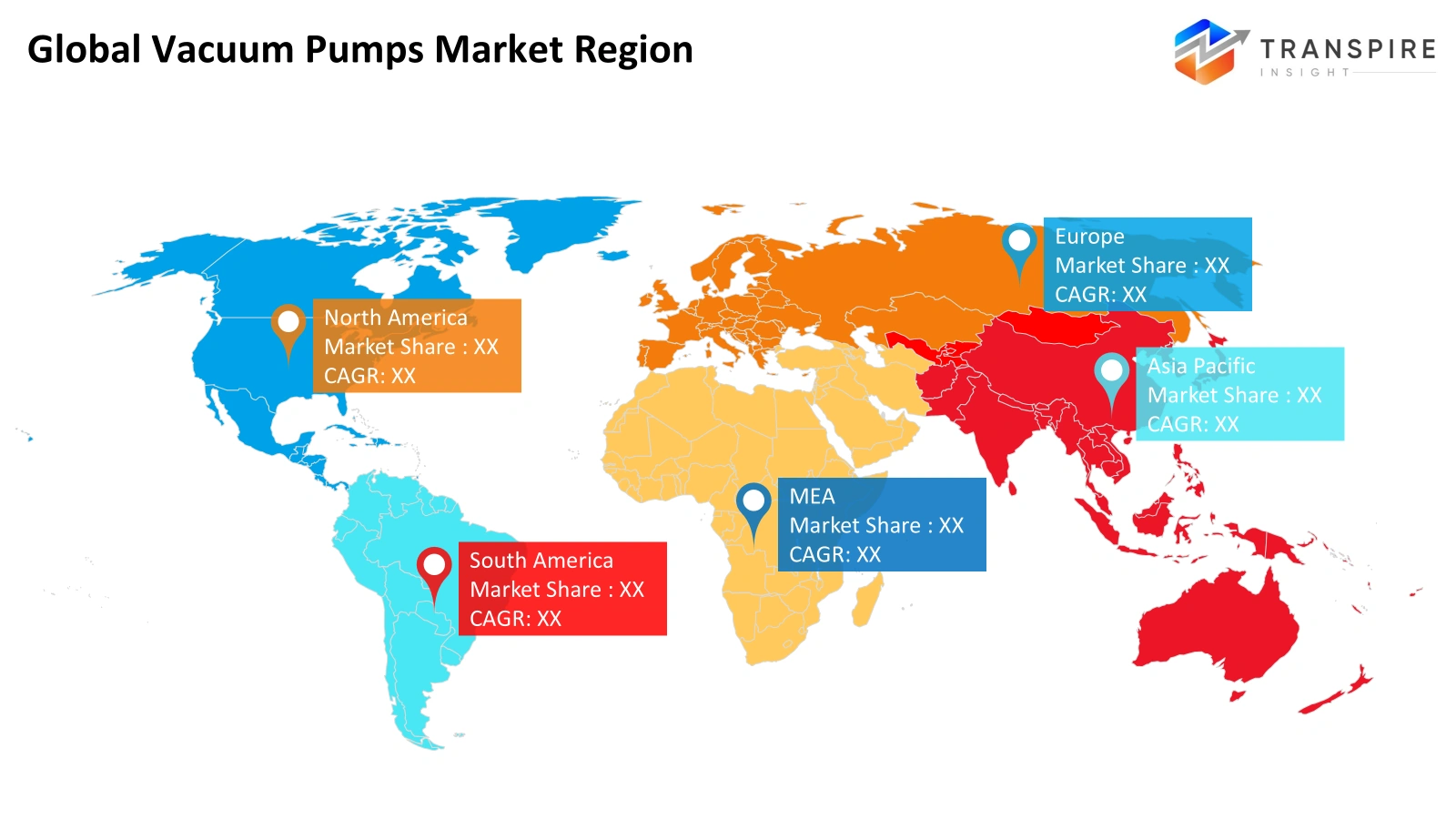
The North America region has accounted for 24% share in the global vacuum pumps market and is expected to witness the highest growth at a CAGR of 13.7% during the forecast period. Increasing investments in the manufacturing of semiconductors, biotechnology products, aerospace and advanced healthcare infrastructure are fueling the demand for smart and energy-efficient vacuum pumps. Companies operating in the region are adopting advanced technologies like artificial intelligence monitoring, predictive maintenance and manufacturing systems to increase efficiency and reduce downtime. These technological advances are expected to generate significant growth opportunities for the North American vacuum pumps market in the coming years. In October 2024, Edwards Vacuum was provided with funding for the proposed manufacture of dry vacuum pumps in the state of New York under the provisions of the U.S. CHIPS and Science Act. This investment enhances the semiconductor supply chain within the region and boosts the domestic production of advanced vacuum pumps utilised in chip manufacture.
Europe
The European market accounts for 27% share of the overall vacuum pumps market owing to the region’s advanced industrial infrastructure and energy-efficient manufacturing technologies. This region has experienced consistent utilisation of advanced vacuum pumps in pharmaceutical production, chemical processing, food manufacturing, and laboratories. Due to stringent environmental norms and sustainable goals set by the companies operating in the region, there has been an increased demand for efficient and maintenance-free vacuum pumps. Industrial modernisation and advancement in engineering solutions is facilitating the sustained growth of the vacuum pumps market in major European nations.In April 2025, Busch Group plans to demonstrate its energy-efficient vacuum pumps and leak detection technologies in applications related to EV battery manufacturing and recycling at the Battery Show Europe 2025 exhibition in Stuttgart.
Asia Pacific
The Asia Pacific region is dominating the worldwide vacuum pump market by contributing 40% of the total market share due to the robust manufacturing infrastructure, along with substantial investments in semiconductor manufacturing facilities and electronics manufacturing. Nations like China, Japan, South Korea, and India are improving their manufacturing facilities and consequently increasing the need for vacuum technology in various applications. Various government policies favouring manufacturing activities, along with substantial investments in EV battery manufacturing and precision engineering, are helping the Asia Pacific gain a competitive edge in the vacuum pump market. In February 2025, Busch Group attended SEMICON Korea 2025, exhibiting its latest developments of dry vacuum pumps and semiconductor vacuum technology to enhance the efficiency of chip manufacture in the Asia-Pacific.
Who are the Key Players in the Global Vacuum Pumps Marketand how do they Compete?
There is stiff competition in the international market for vacuum pumps because manufacturers are concentrating on innovations, energy efficiency, digital monitoring, and global presence in order to increase their competitiveness. The stiff competition has resulted from the high demands of vacuum pumps in semiconductor manufacturing, pharmaceutical, chemical processing, health care, and food industries in which customers require reliable vacuum solutions, have low maintenance costs, and are energy efficient. Manufacturers are establishing local production facilities and providing services in the aftermarket.
Some of the key players in the vacuum pumps industry include Atlas Copco, Busch Vacuum Solutions, Edwards Vacuum, Pfeiffer Vacuum+Fab Solutions, ULVAC, Leybold, EBARA Corporation, Agilent Technologies, Gardner Denver (Ingersoll Rand), and Flowserve Corporation. These players are competing in the market through provision of application-specific vacuum technologies and through innovation. Some of these companies are incorporating IoT technology in their products and are engaging in strategic alliances with semiconductor and industrial equipment manufacturers.
Global Vacuum Pumps Marketcompanies
- Atlas Copco
- Edwards Vacuum
- Busch Vacuum Solutions
- Pfeiffer Vacuum
- ULVAC
- Ebara
- Gardner Denver
- KNF
- Leybold
- Becker Pumps
- Agilent Technologies
- Flowserve
- Tuthill
- Gast Manufacturing
- Anest Iwata
Recent Development News
In March 2026, Atlas Copco announced the release of the DHS 3000 VSD⁺ dry screw vacuum pump, ideal for high-volume applications like paper treatment, food production, and material handling. This launch helped to strengthen Atlas Copco's range of efficient vacuum pumps for industry applications.
Source: https://www.atlascopco.com
In October 2025, Edwards Vacuum rolled out the nXRi dry scroll pump series, which featured increased energy efficiency and reduced noise, along with higher reliability. These innovations were aimed at lab, analytical, and research applications of vacuum technology. This product launch was yet another example of Edwards Vacuum’s dedication to clean vacuum technology and low operational expenses.
Source: https://www.edwardsvacuum.com/en-uk
In September 2025, Pfeiffer Vacuum+Fab Solutions furthered its vacuum technology portfolio with advanced vacuum solutions for semiconductor manufacturing and other advanced industrial processes.
Source: https://www.pfeiffervacuum.com/in/en/
What Strategic Insights Define the Future of the Global Vacuum Pumps Market?
Growth in the global vacuum pumps market is projected due to the increasing automation, energy efficiency, and precise manufacturing in such industries as semiconductors, pharmaceuticals, electronics, and chemicals. The shift in demand from conventional vacuum systems toward oil-free vacuum systems, which help reduce operational cost and improve equipment reliability as well as contribute to sustainable development, is expected to continue. In addition, businesses that invest in the creation of monitoring platforms and predictive maintenance technology will increase their competitive advantage with the modernisation of industrial facilities.
One of the factors that influences the vacuum pumps market but remains invisible for common people is its growing dependence on semiconductor production cycles and the availability of certain electronic components. Any disruption in supply chains or any changes in capital expenditures within this industry may have a temporary impact on the equipment demand and schedule. However, on the other hand, the development of industrial automation, the manufacturing of electric vehicles' batteries, biotechnological products, and advanced electronics creates great opportunities for vacuum pump providers.
To stay competitive, producers should work on providing innovative and application-oriented vacuum equipment with AI technologies and improve local production and services.
Key Segmentations are:
By Type
- Rotary Vane
- Dry Vacuum
- Liquid Ring
- Scroll
- Diaphragm
- Turbomolecular,
- Diffusion
By Pressure
- Low
- Medium
- High
- Ultra-high
By Lubrication
- Oil-sealed
- Dry-running
By End User
- Semiconductor
- Chemical
- Healthcare
- Food & Beverage
- Oil & Gas
By Distribution Channel
- Direct Sales
- Distributors
- OEMs
Regional Outlook
North America
- United States
- Canada
- Mexico
Europe
- Germany
- United Kingdom
- France
- Spain
- Italy
- Rest of Europe
Asia Pacific
- Japan
- China
- Australia & New Zealand
- South Korea
- India
- Rest of Asia Pacific
South America
- Brazil
- Argentina
- Rest of South America
Middle East & Africa
- Saudi Arabia
- United Arab Emirates
- South Africa
- Rest of the Middle East & Africa
Frequently Asked Questions
Find quick answers to common questions.
The global vacuum pumps market size was valued at USD 6.47 Billion in 2025 and is poised to reach USD 10.21 Billion by 2033, expanding at a 5.93% CAGR.
Key segments for the global vacuum pumps market are By Type (Rotary Vane, Dry Vacuum, Liquid Ring, Scroll, Diaphragm, Turbomolecular, Diffusion, Others); By Pressure (Low, Medium, High, Ultra-high, Others); By Lubrication (Oil-sealed, Dry-running, Others); By End User (Semiconductor, Chemical, Healthcare, Food & Beverage, Oil & Gas, Others); By Distribution Channel (Direct Sales, Distributors, OEMs, Others).
Growth is primarily driven by the growth factors, including demand for semiconductor and electronic products, growth in pharmaceutical and chemical production, increased industrial automation, increased usage of vacuum systems in the food packaging industry, and manufacturing of batteries for electric vehicles.
The global market is led by major manufacturers, including Atlas Copco, Edwards Vacuum, Busch Vacuum Solutions, Pfeiffer Vacuum, ULVAC, Ebara, Gardner Denver, KNF, Leybold, Becker Pumps, Agilent Technologies, Flowserve, Tuthill, Gast Manufacturing, and Anest Iwata.
Asia Pacific holds a share of 40% of the worldwide market for vacuum pumps due to its solid manufacturing infrastructure, fast pace of industrialisation, growing production of semiconductors and electronics, as well as significant investments into the development of chemical, pharmaceutical, and automotive industries.
Opportunities in the global vacuum pumps market involve increased demand for semiconductor manufacturing, increased production in the pharmaceutical and biotechnology industry, increased investment in EV battery manufacturing, growing use in food packaging and chemical processing, and increased automation in developing nations.
- Atlas Copco
- Edwards Vacuum
- Busch Vacuum Solutions
- Pfeiffer Vacuum
- ULVAC
- Ebara
- Gardner Denver
- KNF
- Leybold
- Becker Pumps
- Agilent Technologies
- Flowserve
- Tuthill
- Gast Manufacturing
- Anest Iwata
About the Authors

Avinash Kumar
I’m Avinash Kumar, a Senior Research Analyst at Transpire Insight, with expertise in the Electronics and Semiconductor and Energy & Power industry. My work focuses on analyzing emerging technologies, market trends, industry developments, and innovation across these sectors. I specialize in transforming complex technical and market insights into clear, research-backed content that helps professionals, businesses, and decision-makers stay informed. Through continuous industry research and data-driven analysis, I strive to deliver accurate, reliable, and practical perspectives on the latest advancements shaping the semiconductor and energy landscape.

Chakradhar Khansole
Chakradhar serves as the Research Director at Transpire Insight, bringing over 8 years of experience in technology, innovation, and strategic market intelligence. He specializes in transforming complex market data into actionable business insights that enable organizations to make informed, growth-oriented decisions. Recognized for his strategic vision and analytical expertise, Chakradhar leads high-impact research initiatives, delivering comprehensive market assessments, competitive intelligence, and forward-looking industry analysis.
Recently Published Reports
-
Apr 2026
Active Power Filter Market
Active Power Filter Market Size, Share & Analysis Report By Type (Shunt Active Power Filters, Series Active Power Filter, Hybrid Active Power Filter), By Application (Harmonics Mitigation, Reactive Power Compensation, Voltage Regulation, Power Factor Correction), By Phase (Single Phase, Three Phase), By End-User Industry (Manufacturing, Healthcare, Commercial, Automotive, Oil and Gas, Others), and Geography (North America, Europe, Asia-Pacific, Middle East and Africa, South and Central America), 2021 - 2031
-
Apr 2026
Electrical Transformer Market
Electrical Transformer Market Size, Share & Analysis Report By Core (Closed, Shell, and Berry), By Insulation (Gas, Oil, Solid, Air, and Other), By Phase (Single, and Three), By Rating (100 MVA to 500 MVA, 501 MVA to 800 MVA, and 801 MVA to 1200 MVA), and Geography (North America, Europe, Asia-Pacific, Middle East and Africa, South and Central America), 2021 – 2031
-
Apr 2026
Hydraulic Piston Pumps Market
Hydraulic Piston Pumps Market Size, Share & Analysis Report By Type (Axial Piston Pumps, Radial Piston Pumps), By Operating Pressure (Low Pressure, Medium Pressure, High Pressure), By Application (Construction, Mining, Agriculture, Automotive, Oil & Gas, Industrial Machinery, Others), By End-User (OEMs, Aftermarket), and Geography (North America, Europe, Asia-Pacific, Middle East and Africa, South and Central America), 2021 – 2031
-
Apr 2026
Laboratory Gas Generators Market
Laboratory Gas Generators Market Size, Share & Analysis Report By Product (Nitrogen Gas Generator, Hydrogen Gas Generator, Zero Air Gas Generator, Purge Gas Generator, TOC Gas Generators, Others), By Application (Gas Chromatography, Liquid Chromatography-mass Spectrometry (LC-MS), Gas Analyzers, Others), By End-user (Life Science, Chemical & Petrochemical, Food & Beverage, Others), and Geography (North America, Europe, Asia-Pacific, Middle East and Africa, South and Central America), 2021 – 2031