

Global Trade Credit Insurance Market Size & Forecast:
- Global Trade Credit Insurance Market Size 2025: USD 12.83 Billion
- Global Trade Credit Insurance Market Size 2033: USD 30.9 Billion
- Global Trade Credit Insurance Market CAGR: 11.64%
- Global Trade Credit Insurance Market Segments: By Type (Whole Turnover, Single Risk, Export Credit, Domestic Credit), By Application (SMEs, Large Enterprises, Trade Finance, Supply Chain), By End-User (Manufacturers, Exporters, Traders, Financial Institutions)

To learn more about this report,  Download Free Sample Report
Global Trade Credit Insurance Market Summary:
The size of the Trade Credit Insurance market is expected to reach USD 12.83 billion in 2025 and is forecast to reach USD 30.9 billion by 2033, expanding at a CAGR of 11.64% during the 2025-2033 forecast period.
Trade credit insurance serves as a business insurance safety net, guaranteeing that businesses receive payment from corporate clients even if defaults or bankruptcies occur after product shipment. For the past three to five years, due to unexpected insolvencies and disruptions in logistics, businesses have been compelled to move away from the informal trust-based approach of trade. The most significant structural change witnessed in this segment is the adoption of instantaneous digital underwriting mechanisms.
evaluations. For example, the current tough inflationary pressures acted as the real-life catalyst, making consumers short on money and increasing the risk of defaults. Since it is impossible for businesses to survive without a steady cash flow in such an uncertain environment, they pay policy premiums to protect their accounts receivable.
Key Market Insights:
- Total Turnover solution holds a market share of 58%, becoming the dominant choice for the structure, as it forces Atradius and others to adopt the use of automated APIs due to total protection requirements coming from enterprises.
- Total risk solution holds a 16.3% CAGR, becoming the fastest-growing choice and dominating the market share for high-value deals, thereby compelling underwriters to create solutions that are more transaction-based rather than covering the whole portfolio.
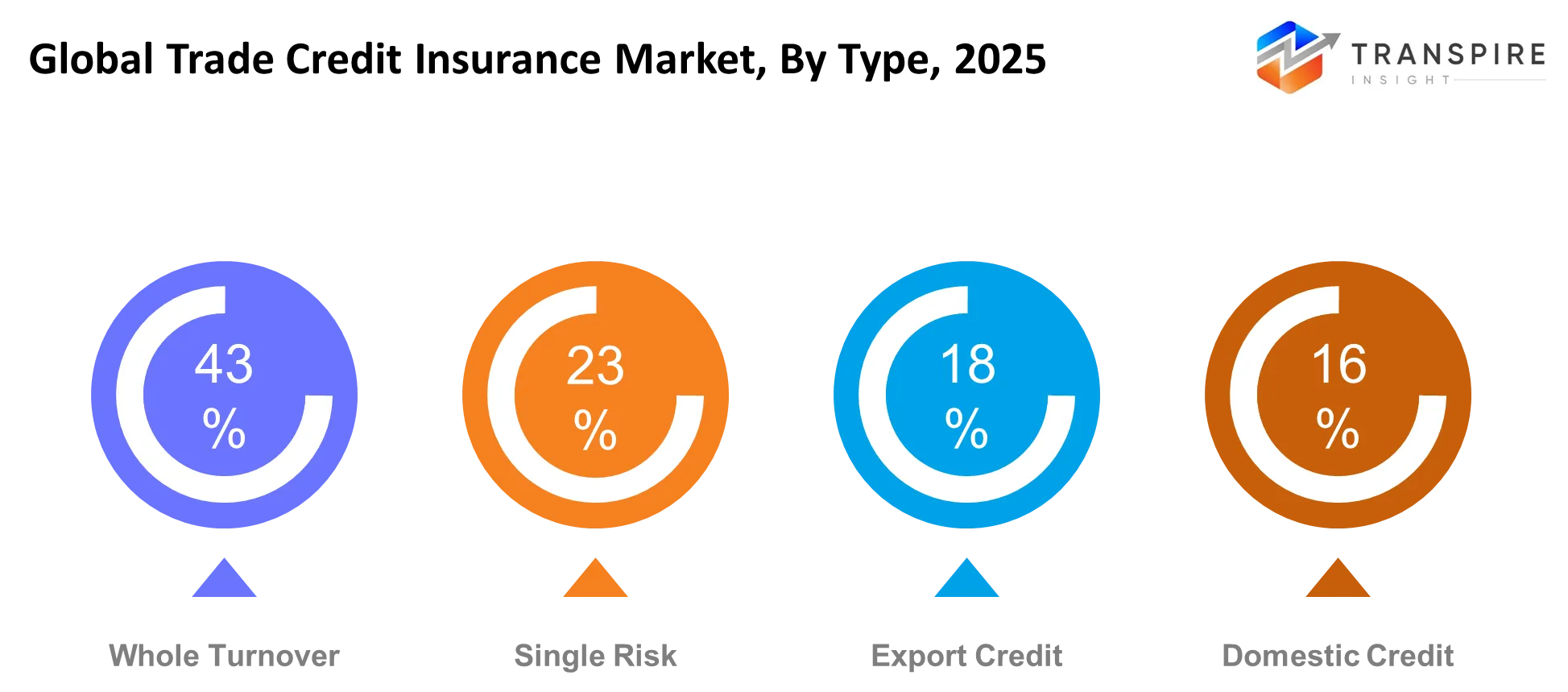
- Total portfolio insurance represents 43% of premium volume in the region, making Allianz Trade and Coface adopt ERP integration solutions in order to avoid monthly manual reports.
- High-risk contract protection holds 23% market share by global volume, prompting insurance companies such as Chubb and Zurich to switch from limit-based insurance programs to monitoring via digital channels.
- International transactions account for 18% of export coverage in cross-border dealmaking, making it imperative for brokers such as Aon and networks like Credendo to develop geopolitics-focused insurance packages.
- Buyer default solutions hold a 16% global market share of activity, forcing Atradius to integrate its trade financing solutions with corporate banks to monitor insolvent customers.
What are the Key Drivers, Restraints, and Opportunities in the Trade Credit Insurance Market?
Drivers
There is annual growth in the amount of international business that needs to be protected against the risk of non-payment. Also, there are developing countries, where the amount of international trade is growing every year; thus, they present wonderful opportunities for designing insurance products for new customers. Besides, the importance of protecting a company from payment risks and using credit insurance to avoid bankruptcy losses has become a key aspect in ensuring stable income. This is caused by the predicted growth in the amount of underwriting technology used to create custom-made policies.
Restraints
High claim ratios during economic downturns cause company default, thus making insurers raise their premiums and tighten their policies in order to ensure profitability. Secondly, low awareness among cost-constrained small and medium enterprises (SMEs) considers insurance as an unnecessary expenditure.
Opportunities
The organisation can grow by engaging in shared-risk partnerships that combine the structure of official agencies with the flexibility of private underwriters to mitigate supply chain disruptions and inflation. Changes in regulatory regimes like the IRDAI guidelines in India in 2021 give general insurers an opportunity to customise insurance packages for suppliers and banks to secure their trading finance portfolio.
What Has the Impact of Artificial Intelligence Been on the Trade Credit Insurance Market?
Generative AI revolutionises trade credit insurance through the automation of obsolete practices with modern, data-driven precision and speed.
It continuously analyses extensive financial documentation and international media reports. The cross-referencing of multiple data sources makes it possible for the technology to predict signs of distress in the buying entity's operations. The insights gained from the prediction improve the insurer's decision-making process, enabling it to avoid risks and minimise losses by making the correct coverage decisions.
This technology introduces operational optimisation through automation in the claims process. In the preliminary stage, it performs fact-checking, document sorting, and case organisation. The automatic processing of tasks reduces errors and increases efficiency, providing clients with prompt, reliable, and effective protection.
There is a significant technological barrier in terms of system integration. Introducing sophisticated predictive models into traditional insurance systems is challenging and may lead to technical issues in communication, exorbitant implementation fees, and prolonged deployment timelines. AI continuously analyses financial documents and media reports to predict signs of financial distress in a buying entity. This allows insurers to make better coverage decisions, avoid high-risk situations, and minimise financial losses.
Key Market Trends:
- Customised Insurance Products vs Standardised Templates: Businesses are moving away from standardised frameworks and embracing customised insurance products designed to cater to particular weaknesses in the supply chain.
- Increased SME Risk Protection: Increased price transparency has led to more coverage among small and medium-sized businesses, who considered risk protection as something only large corporations could afford.
- Assessment of Real-Time Risks: The method of assessing risks has moved from using out-of-date financial information to assessing a buyer's liquidity at the moment of purchase.
- Flexible Pricing for Insurers: Insurers have abandoned the rigid annual pricing framework and introduced premiums based on changing economic situations.
- Improved Financial Statements: Executives use risk coverage as an opportunity to negotiate loan terms, converting risk coverage into a source of income.
- Open-Account Transactions: Increasing geopolitical uncertainty has encouraged international exporters to move away from high-risk open-account transactions to fully protected transactions.
- Protection of North American Assets: Localised instruments such as accounts receivable insurance in Canada are used to protect business finances from defaults by partners.
- Proactive Partner Management: Modern credit management involves the detection of potential bankruptcy among partners prior to placing orders.
- Digitalisation of Client Intake Procedures: The manual documentation process has been replaced with full automation of the intake process.
Global Trade Credit Insurance Market Segmentation:
By Type
Whole turnover insurance is becoming widespread as companies protect themselves against the risk of bankruptcy. Whole Turnover – 58%, Whole Turnover – 43%, Whole Turnover 43%. The insurance of selective debtors is gaining popularity with the rapid development in this market niche, which targets small and medium-sized organisations unable to provide insurance for all their customers due to financial constraints. Single Risk – Insurance has become one of the major segments of global markets, as companies require this coverage to protect their single-risk deals against selected defaults. Single Risk – CAGR 16.3%, dominant, Single Risk 23%. Insurance for multi-risk exposures becomes dominant, as it covers the international supply chain. Export Credit 18%, Domestic Credit 16%.
To learn more about this report, Download Free Sample Report
By Application
In relation to SMEs, trade credit insurance plays a crucial role in protection, where most use flexible premium structures based on sales volume, whereas a certain category uses fixed premiums to offer an estimate of the cost of obtaining loan facilities. The big companies protect their large portfolio using a combination approach, where flexible premiums are used for transaction risk, and fixed premiums are used for longer projects. In trade finance, it serves as basic security where banks can be assured of the payment and hence release money through a combination of flexible and fixed premiums for short-term and structured loans, respectively. For the supply chain, it ensures that the buyer’s failure to pay does not paralyse the whole logistics system.
By End-User
Manufacturers safeguard their initial outlay on the raw materials through flexible premiums, which depend on the inventory and actual exposure to risk during seasons, in addition to fixed premiums for consistent contracts. Exporters insulate themselves against potential delays and political risks inherent in international trade by using flexible premiums for risky emerging regions and fixed premiums for shipping through safe channels. The trader uses it when trading with very thin margins but large volumes, where daily risks vary tremendously, using flexible premiums for fast-moving products and fixed premiums to secure minimum margins.
What Are the Key Use Cases Driving the Trade Credit Insurance Market?
The main use case for trade credit insurance is to protect national accounts receivable against the risk of bankruptcy or prolonged default. The need for such protection is particularly pronounced in industries like manufacturing, wholesale, and construction, where businesses face significant open-account risks and a single large client can trigger a financial catastrophe.
Newer use-cases centre around the optimisation of international business logistics. The practice among foreign exporters is to use this insurance to facilitate their international business transactions, ensuring that their companies' finances do not suffer from volatile market conditions and geopolitical uncertainties.
Future use cases entail digitisation. It has become common practice to monitor trade credit policies in real time, thereby allowing the assessment of credit risk for buyers.
|
Report Metrics |
Details |
|
Market size value in 2025 |
USD12.83 Billion |
|
Market size value in 2026 |
USD14.3 Billion |
|
Revenue forecast in 2033 |
USD 30.9 Billion |
|
Growth rate |
CAGR of 11.64% from 2026 to 2033 |
|
Base year |
2025 |
|
Historical data |
2021 - 2024 |
|
Forecast period |
2026 - 2033 |
|
Report coverage |
Revenue forecast, competitive landscape, growth factors, and trends |
|
Regional scope |
United States; Canada; Mexico; United Kingdom; Germany; France; Italy; Spain; Denmark; Sweden; Norway; China; Japan; India; Australia; South Korea; Thailand; Brazil; Argentina; South Africa; Saudi Arabia; United Arab Emirates |
|
Key company profiled |
Euler Hermes, Atradius, Coface, AIG, Allianz Trade, QBE, Zurich Insurance, AXA, Chubb, Tokio Marine, Credendo, ICICI Lombard, HDFC Ergo, Liberty Mutual, Marsh |
|
Customization scope |
Free report customisation (country, regional & segment scope). Avail customised purchase options to meet your exact research needs. |
|
Report Segmentation |
By Type (Whole Turnover, Single Risk, Export Credit, Domestic Credit), By Application (SMEs, Large Enterprises, Trade Finance, Supply Chain), By End-User (Manufacturers, Exporters, Traders, Financial Institutions) |
Which Regions Are Driving the Growth of The Trade Credit Insurance Market?
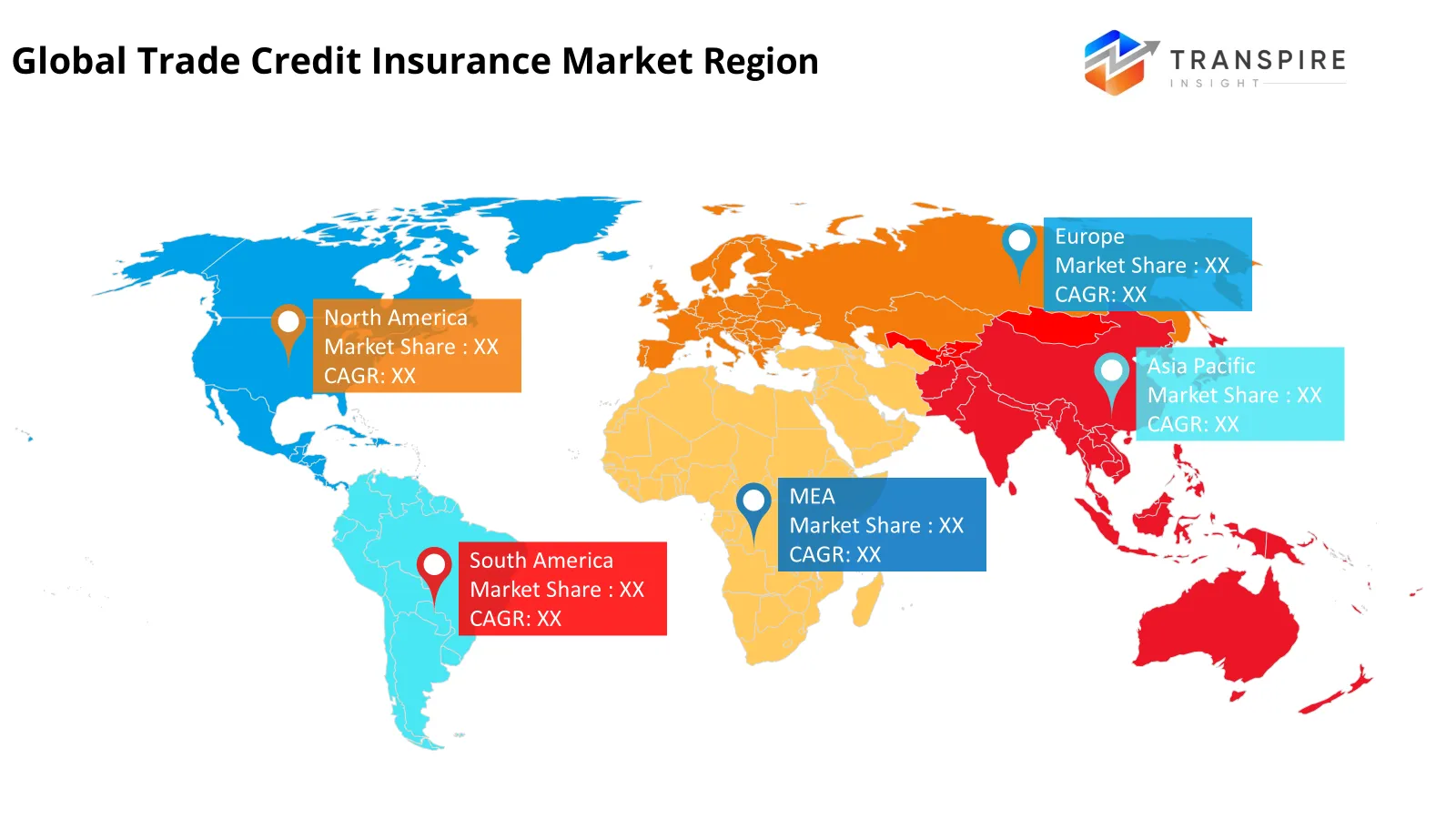
Taking up the largest share of 38%, North America's dominance is a result of heavy reliance on risk management and receivables protection system. The very highly developed business environment creates an enormous need for financial security in view of growing business activities and economic stability. In addition, well-established legal systems provide motivation for businesses in the USA and Canada to secure their cash flows from any defaults. The underwriters made direct integrations of the embedded software with the company’s accounting systems to obtain instant risk clearance at the time of the transaction for US and Canadian managers via Coface Integration.
The second-largest in terms of its 25% share of the global market, Europe is the fastest-growing region at a CAGR of 17.9%. This can be attributed to the conventional approach of corporates towards risk management as well as existing international business relations. Thanks to a stable macroeconomic environment and favourable local regulations, German, French, and Dutch corporates prudently consider their insurance options. Europe Green2Green Initiative: Allianz Trade established specific lines of green insurance in major centres in Europe that insured renewable energy projects and invested the premiums in sustainable bonds.
In the Asia-Pacific region, 22% of the world market share is accounted for by significant changes in purchasing power, driven by increased consumption, the growth of the middle class, and trade policies. In the Rest of the World, 15% of the world market share is accounted for. The region is mainly characterised by the development of major countries such as China and India. Asia-Pacific Vietnam Hub Initiative. The trade underwriters built their own dedicated corporate network branches within the Ho Chi Minh city centre to cover their expanding trade activities and exports.
To learn more about this report, Download Free Sample Report
Who are the Key Players in the Global Trade Credit Insurance Market and how do they Compete?
There is moderate fragmentation within the trade credit insurance industry. Competitive strategies in the trade credit insurance sector have moved away from pricing wars and toward technology and regional customer service. To develop effective client relationships and protect the supply chain, businesses adopt regionalisation and corporate collaboration.
Euler Hermes applies an innovation strategy that differentiates its business model by incorporating data analytics and predictive modelling into its risk assessment framework. Its growth strategy employs these digital technologies for more efficient underwriting decisions. On the other hand, Coface adopts a niche strategy, differentiating its business by introducing a new digital platform to accelerate claim processing for its customers. The company's expansion strategy includes establishing new business setups in emerging markets.
Atradius adopts an innovation strategy, whereby it differentiates its services through corporate alliances between financial and technology firms for improved customer experience. Its growth strategy entails entering high-growth regions; for instance, it establishes a new office in Singapore for customised services to companies in the Asia-Pacific region.
Global Trade Credit Insurance Market Companies
- Euler Hermes
- Atradius
- Coface
- AIG
- Allianz Trade
- QBE
- Zurich Insurance,
- AXA
- Chubb
- Tokio Marine
- Credendo
- ICICI Lombard
- HDFC Ergo
- Liberty Mutual
- Marsh
Recent Development News
In July 2025, the specialised Trade Credit Insurance division of DUAL Europe was established across Europe. The introduction of this new product is meant to provide localised additional coverage for mid-market brokers against potential cross-border payment default risks. https://www.howdengroupholdings.com
In May 2026, Goldman Sachs Alternatives purchased FGI Worldwide LLC, a major player in commercial finance and trade credit insurance brokerage. The acquisition will boost the capabilities of FGI’s proprietary insurance management system, along with Goldman’s role in private credit and working capital around the world. https://am.gs.com
What Strategic Insights Define the Future of the Trade Credit Insurance Market?
The market is shifting towards cloud-based technologies, with a growing demand for digitised credit management both internationally and domestically. Apart from interest rates, the true danger is a sequence of corporate
bankruptcies, when an inevitable collapse of one firm leads to the collapse of all those connected with the firm through the complex supply chain. The promising area here is automatic data analysis services, which can help companies design effective underwriting protection strategies that identify potential liquidity issues before they arise. Companies should abandon outdated techniques and focus on designing flexible cloud security systems for SMEs.
Global Trade Credit Insurance Market Report Segmentation
By Type
- Whole Turnover
- Single Risk
- Export Credit
- Domestic Credit
By Application
- SMEs
- Large Enterprises
- Trade Finance
- Supply Chain
By End-User
- Manufacturers
- Exporters
- Traders
- Financial Institutions
Regional Outlook
North America
- United States
- Canada
- Mexico
Europe
- Germany
- United Kingdom
- France
- Spain
- Italy
- Rest of Europe
Asia Pacific
- Japan
- China
- Australia & New Zealand
- South Korea
- India
- Rest of Asia Pacific
South America
- Brazil
- Argentina
- Rest of South America
Middle East & Africa
- Saudi Arabia
- United Arab Emirates
- South Africa
- Rest of the Middle East & Africa
Frequently Asked Questions
Find quick answers to common questions.
The expected global trade credit insurance market size for the market will be USD 30.9 Billion in 2033.
Key segments for the global trade credit insurance market are by Type (Whole Turnover, Single Risk, Export Credit, Domestic Credit), by Application (SMEs, Large Enterprises, Trade Finance, Supply Chain), by End-User (Manufacturers, Exporters, Traders, Financial Institutions).
Major global trade credit insurance market players are Allianz Trade (formerly Euler Hermes), Atradius N.V., Coface, American International Group, Inc. (AIG), Zurich, Chubb, QBE Insurance Group Limited, Great American Insurance Company, Aon plc, and Credendo.
The global trade credit insurance market size is USD 12.83 Billion in 2025.
The global trade credit insurance market CAGR is 11.64%.
- Euler Hermes
- Atradius
- Coface
- AIG
- Allianz Trade
- QBE
- Zurich Insurance,
- AXA
- Chubb
- Tokio Marine
- Credendo
- ICICI Lombard
- HDFC Ergo
- Liberty Mutual
- Marsh
About the Authors

Mayur Shinde
I am Mayur Shinde, a Senior Research Analyst at Transpire Insight, specializing in the Automotive & Transportation and Information & Communication Technology (ICT) Industry. My work focuses on analyzing emerging market trends, technological advancements, competitive landscapes, and industry developments to deliver accurate, data-driven insights. I am passionate about transforming complex market information into clear, actionable content that helps businesses, professionals, and decision-makers stay informed and make confident strategic decisions.

Chakradhar Khansole
Chakradhar serves as the Research Director at Transpire Insight, bringing over 8 years of experience in technology, innovation, and strategic market intelligence. He specializes in transforming complex market data into actionable business insights that enable organizations to make informed, growth-oriented decisions. Recognized for his strategic vision and analytical expertise, Chakradhar leads high-impact research initiatives, delivering comprehensive market assessments, competitive intelligence, and forward-looking industry analysis.
Recently Published Reports
-
Apr 2026
3D Optical Profiler Market
3D Optical Profiler Market Size, Share & Analysis Report By Type (Desktop 3D Optical Profiler, and Portable 3D Optical Profiler), By Technology (Confocal Technology, and White Light Interference), By End-Use Industry (Manufacturing, Research Institutions, Automotive, Aerospace and Defense, Medical Devices, and Other), and Geography (North America, Europe, Asia-Pacific, Middle East and Africa, South and Central America), 2021 - 2031
-
Apr 2026
Depth Sensor Market
Depth Sensor Market Size, Share & Analysis Report By Type (Infrared Depth Sensors, Time-of-Flight (ToF) Sensors, Stereo Vision Sensors, Structured Light Sensors, Ultrasonic Depth Sensors), By Application (Automotive, Robotics, Gaming, Consumer Electronics, Industrial Automation, Healthcare, Security & Surveillance, Others), By End Users (Automotive Manufacturers, Consumer Electronics Companies, Healthcare Providers, Industrial Companies, Security Agencies, Gaming Companies, Robotics Companies, Others), and Geography (North America, Europe, Asia-Pacific, Middle East and Africa, South and Central America), 2021 – 2031
-
Apr 2026
Digital Manufacturing Market
Digital Manufacturing Market Size, Share & Analysis Report By Component (Hardware, Software, and Services), By Technology (Robotics, 3D Printing, Internet of Things (IoT), and Others), By Application (Automotive and Transportation, Aerospace and Defense, Consumer Electronics, Industrial Machinery, and Others), By Process Type (Computer-Based Designing, Computer-Based Simulation, Computer 3D Visualization, Analytics, and Others), and Geography (North America, Europe, Asia-Pacific, Middle East and Africa, South and Central America), 2021 – 2031
-
Apr 2026
Digital Visa Services Market
Digital Visa Services Market Size, Share & Analysis Report By Type (Individual Travelers, Group Travelers), By Application (Tourism, Business Travel, Others), and Geography (North America, Europe, Asia-Pacific, Middle East and Africa, South and Central America), 2021 – 2031