

North America Digital Insurance Platform Market Size & Forecast:
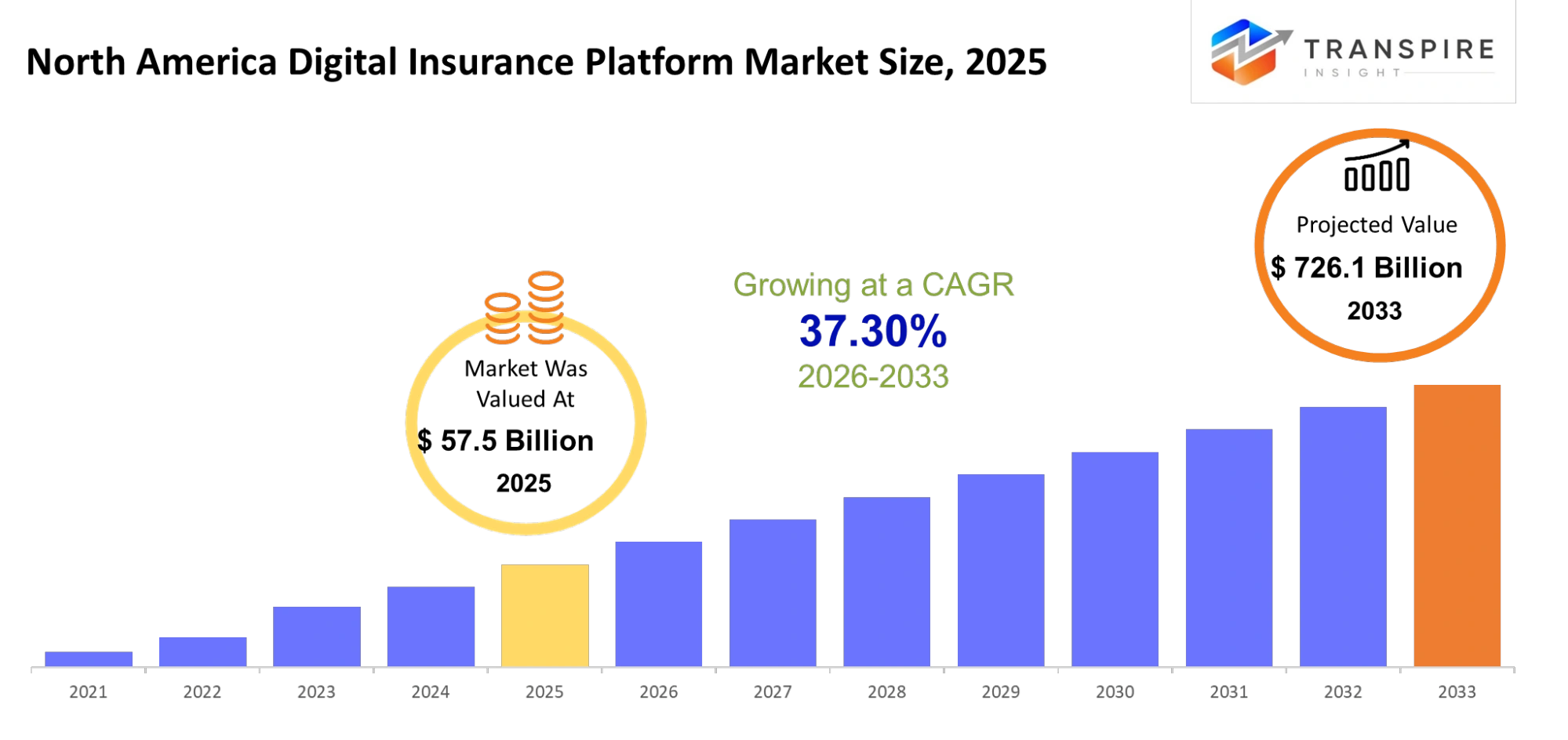
- North America Digital Insurance Platform Market Size 2025: USD 57.5 Billion
- North America Digital Insurance Platform Market Size 2033: USD 726.1 Billion
- North America Digital Insurance Platform Market CAGR: 37.30%
- North America Digital Insurance Platform Market Segments: By Component (Software, Services), By Deployment (Cloud, On-Premise), By Application (Policy Management, Claims Management, Customer Engagement), By End-User (Insurance Companies).
To learn more about this report,  Download Free Sample Report
North America Digital Insurance Platform Market Summary:
The North America Digital Insurance Platform Market size is estimated at USD 57.5 Billion in 2025 and is anticipated to reach USD 726.1 Billion by 2033, growing at a CAGR of 37.30% from 2026 to 2033. The market for digital insurance platforms in North America which includes Canada and the United States and Mexico will experience a shift in the financial technology sector as insurance companies start to operate their businesses according to digital-first standards. Customers will request quicker onboarding processes together with customized coverage options and uninterrupted claims processing which will force service providers to upgrade their existing systems. Insurance companies will begin implementing cloud-native architecture, along with embedded analytics and API-driven ecosystems. Regulatory bodies will persist in their efforts to promote transparency and data protection which will influence how platforms should be designed and implemented. Insurers will focus on developing scalable platforms which enable them to meet changing customer needs while complying with various national regulations as cross-border digital services grow.
Key Market Trends & Insights:
The digital platforms of the future will provide insurance solutions which will adapt to the individual needs of their clients. Insurers will use behavioral data, wearable integrations, and real-time analytics to create customized insurance solutions which match the needs of each customer. Customers will demand immediate premium changes together with usage-based pricing systems which will particularly impact the fields of automobile insurance and health insurance according to their usage patterns. This demand will force companies to develop new pricing methods and ways of interacting with their customers.
The primary insurance operations will undergo transformation through automation which uses artificial intelligence to enhance both underwriting and claims processing. Pattern recognition technology will enhance fraud detection accuracy while decreasing the necessity for human involvement. Intelligent workflow systems will receive funding from insurers because these systems help organizations finish tasks quicker while they improve their physical capacity to operate throughout various online platforms.
Insurers will establish partnership ecosystems to work together with fintech companies, healthcare organizations, and e-commerce businesses. Embedded insurance currently allows digital purchase journeys to deliver coverage protection which will become more common in the future. Insurers will gain access to vital customer decision moments because this transformation will create insurance products which customers can instantly access.
The regulatory changes which happen in Canada, the United States, and Mexico will determine how organizations design their platform systems and control their data management operations. Insurers will implement secure modular systems because the new data privacy regulations and international compliance standards require them to do so. Platforms will be built to provide operational flexibility which enables organizations to meet future changes in legal requirements and consumer protection standards.
North America Digital Insurance Platform Market Segmentation
By Component
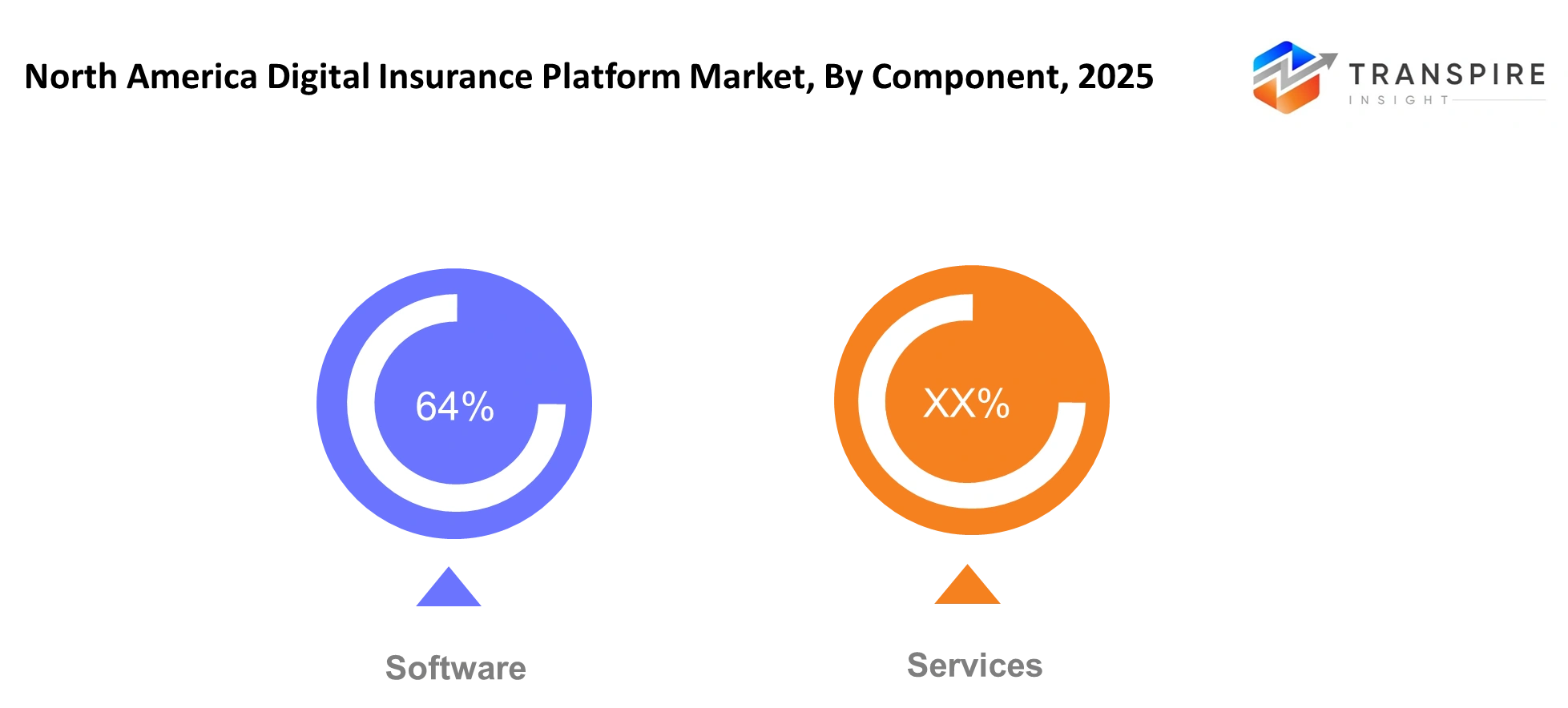
Software- Digital insurance platforms will use software as their foundational element, which enables insurers to handle underwriting, claims and customer interactions through integrated systems. The solutions will combine advanced analytics with automation tools and real-time data processing capabilities. Insurers will prefer modular software solutions which allow rapid customization and updates because this enables them to meet evolving customer needs and comply with changing regulations.
Services- Digital platforms will receive deployment, maintenance and optimization support through the services, which will help insurers' digital platforms. Organizations will use consulting and system integration, and managed services to move from their existing legacy systems into more flexible operational environments. Providers will maintain platform security and performance through their ongoing upgrades and technical assistance. Insurers will depend more on specialized service partners to manage their digital transformation process as operational complexity grows.
To learn more about this report, Download Free Sample Report
By Deployment
Cloud- Insurers will adopt cloud deployment solutions because they need systems that deliver both flexibility and scalability and cost savings. Companies can use the system to develop products at speed while managing varying operational demands and employing new technologies without incurring major initial expenses. Cloud-based platforms will bolster teamwork among remote users while enabling insurers to access the system from any location which meets their diverse customer requirements across different geographical areas.
On-Premise- Insurers who need complete authority over their data and infrastructure will continue to use on-premise deployment methods. Organizations which handle confidential data or work within healthcare-related regulations will choose to maintain their data protection systems within their own facilities. The systems will enable users to customize their setups while maintaining complete control over their operations, but this approach will result in increased operational expenses and decreased system enhancement speed when compared to cloud solutions.
By Application
Policy Management- The policy management solutions will provide organizations with tools that enable them to manage insurance policies throughout their complete lifecycle from initial creation until their final renewal. The platforms will handle documentation, pricing modifications, and compliance evaluations through automated processes, reducing manual errors. The system enables insurers to design adaptive policy frameworks that adapt to changing customer demands and market dynamics through its dynamic pricing capabilities.
Claims Management- The claims management systems will enhance claim processing through three main improvements, which are faster processing times and better visibility and more precise results. The combination of automation and data analytics will enable companies to complete verification processes more quickly, resulting in faster payments and fewer customer complaints. Digital claims workflows will become common for insurers because they provide customers with real-time tracking and self-service capabilities which build trust while decreasing operational expenses and protecting against fraud.
Customer Engagement- The customer engagement tools will change how insurers communicate with policyholders through their various digital platforms. The platforms will enable businesses to create personalized messages which combine chat-based customer support with automatic service notifications. Insurers will establish stronger connections with customers by providing them with uninterrupted experiences that they can access through mobile applications and online meeting platforms throughout their entire customer journey.
By End-User
Insurance Companies- The main users of digital insurance platforms will be insurance companies because they use these platforms to update their business operations and enhance their service delivery methods. The company plans to spend money on complete system solutions that will connect all of its departmental data resources for improved decision-making capabilities. Insurers will use digital platforms to achieve two goals which involve increasing their operational efficiency and decreasing their business expenses while delivering quicker insurance services with better transparency to customers who expect these improvements.
Regional Insights
The United States will lead regional adoption as insurers accelerate digital transformation to meet rising expectations for speed and personalization. Established carriers will modernize their existing systems by implementing cloud-based solutions and advanced analytical technologies. The need for consumers to have uninterrupted mobile access will determine how platforms should be developed while data privacy regulations will dictate how insurers should handle and protect their confidential information.
The Canadian economy will experience consistent growth because of clear regulations and its dedication to developing customer-focused innovative solutions. Insurers will implement digital platforms to enhance transparency and simplify their policy administration procedures. Regional requirements and bilingual service needs will determine the necessary platform customizations. Companies will focus on secure data management which complies with national privacy standards while developing digital accessibility solutions for their customers.
Insurers in Mexico will launch new digital capabilities which will assist them in serving previously neglected communities. Mobile-first strategies will play a key role, enabling easier access to insurance products. Local insurers will invest in scalable platforms to support rapid onboarding and simplified claims processes which will help build trust with first-time policyholders while streamlining operations.
North American insurance companies will develop their software platforms through cross-border operations which will require them to create flexible systems that operate under different regulatory systems. Digital collaboration between partners will increase, supporting embedded insurance models. Insurers across the region will develop insurance solutions that combine technology with responsive service to meet changing customer expectations.
Recent Development News
Consolidation and Digital Platform Expansion
Recent developments in the United States highlight a shift toward consolidation and platform-driven scale. A major merger between two large insurers is expected to create a stronger entity with expanded digital capabilities and customer reach. This move will support integrated platforms handling retirement, life, and asset services more efficiently.
Tokenization and Real-Time Financial Integration
Canada is witnessing innovation through the introduction of tokenized financial systems by major banks. These platforms will enable real-time settlements and programmable transactions, influencing how insurance payments and claims processing evolve. Such integration will push insurers to align with blockchain-enabled ecosystems, improving transaction speed, transparency, and cross-platform compatibility.
|
Report Metrics |
Details |
|
Market size value in 2025 |
USD 57.5 Billion |
|
Market size value in 2026 |
USD 78.95 Billion |
|
Revenue forecast in 2033 |
USD 726.1 Billion |
|
Growth rate |
CAGR of 37.30% from 2026 to 2033 |
|
Base year |
2025 |
|
Historical data |
2021 – 2024 |
|
Forecast period |
2026 – 2033 |
|
Report coverage |
Revenue forecast, competitive landscape, growth factors, and trends |
|
Regional scope |
North America (Canada, The United States, and Mexico) |
|
Key company profiled |
Guidewire Software Inc., Duck Creek Technologies, Majesco, SAP SE, Oracle Corporation, IBM Corporation, Microsoft Corporation, Accenture plc, Cognizant Technology Solutions Corp., Infosys Ltd., Tata Consultancy Services Ltd., DXC Technology Company, Capgemini SE, Wipro Limited, EIS Group Ltd. |
|
Customization scope |
Free report customization (country, regional & segment scope). Avail customized purchase options to meet your exact research needs. |
|
Report Segmentation |
By Component (Software, Services), By Deployment (Cloud, On-Premise), By Application (Policy Management, Claims Management, Customer Engagement), By End-User (Insurance Companies). |
Key North America Digital Insurance Platform Market Company Insights
The digital insurance platform market in North America which includes Canada and the United States and Mexico will see its top companies create expanded systems that combine analytics and automation with customer service solutions. Companies will dedicate resources to develop their digital capabilities through partnerships and cloud-native technology investments. The market competition will focus on three main areas which include how customers experience the product and how quickly companies implement their solutions and how businesses modify their systems to meet different market demands.
Company List
- Guidewire Software Inc.
- Duck Creek Technologies
- Majesco
- SAP SE
- Oracle Corporation
- IBM Corporation
- Microsoft Corporation
- Accenture plc
- Cognizant Technology Solutions Corp.
- Infosys Ltd.
- Tata Consultancy Services Ltd.
- DXC Technology Company
- Capgemini SE
- Wipro Limited
- EIS Group Ltd.
North America Digital Insurance Platform Market Report Segmentation
By Component
- Software
- Services
By Deployment
- Cloud
- On-Premise
By Application
- Policy Management
- Claims Management
- Customer Engagement
By End-User
- Insurance Companies
Frequently Asked Questions
Find quick answers to common questions.
The approximate North America Digital Insurance Platform Market size for the market will be USD 726.1 Billion in 2033.
Key segments for the North America Digital Insurance Platform Market By Component (Software, Services), By Deployment (Cloud, On-Premise), By Application (Policy Management, Claims Management, Customer Engagement), By End-User (Insurance Companies).
Major players in the North America Digital Insurance Platform Market are Guidewire Software Inc., Duck Creek Technologies, Majesco, SAP SE, Oracle Corporation, IBM Corporation, Microsoft Corporation, Accenture plc, Cognizant Technology Solutions Corp., Infosys Ltd., Tata Consultancy Services Ltd., DXC Technology Company, Capgemini SE, Wipro Limited, EIS Group Ltd.
The North America Digital Insurance Platform Market size is USD 57.5 Billion in 2025.
The North America Digital Insurance Platform Market CAGR is 37.30%.
- Guidewire Software Inc.
- Duck Creek Technologies
- Majesco
- SAP SE
- Oracle Corporation
- IBM Corporation
- Microsoft Corporation
- Accenture plc
- Cognizant Technology Solutions Corp.
- Infosys Ltd.
- Tata Consultancy Services Ltd.
- DXC Technology Company
- Capgemini SE
- Wipro Limited
- EIS Group Ltd.
Recently Published Reports
-
Apr 2026
3D Optical Profiler Market
3D Optical Profiler Market Size, Share & Analysis Report By Type (Desktop 3D Optical Profiler, and Portable 3D Optical Profiler), By Technology (Confocal Technology, and White Light Interference), By End-Use Industry (Manufacturing, Research Institutions, Automotive, Aerospace and Defense, Medical Devices, and Other), and Geography (North America, Europe, Asia-Pacific, Middle East and Africa, South and Central America), 2021 - 2031
-
Apr 2026
Depth Sensor Market
Depth Sensor Market Size, Share & Analysis Report By Type (Infrared Depth Sensors, Time-of-Flight (ToF) Sensors, Stereo Vision Sensors, Structured Light Sensors, Ultrasonic Depth Sensors), By Application (Automotive, Robotics, Gaming, Consumer Electronics, Industrial Automation, Healthcare, Security & Surveillance, Others), By End Users (Automotive Manufacturers, Consumer Electronics Companies, Healthcare Providers, Industrial Companies, Security Agencies, Gaming Companies, Robotics Companies, Others), and Geography (North America, Europe, Asia-Pacific, Middle East and Africa, South and Central America), 2021 – 2031
-
Apr 2026
Digital Manufacturing Market
Digital Manufacturing Market Size, Share & Analysis Report By Component (Hardware, Software, and Services), By Technology (Robotics, 3D Printing, Internet of Things (IoT), and Others), By Application (Automotive and Transportation, Aerospace and Defense, Consumer Electronics, Industrial Machinery, and Others), By Process Type (Computer-Based Designing, Computer-Based Simulation, Computer 3D Visualization, Analytics, and Others), and Geography (North America, Europe, Asia-Pacific, Middle East and Africa, South and Central America), 2021 – 2031
-
Apr 2026
Digital Visa Services Market
Digital Visa Services Market Size, Share & Analysis Report By Type (Individual Travelers, Group Travelers), By Application (Tourism, Business Travel, Others), and Geography (North America, Europe, Asia-Pacific, Middle East and Africa, South and Central America), 2021 – 2031