

Global Thermal Insulation Paint Market Size & Forecast:
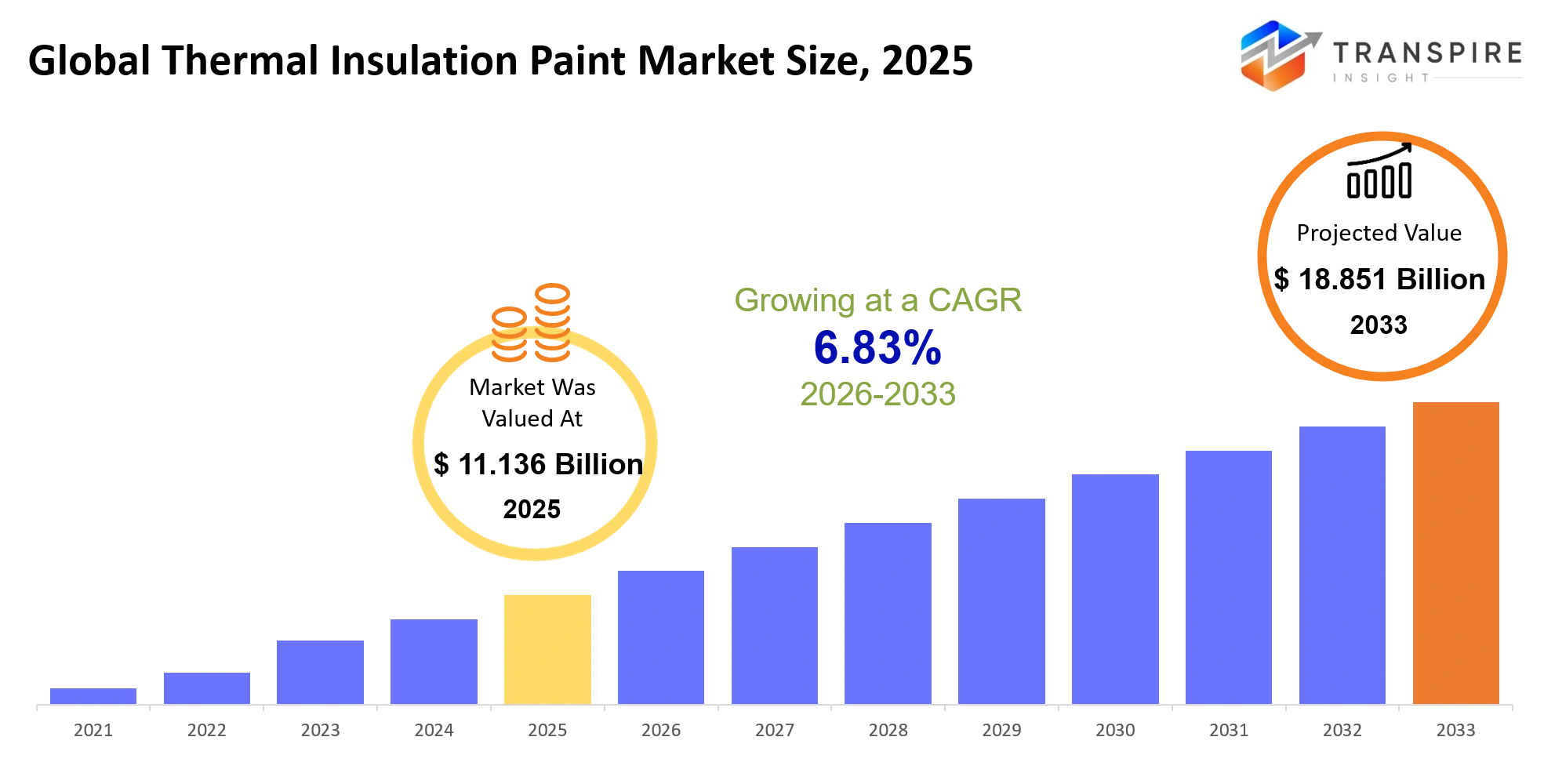
- Global Thermal Insulation Paint Market Size 2025: USD 11.136 Billion
- Global Thermal Insulation Paint Market Size 2033:USD 18.851 Billion
- Global Thermal Insulation Paint Market CAGR: 6.83%
- Global Thermal Insulation Paint Market Segments: By Type (Ceramic Insulation Paints, Acrylic Insulation Paints, Reflective Insulation Paints, Elastomeric Insulation Paints, Nano-insulation Paints, Heat-resistant Coatings, Others); By Application (Residential Buildings, Commercial Buildings, Industrial Equipment, Automotive Applications, Roofing Systems, Others); By End-User (Construction Companies, Industrial Manufacturers, Automotive OEMs, Others); By Formulation (Water-based Paints, Solvent-based Paints, Hybrid Coatings, Eco-friendly Paints, Others).
Global Thermal Insulation Paint Market Summary:
As per Transpire Insight Analysis, the Global Thermal Insulation Paint Market size is estimated at USD 11.136 Billion in 2025 and is anticipated to reach USD 18.851 Billion by 2033, growing at a CAGR of 6.83% from 2026 to 2033. The market revolves around coatings that limit the flow of heat through building structures, machinery, transport systems, and other infrastructures to save on energy costs and expenses. In recent years, the industry has experienced a transition from the use of traditional reflective coatings to advanced and sustainable nanotechnology and multifunctional insulating solutions, owing to the introduction of strict energy-saving measures and sustainability policies. Increased fuel prices and the demand for energy-efficient buildings have served as catalysts in driving change within the industry. The development of the market has been facilitated by industries and the construction sector focusing on energy savings and reduction in carbon footprint.
Global Thermal Insulation Paint Market Insights:
In the Global Thermal Insulation Paint Market, there has been an increasing transition from conventional thermal insulations to coatings due to the emphasis on energy conservation and sustainability. This growth in demand will be aided by rising regulations, modernization of industries, and usage of low-carbon solutions.
- Usage in the Building & Construction Sector is expected to comprise around 35-40% of demand, owing to increased use of thermal coatings for better building performance.
- Low Volatile Organic Compound (VOC) coatings represent around 55%+ market share due to the preference of consumers towards sustainable coatings.
- Coatings based on nanotechnology are gaining popularity, with manufacturers focusing more on ceramic microspheres and multiple functionality thermal insulators.
- The industrial sector accounts for 25–30% market share, owing to growing consumer interest in minimizing heat loss in pipelines, tanks, and other industries.
- The share in Asia-Pacific stands at more than 40%, due to fast urbanization, increased infrastructural investments, and rapid industrial growth initiatives.
- There is an increasing trend towards introduction of reflective and intelligent coating technologies that can help with insulating purposes along with being resistant to corrosion and moisture.
- Escalating energy costs have changed the purchasing dynamics; commercial buildings and factories have started using insulation coatings for minimizing expenses in the long run.
- Increasing applications in the automotive and transport industry due to light-weighted thermal insulation solutions that aid in boosting performance.
- Technological developments are making it possible for producers to manufacture thinner coatings with better thermal and durable characteristics.
What are the Key Drivers, Restraints, and Opportunities in the Global Thermal Insulation Paint Market?
Driver:
The key market driver of the Global Thermal Insulation Paint Market is the rising emphasis on cutting down energy losses in various applications, including building construction, industries, and transport. Higher electricity rates, stringent building regulations, and the need for carbon reduction have prompted the usage of energy-efficient products. The catalyst behind such developments is the rising number of sustainability guidelines and investment into energy-efficient construction projects. With the aim to cut down expenses, more companies are adopting insulation coatings for managing heat flow, which is fostering greater demand and generating new revenue streams.
Restraint:
The high cost of production and uncertainty about performance levels represent significant obstacles to market penetration. Thermal insulation paints usually tend to be more expensive compared to regular paints and are also likely to compete with well-established insulation products like mineral wool and foam. This is due to the fact that performance varies according to the weather, application process, and surface.
Opportunity:
There are considerable future prospects for nanotechnology coatings and smart insulation materials. The development of ceramic microsphere technology along with the rising trend in sustainable infrastructure investments in Asia Pacific and the Middle East will generate new revenue avenues. The combination of coatings with thermal insulation properties and corrosion resistance, as well as waterproof coatings, will open up additional applications.
What Has the Impact of Artificial Intelligence Been on the Global Thermal Insulation Paint Market?
The Artificial Intelligence technology is already making its mark on the Global Thermal Insulation Paint Market by way of advancements made to the materials formulae, production process, and application analysis. The use of artificial intelligence material modeling software is becoming common for the quick development of thermal insulating paints by analyzing data about their thermal conductivity, durability, and environmental friendliness.
With the help of AI-enabled automation systems, the manufacturing process has been optimized for efficient operation by optimizing mixing of raw materials, consistency in coating application, and quality assurance.
Predictive abilities have gained significance due to advances made in AI-powered analytical models that can help businesses predict the performance of their coatings in different temperatures, humidities, and environments. Predictions will help users make appropriate plans regarding their maintenance strategies and maximize insulation performance in the future. In March 2026, various coating manufacturers enhanced their spending on AI-powered formulation technologies aimed at accelerating the production process of nanoceramic coatings. In January 2026, producers of industrial coatings have become more interested in using predictive analytics solutions to enhance production accuracy and optimize energy use during the coating production process.
Global Thermal Insulation Paint Market Trends:
Thermal Insulation Paints Market trends indicate a transition from the traditional ways of insulation to high-performance coating systems which offer energy savings as well as provide multi-functional benefits. The industry is witnessing increased attention toward sustainability and performance optimization with the use of coatings.
- In recent years, there has been an observable shift in demand from conventional insulation products to coating-based systems because of the ease and lower maintenance needs.
- There has also been a trend among manufacturers who are now replacing acrylic-based paints with coatings using nanoceramics and microspheres, providing better insulation properties while minimizing coating thickness.
- Property owners have changed their buying patterns as they are paying more attention to energy-efficient products which reduce their electricity bills as compared to the installation costs.
- There is increased use of multifunctional coatings by industrial consumers that offer features of thermal insulation, corrosion protection, waterproofing, and surface protection.
- Pressure to comply with sustainability standards has led to an increased shift from solvent-based to water-based products for coating.
- Smart manufacturing processes are increasingly employed to enhance the formulation and performance of coating products, minimize waste, and increase consistency.
- Infrastructure providers prefer coating insulation of existing buildings as opposed to installing new insulation for the purposes of insulation.
- The transport and mobility sector is increasingly preferring thermal insulating materials that can help reduce weight, thereby increasing fuel economy.
- Predictive and digital monitoring tools are increasingly common in industry for evaluating performance of coatings and optimizing maintenance intervals.
Global Thermal Insulation Paint Market Segmentation:
By Type
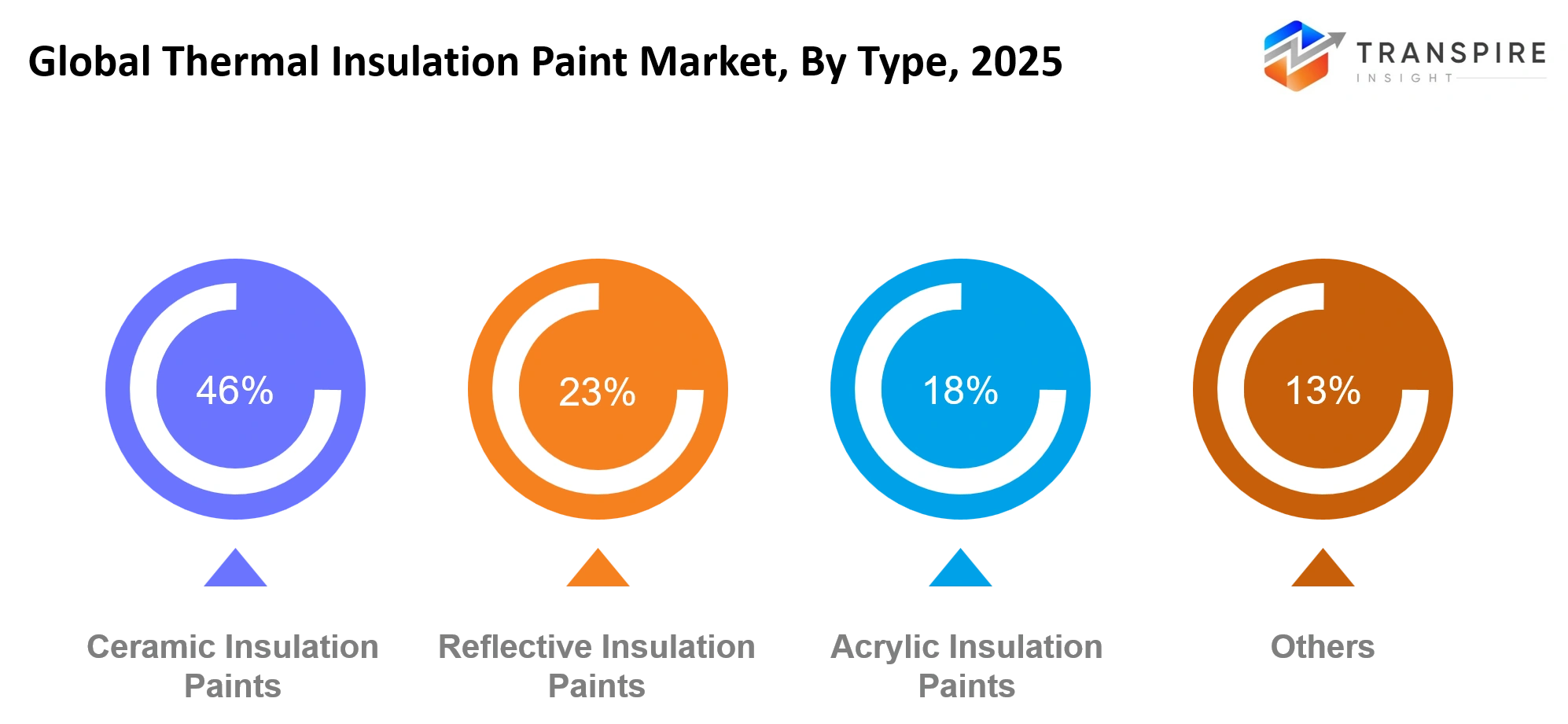
The current ceramic insulation paint enjoys an excellent position in the market owing to its enhanced thermal resistance capabilities and durability. The acrylic-based insulation paints enjoy increasing popularity owing to the ease of applicability and affordability, especially within domestic settings. The reflective and elastomeric insulation paints also enjoy increasing popularity since consumers now seek paints that combine weatherproof qualities along with their thermal properties. The area of nano-insulation paint also enjoys great development potentials since newer technologies enable increased energy efficiency with thinner coatings, thereby allowing sustained growth prospects in terms of high-end products.
By Application
Demand is primarily generated by residential and commercial buildings, as there is an increasing trend toward energy-efficient construction and upgrading efforts by property owners. The applications for industrial machinery are growing in importance, with more emphasis being laid on reducing losses of energy usage and cutting down equipment-maintenance costs. There are new growth opportunities in automotive applications, since manufacturers are looking to adopt light materials for thermal management purposes. Roofing systems are another application, given the use of reflective and insulating materials.
By End-User
Construction companies hold the biggest share in the market owing to infrastructure growth and sustainable construction projects. Industrial producers are increasingly taking up the material due to energy optimization within manufacturing processes. Automotive original equipment manufacturers (OEMs) will be increasingly using the coating in their operations due to lighter vehicles and better thermal efficiency systems.
By Formulation
The use of water-based paint products is more popular now owing to stringent environmental regulations and increasing demand for low-emission paint products. However, solvent-based products still have their importance where more durability and higher environmental resistance are necessary. Hybrid paint products, which exhibit various benefits in one paint product, are becoming popular nowadays. Eco-friendly paints are likely to grow more rapidly with changing market demands and trends.
What are the Key Use Cases Driving the Global Thermal Insulation Paint Market?
Energy Management in Residential and Commercial Structures is the key driver for the Global Thermal Insulation Paint Market. Energy saving in residential and commercial buildings has led to an increase in the number of insulation paint coatings that help reduce energy transmission through the wall, roof, or external parts of the building. Construction firms leverage such paint coats to boost their efficiency and save on cooling.
The new areas for usage are being developed in industrial manufacturing settings, where thermal insulation paints will be applied on pipelines, storage tanks, boilers, and other equipment to cut down the energy losses during operations. The automotive industry is also making its way into using insulation coating to improve temperature regulation and make vehicles lightweight.
Other possible applications include roof systems, smart infrastructure, and electric cars, all of which can benefit from multifunctional coatings with the capacity to insulate against heat and protect against moisture, corrosion, and wear. Nanotechnology-driven paint coatings offer yet another area of application.
|
Report Metrics |
Details |
|
Market size value in 2025 |
USD 11.136 Billion |
|
Market size value in 2026 |
USD 11.872 Billion |
|
Revenue forecast in 2033 |
USD 18.851 Billion |
|
Growth rate |
CAGR of 6.83% from 2026 to 2033 |
|
Base year |
2025 |
|
Historical data |
2021 - 2024 |
|
Forecast period |
2026 - 2033 |
|
Report coverage |
Market size, growth drivers, restraints, opportunities, competitive landscape, AI impact, trends, segmentation analysis, regional insights, company profiling, and future outlook. |
|
Regional scope |
North America, Europe, Asia-Pacific, Latin America, Middle East & Africa |
|
Key company profiled |
Akzo Nobel, Sherwin-Williams, PPG Industries, Nippon Paint, BASF, Kansai Paint, Axalta Coating Systems, Jotun, Asian Paints, Hempel, Berger Paints, RPM International, Sika, DAW SE, Teknos. |
|
Customization scope |
Customized segmentation, regional analysis, competitive benchmarking, company profiling, and additional country-level insights available |
|
Report Segmentation |
By Type (Ceramic Insulation Paints, Acrylic Insulation Paints, Reflective Insulation Paints, Elastomeric Insulation Paints, Nano-insulation Paints, Heat-resistant Coatings, Others); By Application (Residential Buildings, Commercial Buildings, Industrial Equipment, Automotive Applications, Roofing Systems, Others); By End-User (Construction Companies, Industrial Manufacturers, Automotive OEMs, Others); By Formulation (Water-based Paints, Solvent-based Paints, Hybrid Coatings, Eco-friendly Paints, Others). |
Which Regions are Driving the Global Thermal Insulation Paint Market Growth?
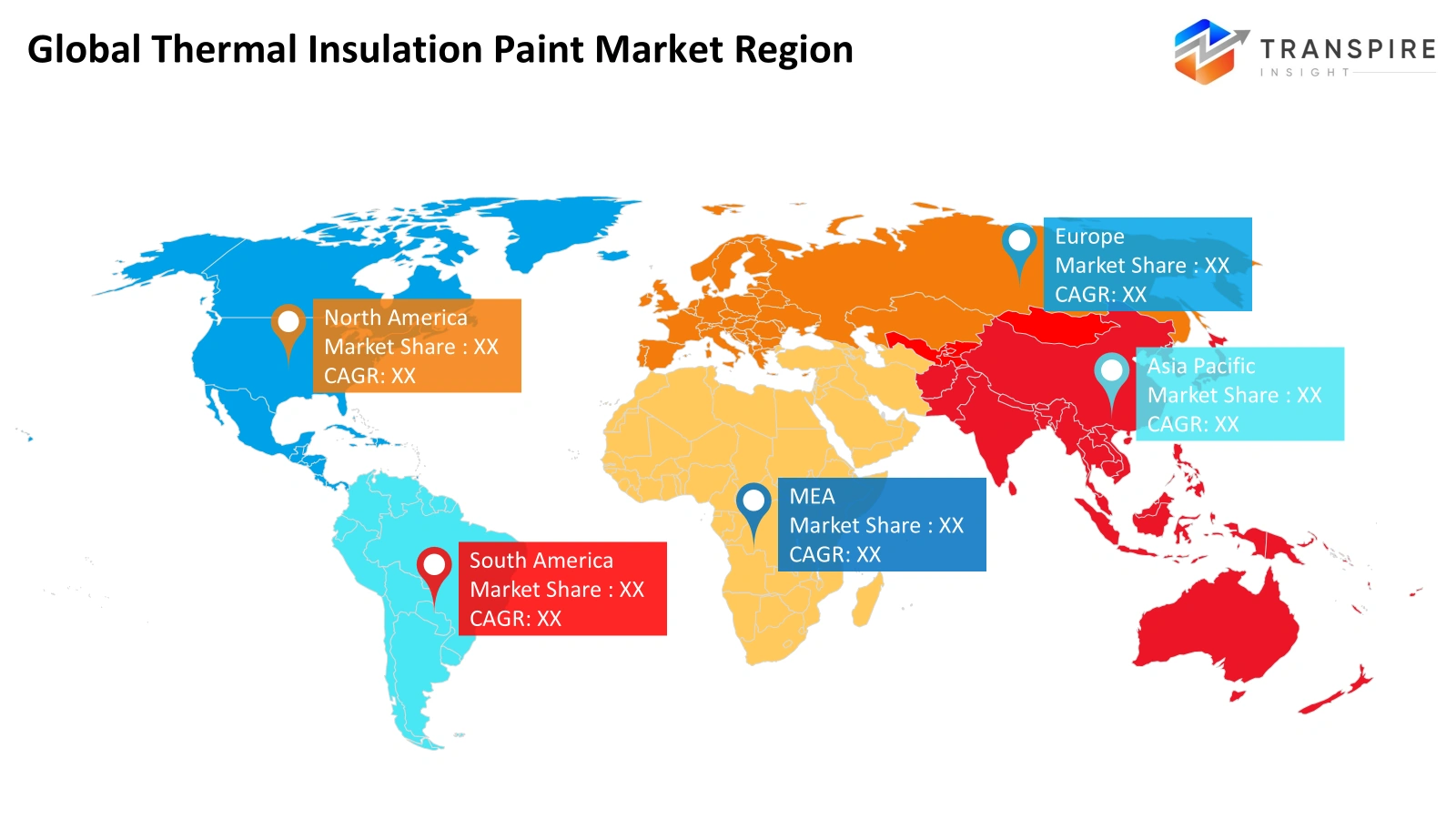
The Asia-Pacific region is expected to dominate the Thermal Insulation Paints Market, owing to fast-paced urbanization and industrialization along with significant infrastructural developments taking place in emerging nations. Construction of large-scale projects, increased investments made towards energy-efficient construction and growth in manufacturing capacities, have led to continuous demand for thermal insulation paints. Regulations by governments to promote sustainable infrastructure and conserve energy have improved penetration levels within various commercial and industrial industries. In March 2026, various projects relating to modernization of infrastructure and investments made toward green constructions boosted the adoption of insulation paints in key Asian nations.
North America comes in at the number two spot, with the assistance of well-established construction sectors, stringent building efficiency requirements, and ongoing industrial modernization efforts. This region’s growth is quite steady when compared with the Asia-Pacific region since the adoption rate here is highly dependent on the process of renewal, renovation, and upgrading of existing equipment and processes, as opposed to infrastructural expansions. Strict regulations, high awareness levels about cost savings during operations, and modern manufacturing facilities keep the market highly stable. In January 2026, new investments led to a rise in the use of thermal coatings.
Middle East & Africa stands out as the fastest-growing market, owing to increased constructions, harsh climatic conditions, and growing efforts to minimize energy used for cooling purposes. The recent trend towards sustainable development and industrial diversification has seen higher investments in the production of insulation products. Commercial activities and smart cities have opened up more avenues for the usage of thermal insulation coatings in roofing, industrial machinery, and buildings. In February 2026, several initiatives in the form of infrastructure expansions and energy savings have fueled market growth in the region.
Who are the Key Players in the Global Thermal Insulation Paint Market and how do they Compete?
Competition in the Global Thermal Insulation Paint Market involves a range of global coating providers, specialist materials manufacturers, and local manufacturers of thermal coatings in competition using performance attributes, formulation techniques, pricing strategies, and application expertise. Competition is becoming based on offering multi-purpose coatings, eco-friendly formulas, and custom-made coatings suited for industrial, commercial, and infrastructure purposes as opposed to competing only on coating costs.
The biggest competitors in this market are the likes of AkzoNobel, Sherwin-Williams, PPG Industries, and Nippon Paint. The primary means of competition among these firms is innovation-driven. The competitive advantage of the firms comes from their investment in advanced coating technology, nanomaterials, and superior insulation formula combining thermal control with corrosion resistance and durability. Expansion strategies of the firms are mainly geared towards enhancing their regional manufacturing capacity and marketing strategies.
Other major players like Jotun, Kansai Paint, Hempel, BASF, Axalta Coating Systems, and RPM International are moving towards specialized positions and application-driven market development. Competitive advantage for these companies comes mainly from the formulation of coatings specifically meant for certain industries. In terms of expansion, the firms have been developing strategies involving partnering and localized production of coatings along with environmentally friendly formula.
Global Thermal Insulation Paint Market Companies
- Akzo Nobel
- Sherwin-Williams
- PPG Industries
- Nippon Paint
- BASF
- Kansai Paint
- Axalta Coating Systems
- Jotun
- Asian Paints
- Hempel
- Berger Paints
- RPM International
- Sika
- DAW SE
- Teknos
Recent Development News:
In May 2026, AkzoNobel declined a partnership approach made by Nippon Paint and Sherwin-Williams that was worth about €12.5 billion and still pursued its merger plan with Axalta. This event shows how consolidation is taking place in the coatings sector and might change competitive dynamics in the insulation and special coatings segments.
Source: https://www.reuters.com
In February 2026, Advancements in thermal insulation coatings using aerogel technology for greater energy efficiency were made by Enze Chemical. It has enhanced the prospects of commercializing the new generation of insulation coating technologies.
Source: https://www.enzegroup.com
In January 2026, Sherwin-Williams kept growing strategic investments in expansion and enhancing advanced coating technology after their acquisitions and manufacturing expansion efforts. This enhances the distribution network and innovation capabilities in high-performance coatings.”
Source: https://investors.sherwin-williams.com/
What Strategic Insights Define the Future of the Global Thermal Insulation Paint Market?
The trend in the Thermal Insulation Paints Market of the future lies in the shift towards advanced coatings that not only offer superior performance but also have multifunctional properties. The future of the Global Thermal Insulation Paint Market depends upon a number of factors like adoption of sustainable infrastructure, compliance with more stringent laws concerning energy use, and requirement for effective, light weight thermal management in industries and in vehicles.
One of the potential threats associated with the market is the growing gap between expectations and actual performance of coatings. If there is no clear evidence that the product performs effectively and saves energy costs in varying operational scenarios, it would hamper the market growth.
Nanotechnology-based formulations, smart coatings and other similar technological innovations present an area of opportunity in the market because they can replace traditional insulation materials when their replacement is too expensive. In future, companies need to focus on proving the performance and benefits of their products through investment in research activities.
Key Segmentations are:
By Type
- Ceramic Insulation Paints
- Acrylic Insulation Paints
- Reflective Insulation Paints
- Elastomeric Insulation Paints
- Nano-insulation Paints
- Heat-resistant Coatings
- Others
By Application
- Residential Buildings
- Commercial Buildings
- Industrial Equipment
- Automotive Applications
- Roofing Systems
- Others
By End-User
- Construction Companies
- Industrial Manufacturers
- Automotive OEMs
- Others
By Formulation
- Water-based Paints
- Solvent-based Paints
- Hybrid Coatings
- Eco-friendly Paints
- Others
Regional Outlook
North America
- United States
- Canada
- Mexico
Europe
- Germany
- United Kingdom
- France
- Spain
- Italy
- Rest of Europe
Asia Pacific
- Japan
- China
- Australia & New Zealand
- South Korea
- India
- Rest of Asia Pacific
South America
- Brazil
- Argentina
- Rest of South America
Middle East & Africa
- Saudi Arabia
- United Arab Emirates
- South Africa
- Rest of the Middle East & Africa
Frequently Asked Questions
Find quick answers to common questions.
The global Global Thermal Insulation Paint Market size was valued at USD 11.136 Billion in 2025 and is poised to reach USD 18.851 Billion by 2033, expanding at a 6.83% CAGR from 2026 to 2033.
Key segments for the Global Thermal Insulation Paint Market are By Type (Ceramic Insulation Paints, Acrylic Insulation Paints, Reflective Insulation Paints, Elastomeric Insulation Paints, Nano-insulation Paints, Heat-resistant Coatings, Others); By Application (Residential Buildings, Commercial Buildings, Industrial Equipment, Automotive Applications, Roofing Systems, Others); By End-User (Construction Companies, Industrial Manufacturers, Automotive OEMs, Others); By Formulation (Water-based Paints, Solvent-based Paints, Hybrid Coatings, Eco-friendly Paints, Others).
Growth is primarily driven by the increasing demand for energy efficiency, green buildings, infrastructure developments, industrial heating systems, environmental regulations, and coating systems to save energy at reduced costs.
The global market is led by major manufacturers including Akzo Nobel, Sherwin-Williams, PPG Industries, Nippon Paint, BASF, Kansai Paint, Axalta Coating Systems, Jotun, Asian Paints, Hempel, Berger Paints, RPM International, Sika, DAW SE, Teknos.
The Asia-Pacific region contributes to approximately 26% market share in the Global Thermal Insulation Paint Market and drives global growth by means of fast urbanization, construction, industrial growth, energy efficiency implementation, and increasing sustainable building demand.
Commercial opportunities in the Global Thermal Insulation Paint Market include expanding nanotechnology-based insulation coatings, growing retrofit and renovation projects, increasing adoption of multifunctional coatings combining insulation with corrosion protection, rising investments in sustainable infrastructure across emerging economies, and expanding applications in automotive, industrial equipment, and energy-efficient building projects.
- Akzo Nobel
- Sherwin-Williams
- PPG Industries
- Nippon Paint
- BASF
- Kansai Paint
- Axalta Coating Systems
- Jotun
- Asian Paints
- Hempel
- Berger Paints
- RPM International
- Sika
- DAW SE
- Teknos
About the Authors

Pankaj Ghogare Patil
I am Pankaj Ghogare Patil, a Senior Research Analyst at Transpire Insight, specializing in the Pharmaceutical, Chemicals & Materials, Healthcare IT, and Biotechnology industry. My expertise lies in conducting comprehensive market research, analyzing industry trends, evaluating competitive landscapes, and translating complex data into actionable insights. At Transpire Insight, I closely follow emerging technologies, regulatory developments, and market innovations to create accurate, well-researched, and informative content that helps businesses and professionals make informed decisions. I am committed to producing credible, evidence-based articles that reflect industry best practices while making technical topics accessible and valuable for a broad audience.

Chakradhar Khansole
Chakradhar serves as the Research Director at Transpire Insight, bringing over 8 years of experience in technology, innovation, and strategic market intelligence. He specializes in transforming complex market data into actionable business insights that enable organizations to make informed, growth-oriented decisions. Recognized for his strategic vision and analytical expertise, Chakradhar leads high-impact research initiatives, delivering comprehensive market assessments, competitive intelligence, and forward-looking industry analysis.
Recently Published Reports
-
May 2026
Healthcare Polymer Packaging Market
Healthcare Polymer Packaging Market Size, Share & Analysis Report By Packaging Type (Syringes, IV Bottles and Pouches, Clamshells, Blisters, Bottles & Jars, Containers, Tubes, IV Parental Packaging, Others), By Type (Regulated, Non-regulated), By Polymer Type (LDPE (Low-Density Polyethylene), HDPE (High-Density Polyethylene), Homo-polymer (Homo), Random Copolymer (Random), Block Copolymer (Block), PET, Polystyrene, Polyvinyl Chloride, Polyamide/EVOH, Others), and Geography (North America, Europe, Asia-Pacific, Middle East and Africa, South and Central America), 2021 - 2031
-
Apr 2026
Hydrophilic Tape (Waterstop) Market
Hydrophilic Tape (Waterstop) Market Size, Share & Analysis Report By Type (Bentonite-Based Hydrophilic Tape, Rubber-Based Hydrophilic Tape), By Application (Residential Buildings, Commercial Buildings, Infrastructure Projects), and Geography (North America, Europe, Asia-Pacific, Middle East and Africa, South and Central America), 2021 - 2031
-
Apr 2026
Metalens Market
Metalens Market Size, Share & Analysis Report By Type (Visible Light Metalens, and Infrared Metalens), By Application (Consumer Electronics, Automotive Electronics, Industrial, Medical, and Others), and Geography (North America, Europe, Asia-Pacific, Middle East and Africa, South and Central America), 2021 - 2031
-
Apr 2026
PBT Resin Market
PBT Resin Market Size, Share & Analysis Report By Type (Reinforced PBT Resin, Unreinforced PBT Resin), By Processing Method (Injection Molding, Extrusion, Blow Molding, Others), By End-User (Automotive, Electrical & Electronics, Consumer Appliances, Industrial Machinery, Medical Devices, Packaging, Others), and Geography (North America, Europe, Asia-Pacific, Middle East and Africa, South and Central America), 2021 - 2031