

Global Taurine Industry Market Size & Forecast:
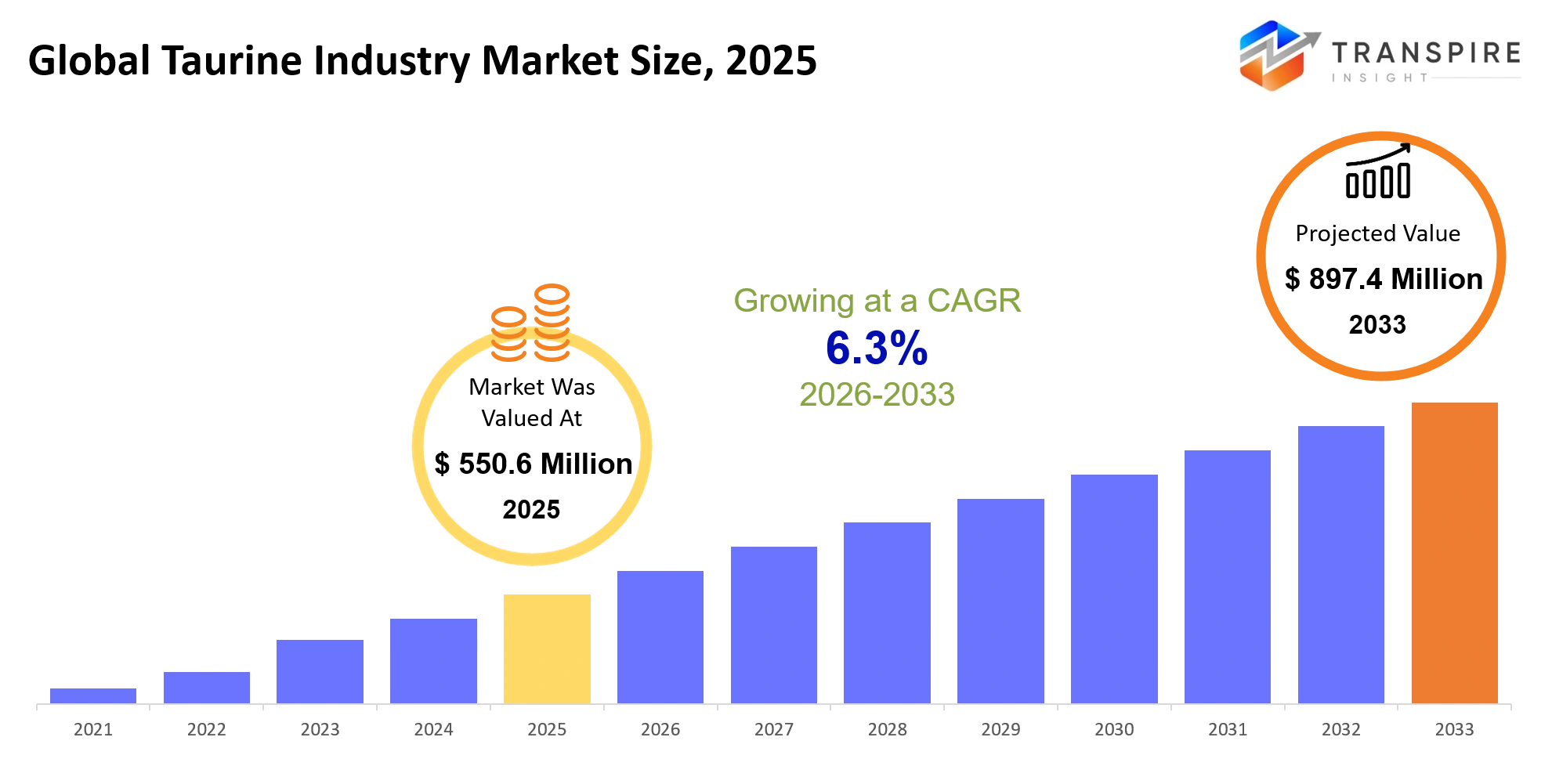
- Global Taurine Industry Market Size 2025: USD 550.6 Million
- Global Taurine Industry Market Size 2033: USD 897.4 Million
- Global Taurine Industry Market CAGR: 6.3%
- Global Taurine Industry Market Segments: By Source (Synthetic Taurine, Natural Taurine, Fermentation-derived Taurine, Others); By Application (Energy Drinks, Animal Feed, Pharmaceuticals, Dietary Supplements, Cosmetics, Others); By Grade (Food Grade, Pharmaceutical Grade, Feed Grade, Others); By Distribution Channel (Direct Sales, Distributors, Online, Others); By End User (Food & Beverage, Animal Nutrition, Healthcare, Personal Care, Others).
Global Taurine Industry Market Summary:
As per Transpire Insight Analysis, the Global Taurine Industry Market size is estimated at USD 550.6 Million in 2025 and is anticipated to reach USD 897.4 Million by 2033, growing at a CAGR of 6.3% from 2026 to 2033.
The taurine industry is getting bigger all the time. This is because companies are using taurine in products like energy drinks, dietary supplements and healthy food. People want to buy things that're healthy and help them feel good. So companies are making products with taurine because people like to buy things. They are also getting better at making taurine. This means they can make taurine. The taurine they make is high quality. More and more people want products that help them perform well and stay healthy. People also want food for their pets. All of this means that the taurine industry is growing because of the demand for taurine.
Companies are spending money to make taurine and to find ways to use taurine. This is helping the industry to keep growing. Taurine is becoming an ingredient in many different types of products. The taurine industry will probably keep getting bigger for a time because companies are using taurine in their products.
Key Market Insights:
The taurine market size has grown as the use of taurine in beverages goes beyond its traditional use as an ingredient in energy drinks. Taurine is now being added to dietary supplements, drugs, and nutritional foods, among others.
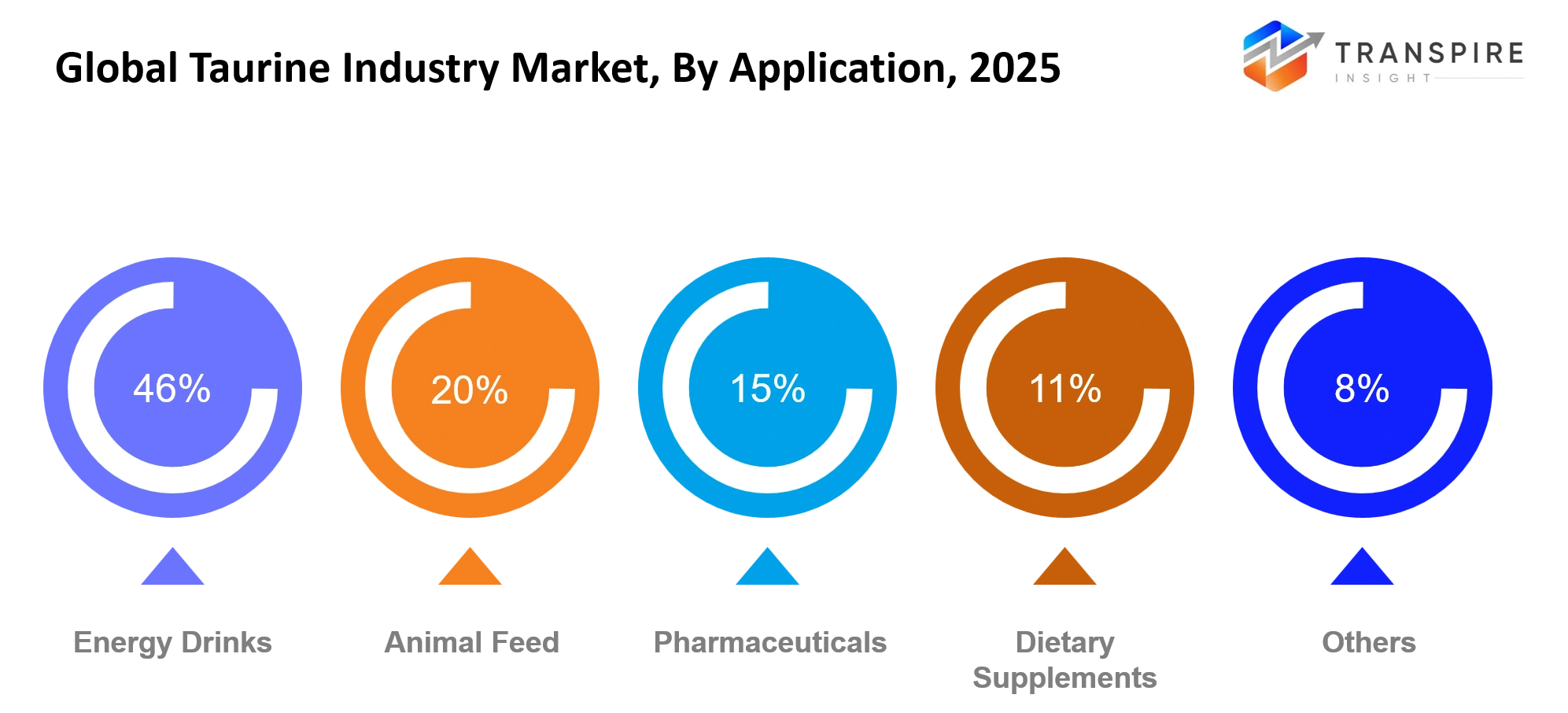
- Energy drink applications represent 46% of the market as beverage manufacturers continue to invest in high-quality energy drinks and sports nutrition.
- The dietary supplements emerge as the fastest-growing segment of this market with a projected 12.9% CAGR driven by the increasing trend of preventive healthcare products among consumers.
- Animal feed represents 20% of the total demand of the taurine market owing to the increased use of this product for the health and productivity of animals.
- The pharmaceutical applications account for 15% of the market due to the research in taurine for the improvement of cardiovascular, neurological, and metabolic health conditions.
- The dietary supplements capture 11% of the market due to the increased consumer preference for the scientifically proven dietary ingredients.
- Manufacturers are using fermentation-based manufacturing processes to enhance the quality and manufacturing efficiency of the products.
- Manufacturers are setting up their manufacturing plants and distribution networks in emerging economies to cater to the rising regional demands.
What are the Key Drivers, Restraints, and Opportunities in the Global Taurine Industry Market?
Drivers
The growth of the market will be driven by an increased usage of taurine in energy drinks, dietary supplements, pharmaceutical products, and animal nutrition. Instead of concentrating solely on one field, producers include taurine in various health-oriented formulations due to evolving consumer preferences. Rising demand for active lifestyles and sports nutrition as well as preventive medicine drives producers of beverages and nutraceuticals to develop taurine-containing products. The technological advancements in the sphere of production and efficiency of manufacture contribute to rising productivity and profitability of manufacturers.
Restraints
One of the major problems that the market faces is the volatility of production costs due to fluctuations in the prices of raw materials, costs of energy and the process of manufacture itself. Observance of pharmaceutical and food-grade standards involves considerable financial investments. The structural problems of this kind still influence production costs for small and medium-sized producers competing with global manufacturers.
Opportunities
Growth opportunities exist in the development of fermented taurine as well as in next-generation functional nutrition products. The companies are looking at adopting sustainable and clean manufacturing techniques to cater to the changing demands of consumers. Increased consumption of high-quality and premium dietary and pet nutrition products from developing nations should result in additional sales, whereas ongoing research on the health benefits of taurine will lead to further commercialisation.
What Has the Impact of Artificial Intelligence Been on the Global Taurine Industry Market?
The taurine industry worldwide is becoming more efficient because of the use of artificial intelligence technology to help taurine manufacturers optimise their production processes, ensure quality of the products, and better manage the supply chain logistics. The AI-powered monitoring system is used for the analysis of manufacturing process information and allows the manufacturer to regulate processing parameters, minimise the amount of waste materials and ensure the consistent quality of the products. Predictive analytics is used to forecast the demands on the market and to optimise the inventory and procure raw materials.
The R&D activities can also benefit from using artificial intelligence to speed up the analysis of ingredients, formulate products and perform quality tests to produce taurine products based on the consumer preferences in energy drinks, supplements, pharmaceuticals and animal nutrition. Despite all the above, the application of artificial intelligence is still difficult for many small and medium enterprises due to costly digital infrastructure, personnel training, and integration of the technology. Moreover, the integration of AI platforms in existing facilities may be a complex process. As costs for the development of new digital manufacturing technologies continue to decrease, artificial intelligence will become increasingly relevant for productivity enhancement, innovative product creation, and competitive advantage for world taurine market players. In March 2025, BASF utilised the capabilities of AI-driven digital manufacturing and predictive analytics to maximise process efficiency and minimise energy utilisation in the manufacture of their chemicals. Additionally, AI-powered digital manufacturing and predictive analytics could be used in the manufacture of speciality chemicals and nutrients, such as taurine, since it makes the process efficient and less expensive.
Key Market Trends:
The world market of taurine is going through a transformation due to shifts in health priorities of consumers, innovations in production technologies, and wider use of taurine in industries. The manufacturers pay attention to sustainable production, diversification of products, and digital manufacturing to enhance their position in the market.
- Functional beverages evolve from energy drinks to those containing taurine with vitamins, minerals, and plant-based ingredients that provide additional nutritional benefits to consumers.
- Fermentation-derived taurine is becoming a more popular option for the manufacturing of health products among producers who decrease their reliance on synthesis and improve sustainability.
- Dietary supplement manufacturers launch various premium products that can boost immunity, support the cardiovascular system and mental functions, and help in sports nutrition.
- There is an increase in scientific work done by pharmaceutical companies to develop taurine-containing products for metabolic, neurological, and cardiovascular diseases.
- The technologies of digital manufacturing such as process monitoring and automated quality control are becoming more widespread among manufacturers.
- Companies expand their facilities and distribution networks in emerging economies due to the growth in demand for health and nutrition products.
- Sustainability becomes a priority that forces manufacturers to produce taurine in energy-efficient conditions and to minimise waste during the process.
Global Taurine Industry Market Segmentation
By sources
The share of artificial taurine will be dominant owing to low cost of manufacturing, high purity levels and extensive usage in food and beverage, pharmaceutical and animal feeding industry. It will remain the most suitable option for mass manufacturers due to its abundance and meeting quality criteria. At the same time, taurine produced through fermentation is gaining popularity due to the implementation of environmentally friendly technologies and sustainable manufacturing processes. Such a tendency is expected to further encourage using naturally produced compounds in the future.
By application
The dominant position in the market belongs to energy drinks (market share of 46%). They constitute the largest part of the taurine market in terms of revenues. Taurine is extensively used in energy drinks to increase performance, stamina and mental sharpness of consumers, providing continuous demand on the global market. Animal feed has 20% market share while pharmaceuticals have 15%. A growing number of studies on metabolism and cardiovascular disorders are contributing to their development. Dietary supplements are 11% of the market size and are expected to grow at a CAGR of 12.9% due to increasing interest in preventive healthcare and nutritional wellness among consumers.
By grade
Food-grade taurine is the dominant market share owing to wide applications in beverages, functional foods, and nutritional products. The pharmaceutical-grade taurine is the next segment due to high purity needs in medicinal formulas. Meanwhile, the feed-grade taurine continues to have robust demand from the livestock and aquaculture industries owing to high animal nutrition needs, with other specific grades serving industrial uses.
By Distribution Channel
Distribution Channel analysis shows that direct sales are dominant due to large-scale buyers of industrial quantities. Such buyers can negotiate long-term supply contracts with beverage, pharmaceutical, and feed producers. While distributors still account for an important part of sales due to their ability to increase regional coverage, e-commerce channels grow steadily due to increased digitisation of the procurement process in businesses.
By end user
The food and beverage industry is still the biggest customer of taurine due to the rising demand for energy drinks and functional beverages. The animal nutrition industry is second in demand due to increased use in high-quality feed formulations. The healthcare industry continues to expand its usage of taurine in pharmaceuticals and dietary supplements. The personal care industry also uses taurine in skin-care products and cosmetics.
What are the Key Use Cases Driving the Global Taurine Industry Market?
Taurine is mostly utilised in energy drinks. The use of taurine by beverage companies in the production of energy drinks to boost their performance and stamina is one of the major applications in the market.
Other than energy drinks, taurine is also commonly used in animal feed, pharmaceuticals, and dietary supplements. It is used in livestock farming as an additive to increase the nutritive value of feed. Pharmaceutical and nutraceutical companies produce a wide range of products based on taurine that are used to promote heart, metabolism, and brain health. This reflects the increasing trend in the dietary supplement market due to consumers' inclination towards prevention through healthcare. There are new applications that are gaining traction in functional foods, cosmetics, personalised nutrition, and luxury pet nutrition. Continued research on the biological functions of taurine is opening up more opportunities in the market through new formulation technologies.
|
Report Metrics |
Details |
|
Market size value in 2025 |
USD 550.6 million |
|
Market size value in 2026 |
USD 585.3 million |
|
Revenue forecast in 2033 |
USD 897.4 million |
|
Growth rate |
CAGR of 6.3% from 2026 to 2033 |
|
Base year |
2025 |
|
Historical data |
2021 - 2024 |
|
Forecast period |
2026 - 2033 |
|
Report coverage |
Revenue forecast, competitive landscape, growth factors, and trends |
|
Regional scope |
United States; Canada; Mexico; United Kingdom; Germany; France; Italy; Spain; Denmark; Sweden; Norway; China; Japan; India; Australia; South Korea; Thailand; Brazil; Argentina; South Africa; Saudi Arabia; United Arab Emirates |
|
Key company profiled |
Taisho Pharmaceutical, Qianjiang Yongan Pharmaceutical, Honjo Chemical, Newtrend Group, Jiangyin Huachang, Grand Pharma, BASF, Merck, Kyowa Hakko, NutraBio, NOW Foods, Ajinomoto, DSM-Firmenich, FUSO Chemical, Gnosis by Lesaffre. |
|
Customization scope |
Free report customization (country, regional & segment scope). Avail customized purchase options to meet your exact research needs. |
|
Report Segmentation |
By Source (Synthetic Taurine, Natural Taurine, Fermentation-derived Taurine, Others); By Application (Energy Drinks, Animal Feed, Pharmaceuticals, Dietary Supplements, Cosmetics, Others); By Grade (Food Grade, Pharmaceutical Grade, Feed Grade, Others); By Distribution Channel (Direct Sales, Distributors, Online, Others); By End User (Food & Beverage, Animal Nutrition, Healthcare, Personal Care, Others). |
Which Regions are Driving the Global Taurine Industry Market Growth?
North America
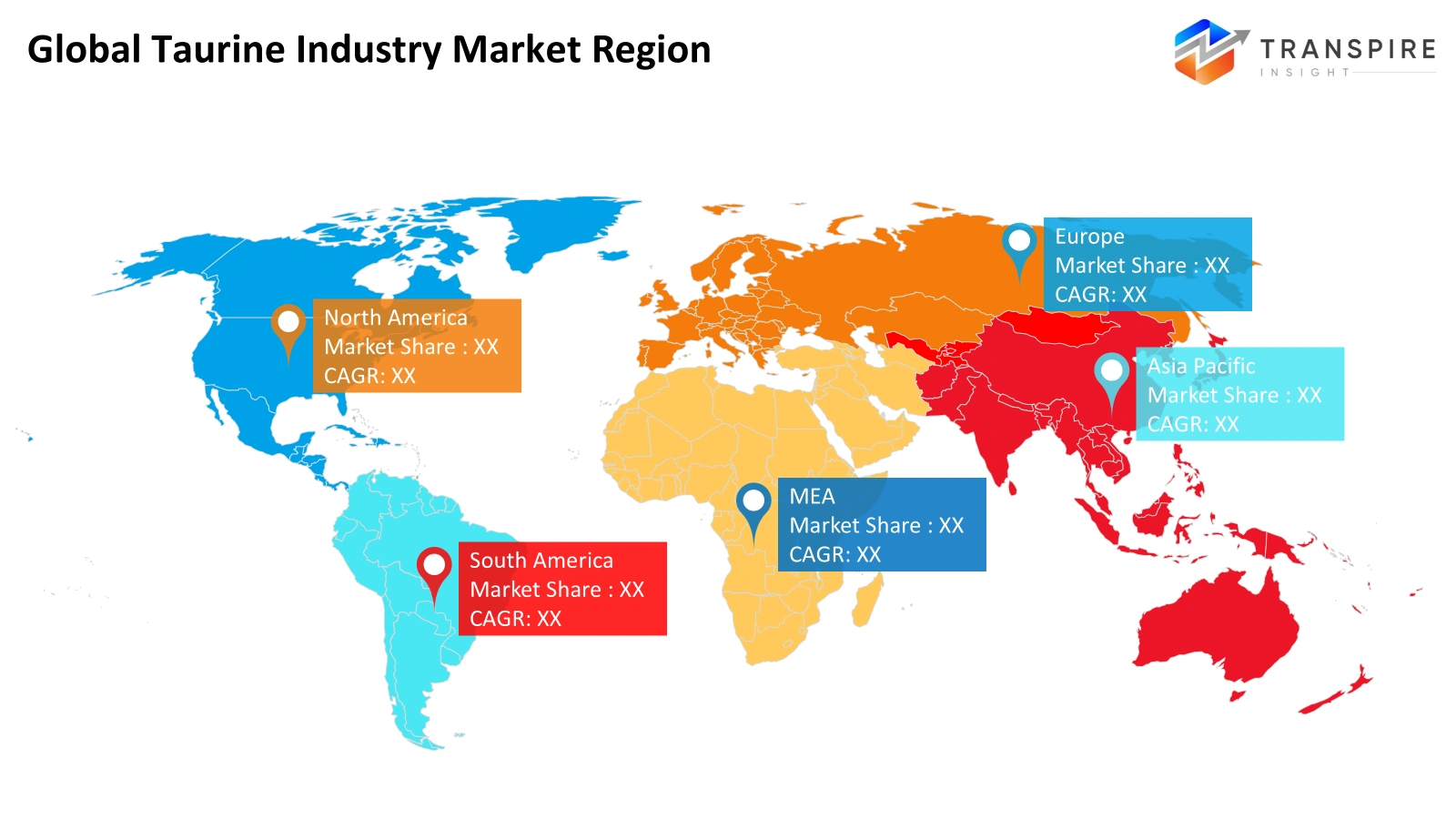
North America accounts for 20% of the world taurine market and is estimated to grow at the highest compound annual growth rate of 13.8%. There is an increase in the usage of premium energy drinks, sports nutrition, and dietary supplements. High investments made in health & wellness products, coupled with innovations in nutraceuticals and functional beverages, will drive the growth in the region. The development in e-commerce, manufacturing technologies, and performance nutritional products is expected to propel market growth in North America in the coming years.
Europe
Europe shares 21% of the global market due to stringent standards regarding the quality of the product, pharmaceutical production processes and increased consumption of functional foods and dietary supplements. Emphasis on sustainability and regulations in Europe is likely to motivate manufacturers to manufacture high-quality products. Increased consumer awareness of preventive healthcare and nutritional products would drive stability in the market. Functional ingredient research would also contribute to the steady growth of the market. In June 2025, Ajinomoto Co., Inc. increased its production capacity of taurine through fermentation to cater for the increased demand for high-purity taurine required by dietary supplements and infant nutrition. The increase in capacity will cater for the rapidly growing European market with manufacturers opting for functional ingredients that are sustainable and clean-label.
Asia Pacific
Asia Pacific dominates the worldwide taurine market with a 48% share owing to its robust manufacturing base, efficient production of chemicals and huge food and beverage industry. Countries such as China, Japan, South Korea, and many others are significant manufacturers and consumers of taurine due to their highly developed industrial base and low-cost production process. In addition, there is a high demand for taurine from energy drinks manufacturers, animal nutrition companies and pharmaceuticals. High investments in production capacity and export-driven manufacturing are expected to make Asia Pacific the largest regional market in the coming years.In May 2025, Qianjiang Yongan Pharmaceutical Co., Ltd, the world's biggest taurine producer, announced plans to boost its taurine production capacity to about 98,000 tons in a year to cater for the global increasing demand for taurine in energy drinks, the pharmaceutical and pet food industry.
Who are the Key Players in the Global Taurine Industry Marketand how do they Compete?
Competitors in the taurine industry are competing based on their manufacturing capacity, taurine quality, pricing, regulatory compliance, and innovations. Companies that make taurine are trying to be better than each other by making more of it, making it better, selling it for money, following the rules and coming up with new ideas. The big companies that make taurine are getting a piece of the market by making more of it, doing things more efficiently and making really good taurine that people want to use in energy drinks, medicine, vitamins and animal feed. These companies are also trying to be kind to the earth and getting their products to people around the world.
The main companies that make taurine are Qianjiang Yongan Pharmaceutical Co., Ltd., Grand Pharma (China) Co., Ltd., Honjo Chemical Corporation, Taisho Pharmaceutical Holdings Co., Ltd., Jiangyin Huachang Food Additive Co., Ltd., and Foodchem International Corporation. These companies are trying to save money by making taurine in a way that's good for the earth and using new technology to make sure it is really good. They want to sell taurine to people around the world that is good enough to use in medicine, food and animal feed.
Most of the companies that make taurine are getting bigger by working with companies selling their products in new places and coming up with new ideas. Some of these companies are using ways to make taurine, like fermentation and using computers to make sure it is good. They are also using machines to do some of the work. The taurine industry is doing these things to make taurine and sell it to people who want to use taurine in different products.
Global Taurine Industry Market companies
- Taisho Pharmaceutical
- Qianjiang Yongan Pharmaceutical
- Honjo Chemical
- Newtrend Group
- Jiangyin Huachang
- Grand Pharma
- BASF
- Merck
- Kyowa Hakko
- NutraBio
- NOW Foods
- Ajinomoto
- DSM-Firmenich
- FUSO Chemical
- Gnosis by Lesaffre
Recent Development News
In March 2025, Kyowa Hakko Bio Co., Ltd. expanded its amino acids ingredients portfolio with taurine products to gain a competitive advantage in the nutraceuticals and functional foods markets. Such an expansion will help meet the growing demand for top-quality dietary supplements and health-oriented formulations.
Source: https://www.kyowahakko-bio.co.jp
In September 2025, Foodchem International Corporation expanded its worldwide sales network of ingredients for food and nutraceuticals, including taurine, to increase the availability of the products throughout North America, Europe, and Asia-Pacific. This move will increase the international market presence of the company and improve customer service.
Source: https://www.bloominglobal.com
In January 2026, a collaboration was formed between Ajinomoto Bio-Pharma Services and NJ Bio, Inc. to increase the ADC development capability. This collaboration will further increase Ajinomoto's expertise of Ajinomoto in biotechnology and innovation in both its amino acid and pharmaceuticals sectors, which will have an indirect impact on the taurine value chain.
Source: https://ajibio-pharma.ajinomoto.com
What Strategic Insights Define the Future of the Global Taurine Industry Market?
The global taurine industry is progressively moving away from its conventional position in energy drinks and emerging as a key component in functional nutrition, medicines, infant nutrition, and luxury pet foods.
Growth in the future will come from the development of high-quality and application-focused taurine by manufacturers through tapping new consumer bases in regions where awareness of health and disposable incomes continue to grow. An unnoticeable risk is the high exposure to raw material availability and concentration of production centres, which make producers vulnerable to fluctuations and interruptions in prices and supplies in times of geopolitical or commercial tensions. On the other hand, the increasing need for natural products and science-based nutrition formulations in wellness and health care products is an opportunity for producers investing in innovation and regulatory compliance.
Key Segmentations are:
By Source
- Synthetic Taurine
- Natural Taurine
- Fermentation-derived Taurine
By Application
- Energy Drinks
- Animal Feed
- Pharmaceuticals
- Dietary Supplements
- Cosmetics
By Grade
- Food Grade
- Pharmaceutical Grade
- Feed Grade
By Distribution Channel
- Direct Sales
- Distributors
- Online
By End User
- Food & Beverage
- Animal Nutrition
- Healthcare
- Personal Care
Regional Outlook
North America
- United States
- Canada
- Mexico
Europe
- Germany
- United Kingdom
- France
- Spain
- Italy
- Rest of Europe
Asia Pacific
- Japan
- China
- Australia & New Zealand
- South Korea
- India
- Rest of Asia Pacific
South America
- Brazil
- Argentina
- Rest of South America
Middle East & Africa
- Saudi Arabia
- United Arab Emirates
- South Africa
- Rest of the Middle East & Africa
Frequently Asked Questions
Find quick answers to common questions.
The future of the global taurine industry market size was valued at USD 550.6 Million in 2025 and is poised to reach USD 897.4 Million by 2033, expanding at a 6.3% CAGR.
Key segments for the future of the global taurine industry market are By Source (Synthetic Taurine, Natural Taurine, Fermentation-derived Taurine, Others); By Application (Energy Drinks, Animal Feed, Pharmaceuticals, Dietary Supplements, Cosmetics, Others); By Grade (Food Grade, Pharmaceutical Grade, Feed Grade, Others); By Distribution Channel (Direct Sales, Distributors, Online, Others); By End User (Food & Beverage, Animal Nutrition, Healthcare, Personal Care, Others).
Growth is primarily driven by Growth can be attributed to high demand for energy drinks, high use of taurine as a dietary supplement and functional food ingredient, increased usage in the pharmaceutical industry, and rising consumer health consciousness.
The global market is led by major manufacturers including Taisho Pharmaceutical, Qianjiang Yongan Pharmaceutical, Honjo Chemical, Newtrend Group, Jiangyin Huachang, Grand Pharma, BASF, Merck, Kyowa Hakko, NutraBio, NOW Foods, Ajinomoto, DSM-Firmenich, FUSO Chemical, Gnosis by Lesaffre.
The share of Asia Pacific in the global market for taurine industry is 48%, which can be attributed to its robust manufacturing industry, raw materials' availability, and high demand from industries such as food and beverages, energy drinks, animal feeds, and pharmaceuticals. Industrialisation and expansion in the consumer base will further reinforce its dominance in the future market.
The commercial potential of the global market for taurine includes increased demand for health drinks and supplements, increased usage in the feed industry, pharmaceutical products, infant nutrition products, and cosmeceuticals. The demand for taurine is especially high in Asia Pacific and Latin American regions.
- Taisho Pharmaceutical
- Qianjiang Yongan Pharmaceutical
- Honjo Chemical
- Newtrend Group
- Jiangyin Huachang
- Grand Pharma
- BASF
- Merck
- Kyowa Hakko
- NutraBio
- NOW Foods
- Ajinomoto
- DSM-Firmenich
- FUSO Chemical
- Gnosis by Lesaffre
About the Authors

Chetan Dhatrak
I’m Chetan Dhatrak, a Senior Research Analyst at Transpire Insight, specializing in the Consumer Goods, Foods and Beverages industry. I focus on analyzing market trends, consumer behavior, competitive landscapes, and industry developments to deliver accurate, data-driven insights. My research at Transpire Insight is built on credible sources and in-depth analysis, helping businesses and readers better understand market dynamics, emerging opportunities, and evolving consumer preferences. I’m committed to creating reliable, well-researched content that supports informed decision-making and reflects the latest developments in the consumer goods and food & beverage sectors.

Chakradhar Khansole
Chakradhar serves as the Research Director at Transpire Insight, bringing over 8 years of experience in technology, innovation, and strategic market intelligence. He specializes in transforming complex market data into actionable business insights that enable organizations to make informed, growth-oriented decisions. Recognized for his strategic vision and analytical expertise, Chakradhar leads high-impact research initiatives, delivering comprehensive market assessments, competitive intelligence, and forward-looking industry analysis.
Recently Published Reports
-
Apr 2026
Baby Infant Formula Market
Baby Infant Formula Market Size, Share & Analysis Report By ype (Infant Milk, Follow On Milk, Specialty Baby Milk, Growing-Up Milk), By Ingredient (Carbohydrate, Fat, Protein, Minerals, Vitamins, and Others), By Product Form (Powder, Liquid, and Ready-to-feed), By Distribution Channels (Supermarket/Hypermarket, Specialty Store, Pharmacies, Online Retail, and Others), and Geography (North America, Europe, Asia-Pacific, Middle East and Africa, South and Central America), 2021 - 2031
-
Apr 2026
Edible Insects for Animal Feed Market
Edible Insects for Animal Feed Market Size, Share & Analysis Report By Type (Insect Powder, Insect Meal, Insect Bar, Insect Paste, Insect Oil, and Others), By Insect Type (Beetles, Cricket, Caterpillar, Hymenoptera, Orthoptera, Tree Bugs, and Others), By Application (Livestock, Pet Food, and Aquaculture), By Livestock Type (Poultry, Swine, and Others), and Geography (North America, Europe, Asia-Pacific, Middle East and Africa, South and Central America), 2021 - 2031
-
Apr 2026
Food Industry Disinfection and Bacterial Control Market
Food Industry Disinfection and Bacterial Control Market Size, Share & Analysis Report By Type (Chemical Disinfectants, Physical Disinfectants, and Biocides and Antimicrobials), By Application (Food Processing Equipment Surface Disinfection, Food Preparation Areas Surface Disinfection, Storage Areas Surface Disinfection, Anti-microbial Coatings Food Preservation, and Preservative Solutions Food Preservation), By End User (Meat and Poultry Processing, Dairy Processing, Seafood Processing, Bakery and Confectionery, Restaurants and Commercial Kitchens, and Food Service Providers), By Sales Channel (Online, Offline), and Geography (North America, Europe, Asia-Pacific, Middle East and Africa, South and Central America), 2021 - 2031
-
May 2026
Freeze Dried Food Market
Freeze Dried Food Market Size, Share & Analysis Report By Product Type (Fruits, Vegetables, Freeze-Dried Dairy Products, Freeze-Dried Meat and Seafood, Freeze-Dried Pet Food, and Prepared Meal), By Nature (Organic, and Conventional), By Form (Powdered, Granules, and Diced), By End Use (Breakfast Cereals, Dairy Products, Bakery & Confectionery, Nutritional Bars & Supplements, Powdered Beverages, Snacks, and Retail (Household)), and Geography (North America, Europe, Asia-Pacific, Middle East and Africa, South and Central America), 2021 - 2031