
Global Synthetic Biology Market Size & Forecast
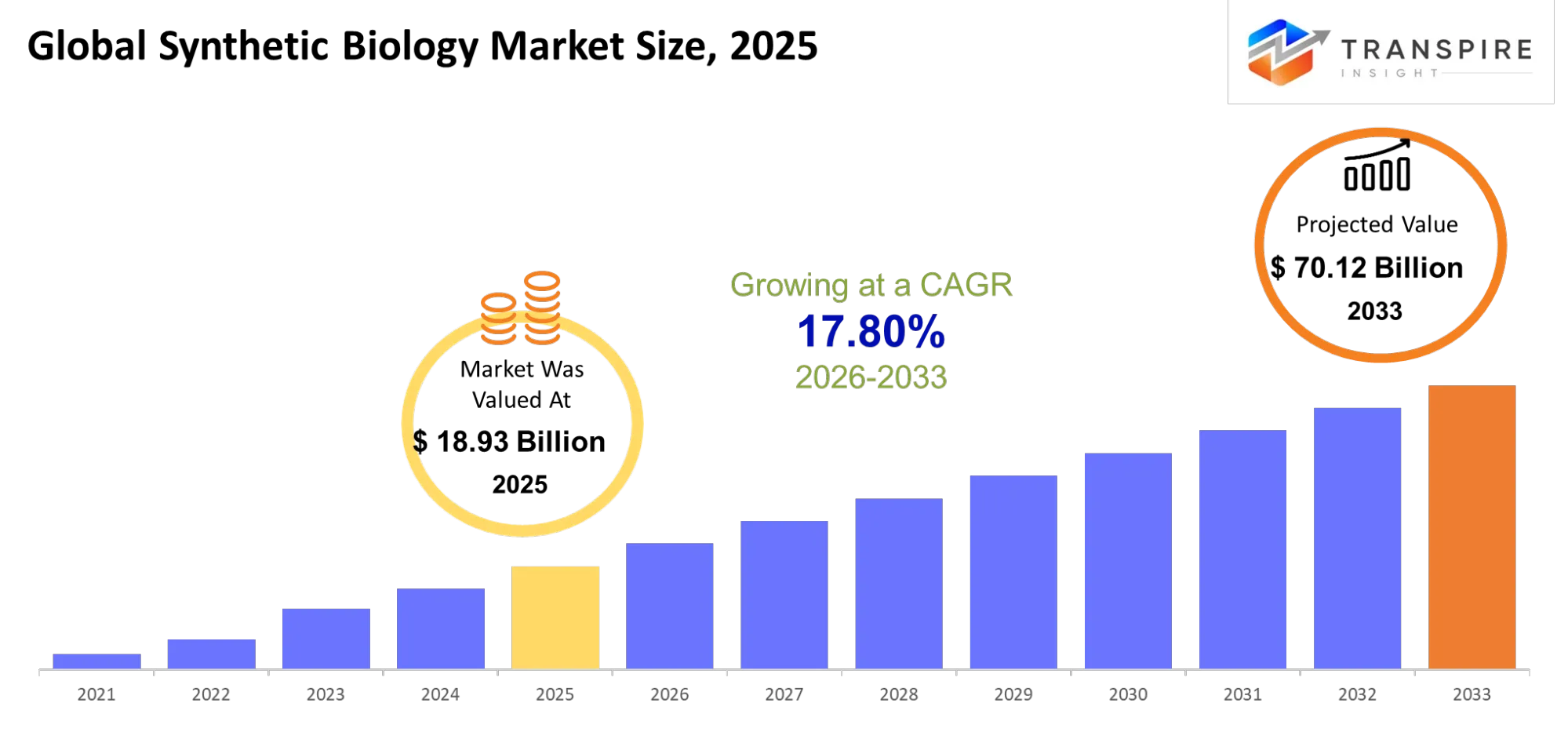
- Global Synthetic Biology Market Size 2025: USD 18.93 Billion
- Global Synthetic Biology Market Size 2033: USD 70.12 Billion
- Global Synthetic Biology Market CAGR: 17.80%
- Global Synthetic Biology Market Segments: By Product (Enzymes, Synthetic DNA, Chassis Organisms, Synthetic Cells), By Technology (Gene Synthesis, Genome Engineering, Bioinformatics), By Application (Healthcare, Industrial Biotechnology, Agriculture, Food & Beverages)
To learn more about this report,  Download Free Sample Report
Global Synthetic Biology Market Summary
The Global Synthetic Biology Market was valued at USD 18.93 billion in 2025 and is projected to reach USD 70.12 Billion by 2033, growing at a CAGR of 17.80%. Synthetic biology applies engineering principles to living systems - designing and building entirely new DNA sequences, microbes, and biological pathways that we don't find naturally. Pharmaceutical companies use synthetic biology to engineer a microorganism that will produce insulin on a huge scale. Specialty chemicals manufacturers construct biosynthetic pathways so they can replace petroleum-based intermediates with fermentation-based production methods instead. An agricultural genomics firm designs a crop chassis organism with a lot more drought tolerance through the insertion of several engineered genes. The whole synthetic biology market covers all the tools, reagents, organisms, and services that make this engineering possible.
The major turning point over the past five years has been the quite widespread availability of DNA synthesis and sequencing technologies. The price of synthesizing one base pair of DNA went down from about USD 0. 50 back in 2010 to under USD 0. 001 by 2023 - effectively reducing both the time and cost involved in designing and testing new biological constructs. This cost reduction really made it possible for a second wave of innovation - allowing smaller companies and academic research groups to actually start running synthetic biology projects that previously were only economically justifiable by the very largest biotech and pharmaceutical companies.
Market growth is really being driven a lot more clearly by regulations and actual commercial deployment of synthetic biology solutions in pharmaceutical production, industrial enzyme production, and agricultural biotechnology. Lower synthesis costs, much more mature bioinformatics platforms, and lots of proven commercial applications are drawing capital into the sector through venture funding, corporate partnerships, and public company acquisitions - all of which have really grown very substantially since 2020.
Key Global Synthetic Biology Market Insights
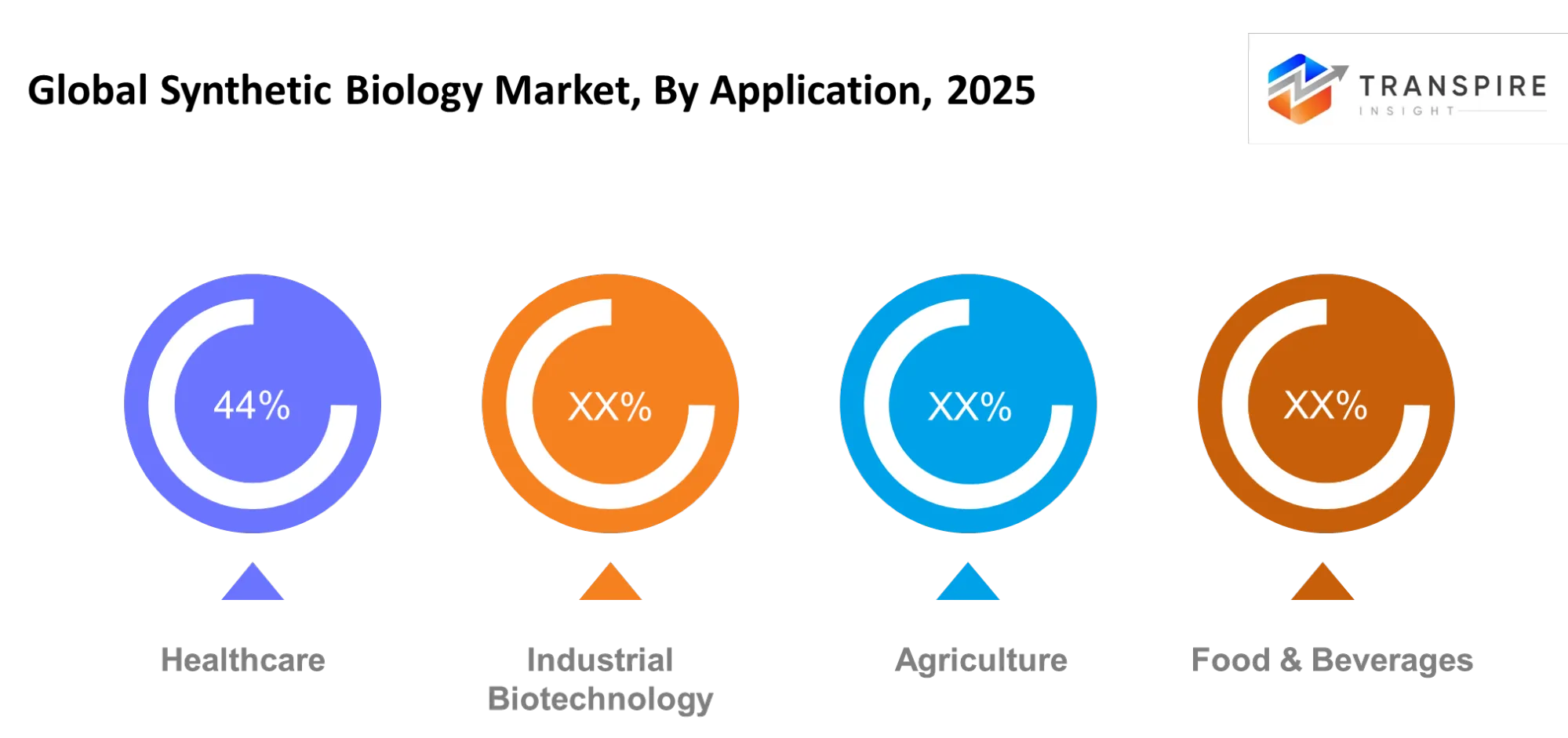
- Healthcare applications command 44% of global synthetic biology market revenue in 2025, concentrated in biopharmaceutical manufacturing, mRNA vaccine production, and therapeutic protein engineering.
- Industrial biotechnology represents 35% of market revenue in 2025, spanning enzyme production, biofuel synthesis, and sustainable chemical manufacturing that replace petroleum-derived processes.
- Agriculture and food & beverages segments combined account for 21% of market revenue in 2025, with growth driven by engineered crop varieties, microbial fermentation for food ingredients, and precision fermentation platforms.
- Twist Bioscience Corporation, Synthetic Genomics Inc., and Intrexon Corporation (now Precigen Inc.) hold the largest market share among pure-play synthetic biology companies through proprietary DNA synthesis and genome engineering platforms.
- Gene synthesis is the dominant technology segment, representing approximately 38% of technology segment revenue in 2025, because DNA synthesis is a foundational input for all synthetic biology applications.
- Genome engineering technology is growing at 22% CAGR through 2033, driven by continued improvement in CRISPR-based and base editing technologies that enable precise modification of living cells and organisms.
- Bioinformatics software and services represent the fastest-growing technology segment, expanding at 28% CAGR through 2033, as machine learning and computational tools become essential for designing complex biological systems.
- Enzymes are the largest product category by revenue, representing 42% of market revenue in 2025, because engineered enzymes are the primary output of synthetic biology applied to industrial biotechnology.
- Synthetic DNA represents 28% of product segment revenue in 2025 and is growing at 19% CAGR through 2033 as demand increases for custom-designed genetic sequences across pharmaceutical and agricultural applications.
- Chassis organisms and synthetic cells represent only 8% of current market revenue but are growing at 31% CAGR through 2033, positioning these emerging product categories as the highest-growth segment by decade end.
What are the Key Drivers, Restraints, and Opportunities in the Global Synthetic Biology Market?
The number one driver is the structural shift in biopharmaceutical manufacturing towards biologics and cell therapies. Traditional small-molecule drug synthesis relies very heavily on chemistry itself. Biologics like monoclonal antibodies, recombinant proteins, and mRNA vaccines need cellular fermentation systems - something that synthetic biology both enables and optimizes very effectively. The global market for biologics has actually reached roughly USD 280 Billion in 2025 - and it's growing even faster than small-molecule drugs. Every new biopharmaceutical product really does require engineered expression systems, optimized fermentation conditions, and purification processes - all of which synthetic biology tools help design and accelerate. This structural shift really does create a lot of recurring demand for DNA synthesis, genome engineering, and bioinformatics services from virtually every pharmaceutical company developing new biologic drugs.
Regulatory frameworks really do vary quite substantially across jurisdictions themselves. The US FDA, European Medicines Agency, and Chinese regulatory authorities all have their own quite different requirements for what constitutes acceptable evidence of safety and efficacy for synthetic biology-derived therapeutics and organisms. A pharmaceutical company developing a synthetic biology therapeutic really has to navigate multiple regulatory pathways - each one requiring distinct preclinical and clinical data packages, which extends development timelines by 18 to 36 months and increases costs by USD 50 to USD 150 Million per program. This regulatory burden really does impact smaller companies and startups more - slowing commercialization of synthetic biology solutions quite a bit outside of large pharmaceutical companies itself.
The convergence of engineered enzymes with sustainable chemistry creates a major commercial opportunity in industrial biotechnology itself. Chemical manufacturers facing carbon reduction mandates and supply chain risks from petroleum price volatility are really starting to evaluate fermentation-based production of specialty chemicals, polymers, and pharmaceutical intermediates using engineered enzymes and microorganisms. Companies such as Amyris Inc. have actually demonstrated the commercial viability of this approach itself with bio-based jet fuel, specialty chemicals, and polymer precursors. As carbon pricing mechanisms expand globally and feedstock costs increase, the economic case for enzyme-based synthesis really does get much stronger itself. Estimates suggest that 20 to 30 percent of global chemical production could actually migrate to enzyme-catalyzed fermentation itself by 2035 - creating a market opportunity worth around USD 150 to USD 200 Billion annually if synthetic biology can provide the necessary engineered enzymes and microorganisms.
What Has the Impact of Artificial Intelligence Been on the Global Synthetic Biology Market?
Artificial intelligence is really changing how synthetic biologists design and test new constructs quite fundamentally. Generative AI models trained on many millions of natural DNA sequences can now predict what specific genetic sequences will do when inserted into a living organism - all this reducing the time needed to design new genes from months of iterative lab testing to just hours of computational simulation. Companies like Ginkgo Bioworks Inc. and Synthego Corporation have actually integrated machine learning into their design pipelines, making it possible to speed up iteration cycles and achieve much higher success rates with very first-pass experiments. The effect really compounds itself: a researcher can now explore 10 to 100 times more genetic designs in the same lab budget than they were able to do just five years ago.
Protein structure prediction tools like AlphaFold have actually accelerated enzyme engineering by predicting how mutations affect protein folding and its catalytic activity without needing to make and test every single variant in the lab. This capability significantly reduces the cost and time required to engineer enzymes for novel reactions by 60 to 80 percent. The pharmaceutical and biotech industry is now actually using AI-driven enzyme engineering to really accelerate the development of biosynthetic pathways for making drugs, reducing manufacturing complexity and cost compared to chemical synthesis. Merck KGaA and Thermo Fisher Scientific Inc. have actually deployed AI-driven design platforms to support their synthetic biology service offerings themselves.
The emerging opportunity is really AI-driven autonomous cell engineering, where machine learning models guide lab robots through multiple rounds of cell design, testing, and learning all without human direction. Codexis Inc. has actually pioneered this approach for evolving enzymes. As these autonomous platforms get more mature, the time required to engineer organisms from start to finish could really compress from 12 to 18 months to 6 to 12 weeks, fundamentally speeding up the commercialization of synthetic biology solutions itself.
Key Market Trends
- Healthcare applications represent 44% of market revenue in 2025 and are growing at 18% CAGR through 2033, driven by increased demand for engineered cell therapies, gene therapy manufacturing platforms, and biopharmaceutical production optimization.
- Industrial biotechnology represents 35% of market revenue in 2025 and is growing at 17% CAGR through 2033 as chemical manufacturers transition specialty chemical production from petroleum-based synthesis to fermentation-based processes.
- Agriculture and food & beverages segments grow at 19% CAGR through 2033, driven by development of disease-resistant crop varieties, precision fermentation platforms for food ingredients, and engineered microorganisms for meat and dairy alternatives.
- DNA synthesis costs continue to decline at 8 to 12 percent annually, extending synthetic biology applications into lower-cost research and development projects and enabling smaller companies to participate in the sector.
- Gene synthesis technology dominates at 38% of technology segment revenue in 2025, but genome engineering is growing faster at 22% CAGR, driven by continued improvement in CRISPR gene editing and emerging base editing technologies.
- Bioinformatics software represents the fastest-growing technology segment at 28% CAGR through 2033, as computational design tools become essential for managing the complexity of multi-gene synthetic pathways.
- Enzymes represent 42% of product segment revenue in 2025, driven by demand for specialized enzymes in pharmaceutical manufacturing, food production, and industrial chemical synthesis.
- Synthetic DNA and chassis organisms are the fastest-growing product segments, expanding at 19% and 31% CAGR respectively through 2033, as these categories mature from research tools to production-scale solutions.
- Large pharmaceutical and specialty chemical companies are acquiring synthetic biology startups at increasing valuations, with 25 major acquisitions completed in 2023 and 2024 valued above USD 100 Million each.
- Strategic partnerships between synthetic biology platforms and contract manufacturing organizations are proliferating, creating integrated service offerings that combine platform technology with manufacturing scale and regulatory expertise.
Global Synthetic Biology Market Segmentation
By Product
Enzymes really represent 42% of product segment revenue by 2025 - they're the main commercial output of applying synthetic biology to industrial biotechnology. Engineered enzymes speed up fermentation reactions so that we can produce chemical precursors at a smaller cost than using petroleum-derived products, manufacture pharmaceutical intermediates on a large scale, and process our food with much more precision. Enzyme engineering through directed evolution and rational design cuts production costs for speciality chemicals by 20 to 40 percent when compared to traditional chemistry. Growth is sustained by an increase in adoption across biofuel production, food processing, and the manufacture of speciality chemicals.
Synthetic DNA represents about 28% of product segment revenue in 2025 and is projected to grow at 19% CAGR through 2033. Custom-designed DNA sequences are inputs to all synthetic biology applications, from initial research to large-scale production of biopharmaceuticals. DNA synthesis demand is driven by the increasing complexity of engineered biological systems, the expansion of mRNA vaccine platforms, and the growing adoption of cell and gene therapies in clinical practice. As synthesis costs decrease and turnaround times get better, DNA synthesis really becomes an increasingly routine input to research and development.
Chassis organisms are engineered microbial or mammalian cell lines optimised for high-level protein expression, metabolite production, or cell-based therapy. They represent 15% of product segment revenue and are growing at 25% CAGR through 2033. Synthetic cells, which are engineered cells stripped of their native metabolic processes and rebuilt with synthetic pathways, represent 8% of market revenue but are actually the fastest-growing product category at 31% CAGR, setting them up to become the dominant product category by 2033.
By Technology
Gene synthesis is set to remain the largest tech segment in 2025, accounting for 38% of the market's revenue. DNA synthesis is really the starting point for all applications of synthetic biology - and ongoing cost reductions are driving adoption wide and far across industry and academia. Contemporary gene synthesis platforms are capable of producing custom DNA sequences of 100 to 300 kilobases in 7 to 14 days at costs below $100 per kilobase, truly making synthesis a daily occurrence rather than something special. Gene synthesis revenue will be sustained by both a rise in volume and the increasing length and complexity of the synthesized constructs themselves.
Genome engineering is going to represent 30% of tech segment revenue in 2025 and is growing at a 22% compound annual growth rate (CAGR) by 2033. CRISPR-based gene editing and emerging base editing technologies make it possible to very precisely modify living cells and organisms on a large scale. Genome engineering is essential to cell therapy production, crop breeding, and microorganism engineering - and continued improvements in editing accuracy and efficiency will drive adoption right across all application areas.
Bioinformatics really comprises the computational tools and algorithms that design genetic sequences, forecast protein structures, and fine-tune fermentation processes. The bioinformatics segment will represent 19% of tech segment revenue in 2025 and is expanding at a 28% CAGR by 2033, driven by the increasing complexity of the biological systems being designed - and the application of machine learning to really speed up design cycles.
By Application
Healthcare applications will account for a substantial 44% of our global synthetic biology market revenue in 2025.
Biopharmaceutical manufacturing, cell therapies, gene therapies, and the production of mRNA vaccines all heavily rely on synthetic biology platforms - to engineer expression systems, optimize fermentation conditions, and create manufacturing processes. The mRNA vaccine industry - which basically didn't exist commercially until 2020 - is now worth some $6 to $8 billion annually in vaccine sales - and it really needs a lot of synthetic biology inputs for platform optimization.
Industrial biotechnology will represent 35% of our market revenue in 2025. Engineered enzymes and fermentation-based processes are actually replacing petroleum-derived synthesis for speciality chemicals, polymers, biofuels, and pharmaceutical precursors. As carbon pricing mechanisms become more widespread and raw material prices go up, the economic argument for fermentation-based production gets even stronger - so this part of the market will keep growing over the forecast period.
Agriculture will account for 14% of our market revenue in 2025 - thanks to the development of plant varieties that are resistant to disease and better adapted to local climates using synthetic biology techniques. Food and beverages will be worth 7% of the market revenue, with growth driven by precision fermentation platforms for dairy alternatives, meat alternatives, and food ingredients such as proteins and flavouring compounds.
To learn more about this report, Download Free Sample Report
What are the Key Use Cases Driving the Global Synthetic Biology Market?
The most common application case globally in the synthetic biology market is optimizing biopharmaceutical manufacturing processes. Pharmaceutical companies make new monoclonal antibodies or recombinant proteins by employing synthetic biology techniques to engineer an optimal mammalian or microbial expression system for high-level protein production, minimizing contamination risks, and making purification very efficient indeed. The engineering efforts really do reduce production costs by 15 to 35 percent and speed up the time-to-market for new medications. This application case is self-perpetuating itself because every new biopharmaceutical product will require an engineered expression system, thus continuing the consistent demand for DNA synthesis, genome engineering, and bioinformatics services.
The second major application case is the production of industrial enzymes for food processing, beverage manufacture, and specialty chemicals. Food manufacturers use synthetic biology to engineer enzymes that will replace traditional chemical processes, save production costs, and really allow for precise food manufacturing. Rennet enzymes for cheese production, amylase enzymes for starch processing, and proteases for tenderizing meat are all being more and more produced through fermentation using specially engineered microorganisms developed by synthetic biology. This application case is really growing fast because enzyme-based processes reduce both production costs and our environmental footprint much more so than conventional chemistry does.
The emerging application case getting the most traction for 2026 to 2033 is cell-free protein synthesis and in vitro fermentation for extremely rapid biomanufacturing. Traditional biopharmaceutical production really requires growing living cells in bioreactors for days to weeks before collecting the target protein itself. Cell-free systems synthesize proteins from DNA templates in just a few hours without needing to grow any living cell cultures, which makes it possible for rapid manufacturing of therapeutic proteins, antibodies, and vaccines at potentially even lower cost - and with better quality consistency. Several pharmaceutical companies are putting significant investments into building their cell-free manufacturing capacity for pandemic response, oncology treatments, and specialty biologics indeed.
Report Overview Table
|
Report Metrics |
Details |
|
Market size value in 2025 |
USD 18.93 Billion |
|
Market size value in 2026 |
USD 22.28 Billion |
|
Revenue forecast in 2033 |
USD 70.12 Billion |
|
Growth rate |
CAGR of 17.80% from 2026 to 2033 |
|
Base year |
2025 |
|
Historical data |
2021 - 2024 |
|
Forecast period |
2026 - 2033 |
|
Report coverage |
Revenue forecast, competitive landscape, growth factors, and trends |
|
Regional scope |
United States; Canada; Mexico; United Kingdom; Germany; France; Italy; Spain; Denmark; Sweden; Norway; China; Japan; India; Australia; South Korea; Thailand; Brazil; Argentina; South Africa; Saudi Arabia; United Arab Emirates |
|
Key companies profiled |
Ginkgo Bioworks Inc., Amyris Inc., Twist Bioscience Corporation, Synthetic Genomics Inc., Intrexon Corporation (Precigen Inc.), Codexis Inc., GenScript Biotech Corporation, Novozymes A/S, Illumina Inc., Thermo Fisher Scientific Inc., Agilent Technologies Inc., Merck KGaA, Evonetix Ltd., Synthego Corporation, Zymergen Inc. |
|
Customization scope |
Free report customization (country, regional & segment scope). Avail customized purchase options to meet your exact research needs. |
|
Report Segmentation |
By Product (Enzymes, Synthetic DNA, Chassis Organisms, Synthetic Cells), By Technology (Gene Synthesis, Genome Engineering, Bioinformatics), By Application (Healthcare, Industrial Biotechnology, Agriculture, Food & Beverages) |
Which Regions are Driving the Global Synthetic Biology Market Growth?
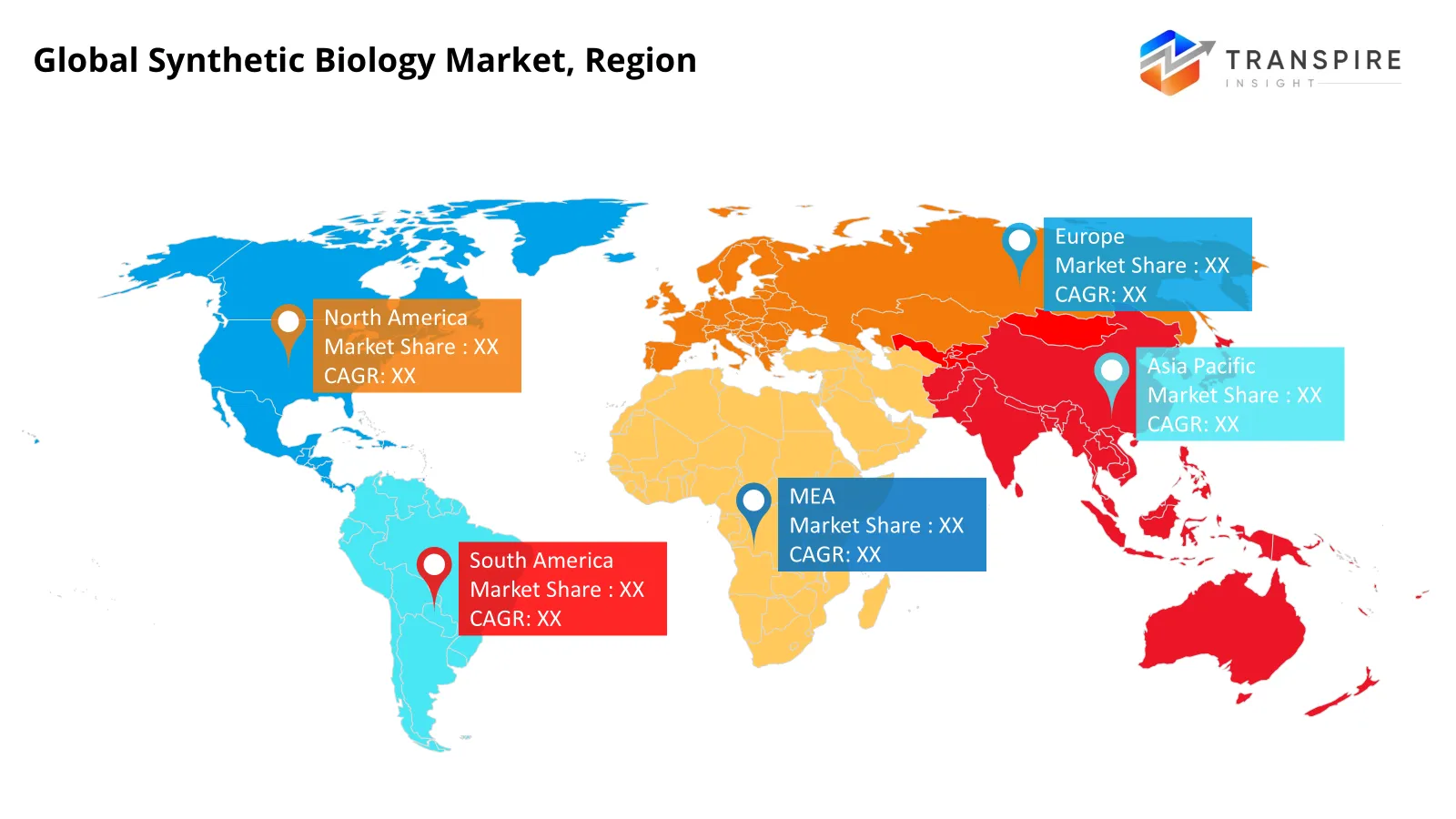
North America leads the global synthetic biology market with approximately 42% of total revenue in 2025. The United States dominates this share through a concentration of biopharmaceutical companies, venture capital funding for synthetic biology startups, and federal research funding through agencies including the National Institutes of Health and the Department of Energy. Major pharmaceutical and biotech companies including Moderna, Pfizer, Johnson & Johnson, and Merck & Co. have all established or acquired synthetic biology capabilities to support their drug development and manufacturing strategies. The North American venture capital ecosystem has invested over USD 3 Billion cumulatively in synthetic biology startups since 2015, creating a competitive advantage in early-stage innovation that translates to market leadership in mature products.
Europe represents approximately 28% of global synthetic biology market revenue in 2025. Germany, Switzerland, and the United Kingdom are the primary centers of synthetic biology innovation and commercialization in Europe, supported by well-established pharmaceutical industries and strong university research programs. The European regulatory framework for biotechnology is complex but well-established, allowing companies that navigate the process to achieve product approvals that create competitive advantages in global markets. Novozymes A/S, a leading enzyme manufacturer headquartered in Denmark, exemplifies the strength of the European enzymes and industrial biotechnology sector.
Asia-Pacific is the fastest-growing regional market, expanding at approximately 21% CAGR through 2033. China is the primary growth driver, with government investment in synthetic biology research and biotech manufacturing capacity through major research initiatives and venture capital funding. Japan and South Korea also have strong biotech sectors with significant synthetic biology capabilities. India is emerging as a contract manufacturing hub for synthetic biology services and engineered enzyme production. Market participants operating in Asia-Pacific should localize manufacturing and service delivery capabilities to compete effectively in this region.
To learn more about this report, Download Free Sample Report
Who are the Key Players in the Global Synthetic Biology Market and How Do They Compete?
The global synthetic biology market comprises three distinct competitive tiers: pure-play synthetic biology companies that focus exclusively on platform technologies and tools; large diversified life sciences companies that offer synthetic biology services as part of broader portfolios; and contract manufacturers and service providers that integrate synthetic biology platforms into manufacturing and research services. Competition at each tier operates on different axes, from platform differentiation and IP protection among pure-play companies to distribution breadth and integrated service offerings among large diversified companies.
Ginkgo Bioworks Inc. is the largest pure-play synthetic biology company by valuation, competing through a horizontally integrated platform that combines DNA synthesis, genome engineering, organism design, and fermentation optimization. The company licenses its platform to partners in biopharmaceuticals, agriculture, and industrial biotechnology, monetizing through upfront licensing fees, milestone payments, and royalties on partner sales. Twist Bioscience Corporation differentiates through proprietary DNA synthesis technology and a software platform that simplifies the design-build-test-learn cycle for synthetic biology applications. Synthetic Genomics Inc. focuses on large-scale genome engineering and synthetic cell development, positioning itself in the higher-value end of the market where regulatory complexity and scientific risk justify premium pricing.
Large diversified life sciences companies including Illumina Inc., Thermo Fisher Scientific Inc., and Agilent Technologies Inc. compete by offering comprehensive portfolios of genetic analysis, DNA synthesis, genome engineering, and bioinformatics tools that provide customers with end-to-end synthetic biology capabilities. These companies leverage their existing sales channels and customer relationships to distribute synthetic biology products, achieving rapid market penetration that pure-play competitors struggle to match. Novozymes A/S dominates the industrial enzyme segment through decades of expertise and a global distribution network for enzymes used in food processing, biofuels, and specialty chemicals. Contract manufacturing organizations including Lonza and Cytiva have integrated synthetic biology into their service portfolios to support biopharmaceutical customers developing complex therapeutics.
Global Synthetic Biology Market Companies
- Ginkgo Bioworks Inc.
- Amyris Inc.
- Twist Bioscience Corporation
- Synthetic Genomics Inc.
- Intrexon Corporation (Precigen Inc.)
- Codexis Inc.
- GenScript Biotech Corporation
- Novozymes A/S
- Illumina Inc.
- Thermo Fisher Scientific Inc.
- Agilent Technologies Inc.
- Merck KGaA
- Evonetix Ltd.
- Synthego Corporation
- Zymergen Inc.
Recent Developments
In February 2026, Ginkgo Bioworks Inc. announced a USD 325 Million funding round from institutional investors and strategic partners, valuing the company at approximately USD 15 Billion. The capital will fund expansion of fermentation capacity, development of new synthetic cell lines, and scaling of its foundry services to support increased demand from pharmaceutical and industrial biotechnology partners. https://www.ginkgobioworks.com
In January 2026, Twist Bioscience Corporation completed the acquisition of a computational genomics company specializing in AI-driven design of engineered proteins and metabolic pathways, expanding its bioinformatics capabilities and enhancing its ability to offer end-to-end synthetic biology design services to customers. The combined platform accelerates the time required to design and validate synthetic biology constructs by 40 to 60 percent compared to conventional approaches. https://www.twistbioscience.com
What Strategic Insights Define the Future of the Global Synthetic Biology Market?
Over the next five to seven years, synthetic biology will transition from a specialized tool used by expert researchers to a routine engineering platform integrated into mainstream biopharmaceutical and chemical manufacturing. This transition is driven by cost reduction in DNA synthesis and sequencing, maturation of genome engineering tools such as CRISPR, and increasing adoption of AI-driven design that democratizes synthetic biology expertise. Companies that position their platforms as easy-to-use, well-integrated solutions for non-expert users will gain market share substantially faster than vendors requiring specialized expertise or custom engineering services.
The competitive dynamics will shift toward integrated solutions that combine platform technology with manufacturing and regulatory expertise. Pure-play synthetic biology companies such as Ginkgo Bioworks and Twist Bioscience are increasingly partnering with contract manufacturing organizations and pharmaceutical companies to offer complete solutions from design through scaled manufacturing. This vertical integration reduces the friction in the customer purchase decision and allows vendors to capture value across multiple stages of the product development and manufacturing process. Companies remaining as pure-technology platforms risk being disintermediated by larger players who can offer integrated solutions at comparable quality but lower total cost.
The emerging opportunity is synthetic biology applied to agricultural biotechnology and precision fermentation for food ingredients. The current market penetration of engineered crop varieties outside of commodity crops such as corn and soy remains low because regulatory approval timelines extend 8 to 12 years for each new variety. As regulatory frameworks for genetic editing mature and speed up approval processes, synthetic biology-derived crop varieties will see rapid adoption, particularly for climate-adapted varieties and disease-resistant crops that address food security challenges. Precision fermentation platforms for alternative proteins, dairy, and food ingredients represent a faster-moving opportunity where multiple companies have achieved commercial viability since 2020.
Global Synthetic Biology Market Report Segmentation
By Product
- Enzymes
- Synthetic DNA
- Chassis Organisms
- Synthetic Cells
By Technology
- Gene Synthesis
- Genome Engineering
- Bioinformatics
By Application
- Healthcare
- Industrial Biotechnology
- Agriculture
- Food & Beverages
Frequently Asked Questions
Find quick answers to common questions.
The Global Synthetic Biology Market size is expected to reach USD 70.12 Billion by 2033.
The key segments are By Product (Enzymes, Synthetic DNA, Chassis Organisms, Synthetic Cells), By Technology (Gene Synthesis, Genome Engineering, Bioinformatics), and By Application (Healthcare, Industrial Biotechnology, Agriculture, Food & Beverages).
Major players include Ginkgo Bioworks Inc., Amyris Inc., Twist Bioscience Corporation, Synthetic Genomics Inc., Intrexon Corporation (Precigen Inc.), Codexis Inc., GenScript Biotech Corporation, Novozymes A/S, Illumina Inc., Thermo Fisher Scientific Inc., Agilent Technologies Inc., Merck KGaA, Evonetix Ltd., Synthego Corporation, and Zymergen Inc.
The Global Synthetic Biology Market size is USD 18.93 Billion in 2025.
The Global Synthetic Biology Market CAGR is 17.80% from 2026 to 2033.
- Ginkgo Bioworks Inc.
- Amyris Inc.
- Twist Bioscience Corporation
- Synthetic Genomics Inc.
- Intrexon Corporation (Precigen Inc.)
- Codexis Inc.
- GenScript Biotech Corporation
- Novozymes A/S
- Illumina Inc.
- Thermo Fisher Scientific Inc.
- Agilent Technologies Inc.
- Merck KGaA
- Evonetix Ltd.
- Synthego Corporation
- Zymergen Inc.
Recently Published Reports
-
Apr 2026
Cord Blood Banking Services Market
Cord Blood Banking Services Market Size, Share & Analysis Report By Type of Service (Collection, Processing, Storage), By Bank Type (Private Banks, Public Banks, and Hybrid Banks), By Component (Cord Blood, and Cord Tissue), By End User (Hospitals, Research Institutions, Biotechnology Companies, and Others) and Geography (North America, Europe, Asia-Pacific, Middle East and Africa, South and Central America), 2021 - 2031
-
Apr 2026
ELISA Processors Market
ELISA Processors Market Size, Share & Analysis Report By Type (Optical Filter ELISA Analyzer, and Optical Grating ELISA Analyzers), By Mode (Automated ELISA Analyzers, and Semi-Automated ELISA Analyzers), By Applications (Immunology, Vaccine development, Drug Monitoring, and Others), By End Users (Biotechnology Companies, Pharmaceutical Companies, Contract Research Organization, and Diagnostic Laboratories) and Geography (North America, Europe, Asia-Pacific, Middle East and Africa, South and Central America), 2021 - 2031
-
Apr 2026
Microscope Slide Scanner Market
Microscope Slide Scanner Market Size, Share & Analysis Report By Type (Portable Microscope Slide Scanner, and Desktop Microscope Slide Scanner), By Application (Biological Research, Medicine, Veterinary, and Other) and Geography (North America, Europe, Asia-Pacific, Middle East and Africa, South and Central America), 2021 - 2031
-
Apr 2026
Microwave Cookware Market
Microwave Cookware Market Size, Share & Analysis Report By Material Type (Plastic, Glass, Ceramic, Silicone, and Metal), By Application (Cooking, Reheating, and Defrosting), By End User (Household, Commercial (Restaurants, Hotels, and Cafes), and Food Service Industry), By Sales Channel (Online Retail, Offline Retail (Supermarkets, Hypermarkets, Specialty Stores), and Direct Sales (Company Outlets)) and Geography (North America, Europe, Asia-Pacific, Middle East and Africa, South and Central America), 2021 - 2031