

Global Supply Chain Management BPO Market Size & Forecast:
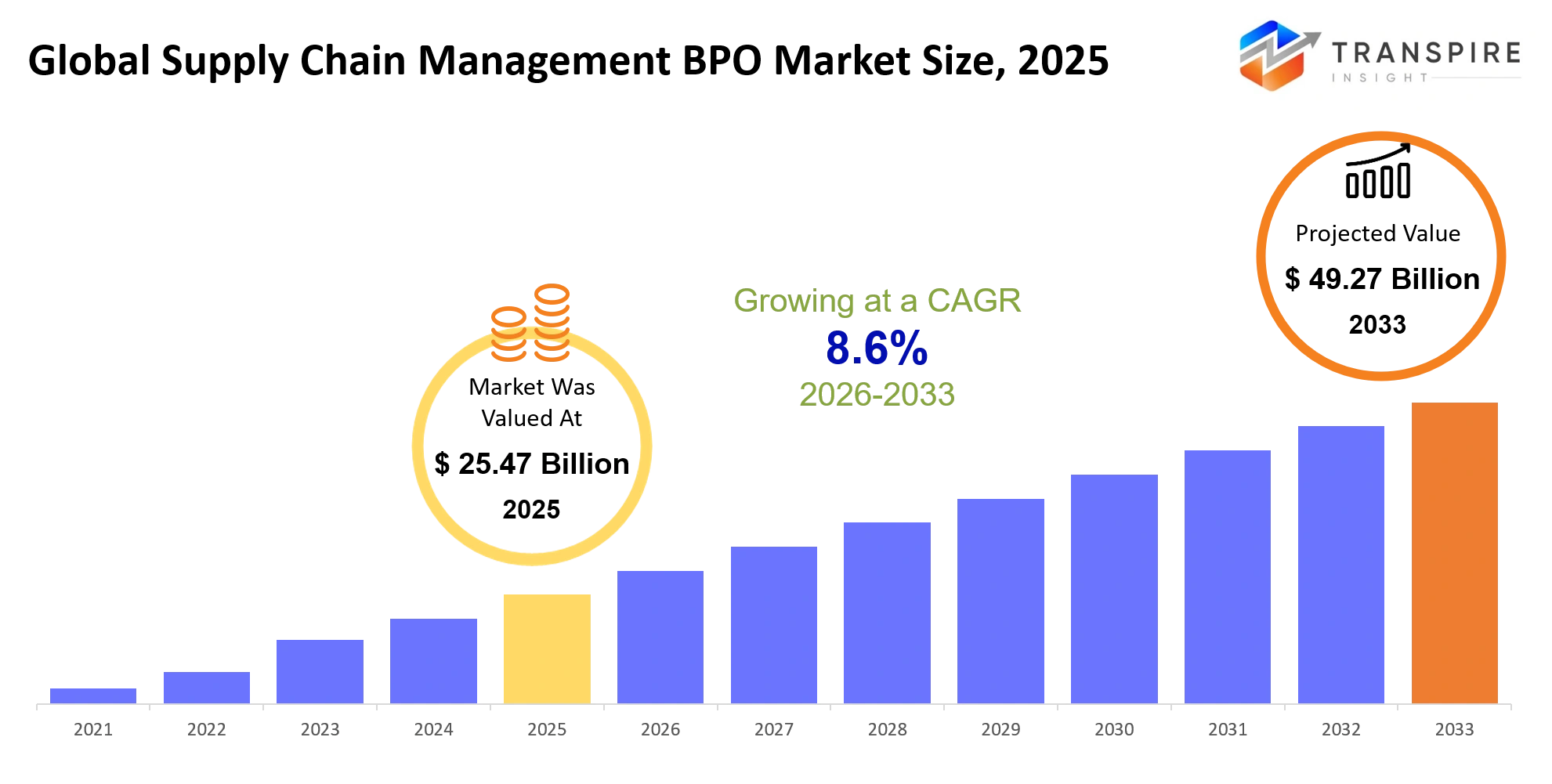
- Global Supply Chain Management BPO Market Size 2025: USD 25.47 Billion
- Global Supply Chain Management BPO Market Size 2033: USD 49.27 Billion
- Global Supply Chain Management BPO Market CAGR: 8.6%
- Global Supply Chain Management BPO Market Segments: By Service Type (Procurement Outsourcing, Logistics Management, Inventory Management, Order Management, Transportation Management, Warehouse Management, Supply Chain Analytics, Others); By Deployment (Cloud-based Solutions, On-premise Solutions, Hybrid Solutions, AI-enabled Platforms, SaaS Solutions, Integrated ERP Systems, Multi-cloud Platforms, Others); By Enterprise Size (Large Enterprises, Medium Enterprises, Small Enterprises, Startups, Government Organizations, Public Sector Enterprises, Non-profit Organizations, Others); By End User (Manufacturing, Retail & E-commerce, Healthcare, Automotive, BFSI, Consumer Goods, IT & Telecom, Others); By Process (Source-to-Pay, Order-to-Cash, Demand Planning, Supplier Management, Distribution Management, Reverse Logistics, Warehouse Optimization, Others).
Global Supply Chain Management BPO Market Summary:
As per Transpire Insight Analysis, the Global Supply Chain Management BPO Market size is estimated at USD 25.47 Billion in 2025 and is anticipated to reach USD 49.27 Billion by 2033, growing at a CAGR of 8.6% from 2026 to 2033.
The Global Supply Chain Management BPO market helps companies outsource core supply chain tasks to experts. These tasks include buying goods organizing transport, managing stock, planning deliveries and handling orders. By doing this, businesses can make operations smoother, save money, get a view of their supply chain and focus on key business goals. Supply Chain Management BPO is getting more important as supply chains get more complicated and global.
In recent years, the Supply Chain Management BPO market has changed a lot. This is because many companies are now using cloud technology, AI analytics, automation and digital supply chain tools. The global uncertainties and high customer expectations have made companies look for more flexible and strong supply chain models. As a result, companies are now looking for BPO providers that can give them up-to-date information, predict problems and help with operations when needed. This change is making companies in different industries like manufacturing, retail and healthcare use Supply Chain Management BPO services, which is helping the market grow.
The use of Supply Chain Management BPO services is increasing because it helps companies to focus on their business. Supply Chain Management BPO providers can handle tasks like procurement, logistics and order processing. This allows companies to save money and make their operations more efficient. The global Supply Chain Management BPO market is growing as more companies are looking for ways to improve their supply chain. Global Supply Chain Management BPO is helping companies to achieve this. The Supply Chain Management BPO market is expected to grow as more companies adopt supply chain solutions.
Key Market Insights:
The global Supply Chain Management (SCM) BPO market is progressing from cost-saving outsourcing to information-based SCM practices using technological means. Businesses are increasingly collaborating with professional service companies to enhance the processes related to procurement, logistics, inventories, and resilience.
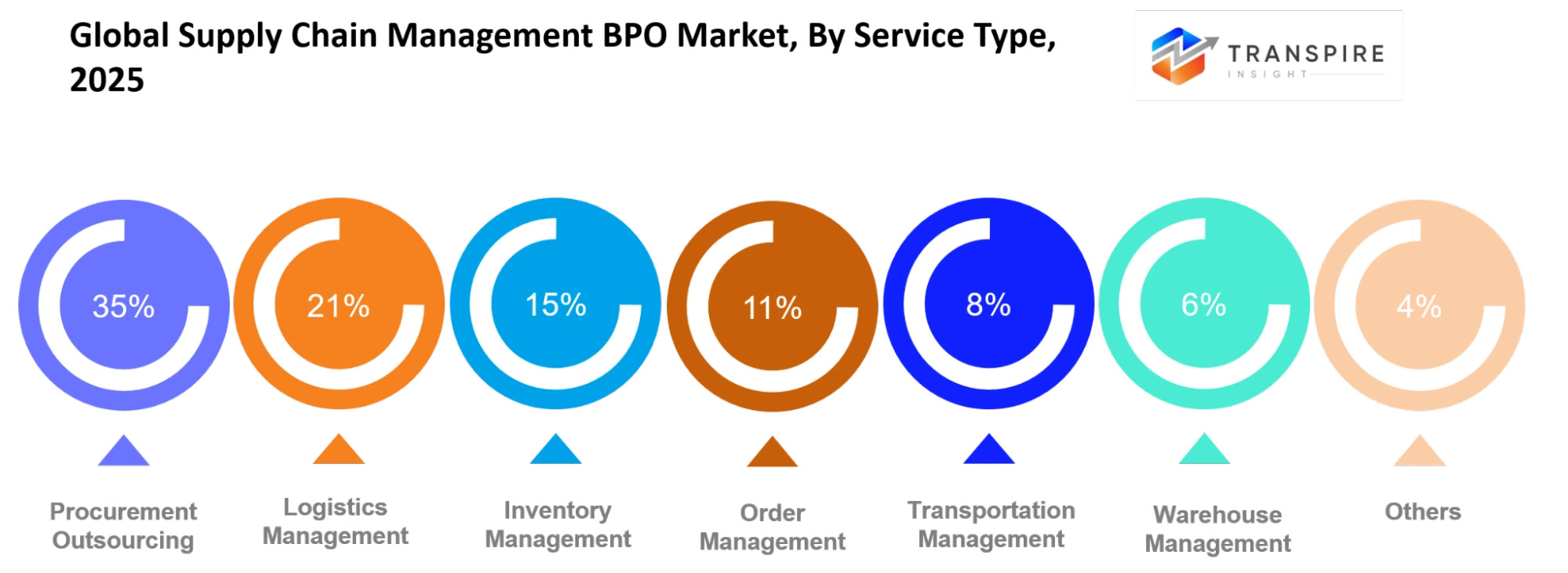
- Procurement Outsourcing represents 35% of the market, driven by the need for strategic sourcing solutions, and providers like Accenture and Genpact are continuously developing their digital procurement solutions.
- Logistics Management constitutes 21% of the total market size, thanks to rising investments in intelligent logistics planning, route optimisation, and real-time shipment tracking.
- Inventory Management takes 15%, with businesses turning to predictive inventory management and cloud-based monitoring solutions to ensure that they minimise any stock shortages and surplus.
- Order Management constitutes 11% of the market, with the fast adoption of omnichannel selling prompting businesses to have better and more efficient order management across various sales channels.
- Transportation Management makes up 8% of the market, with service providers adopting route optimisation and freight visibility platforms powered by artificial intelligence.
- Warehouse Management is worth 6% of the market, backed by increasing investments in automation of warehouses, robotics, and digital inventory management systems.
- Supply Chain Analytics is the fastest-growing segment of the market, expected to grow at a CAGR of 18.1%. This growth comes from investments made in predictive analysis, forecasting of demand, and real-time intelligence to increase the resilience of the supply chain.
- The other 4% of the market includes supply chain services that cater to specific industry needs and include supplier collaboration, compliance assistance, among others.
What are the Key Drivers, Restraints, and Opportunities in the Global Supply Chain Management BPO Market?
Drivers
The need for resilient and efficient supply chain operations is one of the factors driving the expansion of the global supply chain management BPO market. Outsourcing procurement, logistics, inventory planning and order management allows increasing operational flexibility and lowering costs for building infrastructure and maintaining the workforce. Disruptions during the pandemic period, geopolitical situation and changes in trade relations made companies realise the importance of agile supply chains and collaborate with BPO suppliers specialising in such processes. On the other hand, increased use of cloud computing, automation, artificial intelligence and advanced analytics allows providing better service, delivering more visibility, quicker decision-making and demand forecasting, hence facilitating the outsourcing adoption in the manufacturing, retail, healthcare, automotive, and consumer goods sectors.
Restraints
Several obstacles are preventing the market from reaching its full potential. Legacy enterprise systems used by many enterprises are hard to integrate into a new digital BPO platform, which makes the implementation process longer and costly. Cybersecurity concerns, data privacy and confidentiality of information about suppliers are making enterprises hesitate when it comes to outsourcing their supply chain management processes. Furthermore, discrepancies between regional regulations and standards can complicate the process of implementation for
Opportunities
The major opportunity that awaits BPO companies is associated with the increased use of artificial intelligence-enabled supply chain analytics and automation. The rise of predictive planning and digital procurement, along with enhanced visibility in the supply chain, is helping businesses enhance their operational resiliency. Increased industrial operations in the Asia-Pacific region, coupled with investment in digital transformations, create opportunities for BPOs to serve the emerging industries through their technology-driven offerings.
What Has the Impact of Artificial Intelligence Been on the Global Supply Chain Management BPO Market?
The Global Supply Chain Management BPO market has been greatly impacted by artificial intelligence as it has made the processes outsourced smarter and faster. Companies that provide their services in BPO use artificial intelligence in procurement, inventory planning, logistics management and orders to automate routine tasks, minimise the number of manual activities, and improve the accuracy of operations. Intelligent systems capable of processing large amounts of data about the supply chain in real time make it possible to recognise demand changes, assess the performance of suppliers, optimise the amount of inventory, and plan transportation in the best way. These features enable businesses to be more flexible and reduce operational expenses.
Demand forecasting is one of the most useful uses of artificial intelligence in supply chain management outsourcing. Algorithms analyse data such as previous trends, customers' purchasing behaviour, weather conditions, and other market signs in order to predict demand and potential disruptions in the supply chain. As a result, companies manage to eliminate shortages of inventory and minimise surplus. Warehouse operations have been improved thanks to inventory management, replenishment recommendations, and optimal resource allocation. Even though AI has many benefits, there are still some difficulties with its integration into business. The adoption of AI technology may require large amounts of investment, special technical skills, and data processing. Poor quality of data and complicated implementation process might also result in delays in performance improvement. However, with the development of cloud computing and digital supply chain platforms, AI will be used more and more often in providing efficient supply chain solutions by BPO providers.
Key Market Trends:
The Global Supply Chain Management BPO market is maturing from mere outsourcing to seeking technology partners capable of enhancing supply chain visibility, resilience, and decisions. The service providers in this sector continue enhancing their offerings through automation, artificial intelligence, cloud-based services, and analytics for more agile and value-added supply chains.
- The enterprises in this market are switching from transaction-based outsourcing to total supply chain management services, with Accenture and Genpact being some of the firms investing in AI-driven procurement and digital operations.
- There is a shift from legacy on-premises supply chains to cloud-based platforms that will enhance collaboration, rapid deployment, and flexibility of the global supply chains.
- Predictive analytics has become a core business tool, assisting in demand forecasting, optimising inventory, and preventing supply chain disruptions before they affect operations.
- Intelligent automation in procurement, invoice, and order management has enabled BPO providers to be more accurate and fasten the operational turnaround times.
- Supplier risk management has been enhanced through continuous monitoring of the suppliers' operations, performance, compliance, and risks of disruption using data-driven solutions.
- Sustainability is becoming a strategic consideration, and companies are incorporating carbon tracking, responsible sourcing, and ESG reporting into outsourced supply chains.
Global Supply Chain Management BPO Market Segmentation
By Service Type
Procurement Outsourcing has taken the lead in the Global Supply Chain Management BPO industry with 35% market share, which is due to the trend of outsourcing the functions of strategic sourcing, supplier management, and procurement processes. The next biggest service type is Logistics Management with 21%, driven by higher demand for efficient handling of freight movement and distribution management. The third biggest is Inventory Management with 15%, followed by Order Management with 11%, indicating that inventory management and order management are essential components of business operations. Transportation Management has 8%, and Warehouse Management has 6%, and the remaining 4% consists of other specific supply chain services. However, the most rapidly growing service type is Supply Chain Analytics with a CAGR of 18.1%.
By Deployment
Cloud-based Solutions keep becoming popular due to their scalability, cost-efficient infrastructure, and real-time data about the supply chain that is available to businesses from different locations. There is a high demand for AI-Enabled Platforms and SaaS Solutions due to their intelligence, automation capabilities, ability to analyse information and upgrade systems without any additional expenses. Hybrid Solutions are popular among those enterprises that want to combine their legacy infrastructure with cloud capabilities, while On-premise Solutions are still chosen by businesses that have concerns about their data security or need to follow certain regulations. The integration of ERP and multi-cloud platforms helps to increase visibility within enterprises by integrating procurement, logistics, inventory, and financial processes.
By Enterprise Size
Large Enterprises are the primary consumers of supply chain BPO services due to the presence of numerous suppliers, their international scope, and bigger budget for outsourcing services. Increasingly, medium-sized companies are turning to BPO in order to increase the efficiency of operations while reducing their internal efforts. Moreover, small businesses and startups are also beginning to use outsourced supply chain solutions due to the cost-efficiency of cloud technologies that provide advanced capabilities. Government and public sector enterprises and non-profit organizations begin using specialized BPO services.
By End User
The manufacturing industry still forms the biggest end user market segment due to the necessity to have an effective process of procurement, supplier management, production planning, and inventory management. There is a trend for retail and e-commerce organisations to outsource their supply chain services to cope with increased order volume and provide better customer fulfilment. Healthcare providers require the services of BPO providers to guarantee the continuous availability of supplies and meet all regulatory requirements. The automotive industry is focused on supplier management and production planning, and BFSI, consumer goods, and IT & telecom markets are expanding their investment in the outsourcing of supply chain management.
By Process
One of the processes that should be emphasised among the others in regard to its significance is source-to-pay, as it includes such processes as procurement, supplier management, purchasing, and payment. It is crucial to increase the focus on order-to-cash and demand planning to have better order fulfilment and forecasting of sales. Supplier management evolves as there are digital platforms for vendor performance and compliance management. Processes such as distribution management, reverse logistics, and warehouse optimisation are becoming more technological due to automation, planning by using AI, and real-time tracking of orders.
What are the Key Use Cases Driving the Global Supply Chain Management BPO Market?
Global Supply chain management BPO services' most common application is procurement outsourcing, where organisations in manufacturing, automotive, healthcare, and consumer goods industries outsource their procurement functions in order to better manage suppliers, reduce purchasing costs, improve the sourcing process, and ensure constant availability of materials. This helps businesses to concentrate on strategy execution while increasing procurement efficiency and supply chain resilience.
Apart from procurement, businesses are also resorting to outsourcing of logistics management, inventory management, transportation planning, and order processing in order to increase operational performance. Retail and e-commerce companies benefit from such outsourcing through increased speed of delivery, optimisation of inventory, and improvement of customer satisfaction. In addition, manufacturers benefit from logistics and warehouse management outsourcing in order to ensure production continuity and decrease their operating expenses.
New applications of supply chain BPO services revolve around Supply Chain Analytics, where businesses leverage artificial intelligence-based analytics, predictive demand forecasting, and real-time supply chain monitoring in order to discover disruptions, improve planning accuracy, and make informed decisions.
|
Report Metrics |
Details |
|
Market size value in 2025 |
USD 25.47 Billion |
|
Market size value in 2026 |
USD 27.66 Billion |
|
Revenue forecast in 2033 |
USD 49.27 Billion |
|
Growth rate |
CAGR of 8.6% from 2026 to 2033 |
|
Base year |
2025 |
|
Historical data |
2021 - 2024 |
|
Forecast period |
2026 - 2033 |
|
Report coverage |
Revenue forecast, competitive landscape, growth factors, and trends |
|
Regional scope |
United States; Canada; Mexico; United Kingdom; Germany; France; Italy; Spain; Denmark; Sweden; Norway; China; Japan; India; Australia; South Korea; Thailand; Brazil; Argentina; South Africa; Saudi Arabia; United Arab Emirates |
|
Key company profiled |
Accenture, Genpact, Tata Consultancy Services, Infosys BPM, WNS Global, Cognizant, EXL Service, Capgemini, IBM, HCLTech, Tech Mahindra, DXC Technology, Wipro, Sutherland Global Services, Conduent. |
|
Customization scope |
Free report customization (country, regional & segment scope). Avail customized purchase options to meet your exact research needs. |
|
Report Segmentation |
By Service Type (Procurement Outsourcing, Logistics Management, Inventory Management, Order Management, Transportation Management, Warehouse Management, Supply Chain Analytics, Others); By Deployment (Cloud-based Solutions, On-premise Solutions, Hybrid Solutions, AI-enabled Platforms, SaaS Solutions, Integrated ERP Systems, Multi-cloud Platforms, Others); By Enterprise Size (Large Enterprises, Medium Enterprises, Small Enterprises, Startups, Government Organizations, Public Sector Enterprises, Non-profit Organizations, Others); By End User (Manufacturing, Retail & E-commerce, Healthcare, Automotive, BFSI, Consumer Goods, IT & Telecom, Others); By Process (Source-to-Pay, Order-to-Cash, Demand Planning, Supplier Management, Distribution Management, Reverse Logistics, Warehouse Optimization, Others). |
Which Regions are Driving the Global Supply Chain Management BPO Market Growth?
North America
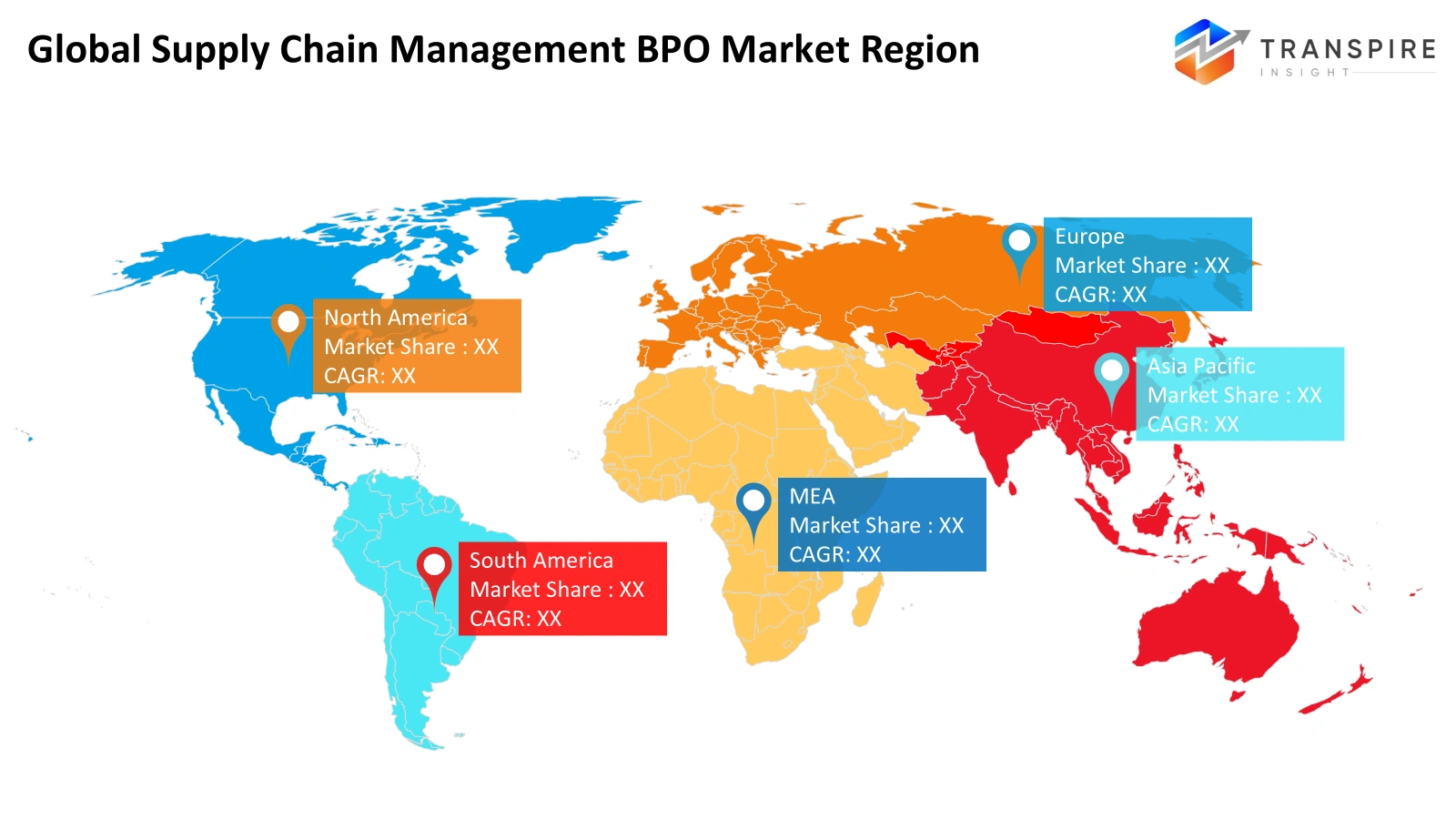
North America holds a 43% share of the global market in terms of GSCM BPO, due to a significant presence of multinational corporations, state-of-the-art IT infrastructure, and an early adoption of cloud supply chain technologies. Many businesses from different industries, such as manufacturing, retail, healthcare and consumer goods sectors, are shifting their procurement, logistics and inventory management functions to outsourcing to streamline processes and decrease expenses. Constant innovations and improvements in artificial intelligence, automation and data analytics increase the leadership of this area through the possibility of real-time supply chain visibility and fast decision-making. In May 2025, Blue Yonder launched its AI Agents and Supply Chain Knowledge Graph during ICON 2025 to automate planning, procurement, inventory, and logistics decision-making. This launch is expected to promote AI-driven supply chain outsourcing and digital supply chains within North American companies.
Europe
The European region accounts for 26% of the global market because of its advanced manufacturing capabilities, strict regulations and sustainable supply chains. Businesses from the automotive, pharmaceuticals, industrial manufacturing, and retail sectors use outsourcing of supply chain management services to increase procurement efficiency and improve cooperation with suppliers. There are also many developments in digital procurement platforms, warehouse automation, and logistics solutions in Europe that help businesses to be resilient and provide high-quality services.In October 2025, CtrlChain has launched its Shipper Transport Management System (TMS). The system is a cloud-based software allowing businesses to outsource their transport planning and logistics management by automating logistics processes, contributing to the rapid development of supply chain BPO services in Europe.
Asia Pacific
The Asia Pacific region accounts for 23% of the overall market share and is the most rapidly growing segment, with a forecast CAGR of 19.2%. The rapid industrialisation process, growing manufacturing capabilities, flourishing e-commerce, and cross-border trade have significantly fuelled the growth of the outsourced supply chain management services market. Both governments and enterprises in this region are investing heavily in developing intelligent logistics and artificial intelligence-based supply chain technologies to make their operations more efficient and competitive. With the growing number of both domestic and foreign enterprises in the region, the market demand is anticipated to grow further. In August 2025, Infosys and Telstra have started a joint venture in Australia to boost AI, cloud and digital transformation services in the region. This collaboration will help boost enterprise outsourcing services, including digital supply chain and procurement, thus fostering the growth of supply chain BPO in the Asia Pacific region.
Who are the Key Players in the Global Supply Chain Management BPO Market and how do they Compete?
The competition in the Global Supply Chain Management BPO industry is based on technological innovation, domain experience, and ability to provide end-to-end services of supply chains in global markets. Market leaders are continuously enhancing their service portfolio by including artificial intelligence, cloud computing, automation, predictive analytics, and intelligent procurement into their services. Also, providers expand their geographical presence by developing partnerships, making acquisitions, and investing in digital transformation due to increased demand for agility and resilience of supply chains.
The competitive advantage of Accenture is based on the provision of consulting services and supply chain solutions based on AI, which allow enterprises to transform their procurement, logistics, and planning practices. The company offers integrated services of digital transformation supported by advanced analytics and cloud technologies.
The competitive advantage of Genpact is based on the data-driven optimisation of supply chains and intelligent procurement services. By incorporating automation, machine learning, and predictive analytics into its operations, the company helps its customers to enhance their efficiency and cut costs. The company's expansion strategy consists in continuous investment in AI capabilities and collaboration with enterprise technology vendors.
Global Supply Chain Management BPO Market companies
- Accenture
- Genpact
- Tata Consultancy Services
- Infosys BPM
- WNS Global
- Cognizant
- EXL Service
- Capgemini
- IBM
- HCLTech
- Tech Mahindra
- DXC Technology
- Wipro
- Sutherland Global Services
- Conduent
Recent Development News
In February 2026, Accenture announced new AI-based procurement capabilities aimed at advancing autonomous supply chains through intelligent sourcing, spend categorisation, automated contracting, and risk prediction. This announcement enhances Accenture’s digital supply chain BPO offering as it allows firms to enhance procurement efficiencies and resiliency.
Source: https://www.accenture.com
In April 2025, Genpact announced its 2025 vision of autonomous supply chains, which emphasises the use of agentic AI that can enable connectivity of planning, sourcing, manufacturing, logistics, and after-sales functions into one digital platform. This development will enable rapid decision-making and visibility of the supply chain, as well as enhance the agility of global companies.
Source: https://www.genpact.com
In April 2025, ISG named Genpact the Global CX Star Performer in Procurement BPO Services in their Voice of the Customer evaluation. The designation is based on the strong customer experience at Genpact, their continuing investments in artificial intelligence-based procurement services, and increasing competitiveness in the global supply chain management BPO market.
Source: https://isg-one.com/
What Strategic Insights Define the Future of the Global Supply Chain Management BPO Market?
The global supply chain management BPO market is developing towards a technological solution approach in which artificial intelligence, automation, cloud technology, and predictive analytics will play an important role in boosting efficiency and building supply chain resilience. As more companies diversify their supplier base and improve risk management practices, the need for intelligent partners in outsourcing will rise within sectors such as manufacturing, retail, healthcare, and logistics.
The increasing difficulty of integrating advanced digital technologies into existing legacy enterprise systems may slow down such initiatives and boost the cost of the process. Nevertheless, the fast development of AI-powered supply chain analytics tools and cloud-based procurement solutions opens up many growth opportunities for service providers who can offer scalable operations based on big data. Firms that can develop their digital capabilities, ensure cybersecurity, specialise in different industries, and establish successful tech partnerships will gain an important competitive advantage.
Key Segmentations are:
By Service Type
- Procurement Outsourcing
- Logistics Management
- Inventory Management
- Order Management
- Transportation Management
- Warehouse Management
- Supply Chain Analytics
By Deployment
- Cloud-based Solutions
- On-premise Solutions
- Hybrid Solutions
- AI-enabled Platforms
- SaaS Solutions
- Integrated ERP Systems
- Multi-cloud Platforms
By Enterprise Size
- Large Enterprises
- Medium Enterprises
- Small Enterprises
- Startups
- Government Organizations
- Public Sector Enterprises
- Non-profit Organizations
By End User
- Manufacturing
- Retail & E-commerce
- Healthcare
- Automotive
- BFSI
- Consumer Goods
- IT & Telecom
By Process
- Source-to-Pay
- Order-to-Cash
- Demand Planning
- Supplier Management
- Distribution Management
- Reverse Logistics
- Warehouse Optimisation
Regional Outlook
North America
- United States
- Canada
- Mexico
Europe
- Germany
- United Kingdom
- France
- Spain
- Italy
- Rest of Europe
Asia Pacific
- Japan
- China
- Australia & New Zealand
- South Korea
- India
- Rest of Asia Pacific
South America
- Brazil
- Argentina
- Rest of South America
Middle East & Africa
- Saudi Arabia
- United Arab Emirates
- South Africa
- Rest of the Middle East & Africa
Frequently Asked Questions
Find quick answers to common questions.
The global supply chain management BPO market size was valued at USD 25.47 Billion in 2025 and is poised to reach USD 49.27 Billion by 2033, expanding at a 8.6% CAGR.
Key segments for the global supply chain management BPO market are By Service Type (Procurement Outsourcing, Logistics Management, Inventory Management, Order Management, Transportation Management, Warehouse Management, Supply Chain Analytics, Others); By Deployment (Cloud-based Solutions, On-premise Solutions, Hybrid Solutions, AI-enabled Platforms, SaaS Solutions, Integrated ERP Systems, Multi-cloud Platforms, Others); By Enterprise Size (Large Enterprises, Medium Enterprises, Small Enterprises, Startups, Government Organizations, Public Sector Enterprises, Non-profit Organizations, Others); By End User (Manufacturing, Retail & E-commerce, Healthcare, Automotive, BFSI, Consumer Goods, IT & Telecom, Others); By Process (Source-to-Pay, Order-to-Cash, Demand Planning, Supplier Management, Distribution Management, Reverse Logistics, Warehouse Optimization, Others).
Growth is primarily driven by Increased demand for cost-effective supply chain systems, increasing usage of digital technology and AI, increased e-commerce operations, increased need for logistics visibility, and outsourcing of procurement and inventory management functions.
The global market is led by major manufacturers including Accenture, Genpact, Tata Consultancy Services, Infosys BPM, WNS Global, Cognizant, EXL Service, Capgemini, IBM, HCLTech, Tech Mahindra, DXC Technology, Wipro, Sutherland Global Services, Conduent.
North America represents 43% of the entire global market for Supply Chain Management BPO, owing to the extensive usage of outsourcing procurement and logistics activities, successful implementation of digital transformation strategies, sophisticated cloud-based supply chain management technology, and also the availability of prominent players offering their BPO services to large corporations.
Opportunities available within the BPO market for global supply chain management include expanding AI-driven supply chain services, increased need for cloud-based logistics software solutions, outsourcing by small and medium-sized enterprises, cross-border e-commerce solutions, and analytics and risk management solutions.
- Accenture
- Genpact
- Tata Consultancy Services
- Infosys BPM
- WNS Global
- Cognizant
- EXL Service
- Capgemini
- IBM
- HCLTech
- Tech Mahindra
- DXC Technology
- Wipro
- Sutherland Global Services
- Conduent
About the Authors

Mayur Shinde
I am Mayur Shinde, a Senior Research Analyst at Transpire Insight, specializing in the Automotive & Transportation and Information & Communication Technology (ICT) Industry. My work focuses on analyzing emerging market trends, technological advancements, competitive landscapes, and industry developments to deliver accurate, data-driven insights. I am passionate about transforming complex market information into clear, actionable content that helps businesses, professionals, and decision-makers stay informed and make confident strategic decisions.

Chakradhar Khansole
Chakradhar serves as the Research Director at Transpire Insight, bringing over 8 years of experience in technology, innovation, and strategic market intelligence. He specializes in transforming complex market data into actionable business insights that enable organizations to make informed, growth-oriented decisions. Recognized for his strategic vision and analytical expertise, Chakradhar leads high-impact research initiatives, delivering comprehensive market assessments, competitive intelligence, and forward-looking industry analysis.
Recently Published Reports
-
Apr 2026
3D Optical Profiler Market
3D Optical Profiler Market Size, Share & Analysis Report By Type (Desktop 3D Optical Profiler, and Portable 3D Optical Profiler), By Technology (Confocal Technology, and White Light Interference), By End-Use Industry (Manufacturing, Research Institutions, Automotive, Aerospace and Defense, Medical Devices, and Other), and Geography (North America, Europe, Asia-Pacific, Middle East and Africa, South and Central America), 2021 - 2031
-
Apr 2026
Depth Sensor Market
Depth Sensor Market Size, Share & Analysis Report By Type (Infrared Depth Sensors, Time-of-Flight (ToF) Sensors, Stereo Vision Sensors, Structured Light Sensors, Ultrasonic Depth Sensors), By Application (Automotive, Robotics, Gaming, Consumer Electronics, Industrial Automation, Healthcare, Security & Surveillance, Others), By End Users (Automotive Manufacturers, Consumer Electronics Companies, Healthcare Providers, Industrial Companies, Security Agencies, Gaming Companies, Robotics Companies, Others), and Geography (North America, Europe, Asia-Pacific, Middle East and Africa, South and Central America), 2021 – 2031
-
Apr 2026
Digital Manufacturing Market
Digital Manufacturing Market Size, Share & Analysis Report By Component (Hardware, Software, and Services), By Technology (Robotics, 3D Printing, Internet of Things (IoT), and Others), By Application (Automotive and Transportation, Aerospace and Defense, Consumer Electronics, Industrial Machinery, and Others), By Process Type (Computer-Based Designing, Computer-Based Simulation, Computer 3D Visualization, Analytics, and Others), and Geography (North America, Europe, Asia-Pacific, Middle East and Africa, South and Central America), 2021 – 2031
-
Apr 2026
Digital Visa Services Market
Digital Visa Services Market Size, Share & Analysis Report By Type (Individual Travelers, Group Travelers), By Application (Tourism, Business Travel, Others), and Geography (North America, Europe, Asia-Pacific, Middle East and Africa, South and Central America), 2021 – 2031