
Global Subscriber Identity Module (SIM) Market Size & Forecast:
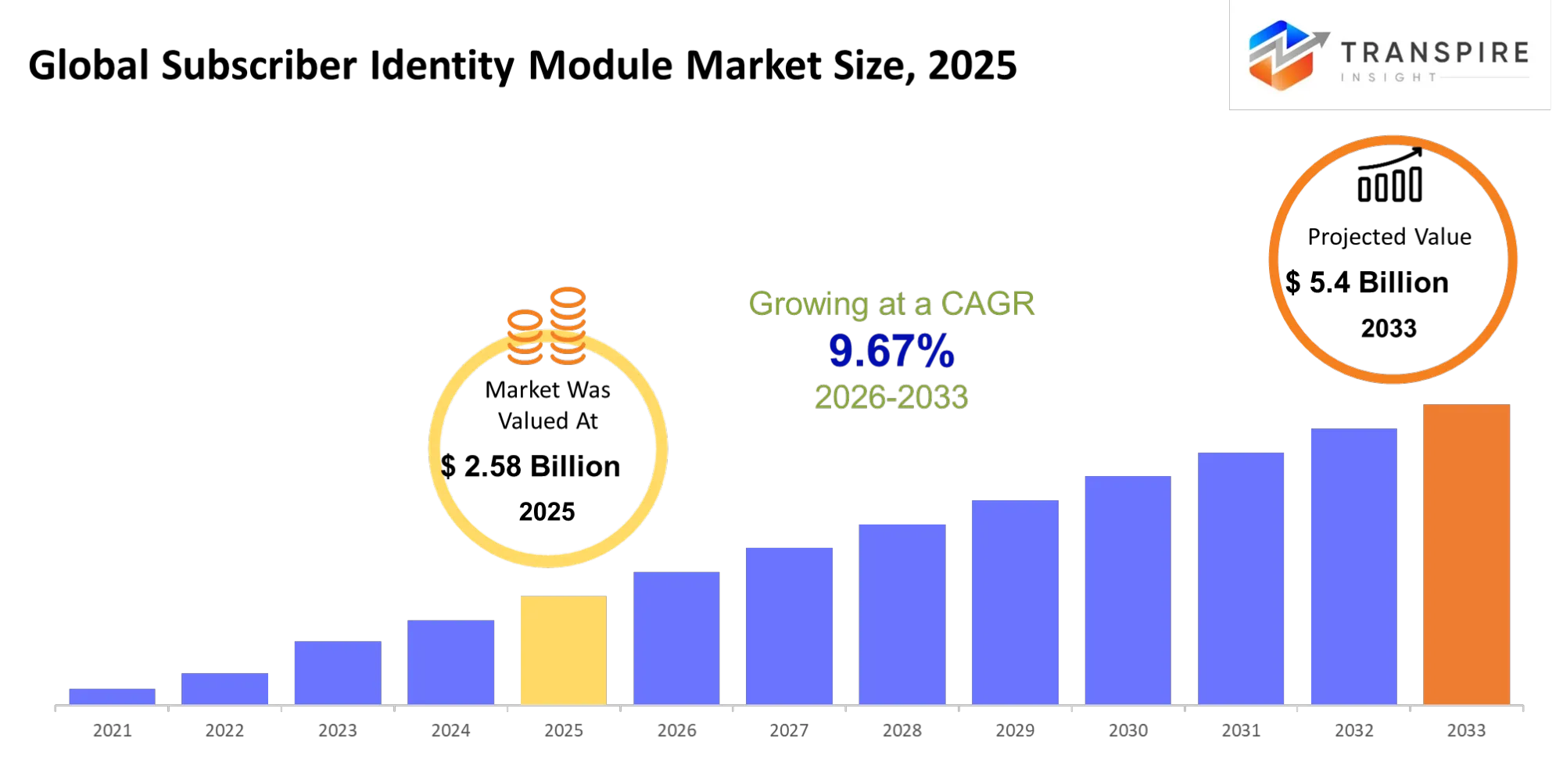
- Global Subscriber Identity Module (SIM) Market Size 2025: USD 2.58 Billion
- Global Subscriber Identity Module (SIM) Market Size 2033: USD 5.4 Billion
- Global Subscriber Identity Module (SIM) Market CAGR: 9.67%
- Global Subscriber Identity Module (SIM) Market Segments:By Type (Standard SIM, Micro SIM, Nano SIM, eSIM), By Application (Mobile Devices, IoT, Automotive, Wearables), By End-User (Telecom Operators, Consumers, Enterprises, OEMs).
Global Subscriber Identity Module (SIM) Market Summary:
The Subscriber Identity Module size is estimated at USD 2.58 Billion in 2025 and is anticipated to reach USD 5.4 Billion by 2033, growing at a CAGR of 9.67% from 2026 to 2033, driven by the rapid evolution of digital connectivity, embedded communication systems, and cloud-managed telecom infrastructure. The market enables secure subscriber authentication and network access across smartphones, connected vehicles, industrial IoT systems, wearables, and smart infrastructure applications. Over the last few years, the industry has shifted from physical SIM card distribution toward eSIM and iSIM technologies that support remote provisioning and software-based connectivity management.
A major structural shift has been the transition toward embedded and remotely programmable SIM ecosystems powered by 5G and AI-enabled telecom platforms. This transformation accelerated after the global expansion of IoT networks and increasing adoption of connected consumer devices by companies such as Apple Inc. and automotive manufacturers integrating eSIM-enabled systems. The market is growing because enterprises and telecom operators require scalable, secure, and remotely managed connectivity solutions that reduce operational costs while supporting billions of interconnected devices across industries.
Global Subscriber Identity Module (SIM) Market Insights:
- Almost 68% of all smartphones shipped globally support eSIM technology, with Apple Inc. and Samsung Electronics fast growing their respective ecosystems, focusing on exclusively using eSIMs for their smartphones.
- About 45% of telecom operators globally offer commercial eSIM management platforms, whereas Thales Group and IDEMIA continue developing remote SIM provisioning services for hassle-free switching between carriers.
- The IoT industry constitutes almost 30% of all SIM usage growth, owing to smart metering systems, industrial automation projects, and connected cars, with Giesecke+Devrient launching its industrial IoT SIM portfolio designed for long battery life.
- Over 55% of all automotive manufacturers incorporate embedded SIMs in their connected car fleets, thanks to innovations made by Infineon Technologies in terms of providing secure chipsets for vehicle telematics and autonomous driving.
- As many as 70% of 5G-capable phones shipped worldwide support advanced SIM authentication technology, spurring NXP Semiconductors to expand its offerings of secure elements that would help speed up 5G access and improve cybersecurity.
What are the Key Drivers, Restraints, and Opportunities in the Global Subscriber Identity Module (SIM) Market?
Driver
The market for Subscriber Identity Modules (SIMs) is mainly influenced by the quick change towards ecosystems that are equipped with eSIM technology and are connected to the Internet of Things (IoT). The installation of 5G infrastructure prompted a paradigm shift in terms of telecommunications identity verification, and thus mobile network providers and manufacturers of phones had no choice but to switch to remotely programmable SIM cards. Leading smartphone companies such as Apple Inc. and Samsung Electronics have begun including eSIM technology exclusively in their top-of-the-line phones, minimizing reliance on physical SIM card delivery processes.
Restraint
One key limitation is the fragmented nature of the telecommunications regulation framework and reliance on outdated technology infrastructure in developing countries. Most mobile operators use the conventional SIM card deployment framework which necessitates the presence of a physical delivery mechanism and manual customer authentication procedures. The continued existence of incompatible carrier standards, cybersecurity issues, and device-operator interoperability challenges hinder the worldwide adoption of the eSIM solution.
Opportunity
One of the key areas of growth is the development of IoT in industries and the rise of mobile connectivity ecosystems. The use of embedded SIM (eSIM/iSIM) technology could enable the adoption of autonomous vehicles, smart manufacturing facilities, and logistics networks that operate across international borders with seamless network connectivity. Telecom operators in Asia Pacific and the Middle East are becoming prime locations for deploying advanced digital identity management solutions.
What Has the Impact of Artificial Intelligence Been on the Global Subscriber Identity Module (SIM) Market?
AI technology has brought about innovations in the Subscriber Identity Module market by facilitating the automation of eSIM configuration, fraud detection, and telecom networks management. With AI, it is possible to analyze subscriber behavior, device authentication activities, and usage of connectivity in real-time for better performance and cybersecurity within telecom networks. Telecommunications operators are using AI in remote SIM provisioning solutions to automate the process of profile configuration and enhance connectivity in millions of Internet of Things devices. A more recent instance would be the alliance made in 2025 between Thales Group and AT&T in developing an AI-enabled eSIM management system to facilitate massive deployment of IoT devices. This system provides capabilities such as automated subscription management, predictive diagnostic analytics, and over-the-air profile switching.
AI has enhanced operational efficiency by employing predictive maintenance and network optimization strategies. Analytics are used to forecast network traffic and identify any suspicious activity in SIMs or identity theft before a network crash takes place. Remote provisioning of SIM cards also lowers logistics expenses that come with the physical distribution of SIMs.
Global Subscriber Identity Module (SIM) Market Trends:
- Telecom providers are quickly moving away from SIM logistics to remote SIM activation services, minimizing the need for physical SIMs through retail outlets and increasing digital onboarding capabilities.
- eSIM-only smartphone models are becoming more popular among device makers, highlighting the industry's ongoing push towards complete integration of mobile functionality without physical SIM hardware.
- Embedded SIM technology is being incorporated into the design of automotive systems, allowing for functions such as real-time navigation, telematics, self-driving capabilities, and over-the-air firmware updates.
- IoT applications are adopting the use of low-power consumption eSIM and iSIM configurations, facilitating constant machine-to-machine connectivity in smart manufacturing plants, utilities, and logistics operations.
- International mobile network interoperability is progressing via multi-SIM devices that seamlessly switch between networks depending on signal strength, efficiency of costs, and regional availability.
- Wearable technology companies are incorporating miniaturized SIMs within watches and health/fitness trackers to achieve independent mobile connectivity.
- Communication satellite firms as well as NTN organizations are focusing on developing SIMs suitable for satellite communication, thereby improving telecom services in inaccessible areas.
- The concept of sustainability is driving SIM manufacturing practices, and telecom companies have started considering reducing their plastic SIM card usage in favor of digital SIM technology.
Global Subscriber Identity Module (SIM) Market Segmentation:
By Type:
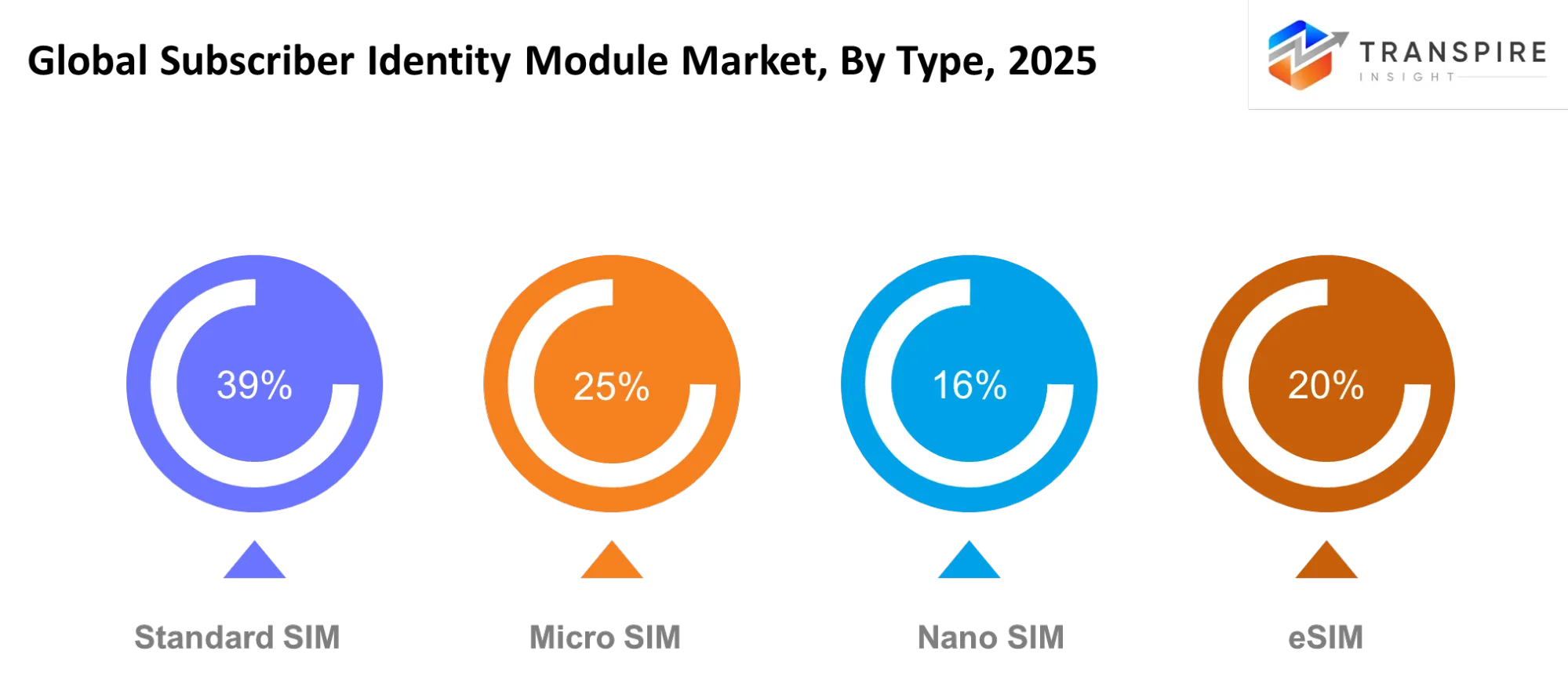
Subscriber Identity Module (SIM) Market exhibits varying dynamics within the sub-markets on the basis of types, applications, and end users while making a move from the conventional telecom identity model towards that of digitally embedded connectivity ecosystems. In terms of types, the Nano SIM holds the current leadership position in the SIM market owing to its wide usage in smartphones and connected devices which need thin form factors and high performance. It is likely to continue growing owing to constant renewal of smartphones and the demand for slim and high-performing mobile equipment. Nevertheless, the eSIM would prove to be the most significant one going forward as it does not depend on physical cards and allows remote provisioning and usage of more than one network.
By Application:
In terms of applications, the biggest income-generating segment will be the mobile segment, as smartphones continue to be the main channel for digital communications, online transactions, and Internet use across the world. The rationale behind the growth of this segment stems from the increasing uptake of 5G and the growing need for uninterrupted communication across borders. The other major growth trend is evident within the IoT segment owing to developments in industrial automation, healthcare systems that are connected, and the need for connected utilities that have the need for machine-to-machine communication. The other application segment witnessing rapid growth is automotive applications as connected cars utilize the eSIM technology.
By End-User:
With regard to the end-users' point of view, the telecom providers remain the dominant forces dictating the needs within the market as they control the processes relating to subscriber identity management and connectivity. They are currently focusing more on cloud-based provisioning systems and AI-integrated networking security services. The enterprises will become an increasingly important growth market as industries start adopting Internet of Things technology for asset tracking, remote monitoring, and smart manufacturing through the use of secure embedded connectivity solutions. The manufacturers will also become more influential by embedding SIM-based solutions directly in consumer electronic devices and industrial machines as they come off the production line.
What are the Key Use Cases Driving the Subscriber Identity Module Market?
The main application that is fueling the growth in the SIM card market is that of smartphone connectivity as well as mobile broadband connections wherein telecommunication companies use SIM technology for user authentication and network access and management. The consumer electronics industry continues to remain the major contributor owing to the growing adoption of 5G smartphones as well as eSIM functionalities.
Use cases continue to grow in industries such as the Internet of Things, health care, and automobiles. Embedded SIMs help companies achieve machine-to-machine communication and device management without interruption through smart meters, logistics solutions, connected medical devices, and automobile telematics.
New applications are focused on the domain of smart cities, autonomous transport, and satellite-based communications systems. Organizations are creating iSIM as well as cloud-based provisioning solutions for drones, self-driving cars, and remote infrastructure monitoring systems. Moreover, the advent of NTN is opening up new possibilities for connectivity in maritime, aviation, and rural communication scenarios, which do not have extensive cellular coverage.
|
Report Metrics |
Details |
|
Market size value in 2025 |
USD 2.58 Billion |
|
Market size value in 2026 |
USD 2.83 Billion |
|
Revenue forecast in 2033 |
USD 5.4 Billion |
|
Growth rate |
CAGR of 9.67% from 2026 to 2033 |
|
Base year |
2025 |
|
Historical data |
2020 - 2024 |
|
Forecast period |
2026 - 2033 |
|
Report coverage |
Market trends, drivers, restraints, opportunities, competitive landscape, technology analysis, AI impact, regional outlook, and industry use cases |
|
Regional scope |
United States; Canada; Mexico; United Kingdom; Germany; France; Italy; Spain; Denmark; Sweden; Norway; China; Japan; India; Australia; South Korea; Thailand; Brazil; Argentina; South Africa; Saudi Arabia; United Arab Emirates |
|
Key company profiled |
Gemalto, Giesecke+Devrient, IDEMIA, Thales, STMicroelectronics, NXP, Infineon, Sierra Wireless, Qualcomm, Samsung, Apple, Huawei, China Mobile, Vodafone, AT&T |
|
Customization scope |
Free report customization (country, regional & segment scope). Avail customized purchase options to meet your exact research needs. |
|
Report Segmentation |
By Type (Standard SIM, Micro SIM, Nano SIM, eSIM), By Application (Mobile Devices, IoT, Automotive, Wearables), By End-User (Telecom Operators, Consumers, Enterprises, OEMs) |
Which Regions are Driving the Subscriber Identity Module Market Growth?
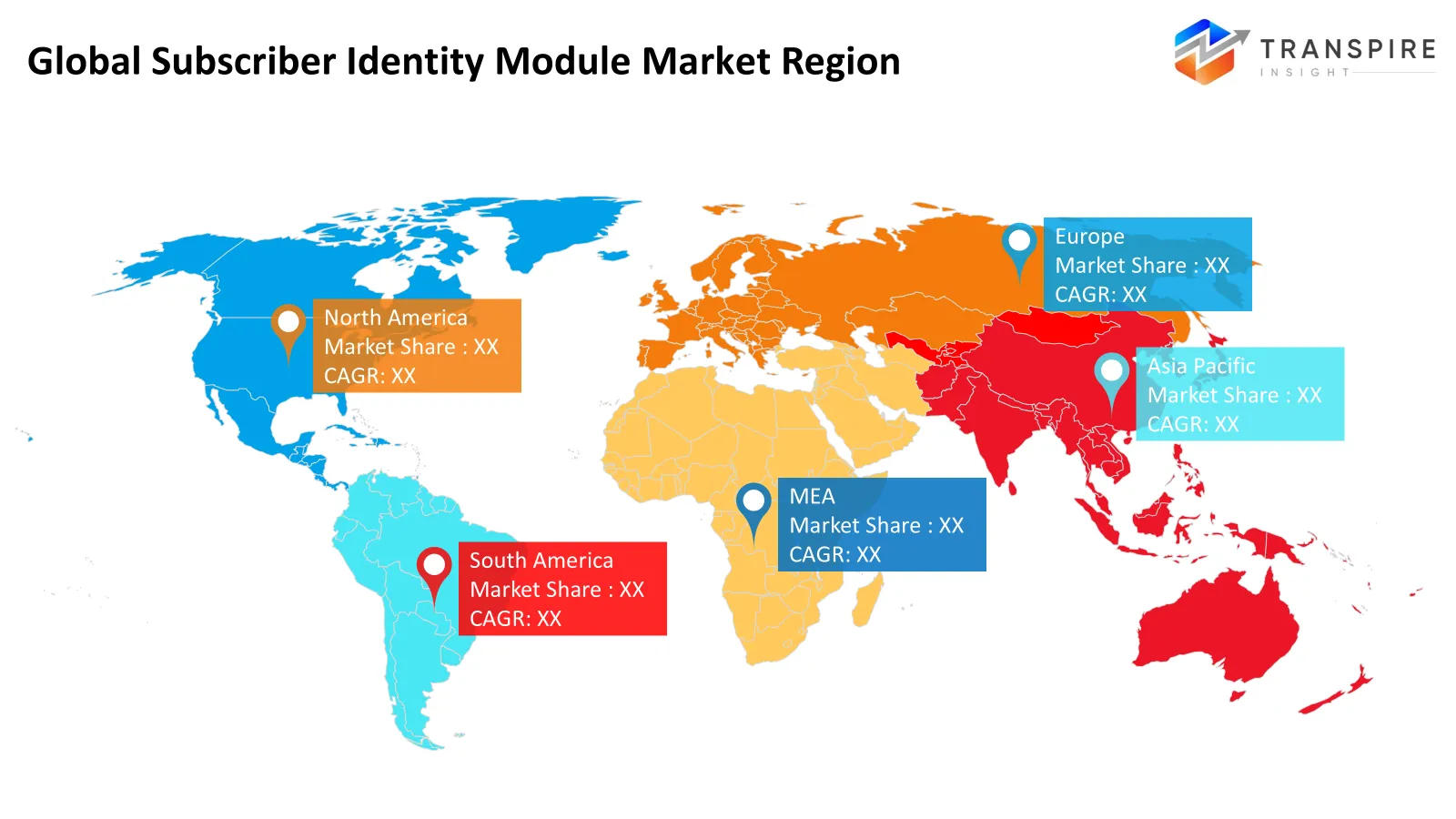
The Asia-Pacific region holds dominance in the SIM card market owing to its unmatched number of telecommunication subscribers, advanced manufacturing of smartphones, and implementation of 5G technology. These countries together hold a majority of the share in mobile device manufacturing and demand for telecom services, resulting in consumption of Nano SIM and eSIM cards. The growth and advancement of government digital transformation policies, mobile broadband, and IoT adoption contribute positively to the ecosystem. In February 2026, India’s Department of Telecommunications tightened the digital identity policies related to SIM cards with the help of telecom companies such as Reliance Jio and Bharti Airtel.
Europe ranks second in terms of size as a regional market due to having advanced automotive connectivity infrastructure, stringent cyber security laws, and extensive use of industrial Internet of Things. Contrary to the Asian Pacific region, where the growth strategy is size, Europe enjoys the benefit of standardized telecommunication systems and early deployment of embedded connectivity systems within connected cars and factories. In September 1, 2025, Ubigi enhanced its partnership with eSIM enabled connected cars in Europe in order to increase connectivity in cars and promote autonomous driving.
The MEA region will be witnessing fast growth owing to investments made into smart city solutions, AI-driven telecommunications, and ambitious rollouts of 5G connectivity. Telecom companies in the United Arab Emirates (UAE) and Saudi Arabia are making substantial investments in cloud-based infrastructure development for their digital economy initiatives, which creates a need for embedded SIM and remote provisioning services. Growth in this region will depend primarily on enterprise IoT deployments, fintech ecosystems, and developments in connected public infrastructures.
Who are the Key Players in the Global Subscriber Identity Module (SIM) Market and how do they Compete?
Competition in the Subscriber Identity Module (SIM) Market lies in the area of secure digital identity management, eSIM advancements, IoT scaling, and telecom security integration instead of the conventional competition based only on the manufacturing of SIM cards. Businesses are now competing by means of cloud-based remote provisioning systems, embedded SIM technology, artificial intelligence for authentication purposes, and even partnerships within the telecom industry. There is also a gradual shift in competition from hardware to software-based connectivity in 5G, automotive, and IoT.
The Thales Group stands out through its highly secured eSIM and remote SIM management capabilities, which are meant for telecom operators, car manufacturers, and providers of enterprise IoT connectivity. This makes Thales unique, owing to the combination of cybersecurity knowledge and digital identity infrastructure that makes it possible for Thales to connect large ecosystems. Thales is growing through collaborations with telecoms around the globe and developing artificial intelligence enabled SIM verification solutions.
The key selling points for Giesecke+Devrient lie in the provision of embedded connectivity and industrial IoT SIM services, designed specifically to support machine-to-machine communications for an extended period of time. Giesecke+Devrient's unique selling points can be found in its provision of highly durable industrial SIM services and cloud-based connectivity solutions aimed at creating smart factories, utility services, and logistics systems. IDEMIA, however, places emphasis on the use of biometric security and digital identity verification in the telecommunication industry.
Subscriber Identity Module Market Companies:
- Gemalto
- Giesecke+Devrient
- IDEMIA
- Thales
- STMicroelectronics
- NXP
- Infineon
- Sierra Wireless
- Qualcomm
- Samsung
- Apple
- Huawei
- China Mobile
- Vodafone
- AT&T
Recent Development News
- In May 2025, GCT Semiconductor and Giesecke+Devrient collaborated to introduce an SGP.32 compliant eSIM solution for IoT applications. This collaboration enhanced the intelligent multi-network connectivity and supported location-based remote provision capabilities for the IoT solutions. https://iot-now.com
- In September 2025, Tata Communications and Cisco Systems collaborated to introduce a global eSIM orchestration service in the IoT Control Center platform of Cisco Systems. This collaboration made IoT connectivity easier in 200+ countries. https://www.tatacommunications.com
What Strategic Insights Define the Future of the Subscriber Identity Module Market?
Future trends in the SIM card market suggest that there will be a move towards completely digital and software-defined connectivity systems wherein eSIM and iSIM technology eliminates the requirement of physical SIM cards in smartphones, automobiles, industrial Internet of Things (IoT), and smart infrastructures. Future competition in the SIM card market will increasingly rely on secure cloud-based deployment, AI-powered verification, and interconnectivity beyond hardware production capacity. Telecommunications companies and semiconductor organizations will make investments in embedded connectivity solutions with billions of connected devices.
One of the risks that remain under the radar is that there is increasing dependence on cloud service providers who provide telecom identity infrastructure services. These risks may include cyber security threats, interoperability issues, and even regulatory issues associated with digital sovereignty.
The new upcoming area is that of satellite-based connectivity and NTN (Non-Terrestrial Network) to be applied in remote mobility, logistics, aviation, and maritime communications. Early movers who adopt AI-enabled secure remote provisioning and multi-connectivity will reap big in the future. The areas of emphasis should include interoperable eSIM standards, telecom cloud computing, and digital identity cybersecurity management.
Global Subscriber Identity Module Market Segmentation:
By Type
- Standard SIM
- Micro SIM
- Nano SIM
- eSIM
By Application
- Mobile Devices
- IoT
- Automotive
- Wearables
By End-User
- Telecom Operators
- Consumers
- Enterprises
- OEMs
Regional Outlook
North America
- United States
- Canada
- Mexico
Europe
- Germany
- United Kingdom
- France
- Spain
- Italy
- Rest of Europe
Asia Pacific
- Japan
- China
- Australia & New Zealand
- South Korea
- India
- Rest of Asia Pacific
South America
- Brazil
- Argentina
- Rest of South America
Middle East & Africa
- Saudi Arabia
- United Arab Emirates
- South Africa
- Rest of the Middle East & Africa
Frequently Asked Questions
Find quick answers to common questions.
The expected global subscriber identity module (SIM) market size for the market will be USD 5.4 Billion in 2033.
The Subscriber Identity Module (SIM) Market is segmented By Type (Standard SIM, Micro SIM, Nano SIM, eSIM), By Application (Mobile Devices, IoT, Automotive, Wearables), By End-User (Telecom Operators, Consumers, Enterprises, OEMs).
Major global subscriber identity module (SIM) market players are Gemalto, Giesecke+Devrient, IDEMIA, Thales, STMicroelectronics, NXP, Infineon, Sierra Wireless, Qualcomm, Samsung, Apple, Huawei, China Mobile, Vodafone, AT&T.
The Subscriber Identity Module Market size is USD 2.83 Billion in 2026.
The global subscriber identity module (SIM) market CAGR is 9.67% for the forecasted period 2026-2033.
- Gemalto
- Giesecke+Devrient
- IDEMIA
- Thales
- STMicroelectronics
- NXP
- Infineon
- Sierra Wireless
- Qualcomm
- Samsung
- Apple
- Huawei
- China Mobile
- Vodafone
- AT&T
About the Authors

Mayur Shinde
I am Mayur Shinde, a Senior Research Analyst at Transpire Insight, specializing in the Automotive & Transportation and Information & Communication Technology (ICT) Industry. My work focuses on analyzing emerging market trends, technological advancements, competitive landscapes, and industry developments to deliver accurate, data-driven insights. I am passionate about transforming complex market information into clear, actionable content that helps businesses, professionals, and decision-makers stay informed and make confident strategic decisions.

Chakradhar Khansole
Chakradhar serves as the Research Director at Transpire Insight, bringing over 8 years of experience in technology, innovation, and strategic market intelligence. He specializes in transforming complex market data into actionable business insights that enable organizations to make informed, growth-oriented decisions. Recognized for his strategic vision and analytical expertise, Chakradhar leads high-impact research initiatives, delivering comprehensive market assessments, competitive intelligence, and forward-looking industry analysis.
Recently Published Reports
-
Apr 2026
3D Optical Profiler Market
3D Optical Profiler Market Size, Share & Analysis Report By Type (Desktop 3D Optical Profiler, and Portable 3D Optical Profiler), By Technology (Confocal Technology, and White Light Interference), By End-Use Industry (Manufacturing, Research Institutions, Automotive, Aerospace and Defense, Medical Devices, and Other), and Geography (North America, Europe, Asia-Pacific, Middle East and Africa, South and Central America), 2021 - 2031
-
Apr 2026
Depth Sensor Market
Depth Sensor Market Size, Share & Analysis Report By Type (Infrared Depth Sensors, Time-of-Flight (ToF) Sensors, Stereo Vision Sensors, Structured Light Sensors, Ultrasonic Depth Sensors), By Application (Automotive, Robotics, Gaming, Consumer Electronics, Industrial Automation, Healthcare, Security & Surveillance, Others), By End Users (Automotive Manufacturers, Consumer Electronics Companies, Healthcare Providers, Industrial Companies, Security Agencies, Gaming Companies, Robotics Companies, Others), and Geography (North America, Europe, Asia-Pacific, Middle East and Africa, South and Central America), 2021 – 2031
-
Apr 2026
Digital Manufacturing Market
Digital Manufacturing Market Size, Share & Analysis Report By Component (Hardware, Software, and Services), By Technology (Robotics, 3D Printing, Internet of Things (IoT), and Others), By Application (Automotive and Transportation, Aerospace and Defense, Consumer Electronics, Industrial Machinery, and Others), By Process Type (Computer-Based Designing, Computer-Based Simulation, Computer 3D Visualization, Analytics, and Others), and Geography (North America, Europe, Asia-Pacific, Middle East and Africa, South and Central America), 2021 – 2031
-
Apr 2026
Digital Visa Services Market
Digital Visa Services Market Size, Share & Analysis Report By Type (Individual Travelers, Group Travelers), By Application (Tourism, Business Travel, Others), and Geography (North America, Europe, Asia-Pacific, Middle East and Africa, South and Central America), 2021 – 2031