
Europe Automotive Secure Element Chip Market Size & Forecast:
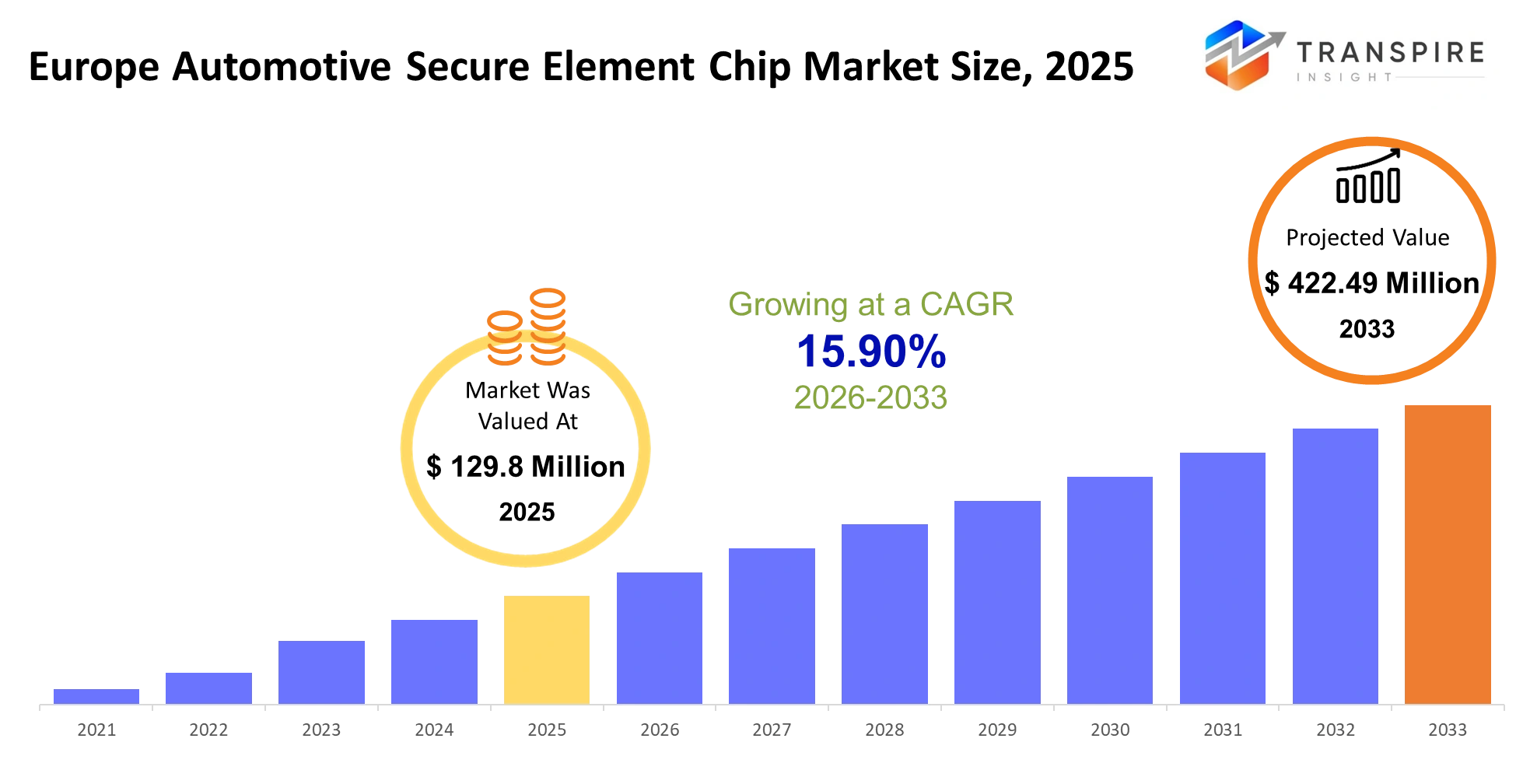
- Europe Automotive Secure Element Chip Market Size 2025: USD 129.8 Million
- Europe Automotive Secure Element Chip Market Size 2033: USD 422.49 Million
- Europe Automotive Secure Element Chip Market CAGR: 15.90%
- Europe Automotive Secure Element Chip Market Segments: By Type (Embedded Secure Elements, Discrete Secure Elements, Integrated Secure Elements, Others); By Application (Vehicle Security, Telematics, Infotainment Systems, V2X Communication, Keyless Entry Systems, Others); By End-User (Automakers, Tier 1 Suppliers, Semiconductor Companies, Fleet Operators, Automotive OEMs, Others); By Technology (NFC, RFID, Encryption Chips, Secure Microcontrollers, Others).
To learn more about this report,  Download Free Sample Report
Europe Automotive Secure Element Chip Market Summary:
The Europe Automotive Secure Element Chip Market size is estimated at USD 129.8 Million in 2025 and is anticipated to reach USD 422.49 Million by 2033, growing at a CAGR of 15.90% from 2026 to 2033. europe automotive secure element chip market within the context of the automotive semiconductor market will serve as a distinct market sector, which will be centered on the hardware solution for providing security in connected cars. This market will continue to develop as cars become more platform-like devices, whose key concern will lie in securing communication, identification, and transactions. Automotive manufacturers will use secure element chips to protect access to their cars, provide secure over-the-air updates, and implement digital keys..
What Has the Impact of Artificial Intelligence Been on the Europe Automotive Secure Element Chip Market?
The European automotive secure element chip market experiences transformation because artificial intelligence converts traditional hardware security methods into a security solution that adapts based on data. The European automotive secure element chip market uses AI to improve company operations which involve processing extensive data from vehicles and firmware and security threats. The stakeholders will discover hidden cybersecurity patterns through top-tier analytics and machine learning which will result in precise market research and improved decision-making capacities. Artificial intelligence in europe automotive secure element chip market analysis will also refine demand forecasting, allowing suppliers to anticipate shifts in OEM requirements, software-defined vehicle adoption, and secure digital key usage with greater precision.
The European automotive secure element chip market will benefit from AI because it provides more than knowledge which will enhance production and operational processes in the industry. The smart automation systems will enhance chip design validation through their ability to decrease testing periods and increase production success rates. Predictive analytics will strengthen supply chain management through its ability to predict component shortages while also reducing delays and cutting procurement costs. The AI-based security systems will provide manufacturers with a market advantage through their capacity to execute constant user verification and detect threats in real time. The European automotive secure element chip market will become an essential component for safe and expandable vehicle research because of its connection to intelligent systems which support the current trend towards connected and self-driving vehicles.
Key Market Trends & Insights:
- Germany is the leading country in the europe automotive secure element chip market with around 28% market share in 2025 owing to automotive production strength and semiconductor innovations.
- France and Italy together have a significant market share owing to the implementation of secure in-vehicle communication systems in OEMs.
- Eastern Europe would witness the fastest growth from 2026 to 2030 owing to growing electronics production and favorable manufacturing economies.
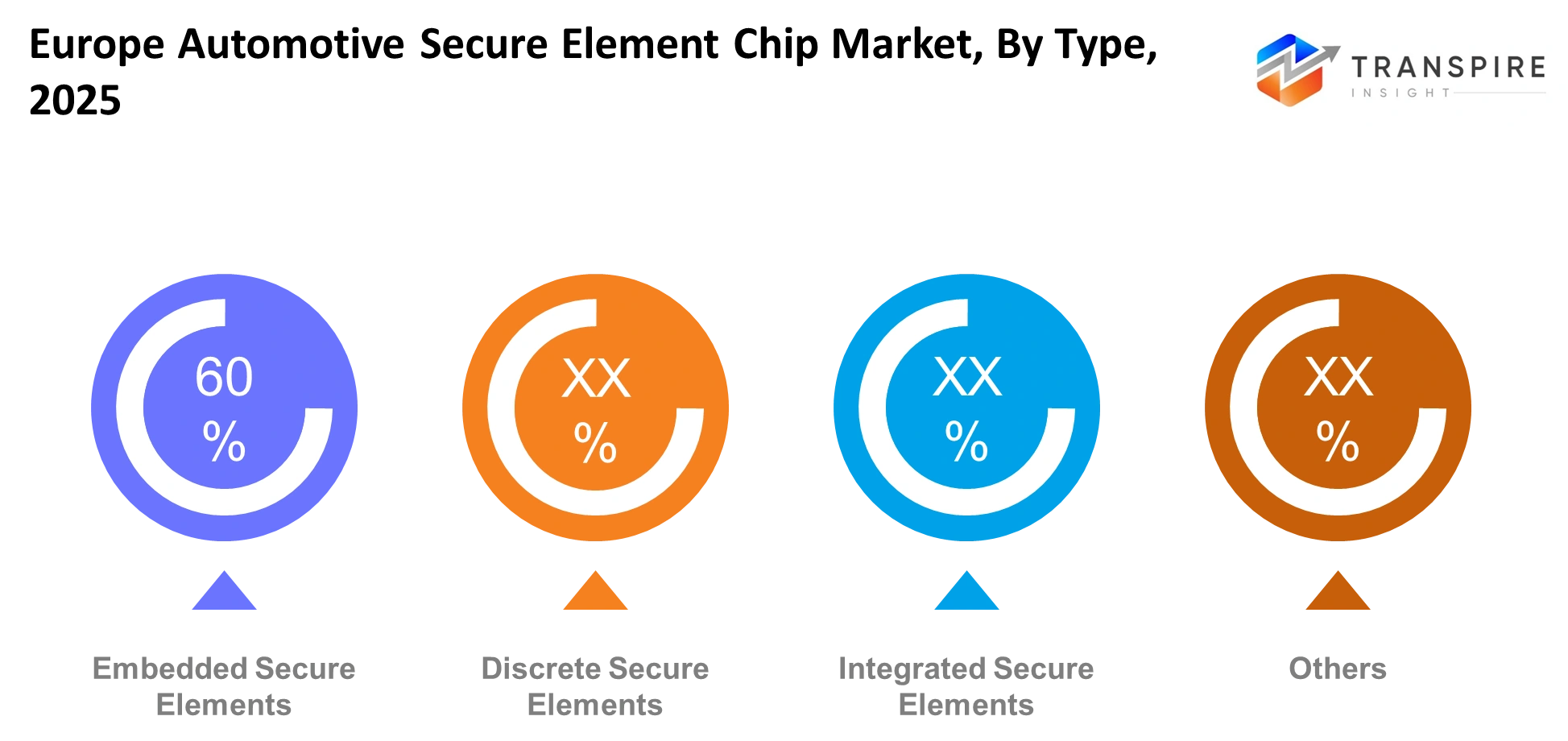
- Embedded secure element chips are the most dominant application with about 55% market share in 2025 because of their incorporation into infotainment and telematics applications.
- Discrete secure element chips constitute the second-largest market share owing to their use in aftermarket security solutions and retrofits.
- The integrated eSIM-based secure chips segment would witness the fastest growth from 2026 to 2030 owing to the emergence of connected car ecosystems and remote provisioning needs.
- Vehicle access management constitutes the leading segment with a significant market share (~40%) owing to rising digital key solutions.
- Over-the-Air (OTA) security and updates are the fastest-growing segments owing to rising software-defined vehicles.
- Passenger vehicles represent the largest end-user segment (~65%) due to rising connected and premium security solutions.
- Electric Vehicles (EVs) would be the fastest-growing end-users owing to growing electronics and cyber-security needs.
Europe Automotive Secure Element Chip Market Segmentation
By Type
Embedded secure elements will be included inside the automotive control units themselves, providing consistent security for the transfer of information and authentication of systems. This version will ensure secure booting and encryption of the vehicle module communication. The implementation of secure elements through hardware will make them less dependent on outside influences and harder to tamper with. Their adoption will increase as automobiles become more dependent on networking and digital control systems.
Discrete secure elements will function as stand-alone chips, allowing them to be retrofitted into automobiles easily. Integrated secure elements will integrate communication and security capabilities to save space and power. Other versions of secure elements will include hybrid versions tailored to automotive applications. The demand for all types of secure elements will grow as the emphasis on secure scalability increases in automotive design.
To learn more about this report, Download Free Sample Report
By Application
Security in vehicles will continue to be a key requirement, where secure components will provide encrypted vehicle access and protection against unauthorized entry into the vehicle. The system will facilitate secure keyless entry into the vehicle while providing digital authentication of the interaction between the user and the vehicle. The telematics system will incorporate secure chips that will protect the data transfer between the vehicle and the cloud.
Vehicle-to-everything technology will ensure that secure data transfer happens between different vehicles, infrastructures, and networks. Keyless entry applications will require secure authentication of the process to prevent relay attacks. Other applications will include the protection of the firmware and the implementation of over-the-air update technologies.
By End-User
Automakers will integrate secure element chips during vehicle design to ensure built-in cybersecurity from the start. Tier 1 suppliers will develop and supply secure modules aligned with manufacturer requirements. Semiconductor companies will focus on innovation in chip design, improving performance and security standards. Collaboration between these groups will shape product development and deployment.
Fleet operators will adopt secure elements to manage connected vehicle data and ensure safe communication across fleets. Automotive OEMs will drive large-scale implementation through production and system integration. Other end-users will include service providers supporting connected mobility solutions. Demand across segments will increase as digital vehicle ecosystems expand.
By Technology
The NFC technology will facilitate secure communication for short ranges, which will include digital keys and contactless access. The RFID will be used for the purpose of identification and tracking in automobile systems, with the help of which controlled access can be gained to particular parts. Encryption chips will offer specialized hardware for secure data handling and encryption purposes.
Other technologies would include crypto modules that will be specifically tailored to meet the needs of an auto performance environment. Development will increase their efficiency against cyber attacks. Adoption of such technologies will be linked to rising requirements for secure connectivity in automobiles.
What are the Main Challenges for the Europe Automotive Secure Element Chip Market Growth?
However, there are some notable challenges faced by the europe automotive secure element chip market in terms of technological and operational challenges, hindering steady incorporation into vehicles. Hardware compatibility issues would be prominent since the use of such components requires matching with various electronic control units as well as software-defined systems. Issues of performance in harsh conditions, such as temperatures, will also require ongoing verification processes. Moreover, any supply chain disruption for advanced semiconductors would lead to delayed deliveries and rising costs.
Further challenges related to the production and commercialization process would restrict growth in the europe automotive secure element chip market. The production process itself will involve the use of advanced fabrication nodes, thus requiring substantial investments from suppliers. Compliance to all cybersecurity measures within Europe will also lengthen product certification process, leading to delayed launches. Cost concerns will pose additional limitations due to demand for affordable yet high-level security features.
Adoption issues will remain because of inadequate readiness of the infrastructure and lack of cybersecurity professionals in the automobile industry. Small-scale producers will refrain from adopting the technology because of its complex nature and uncertain benefits. Financial constraints in developing parts of Europe will also inhibit the deployment of technologies, further limiting expansion in the europe automotive secure element chip market.
Software security mechanisms and other encryption techniques will pose future threats. Price competition in the semiconductor industry will reduce profit margins, whereas quick advancements will necessitate innovative approaches.
Regional Insights
The Western European region will be able to maintain an advantageous market position owing to high-end automobile manufacturing and implementation of security systems within connected cars. The countries of Germany, France, and the United Kingdom will take the lead regarding the incorporation of secure elements within their vehicles, owing to a robust presence of OEM partners and semiconductor technology within the region.
The Southern European market will be able to experience significant growth through investments in automotive electronics production and provision of connected mobility services within countries such as Italy and Spain. Investments in infrastructure and digital vehicle systems will drive the demand for secure hardware components within the region.
The area will develop into a developing center with automobile assembly becoming prominent, along with affordable manufacturing operations. The nations that would attract such investments include countries like Poland, Hungary, and the Czech Republic. Though a lack of proper infrastructure and skilled workers will be responsible for the delayed growth process, industrialization will provide opportunities for integrating security components in the future.
Recent Development News
In April 2026, STMicroelectronics reported earnings growth. The company posted stronger-than-expected Q1 2026 revenue of $3.10 billion, driven by a rebound in automotive semiconductor demand, signaling recovery in secure chip segments.
Source: (Reuters)
In April 2026, BE Semiconductor Industries reported earnings growth. The company recorded a 104.5% surge in order bookings to €269.7 million, supported by rising adoption of advanced chip packaging technologies linked to automotive and AI-driven semiconductor demand.
Source: (Reuters)
|
Report Metrics |
Details |
|
Market size value in 2025 |
USD 129.8 Million |
|
Market size value in 2026 |
USD 150.44 Million |
|
Revenue forecast in 2033 |
USD 422.49 Million |
|
Growth rate |
CAGR of 15.90% from 2026 to 2033 |
|
Base year |
2025 |
|
Historical data |
2021 - 2024 |
|
Forecast period |
2026 - 2033 |
|
Report coverage |
Revenue forecast, competitive landscape, growth factors, and trends |
|
Regional scope |
Europe (Germany, United Kingdom, France, Italy, Spain, Rest of Europe) |
|
Key company profiled |
NXP, Infineon, STMicroelectronics, Renesas, Qualcomm, Texas Instruments, Microchip, Samsung, Broadcom, Intel, MediaTek, Sony, ON Semiconductor, Cypress, Bosch. |
|
Customization scope |
Free report customization (country, regional & segment scope). Avail customized purchase options to meet your exact research needs. |
|
Report Segmentation |
By Type (Embedded Secure Elements, Discrete Secure Elements, Integrated Secure Elements, Others); By Application (Vehicle Security, Telematics, Infotainment Systems, V2X Communication, Keyless Entry Systems, Others); By End-User (Automakers, Tier 1 Suppliers, Semiconductor Companies, Fleet Operators, Automotive OEMs, Others); By Technology (NFC, RFID, Encryption Chips, Secure Microcontrollers, Others). |
How Can New Companies Establish a Strong Foothold in the Europe Automotive Secure Element Chip Market?
The europe automotive secure element chip market can be successfully penetrated by newcomers through a concentrated approach towards the exploitation of clearly defined niches with security requirements still unmet. In this case, focusing on opportunities in relation to software-defined vehicles, electric mobility solutions, and digital key solutions would help startups concentrate efforts on satisfying their specific needs and not fight over generic ones. As the europe automotive secure element chip market is characterized by high expectations regarding cybersecurity measures, manufacturers which develop chips capable of ensuring real-time authentication and low-power encryption capabilities will have an edge in penetrating the market.
Innovative approaches will represent an important part of any company’s business model in the europe automotive secure element chip market. The creation of light-weight encryption, alongside threat detection based on machine learning embedded directly in the chip, is an important innovation to consider. In addition, forming alliances with automobile OEMs and suppliers will allow for quicker validation and increased probability of commercial success. Collaborations with providers of cloud security solutions will also prove helpful in overcoming certain challenges in terms of hardware/software integrations.
Companies like Crypto Quantique and Kudelski IoT show what can be achieved through narrow specialization in terms of adding value. They concentrate on device authentication, provision, and management, providing innovative solutions that fit well with connected cars. As such, by concentrating on narrow specialization, building solid security design, and forging strong partnerships, new entrants have an excellent chance of succeeding in the Europe Automotive Secure Element Chip market.
Key Europe Automotive Secure Element Chip Market Company Insights
Competitive advantage will continue to come from innovation in hardware security, with leading semiconductor players concentrating on innovative encryption and hardware design. Competitive positions will be consolidated by steady upgrading of products and compatibility with automotive cybersecurity norms. Research will provide the basis for competitive advantage, as will adoption of secure architecture at an early stage of product design.
Partnerships and alliances will play an important role in defining competition, especially in partnering with automakers and Tier 1 automotive players to facilitate deployment and adoption. Strategic alliances can help validate and implement the technology in automotive systems. Expansion into regional markets is another important strategy that can benefit competitive positioning.
Company List
- NXP
- Infineon
- STMicroelectronics
- Renesas
- Qualcomm
- Texas Instruments
- Microchip
- Samsung
- Broadcom
- Intel
- MediaTek
- Sony
- ON Semiconductor
- Cypress
- Bosch
What are the Key Use-Cases Driving the Growth of the Europe Automotive Secure Element Chip Market?
The european automotive secure element chip market is experiencing growth because of rising demand for secure vehicle access and identity protection systems. Digital key solutions which use embedded secure elements will enable smartphones and wearables to function as keys because they will maintain encrypted authentication. The European automotive secure element chip market will see increased adoption of this application because premium and mid-range vehicles use it to provide users with seamless experiences while maintaining strong security measures.
The European automotive secure element chip market requires secure over-the-air software updates as an essential function. Automakers will use hardware-based encryption to authenticate firmware during remote updates while stopping unauthorized changes. The system will enable software-defined vehicles to receive ongoing feature improvements and security updates which will become common practice. Through secure element integration vehicle systems will gain protection against cyber attacks while maintaining data integrity which will enhance their long-term performance.
The European automotive secure element chip market experiences growth because vehicle-to-everything communication develops. The secure chips would allow the exchange of information between the vehicles, the infrastructure, and the cloud computing environment, making traffic management and autonomous driving possible. The secured data management for fleet management and intelligent mobility applications would improve operational efficiency and client reliability, thereby creating future growth opportunities.
Europe Automotive Secure Element Chip Market Report Segmentation
By Type
- Embedded Secure Elements
- Discrete Secure Elements
- Integrated Secure Elements
- Others
By Application
- Vehicle Security
- Telematics
- Infotainment Systems
- V2X Communication
- Keyless Entry Systems
- Others
By End-User
- Automakers
- Tier 1 Suppliers
- Semiconductor Companies
- Fleet Operators
- Automotive OEMs
- Others
By Technology
- NFC
- RFID
- Encryption Chips
- Secure Microcontrollers
- Others
Frequently Asked Questions
Find quick answers to common questions.
The approximate Europe Automotive Secure Element Chip Market size for the market will be USD 422.49 Million in 2033.
Key segments for the Europe Automotive Secure Element Chip Market are By Type (Embedded Secure Elements, Discrete Secure Elements, Integrated Secure Elements, Others); By Application (Vehicle Security, Telematics, Infotainment Systems, V2X Communication, Keyless Entry Systems, Others); By End-User (Automakers, Tier 1 Suppliers, Semiconductor Companies, Fleet Operators, Automotive OEMs, Others); By Technology (NFC, RFID, Encryption Chips, Secure Microcontrollers, Others).
Major Europe Automotive Secure Element Chip Market players are NXP, Infineon, STMicroelectronics, Renesas, Qualcomm, Texas Instruments, Microchip, Samsung, Broadcom, Intel, MediaTek, Sony, ON Semiconductor, Cypress, Bosch.
The Europe Automotive Secure Element Chip Market size is USD 129.8 Million in 2025.
The Europe Automotive Secure Element Chip Market CAGR is 15.90%.
- NXP
- Infineon
- STMicroelectronics
- Renesas
- Qualcomm
- Texas Instruments
- Microchip
- Samsung
- Broadcom
- Intel
- MediaTek
- Sony
- ON Semiconductor
- Cypress
- Bosch
Recently Published Reports
-
Apr 2026
ATV & UTV Market
ATV & UTV Market Size, Share & Analysis Report By Type (ATV, and UTV), By Variants (Less Than 400 CC, 400 CC To 800 CC, and More Than 800 CC), and Geography (North America, Europe, Asia-Pacific, Middle East and Africa, South and Central America), 2021 - 2031
-
Apr 2026
Automotive Central Gateway Module Market
Automotive Central Gateway Module Market Size, Share & Analysis Report By Type (Ethernet Central Gateway Module, CAN Central Gateway Module, LIN Central Gateway Module, and FlexRay), By Application (Powertrain Control, Body Control, Infotainment System, Advanced Driver Assistance Systems (ADAS), and Others), By End User (Passenger Vehicles, and Commercial Vehicles), and Geography (North America, Europe, Asia-Pacific, Middle East and Africa, South and Central America), 2021 - 2031
-
Apr 2026
Automotive Engine Oil Filter Market
Automotive Engine Oil Filter Market Size, Share & Analysis Report By Filter Type (Fuel Filter, Engine Oil Filter, Hydraulic Oil Filter, and Others), By Filter Media (Cellulose, Synthetic, and Micro), By Sales Channel (OEMs, and Aftermarket), By Vehicle Type (Passenger Cars, Light Commercial Vehicles, Heavy Duty Trucks, Buses and Coaches, and Off-road Vehicles), and Geography (North America, Europe, Asia-Pacific, Middle East and Africa, South and Central America), 2021 - 2031
-
Apr 2026
Automotive Parts Aluminium Die Casting Market
Automotive Parts Aluminium Die Casting Market Size, Share & Analysis Report By Production Process (Pressure Die Casting, Vacuum Die Casting, Squeeze Die Casting, Gravity Die Casting), By Application (Body Parts, Engine Parts, Transmission Parts, Battery And Related Components, Other Application Types), and Geography (North America, Europe, Asia-Pacific, Middle East and Africa, South and Central America), 2021 - 2031
Our Clients