
Global Smart Locks Market Size & Forecast:
- Global Smart Locks Market Size 2025: USD 3315.7 Million
- Global Smart Locks Market Size 2033: USD 14166.4 Million
- Global Smart Locks Market CAGR: 19.93%
- Global Smart Locks Market Segments: By Type (Deadbolt Smart Locks, Lever Handle Smart Locks, Padlock Smart Locks, Biometric Smart Locks, Wi-Fi Smart Locks, Bluetooth Smart Locks, Others); By Application (Residential, Commercial, Hospitality, Government Buildings, Others); By End-User (Homeowners, Enterprises, Hotels, Government Agencies, Others); By Technology (Biometric Authentication, Mobile Access, Cloud-based Access, AI Security, Others).
Global Smart Locks Market Summary:
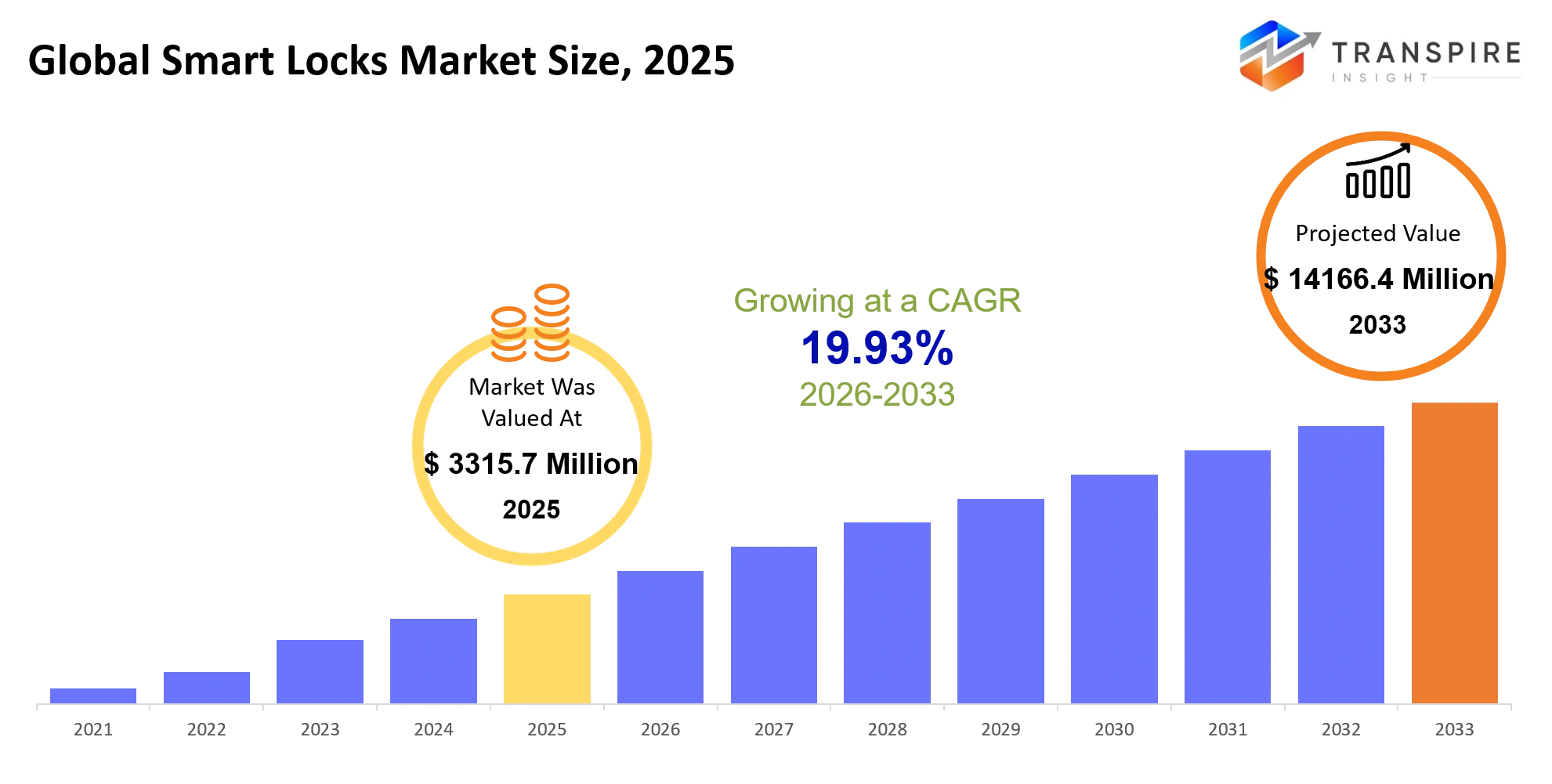
As per Transpire Insight Analysis, the Global Smart Locks Market size is estimated at USD 3315.7 Million in 2025 and is anticipated to reach USD 14166.4 Million by 2033, growing at a CAGR of 19.93% from 2026 to 2033.
Smart locks are really important for keeping our homes and buildings safe. We can use our smartphones and special keys to control who gets in and out. This is not just for homes. It is also used in offices, hotels and government buildings. People want to be able to keep an eye on who's coming and going.
One big change we have seen is that we do not just use locks by themselves anymore. Now we use systems that work with our phones, special keys and computers to keep everything safe. More and more people are getting homes and devices that can talk to each other, so they are using smart locks too.
Over the past few years, things have changed a lot. People are getting more used to having things in their homes and feeling safe with digital security. One big change is that we do not just have locks that stand alone. We have whole systems that work together. These systems use our phones to get in scanners that read our bodies, and computers to manage everything. People like that locks are easy to use, and they can check on their homes from far away. This means that smart locks are becoming very popular and are replacing locks. Smart locks are going to keep getting more popular in countries, which is good for the people who make them and the people who use them.
Key Market Insights:
Smart locks have become more advanced, from basic keyless locking systems to intelligent platforms that provide remote verification, monitoring, and security functionalities. The rising use of connected devices, biometric solutions, and cloud-based platforms is changing security strategies in both residential and business settings.
- In terms of application areas, residential installations will account for 59% of overall market demand, due to the growing use of smart homes and smartphone-operated security solutions.
- Smart biometric locks will be the fastest-growing type, recording a CAGR of 16.2%, owing to the increased adoption of facial recognition and fingerprint sensors.
- Leading firms will incorporate artificial intelligence (AI) based monitoring functionalities that improve access control and ease usage.
- Cloud-based access management systems will gain popularity in enterprises that require a central system to manage users and sites.
- Consumers will prefer smartphone-operated entry locks that provide convenience by eliminating the need to use keys.
- The hospitality industry will replace their old-fashioned key cards with new-generation locks to provide better experiences to guests.
- The ability of smart lock systems to integrate with voice assistants and home automation systems will drive purchase decisions.
- Cybersecurity concerns have motivated manufacturers to upgrade encryption technologies and secure communication protocols.
What are the Key Drivers, Restraints, and Opportunities in the Global Smart Locks Market?
Drivers
The major market driver stems from the rising use of connected security systems at homes, workplaces, and institutional settings. The growth in the number of smart homes, coupled with consumer knowledge about the technologies used in securing data, fuels the demand for smarter entryways. Consumers today want devices that offer them remote control options and enable them to monitor their activities in real time. Such innovations enhance user experience and create revenue streams for manufacturers in the form of subscription fees.
Restraints
The threat of cybersecurity attacks continues to pose a challenge in the growth of the market. Even with the development of new technology, the fear of being hacked by cybercriminals continues to be a major concern for both consumers and organisations when using connected security devices. This restraint arises from the different standards used by manufacturers in the industry to ensure that their products are secure.
Opportunity
The key opportunity in the future is the combination of biometric recognition with artificial intelligence and cloud access control. Enterprises will be looking at sophisticated solutions that can identify suspicious access behaviours and enhance security reactions. There will be investments being made in emerging markets such as Asia-Pacific, the Middle East, and Latin America in smart building technologies and infrastructure. This would create an environment ripe for implementation of such solutions. Growth in artificial intelligence security solutions and smart cities will bring in revenues for industry players.
What Has the Impact of Artificial Intelligence Been on the Global Smart Locks Market?
The technology of artificial intelligence has brought great improvements to smart locks by making their functionality smarter, adaptable, and secure. Smart locks now use AI technologies that allow the system to detect user behaviour, verify identities, and detect any abnormal activity concerning access. Such a solution allows owners of houses, companies, and other establishments to increase their security level and become less reliant on classic key-and-locks.
Moreover, the technology of artificial intelligence helps to automate access to facilities as smart locks are able to learn user behaviour and credentials and grant them automatic access if all conditions are met. For example, in commercial spaces, smart locks use AI technologies for automated access based on pre-approved security policies. Also, AI can make the access detection process more predictable by detecting abnormal access behaviour and providing notifications about any suspicious activity.
Another advantage of using artificial intelligence for smart locks is integration with cloud access management. It allows the access detection system to monitor access across multiple buildings and provide real-time reports and data analytics. However, AI usage faces certain difficulties. AI-based advanced smart locks tend to cost more to install and need connectivity and integration capabilities of software. Accuracy may also be hampered by external conditions and incomplete biometric information, raising concerns about authentication. Nonetheless, it is anticipated that progress in ML, edge computing, and biometrics will ensure that AI becomes integral to next-generation smart locks. In September 2025, ON Semiconductor (onsemi) launched a smart lock reference design powered by artificial intelligence that integrates machine learning, facial recognition, and 3D imaging capabilities. This technology employs AI-based face detection and recognition to enhance precision in access management, highlighting the increasing use of artificial intelligence in smart locks.
Key Market Trends:
The manufacturers of smart locks are gradually moving away from providing stand-alone hardware products towards providing an ecosystem consisting of software, cloud services, and advanced authentication technologies.
- Consumer preferences have shifted towards convenience when accessing smart locks, which has led to advancements in biometric and mobile identity authentication technology.
- Biometric authentication systems have found popularity due to consumer preferences for access via fingerprint and face scans, rather than using passwords.
- The use of mobile-based credentials has made physical access cards obsolete both in homes and businesses, as consumers seek more convenient options.
- Cloud-based access management solutions become the choice for companies running several sites or user communities.
- Smart building integration becomes a major requirement as consumers look for seamless connectivity among all building devices, including cameras, alarm systems, and smart voice assistants.
- Businesses in the hospitality sector are now switching from key card-based access solutions to digital access based on smartphones.
- AI-based anomaly detection features are increasingly being incorporated into new models.
- Remote access management is gaining popularity amid property owners’ demands for better access control and management capabilities.
- Intelligent access management systems have become prevalent in the development of smart buildings.
Global Smart Locks MarketSegmentation
By type
Smart lock products fall into various categories that serve different needs in terms of security and access control purposes. Deadbolt smart locks have continued to be popular owing to the fact that they come with easy installation and digital features. Lever handle smart locks are becoming more accepted in office buildings due to their ease of use. Smart locks for padlocks have been increasingly favoured for applications such as storage containers, gates, and temporary access control needs. The biometric type is experiencing rapid growth owing to a CAGR of 16.2%. Wi-Fi and Bluetooth smart locks are also growing in popularity owing to their connectivity capabilities.
By application
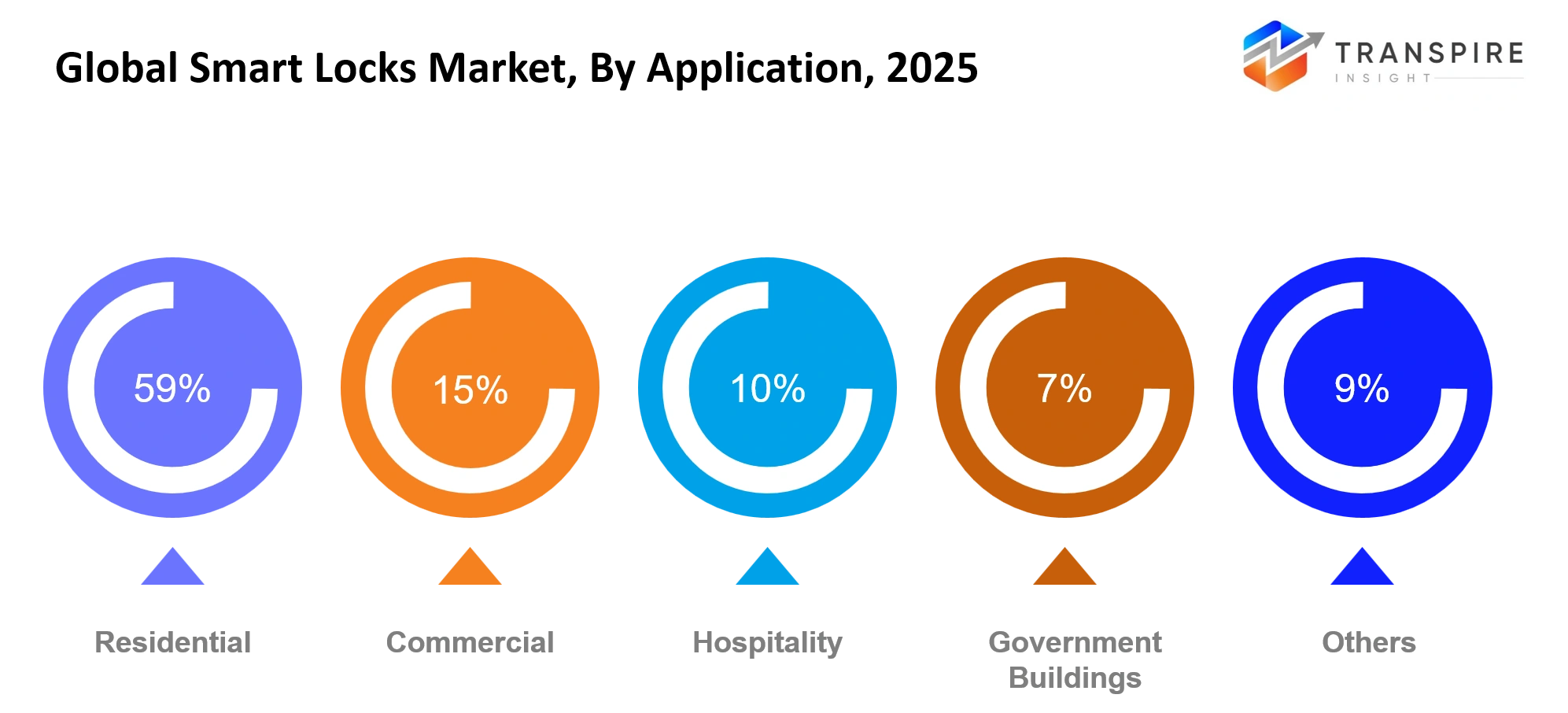
Application-based demand is dominated by residential uses, contributing to 59% of the market. Smart locks are increasingly installed in homes to enhance convenience, increase security, and manage remote access control. Commercial applications make up 15% of the market demand as companies update security systems in their facilities. In hospitality services, 10% of market demand stems from the increased use of digital guest access systems, while 7% belongs to government facilities due to enhanced security demands. Educational institutes, healthcare facilities, and others make up the rest of the demand.
By end-user
Individual households are the major consumers of smart locks because of the high compatibility of such products with expanding smart home ecosystems. Companies utilise smart access control systems to improve security for workers and better control of operations. Hotels are using digital entry technology to make guests' lives easier and lower operational expenses. Government entities are spending on more robust authentication solutions to provide better security of their facilities.
By technology
Adoption of technology is shifting towards more focus on technologies like biometric authentication, mobile access, cloud management tools, and AI-enabled security. Biometric verification is emerging as a popular choice for security because of its ease and increased protection. The popularity of mobile access technologies will continue to grow owing to the increasing use of smartphones worldwide. The use of AI-powered security measures will aid in enhancing security features and access intelligence.
What are the Key Use Cases Driving the Global Smart Locks Market?
The use cases of smart lock devices are home security, which accounts for the largest market segment with respect to consumer demand at 59%. More and more homeowners are using smart locks to remotely manage their property access control system, monitor entry processes in real time, and eliminate the need for physical keys. However, beyond residential use cases, more and more enterprises across industries such as business office premises, hotels, and co-working spaces are utilising smart locks for purposes such as better access management, improved security, and reduced operational costs compared to traditional physical access control systems.
Emerging use cases for smart locks are being seen in organisations such as governments, educational institutions, and healthcare centres, where biometrics-based smart access control systems and even cloud connectivity are being used to improve both security and access management.
|
Report Metrics |
Details |
|
Market size value in 2025 |
USD 3315.7 million |
|
Market size value in 2026 |
USD 3968.9 million |
|
Revenue forecast in 2033 |
USD 14166.4 million |
|
Growth rate |
CAGR of 19.93% from 2026 to 2033 |
|
Base year |
2025 |
|
Historical data |
2021 - 2024 |
|
Forecast period |
2026 - 2033 |
|
Report coverage |
Revenue forecast, competitive landscape, growth factors, and trends |
|
Regional scope |
United States; Canada; Mexico; United Kingdom; Germany; France; Italy; Spain; Denmark; Sweden; Norway; China; Japan; India; Australia; South Korea; Thailand; Brazil; Argentina; South Africa; Saudi Arabia; United Arab Emirates |
|
Key company profiled |
Assa Abloy, Allegion, dormakaba, Yale, Samsung SDS, Honeywell, Bosch, Schlage, Kwikset, Salto Systems, August Home, HavenLock, Level Home, Ultraloq, igloohome. |
|
Customization scope |
Free report customization (country, regional & segment scope). Avail customized purchase options to meet your exact research needs. |
|
Report Segmentation |
By Type (Deadbolt Smart Locks, Lever Handle Smart Locks, Padlock Smart Locks, Biometric Smart Locks, Wi-Fi Smart Locks, Bluetooth Smart Locks, Others); By Application (Residential, Commercial, Hospitality, Government Buildings, Others); By End-User (Homeowners, Enterprises, Hotels, Government Agencies, Others); By Technology (Biometric Authentication, Mobile Access, Cloud-based Access, AI Security, Others). |
Which Regions are Driving the Global Smart Locks Market Growth?
North America
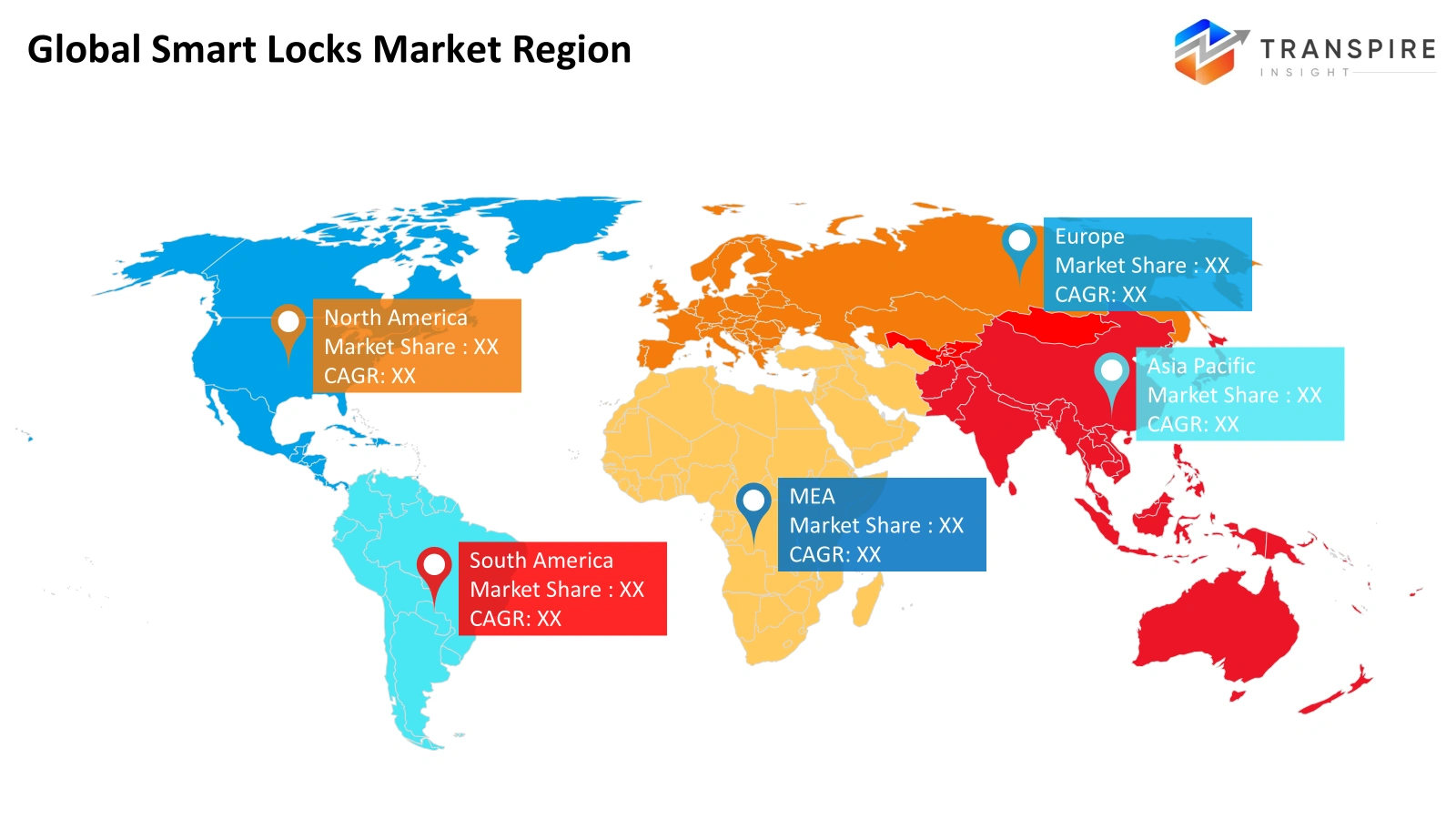
North America contributes 36% of the global smart lock market value and continues to be the leading market region. High penetration of smart homes, consumer awareness regarding smart security solutions, and usage of IoT devices are contributing factors behind North America’s lead position in the smart locks industry. Technological advancement and the availability of leading security and tech solution companies in North America have also been supporting regional growth in recent years. In June 2026, Schlage introduced its Sense Pro smart lock product in the US. This product was equipped with Ultra-Wideband technology, Matter-over-Thread capability, and hands-free unlocking. This move helps to solidify the supremacy of North America in smart home security solutions.
Europe
The European region accounts for 22% of the worldwide market share of the smart lock devices market. It is a stable growth segment that is influenced by building modernisation drives and security requirements. Growing preference for energy-efficient buildings and access control systems in the digital age boosts demand in the regional market. Companies operating in Europe are consistently deploying security technology solutions to enhance efficiency and convenience. Increasing importance of digital infrastructure and smart property management is likely to provide opportunities in the region. In April 2026, the Keypad 2 NFC was launched by Nuki in Europe, featuring Apple Home Key and Samsung Digital Home Key compatibility. This is an improvement in interoperability and digital access control for residential properties in the region.
Asia-Pacific
Asia-Pacific makes up 34% of the global market value and is considered the most promising regional market segment with the highest growth rate (CAGR 15.4%). Urbanisation trend, increased use of smartphones, and rising investments in smart cities have been creating an ideal environment for smart lock installations. As opposed to North America, the growth in Asia Pacific is driven by large infrastructure development and investment in smart home solutions by the expanding middle class. In January 2025, SEALSQ formed a partnership with MIWA Lock Co., Ltd. of Japan to acquire the nation's first smart lock compatible with the Matter protocol. This is a step towards smart home adoption and enhances the smart lock market in the Asia-Pacific region.
Who are the Key Players in the Global Smart Locks Marketand how do they Compete?
The competitive landscape of the international market of smart locks includes constant innovations, implementation of technology, and integration in new smart building ecosystems. The companies compete by offering improved features related to safety, increased connectivity, software capabilities, and better distribution channels. In addition, some conventional lock makers have competitors among IT security service providers that want to stand out with advanced authentication and access management products.
ASSA ABLOY is committed to innovation and relies on connectivity for access, biometrics, and cloud-based security. Competitive advantage of ASSA ABLOY can be seen in its wide variety of products targeted at residential, commercial, and institutional clients. The company's expansion strategy implies acquisitions, partnerships, and product development. For Allegion plc, the emphasis is on the development of access-control solutions for commercial and institutional environments with integrated security services and enhanced enterprise access management systems. This company also seeks to expand due to software-enabled security, integration into digital ecosystems, and establishment of a distribution network in various regions.
Dormakaba, Honeywell International, Aqara, Yale, and Samsung SDS also seek to expand their presence in smart homes, implement biometrics, provide cloud connectivity, and expand their business in growing residential and commercial markets.
Global Smart Locks Market companies
- Assa Abloy
- Allegion
- Dormakaba
- Yale
- Samsung SDS
- Honeywell
- Bosch
- Schlage
- Kwikset
- Salto Systems
- August Home
- HavenLock
- Level Home
- Ultraloq
- igloohome
Recent Development News
In January 2026, Connectivity Standards Alliance unveiled the Aliro smart lock specification with participation from major companies such as Apple, Google, Samsung, Allegion, and ASSA ABLOY. This program promoted better connectivity within smart lock systems and helped drive the adoption of digital key technology.
Source: https://www.theverge.com
In May 2026, SwitchBot unveiled its Lock Vision Series of smart deadbolt locks. This innovative product is the world’s first set of deadbolts equipped with 3D facial recognition technology. It is one such product launch that further increased innovation in the smart locks industry.
Source: https://www.t3.com
In January 2025, Schlage introduced the Sense Pro Smart Deadbolt with Ultra-Wideband (UWB) technology and compatibility with Matter. This product release enhanced hands-free unlocking options while improving interoperability within smart home systems.
Source: https://www.theverge.com
What Strategic Insights Define the Future of the Global Smart Locks Market?
The future development of the smart locks market will depend on the coming together of various trends, including the use of biometric verification methods, artificial intelligence technologies, cloud services, and advanced smart buildings solutions. As customers demand better access management systems, it is likely that the market will see a growing trend towards the sale of security systems, rather than hardware alone.
One of the key areas where smart lock devices can find new application areas is in smart city development, smart homes, and intelligent properties in commercial settings. Manufacturers of such devices should consider how they can implement AI and other advanced technologies to meet the needs of customers from the Asia-Pacific region. Concerning strategic considerations, companies manufacturing such products should focus on developing security ecosystems rather than focusing purely on the development of new and innovative hardware products.
Global Smart Locks Market Segmentation
By Type
- Deadbolt Smart Locks
- Lever Handle Smart Locks
- Padlock Smart Locks
- Biometric Smart Locks
- Wi-Fi Smart Locks
- Bluetooth Smart Locks
By Application
- Residential
- Commercial
- Hospitality
- Government Buildings
By End-User
- Homeowners
- Enterprises
- Hotels
- Government Agencies
By Technology
- Biometric Authentication
- Mobile Access
- Cloud-based Access
- AI Security
Regional Outlook
North America
- United States
- Canada
- Mexico
Europe
- Germany
- United Kingdom
- France
- Spain
- Italy
- Rest of Europe
Asia Pacific
- Japan
- China
- Australia & New Zealand
- South Korea
- India
- Rest of Asia Pacific
South America
- Brazil
- Argentina
- Rest of South America
Middle East & Africa
- Saudi Arabia
- United Arab Emirates
- South Africa
- Rest of the Middle East & Africa
Frequently Asked Questions
Find quick answers to common questions.
The global smart locks market size was valued at USD 3315.7 Million in 2025 and is poised to reach USD 14166.4 Million by 2033, expanding at a 19.93% CAGR.
Key segments for the global smart locks market are By Type (Deadbolt Smart Locks, Lever Handle Smart Locks, Padlock Smart Locks, Biometric Smart Locks, Wi-Fi Smart Locks, Bluetooth Smart Locks, Others); By Application (Residential, Commercial, Hospitality, Government Buildings, Others); By End-User (Homeowners, Enterprises, Hotels, Government Agencies, Others); By Technology (Biometric Authentication, Mobile Access, Cloud-based Access, AI Security, Others).
Growth is primarily driven by the growth of the global smart locks market can be attributed to several factors, such as increasing use of smart home technologies, growing need for improved security solutions, growing penetration of smartphones, and the proliferation of IoT-enabled devices. The other drivers of market growth include developments in biometrics, remote management solutions, and smart city concepts.
The global market is led by major manufacturers including Assa Abloy, Allegion, dormakaba, Yale, Samsung SDS, Honeywell, Bosch, Schlage, Kwikset, Salto Systems, August Home, HavenLock, Level Home, Ultraloq, igloohome.
The market for smart locks in North America accounts for around 36% of the total global market, thus making it the largest regional market worldwide. Its dominance stems from high usage rates of smart home products, increased knowledge about home security products, and integration of IoT-based products. The presence of tech giants, a robust digital framework, and increasing security system installations also contribute to this dominance.
The smart locks market in the global scenario presents business opportunities due to the increasing use of smart homes, connected security, and IoT-enabled devices. Opportunities abound for players in the development of smart lock technology such as biometrics, mobile application locks, and AI-powered locks, as demand is increasing from residential as well as hospitality and commercial segments.
- Assa Abloy
- Allegion
- Dormakaba
- Yale
- Samsung SDS
- Honeywell
- Bosch
- Schlage
- Kwikset
- Salto Systems
- August Home
- HavenLock
- Level Home
- Ultraloq
- igloohome
About the Authors

Avinash Kumar
I’m Avinash Kumar, a Senior Research Analyst at Transpire Insight, with expertise in the Electronics and Semiconductor and Energy & Power industry. My work focuses on analyzing emerging technologies, market trends, industry developments, and innovation across these sectors. I specialize in transforming complex technical and market insights into clear, research-backed content that helps professionals, businesses, and decision-makers stay informed. Through continuous industry research and data-driven analysis, I strive to deliver accurate, reliable, and practical perspectives on the latest advancements shaping the semiconductor and energy landscape.

Chakradhar Khansole
Chakradhar serves as the Research Director at Transpire Insight, bringing over 8 years of experience in technology, innovation, and strategic market intelligence. He specializes in transforming complex market data into actionable business insights that enable organizations to make informed, growth-oriented decisions. Recognized for his strategic vision and analytical expertise, Chakradhar leads high-impact research initiatives, delivering comprehensive market assessments, competitive intelligence, and forward-looking industry analysis.
Recently Published Reports
-
Apr 2026
Fiber Optic Faceplates Market
Fiber Optic Faceplates Market Size, Share & Analysis Report By Type (< 300 mm2, 300-350 mm2, and > 350 mm2, By Application (Night Vision, Holographic Imaging, Medical, and Others), and Geography (North America, Europe, Asia-Pacific, Middle East and Africa, South and Central America), 2021 - 2031
-
Apr 2026
High Temperature Superconductors Market
High Temperature Superconductors Market Size, Share & Analysis Report By Type (1G HTS, and 2G HTS), By Application (Power Cable, Fault Current Limiter, and Transformer), and Geography (North America, Europe, Asia-Pacific, Middle East and Africa, South and Central America), 2021 - 2031
-
Apr 2026
Industrial Plugs and Socket Market
Industrial Plugs and Socket Market Size, Share & Analysis Report By Type (Industrial Plugs, Industrial Sockets), By Current (Up to 32 A, 32 to 125 A, Above 125 A), By Protection (Dustproof and Splash Proof, Waterproof, Explosion Proof), By End User (Heavy Industries, Oil and Gas, Chemicals and Pharmaceuticals, Power Generation, Others), and Geography (North America, Europe, Asia-Pacific, Middle East and Africa, South and Central America), 2021 - 2031
-
Apr 2026
InGaAs Avalanche Photodiodes Market
InGaAs Avalanche Photodiodes Market Size, Share & Analysis Report By Type (1100 - 1700 nm, and 1000 - 1600 nm), By Application (Missile Warning System, Muzzle Flash Detection, Wafer Defect Inspection, Laser Rangefinders, and Others), and Geography (North America, Europe, Asia-Pacific, Middle East and Africa, South and Central America), 2021 - 2031