
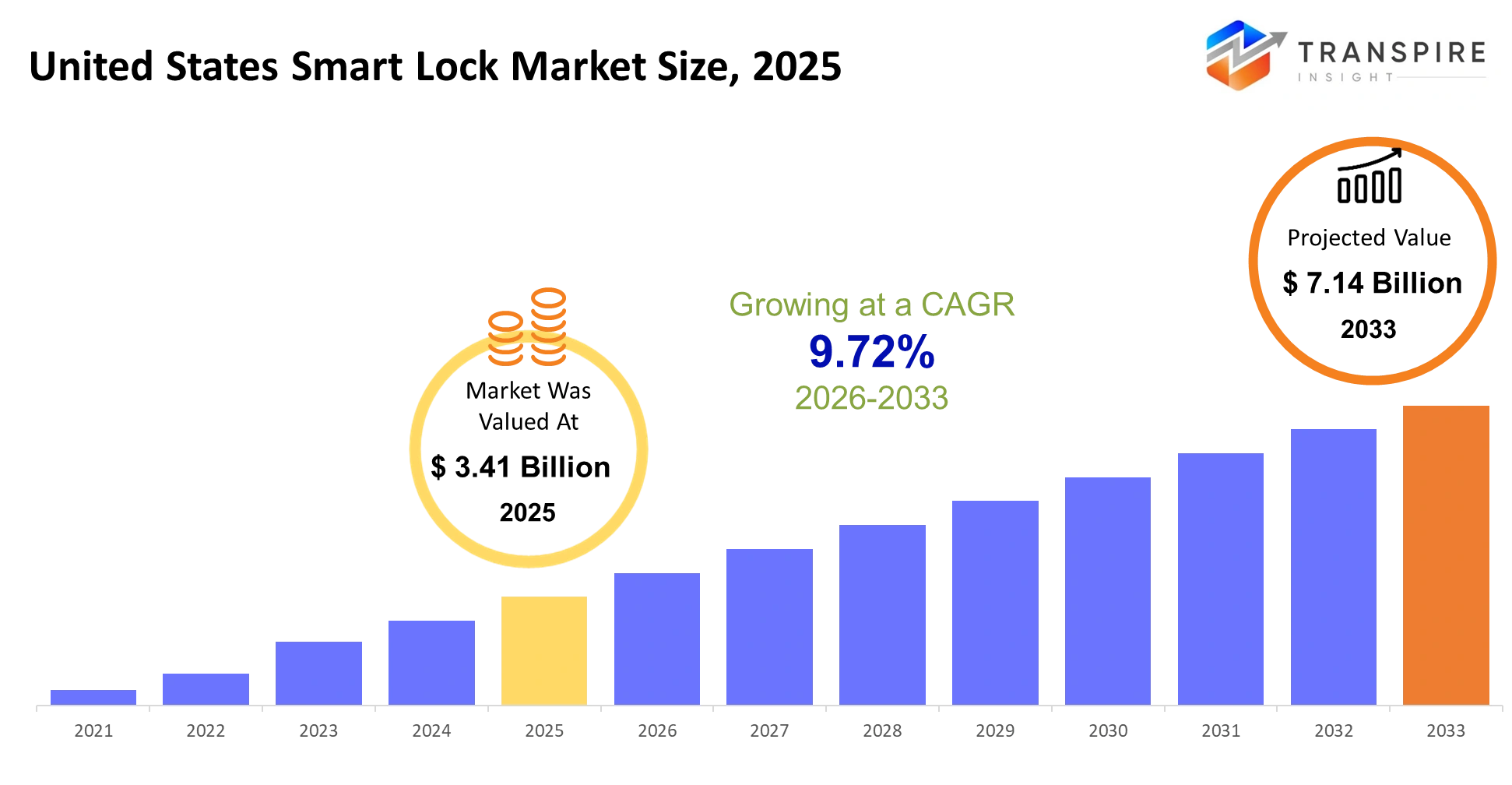
United States Smart Lock Market Size & Forecast:
- United States Smart Lock Market Size 2025: USD 3.41 Billion
- United States Smart Lock Market Size 2033: USD 7.14 Billion
- United States Smart Lock Market CAGR: 9.72%
- United States Smart Lock Market Segments:By Product Type (Deadbolt Smart Locks, Lever Handle Smart Locks, Padlock Smart Locks), By Communication Protocol (Bluetooth, Wi-Fi, Zigbee, Z-Wave), By End User (Residential, Commercial).
To learn more about this report,  Download Free Sample Report
United States Smart Lock Market Summary:
The United States Smart Lock market size is estimated at USD 3.41 billion in 2025 and is anticipated to reach USD 7.14 billion by 2033, growing at a CAGR of 9.72% from 2026 to 2033. The United States smart lock market experiences continuous expansion because residential customers demand home automation systems and better security solutions. Consumers are increasing their use of smart locks because these devices provide them with easy-to-use features and the ability to control their locks from remote locations and connect with their home automation systems. The use of biometric access systems together with mobile application control systems has increased product adoption in the market. Security concerns about residential properties and the rise of internet-connected devices drive both home users and business users to purchase advanced security locks which offer better performance.
Key Market Trends & Insights:
- The practice of integrating smart locks into connected home systems has become a standard operating procedure. Modern households which operate smart assistants together with IoT devices now require lock systems that function as essential components of their everyday activities.
- Security threats have made consumers choose advanced security systems as their primary protection method. Smart locks provide users with real-time alerts and activity tracking features which enhance their security.
- Digital access methods are replacing traditional keys in modern society. Entry systems which use PIN codes and fingerprint scanning and smartphone controls make access to buildings quicker and simpler and more secure.
- Biometric authentication systems which use fingerprint and facial recognition technology have become more common. These systems enhance security protection while providing users with better access to services.
- Smart locks are now used in offices and co-working spaces and retail stores. The system enables organisations to control employee access while maintaining entry logs, which leads to better overall business performance.
- The use of smart locks as connected devices has led to increased hacking risks. Manufacturers choose to spend money on advanced encryption methods and ongoing software development to establish buyer confidence.
United States Smart Lock Market Segmentation
By Product Type
- Deadbolt Smart Locks: The deadbolt smart lock system protects United States homes because its security capabilities make it the most secure lock system available. The system combines traditional deadbolt security with modern smart home features which allow users to access their locks from remote locations. Homeowners need the dual benefits of increased security and easy access because their main doors serve as the primary entrance to their homes.
- Lever Handle Smart Locks: Interior areas and commercial spaces both use lever handle smart locks as their primary locking solution. The locking system enables children and elderly users to operate it while maintaining modern security features such as keyless entry and app control. The system provides offices and secondary doors with both stylish appearance and operational efficiency.
- Padlock Smart Locks: Smart padlocks are becoming increasingly popular because they serve as effective security solutions for both lockers and gates and storage units. Users can access their locks through mobile applications or biometric systems which eliminate the requirement for physical keys. The security system delivers portable and flexible solutions which users can use in both residential and business environments outside their standard door lock applications.
By Communication Protocol
- Bluetooth: People can unlock doors with their smartphones from nearby locations because smart locks use Bluetooth technology for this purpose. The locks provide safe door access for personal use because they allow users to open doors without needing an internet connection which enables them to access their doors during network outages.
- Wi-Fi: Wi-Fi smart locks provide greater flexibility with remote access from anywhere. The system enables users to control door locks while they track system activity and receive instant notifications about system events. Modern smart homes rely heavily on these devices because they provide easy operation, yet they consume more energy than different communication methods.
- Zigbee: Advanced home automation systems often use smart locks which operate on the Zigbee protocol. The system provides two important features because it uses minimal energy and establishes dependable wireless connections between smart home devices. Users who want to connect their locks with other home automation components will find these locks to be perfect because they deliver efficient operation and their home automation system remains operational.
- Z-Wave: The Z-Wave smart locks provide users with two main benefits because they protect their data through secure transmission methods and deliver uninterrupted communication capabilities. The system operates on a dedicated frequency which reduces all types of signal interruptions. These locks become the standard equipment for smart home systems because they provide permanent operational links and advanced protection features which appeal to modern homeowners.
By End User
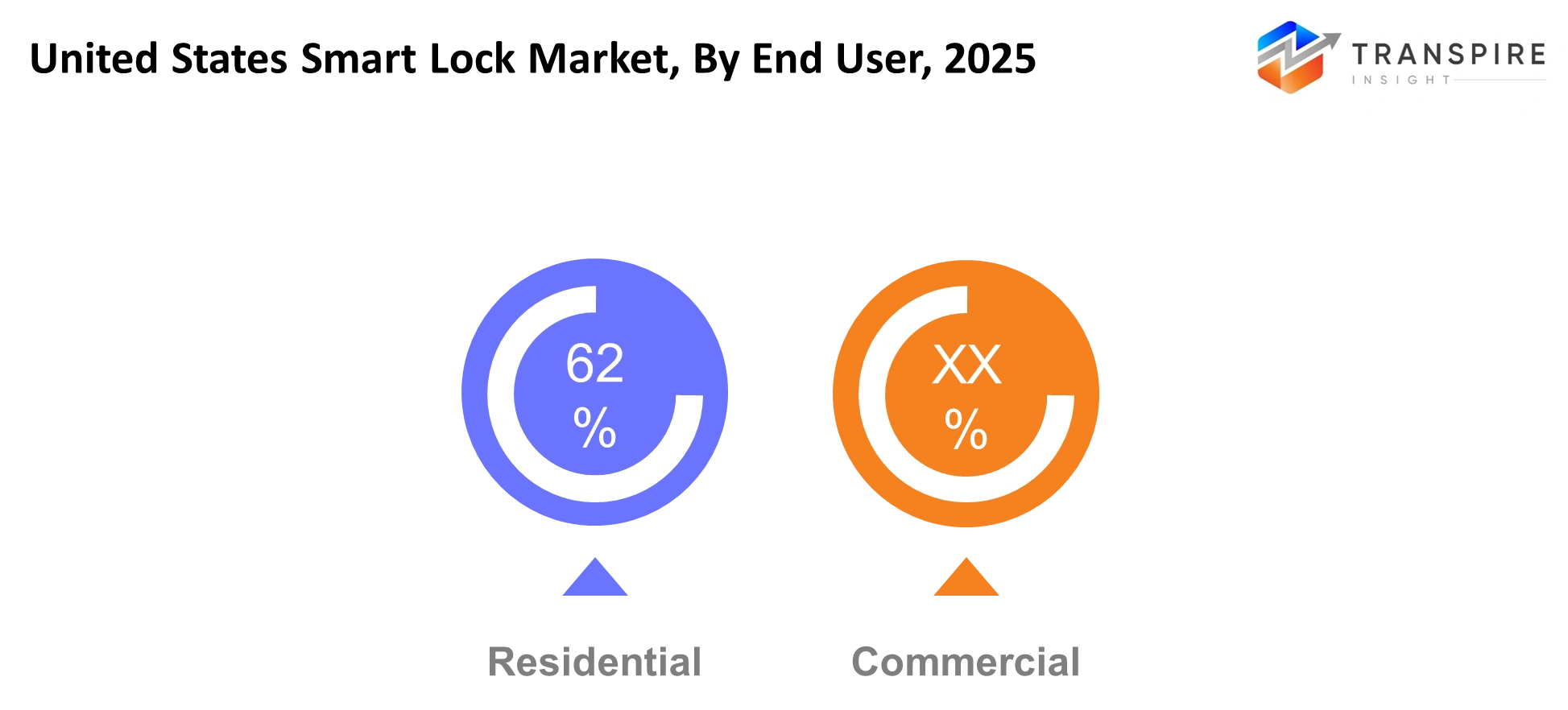
- Residential: The U.S. smart lock market for residential use leads all other markets because more people are adopting smart home technology. Homeowners are drawn to features like remote access and enhanced security and convenience of home automation systems. People find smart locks to be appealing upgrades because they enable users to monitor and control their entry points through mobile devices.
- Commercial: Smart locks are changing how commercial spaces handle their access management systems. Businesses use smart locks to control their workers' access while monitoring their movements and increasing their protection measures. Keyless systems help offices, hotels and retail businesses to manage their operations more easily while creating better access control systems and protecting themselves from security threats.
To learn more about this report, Download Free Sample Report
Country Insights
The United States smart lock market shows strong evidence of moving toward connected living and digital security technologies. Consumers start to embrace smart technology because they have access to smartphones and internet services throughout their daily activities. Smart home technology is developing in urban regions because developers build advanced locking systems into their smart homes and apartment buildings.
Homeowners choose to purchase smart locks because they want to protect their homes better and because package deliveries have become more common. The presence of leading tech companies together with ongoing development of IoT devices creates an environment which allows the market to grow. Smart locks enable offices and rental properties in the commercial sector to achieve better control over their access management systems. United States markets show continuous development because both technology advancements and consumer lifestyle patterns shape their evolution.
Recent Development News
In March 2026, Smart Lock Prices Drop During U.S. Retail Sales: Recent U.S. retail events have seen major discounts on premium smart locks, making advanced security more accessible to homeowners. This is expected to boost adoption across mid-income households.
In March 2026, Apple Home Key Integration Expands in Smart Locks: Smart lock brands are integrating Apple Home Key, allowing users to unlock doors with iPhones and Apple Watches. This reflects growing demand for seamless, phone-based access.
|
Report Metrics |
Details |
|
Market size value in 2025 |
USD 3.41 Billion |
|
Market size value in 2026 |
USD 3.73 Billion |
|
Revenue forecast in 2033 |
USD 7.14 Billion |
|
Growth rate |
CAGR of 9.72% from 2026 to 2033 |
|
Base year |
2025 |
|
Historical data |
2021 – 2024 |
|
Forecast period |
2026 – 2033 |
|
Report coverage |
Revenue forecast, competitive landscape, growth factors, and trends |
|
Country scope |
United States |
|
Key company profiled |
ASSA ABLOY AB, Allegion PLC, Dormakaba Holding AG, Samsung SDS Co. Ltd., Honeywell International Inc., Xiaomi Corporation, August Home Inc., Kwikset Corporation, Schlage Lock Company LLC, Yale Locks & Hardware, Vivint Smart Home Inc., Spectrum Brands Holdings Inc., HavenLock Inc., Ultraloq (U-Tec), Igloohome Pte Ltd. |
|
Customization scope |
Free report customization (country, regional & segment scope). Avail customized purchase options to meet your exact research needs. |
|
Report Segmentation |
By Product Type (Deadbolt Smart Locks, Lever Handle Smart Locks, Padlock Smart Locks), By Communication Protocol (Bluetooth, Wi-Fi, Zigbee, Z-Wave), By End User (Residential, Commercial). |
Key United States Smart Lock Company Insights
The United States smart lock market displays a dual structure because established technology companies and new market entrants work together to build better user experiences. Companies are focusing on three design elements, which include user-friendly interfaces and complete application compatibility and security solutions which use biometric identification and encryption technology. Companies achieve product differentiation through their ongoing research and development investments which create more intelligent product capabilities. Brands use their partnerships with smart home ecosystem providers to extend their market presence. The strong competition in the market drives companies to develop smart locking systems which provide customers with dependable security features and easy-to-use interfaces.
Company List
- ASSA ABLOY AB
- Allegion PLC
- Dormakaba Holding AG
- Samsung SDS Co. Ltd.
- Honeywell International Inc.
- Xiaomi Corporation
- August Home Inc.
- Kwikset Corporation
- Schlage Lock Company LLC
- Yale Locks & Hardware
- Vivint Smart Home Inc.
- Spectrum Brands Holdings Inc.
- HavenLock Inc.
- Ultraloq (U-Tec)
- Igloohome Pte Ltd.
United States Smart Lock Market Report Segmentation
By Product Type
- Deadbolt Smart Locks
- Lever Handle Smart Locks
- Padlock Smart Locks
By Communication Protocol
- Bluetooth
- Wi-Fi
- Zigbee
- Z-Wave
By End User
- Residential
- Commercial
Frequently Asked Questions
Find quick answers to common questions.
The Approximate United States Smart Lock Market size for the Market will be USD 7.14 Billion in 2033.
The key Segments of the United States Smart Lock Market are By Product Type (Deadbolt Smart Locks, Lever Handle Smart Locks, Padlock Smart Locks), By Communication Protocol (Bluetooth, Wi-Fi, Zigbee, Z-Wave), By End User (Residential, Commercial).
Major Players in the United States Smart Lock Market are ASSA ABLOY AB, Allegion PLC, Dormakaba Holding AG, Samsung SDS Co. Ltd., Honeywell International Inc., Xiaomi Corporation, August Home Inc., Kwikset Corporation, Schlage Lock Company LLC, Yale Locks & Hardware, Vivint Smart Home Inc., Spectrum Brands Holdings Inc., HavenLock Inc., Ultraloq (U-Tec), Igloohome Pte Ltd.
The Current Market size of the United States Smart Lock Market is USD 3.41 Billion in 2025.
The United States Smart Lock Market CAGR is 9.72%.
- ASSA ABLOY AB
- Allegion PLC
- Dormakaba Holding AG
- Samsung SDS Co. Ltd.
- Honeywell International Inc.
- Xiaomi Corporation
- August Home Inc.
- Kwikset Corporation
- Schlage Lock Company LLC
- Yale Locks & Hardware
- Vivint Smart Home Inc.
- Spectrum Brands Holdings Inc.
- HavenLock Inc.
- Ultraloq (U-Tec)
- Igloohome Pte Ltd.
Recently Published Reports
-
Apr 2026
Fiber Optic Faceplates Market
Fiber Optic Faceplates Market Size, Share & Analysis Report By Type (< 300 mm2, 300-350 mm2, and > 350 mm2, By Application (Night Vision, Holographic Imaging, Medical, and Others), and Geography (North America, Europe, Asia-Pacific, Middle East and Africa, South and Central America), 2021 - 2031
-
Apr 2026
High Temperature Superconductors Market
High Temperature Superconductors Market Size, Share & Analysis Report By Type (1G HTS, and 2G HTS), By Application (Power Cable, Fault Current Limiter, and Transformer), and Geography (North America, Europe, Asia-Pacific, Middle East and Africa, South and Central America), 2021 - 2031
-
Apr 2026
Industrial Plugs and Socket Market
Industrial Plugs and Socket Market Size, Share & Analysis Report By Type (Industrial Plugs, Industrial Sockets), By Current (Up to 32 A, 32 to 125 A, Above 125 A), By Protection (Dustproof and Splash Proof, Waterproof, Explosion Proof), By End User (Heavy Industries, Oil and Gas, Chemicals and Pharmaceuticals, Power Generation, Others), and Geography (North America, Europe, Asia-Pacific, Middle East and Africa, South and Central America), 2021 - 2031
-
Apr 2026
InGaAs Avalanche Photodiodes Market
InGaAs Avalanche Photodiodes Market Size, Share & Analysis Report By Type (1100 - 1700 nm, and 1000 - 1600 nm), By Application (Missile Warning System, Muzzle Flash Detection, Wafer Defect Inspection, Laser Rangefinders, and Others), and Geography (North America, Europe, Asia-Pacific, Middle East and Africa, South and Central America), 2021 - 2031