
Global Recycled Scrap Metal Market Size & Forecast:
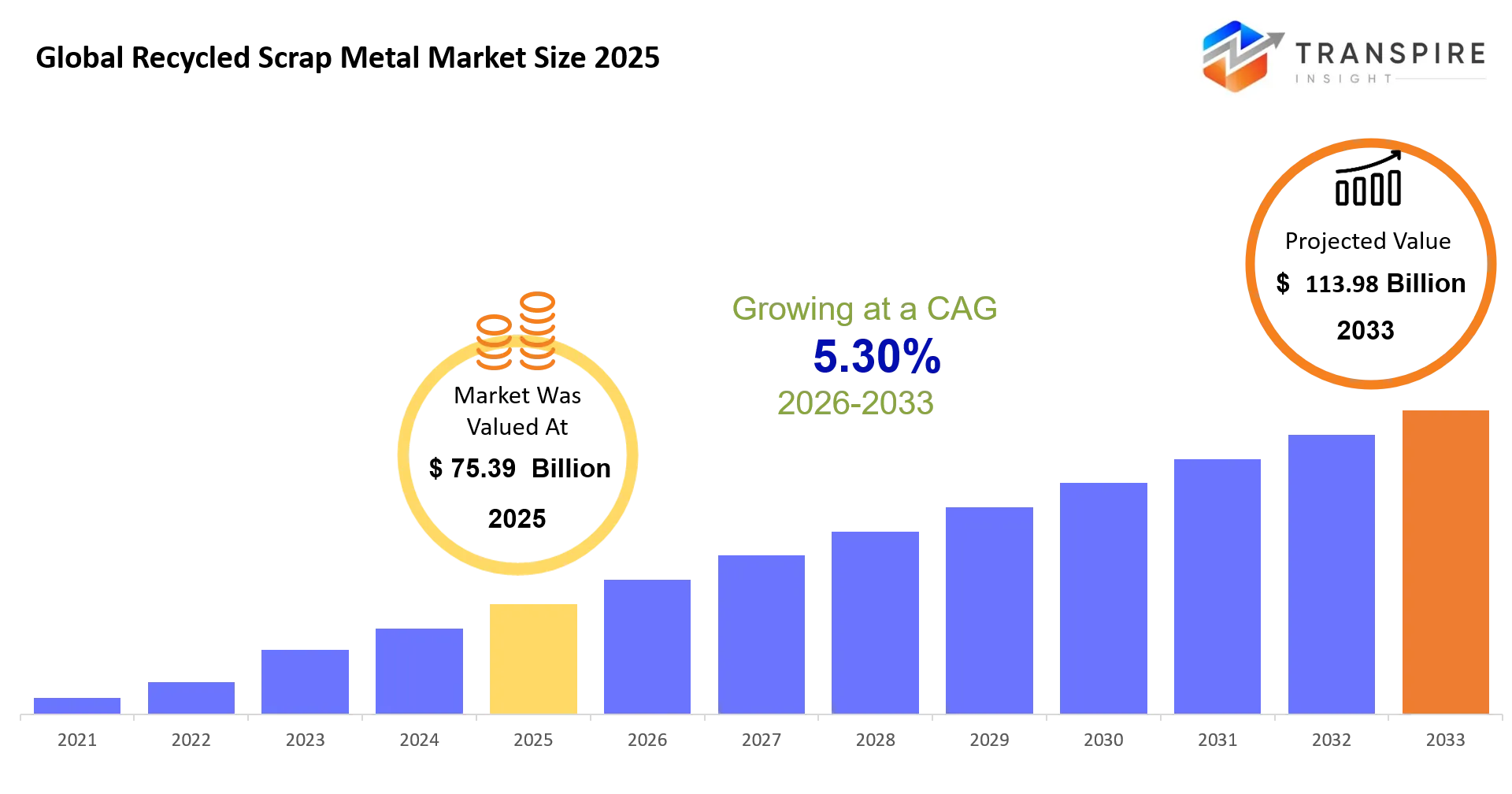
- Global Recycled Scrap Metal Market Size 2025: USD 75.39 Billion
- Global Recycled Scrap Metal Market Size 2033: USD 113.98 Billion
- Global Recycled Scrap Metal Market CAGR: 5.30%
- Global Recycled Scrap Metal Market Segments: By Metal Type (Ferrous Scrap, Non-Ferrous Scrap, Aluminum Scrap, Copper Scrap, Stainless Steel Scrap, Brass Scrap, Lead Scrap, Others); By Source (Industrial Scrap, Construction Scrap, Automotive Scrap, Consumer Appliances, Shipbreaking, Electronic Waste, Municipal Scrap, Others); By Processing Method (Shredding, Baling, Shearing, Sorting, Melting, Granulation, Compaction, Others); By End User (Steel Industry, Foundries, Automotive, Construction, Aerospace, Electronics, Packaging, Others); By Distribution Channel (Direct Supply, Scrap Dealers, Recycling Centers, Online Trading Platforms, Exporters, Importers, Auction Platforms, Others)
Global Recycled Scrap Metal Market Summary:
As per Transpire Insight Analysis, the Global Recycled Scrap Metal Market size is estimated at USD 75.39 Billion in 2025 and is anticipated to reach USD 113.98 Billion by 2033, growing at a CAGR of 5.30% from 2026 to 2033.
The Global Recycled Scrap Metal Market repurposes waste generated from the automotive, industrial, construction, and consumer goods sectors to supply viable materials for manufacturing, lessening our reliance on mining and stabilizing our supply chain. In the last 5 years, the market has seen a transition away from purely collection-focused operations toward a digitally optimized network of recovery specialists supported by automated sortation, material tracking and significantly improved material output quality. In structural terms, tightening circularity policy across the manufacturing space along with mandatory recycled content requirements for various sectors. With increased growth in Electric Vehicle adoption and new builds, the use of recovered Aluminium, Copper and other specialist metals is rising.
Volatility in prices for virgin materials is driving manufacturers to source recovered material and gain some cost control while contributing positively towards ESG commitments. This has increased the availability of long-term recycling contracts, increased funding into high-tech reprocessing facilities and boosted intra- and inter-state scrap trading.
Key Global Recycled Scrap Metal Market Insights:
The industry is moving away from being just a volume-based business towards high-tech material refinement because traceable, low-carbon industrial feedstocks are needed. The change requires a complete change in the supply chain logistics with a focus on chemical consistency rather than the raw tonnage from the past.
- Ferrous Scrap remains the leader with 46% of sales, while Nucor Corporation continues to build capacity for its electric-arc furnaces, driving low-carbon steel production.
- Asia Pacific's network expands with a 42% market share, while Chiho Environmental Group expands the scale of its integrated recycling hubs by material tracking with digital technology.
- Aluminum Scrap holds an 18% share as Sims Metal Management invests in advanced non-ferrous sorting with AI-enabled optical systems.
- Copper Scrap accounts for a 14% share and benefits from grid electrification as Aurubis AG optimises closed-loop copper recovery technologies.
- European Metal Recycling is expected to increase the automated recovery of complex value metals, leading to an electronic waste recycling CAGR of 14.6%.
- North America accounts for 23% of the market, and Commercial Metals Company has invested in state-of-the-art processing facilities to increase industrial recycling uptake.
- ELG Haniel enhances the efficiency of alloy recovery by speciality recycling and precision material segregation, while Stainless Steel Scrap accounts for 9% share.
- Meanwhile, ArcelorMittal is promoting circular manufacturing in Europe, where recycled-content steel production is growing thanks to digital traceability.
What are the Key Drivers, Restraints, and Opportunities in the Global Recycled Scrap Metal Market?
Driver:
Industrial decarbonisation remains the most influential catalyst for the recycled scrap metal market, driven by the shift to Green Steel and increased carbon reduction benchmarks in the steelmaking, automotive and infrastructure verticals. Importantly, the implementation of Scope 3 reporting has driven OEMs to lower embodied carbon, favouring premium recycled ferrous scrap consumption over virgin feedstocks. Significantly, volatile iron ore and base metals pricing, alongside policy backing for Circular Manufacturing, is also boosting demand for scrap by reducing production costs, bolstering supply-chain robustness and providing recyclers with a position to win more high-value processing orders.
In January 2026, Thyssenkrupp entered into a multi-year partnership with Stegra to acquire large volumes of non-prime green steel for downstream industrial clients across Europe. This enables automotive and infrastructure OEMs to efficiently achieve Scope 3 decarbonisation targets using independently verified, scrap-based circular products.
Restraint:
Contamination and alloying issues, poor-quality scrap, multi-metal device composition (electronic waste) limitations, and hazardous combinations of scrap material, especially from electronic products, restrict the recovery of high-grade material and push the overall costs up through complex collection systems, limited sorting infrastructure, and off-line car scrapping practices. Modern products are designed for performance, not recycling and elevated investment in sorting and recycling equipment is considerable, requiring long-term regulatory oversight.
Opportunity:
Further expansion will enable autonomous recycling facilities utilising integrated Artificial Intelligence optical and X-ray fluorescence (XRF) sorting systems to sort complex alloys with high separation accuracy. In combination with increasing urban mining and electronics recovery, these intelligent systems optimize copper, aluminium, and rare metals recovery from complex segregated waste streams. Increasing investments across Asia-Pacific and Europe are converting traditional scrap yards into high-value, high-quality imputers providing premium scrap production, risk hedging through new revenue streams, increased resource security and rapid transition to circular manufacturing.
In May 2026, Machinex launched a new AI platform at IFAT 2026, allowing operators to achieve system-wide optimisation, real-time material analysis, and advanced reporting. This integration provides facilities with improved decision-making to scale autonomous metal sorting.
What Has the Impact of Artificial Intelligence Been on the Global Recycled Scrap Metal Market?
Artificial intelligence is transforming the global recycled scrap metal industry from a human labour-intensive process into a digital, precision manufacturing ecosystem. Computer vision, hyperspectral imaging, robotic arms and sensor-based segregation systems afford precise identification and segregation of ferrous, aluminium, copper, stainless steel and mixed alloy compositions, resulting in higher recovery rates, lower contamination levels and higher-value recycled materials. Predictive analytics forecast or analyse price movements, provide incoming quality assessment, automate inventory planning and optimise logistics, thereby decreasing labour cost. Internet-of-Things-enabled machine learning optimises inflow handling capacity and reduces equipment downtime through wear prediction and energy optimisation of shredding, sorting and remelting. Web platforms developed for buyer-seller matching and pricing transparency help to de-risk and grow consumption. However, such solutions' widespread deployment is constrained by capital-intensive retrofitting of ageing recycling plants with automated technology, challenges in processing highly oxidised or contaminated scrap, and the limited scope of current applications to achieve consistency in the extraction of the highest-quality recycled metal. In May 2026, TOMRA launched the FINDER platform and increased its stake in PolyPerception to a majority holding. This integration unites real-time data monitoring with physical sorting, enabling recyclers to precisely upgrade complex non-ferrous streams and optimize equipment wear.
Key Global Recycled Scrap Metal Market Trends:
The Cold Laser Therapy market is moving from a medical niche to mainstream, technology-driven rehabilitation; a complete paradigm shift toward at-home, portable use and evidence-based non-drug pain relief.
- Move to Home-Care: Clinical-only setups are giving way to FDA-cleared, portable, handheld devices that allow patients to receive treatment.
- Technological Maturation: Diode efficiency improvements have helped to make them smaller without compromising on power or deep tissue penetration.
- Non-Invasive Priority: Patients' preference for a non-pharmacological approach to pain management has grown, leaving a continued demand for non-invasive therapeutic options.
- Protocol standardization: The more uniform clinical effectiveness of the past is being reduced by industry-wide efforts to establish verified treatment protocols.
- Integrated Wellness: Physiotherapy is moving from niche to mainstream recovery routines, with manufacturers partnering with recovery centres and wellness centres.
- Data-Driven Adoption: Today's devices are digital, providing practitioners with an opportunity to monitor patient adherence and outcomes from a distance.
- Regulatory Validation: Greater acceptance in key markets has left the credibility of photobiomodulation treatment for chronic pain firmly established.
- Value-Based Care: Laser therapy is gaining popularity as a cost-effective option for soft tissue injuries over surgery.
Global Recycled Scrap Metal Market Segmentation
By Metal Type:
Ferrous scrap dominates at 46% owing to its preeminent markets of steel construction and production, where large flows of recycling can be cost-efficiently reduced in both costs and embedded Carbon. Aluminium Scrap 18% continues to grow, driven by the need for lightweight Transport and Packaging production, with increased demand for electrically conductive Copper Scrap at 14%. 9% Stainless Steel Scrap, 6% Brass Scrap, 4% Lead Scrap, and 3% other specialised alloys. Higher overall supply diversity enhances industrial responsibilities for key inputs.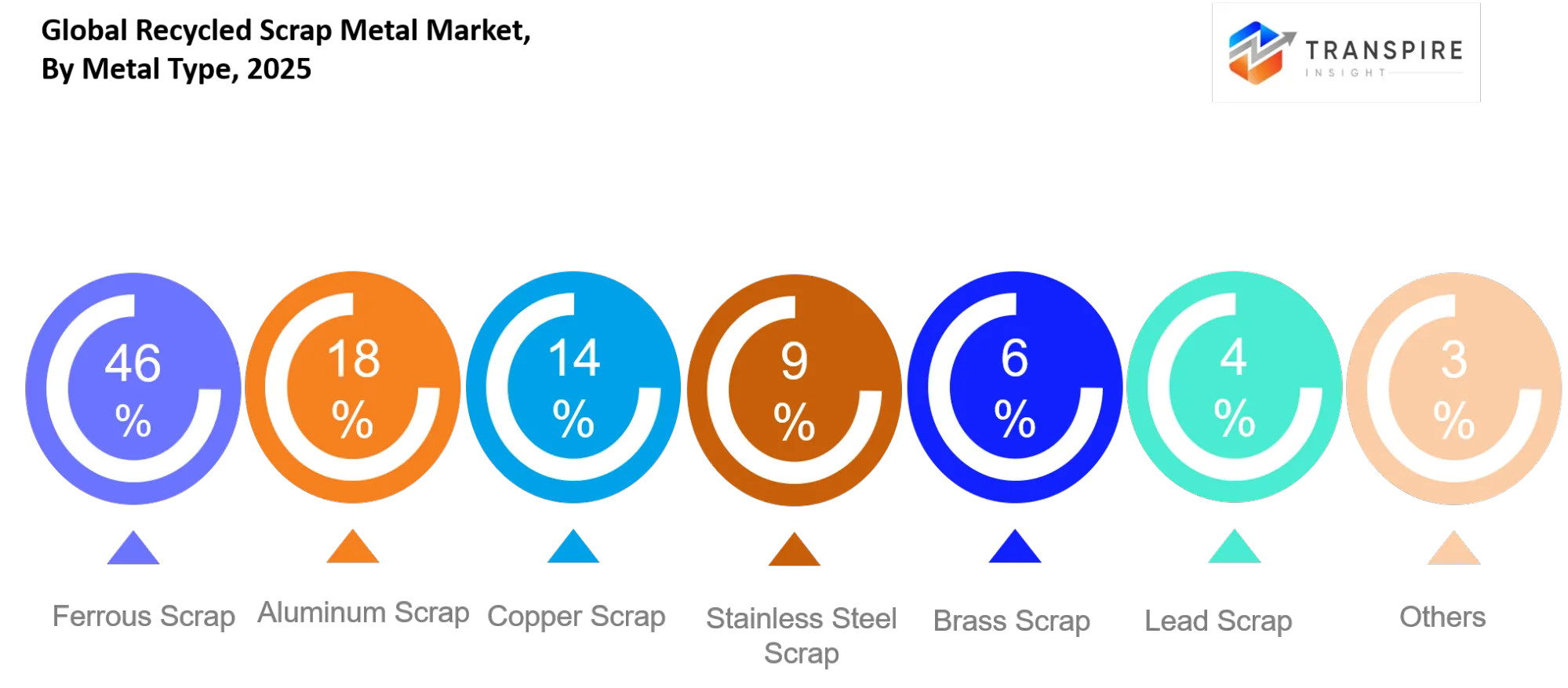
By Source:
The industrial sector continues to have the highest quality and most stable feedstock, remaining the mainstay of world recycling. Construction / Automotive demand will continue to rise with the ageing of infrastructure and replacement of vehicles, producing higher quality metals. Electronic Waste Recycling is currently the fastest growing recyclable source, with a 14.6% CAGR, due to higher recovery of metals from dated electronic devices. Shipbreaking, Municipal, Appliances, and other flows increase the diversity.
By Processing Method:
Shredding continues to be the prevailing method because it effectively prepares mixed scrap for further separation. The trend for improved sorting technologies persists with the incorporation of AI-enabled optical sensors, while baling, shearing, melting, granulation, compaction and others all play a role in logistics efficiency and increased recovery of valuable materials from ever more complex waste streams.
By End User:
The largest resulting user was the steel industry, as there is an unceasing requirement for recycled ferrous feedstocks. Automotive, construction, foundries, aerospace, electronics, packaging, and other industries are all utilising more recycled metals to decrease their production emissions and increase their raw material security.
By Distribution Channel:
Direct supply dominates large industrial transactions, while scrap dealers and recycling centres remain essential collection hubs. Online trading platforms, exporters, importers, auction platforms, and other digital channels are reshaping global scrap commerce through improved pricing transparency and wider market accessibility.
What are the Key Use Cases Driving the Global Recycled Scrap Metal Market?
The main application is still steel production, with 46% of the market now supplied using recycled feedstock by Ferrous Scrap in the production of structural steel, reinforcement and all kinds of industrial machinery and equipment, as the incorporation of recycled material reduces electrical energy use and reduces reliance on virgin ore.
Beyond traditional metallurgy, recycled aluminium, copper, and stainless steel are also more commonly used in automotive manufacturing, renewable energy equipment, consumer electronics, aerospace manufacturing, and other new construction projects.
Electronics Recycling, Battery Manufacturing and Circular Production Channels underlie new applications. Growing Electronics Waste Recycling presents new opportunities to recover important metals for the high-tech, electric vehicle, intelligent infrastructure and next-generation clean energy fields.
|
Report Metrics |
Details |
|
Market size value in 2025 |
USD 75.39 Billion |
|
Market size value in 2026 |
USD 79.38 Billion |
|
Revenue forecast in 2033 |
USD 113.98 Billion |
|
Growth rate |
CAGR of 5.30% from 2026 to 2033 |
|
Base year |
2025 |
|
Historical data |
2021 - 2024 |
|
Forecast period |
2026 - 2033 |
|
Report coverage |
Revenue forecast, competitive landscape, growth factors, and trends |
|
Regional scope |
United States; Canada; Mexico; United Kingdom; Germany; France; Italy; Spain; Denmark; Sweden; Norway; China; Japan; India; Australia; South Korea; Thailand; Brazil; Argentina; South Africa; Saudi Arabia; United Arab Emirates |
|
Key company profiled |
Sims Metal Management, Commercial Metals Company, Nucor Corporation, Schnitzer Steel Industries, European Metal Recycling, OmniSource, Alter Trading, Aurubis AG, Kuusakoski Group, ArcelorMittal, SA Recycling, Chiho Environmental Group, Ferrous Processing & Trading, DJJ, ELG Haniel |
|
Customization scope |
Free report customization (country, regional & segment scope). Avail customized purchase options to meet your exact research needs. |
|
Report Segmentation |
By Metal Type (Ferrous Scrap, Non-Ferrous Scrap, Aluminum Scrap, Copper Scrap, Stainless Steel Scrap, Brass Scrap, Lead Scrap, Others); By Source (Industrial Scrap, Construction Scrap, Automotive Scrap, Consumer Appliances, Shipbreaking, Electronic Waste, Municipal Scrap, Others); By Processing Method (Shredding, Baling, Shearing, Sorting, Melting, Granulation, Compaction, Others); By End User (Steel Industry, Foundries, Automotive, Construction, Aerospace, Electronics, Packaging, Others); By Distribution Channel (Direct Supply, Scrap Dealers, Recycling Centers, Online Trading Platforms, Exporters, Importers, Auction Platforms, Others) |
Which Regions are Driving the Global Recycled Scrap Metal Market?
Asia Pacific leads the pack with 42% market share; urbanisation increases scrap generation, but organised collection systems, industrial activity, and government recycling policies are the real drivers. This ecosystem brings the collection of scrap directly into the city, increasing the flow of scrap in urban areas and creating continuity to feed the industry in the region. Local players concentrate on scaling and throughput to cater for the insatiable construction demand. This centralised model provides good protection against commodity price fluctuations in the global market for regional foundries.
In April 2026, Emirates Global Aluminium acquired a majority stake in Italy-based Eco Green, boosting its annual recycling capacity to over 400,000 tonnes to bolster European domestic material supply.
North America accounts for 23% of the market and has a level of private sector efficiency that is more advanced than the government requirements. CSR and sustainability initiatives from the automotive industry are driving growth, alongside the need for companies to meet their ESG targets. Infrastructure is concerned with high-tech sorting, maximising the value of good-grade material, not bulk volume. This focus guarantees continuity of revenue despite the variability in exports across the globe. In May 2026, the European Union and India launched a €15.2 million joint initiative to strengthen EV battery recycling and establish a circular-economy supply chain, reducing reliance on virgin materials.
Europe is the fastest-growing region with a CAGR of 13.9%, thanks to strong regulations and carbon taxation. These requirements force a quick transition to automated recovery, with opportunities for cross-border circularity. European companies are now the market leaders when it comes to creating international benchmarks in chemical recycling, giving them the power to shape the future of low-carbon industrial feedstocks.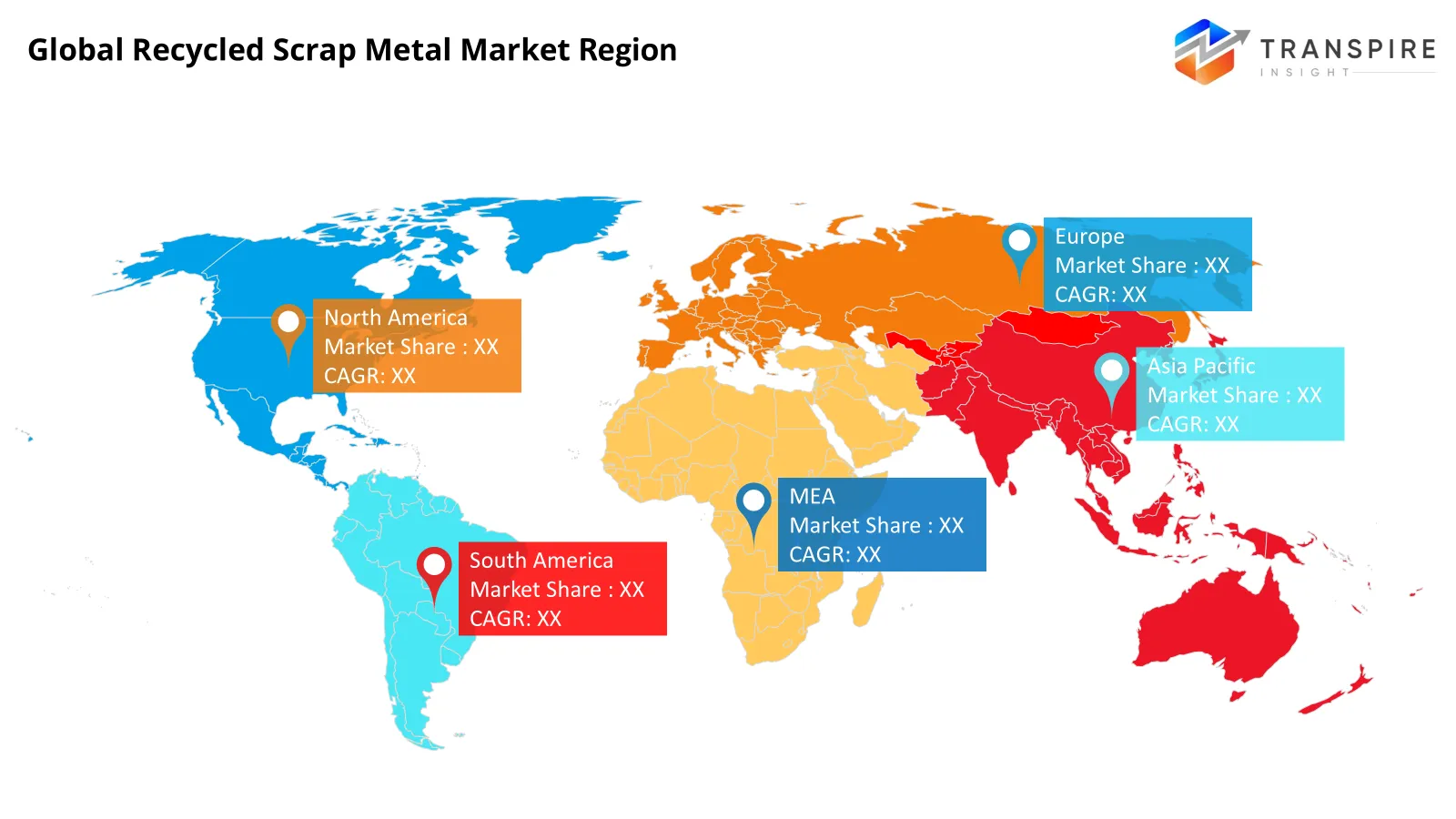
Who are the Key Players in the Global Recycled Scrap Metal Market and how do they compete?
The focus of the competition is shifting from scale to processing effectiveness, quality of output streams, digital recycling, and regional collection systems. Firms are competing on technology gains, integrated operations, and specific recovery skills tailored to various industrial customers.
Sims Metal Management underscores the importance of logical sorting and global collection infrastructure, whereas Commercial Metals Company combines recycling with electric-arc steel manufacturing to achieve cost savings. Nucor Corporation enhances captive scrap sourcing through vertical integration, and Schnitzer Steel Industries utilises high-capacity sorting and processing lines to optimise the recovery of scrap metals. European Metal Recycling concentrates on effective environmental standards, while OmniSource and Alter Trading boast broad supplier networks in North America.
Aurubis AG centres on premium copper recovery via metallurgical innovation. Kuusakoski Group thrives on complex industrial dismantling. ArcelorMittal uses recycled materials in its low-carbon steel plants, while SA Recycling, Chiho Environmental Group, Ferrous Processing & Trading, DJJ and ELG Haniel grow through regional acquisitions, specialist alloy recycling, digital logistics, premium-scapper-trader scrap processing for new-technology design needs.
Key Players are:
- Sims Metal Management
- Commercial Metals Company
- Nucor Corporation
- Schnitzer Steel Industries
- European Metal Recycling
- OmniSource
- Alter Trading
- Aurubis AG
- Kuusakoski Group
- ArcelorMittal
- SA Recycling
- Chiho Environmental Group
- Ferrous Processing & Trading
- DJJ
- ELG Haniel
Recent Development News
- In June 2026, MAIRE acquired a 70% controlling stake in Italian metals recycling specialist ETEK S.r.l. through its subsidiary NEXTCHEM. This acquisition allows NEXTCHEM to integrate ETEK’s advanced proprietary equipment and Top Blown Rotary Converter furnace technologies to extract high-value metals like copper, gold, and silver from industrial waste streams.
https://www.indianchemicalnews.com
- In January 2026, India's NITI Aayog launched three major policy reports focused on the circular economy. This regulatory deployment recommends the strict enhancement of the Extended Producer Responsibility (EPR) framework, establishing mandatory annual targets for scrap metal recycling and boosting formal infrastructure development for raw materials.
- In February 2026, Gravita India expanded its lead recycling capacity at its Mundra facility by 80,300 metric tons per annum. This internal funding deployment brings the facility's total processing capacity up to 145,100 metric tons per annum, optimising scrap metal logistics and raw material sourcing for key export markets.
https://investmentguruindia.com
What Strategic Insights Define the Future of the Global Recycled Scrap Metal Market?
The outlook is for highly integrated circular supply chains, with recycling becoming a strategic industry input rather than a sideline activity. Competitive advantage will be driven by digital traceability, automation, and building long-term collaborations with recyclers and manufacturer clients to offer reliable, low-carbon feedstock. Foreseeable yet less obvious risks include an increasing mismatch in processing capacity and availability of good-quality scrap, leading to increased price volatility even as recycling investments grow. New opportunities include urban mining, e-waste processing, and AI-based identification of metal scrap, unlocking more value from complex waste streams to ensure a critical mineral supply. Business should focus on investments in intelligent sorting systems, regional collection networks, and digital platforms, creating transparent trading ecosystems. Today, establishing resilient procurement ecosystems should enable market participants to profit from mounting regulation and rising industrial decarbonization in the decade ahead.
Key Segmentations are:
By Metal Type
- Ferrous Scrap
- Non-Ferrous Scrap
- Aluminum Scrap
- Copper Scrap
- Stainless Steel Scrap
- Brass Scrap
- Lead Scrap
- Others
By Source
- Industrial Scrap
- Construction Scrap
- Automotive Scrap
- Consumer Appliances
- Shipbreaking
- Electronic Waste
- Municipal Scrap
- Others
By Processing Method
- Shredding
- Baling
- Shearing
- Sorting
- Melting
- Granulation
- Compaction
- Others
By End User
- Steel Industry
- Foundries
- Automotive
- Construction
- Aerospace
- Electronics
- Packaging
- Others
By Distribution Channel
- Direct Supply
- Scrap Dealers
- Recycling Centers
- Online Trading Platforms
- Exporters
- Importers
- Auction Platforms
- Others
Regional Outlook
North America
- United States
- Canada
- Mexico
Europe
- Germany
- United Kingdom
- France
- Spain
- Italy
- Rest of Europe
Asia Pacific
- Japan
- China
- Australia & New Zealand
- South Korea
- India
- Rest of Asia Pacific
South America
- Brazil
- Argentina
- Rest of South America
Middle East & Africa
- Saudi Arabia
- United Arab Emirates
- South Africa
- Rest of the Middle East & Africa
Frequently Asked Questions
Find quick answers to common questions.
The Global Recycled Scrap Metal Market size was valued at USD 75.39 Billion in 2025 and is poised to reach USD 113.98 Billion by 2033, expanding at a 5.30% CAGR.
Key segments for the Global Recycled Scrap Metal Market are By Metal Type (Ferrous Scrap, Non-Ferrous Scrap, Aluminum Scrap, Copper Scrap, Stainless Steel Scrap, Brass Scrap, Lead Scrap, Others); By Source (Industrial Scrap, Construction Scrap, Automotive Scrap, Consumer Appliances, Shipbreaking, Electronic Waste, Municipal Scrap, Others); By Processing Method (Shredding, Baling, Shearing, Sorting, Melting, Granulation, Compaction, Others); By End User (Steel Industry, Foundries, Automotive, Construction, Aerospace, Electronics, Packaging, Others); By Distribution Channel (Direct Supply, Scrap Dealers, Recycling Centers, Online Trading Platforms, Exporters, Importers, Auction Platforms, Others).
Growth is primarily driven by the mandatory industry-wide transition to "green steel" production via Electric Arc Furnaces (EAF), rising raw material costs, and aggressive circular economy regulations that prioritise the use of sustainable, low-carbon recycled feedstocks over virgin ore.
The Global Recycled Scrap Metal Market is led by major manufacturers, including Sims Metal Management, Commercial Metals Company, Nucor Corporation, Schnitzer Steel Industries, European Metal Recycling, OmniSource, Alter Trading, Aurubis AG, Kuusakoski Group, ArcelorMittal, SA Recycling, Chiho Environmental Group, Ferrous Processing & Trading, DJJ, and ELG Haniel.
Asia Pacific, holding a dominant 42% market share, influences global dynamics through rapid urbanisation and centralized industrial infrastructure that ensure a massive, high-volume supply of scrap to satisfy the region's intense manufacturing and construction output.
Commercial opportunities include deploying AI-integrated automated sorting technologies to achieve high-purity alloy separation, developing specialised "urban mining" infrastructure to extract rare earth metals from e-waste, and securing long-term circular supply contracts with electric vehicle and aerospace OEMs.
- Sims Metal Management
- Commercial Metals Company
- Nucor Corporation
- Schnitzer Steel Industries
- European Metal Recycling
- OmniSource
- Alter Trading
- Aurubis AG
- Kuusakoski Group
- ArcelorMittal
- SA Recycling
- Chiho Environmental Group
- Ferrous Processing & Trading
- DJJ
- ELG Haniel
About the Authors

Pankaj Ghogare Patil
I am Pankaj Ghogare Patil, a Senior Research Analyst at Transpire Insight, specializing in the Pharmaceutical, Chemicals & Materials, Healthcare IT, and Biotechnology industry. My expertise lies in conducting comprehensive market research, analyzing industry trends, evaluating competitive landscapes, and translating complex data into actionable insights. At Transpire Insight, I closely follow emerging technologies, regulatory developments, and market innovations to create accurate, well-researched, and informative content that helps businesses and professionals make informed decisions. I am committed to producing credible, evidence-based articles that reflect industry best practices while making technical topics accessible and valuable for a broad audience.

Chakradhar Khansole
Chakradhar serves as the Research Director at Transpire Insight, bringing over 8 years of experience in technology, innovation, and strategic market intelligence. He specializes in transforming complex market data into actionable business insights that enable organizations to make informed, growth-oriented decisions. Recognized for his strategic vision and analytical expertise, Chakradhar leads high-impact research initiatives, delivering comprehensive market assessments, competitive intelligence, and forward-looking industry analysis.
Recently Published Reports
-
May 2026
Healthcare Polymer Packaging Market
Healthcare Polymer Packaging Market Size, Share & Analysis Report By Packaging Type (Syringes, IV Bottles and Pouches, Clamshells, Blisters, Bottles & Jars, Containers, Tubes, IV Parental Packaging, Others), By Type (Regulated, Non-regulated), By Polymer Type (LDPE (Low-Density Polyethylene), HDPE (High-Density Polyethylene), Homo-polymer (Homo), Random Copolymer (Random), Block Copolymer (Block), PET, Polystyrene, Polyvinyl Chloride, Polyamide/EVOH, Others), and Geography (North America, Europe, Asia-Pacific, Middle East and Africa, South and Central America), 2021 - 2031
-
Apr 2026
Hydrophilic Tape (Waterstop) Market
Hydrophilic Tape (Waterstop) Market Size, Share & Analysis Report By Type (Bentonite-Based Hydrophilic Tape, Rubber-Based Hydrophilic Tape), By Application (Residential Buildings, Commercial Buildings, Infrastructure Projects), and Geography (North America, Europe, Asia-Pacific, Middle East and Africa, South and Central America), 2021 - 2031
-
Apr 2026
Metalens Market
Metalens Market Size, Share & Analysis Report By Type (Visible Light Metalens, and Infrared Metalens), By Application (Consumer Electronics, Automotive Electronics, Industrial, Medical, and Others), and Geography (North America, Europe, Asia-Pacific, Middle East and Africa, South and Central America), 2021 - 2031
-
Apr 2026
PBT Resin Market
PBT Resin Market Size, Share & Analysis Report By Type (Reinforced PBT Resin, Unreinforced PBT Resin), By Processing Method (Injection Molding, Extrusion, Blow Molding, Others), By End-User (Automotive, Electrical & Electronics, Consumer Appliances, Industrial Machinery, Medical Devices, Packaging, Others), and Geography (North America, Europe, Asia-Pacific, Middle East and Africa, South and Central America), 2021 - 2031