
Global Lithium Sulfur Battery Market Size & Forecast:
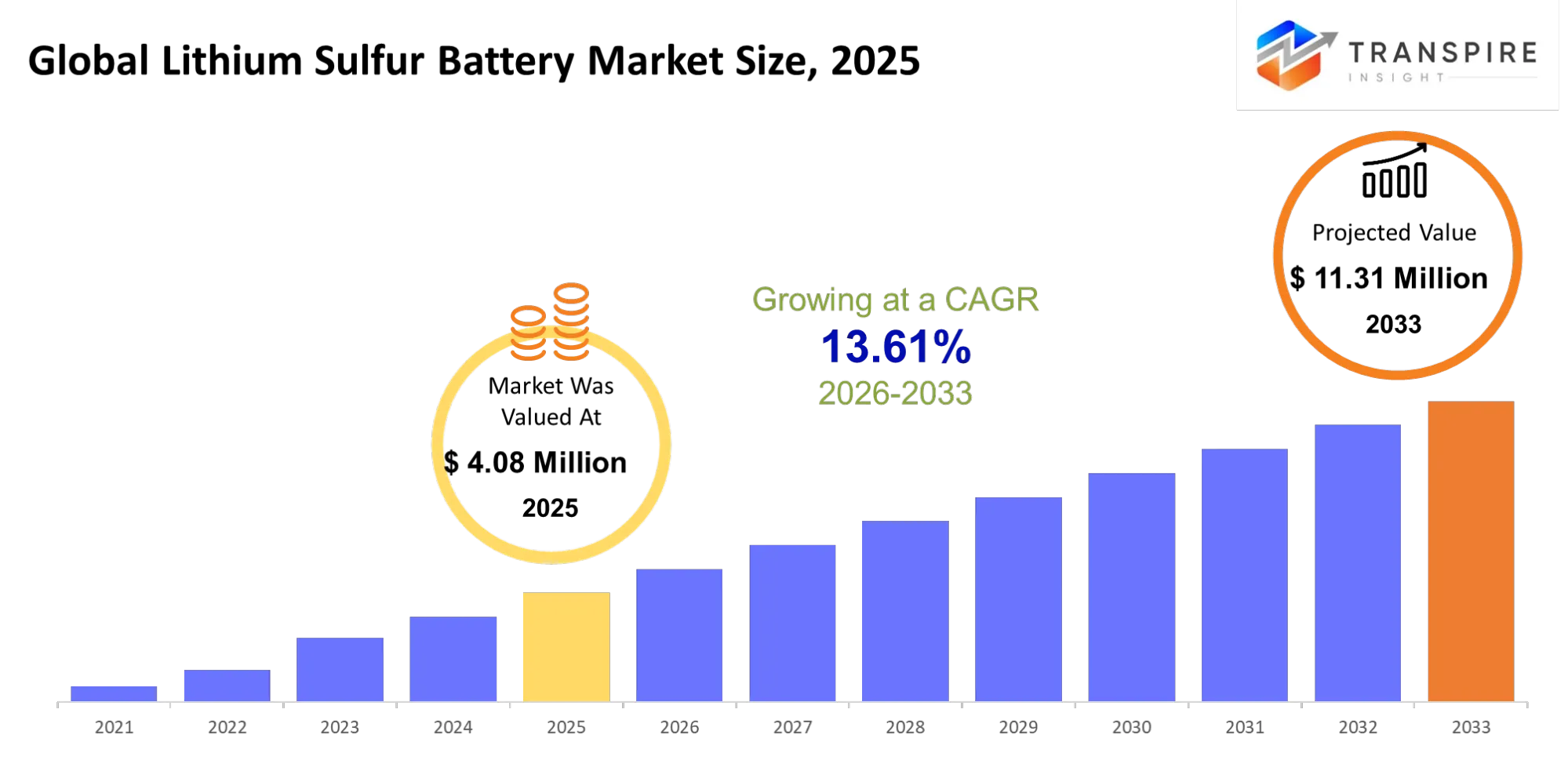
- Global Lithium Sulfur Battery Market Size 2025: USD 4.08 Million
- Global Lithium Sulfur Battery Market Size 2033: USD 11.31 Million
- Global Lithium Sulfur Battery Market CAGR: 13.61%
- Global Lithium Sulfur Battery Market Segments: By Product (High Energy Density Batteries, Solid-State Li-S Batteries, Rechargeable Li-S Batteries, Primary Li-S Batteries, Flexible Batteries, Modular Batteries, Others); By Application (Electric Vehicles, Aerospace & Defense, Consumer Electronics, Energy Storage Systems, Drones, Marine, Others); By End User (Automotive, Aerospace, Electronics, Utilities, Defense, Industrial, Others); By Technology (Conventional Li-S, Solid-State, Nanomaterial-based, Advanced Electrolytes, Others); By Capacity (Below 500 mAh, 500–1000 mAh, Above 1000 mAh, Others
Global Lithium Sulfur Battery Market Summary:
As per Transpire Insight Analysis, the Global Lithium Sulfur Battery Market size is estimated at USD 4.08 Million in 2025 and is anticipated to reach USD 11.31 million by 2033, growing at a CAGR of 13.61% from 2026 to 2033.
The global lithium sulfur battery market is changing. It is moving from tests in labs to being used in real life. This is because companies are looking for batteries that can store a lot of energy and do not cost much to make. Over the past few years, people have been investing more in new battery technology. The government is also helping by supporting energy programs and working with companies to do more research. This has helped to make products faster. The lithium sulfur battery market is also getting a boost from people wanting to use cars and planes. It is also being used to store energy for a time. In these cases, batteries that are light and can work for a time are very useful.
There is a change happening in the industry. Companies are moving away from the kind of lithium-ion batteries. They are starting to use lithium sulfur and solid-state batteries instead. These new batteries work better. Are more environmentally friendly. The fact that more electric cars are being made and renewable energy projects are being started has increased the demand for batteries that can store a lot of energy. As companies make batteries that last longer and charge faster, lithium sulfur batteries are becoming an option for real-life uses. This is creating opportunities for growth in many areas, including transportation, defence, consumer electronics and storing energy on a big scale, with lithium sulfur batteries.
Key Market Insights
The global lithium sulfur batteries market is transitioning from research-driven development to commercialisation, with companies concentrating on improving the performance, reliability, and manufacturing of these batteries. Constant technological advancements, investments made into energy storage technology, and increasing applications are impacting the market competition.
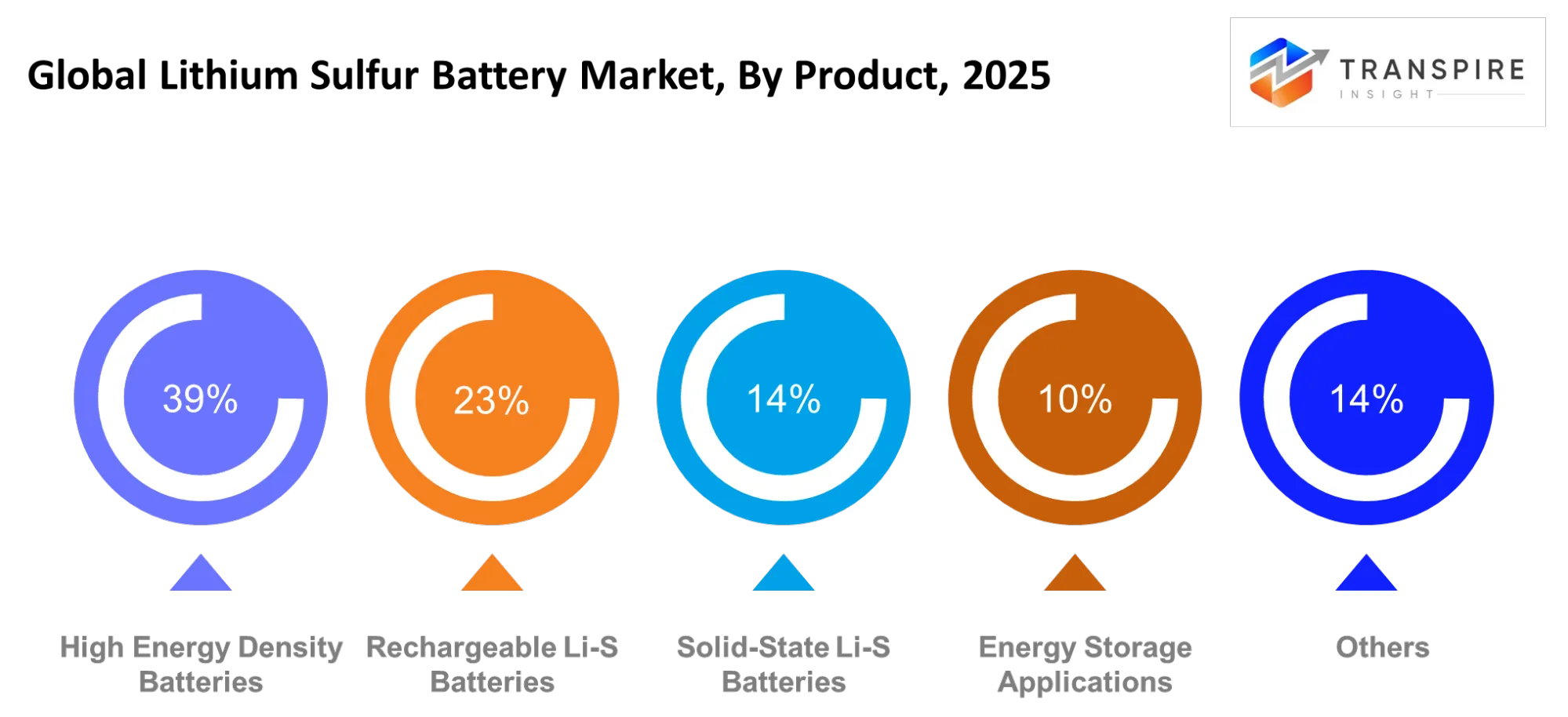
- High Energy Density Batteries have a 39% market share due to the increasing demand from applications in electric vehicles and aerospace, where light but powerful batteries are needed.
- Rechargeable Lithium Sulfur Batteries have 23% market share, with the industry shifting towards rechargeable batteries able to ensure extended cycles of operation.
- Solid-State Lithium Sulfur Batteries occupy 14% of the total market, due to improvements made in their safety, thermal management, and next-generation battery technology.
- Energy Storage Applications make up for 10% of the total market demand due to the increasing demand for renewable energy storage systems.
- Battery manufacturers are intensively working with advanced cathodes, electrolytes, and production methods to commercialise these batteries.
- Strategic alliances between battery manufacturers, automotive players, and research organisations are helping advance the products and accelerate the development.
- Companies in the lithium sulfur batteries market put a stronger focus on increasing battery longevity and charging efficiency.
What are the Key Drivers, Restraints, and Opportunities in the Global Lithium Sulfur Battery Market?
Drivers
Growth of the lithium sulfur battery market on the global level is being driven by an increasing demand for lighter and energy-dense batteries in the aerospace, military, electric vehicle, and renewable energy industry segments. The lithium sulfur battery is an alternative to traditional lithium-ion batteries, allowing the use of sulfur – a more common and cheaper material – that can deliver higher energy density batteries. Investment in next-generation battery technology, pilot plants, and government initiatives related to green energy projects contributed to the fast development of products. As cycle life and other characteristics of batteries are improved, the adoption of this new battery type becomes wider in applications where longer driving range and lower battery weight play the main role in customers' purchasing decision-making.
Restraints
Although this product holds great potential, there are several technical and business limitations in terms of successful implementation. Poor cycle stability, capacity loss during cycling, and the polysulfide shuttle effect limit further commercialisation of batteries. Moreover, the process of producing batteries is still under development, making production more expensive compared to the mature lithium-ion technology.
Opportunities
Continuous innovations in solid-state lithium-sulfur batteries, advanced electrolytes, and nanomaterial-based electrodes offer immense growth opportunities. Cooperation between battery suppliers, automobile companies, universities, and research institutions is likely to expedite the commercialisation process. In view of the growing global scope of electric mobility, aviation electrification, and renewable energy storage initiatives, lithium-sulfur batteries appear ready for an important share in future energy storage technologies.
What has the Impact of Artificial Intelligence Been on the global lithium-sulfur battery market?
Artificial intelligence is becoming increasingly significant in propelling the development of the international lithium sulfur battery market by refining the research process, manufacturing procedure, and battery management. The use of AI to analyse data enables scientists to test several material combinations within a shorter period, which leads to the identification of better sulfur cathodes, electrolytes, and protective coatings for efficient batteries.
As for the manufacturing process, artificial intelligence is used for automating production to achieve greater consistency through parameter monitoring, defect detection, and optimisation of assembly procedures. Manufacturers are also utilising machine learning for the purposes of quality control, which helps in minimising waste of material resources, increasing the yield rate and ensuring consistent battery performance. At the level of applications, AI-powered battery management systems help in monitoring charging procedures, temperature, and battery performance. However, despite these strengths, the use of AI comes with practical difficulties. The implementation of sophisticated AI systems calls for considerable financial input to build necessary digital infrastructure, train experts, and acquire quality data for analysis. Moreover, accurate predictions rely on the presence of quality data, which is limited in the case of the latest lithium sulfur batteries. With increased commercialisation and the availability of more data on battery performance, AI will play a vital role in optimising batteries. In January 2024, a collaboration between Microsoft and the Pacific Northwest National Laboratory (PNNL) on a long-term partnership that will harness the power of AI and HPC for advancing battery materials discovery, including materials suitable for lithium-sulfur batteries, drastically cuts down on research and development times associated with battery material innovations.
Key Market Trends:
The global lithium sulfur battery market is seeing a shift from a research-based innovation process toward commercial-level innovation fueled by developments in battery science, fabrication methods, and the growing number of industries utilising such technology. The continuous investment in energy-efficient storage systems encourages manufacturers to enhance battery longevity, reliability, and efficiency.
- The battery industry is moving from laboratory trials toward pilot plant operations to boost the commercial potential of the lithium sulfur battery technology.
- Increasing importance is placed on the enhancement of battery cycle life thanks to the implementation of innovative cathode materials, electrolytes, and protective coatings in the manufacturing process.
- Research and investments in solid-state lithium sulfur batteries are growing due to better safety levels, higher energy density, and increased thermal stability.
- Manufacturers of automobiles are intensifying their cooperation with the producers of battery technology to develop lightweight batteries allowing electric cars to travel farther distances.
- The demand for lightweight power systems for aircraft, satellites, and unmanned aerial vehicles drives the usage of lithium sulfur batteries in aerospace and defence sectors.
- Artificial Intelligence and digital manufacturing technology are becoming increasingly popular in battery research and production.
Global Lithium Sulfur Battery Market Segmentation
By Product
High Energy Density Batteries have a share of 39%, representing the largest segment of the global market for lithium sulfur batteries due to their high energy storage capability, while making batteries lightweight. These batteries are extensively used in electric vehicles, aerospace, and defence applications, as higher energy generation is highly required in such applications. The share of the Rechargeable Li-S Batteries segment is 23%, as rechargeability is sought after in industries to facilitate sustainable operations and lower maintenance costs. The Solid-State Li-S Batteries have a share of 14%, which is predicted to grow at the fastest pace owing to enhanced battery safety, longevity, and efficiency.
By Application
Electric vehicles continue to lead all the application sectors since automobile companies are trying to maximise the range of the vehicles while minimising their weight. Aerospace and defence sectors are making greater use of lithium sulfur batteries due to their high energy density and lightness for satellites, planes, and unmanned aerial systems. The consumer electronics industry is also developing interest in this technology, as it would make the batteries last longer in smaller gadgets. On the other hand, Energy Storage Applications account for 10% of the market as more effort is made in integrating renewable energies into the grids.
By End Users
The automotive industry comprises the biggest end user group owing to the rapid growth of electric vehicles and new generation vehicles. Lithium-sulfur batteries are being increasingly used by aerospace companies to enhance aircraft efficiency and lower the weight of the system. Electronic companies have started using lithium-sulfur batteries as a result of the growing consumer demand for portable electronic products with high energy density and lightweight. Utilities are exploring these batteries for their use in renewable energy storage systems, whereas the defence industry is attracted by their high energy density feature.
By Technology
The conventional lithium sulfur batteries currently have considerable market presence owing to the well-established base of their research, along with their commercialisation process. Nonetheless, there is an increasing trend toward solid-state batteries because manufacturers seek to ensure the safety, heat resistance, and longevity of the product. The nanomaterial batteries improve the performance and conductivity of electrodes, while the improved electrolyte technologies decrease the capacity loss and increase the life of the batteries. Innovation in this field will allow to increase in the commercial success of the batteries in question in the following years.
By Capacity
The batteries of 1000 mAh or more are in high demand for use in electric cars, aircraft, and stationary energy storage systems for their extended operating period. The batteries between 500 and 1000 mAh can be used in a variety of industrial machines and household electronics as a compromise between energy capacity and the size of the batteries. The batteries under 500 mAh can be effectively applied in the portable devices and electronics industry.
What are the Key Use Cases Driving the Global Lithium Sulfur Battery Market?
High energy density batteries are mainly employed in electric cars, wherein minimising the weight of batteries along with extending the driving distance becomes an important target. The automotive industry is moving towards the use of lithium-sulfur batteries to enhance the efficiency of its vehicles and also to achieve next-generation electric mobility.
Apart from being employed in the transport sector, lithium-sulfur batteries are being used in aerospace and defence sectors, such as satellites, UAVs, and other military devices that need lightweight power sources along with high energy output. The technology is also being utilised in energy storage sectors, which account for 10% of market consumption. The new application areas include consumer electronic devices, marine systems, industrial machinery, and next-generation drone platforms. Continued enhancements in the technologies of rechargeable and solid-state lithium-sulfur batteries would enable further commercial success.
|
Report Metrics |
Details |
|
Market size value in 2025 |
USD 4.08 million |
|
Market size value in 2026 |
USD 4.63 million |
|
Revenue forecast in 2033 |
USD 11.31 million |
|
Growth rate |
CAGR of 13.61% from 2026 to 2033 |
|
Base year |
2025 |
|
Historical data |
2021 - 2024 |
|
Forecast period |
2026 - 2033 |
|
Report coverage |
Revenue forecast, competitive landscape, growth factors, and trends |
|
Regional scope |
United States; Canada; Mexico; United Kingdom; Germany; France; Italy; Spain; Denmark; Sweden; Norway; China; Japan; India; Australia; South Korea; Thailand; Brazil; Argentina; South Africa; Saudi Arabia; United Arab Emirates |
|
Key company profiled |
Lyten, OXIS Energy, Sion Power, PolyPlus Battery, NexTech Batteries, LG Energy Solution, Samsung SDI, Panasonic, CATL, Saft, Gelion Technologies, Zeta Energy, Johnson Matthey, Airbus, BASF |
|
Customization scope |
Free report customization (country, regional & segment scope). Avail customized purchase options to meet your exact research needs. |
|
Report Segmentation |
By Product (High Energy Density Batteries, Solid-State Li-S Batteries, Rechargeable Li-S Batteries, Primary Li-S Batteries, Flexible Batteries, Modular Batteries, Others); By Application (Electric Vehicles, Aerospace & Defense, Consumer Electronics, Energy Storage Systems, Drones, Marine, Others); By End User (Automotive, Aerospace, Electronics, Utilities, Defense, Industrial, Others); By Technology (Conventional Li-S, Solid-State, Nanomaterial-based, Advanced Electrolytes, Others); By Capacity (Below 500 mAh, 500–1000 mAh, Above 1000 mAh, Others) |
Which Regions are Driving the Global Lithium Sulfur Battery Market Growth?
North America
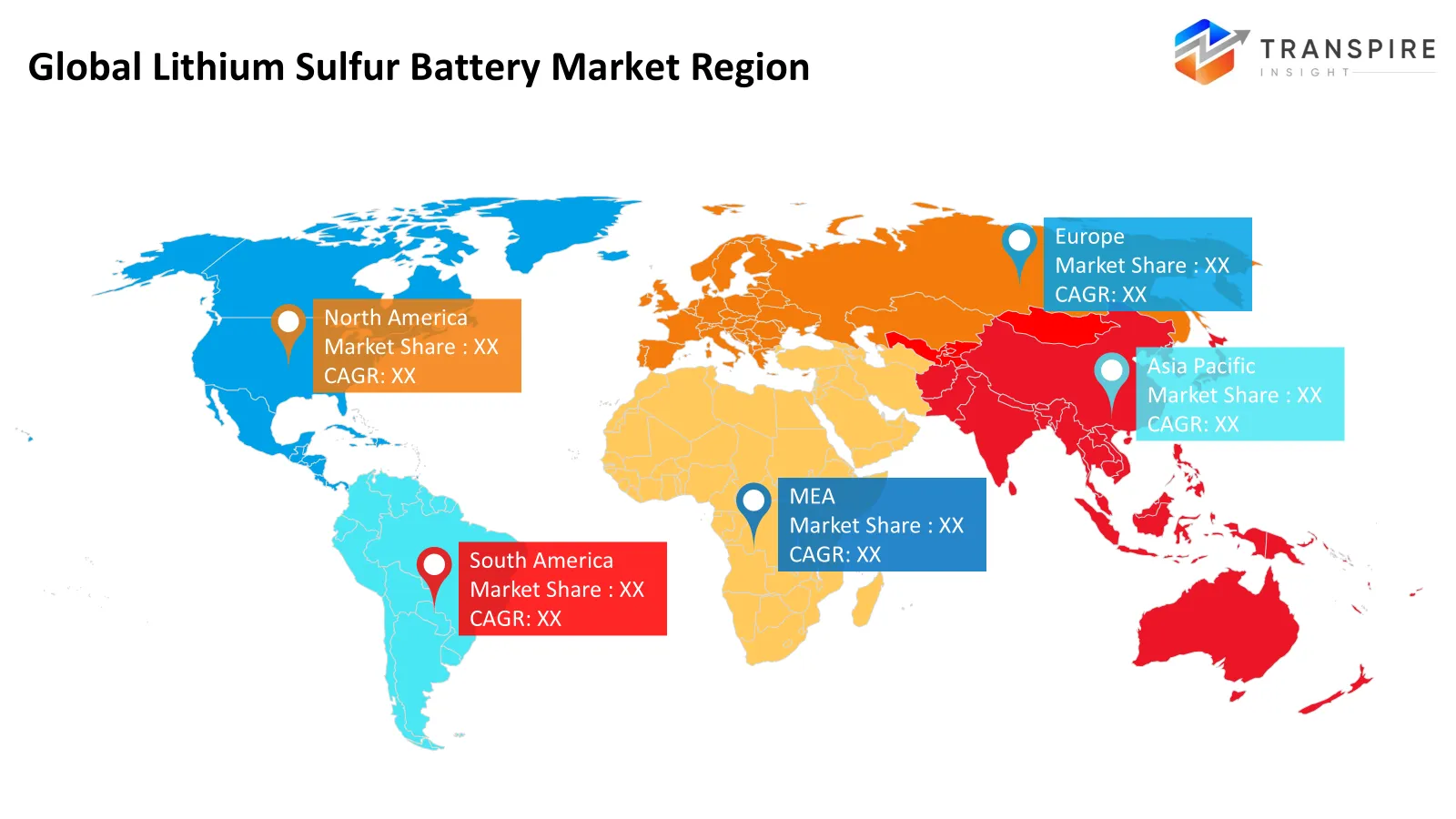
North America represents 36% of the world market share of the lithium sulfur battery market and leads all regions in this regard. This region is dominant due to heavy investments made in battery research, a robust electric vehicle industry, and leading aerospace and defence companies in the region. Continued government funding for clean energy technologies and collaborations between institutions and battery developers are further fueling innovation and early-stage commercialisation.In September 2024, Lyten revealed that their lithium-sulfur battery cells have been chosen by the Defense Innovation Unit (DIU), U.S., for demonstration on board the International Space Station, underlining North America’s supremacy in advanced lithium-sulfur battery innovations and aerospace uses.
Europe
The second biggest market share is held by Europe at 22%. The region continues to grow due to its bold carbon emission reduction plans, stringent environmental policies, and efforts to promote electric mobility. Compared to North America, the region focuses more on sustainable production, battery recycling, and developing regional supply chains.
Asia Pacific
The Asia Pacific region constitutes 31% of the world market and is expected to witness the highest growth rate at a CAGR of 24.1%. The factors that fuel the growth in this region include high production of electric vehicles, increasing investments in battery production, and the increasing use of renewable sources of energy. Nations like China, Japan, and South Korea are improving their production capacity and technology innovation, which offer great prospects for the commercialisation of lithium sulfur batteries.
Who are the Key Players in the Global Lithium Sulfur Battery Marketand how do they Compete?
Competition in the international market of lithium sulfur batteries focuses on technology innovations, material advancements, and partnerships to accelerate the commercialisation of the products. Instead of competing through large-scale manufacturing capacity alone, companies are now focusing on improving battery technology, energy density, longevity, and manufacturing technology that enables scaling production. Partnership with automobile, aerospace, and research organisations is one of the strategies used by the companies to improve their market positions.
Organisations such as Lyten, Theion, Sion Power, OXIS Energy (inherited technology), and Gelion Technologies distinguish themselves from other competitors by introducing advanced battery designs and conducting research about cathode and electrolyte technologies. These companies are concentrating on solving technical problems related to cycle stability and longevity while providing lightweight and advanced battery solutions for electric vehicles, aerospace, and defence sectors. Most of them are increasing IP portfolios and cooperating with research organisations to speed up their product developments. Well-established producers of batteries and technology development companies partner with automobile manufacturers, universities, and government-backed research organisations for the development of lithium sulfur batteries in order to approach their commercialisation.
Global Lithium Sulfur Battery Market Companies
- Lyten
- OXIS Energ
- Sion Power
- PolyPlus BatteryN
- NexTech Batteries
- LG Energy Solution
- Samsung SDI
- Panasonic
- CATL
- Saft
- Gelion Technologies
- Zeta Energy
- Johnson Matthey
- Airbus
- BASF
Recent Development News
In February 2026, Lyten concluded the purchase of Northvolt's Swedish battery manufacturing facility. With this acquisition, Lyten's manufacturing operations will have expanded in Europe, and the company can further pursue the commercialisation of lithium-sulfur batteries in energy storage, defence, and future automotive applications.
In April 2025, Lyten commenced manufacturing of battery-grade lithium metal at U.S. facilities for lithium-sulfur batteries. Manufacturing of lithium metal is another step in Lyten's vertical integration, supply chain security, and commercialisation of lithium
What Strategic Insights Define the Future of the Global Lithium Sulfur Battery Market?
The global lithium sulfur battery market is heading towards its early commercialisation stage, where higher energy densities, lightweight batteries and efficient material choices for electric vehicles, air crafts, defence industry and stationary energy storage are in focus. Further investments into advanced battery technologies, production facilities, and collaboration will drive the transition from research to large-scale manufacture. The growing need for grid-scale energy storage, along with the demand for electric transportation, creates extra opportunities for lithium sulfur batteries. The hidden threat is the ability of the industry to deliver reliable and consistent large-scale production while facing difficulties with cycle life, polysulfide shuttle effect and scalability. Failure to solve these problems will lead to delayed commercialisation despite all market interests.
One of the great opportunities is the creation of solid-state lithium sulfur batteries, artificial intelligence battery design and innovative materials for electrodes. It will be important for the companies to focus on scalable production technologies, research collaborations and application areas other than electric vehicles.
Global Lithium Sulfur Battery Market Segmentation
By Product
- High Energy Density Batteries,
- Solid-State Li-S Batteries
- Rechargeable Li-S Batteries
- Primary Li-S Batteries
- Flexible Batteries
- Modular Batteries
By Application
- Electric Vehicles
- Aerospace & Defense
- Consumer Electronics
- Energy Storage Systems,
- Drones
- Marine
By End User
- Automotive
- Aerospace
- Electronics
- Utilities
- Defense
- Industrial
By Technolog
- Conventional Li-S
- Solid-State
- Nanomaterial-based
- Advanced Electrolytes
By Capacity
- Below 500 mAh
- 500–1000 mAh
- Above 1000 mAh
By Regional Analysis
North America
- United States
- Canada
- Mexico
Europe
- Germany
- United Kingdom
- France
- Italy
- Spain
- Russia
- Rest of Europe
Asia Pacific
- China
- Japan
- India
- South Korea
- Australia
- Rest of Asia Pacific
South America
- Brazil
- Argentina
- Rest of South America
Middle East & Africa
- Saudi Arabia
- United Arab Emirates
- Qatar
- South Africa
- Rest of the Middle East & Africa
Frequently Asked Questions
Find quick answers to common questions.
The global lithium sulfur battery market size was valued at USD 4.08 million in 2025 and is poised to reach USD 11.31 million by 2033, expanding at a 13.61%CAGR.
Key segments for the global lithium sulfur battery market are By Product (High Energy Density Batteries, Solid-State Li-S Batteries, Rechargeable Li-S Batteries, Primary Li-S Batteries, Flexible Batteries, Modular Batteries, Others); By Application (Electric Vehicles, Aerospace & Defense, Consumer Electronics, Energy Storage Systems, Drones, Marine, Others); By End User (Automotive, Aerospace, Electronics, Utilities, Defense, Industrial, Others); By Technology (Conventional Li-S, Solid-State, Nanomaterial-based, Advanced Electrolytes, Others); By Capacity (Below 500 mAh, 500–1000 mAh, Above 1000 mAh, Others).
Growth is primarily driven by the growth in the market can be attributed to the rising demand for high-energy-density batteries in EVs, investment in research & development for battery technology, installation of energy storage systems for renewable energy generation, and lightweight batteries for aerospace & defence applications.
The global market is led by major manufacturers including Lyten, OXIS Energy, Sion Power, PolyPlus Battery, NexTech Batteries, LG Energy Solution, Samsung SDI, Panasonic, CATL, Saft, Gelion Technologies, Zeta Energy, Johnson Matthey, Airbus, BASF.
North America makes up 36% of the total market for lithium-sulfur batteries worldwide due to significant spending on research in battery technology, military and aerospace usage, use in electric vehicles, and being home to key companies and centres of research.
- Lyten
- OXIS Energ
- Sion Power
- PolyPlus BatteryN
- NexTech Batteries
- LG Energy Solution
- Samsung SDI
- Panasonic
- CATL
- Saft
- Gelion Technologies
- Zeta Energy
- Johnson Matthey
- Airbus
- BASF
About the Authors

Avinash Kumar
I’m Avinash Kumar, a Senior Research Analyst at Transpire Insight, with expertise in the Electronics and Semiconductor and Energy & Power industry. My work focuses on analyzing emerging technologies, market trends, industry developments, and innovation across these sectors. I specialize in transforming complex technical and market insights into clear, research-backed content that helps professionals, businesses, and decision-makers stay informed. Through continuous industry research and data-driven analysis, I strive to deliver accurate, reliable, and practical perspectives on the latest advancements shaping the semiconductor and energy landscape.

Chakradhar Khansole
Chakradhar serves as the Research Director at Transpire Insight, bringing over 8 years of experience in technology, innovation, and strategic market intelligence. He specializes in transforming complex market data into actionable business insights that enable organizations to make informed, growth-oriented decisions. Recognized for his strategic vision and analytical expertise, Chakradhar leads high-impact research initiatives, delivering comprehensive market assessments, competitive intelligence, and forward-looking industry analysis.
Recently Published Reports
-
Apr 2026
Fiber Optic Faceplates Market
Fiber Optic Faceplates Market Size, Share & Analysis Report By Type (< 300 mm2, 300-350 mm2, and > 350 mm2, By Application (Night Vision, Holographic Imaging, Medical, and Others), and Geography (North America, Europe, Asia-Pacific, Middle East and Africa, South and Central America), 2021 - 2031
-
Apr 2026
High Temperature Superconductors Market
High Temperature Superconductors Market Size, Share & Analysis Report By Type (1G HTS, and 2G HTS), By Application (Power Cable, Fault Current Limiter, and Transformer), and Geography (North America, Europe, Asia-Pacific, Middle East and Africa, South and Central America), 2021 - 2031
-
Apr 2026
Industrial Plugs and Socket Market
Industrial Plugs and Socket Market Size, Share & Analysis Report By Type (Industrial Plugs, Industrial Sockets), By Current (Up to 32 A, 32 to 125 A, Above 125 A), By Protection (Dustproof and Splash Proof, Waterproof, Explosion Proof), By End User (Heavy Industries, Oil and Gas, Chemicals and Pharmaceuticals, Power Generation, Others), and Geography (North America, Europe, Asia-Pacific, Middle East and Africa, South and Central America), 2021 - 2031
-
Apr 2026
InGaAs Avalanche Photodiodes Market
InGaAs Avalanche Photodiodes Market Size, Share & Analysis Report By Type (1100 - 1700 nm, and 1000 - 1600 nm), By Application (Missile Warning System, Muzzle Flash Detection, Wafer Defect Inspection, Laser Rangefinders, and Others), and Geography (North America, Europe, Asia-Pacific, Middle East and Africa, South and Central America), 2021 - 2031