

Global Label Printers Market Size & Forecast:
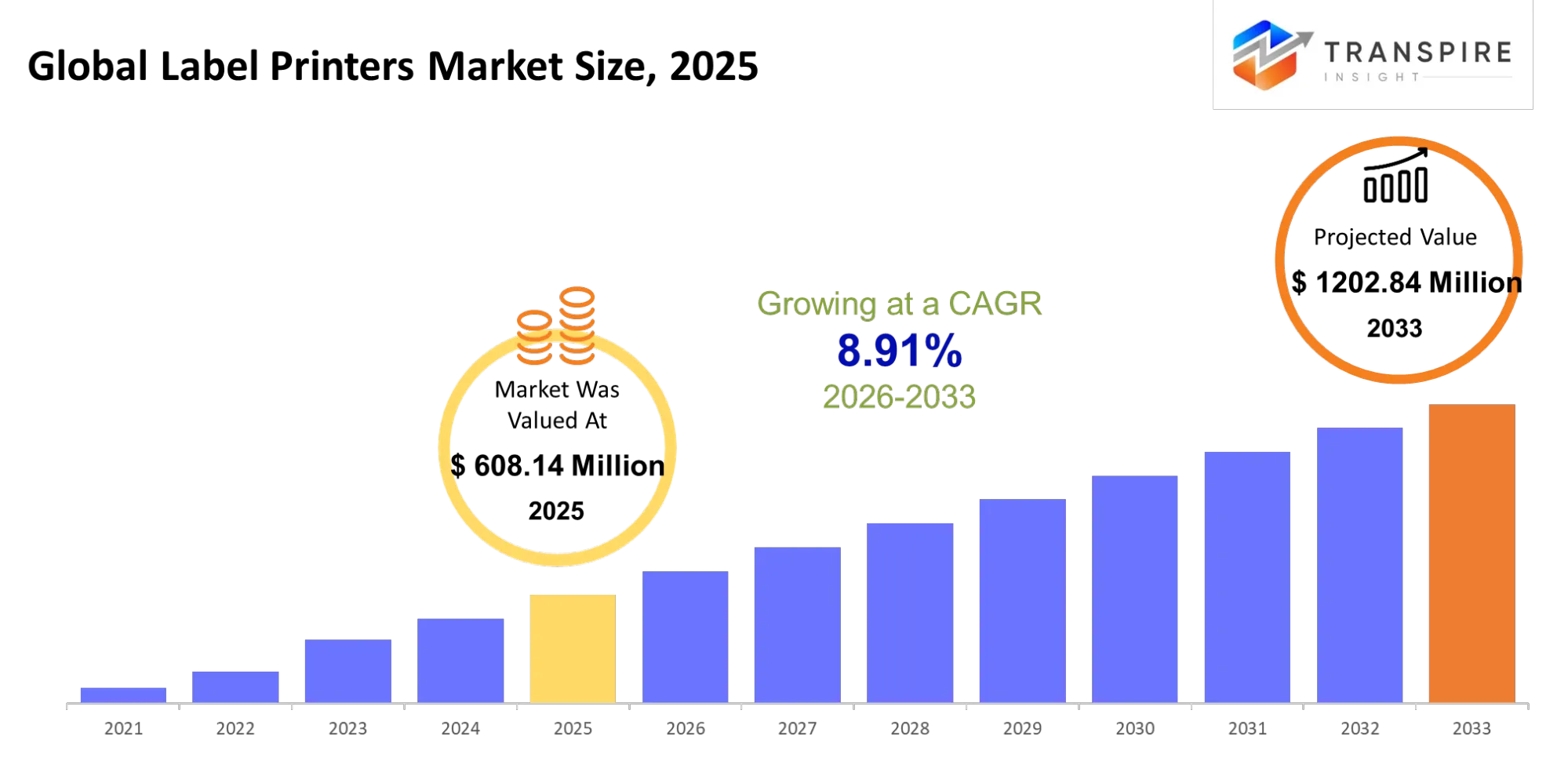
- Global Label Printers Market Size 2025: USD 608.14 Million
- Global Label Printers Market Size 2033: USD 1202.84 Million
- Global Label Printers Market CAGR: 8.91%
- Global Label Printers Market Segments: By Type (Desktop Label Printers, Industrial Label Printers, Mobile Label Printers, Thermal Label Printers, RFID Label Printers, Barcode Label Printers, Others); By Application (Retail Labeling, Logistics & Shipping, Healthcare Labeling, Industrial Labeling, Warehouse Management, Others); By End-User (Retailers, Logistics Providers, Manufacturers, Healthcare Institutions, Others); By Technology (Direct Thermal Printing, Thermal Transfer Printing, Inkjet Printing, Laser Printing, Others)
To learn more about this report,  Download Free Sample Report
Global Label Printers Market Summary:
The Global Label Printers Market size is estimated at USD 608.14 Million in 2025 and is anticipated to reach USD 1202.84 million by 2033, growing at a CAGR of8.91% from 2026 to 2033.
The Global Label Printers Market is now a part of retail, warehouse management, product tracking and industrial packaging. Many businesses in logistics, healthcare and manufacturing are using labelling systems to make operations more accurate and product identification easier. This is because online retail and distribution have grown a lot in recent years, and faster and more reliable printing solutions are needed. A major change in the market is the use of RFID-based printing systems for fast inventory tracking and automated warehouse operations.
Companies are upgrading their labelling systems because they have shipments and want to improve supply chain visibility. Mobile and wireless printing devices are also becoming more popular in warehouses and transportation, where flexibility and real-time labeling're crucial. The market is growing steadily because of investments in retail, modern logistics and industrial automation. The Global Label Printers Market growth is driven by the need for labelling systems, and label printers are becoming more widely used. Businesses are adopting label printers to streamline their operations, and label printers are supportingthe growth of industries.
Key Market Insights:
- Increased demand for fast tracking and more accurate inventory is being seen in the logistics, industrial packaging, and retail segments, driven by the desire for better efficiency. Technological advancements and upgrades are also affecting purchase decision-making in the commercial industry.
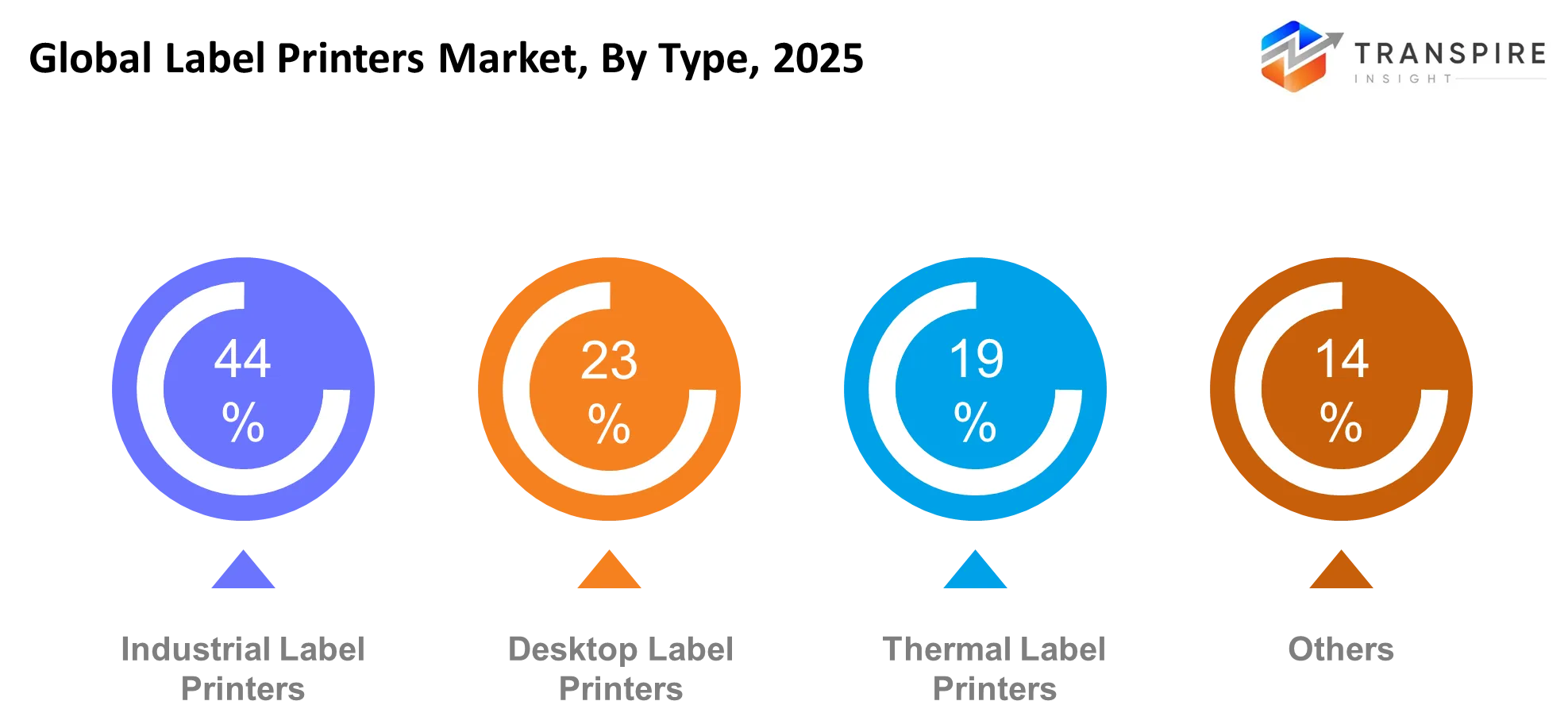
- About 44% of the label printing market consists of industrial label printers because of their heavy usage in warehouses and manufacturing units.
- An increase in RFID labels is expected at a CAGR of 11.7%, driven by the need for enhanced inventory visibility systems.
- Some 23% of the label printing market involves desktop printers due to increased adoption by retailers and office-based firms.
- Approximately 19% of the label printing market comprises thermal label printers because of their ease of use and quick print speeds.
- Zebra Technologies will continue growing in the development of industrial label printers for use in warehousing and transport.
- Brother Industries will enhance its range of wireless label printers for both commercial and retail environments.
- Hospitals and clinics are adopting the use of barcode label printing for improved patient management and medication control.
- Logistics services are using portable printing machines to increase efficiency in shipment and verification processes.
- There is increased demand for tough and fast label printers for food packaging, transport, and industrial applications.
What are the Key Drivers, Restraints, and Opportunities in the Global Label Printers Market?
Drivers
One of the leading influences driving the growth of the label printer market can be attributed to the fast development of e-commerce, along with warehousing activities. There have been increases in the volume of shipped parcels, thereby enhancing the need for barcode printers, product identification solutions, and inventory management systems. Another reason why the Global Label Printers Market is seeing a surge in demand lies in the emergence of same-day delivery services and digital supply chains.
Restraints
The market will continue experiencing difficulties relating to cost of installation and compatibility issues with existing infrastructure. More sophisticated printers especially those using RFID technology, have been noted to require installation of new software and network management services. Small-scale firms in developing countries still depend on old-fashioned printers due to limited finances and other resource-related challenges.
Opportunities
One of the major business opportunities that exist today involves intelligent connected warehouse solutions and smart infrastructure for inventory management. Companies are adopting scalable label printing technologies, which can enable them to track products on a real-time basis. North America and Asia-Pacific have started implementing RFID-enabled printing facilities, thereby presenting great growth opportunities for companies providing innovative and connected printing solutions.
What Has the Impact of Artificial Intelligence Been on the Global Label Printers Market?
The market for label printers has seen positive changes due to software integration and automation in their operation. The contemporary environment of printing now allows companies to monitor their print performance, detect maintenance needs, and enhance production precision in various industries. These advancements will contribute to lower downtimes and ensure continuity of labelling processes.
Predictive monitoring is used to assist in inventory and logistics management as it enables companies to adapt their printing demands to the movement of shipments and the level of activity in their warehouses. Barcode verification services will be useful in providing greater accuracy of product identification in the healthcare, retailing, and transportation industries.
There have been advances made in operational efficiency as well; specifically, printer management solutions now enable organisations to manage multiple printers in operational platforms. They help in cutting down on wastage, increasing efficiency, and ensuring proper workflow coordination in the warehouse environment. The problems facing such solutions are their cost and compatibility issues, especially for small enterprises. Such enterprises find it difficult to adapt to these advancements because of high costs and infrastructure limitations.
Instance
In March 2024, the enhancements in printer management through artificial intelligence by Zebra Technologies, which was launched, will enable predictive maintenance, remote monitoring, and increased accuracy in barcode verification processes.
Key Market Trends:
- The trend in the market is towards connected printers, quicker inventory scanning and tracking solutions, and mobile business solutions. The market focuses on the increasing demand for efficient operations and real-time labelling capabilities.
- Automated warehouses have started to favour industrial printing systems rather than the traditional stand-alone ones.
- An increase in RFID label printers can be seen with improved inventory scanning and tracking capabilities in place. Mobile printers are being increasingly used in logistics operations to speed up shipments.
- Thermal printers are replacing ink-based printers due to their low maintenance.
- Cloud printing solutions are increasing centralized operation controls within warehouses and retailers.
- Hospitals are utilising barcode printers for increased patient and medication traceability and identification purposes.
- Connected printer monitoring solutions are aiding businesses in improving machine performance and reducing operational disruptions.
- With rising sustainability concerns, energy-efficient and linerless label printing solutions have been favoured.
- Small and portable desktop printers are gaining popularity amongst retailers and small businesses.
- Warehouse management system integration with label printing solutions is increasing within logistics operations.
Global Label Printers Market Segmentation
By Type
The industrial label printers are leading the market with a market share of 44% due to the increasing demand from warehouses, manufacturing plants, and logistics centres. Industrial printers are considered preferable for bulk printing applications. The desktop label printers occupy a market share of 23% and have been extensively used in retail stores and offices as they are smaller in size and also reasonably priced. The thermal label printers account for 19% of the total market, as companies tend to look for fast printers that do not require much maintenance in case of printing barcodes. The RFID label printers are expected to have the highest CAGR of 11.7%, driven by the need for inventory control and monitoring systems in warehouses.
To learn more about this report, Download Free Sample Report
By Application
Logistics and transportation are still dominating the application categories due to expanding warehouse activities and more shipments. The use of label printing machines continues to increase for such purposes as barcode printing, shipping labelling, and inventory control. Retail labelling applications continue to play an important role since retailers have to manage their inventories, price labels, and organise products. Medical labelling continues to be in demand since it is becoming increasingly used for patient identification, drug packaging, and laboratory tracking.
By End User
Label printer manufacturers still form a large base of end users, owing to their ongoing use of printers for labelling purposes. Logistics service providers are increasingly adopting industrial printers and mobile printing technology to facilitate shipping and manage warehouses. Printers used by retailers include desktop printers and barcode printers that are aimed at enhancing inventory visibility. Barcodes and RFID technology-powered printers are popular among healthcare organisations. Some other end users are packaging companies and transportation organisations.
By Technology
The direct thermal printing technology is prevalent due to its capability of providing quick printout, ease-of-use and low maintenance. The thermal transfer printing technology is dominant, owing to its provision of durable labels for industrial purposes. The inkjet printing technology is popular due to its capability of producing colourful prints. The laser printing technology provides commercial uses due to high-resolution printing capabilities and precision printing.
What are the Key Use Cases Driving the Global Label Printers Market?
Logistics and warehouse management is the leading application that accounts for the majority of market share, wherein label printers are widely employed to create barcodes, track deliveries, identify pallets, and conduct inventory management tasks. Major fulfilment centres use thermal and industrial printers to ensure fast processing and control over products.
Other growing applications are related to retailing and the healthcare industry. Retailers apply barcode and desktop printers in order to print labels to control prices, manage stocks, and arrange shelves. On the other hand, the healthcare sector uses labelling systems to organise information about patients, lab results, and medicines.
Another area where new applications are emerging involves RFID-based inventory solutions. The manufacturing and transport industry actively introduces intelligent labelling systems to increase visibility and traceability of assets, monitor logistics movements in warehouses, and coordinate supply chains.
|
Report Metrics |
Details |
|
Market size value in 2025 |
USD 608.14 Million |
|
Market size value in 2026 |
USD 661.97 Million |
|
Revenue forecast in 2033 |
USD 1202.84 Million |
|
Growth rate |
CAGR of 8.91% from 2026 to 2033 |
|
Base year |
2025 |
|
Historical data |
2021 - 2024 |
|
Forecast period |
2026 - 2033 |
|
Report coverage |
Revenue forecast, competitive landscape, growth factors, and trends |
|
Regional scope |
United States; Canada; Mexico; United Kingdom; Germany; France; Italy; Spain; Denmark; Sweden; Norway; China; Japan; India; Australia; South Korea; Thailand; Brazil; Argentina; South Africa; Saudi Arabia; United Arab Emirates |
|
Key company profiled |
Zebra Technologies, Brother Industries, SATO Holdings, Toshiba Tec, Epson, Honeywell, TSC Auto ID, Godex International, Avery Dennison, Primera Technology, Brady Corporation, Bixolon, Citizen Systems, Dymo, Cab Produkttechni |
|
Customization scope |
Free report customization (country, regional & segment scope). Avail customized purchase options to meet your exact research needs. |
|
Report Segmentation |
By Type (Desktop Label Printers, Industrial Label Printers, Mobile Label Printers, Thermal Label Printers, RFID Label Printers, Barcode Label Printers, Others); By Application (Retail Labeling, Logistics & Shipping, Healthcare Labeling, Industrial Labeling, Warehouse Management, Others); By End-User (Retailers, Logistics Providers, Manufacturers, Healthcare Institutions, Others); By Technology (Direct Thermal Printing, Thermal Transfer Printing, Inkjet Printing, Laser Printing, Others) |
Which Regions are Driving the Global Label Printers Market Growth?
North America
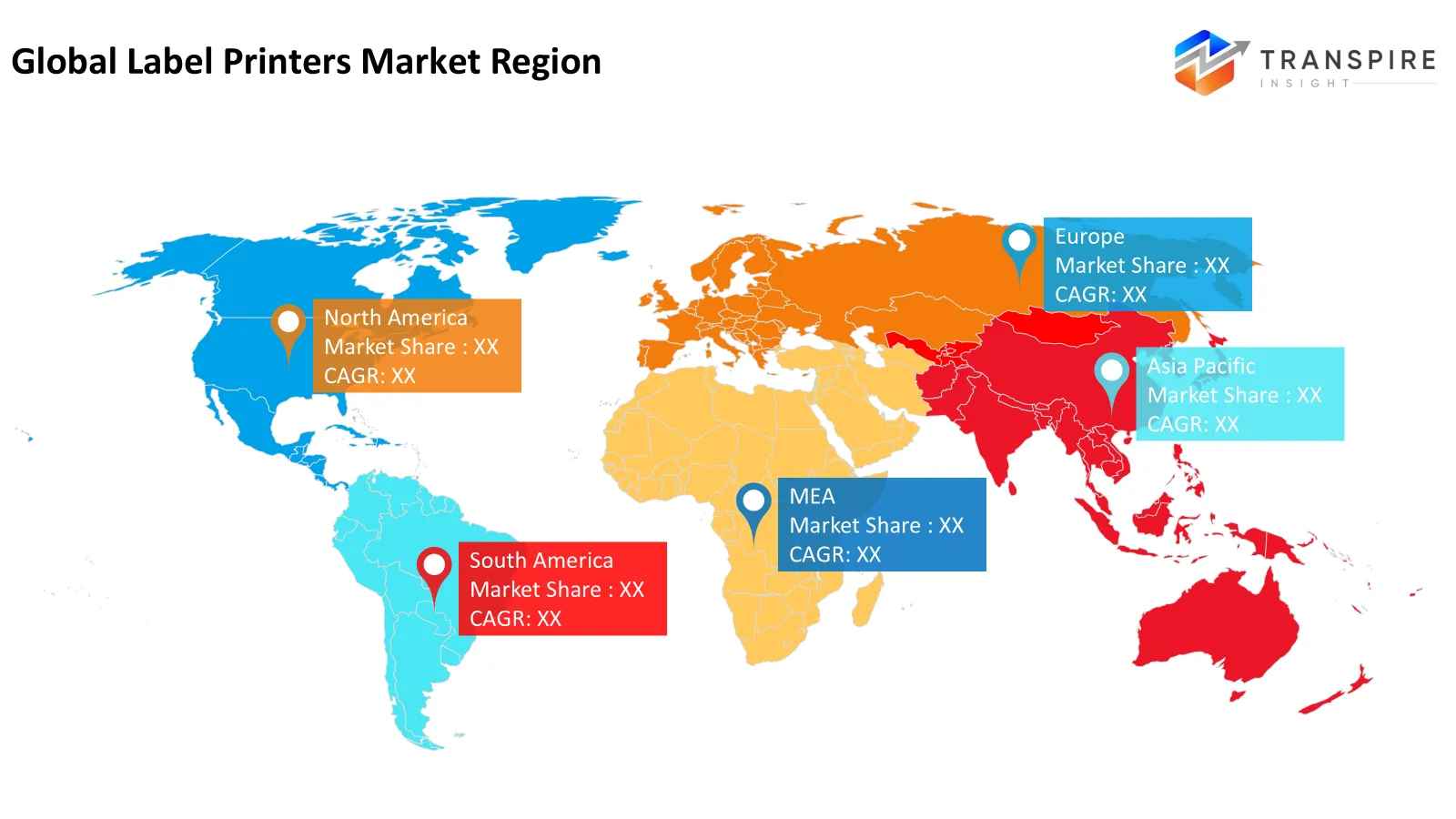
North America constitutes approximately 30% of the market share and has been found to be the fastest-growing geographic area with a Compound Annual Growth Rate (CAGR) estimated at 12.3%. The growth witnessed in North America is majorly attributed to advancements in technology, robust warehousing facilities, and effective inventory management system connectivity. RFID-enabled and wireless printers have been gaining more popularity amongst businesses seeking greater efficiency. In October 2025, Walmart teamed up with Avery Dennison for RFID sensors embedded on labels for fresh foods that enhanced traceability and made warehousing operations more efficient, raising the need for label printers.
Europe
The European region accounts for a market share of about 24%, with stable demand due to rigorous product labelling policies, pharmaceutical norms, and automation. Sustainable business practices are driving the use of energy-efficient printing methods. Efficient logistics networks, along with solid industrial operations, are continuing to support the demand within this region. RoW region accounts for almost 8% of market share, with increasing retail presence and efficient logistics chains. In February 2025 The Packaging and Packaging Waste Regulation of the European Union became effective, promoting sustainable and reusable packaging options, as well as creating a high demand for environmentally-friendly printing solutions.
Asia Pacific
Asia Pacific is leading the global market with an estimated market share of 38% because of robust manufacturing, rising retail networks, and growth in the number of warehouse automation initiatives. Various countries within the region are constantly making investments in logistics development and industrial activities geared towards exports. Another major driver of the steady demand for industrial labelling solutions is consumer goods manufacturing and packaging.In May 2026, the quick investments made in automating warehouses and logistics in various nations, including China, India, and Japan, promoted the use of industrial labelling systems along with the installation of barcode RFID printers.
To learn more about this report, Download Free Sample Report
Who are the Key Players in the Global Label Printers Market and how do they Compete?
Market competition in the label printer industry is mainly centred on efficiency, reliability, and innovative printing solutions tailored to logistical, retail, medical, and industrial needs. Printing speed, connectivity options, and scalable technology remain the focal areas of development in the market.
In the label printer market, Zebra Technologies is further expanding its industrial printer line through printers that target warehouse operations with RFID-enabled capabilities. In addition, Brother Industries' main area of focus is wireless printers that meet the requirements of commercial and retail organisations. SATO Holdings and Toshiba Tec remain focused on industrial durability and the integration of the printer into supply chains serving the manufacturing and transport industries.
In relation to Epson and Honeywell, they continue advancing their printing connectivity solutions to cater to the operations management needs of enterprises. TSC Auto ID and Godex International have made significant investments in affordable industrial printer models suitable for cost-conscious customers. Meanwhile, Avery Dennison remains focused on expanding its product lines of smart labelling and RFID printers. Other players include Brady Corporation, Primera Technology, Bixolon, Citizen Systems, Dymo, and Cab Produkttechnik.
Global Label Printers Market Companies
- Zebra Technologies
- Brother Industries
- SATO Holdings
- Toshiba Tec
- Epson
- Honeywell
- TSC Auto ID
- Godex International
- Avery Dennison
- Primera Technology
- Brady Corporation
- Bixolon,
- Citizen Systems
- Dymo
- Cab Produkttechni
Recent Development News
In June 2025. TSC Auto ID rolled out scalable RFID upgrades for the MB241 Series of heavy-duty label printers. The product rollout was notable because TSC embedded the adaptable data tracking feature in the durable printer framework.
In January 2026, SATO Corporation launched its most popular industrial thermal label printer called CL4-SXR. The introduction of this device made improvements in the physical hardware used in warehouses due to the use of recycled ABS plastic on the exterior part and inclusion of a unique interior mechanism that halts wastage of the first label entirely.
What Strategic Insights Define the Future of the Global Label Printers Market?
The market is shifting towards interconnected label environments with the help of RFID integration, warehouse improvements, and real-time inventory management. Companies now see their label environments as essential components of operations, not just printing processes.
The first significant threat stems from increased integration complications when dealing with interconnected printing. Businesses that depend significantly on network-enabled infrastructures could be affected by operational disruptions due to integration complications and maintenance needs. On the other hand, good business prospects await those interested in implementing RFID-enabled printing technologies that automate logistics and provide inventory visibility. Businesses that focus on flexibility, interconnections between operations, and integration into warehouses will become even more prominent in the future market.
Global Label Printers Market Segmentation
By Type
- Desktop Label Printers
- Industrial Label Printers
- Mobile Label Printers
- Thermal Label Printers
- RFID Label Printers
- Barcode Label Printers
By Application
- Retail Labelling
- Logistics & Shipping
- Healthcare Labelling
- Industrial Labelling
- Warehouse Management
By End-User
- Retailers
- Logistics Providers
- Manufacturers
- Healthcare Institutions
By Technology
- Direct Thermal Printing
- Thermal Transfer Printing
- Inkjet Printing
- Laser Printing
Frequently Asked Questions
Find quick answers to common questions.
The global label printers market size was valued at USD 608.14 million in 2025 and is poised to reach USD 1202.84 million by 2033, expanding at an 8.91% CAGR.
Key segments for the global label printers market are by type (Desktop Label Printers, Industrial Label Printers, Mobile Label Printers, Thermal Label Printers, RFID Label Printers, Barcode Label Printers, Others); By Application (Retail Labeling, Logistics & Shipping, Healthcare Labeling, Industrial Labeling, Warehouse Management, Others); By End-User (Retailers, Logistics Providers, Manufacturers, Healthcare Institutions, Others); By Technology (Direct Thermal Printing, Thermal Transfer Printing, Inkjet Printing, Laser Printing, Others).
The major factors driving the growth in the global label printers market on a global scale include the fast growth in e-commerce and warehouses. The increase in the number of parcels sent has resulted in the increased need for barcode printers, identification products, and inventory management systems. Moreover, the growing use of same-day delivery services is expected to drive the demand for faster label printers.
The global market is led by major manufacturers including Zebra Technologies, Brother Industries, SATO Holdings, Toshiba Tec, Epson, Honeywell, TSC Auto ID, Godex International, Avery Dennison, Primera Technology, Brady Corporation, Bixolon, Citizen Systems, Dymo, Cab Produkttechni.
The Asia Pacific region accounts for nearly 38% share in the Global global label printers market owing to strong manufacturing activities, rising logistics investments, warehouse automation, and increasing demands for packaging.
The global label printers market is benefiting from increased use of smart warehouses, RFID printing, and developments in the e-commerce sector. The rise in demand for portable and IoT-enabled label printers is another factor contributing to growth in the market.
- Zebra Technologies
- Brother Industries
- SATO Holdings
- Toshiba Tec
- Epson
- Honeywell
- TSC Auto ID
- Godex International
- Avery DennisonP
- rimera Technology
- Brady Corporation
- Bixolon,
- Citizen Systems
- Dymo
- Cab Produkttechni
About the Authors

Avinash Kumar
I’m Avinash Kumar, a Senior Research Analyst at Transpire Insight, with expertise in the Electronics and Semiconductor and Energy & Power industry. My work focuses on analyzing emerging technologies, market trends, industry developments, and innovation across these sectors. I specialize in transforming complex technical and market insights into clear, research-backed content that helps professionals, businesses, and decision-makers stay informed. Through continuous industry research and data-driven analysis, I strive to deliver accurate, reliable, and practical perspectives on the latest advancements shaping the semiconductor and energy landscape.

Chakradhar Khansole
Chakradhar serves as the Research Director at Transpire Insight, bringing over 8 years of experience in technology, innovation, and strategic market intelligence. He specializes in transforming complex market data into actionable business insights that enable organizations to make informed, growth-oriented decisions. Recognized for his strategic vision and analytical expertise, Chakradhar leads high-impact research initiatives, delivering comprehensive market assessments, competitive intelligence, and forward-looking industry analysis.
Recently Published Reports
-
Apr 2026
Fiber Optic Faceplates Market
Fiber Optic Faceplates Market Size, Share & Analysis Report By Type (< 300 mm2, 300-350 mm2, and > 350 mm2, By Application (Night Vision, Holographic Imaging, Medical, and Others), and Geography (North America, Europe, Asia-Pacific, Middle East and Africa, South and Central America), 2021 - 2031
-
Apr 2026
High Temperature Superconductors Market
High Temperature Superconductors Market Size, Share & Analysis Report By Type (1G HTS, and 2G HTS), By Application (Power Cable, Fault Current Limiter, and Transformer), and Geography (North America, Europe, Asia-Pacific, Middle East and Africa, South and Central America), 2021 - 2031
-
Apr 2026
Industrial Plugs and Socket Market
Industrial Plugs and Socket Market Size, Share & Analysis Report By Type (Industrial Plugs, Industrial Sockets), By Current (Up to 32 A, 32 to 125 A, Above 125 A), By Protection (Dustproof and Splash Proof, Waterproof, Explosion Proof), By End User (Heavy Industries, Oil and Gas, Chemicals and Pharmaceuticals, Power Generation, Others), and Geography (North America, Europe, Asia-Pacific, Middle East and Africa, South and Central America), 2021 - 2031
-
Apr 2026
InGaAs Avalanche Photodiodes Market
InGaAs Avalanche Photodiodes Market Size, Share & Analysis Report By Type (1100 - 1700 nm, and 1000 - 1600 nm), By Application (Missile Warning System, Muzzle Flash Detection, Wafer Defect Inspection, Laser Rangefinders, and Others), and Geography (North America, Europe, Asia-Pacific, Middle East and Africa, South and Central America), 2021 - 2031