
Global Digital Label Printers Market Size & Forecast:
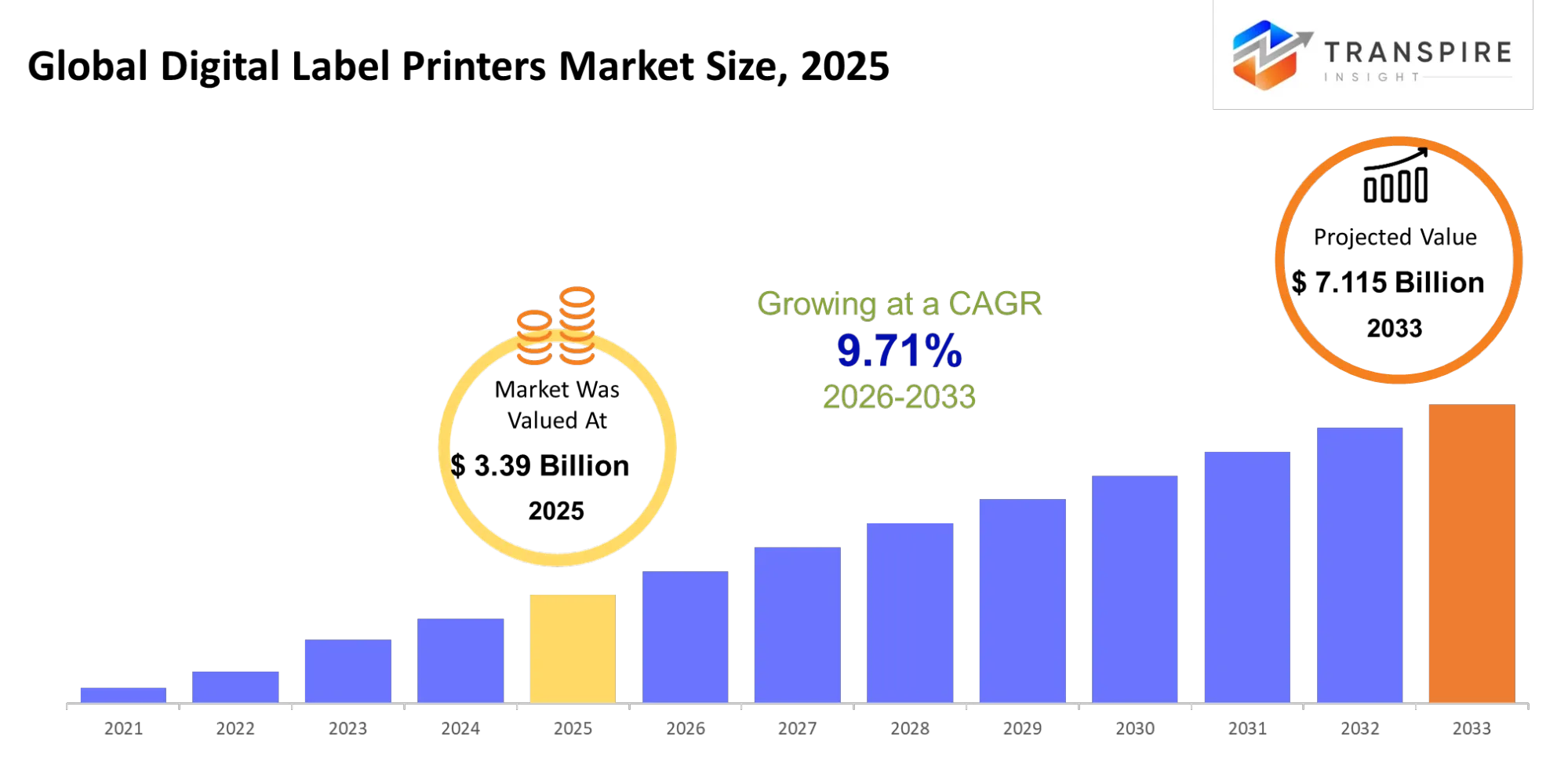
- Global Digital Label Printers Market Size 2025: USD 3.39 Billion
- Global Digital Label Printers Market Size 2033: USD 7.115 Billion
- Global Digital Label Printers Market Size CAGR: 9.71%
- Global Digital Label Printers Market Size Segments: By Type (Inkjet Label Printers, Laser Label Printers, Thermal Transfer Label Printers, UV Digital Label Printers, Color Label Printers, Industrial Label Printers, Others); By Application (Food & Beverage Labeling, Pharmaceutical Labeling, Logistics & Shipping Labels, Retail Product Labels, Industrial Labeling, Others); By End-User (Packaging Companies, Retailers, Logistics Providers, Manufacturers, Others); By Connectivity (USB-connected Printers, Wireless Printers, Cloud-enabled Printers, IoT-integrated Printers, Others).
To learn more about this report,  Download Free Sample Report
Global Digital Label Printers Market Size Summary:
The Global Digital Label Printers Market size is estimated at USD 3.39 billion in 2025 and is anticipated to reach USD 7.115 billion by 2033, growing at a CAGR of 9.71% from 2026 to 2033. The Global Digital Label Printers Market strengthens industries such as pharmaceuticals, food, and retail by enabling fast, personalized, short-run label printing with minimal setup time.
In recent years, the market has transformed from old-school printing to digital and consumption-based production. Because brands demand rapid product launches and customized packaging. A prominent structural change came from the rise of smart packaging and stricter labeling rules, pushing companies to adopt finely detailed, data-centric printing systems.
The rise in the number of e-commerce and home delivery services acted as a real-world trigger, sharply increasing demand for barcode, shipping, and tracking labels worldwide. Businesses are investing in digital label printers because they diminish material waste, lower operational costs, and improve production flexibility, leading to superfast turnaround times and better inventory management.
Key Market Insights:
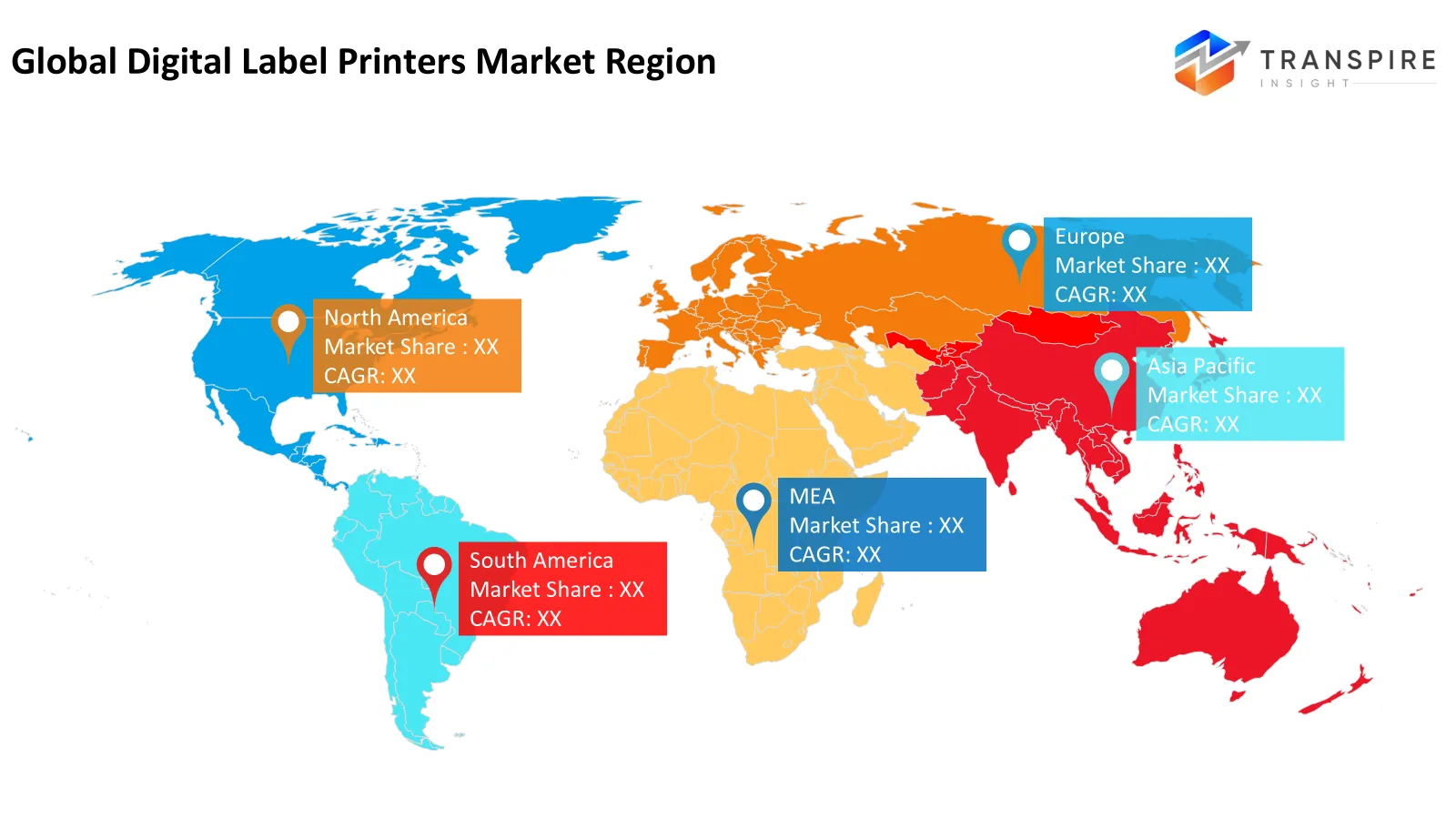
- North America is the dominant region with a market share of 37%.
- The fastest-growing region is the Asia Pacific in the field of the Global Digital Label Printers Market, with a CAGR 13.4%
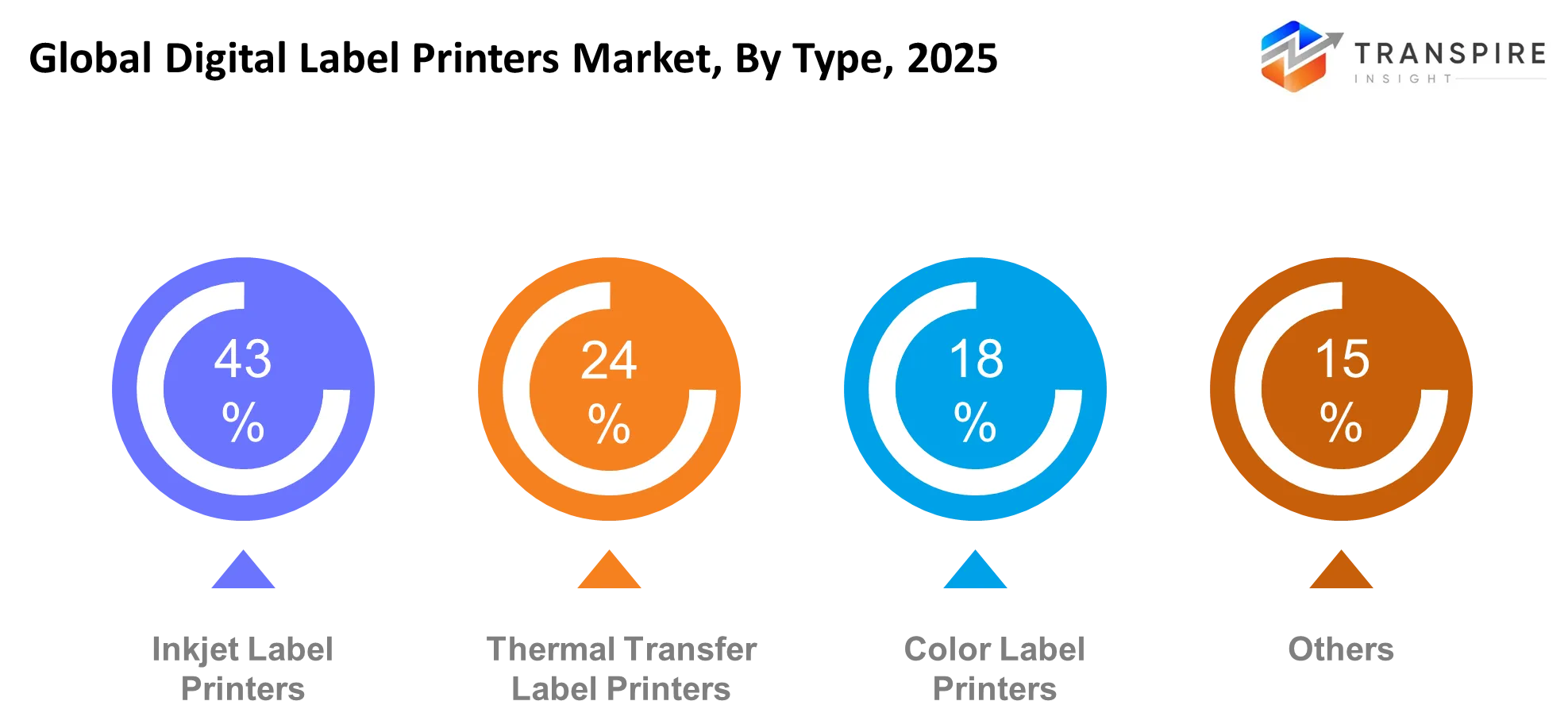
- Inkjet label printers are the dominant segment with 43% of market share.
- Thermal transfer label printers have a market share of 24%.
- The color label printers segment has a market share of 18%.
- The Europe region has a market share of 29%.
- UV digital label printers are the fastest-growing segment with a CAGR of 12.5%
What are the Key Drivers, Restraints, and Opportunities in the Global Digital Label Printers Market?
Drivers
Numerous drivers are driving the growth of the Global Digital Label Printers Market. Increasing need for packaging goods, strict rules regarding product labeling, traceability, and safety standards. Also, to maintain a large quantity of orders, the e-commerce sector is expanding rapidly. Technological advancement is one of the biggest drivers leading the growth. HP Industrial Print reported growing demand for digital label presses due to its HP Indigo V12 platform, which uses advanced LEPx technology to improve high-volume label printing speed, automation, and production efficiency. On January 12, 2026, HP Industrial Print reported strong growth in digital label press adoption, driven by its HP Indigo V12 platform featuring LEPx technology for industrial-scale digital label production and automated workflows.
Restraints
There are a few problems in the Global Digital Label Printers Market. Digital label printers with fast speed and color capabilities have become expensive. Medium-sized businesses and small-sized businesses may disagree on investing such a huge amount. Sometimes, there can be an inconvenience related to technical complexity and maintenance.
Opportunities
The digital label printing market has numerous growth opportunities. Companies can earn more by giving personalized labels for food, cosmetics, and medicines. Increasing online shopping is creating demand for shipping and barcode labels. There is also a strong opportunity in eco-friendly printing, as brands are seeking sustainable labels with less material waste and better printing efficiency.
What Has the Impact of Artificial Intelligence Been on the Digital Label Printing Market?
The AI revolution has revolutionized the digital label printing industry, making the printing process not just faster but also smarter and more accurate. Color matching, print alignment, quality checking, and workflow management are all now automated using AI-powered software, which helps to minimize manual tasks and production mistakes. Some digital printers also employ AI-driven predictive maintenance systems that can identify machine issues before they become problematic and prevent unforeseen downtime for businesses. The AI analytics tools analyze printing habits, ink consumption, and production speed to fine-tune performance and minimize material waste. Besides, AI systems that are cloud-based make handling short-run and customised label orders more efficient for manufacturers. The technologies increase the operational productivity, reduce production costs, enhance the printing precision, and aid businesses in providing labels to various industries (food, healthcare, retail, and e-commerce) faster.
Xaar has recently introduced the Versatex Black printbar for high-speed variable data printing, which is powered by AI technology, for smart traceability, barcode printing, and supply chain tracking in digital label production. In May 2026, Xaar launched the Versatex Black printbar with AI-supported high-speed variable data printing technology for smart traceability, barcode printing, and supply chain tracking in digital label production.
Key Market Trends:
- E-commerce and direct-to-consumer brands are moving away to gain total control over lead times and product testing.
- Material sourcing behavior is shifting to bio-based alternatives derived from agricultural waste, forcing printers to re-engineer their systems to support water-based inks and compostable adhesives.
- The label production sector is moving toward unified hybrid systems, mixing the high-volume speed of traditional tech with the precise, short-run flexibility of inkjet units.
- Material sourcing behavior is shifting towards bio-based alternatives get evolved from agricultural waste, forcing printers to re-engineer their systems to support water-based inks and compostable adhesives.
- The label production sector is moving towards the unified hybrid systems, blending the high-volume speed of traditional tech with the precise, short-run flexibility of inkjet units.
- Label converters are moving toward compact, connected, and highly responsive production environments that unify digital printing and automated inline finishing into a single step.
- In response to strict global anti-counterfeiting laws, pharmaceutical and chemical labeling is multi-layered Extended Content Labels (ECLs) and booklet formats capable of housing massive amounts of serialized data.
Global Digital Label Printers Market Segmentation
By Type
The inkjet label printers are the major type of printer, accounting for 43% of the total market share, since these printers can print rich colors on many different materials and do not require any costly setup plates. The differentiating logic of their growth is the existence of a large number of brands of small businesses and seasonal products, which demand very large print runs or medium-sized print runs that are very professional. This will lead to a future where inkjet is the engine used for all everyday consumer packaging, and will eliminate the need for analog printing presses from factories anywhere.
The fastest growing segment of the market is digital UV inks – they grow at a remarkable 12.5 percent a year and are specially formulated to dry immediately when exposed to ultraviolet light, creating an almost indestructible barrier. The remarkable growth logic for this surging increase is the need of the chemical and medical industries for labels that will resist harsh liquids, washing, and heavy usage. UV printing will eventually be the main technology for high-end packaging, making it difficult to distinguish between high-volume mass-produced packaging and high-end custom-designed packaging.
Laser label printers are held in a very stable market segment for printing clear, high-resolution black and white labels. Thermal transfer printers sit in a stable secondary market position with 24% market share, a reliable workhorse that will track the rough industrial jobs. Color label printers are regarded as a niche, decentralized market, holding an 18% share, to satisfy the demand for small machines and for printing on demand, right in the back offices. Industrial label printers are heavy-duty label printers and occupy a high-volume production space for continuous 24/7 operation. The remaining 15% of the global space is made up of other miscellaneous printing types, making up the remaining space in the technology market.
To learn more about this report, Download Free Sample Report
By Application
The food and beverage labelling market is huge, and it has a high volume because it is consumed on a daily basis. It is driven by its distinct growth logic and a constantly changing culture in which food brands are constantly coming up with new regional variations and different nutritional claims. Soon, this will make food packaging a sort of hyper-localized canvas that will shift label by label according to the trends of the local community and sudden changes of ingredients.
Pharmaceutical labels have a very sensitive and critical market niche where errors in printing are not permissible on a statutory basis. It has an entirely different logic of growth, and is subject to strict government tracking requirements to combat fake drugs that mandate a unique tracking code, invisible to the naked eye, be stamped onto each bottle of pills. This will result in future medical labels being able to serve as a secure digital data sheet and will protect patient safety internationally, with the micro-print being un-smudgeable.
Labels for logistics and shipping lines are part of a high-volume, global infrastructure, handling billions of packages in e-commerce sorting hubs daily. Retail product labels remain in a marketing role due to their high visibility on the shelves, ensuring that they attract consumers' attention. The industrial labeling business niche has a specific market niche, producing warnings for manufacturing facilities, automobiles, and building sites. Miscellaneous applications have a very small, but stable, market niche for everyday organisation, such as clothing tags and school labels.
By End-User
The packaging companies are the main high-end machinery buyers and thus occupy the dominant market position on a large scale. Their exclusive growth logic is that of survival, and they have to learn to use digital presses if they want to be able to produce the pack of small, custom orders that traditional, giant printing presses can't handle profitably. These will be fully automated, digital print centres, capable of printing a variety of products, including juice labels and shampoo stickers, with a click of a button in the future.
Retailers have gained a strong market share in the on-site market due to the fast growth in the retailing industry right in the consumer's face. Their distinctive growth model is based on the need to eliminate middlemen, empowering store managers to print out markdowns and price changes in the store's shopping aisle. That means future retail areas will have mini print stations, allowing for no restrictions on pricing and instant reactions to shoppers' habits.
Logistics providers have a critical operational market position, with their massive printers solidly entrenched in giant fulfillment centers. Manufacturers have a very embedded position in the market, with their own digital printers installed at the tail of the factory assembly line. There are other small end-users, e.g., hospitals, schools, that have a small, local administration but are a part of the larger system. The particular growth logic is based on basic internal tracking, asset management, and organizing internal patient/student data.
By Connectivity
Traditional and basic, USB-connected printers are established in the market as plug-and-play, desktop printers. Their special growth logic is based on maximum data security and offline reliability, which is why they are the preferred choice for remote desks (weak or blocked wireless signals). In the future, these wired solutions will be a sure backup for businesses where the internet is not always a part of the equation, but shipping bays still need to keep up.
Wireless printers are in a very dynamic and fast-growing niche in today's warehouses and distribution centers. The distinctive logic behind their adoption is the unparalleled mobility, with workers able to tag heavy goods wherever they are, with the use of small printers attached to their belts. This transformation suggests the future of completely mobile workforces with inventory being logged and labeled as it moves, eliminating the need for printing desks in the center.
Cloud-based printers are at a high level in the corporate market, connecting printers through the network. The current state of the market for IoT integration in printers is the most advanced and high-tech. The specific growth logic is based on the intelligent internal sensor that tracks the level of ink and part wear and notifies technicians before the machine fails. Other alternative connections, such as standard network cables and tap-to-print phone links, are protected and second-hand.
What are the Key Use Cases Driving the Digital Labels Printers Market?
A major core that is driving this market is the localized, short-run food and beverage packaging market, which is very dependent on high-speed inkjet technology. Brands are giving up their huge library of labels to create regional, seasonal, and promotional variations that can be printed on the spot to reflect changing consumer trends.
New use cases such as pharmaceutical serialization and e-commerce logistics are driving up precision tracking needs. Error-free medical compliance demands data matrices on each pill bottle, along with the massive volume of barcodes needed by fulfillment centers for the global growth in online shopping.
The emerging use cases are on smart, interactive labelling in premium retail and heavy industrial environments. QR codes are being incorporated into products as part of the tag, making the label a secure, anti-counterfeiting, and UV-resistant gateway to the digital world.
Report Metrics
|
Report Metrics |
Details |
|
Market size value in 2025 |
USD 3.39 Billion |
|
Market size value in 2026 |
USD 3.719 Billion |
|
Revenue forecast in 2033 |
USD 7.115 Billion |
|
Growth rate |
CAGR of 9.71% from 2026 to 2033 |
|
Base year |
2025 |
|
Historical data |
2021 - 2024 |
|
Forecast period |
2026 - 2033 |
|
Report coverage |
Revenue forecast, competitive landscape, growth factors, and trends |
|
Regional scope |
United States; Canada; Mexico; United Kingdom; Germany; France; Italy; Spain; Denmark; Sweden; Norway; China; Japan; India; Australia; South Korea; Thailand; Brazil; Argentina; South Africa; Saudi Arabia; United Arab Emirates |
|
Key company profiled |
HP Indigo, Epson, Zebra Technologies, Brother Industries, Canon, Primera Technology, Afinia Label, Konica Minolta, Domino Printing Sciences, Durst Group, SATO Holdings, Toshiba Tec, GoDEX, VIPColor, Colordyne Technologies. |
|
Customization scope |
Free report customization (country, regional & segment scope). Avail customized purchase options to meet your exact research needs. |
|
Report Segmentation |
By Type (Inkjet Label Printers, Laser Label Printers, Thermal Transfer Label Printers, UV Digital Label Printers, Color Label Printers, Industrial Label Printers, Others); By Application (Food & Beverage Labeling, Pharmaceutical Labeling, Logistics & Shipping Labels, Retail Product Labels, Industrial Labeling, Others); By End-User (Packaging Companies, Retailers, Logistics Providers, Manufacturers, Others); By Connectivity (USB-connected Printers, Wireless Printers, Cloud-enabled Printers, IoT-integrated Printers, Others). |
Which Regions are driving the Digital Label Printing market Growth?
North America is the largest region of the digital label printing market, with a majority share of 37% in the global label printing market. The volume of big consumer packaged goods (CPG) companies and the highly advanced e-commerce fulfillment ecosystem are the reasons behind this leadership position. In addition, a compliance-centric ecosystem supports this market, such as with strong federal regulations, such as the U.S. Drug Supply Chain Security Act (DSCSA). The strict tracking regulations have driven huge capital investment into high-speed inkjet platforms that can handle complex serialization, variable data printing, and automated inline inspection. Recently, Canon has launched the full-color label printer, LG-P800, which offers faster and more flexible digital printing for high-quality product, shipping, and packaging labels. In January 2026, Canon launched the LG-P800 full-color label printer, designed for high-quality product, shipping, and packaging labels with faster and more flexible digital printing capabilities.
Europe is the second biggest region in the market, accounting for 29% of the market share. The European sector is highly stable due to a strong regulatory framework, which is fully harmonised across Europe, especially the EU Falsified Medicines Directive (FMD) and strict circular economy waste legislation. European stability factors are less about high-speed volumes and more about a strong need for premium and custom labels in the luxury cosmetics, automotive, and specialty wine sectors in Europe. In this particular market scenario, regional converters have had to become the first to adopt sophisticated hybrid press setups that integrate flexographic systems with digital inkjet to maximise material usage and minimise waste. Ecolyne digital label press has been launched. It provides a subscription printing model that lowers the initial investments required by label converters and packaging companies. In May 2026, Xeikon introduced its Ecolyne digital label press across Europe, offering a subscription-based printing model that reduces upfront investment costs for label converters and packaging companies.
The Asia Pacific region is the fastest-growing market in the world with an explosive compound annual growth rate (CAGR) of 13.4%. What has happened in recent years is a huge structural change at the regional level: manufacturing is now rapidly growing in China and India, but in a localized way, and there is an unprecedented rise in the spending of the middle class on packaged food and medicines. Moreover, the domestic regulatory environment has recently set very strict standards on the accurate and localised labelling of nutrition and batches, triggering a fast industrial transition from analogue to digital.
SATO Corporation presented new industrial label printers that enable faster printing, high label quality, and intelligent AI systems to minimize problems with the machines in Southeast Asia. In the Asia-Pacific, the increasing efficiency of logistics, warehousing, and manufacturing operations helps to foster the growth of the digital label printing market. In March 2026, SATO Corporation launched its next-generation CL4/6-SXR industrial label printers in Southeast Asia, featuring AI-powered predictive maintenance, faster printing speed, and improved label accuracy for logistics and manufacturing industries.
To learn more about this report, Download Free Sample Report
Who are the Key Players in the Global Digital Label Printers Market and how do they Compete?
The digital label printer market is very competitive and structurally split between high-capacity industrial printers and agile, on-demand desktop printers. Competition focuses on cost-efficient and speedy variable data printing, as e-commerce grows and regulations mandate tracking.
Top leaders such as HP Indigo, Canon, and Konica Minolta use innovation strategies to win market share. They distinguish themselves through ultra-speed water-based digital presses and intelligent, AI-driven automation, growing by deep integration into global industrial packaging supply chains. On the other hand, Epson and Brother use cost-efficiency methods, providing specialized inkjet-Epson/ Brother PrecisionCore or high-capacity ink-tank systems, which lower the total cost of ownership for short-to-medium runs. They are growing by focusing on mid-market businesses and desktop on-demand printing.
In barcode-intensive industries, Zebra Technologies, SATO, and Toshiba Tec are taking innovation-driven, mission-critical approaches. They distinguished themselves with extremely reliable thermal transfer technologies and incorporated cloud-based tracking programming for IoT. Their growth is achieved through substantial penetration into the drug and logistics industries. Agile niche players, such as Primera, Afinia, Domino, Durst, GoDEX, VIPColor, and Colordyne, however, focus on niche strategies. They distinguish themselves with eco-friendly UV-curable inks, hybrid digital/thermal printing, and custom boutique solutions, and they continue to grow by targeting specialty food and craft beverage brands in their respective regions.
Key Global Digital Label Printers Market Companies
- HP Indigo
- Epson
- Zebra Technologies
- Brother Industries
- Canon
- Primera Technology
- Afinia Label
- Konica Minolta
- Domino Printing Sciences
- Durst Group
- SATO Holdings
- Toshiba Tec
- GoDEX
- VIPColor
- Colordyne Technologies
Recent Development News
In January 2026, HP Indigo showcased its advanced digital printing ecosystem at PAMEX 2026, introducing AI-powered workflow automation and high-productivity presses like the Indigo 7K, 18K, and 120K for commercial and label printing applications.
(Source- https://thepackman.in)
What Strategic Insights Define the Future of the Global Digital Label Printers Market?
An aggressive move towards automated and agile micro-production is the defining trend of the Global Digital Label Printers Market. With unsustainable analog runs becoming more of a thing of the past due to skyrocketing SKU numbers and stringent sustainability requirements, the market is shifting toward automated, high-accuracy digital runs, which reduce material waste and remove prepress bottlenecks.
There is a huge opportunity in intelligent compliance packaging via digital embellishment and variable data printing. Global requirements for a transparent circular economy mean data integration into localized QR codes, anticounterfeiting tracking features, and sustainable substrates bring in a very lucrative revenue stream.
AI-based workflow engines need to be integrated into the print equipment itself, and not be software that is downloaded separately. Strategic investments should focus on end-to-end, ‘lights-out' automation, spanning from automated file preparation to in-line finishing, to align with the need to remain profitable when dealing with a high onslaught of multi-SKU printing, and to turn this into a competitive, end-to-end, frictionless, high-margin advantage.
Global Digital Label Printers Market Segmentation
By Type
- Inkjet Label Printers
- Laser Label Printers
- Thermal Transfer Label Printers
- UV Digital Label Printers
- Color Label Printers
- Industrial Label Printers
- Others
By Application
- Food & Beverage Labeling
- Pharmaceutical Labeling
- Logistics & Shipping Labels
- Retail Product Labels
- Industrial Labeling
- Others
By End-User
- Packaging Companies
- Retailers
- Logistics Providers
- Manufacturers
- Others
By Connectivity
- USB-connected Printers
- Wireless Printers
- Cloud-enabled Printers
- IoT-integrated Printers
- Others
Regional Outlook
North America
- United States
- Canada
- Mexico
Europe
- Germany
- United Kingdom
- France
- Spain
- Italy
- Rest of Europe
Asia Pacific
- Japan
- China
- Australia & New Zealand
- South Korea
- India
- Rest of Asia Pacific
South America
- Brazil
- Argentina
- Rest of South America
Middle East & Africa
- Saudi Arabia
- United Arab Emirates
- South Africa
- Rest of the Middle East & Africa
Frequently Asked Questions
Find quick answers to common questions.
The global Global Digital Label Printers Market size was valued at USD 3.39 billion in 2025 and is poised to reach USD 7.115 billion by 2033, expanding at a 9.71% CAGR.
Key segments for the Global Digital Label Printers Market are By Type (Inkjet Label Printers, Laser Label Printers, Thermal Transfer Label Printers, UV Digital Label Printers, Color Label Printers, Industrial Label Printers, Others); By Application (Food & Beverage Labeling, Pharmaceutical Labeling, Logistics & Shipping Labels, Retail Product Labels, Industrial Labeling, Others); By End-User (Packaging Companies, Retailers, Logistics Providers, Manufacturers, Others); By Connectivity (USB-connected Printers, Wireless Printers, Cloud-enabled Printers, IoT-integrated Printers, Others).
Growth is primarily driven by strict labeling rules, increasing need for packaged goods, and the expanding E-commerce sector.
The global Global Digital Label Printers Market is led by major manufacturers, such as HP Indigo, Epson, Zebra Technologies, Brother Industries, Canon, Primera Technology, Afinia Label, Konica Minolta, Domino Printing Sciences, Durst Group, SATO Holdings, Toshiba Tec, GoDEX, VIPColor, and Colordyne Technologies.
North America holds 37% of the global Global Digital Label Printers Market due to strong demand from e-commerce, food, and pharmaceutical industries, along with early adoption of AI-based printing technologies, customized packaging solutions, and strict labeling regulations.
Commercial opportunities in the Global Digital Label Printers Market include growing demand for personalized labels in food, cosmetics, and healthcare products, rising need for barcode and shipping labels due to e-commerce growth, and increasing adoption of eco-friendly printing solutions that reduce waste and improve printing efficiency.
- HP Indigo
- Epson
- Zebra Technologies
- Brother Industries
- Canon
- Primera Technology
- Afinia Label
- Konica Minolta
- Domino Printing Sciences
- Durst Group
- SATO Holdings
- Toshiba Tec
- GoDEX
- VIPColor
- Colordyne Technologies
About the Authors

Avinash Kumar
I’m Avinash Kumar, a Senior Research Analyst at Transpire Insight, with expertise in the Electronics and Semiconductor and Energy & Power industry. My work focuses on analyzing emerging technologies, market trends, industry developments, and innovation across these sectors. I specialize in transforming complex technical and market insights into clear, research-backed content that helps professionals, businesses, and decision-makers stay informed. Through continuous industry research and data-driven analysis, I strive to deliver accurate, reliable, and practical perspectives on the latest advancements shaping the semiconductor and energy landscape.

Chakradhar Khansole
Chakradhar serves as the Research Director at Transpire Insight, bringing over 8 years of experience in technology, innovation, and strategic market intelligence. He specializes in transforming complex market data into actionable business insights that enable organizations to make informed, growth-oriented decisions. Recognized for his strategic vision and analytical expertise, Chakradhar leads high-impact research initiatives, delivering comprehensive market assessments, competitive intelligence, and forward-looking industry analysis.
Recently Published Reports
-
Apr 2026
Fiber Optic Faceplates Market
Fiber Optic Faceplates Market Size, Share & Analysis Report By Type (< 300 mm2, 300-350 mm2, and > 350 mm2, By Application (Night Vision, Holographic Imaging, Medical, and Others), and Geography (North America, Europe, Asia-Pacific, Middle East and Africa, South and Central America), 2021 - 2031
-
Apr 2026
High Temperature Superconductors Market
High Temperature Superconductors Market Size, Share & Analysis Report By Type (1G HTS, and 2G HTS), By Application (Power Cable, Fault Current Limiter, and Transformer), and Geography (North America, Europe, Asia-Pacific, Middle East and Africa, South and Central America), 2021 - 2031
-
Apr 2026
Industrial Plugs and Socket Market
Industrial Plugs and Socket Market Size, Share & Analysis Report By Type (Industrial Plugs, Industrial Sockets), By Current (Up to 32 A, 32 to 125 A, Above 125 A), By Protection (Dustproof and Splash Proof, Waterproof, Explosion Proof), By End User (Heavy Industries, Oil and Gas, Chemicals and Pharmaceuticals, Power Generation, Others), and Geography (North America, Europe, Asia-Pacific, Middle East and Africa, South and Central America), 2021 - 2031
-
Apr 2026
InGaAs Avalanche Photodiodes Market
InGaAs Avalanche Photodiodes Market Size, Share & Analysis Report By Type (1100 - 1700 nm, and 1000 - 1600 nm), By Application (Missile Warning System, Muzzle Flash Detection, Wafer Defect Inspection, Laser Rangefinders, and Others), and Geography (North America, Europe, Asia-Pacific, Middle East and Africa, South and Central America), 2021 - 2031