

Global Hydrodesulfurization Catalyst Market Size & Forecast:
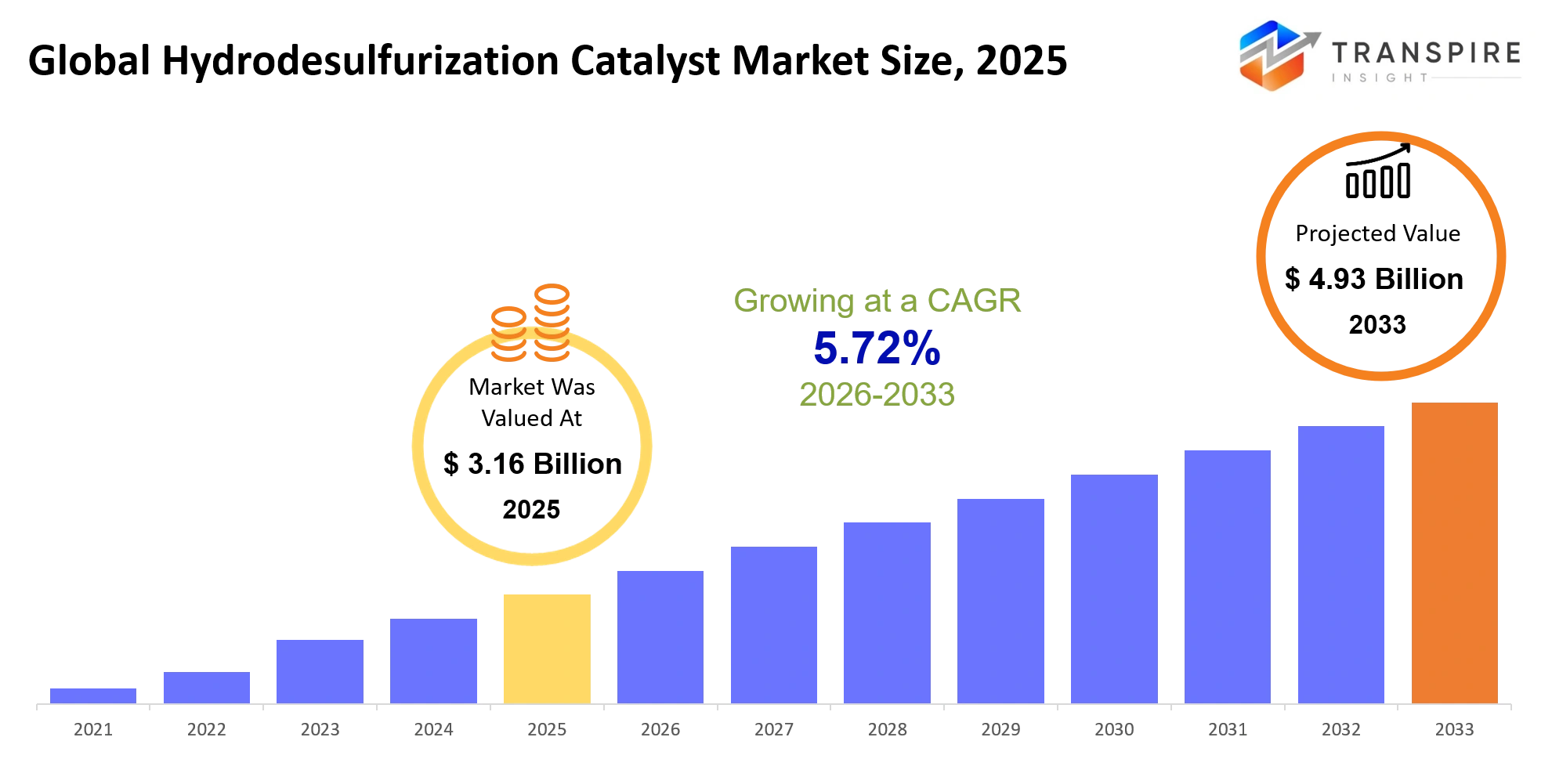
- Global Hydrodesulfurization Catalyst Market Size 2025: USD 3.16 Billion
- Global Hydrodesulfurization Catalyst Market Size 2033: USD 4.93 Billion
- Global Hydrodesulfurization Catalyst Market CAGR: 5.72%
- Global Hydrodesulfurization Catalyst Market Segments: By Catalyst Type (Cobalt-Molybdenum, Nickel-Molybdenum, Nickel-Tungsten, Noble Metal Catalysts, Others); By Feedstock (Diesel, Naphtha, Vacuum Gas Oil, Kerosene, Others); By Application (Petroleum Refining, Petrochemicals, Renewable Fuels, Others); By End User (Refineries, Petrochemical Plants, Chemical Companies, Others); By Process (Fixed Bed, Fluidized Bed, Moving Bed, Others).
Global Hydrodesulfurization Catalyst Market Summary:
As per Transpire Insight Analysis, the Global Hydrodesulfurization Catalyst Market size is estimated at USD 3.16 Billion in 2025 and is anticipated to reach USD 4.93 Billion by 2033, growing at a CAGR of 5.72% from 2026 to 2033.
The global hydrodesulfurization catalyst market to Benefit Refinery Performance and Fuel-Quality Compliance. The Global Hydrodesulfurization Catalyst Market assists refineries in desulfurising transportation fuels to meet fuel-quality regulations and to increase efficiency and product value. In the last three to five years, investments have refocused from the usual replacement activities towards high-performance formulation to manage the refining of heavies, renewables, and the increasing share of difficult-to-process feeds. One key structural change in the HDS market has been a clear movement toward ULS fuel processing backed by a range of environmental regulations. The development of clear fuel standards across the Asia-Pacific and Middle East regions provides a notable real-world trigger with ongoing refinery modernisation and catalyst refresh projects. Demand growth is being driven by a desire for extended catalyst life, greater sulfur conversion capability, and increased refiner economy to support higher throughput, less downtime, and stronger refinery profits.
Key Global Hydrodesulfurization Catalyst Market Insights:
Refinery modernisation, cleaner fuel standards and catalyst efficiency are becoming more important than refining capacity in determining hydrodesulfurization catalyst demand. The future of innovation is towards longer cycles for the catalysts, more flexibility with compatible renewables, and process optimisation via digitalisation.
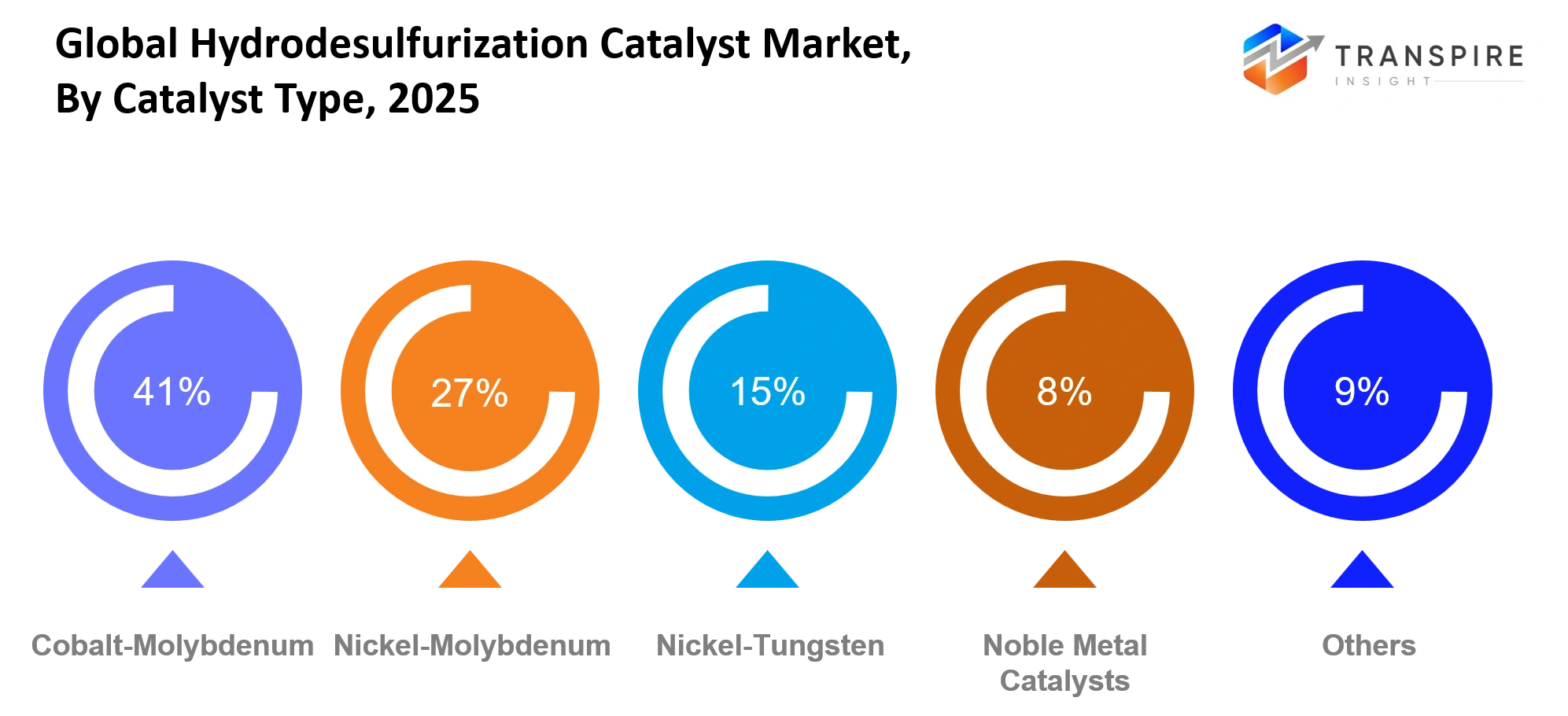
- Albemarle and BASF continue to develop high-activity catalysts, with 41% cobalt-molybdenum catalysts still leading the way.
- Nickel-Molybdenum catalysts (27%) are gaining ground with Haldor Topsoe and Axens technologies for deeper sulfur conversion and processing heavier crudes.
- Asia Pacific holds a 43% share due to the increase in refinery upgrade projects, with Sinopec Catalyst producing localised catalysts.
- Renewable Fuel Catalysts are expected to expand at a 12.8% CAGR, and Honeywell UOP is rapidly advancing solutions for renewable diesel and sustainable aviation fuel production.
- North America accounts for 23% of the market, motivating W. R. Grace to invest in digital catalyst monitoring that enhances predictive maintenance decisions.
- Europe accounts for 22% of the market and is experiencing the launch of lower-emission catalyst technologies compatible with refinery decarbonisation plans by Johnson Matthey.
- Middle East & Africa will grow at a 13.4% CAGR, with Shell Catalysts projected to grow with refinery expansion for high-performance catalyst deployment.
- The key factors preferred by refinery operators around the world are AI-assisted catalyst optimisation, digital twins and customized catalyst service programs.
What are the Key Drivers, Restraints, and Opportunities in the Global Hydrodesulfurization Catalyst Market?
Driver:
Refinery upgrade programs to treat heavier crude while continuing to produce ultra-low-sulfur fuel are a growth driver of the market. More stringent environmental fuel specifications and investments in new refinery facilities within developing economies have been catalysts for this growth. This has led refiners to transition to newer, high-performance hydrodesulfurization (HDS) catalysts offering increased metal dispersion and higher levels of sulfur removal for improved operating cycles, less hydrogen consumption and increased production of premium transportation fuels, which directly drive revenue through increased refining margins and repeat catalyst replacement contracts.
In January 2026, Johnson Matthey launched advanced hydroprocessing catalysts designed to improve efficiency and sulfur removal in heavy crude processing Source. This directly aids refiners in expanding their operational cycles and increasing premium transportation fuel output.
Restraint:
Catalyst deactivation via contaminants (metals, nitrogen species, coke formation), introduced through challenging feedstock, still represents the main limitation. The problem lies within the inherent issue of feed quality fluctuation at global refining locations, coupled with costly shutdowns and associated facilities for the regeneration/replacement of catalyst. Moreover, the substantial research cost of robust catalyst formulation often discourages the widespread deployment amongst small-sized refinery operations, which have stringent capital spending policies.
Opportunity:
The growth engine for future catalysts comes from renewables for renewable diesel, sustainable aviation fuels, and bio-based feedstocks with different sulfur removal requirements. The focus is now on new-age catalyst chemistry, digital monitoring of catalysts, and decarbonization projects in refineries, which provide additional commercial upsides. Additional capacity for renewable fuels in Asia-Pacific and the Middle East, together with strategic joint efforts between catalyst suppliers and refinery owners, is seen as driving premium catalyst placements and premium service offerings over the next 10 years.
In April 2026, Company Gevo licensed two patented catalyst technologies from the U.S. Department of Energy's Oak Ridge National Laboratory to scale up sustainable aviation fuel production. This impact streamlines the transition of catalysts from lab-scale to pilot-scale reactors.
What Has the Impact of Artificial Intelligence Been on the Global Hydrodesulfurization Catalyst Market?
AI optimises refinery hydrodesulfurization catalyst performance. Refinery operators use AI platforms to analyse operating conditions, catalyst activity, feedstock composition, sulfur conversion and hydrogen usage. This information can be used to tailor optimum conditions. These systems can predict catalyst deactivation rates so operators know when a catalyst needs regenerating or replacing. This can help prevent unplanned downtime, improve capacity, extend the working life of the catalyst, and reduce maintenance costs. Oil and gas companies are using AI-powered digital twins of their facilities to run virtual trials of different crude feedstocks, so engineers can observe catalyst performance before making real-time changes, so no production is lost. Smart monitoring helps control temperature and pressure, and a refinery's reactor conditions, to increase sulfur capture and cut fuel use. Refiners may find the benefits of improved operational reliability more enticing because of the improved profitability of their facility. The cost of implementation and the challenge in linking up modern AI systems with older refinery control infrastructure have delayed uptake from small and medium-sized facilities that have, in many cases, limited data from historical operating conditions available.
In May 2026, Aramco partnered with Emerson's AspenTech to deploy AI-driven hybrid models that optimise complex refinery planning workflows and nonlinear optimisations based on plant data.
Key Global Hydrodesulfurization Catalyst Market Trends:
The advanced catalysts are transforming the economics of refinery operations by delivering both higher sulfur removal efficiency and lower fuel sulfur content, with a longer refractory life cycle. Global refining industries are shifting the focus of catalyst development to digital optimisation and integration of renewable fuels.
- The formulations are moving to heavier crude oil and higher active materials with better sulfur conversion efficiency.
- Rather than replacing calendar-based time for catalyst changes, refiners are shifting to predictive performance monitoring with digital analytics.
- Demand for hydroprocessing catalyst technologies for renewable fuel projects is growing, particularly in the field of sustainable aviation fuel.
- Multi-functional catalysts are becoming more popular as refiners look to simultaneously remove sulfur, nitrogen and metals.
- Other catalyst manufacturers are expanding collaboration with refineries to provide customised performance optimisation and technical service programs.
- The catalyst research investment is moving toward longer life and less hydrogen consumption to enhance the economics of refining.
- Commercial catalyst development can be sped up by process simulation, digital twins, and AI in catalyst evaluation.
- Throughout catalyst life-cycle management, sustainability goals are driving the use of more recyclable catalyst materials and better metal recovery technologies.
Global Hydrodesulfurization Catalyst Market Segmentation
By Catalyst Type:
Cobalt-Molybdenum catalytic material had the largest market share with 41% and led the market, with an ideal balance between sulfur removal efficiency, working stability, and price for the treatment of diesel and gas oil. Nickel-Molybdenum catalyst captured the second-largest share of the market with 27%, providing greater performance in more severe conditions of heavier feedstocks and more complete desulfurization. Nickel-Tungsten catalytic material had the third-largest share of 15%, as the demand for higher severity hydro processing increases. Noble Metal Catalysts have a demand of 8%, especially in high-purity requirements, and others' shares were 9%. Renewable Fuel Catalysts were to grow at a 12.8% CAGR due to refinery adaptation to renewable fuels.
By Feedstock:
Among the major products, diesel continues to hold its share, with transport fuels required to be very low sulfur, as it’s supported by growing conversions using VGO in refineries to add capacity. Naphtha demand is growing due to petrochemicals, and in the case of Kerosene, growing stricter standards for Aviation fuel demand are a plus.
By Application:
Petroleum remains the top revenue driver, and the refineries require their catalyst stocks to be constantly changed to meet standards. Petrochemicals support demand by reducing impurities in intermediate feedstocks. And the fastest-growing end use is renewable fuels, backed by significant biorefinery investments.
By End User :
The refineries present the biggest market since catalyst cycles are continuous and there's an ongoing trend towards optimisation of processes. Speciality catalyst systems are being adopted more and more in chemical and petrochemical plants to provide greater flexibility to operations and enhance the quality of the output product.
By Process:
Fixed-bed reactors represent the bulk of the commercial units in service due to proven reliability and the low cost associated with them. The fluidised-bed and moving-bed approaches are finding increased use where long-term advantages justify the increased initial and operating costs due to continuous catalyst regeneration and flexibility.
What are the Key Use Cases Driving the Global Hydrodesulfurization Catalyst Market?
Petroleum refining, its major market, continues to see Cobalt-Molybdenum catalysts facilitate significant improvements in refinery performance by removing sulfur efficiently from diesel and other transport fuels for strict quality specifications.
This, along with increased conversion efficiencies as part of larger integrated refining/petrochemical sites, has seen uptake by plants across applications such as naphtha, vacuum gas oil, and kerosene for use in either purified feedstocks for the petrochemical sector or more valuable fuels.
Emerging sectors such as renewable diesel and sustainable jet fuel production are presenting substantial growth opportunities for catalyst providers, with forecasts of renewable fuel catalysts growing at 12.8% per annum and ongoing developments with new formulations for biological feeds.
|
Report Metrics |
Details |
|
Market size value in 2025 |
USD 3.16 Billion |
|
Market size value in 2026 |
USD 3.34 Billion |
|
Revenue forecast in 2033 |
USD 4.93 Billion |
|
Growth rate |
CAGR of 5.72% from 2026 to 2033 |
|
Base year |
2025 |
|
Historical data |
2021 - 2024 |
|
Forecast period |
2026 - 2033 |
|
Report coverage |
Revenue forecast, competitive landscape, growth factors, and trends |
|
Regional scope |
United States; Canada; Mexico; United Kingdom; Germany; France; Italy; Spain; Denmark; Sweden; Norway; China; Japan; India; Australia; South Korea; Thailand; Brazil; Argentina; South Africa; Saudi Arabia; United Arab Emirates |
|
Key company profiled |
Albemarle, W. R. Grace, BASF, Haldor Topsoe, Axens, Johnson Matthey, Honeywell UOP, Sinopec Catalyst, Clariant, Shell Catalysts, Eurecat, JGC Catalysts, CRI Catalyst, Chevron Lummus Global, ExxonMobil Catalysts. |
|
Customization scope |
Free report customization (country, regional & segment scope). Avail customized purchase options to meet your exact research needs. |
|
Report Segmentation |
By Catalyst Type (Cobalt-Molybdenum, Nickel-Molybdenum, Nickel-Tungsten, Noble Metal Catalysts, Others); By Feedstock (Diesel, Naphtha, Vacuum Gas Oil, Kerosene, Others); By Application (Petroleum Refining, Petrochemicals, Renewable Fuels, Others); By End User (Refineries, Petrochemical Plants, Chemical Companies, Others); By Process (Fixed Bed, Fluidized Bed, Moving Bed, Others). |
Which Regions are Driving the Global Hydrodesulfurization Catalyst Market Growth?
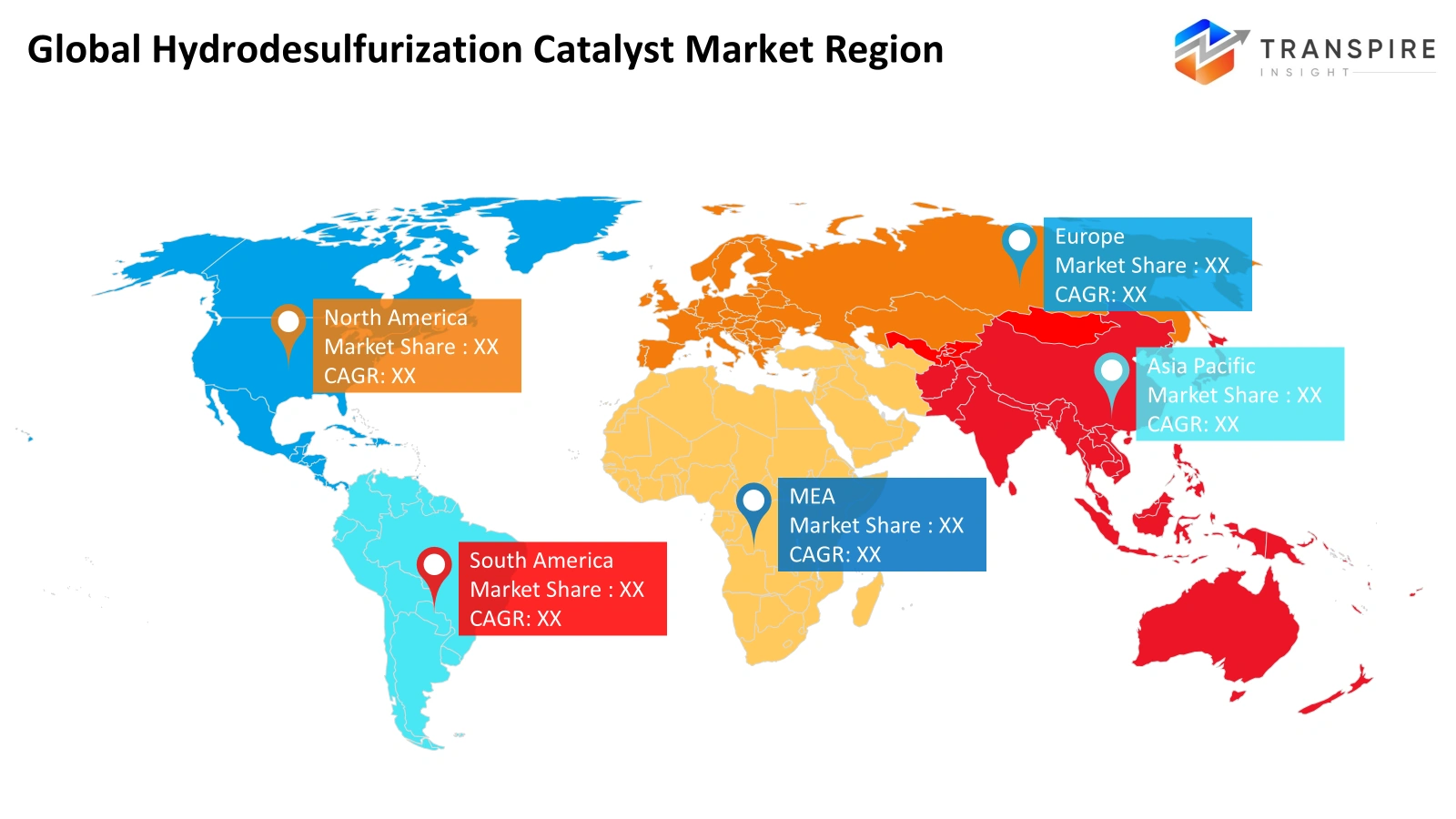
Asia Pacific has the largest refining capacity, growing fuel consumption, and steady investments in cleaner fuel infrastructure, accounting for 43% of the global market. Governments are still imposing tighter sulfur emission limits and are pressing refiners to upgrade their hydroprocessing units to next-generation catalysts. Additionally, the region has good domestic capabilities in catalyst manufacturing and integrated refinery-petrochemical complexes, bolstering the region's competitiveness. Long-term programs of catalyst replacement and modernisation are maintained by the rapid industrialisation and the growing need for transportation fuels.
In April 2026, PetroChina Company Limited expanded the deployment of hydroprocessing catalysts across domestic refineries. This rollout supports cleaner fuel production and ensures compliance with tightening low-sulfur fuel regulations.
https://www.openpr.com/news/4549472/china-refinery-catalyst-market-gains-momentum-amid-expanding
North America comes in second with 23%, with Europe close behind, whose refinery network is very mature and has a history of catalyst replacement cycles. These markets focus on maximising catalyst performance and optimising digital processes over scaling up, unlike Asia Pacific. Favourable environmental regulations promote investment in high-quality catalyst formulations that have longer lifetimes. The market demand is robust due to good research interaction between refiners, technology licensors, and catalyst suppliers, despite lower refinery growth.
In March 2026, Ketjen partnered with Saudi Aramco Technologies Company to accelerate the development of proprietary fluid catalytic cracking catalysts, enhancing high-value yields and reducing environmental footprints.
Middle East & Africa is expected to witness the highest CAGR growth at 13.4% during the forecast period. The catalyst demand has gained considerable strength due to the recent investments in the production of clean fuels, diversification strategies downstream, and refinery expansions. The region is increasing the amount of heavy crude oil being processed, which presents opportunities for more efficient hydrodesulfurization technologies. With the ongoing expansion of refining capacity and with more fuel being exported, catalyst suppliers are likely to expand their local technical support and regional partnerships.
In March 2026, Chevron Lummus Global (CLG) expanded its clean-fuels refinery catalyst portfolio by signing a definitive technology licensing agreement to deliver advanced Fischer-Tropsch (FT) liquid upgrading solutions. This specialized product rollout integrates CLG's hydroprocessing catalyst systems to optimize the hydrocracking and desulfurization of complex feedstocks.
Who are the Key Players in the Global Hydrodesulfurization Catalyst Market, and how do they compete?
Winning products compete on catalyst performance, processing flexibility, total cost of ownership, and service, not simply on price. Vendors offer customers competitive advantages based on optimised custom catalyst solutions, digital processing support and lasting partnerships with refiners to boost sulfur capture rates and boost equipment reliability.
In the leading edge segment are Albemarle, BASF, W. R. Grace, Haldor Topsoe, Axens, Johnson Matthey, and Honeywell UOP, highlighting advanced catalyst chemistry, higher activity metals, and innovative process technologies. These players compete with tailored catalyst formulations, strong research capabilities, and integrated engineering services, expanding globally on new refinery constructions and upgrades, licensing partnerships, and technical relationships with major oil producers. In addition to innovation in the leading edge, there is the regional approach taken by Sinopec Catalyst, Shell Catalysts, Clariant, Eurecat, JGC Catalysts, CRI Catalyst, Chevron Lummus Global and ExxonMobil Catalysts, competing with regional manufacturing advantages, specific applications and refinery-specific solutions. These players complement catalyst offerings with customized development, local support and a strategy targeting emerging markets, and are increasingly expanding in areas like renewables, upgrading heavy crudes, and managing digital catalyst performance.
Key Players are:
- Albemarle
- W. R. Grace
- BASF
- Haldor Topsoe
- Axens
- Johnson Matthey
- Honeywell UOP
- Sinopec Catalyst
- Clariant
- Shell Catalysts
- Eurecat
- JGC Catalysts
- CRI Catalyst
- Chevron Lummus Global
- ExxonMobil Catalysts
Recent Development News
In February 2026, AMG Critical Materials N.V. completed an agreement to acquire AURA Technologie GmbH for €10 million. This acquisition directly establishes AMG’s circular, high-purity molybdenum platform by integrating an operational facility specialised in sourcing and roasting spent hydrodesulfurization (HDS) catalysts.
Source: http://globenewswire.com
In July 2026, Joby Aviation formed a specialised manufacturing and capital joint venture with Toyota Motor Corporation. This multi-year industrial partnership injects heavy automotive mass-production engineering into Joby’s assembly lines, directly accelerating the scalable commercial rollout of FAA-certified electric vertical takeoff and landing (eVTOL) air taxis.
Source: https://www.manufacturingdive.com
What Strategic Insights Define the Future of the Global Hydrodesulfurization Catalyst Market?
Refiners are turning to sophisticated catalyst systems that can handle heavier crude, renewable feedstocks, and more stringent ultra-low sulfur requirements while maintaining their operational efficiency. Catalyst longevity, digital optimisation, and an integrated technical service offering will become a bigger differentiator compared with scale. One of the unseen risks is the faster pace of energy transition. Imbalances in investment and a lack of long-term clarity in fossil fuel demand may impact catalyst replacement cycles in some segments. Meanwhile, renewable diesel and sustainable aviation fuel offer new business for high-performance speciality hydroprocessing catalysts. Investment in AI-based catalyst monitoring, recyclable catalyst options, and local development offers future opportunities for selected players to capture refinery upgrade activity. Long-term competitive advantage depends on the willingness to invest in innovation in catalytic technology as well as strategic cooperation agreements with refiners and licensors for repeated catalyst contracts.
Key Segmentations are:
By Catalyst Type
- Cobalt-Molybdenum
- Nickel-Molybdenum
- Nickel-Tungsten
- Noble Metal Catalysts
- Others
By Feedstock
- Diesel
- Naphtha
- Vacuum Gas Oil
- Kerosene
- Others
By Application
- Petroleum Refining
- Petrochemicals
- Renewable Fuels
- Others
By End User
- Refineries
- Petrochemical Plants
- Chemical Companies
- Others
By Process
- Fixed Bed
- Fluidized Bed
- Moving Bed
- Others
Regional Outlook
North America
- United States
- Canada
- Mexico
Europe
- Germany
- United Kingdom
- France
- Spain
- Italy
- Rest of Europe
Asia Pacific
- Japan
- China
- Australia & New Zealand
- South Korea
- India
- Rest of Asia Pacific
South America
- Brazil
- Argentina
- Rest of South America
Middle East & Africa
- Saudi Arabia
- United Arab Emirates
- South Africa
- Rest of the Middle East & Africa
Frequently Asked Questions
Find quick answers to common questions.
The global hydrodesulfurization catalyst market size was valued at USD 3.16 Billion in 2025 and is poised to reach USD 4.93 Billion by 2033, expanding at a 5.72% CAGR.
Key segments for the global hydrodesulfurization catalyst market are By Catalyst Type (Cobalt-Molybdenum, Nickel-Molybdenum, Nickel-Tungsten, Noble Metal Catalysts, Others); By Feedstock (Diesel, Naphtha, Vacuum Gas Oil, Kerosene, Others); By Application (Petroleum Refining, Petrochemicals, Renewable Fuels, Others); By End User (Refineries, Petrochemical Plants, Chemical Companies, Others); By Process (Fixed Bed, Fluidized Bed, Moving Bed, Others).
Growth is primarily driven by refinery modernisation, stringent ultra-low sulfur fuel regulations, heavier crude oil processing, and the adoption of high-performance catalysts that improve operational efficiency and catalyst life.
The global hydrodesulfurization catalyst market is led by major manufacturers, including Albemarle, W. R. Grace, BASF, Haldor Topsoe, Axens, Johnson Matthey, Honeywell UOP, Sinopec Catalyst, Clariant, Shell Catalysts, Eurecat, JGC Catalysts, CRI Catalyst, Chevron Lummus Global, and ExxonMobil Catalysts.
Asia Pacific, holding 43% of the market, dominates through large-scale refining capacity, strong government clean-fuel policies, expanding refinery upgrades, and increasing transportation fuel demand.
Commercial opportunities are emerging in renewable diesel and sustainable aviation fuel catalysts, AI-enabled catalyst optimisation, refinery decarbonization projects, and expanding refinery investments across the Middle East & Africa and Asia Pacific.
- Albemarle
- W. R. Grace
- BASF
- Haldor Topsoe
- Axens
- Johnson Matthey
- Honeywell UOP
- Sinopec Catalyst
- Clariant
- Shell Catalysts
- Eurecat
- JGC Catalysts
- CRI Catalyst
- Chevron Lummus Global
- ExxonMobil Catalysts
About the Authors

Pankaj Ghogare Patil
I am Pankaj Ghogare Patil, a Senior Research Analyst at Transpire Insight, specializing in the Pharmaceutical, Chemicals & Materials, Healthcare IT, and Biotechnology industry. My expertise lies in conducting comprehensive market research, analyzing industry trends, evaluating competitive landscapes, and translating complex data into actionable insights. At Transpire Insight, I closely follow emerging technologies, regulatory developments, and market innovations to create accurate, well-researched, and informative content that helps businesses and professionals make informed decisions. I am committed to producing credible, evidence-based articles that reflect industry best practices while making technical topics accessible and valuable for a broad audience.

Chakradhar Khansole
Chakradhar serves as the Research Director at Transpire Insight, bringing over 8 years of experience in technology, innovation, and strategic market intelligence. He specializes in transforming complex market data into actionable business insights that enable organizations to make informed, growth-oriented decisions. Recognized for his strategic vision and analytical expertise, Chakradhar leads high-impact research initiatives, delivering comprehensive market assessments, competitive intelligence, and forward-looking industry analysis.
Recently Published Reports
-
May 2026
Healthcare Polymer Packaging Market
Healthcare Polymer Packaging Market Size, Share & Analysis Report By Packaging Type (Syringes, IV Bottles and Pouches, Clamshells, Blisters, Bottles & Jars, Containers, Tubes, IV Parental Packaging, Others), By Type (Regulated, Non-regulated), By Polymer Type (LDPE (Low-Density Polyethylene), HDPE (High-Density Polyethylene), Homo-polymer (Homo), Random Copolymer (Random), Block Copolymer (Block), PET, Polystyrene, Polyvinyl Chloride, Polyamide/EVOH, Others), and Geography (North America, Europe, Asia-Pacific, Middle East and Africa, South and Central America), 2021 - 2031
-
Apr 2026
Hydrophilic Tape (Waterstop) Market
Hydrophilic Tape (Waterstop) Market Size, Share & Analysis Report By Type (Bentonite-Based Hydrophilic Tape, Rubber-Based Hydrophilic Tape), By Application (Residential Buildings, Commercial Buildings, Infrastructure Projects), and Geography (North America, Europe, Asia-Pacific, Middle East and Africa, South and Central America), 2021 - 2031
-
Apr 2026
Metalens Market
Metalens Market Size, Share & Analysis Report By Type (Visible Light Metalens, and Infrared Metalens), By Application (Consumer Electronics, Automotive Electronics, Industrial, Medical, and Others), and Geography (North America, Europe, Asia-Pacific, Middle East and Africa, South and Central America), 2021 - 2031
-
Apr 2026
PBT Resin Market
PBT Resin Market Size, Share & Analysis Report By Type (Reinforced PBT Resin, Unreinforced PBT Resin), By Processing Method (Injection Molding, Extrusion, Blow Molding, Others), By End-User (Automotive, Electrical & Electronics, Consumer Appliances, Industrial Machinery, Medical Devices, Packaging, Others), and Geography (North America, Europe, Asia-Pacific, Middle East and Africa, South and Central America), 2021 - 2031