
Global Hard Carbon Anode Market Summary:
According to Transpire Insights, a detailed research report on the market reflects that the sodium-ion battery application segment dominates the Global Hard Carbon Anode Market, accounting for approximately 72% of the total share worldwide. BTR New Material Group Co., Ltd. leads the market with approximately (around USD 4.5 billion) in annual revenue and an estimated 18–22% global market share, making it the leading contributor to global market development, innovation, advanced hard carbon material production, expanding manufacturing capabilities, and growth dynamics.
Market Snapshot
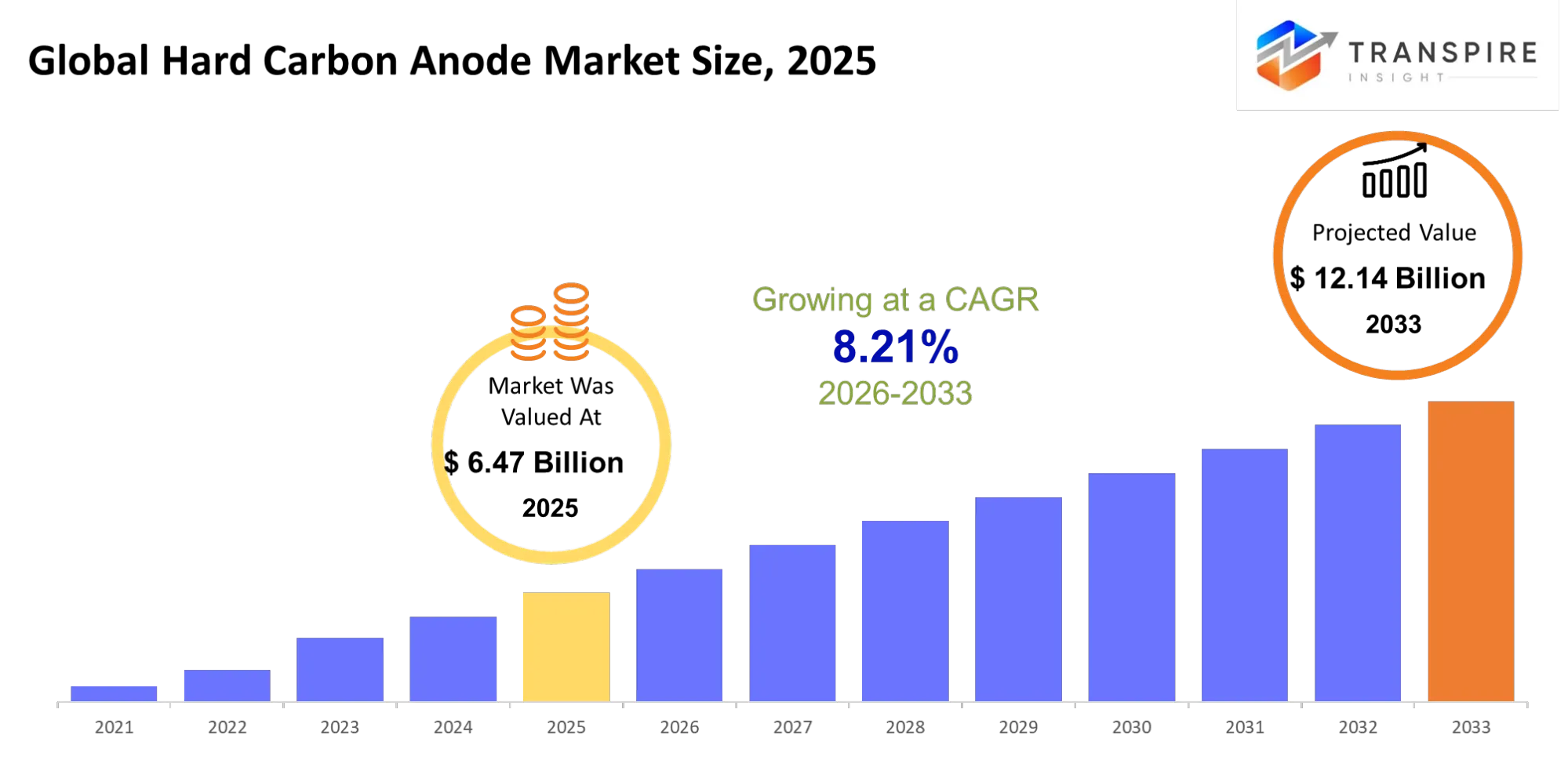
- Global Market Value (2025): USD 6.47 Billion.
- Expected Market Value (2026): USD 6.99 Billion.
- Estimated Market Value (2033): USD 12.14 Billion.
- Forecast CAGR (2026–2033): 8.21%.
- Leading Region in 2025: Asia Pacific
- Second-largest Region: Europe
- Fastest Growing Region: North America
Introduction
The manufacturing, distribution, and commercial use of hard carbon materials for cutting-edge battery applications are all part of the hard carbon anode market. Even at extremely high temperatures, hard carbon, also known as non-graphitizable carbon, does not transform into graphite due to its highly disordered structure. Larger interlayer space and nanopores are created by this special structure, which enables effective sodium ion storage and movement. Hard carbon is therefore favored as the anode material for sodium-ion batteries because of its superior low-temperature properties, stable cycle performance, and good safety. Furthermore, it is an appealing and sustainable method for next-generation energy storage technology since it can be produced from cheap, plentiful biomass materials including lignin, coconut shells, and agricultural waste.
- For Instance:- Regional Hub: Due to substantial investments made by Chinese manufacturers in domestic sodium-ion battery and synthetic hard carbon production capacity, the Asia-Pacific region holds the greatest share of the hard carbon anode market.
- Europe, Lignin-Based Anodes: In order to promote sustainable battery production and bolster the local battery materials supply chain, Stora Enso has teamed up with sodium-ion battery manufacturer Altris to commercialize lignin-based hard carbon anode materials made from wastes of the forest industry.
Key Market Highlights: -
- Asia Pacific is expected to grow at a rapid CAGR in the Global Hard Carbon Anode Market by holding approximately 55% of the share during the forecast period.
- Europe is the fastest-growing region in the Global Hard Carbon Anode Market during the period, holding approximately 18.6% share.
- North Americais anticipated to hold approximately 17% share of the Global Hard Carbon Anode Market over the predicted timeframe.
- By Product Type, the Synthetic Hard Carbon segment dominated the market and holds approximately 57.4% share in 2025 and is projected to grow at a substantial CAGR during the forecast period.
- By Battery Type, the Lithium-ion Batteries segment dominated the market and holds approximately 45.0% share in 2025 and is projected to grow at a substantial CAGR during the forecast period.
- By Application, the Electric Vehicles segment dominated the market and holds approximately 52% share in 2025 and is projected to grow at a substantial CAGR during the forecast period.
- New Battery Component Incentives: India is preparing a proposed ₹12,000 crore incentive scheme to promote domestic manufacturing of upstream battery components, including Anode Active Materials (AAM) such as hard carbon. The initiative is expected to complement the existing ₹18,100 crore Production Linked Incentive (PLI) scheme for Advanced Chemistry Cell (ACC) battery storage and strengthen the country's battery materials supply chain.
How is Technology Driving Growth in the Global Hard Carbon Anode Market?
The market for hard carbon anodes is expanding due to advancements in sodium-ion battery technology. Because sodium ions are bigger than lithium ions, conventional graphite anodes cannot effectively hold them. Improved cycle stability, quick charging, and increased sodium ion storage are all possible with hard carbon that has a disordered structure and a larger interlayer distance. Because of continuous advancements in material design, purity, and production techniques, hard carbon is becoming a more appealing anode material for grid energy storage and electric vehicle applications, significantly improving battery performance.
Market Drivers
The global market for hard carbon anodes is being driven by supply-chain localization and government backing. Incentives like the U.S. Inflation Reduction Act (IRA), which allots over USD 370 billion for clean energy and climate-related activities, are encouraging domestic battery production and reducing reliance on imported parts. These regulations are encouraging the growth of regional production facilities and attracting investments in essential battery components, including as hard carbon anodes. In the global hard carbon anode market, manufacturers are increasing capacity, fortifying regional supply chains, accelerating innovation, boosting production resilience, and generating new growth prospects.
- For Instance: -India, Sustainable Hard Carbon Innovation: Epsilon Advanced Materials is creating hard carbon anodes based on coconut shells to promote sustainable battery production, lessen reliance on graphite, and bolster India's ecosystem for sodium-ion battery materials.
- India, Government Support: By promoting investment in battery production, material processing, and anode active materials, India's ACC PLI program is bolstering domestic supply chains and fostering the expansion of the hard carbon anode market.
Restrain
The main obstacles to the global hard carbon anode market are high production costs and fierce competition from synthetic graphite. The manufacturing expenses are further increased by the energy-intensive carbonization and processing stages. Scalable, high-performing, and affordable alternatives are provided by well-established graphite supply chains. These elements may make it more difficult for hard carbon anodes to be widely used and commercialized.
Analysis of Prices and Consumer Behaviour
Due to their growing application in consumer electronics, electric vehicles, and energy storage systems, sodium-ion batteries are leading the industry with around 72% of overall demand. Bio-based hard carbon compounds are becoming more popular because of their environmental advantages and can lower raw material costs by as much as 12%. Due to significant manufacturing activity and battery investments, the Asia Pacific region accounts for over 56% of the global market revenue. About 70% of demand is met by the production of batteries and energy storage. While manufacturers continue to invest in local supply chains and cutting-edge hard carbon production processes worldwide, consumer preferences are gradually evolving toward high-performance, affordable, and sustainable battery materials.
Top Companies in the Global Hard Carbon Anode Market
- Kuraray
- Resonac Holdings
- BTR New Material Group
- Shanshan Technology
- JFE Chemical
- Ningbo Shanshan
- Kureha Corporation
- Tokai Carbon
- SGL Carbon
- Mitsubishi Chemical
- POSCO Future M
- CNANO Technology
- Ningxia Baofeng
- Cnano Energy
- Sinosteel
Global Hard Carbon Anode Market Segmentation
The Global Hard Carbon Anode Market share is divided into five categories: Product Type, Battery Type, Application, End User, and Production Process
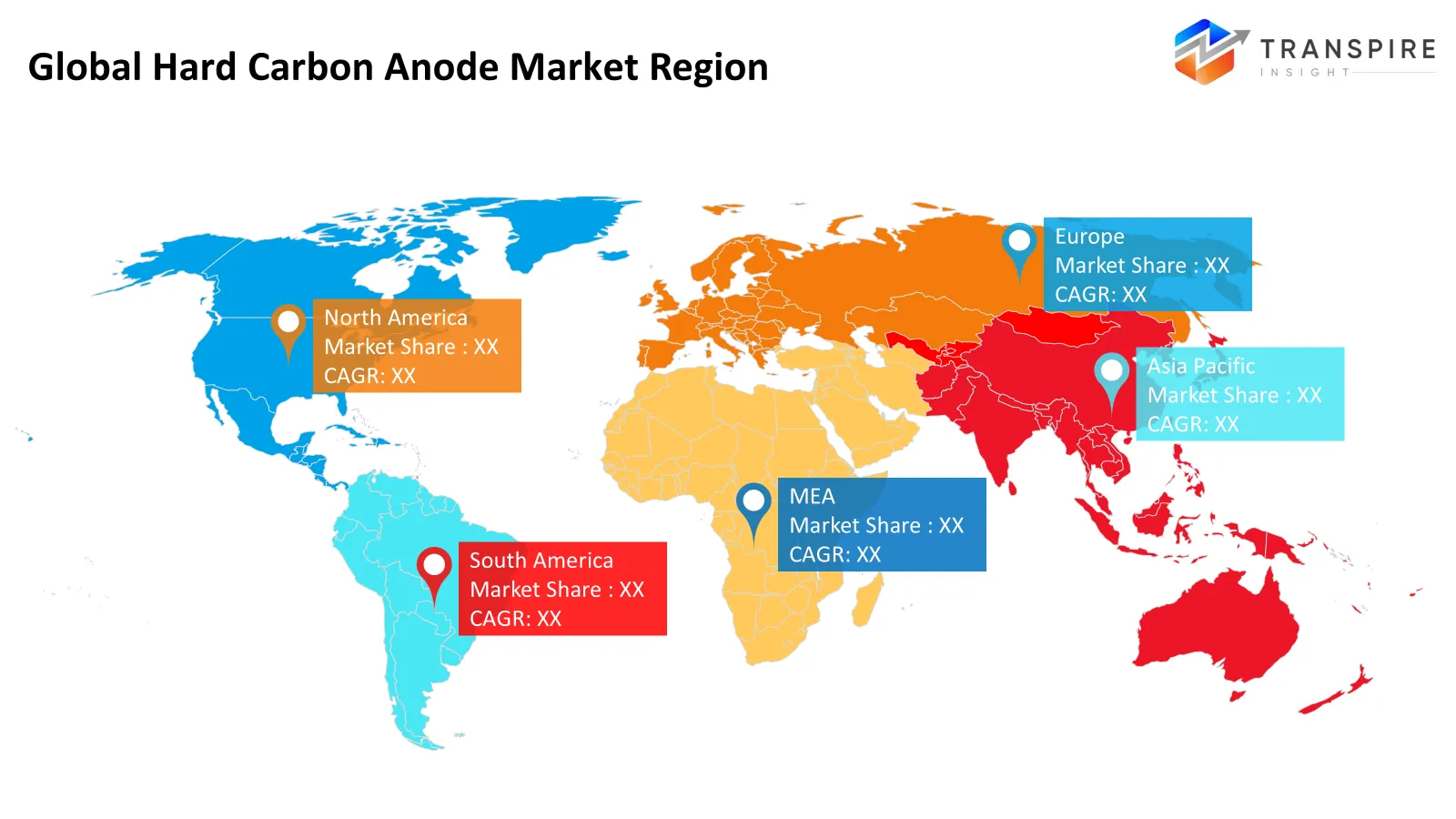
TheSynthetic Hard Carbondominated the market, accounting for approximately 57.4%in 2025, and is expected to rise at a significant CAGR during the forecast period.
The Global Hard Carbon Anode Marketis segmented by product type into biomass-derived hard carbon, synthetic hard carbon, pitch-based hard carbon, resin-based hard carbon, coconut shell hard carbon, wood-derived hard carbon, hybrid hard carbon, others. Among these, the Synthetic Hard Carbon dominated the market, accounting for approximately 57.4% in 2025 and expected to increase at a significant CAGR during the forecast period. It is because of its superior structural homogeneity, adjustable electrochemical characteristics, and increased application in sodium-ion and lithium-ion batteries to satisfy the expanding needs of renewable energy storage and electric cars.
The Lithium-ion Batteriessegmentheld the greatest share of approximately 45.0% in 2025 and is expected to increase at a substantial CAGR over the forecast period.
The Global Hard Carbon Anode Marketis segmented by battery type into sodium-ion batteries, lithium-ion batteries, solid-state batteries, hybrid batteries, grid storage batteries, EV batteries, consumer electronics batteries, others. Among these, the Lithium-ion Batteries segment held the greatest share of approximately 45.0% in 2025 and is expected to increase at a substantial CAGR over the forecast period. Their long cycle life, better energy density, and declining production costs are what propel growth. They are the best power source for renewable energy storage and electric vehicles (EVs) because of these advantages.
The Electric Vehiclessegmentheld the greatest share of approximately 52%in 2025 and is expected to increase at a high CAGR over the forecast period.
The Global Hard Carbon Anode Marketis segmented by application into electric vehicles, energy storage systems, consumer electronics, industrial equipment, power tools, medical devices, aerospace batteries, others. Among these, the Electric Vehicles segment held the greatest share of approximately 52% in 2025 and is expected to increase at a considerable CAGR over the projected period. Growth is driven by supportive government subsidies, stricter global emission regulations, declining battery costs, and expanding charging infrastructure. These factors significantly improve affordability and encourage consumer adoption.
Regional Segment Analysis of the Global Hard Carbon Anode Market
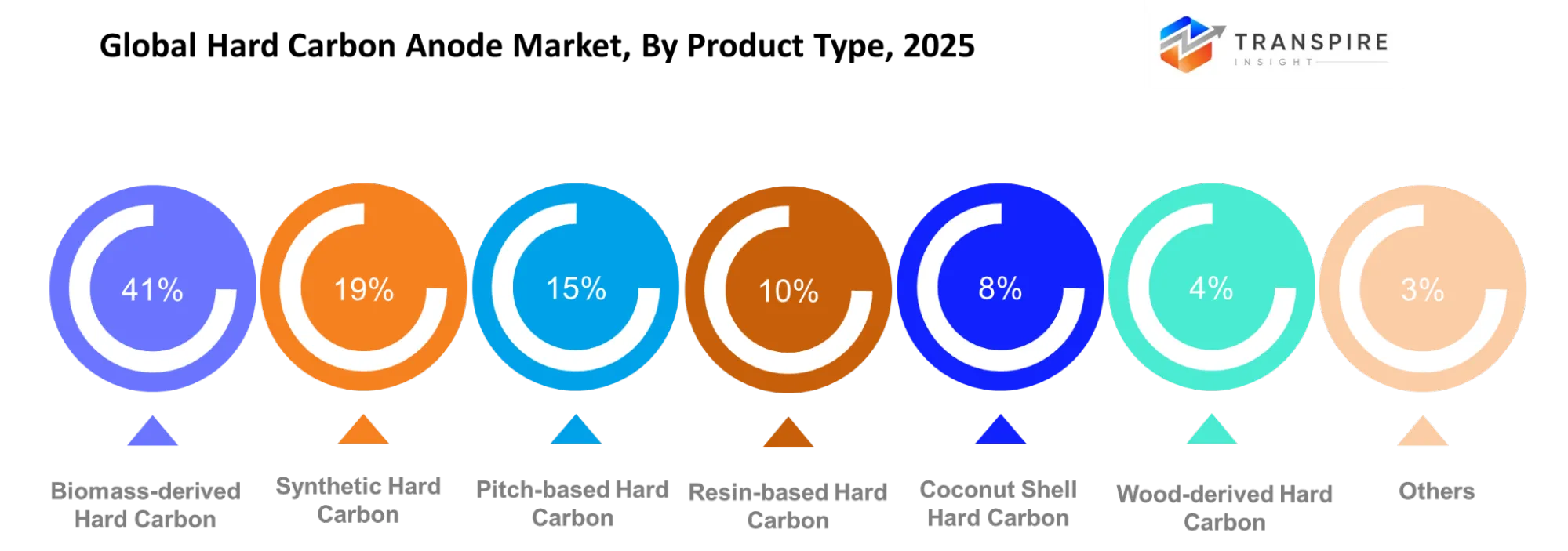
- North America (U.S., Canada, Mexico)
- Europe (Germany, France, U.K., Italy, Spain, Rest of Europe)
- Asia-Pacific (China, Japan, India, Rest of APAC)
- South America (Brazil and the Rest of South America)
- The Middle East and Africa (UAE, South Africa, Rest of MEA)
Asia Pacificis expected to grow at a rapid CAGR in the Global Hard Carbon Anode Market by holding approximately 55% of the share during the forecast period.
Over the course of the forecast period, the global hard carbon anode market is anticipated to rise rapidly in Asia Pacific. It makes up about 55% of the market. The area dominates this market because of the robust battery manufacturing ecosystem, particularly in China and Japan, which are the main centers of battery invention and production. Demand is further fueled by strong electric vehicle production, rising investments in renewable energy storage, and encouraging government regulations. Additionally, the fast commercialization of next-generation sodium-ion batteries is driving hard carbon anode material adoption, solidifying Asia Pacific's position as the top regional market.
Europe is the fastest-growing region in the Global Hard Carbon Anode Market during the period, holding approximately 18.6% share.
With an estimated 18.6% of the global hard carbon anode market share throughout the projection period, Europe is expected to grow at the highest rate. The EU Battery Regulations' focus on regional, transparent, and sustainable battery supply chains is what propels the expansion. The area is investing heavily in developing sodium-ion batteries, producing batteries locally, and developing next-generation energy storage technologies. Collaborations between material manufacturers and battery developers are advancing the commercialization of sustainable hard carbon anode materials throughout Europe, enabling long-term market growth, and nations like Sweden and Germany are emerging as significant innovation hubs.
North America is anticipated to hold approximately 17% share of the Global Hard Carbon Anode Market over the predicted timeframe.
North America is estimated to account for nearly 17% of the global hard carbon anode market over the forecast period. The region is expected to grow steadily, aided by substantial government assistance for sustainable energy and battery production, particularly through the US Inflation Reduction Act. Increased electric car production, increased investments in grid-scale energy storage, and expanding interest in sodium-ion battery technologies all contribute to market growth. Furthermore, efforts to localize battery supply chains and increase domestic production of critical materials are driving innovation, capacity expansion, and commercialization of advanced hard carbon anode materials across North America.
Strategies for Market Growth in Non-Leading Regions:
Non-leading regions can spur growth by building cost-effective and scalable hard carbon production plants with locally available biomass feedstocks including agricultural waste, coconut shells, and lignin. This will reduce reliance on imports and strengthen battery material supply chains by developing regional manufacturing and processing skills. Strategic collaborations with battery manufacturers, energy storage developers, automobile firms, and research institutions will help to accelerate commercialization and market penetration. Investments in personnel training, R&D, and sophisticated processing technologies are crucial for increasing product quality and industrial efficiencies. Additionally, government incentives, clean-energy policies, localization initiatives, and digital procurement and distribution channels can improve accessibility, attract investment, and accelerate the long-term expansion of the Global Hard Carbon Anode Market in rising economies around the world.
Future Market Trends for the Global Hard Carbon Anode Market: -
- Sodium-Ion Battery (SIB) Dominance, as lithium supply chains become constrained, SIBs have emerged as a key alternative, with industry giants such as CATL introducing mass-produced sodium-ion electric vehicles. Hard carbon is the favored anode for SIBs, with over 42% of the application market share.
- Shift to Sustainable Feedstocks, Manufacturers are increasingly relying on renewable biomass precursors—such as bamboo, coconut shells, and agricultural waste—to meet global ESG targets while avoiding the expensive, difficult synthesis of traditional petroleum-pitch hard carbons.
- 3.Technological and manufacturing upgrades, to compensate for hard carbon's low Initial Coulombic Efficiency (ICE), companies are investing in pre-lithiation technology and automated synthesis scaling to bring production costs closer to parity with regular graphite.
Recent Development
- May 18, 2026 – Epsilon Advanced Materials (India): Launched a next-generation sustainable hard carbon anode developed entirely through in-house R&D for sodium-ion batteries and grid-scale Energy Storage Systems (ESS). The coconut-shell-based material is designed to provide a graphite-free, lower-carbon, and cost-effective alternative for advanced battery applications, supporting the growing commercialization of sodium-ion technology.
- In December 2025 Stora Enso (Finland): Advanced the pilot production and commercialization of its Lignode product line, a bio-based hard carbon material derived from renewable lignin sourced from forest-industry byproducts. The initiative aims to support sustainable battery manufacturing, strengthen localized battery material supply chains, and address the increasing demand for sodium-ion and energy storage applications in Europe.
Market Segment
This study forecasts revenue at global, regional, and country levels from 2020 to 2033. Transpire Insights has segmented the Global Hard Carbon Anode Market based on the below-mentioned segments:
Global Hard Carbon Anode Market, By Product
- Biomass-derived Hard Carbon
- Synthetic Hard Carbon
- Pitch-based Hard Carbon
- Resin-based Hard Carbon
- Coconut Shell Hard Carbon
- Wood-derived Hard Carbon
- Hybrid Hard Carbon
- Others.
Global Hard Carbon Anode Market, By Battery Type
- Sodium-ion Batteries
- Lithium-ion Batteries
- Solid-state Batteries
- Hybrid Batteries
- Grid Storage Batteries
- EV Batteries
- Consumer Electronics Batteries
- Others.
Global Hard Carbon Anode Market, By Application
- Electric Vehicles
- Energy Storage Systems
- Consumer Electronics
- Industrial Equipment
- Power Tools
- Medical Devices
- Aerospace Batteries
- Others.
Global Hard Carbon Anode Market, By End User
- Battery Manufacturers
- Automotive OEMs
- Energy Storage Companies
- Electronics Manufacturers
- Research Institutes
- Chemical Companies
- Defense Sector
- Others.
Global Hard Carbon Anode Market, By Production Process
- Pyrolysis
- Carbonization
- Chemical Activation
- Hydrothermal Processing
- Template Synthesis
- High-temperature Treatment
- Composite Processing
- Others.
Global Hard Carbon Anode Market, By Regional Analysis
North America
- United States
- Canada
- Mexico
Europe
- Germany
- United Kingdom
- France
- Italy
- Spain
- Russia
- Rest of Europe
Asia Pacific
- China
- Japan
- India
- South Korea
- Australia
- Rest of Asia Pacific
South America
- Brazil
- Argentina
- Rest of South America
Middle East & Africa
- Saudi Arabia
- United Arab Emirates
- Qatar
- South Africa
- Rest of the Middle East & Africa
Frequently Asked Questions
Find quick answers to common questions.
Growth is driven by sodium-ion battery commercialization, renewable energy storage demand, electric vehicles, and supportive government manufacturing policies.
Asia Pacific leads the market due to strong battery manufacturing, electric vehicle production, and rapid sodium-ion battery commercialization.
Hard carbon offers larger interlayer spacing, good low-temperature performance, enhanced safety, and efficient sodium-ion storage capabilities.
High production costs and competition from established synthetic graphite supply chains remain the primary challenges for market adoption.
Synthetic hard carbon dominates the market because of its structural uniformity, tunable properties, and broad battery applications.
- Kuraray
- Resonac Holdings
- BTR New Material Group
- Shanshan Technology
- JFE Chemical
- Ningbo Shanshan
- Kureha Corporation
- Tokai Carbon
- SGL Carbon
- Mitsubishi Chemical
- POSCO Future M
- CNANO Technology
- Ningxia Baofeng
- Cnano Energy
- Sinosteel
About the Authors

Pankaj Ghogare Patil
I am Pankaj Ghogare Patil, a Senior Research Analyst at Transpire Insight, specializing in the Pharmaceutical, Chemicals & Materials, Healthcare IT, and Biotechnology industry. My expertise lies in conducting comprehensive market research, analyzing industry trends, evaluating competitive landscapes, and translating complex data into actionable insights. At Transpire Insight, I closely follow emerging technologies, regulatory developments, and market innovations to create accurate, well-researched, and informative content that helps businesses and professionals make informed decisions. I am committed to producing credible, evidence-based articles that reflect industry best practices while making technical topics accessible and valuable for a broad audience.

Chakradhar Khansole
Chakradhar serves as the Research Director at Transpire Insight, bringing over 8 years of experience in technology, innovation, and strategic market intelligence. He specializes in transforming complex market data into actionable business insights that enable organizations to make informed, growth-oriented decisions. Recognized for his strategic vision and analytical expertise, Chakradhar leads high-impact research initiatives, delivering comprehensive market assessments, competitive intelligence, and forward-looking industry analysis.
Recently Published Reports
-
May 2026
Healthcare Polymer Packaging Market
Healthcare Polymer Packaging Market Size, Share & Analysis Report By Packaging Type (Syringes, IV Bottles and Pouches, Clamshells, Blisters, Bottles & Jars, Containers, Tubes, IV Parental Packaging, Others), By Type (Regulated, Non-regulated), By Polymer Type (LDPE (Low-Density Polyethylene), HDPE (High-Density Polyethylene), Homo-polymer (Homo), Random Copolymer (Random), Block Copolymer (Block), PET, Polystyrene, Polyvinyl Chloride, Polyamide/EVOH, Others), and Geography (North America, Europe, Asia-Pacific, Middle East and Africa, South and Central America), 2021 - 2031
-
Apr 2026
Hydrophilic Tape (Waterstop) Market
Hydrophilic Tape (Waterstop) Market Size, Share & Analysis Report By Type (Bentonite-Based Hydrophilic Tape, Rubber-Based Hydrophilic Tape), By Application (Residential Buildings, Commercial Buildings, Infrastructure Projects), and Geography (North America, Europe, Asia-Pacific, Middle East and Africa, South and Central America), 2021 - 2031
-
Apr 2026
Metalens Market
Metalens Market Size, Share & Analysis Report By Type (Visible Light Metalens, and Infrared Metalens), By Application (Consumer Electronics, Automotive Electronics, Industrial, Medical, and Others), and Geography (North America, Europe, Asia-Pacific, Middle East and Africa, South and Central America), 2021 - 2031
-
Apr 2026
PBT Resin Market
PBT Resin Market Size, Share & Analysis Report By Type (Reinforced PBT Resin, Unreinforced PBT Resin), By Processing Method (Injection Molding, Extrusion, Blow Molding, Others), By End-User (Automotive, Electrical & Electronics, Consumer Appliances, Industrial Machinery, Medical Devices, Packaging, Others), and Geography (North America, Europe, Asia-Pacific, Middle East and Africa, South and Central America), 2021 - 2031