

Global ESR Analyzer Market Summary:
According to Transpire Insights, a detailed research report on the market reflects that the automated ESR analyzers segment dominates the Global ESR Analyzer Market, accounting for approximately 69% of the total share worldwide. Alifax S.r.l. leads the market with approximately (around USD 210 million) in annual revenue and an estimated 18–22% global market share, making it the leading contributor to global market development, innovation, advanced automated erythrocyte sedimentation rate (ESR) analyzers, high-throughput hematology diagnostics, expanding clinical laboratory automation capabilities, and overall market growth dynamics.
Market Snapshot
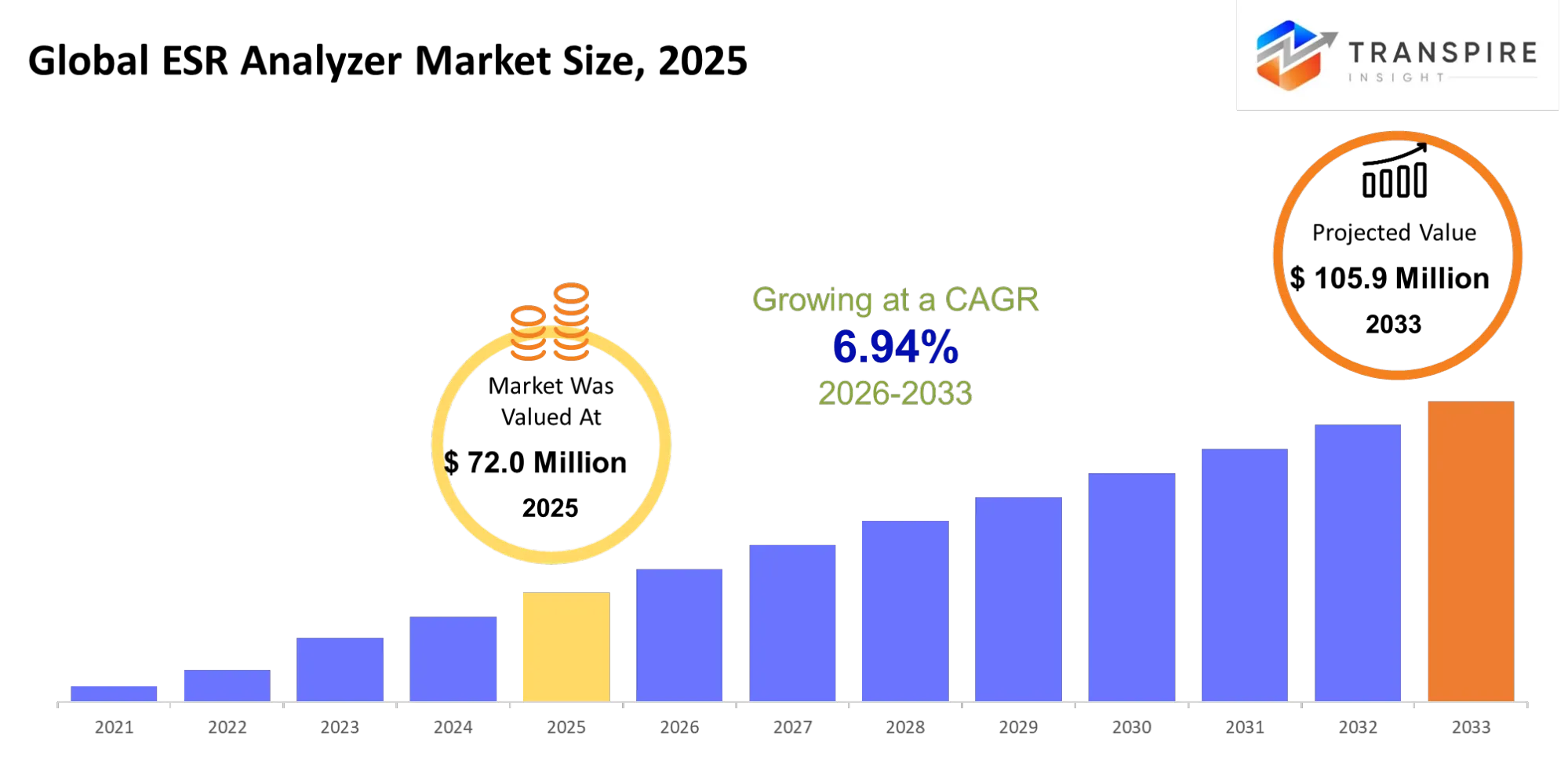
- Global Market Value (2025): USD 72.0 Million.
- Expected Market Value (2026): USD 75.56 Million.
- Estimated Market Value (2033): USD 105.9 Million.
- Forecast CAGR (2026–2033): 6.94%.
- Leading Region in 2025: Asia Pacific
- Second-largest Region: Europe
- Fastest Growing Region: North America
Introduction
The Global ESR Analyzer Market encompasses the development, manufacturing, distribution, and commercial application of automated and semi-automated erythrocyte sedimentation rate (ESR) analyzers used for measuring the rate at which red blood cells settle in a blood sample. ESR analyzers play a vital role in clinical diagnostics by assisting healthcare professionals in detecting and monitoring inflammatory conditions, autoimmune disorders, infectious diseases, and chronic illnesses. These systems offer faster turnaround times, improved accuracy, standardized testing, reduced manual intervention, and enhanced laboratory efficiency compared to conventional Westergren methods. Growing demand for automated laboratory diagnostics, increasing prevalence of chronic and inflammatory diseases, rising healthcare expenditure, technological advancements in hematology analyzers, and expanding diagnostic laboratory infrastructure are driving the global growth of the ESR Analyzer Market.
- For Instance:- North America holds the largest share of the Global ESR Analyzer Market. Countries such as the United States and Canada are major production and consumption hubs, supported by advanced clinical laboratories, favorable healthcare investments, and growing demand for accurate diagnostic solutions.
- Europe, Companies such as AlifaxS.r.l. are expanding research, product development, and global distribution of advanced ESR analyzers, improving diagnostic accuracy, laboratory productivity, and standardized inflammatory disease testing while strengthening the regional in-vitro diagnostics market.
Key Market Highlights: -
- Asia Pacific is expected to grow at a rapid CAGR in the ESR Analyzer Market by holding approximately 24% of the share during the forecast period.
- Europe is the fastest-growing region in the ESR Analyzer Market during the period, holding approximately 30% share.
- North Americais anticipated to hold projected 38% share of the ESR Analyzer Market over the predicte segment dominated the ESR Analyzer Ingredients Market and holds approximately d timeframe.
- By Product Type: The Automated ESR Analyzers segment dominated the market and held approximately61.5% share in 2025. The segment is projected to grow at a substantial CAGR during the forecast period due to increasing demand for high-throughput diagnostic testing, improved accuracy, reduced manual intervention, and growing adoption of laboratory automation in hospitals and diagnostic centers.
- 5. By Technology: The Optical Detection Technology segment dominated the market and held around57.2% share in 2025. Optical-based ESR analyzers are widely preferred because they provide rapid analysis, high precision, standardized results, and seamless integration with modern laboratory information systems.
- 6. By End User: The Hospital Laboratories segment dominated the market and held approximately48.0% share in 2025. Increasing patient admissions, growing prevalence of inflammatory and autoimmune disorders, rising demand for routine hematology testing, and expanding hospital laboratory infrastructure are expected to drive strong growth throughout the forecast period.
- Europe – Diagnostic Innovation: Europe continues to strengthen its position through investments in laboratory automation, advanced hematology diagnostics, and digital healthcare infrastructure. Manufacturers are expanding the development and production of automated ESR analyzers to improve diagnostic accuracy, reduce turnaround times, enhance workflow efficiency, and support the region's growing demand for standardized inflammatory disease testing across hospitals, diagnostic laboratories, and healthcare institutions.
How is Technology Driving Growth in the ESR Analyzer Market?
The ESR Analyzer Market is expanding due to continuous advancements in laboratory automation, digital diagnostics, and precision hematology technologies. Modern ESR analyzers utilize automated sample handling, optical detection systems, and advanced data processing algorithms to deliver rapid, accurate, and standardized erythrocyte sedimentation rate measurements compared to conventional manual Westergren methods. Innovations in high-throughput testing, barcode-based sample tracking, integrated laboratory information system (LIS) connectivity, and quality control features have enhanced testing efficiency, result consistency, and laboratory workflow while minimizing human error and turnaround time. These technological advancements are increasing the adoption of automated ESR analyzers across hospitals, diagnostic laboratories, and healthcare institutions, driving market growth through improved diagnostic accuracy, operational efficiency, and the rising demand for reliable inflammatory disease testing.
Market Drivers
The ESR AnalyzerMarket is being driven by increasing demand for automated diagnostic solutions, expanding healthcare infrastructure, and supportive government initiatives promoting early disease detection and laboratory modernization. Advancements in laboratory automation, digital diagnostics, and hematology technologies are enabling manufacturers to develop ESR analyzers with higher accuracy, faster turnaround times, and improved workflow efficiency compared to conventional manual testing methods. Rising investments in healthcare infrastructure, increasing prevalence of inflammatory and chronic diseases, growing diagnostic testing volumes, and regulatory support for advanced in-vitro diagnostic (IVD) technologies are encouraging manufacturers to expand production capacity, strengthen regional supply chains, accelerate product innovation, and create new growth opportunities across global markets.
- For Instance – India, Healthcare Diagnostics Expansion: Indian healthcare providers and diagnostic laboratory chains are increasingly investing in automated ESR analyzers and modern laboratory equipment to improve diagnostic accuracy, enhance testing efficiency, reduce turnaround times, and support the growing demand for routine hematology and inflammatory disease testing.
- For Instance – Government Support: Government initiatives across regions, including India, the European Union, and North America, are promoting healthcare modernization, laboratory automation, and improved access to diagnostic services through healthcare funding, infrastructure development, and favourable regulatory frameworks. These initiatives are encouraging investment in advanced ESR analysers, strengthening domestic diagnostic capabilities, and accelerating the growth of the Global ESR analyser Market.
Restrain
The ESR Analyzer Market faces challenges from the availability of alternative inflammatory biomarkers such as C-reactive protein (CRP), high acquisition and maintenance costs of automated analyzers, limited adoption resource-constrained healthcare facilities, and stringent regulatory approval requirement
Analysis of Prices and Consumer Behaviour
The ESR Analyzer Market is witnessing steady growth as demand increases across hospitals, diagnostic laboratories, and research institutions. Hospital laboratories account for approximately48% of total demand due to the rising need for rapid and standardized inflammatory disease testing. Automated ESR analyzers command a 20–30% price premium over semi-automated and manual systems because of their higher throughput, improved accuracy, reduced turnaround time, and advanced automation features. North America contributes over38% of global market revenue, supported by well-established healthcare infrastructure and widespread adoption of automated laboratory diagnostics. Nearly 70% of total demand originates from hospitals and diagnostic laboratories, while healthcare providers continue shifting toward fully automated, integrated diagnostic solutions, encouraging manufacturers to expand production capacity and invest in advanced laboratory automation technologies.
Top Companies in the ESR Analyzer Market
- Alifax
- Diesse Diagnostica Senese
- Streck
- Greiner Bio-One
- ELITechGroup
- Sysmex
- HORIBA
- Beckman Coulter
- Mindray
- Abbott
- Siemens Healthineers
- Roche Diagnostics
Global ESR Analyzer Market Segmentation
The ESR Analyzer Market share is divided into five categories: Product Type, technology Type, Application, End User, and distribution channel type
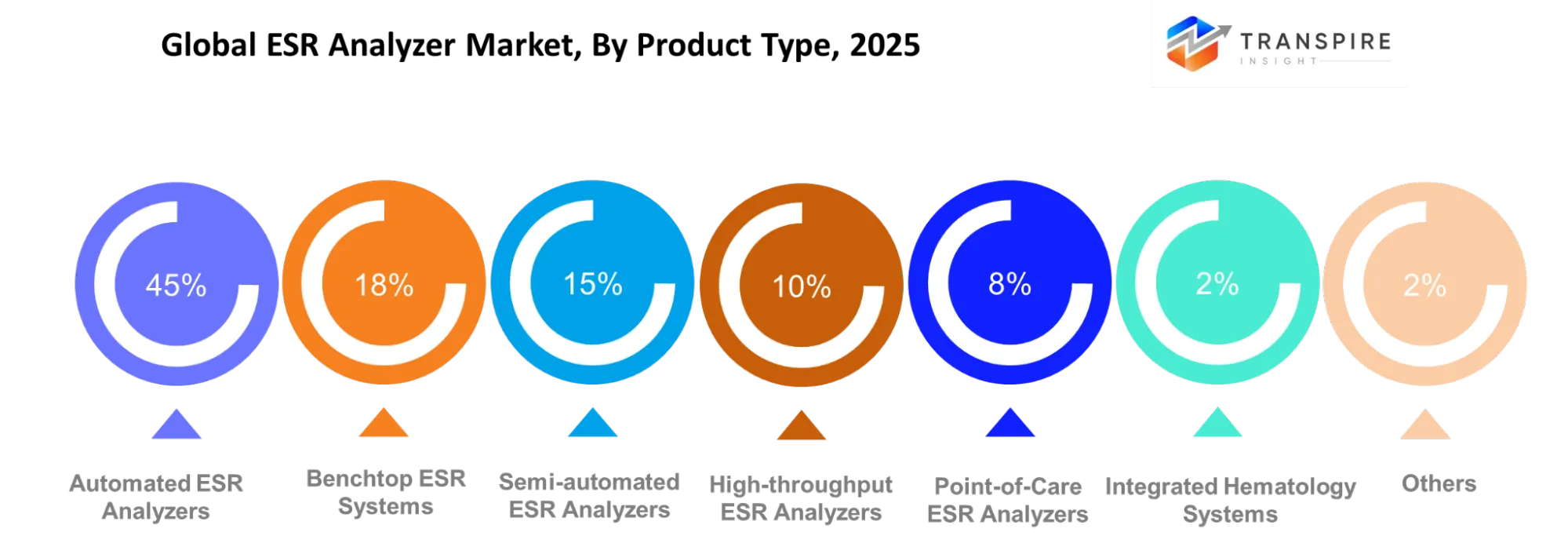
TheAutomated ESR Analyzers segment dominated the market, accounting for approximately 61%in 2025, and is expected to rise at a significant CAGR during the forecast period.
The ESR Analyzer Marketis segmented by product type into Automated ESR Analyzers, Semi-automated ESR Analyzers, Point-of-Care ESR Analyzers, Benchtop ESR Systems, Compact ESR Analyzers, High-throughput ESR Analyzers, Integrated Hematology Systems, Others segment held the greatest share of approximately 61% in 2025 and is expected to increase at a substantial CAGR over the forecast period. Automated ESR Analyzers dominate the market because they significantly reduce turnaround times, minimize human error, and require less manual intervention. Their high throughput and seamless lab integration capabilities perfectly suit busy clinical settings handling large sample volumes
The Optical Detection Technologysegment held the greatest share of approximately 57% in 2025 and is expected to increase at a substantial CAGR over the forecast period.
The ESR Analyzer Market is segmented by technology type into Westergren Method, Modified Westergren Method, Capillary Photometric Method, Microfluidic ESR Technology, Optical Detection, AI-assisted Analysis, Digital ESR Systems, OthersIt is because Within the broader photonic ecosystem, the Optical Detection Technology segment (including optical sensors, detectors, and imaging instruments) secures the greatest market share. This dominance is primarily driven by its high sensitivity, speed, and versatility in capturing data for consumer electronics, industrial automation, and healthcare
The Hospital Laboratoriessegmentheld the largest share, at approximately 48%, in 2025 and is expected to grow at a high CAGR over the forecast period.
The ESR Analyzer Marketis segmented by application Dietary Supplements, Functional Foods, Beverages, Animal Nutrition, Pharmaceuticals, Sports Nutrition, Infant Nutrition, Others Among these, the Hospital Laboratories segment holds the greatest share due to the increasing number of routine blood tests, rising prevalence of inflammatory and infectious diseases, growing adoption of automated laboratory diagnostics, and the need for rapid, accurate, and standardized erythrocyte sedimentation rate (ESR) testing to support timely clinical decision-making and patient management.
Regional Segment Analysis of the Global ESR Analyzer Market
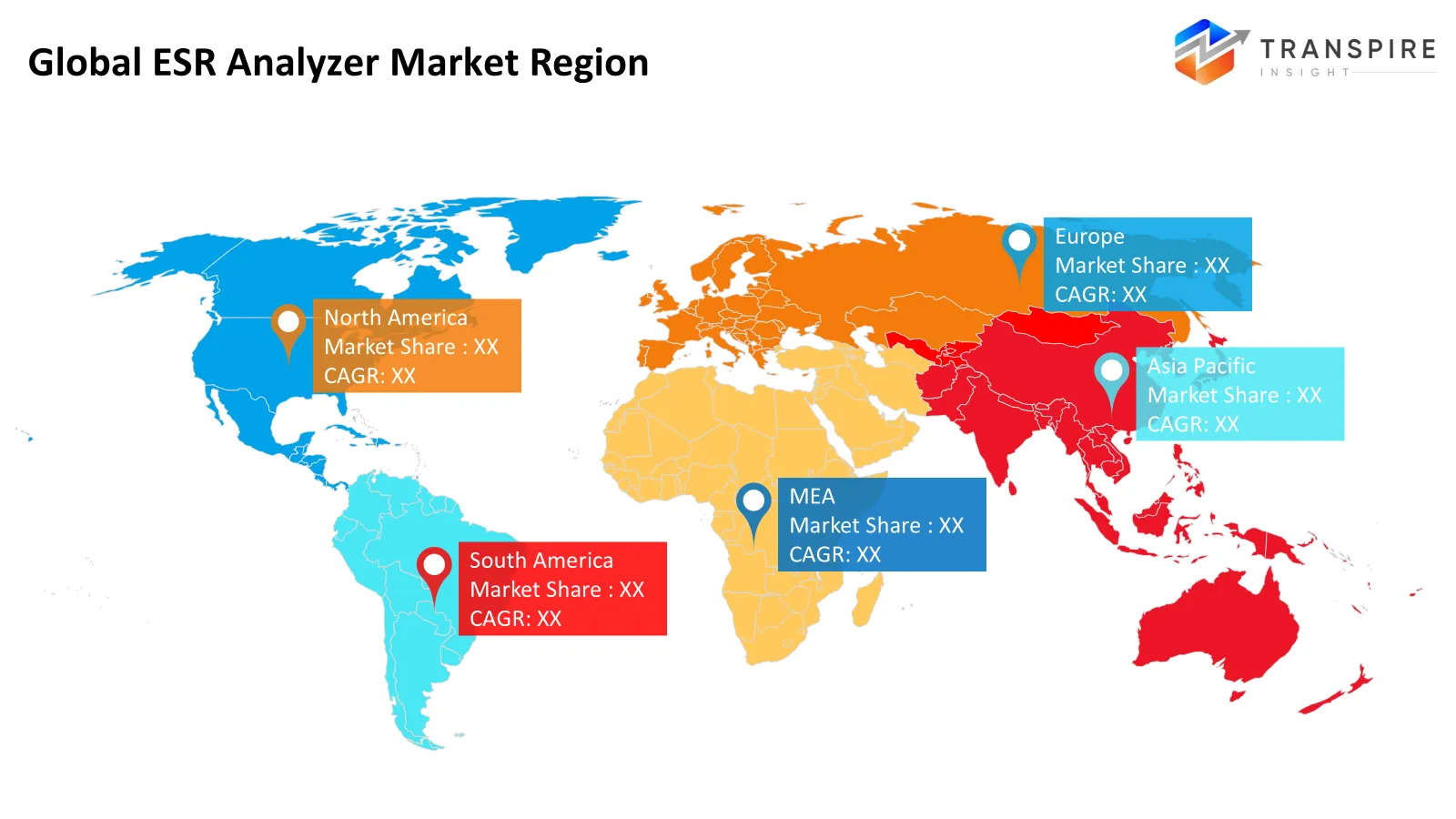
- North America (U.S., Canada, Mexico)
- Europe (Germany, France, U.K., Italy, Spain, Rest of Europe)
- Asia-Pacific (China, Japan, India, Rest of APAC)
- South America (Brazil and the Rest of South America)
- The Middle East and Africa (UAE, South Africa, Rest of MEA)
Asia Pacificis expected to grow at a rapid CAGR in the ESR Analyzer Market by holding approximately 30% of the share during the forecast period.
Over the course of the forecast period, the ESR Analyzer Market is anticipated to rise rapidly in Asia Pacific. It accounts for approximately 30% of the global market. The region is experiencing strong growth due to the expanding healthcare infrastructure, increasing adoption of automated laboratory diagnostics, and rising investments in hospitals and diagnostic laboratories, particularly in China, Japan, and India. Demand is further fueled by the growing prevalence of chronic and infectious diseases, increasing healthcare expenditure, and government initiatives to modernize diagnostic services. Additionally, continuous advancements in laboratory automation, expanding access to healthcare, and the growing presence of international and regional diagnostic equipment manufacturers are accelerating the adoption of automated ESR analyzers, strengthening Asia Pacific's position as one of the fastest-growing regional markets.
Europe is the fastest-growing region in the ESR Analyzer Market during the period, holding approximately 34% share.
With an estimated 34% of the Global ESR Analyzer Market share throughout the projection period, Europe is expected to grow at the highest rate. The region's expansion is driven by increasing investments in healthcare modernization, laboratory automation, and advanced in-vitro diagnostic (IVD) technologies. Growing prevalence of chronic, inflammatory, and autoimmune diseases, along with favorable government healthcare policies and strong public healthcare systems, is accelerating demand for automated ESR analyzers. Collaborations between diagnostic equipment manufacturers, hospitals, and research institutions are advancing the development and adoption of next-generation ESR analyzers featuring improved automation, digital connectivity, and standardized testing capabilities. Countries such as Germany, the United Kingdom, France, and Italy are emerging as major innovation hubs, supporting long-term market growth across Europe.
North America is anticipated to hold approximately 27% share of the ESR Analyzer Market over the predicted timeframe.
North America, accounting for approximately 27% of the global market. The region dominates the market due to its well-established healthcare infrastructure, widespread adoption of automated laboratory diagnostics, and the presence of leading in-vitro diagnostic (IVD) manufacturers. Demand is further driven by the increasing prevalence of inflammatory, autoimmune, and infectious diseases, rising diagnostic testing volumes, and favorable healthcare expenditure. Additionally, continuous investments in laboratory automation, digital healthcare technologies, and advanced hematology diagnostics are accelerating the adoption of automated ESR analyzers, reinforcing North America's position as the leading regional market.
Strategies for Market Growth in Non-Leading Regions:
Non-leading regions can spur growth by establishing cost-effective diagnostic manufacturing facilities, expanding healthcare infrastructure, and improving access to automated laboratory technologies. This will reduce reliance on imported diagnostic equipment and strengthen regional medical device supply chains by developing local manufacturing and technical expertise. Strategic collaborations with hospitals, diagnostic laboratories, healthcare providers, distributors, and research institutions will help accelerate product adoption and market penetration. Investments in workforce training, research and development, laboratory automation, and digital healthcare technologies are essential for improving diagnostic accuracy and operational efficiency. Additionally, government healthcare funding, favorable regulatory policies, localization initiatives, and digital procurement and distribution networks can enhance accessibility, attract investment, and accelerate the long-term expansion of the ESR Analyzer Market in emerging economies worldwide.
Future Market Trends for the ESR Analyzer Market: -
- Growing Adoption of Fully Automated ESR Analyzers:
Healthcare facilities are increasingly replacing manual and semi-automated systems with fully automated ESR analyzers to improve testing accuracy, reduce turnaround time, minimize human error, and handle rising diagnostic workloads efficiently. - Integration with Digital Laboratory Ecosystems:
Manufacturers are integrating ESR analyzers with Laboratory Information Systems (LIS), Hospital Information Systems (HIS), barcode-based sample tracking, and cloud-enabled data management to enhance workflow automation, data accuracy, and laboratory productivity. - Advancements in High-Throughput and Multi-Parameter Diagnostics:
Companies are investing in high-throughput ESR analyzers with improved optical sensing technologies, AI-assisted quality control, and integration with hematology analyzers, enabling faster processing, standardized results, and comprehensive diagnostic capabilities for modern clinical laboratories.
Recent Development
- March 2026 – Alifax S.r.l. (Italy): Introduced a next-generation fully automated ESR analyzer featuring enhanced optical detection technology, higher sample throughput, and seamless Laboratory Information System (LIS) connectivity. The new system is designed to improve diagnostic accuracy, reduce turnaround time, and enhance workflow efficiency in hospitals and high-volume diagnostic laboratories.
- June 2026 – Diesse Diagnostica Senese S.p.A. (Italy): Expanded its automated ESR diagnostic portfolio with upgraded analyzer software incorporating advanced quality control, barcode-based sample traceability, and digital data management capabilities. The development aims to improve laboratory automation, ensure standardized ESR testing, and support the growing demand for rapid inflammatory disease diagnostics across global healthcare institutions.
Market Segment
This study forecasts revenue at global, regional, and country levels from 2020 to 2033. Transpire Insights has segmented the ESR Analyzer Market based on the below-mentioned segments:
ESR Analyzer Market, By Product
- Automated ESR Analyzers
- Semi-automated ESR Analyzers
- Point-of-Care ESR Analyzers
- Benchtop ESR Systems
- Compact ESR Analyzers
- High-throughput ESR Analyzers
- ntegrated Hematology Systems
- Others
ESR Analyzer Market, By Technology
- Westergren Method
- Modified Westergren Method
- Capillary Photometric Method
- Microfluidic ESR Technology
- Optical Detection
- AI-assisted Analysis
- Digital ESR Systems
- Others.
ESR Analyzer Market, By Application
- Inflammatory Disease Testing
- Autoimmune Disease Diagnosis
- Infection Monitoring
- Cancer Diagnostic
- Rheumatology Testing
- Clinical Research
- Routine Health Screening
- Others
ESR Analyzer Market, By End User
- Hospitals
- Diagnostic Laboratories
- Research Institutes
- Blood Banks
- Specialty Clinics
- Academic Institutions
- Ambulatory Centers
- Others
ESR Analyzer Market, By Distribution
- Direct Sales
- Medical Equipment Distributors
- Online B2B Platforms
- Hospital Procurement
- OEM Suppliers
- Exporters
- Wholesalers
- Others
ESR Analyzer Market, By Regional Analysis
North America
- United States
- Canada
- Mexico
Europe
- Germany
- United Kingdom
- France
- Italy
- Spain
- Russia
- Rest of Europe
Asia Pacific
- China
- Japan
- India
- South Korea
- Australia
- Rest of Asia Pacific
South America
- Brazil
- Argentina
- Rest of South America
Middle East & Africa
- Saudi Arabia
- United Arab Emirates
- Qatar
- South Africa
- Rest of the Middle East & Africa
Frequently Asked Questions
Find quick answers to common questions.
Growth is driven by increasing demand for automated laboratory diagnostics, rising prevalence of inflammatory and chronic diseases, expanding healthcare infrastructure, and advancements in ESR analyzer technologies.
North America leads the market due to its advanced healthcare infrastructure, widespread adoption of laboratory automation, high diagnostic testing volumes, and strong investment in medical technologies.
Automated ESR analyzers provide faster turnaround times, higher accuracy, standardized results, reduced human error, and improved laboratory workflow efficiency.
High equipment costs, competition from alternative inflammatory biomarkers such as C-reactive protein (CRP), and limited adoption in resource-constrained healthcare facilities are key market restraints.
Automated ESR analyzers dominate the market due to their high throughput, operational efficiency, reliable performance, and growing adoption in hospitals and diagnostic laboratories worldwide.
- Alifax
- Diesse Diagnostica Senese
- Streck
- Greiner Bio-One
- ELITechGroup
- Sysmex
- HORIBA
- Beckman Coulter
- Mindray
- Abbott
- Siemens Healthineers
- Roche Diagnostics
About the Authors

Pankaj Ghogare Patil
I am Pankaj Ghogare Patil, a Senior Research Analyst at Transpire Insight, specializing in the Pharmaceutical, Chemicals & Materials, Healthcare IT, and Biotechnology industry. My expertise lies in conducting comprehensive market research, analyzing industry trends, evaluating competitive landscapes, and translating complex data into actionable insights. At Transpire Insight, I closely follow emerging technologies, regulatory developments, and market innovations to create accurate, well-researched, and informative content that helps businesses and professionals make informed decisions. I am committed to producing credible, evidence-based articles that reflect industry best practices while making technical topics accessible and valuable for a broad audience.

Chakradhar Khansole
Chakradhar serves as the Research Director at Transpire Insight, bringing over 8 years of experience in technology, innovation, and strategic market intelligence. He specializes in transforming complex market data into actionable business insights that enable organizations to make informed, growth-oriented decisions. Recognized for his strategic vision and analytical expertise, Chakradhar leads high-impact research initiatives, delivering comprehensive market assessments, competitive intelligence, and forward-looking industry analysis.
Recently Published Reports
-
Apr 2026
AI in Diabetic Retinopathy Market
AI in Diabetic Retinopathy Market Size, Share & Analysis Report By Type (Screening AI Systems, Diagnostic AI Systems, and Predictive AI Models), By Application Segment (Hospitals, Ophthalmology Clinics, Diagnostic Centers, and Research and Development), and Geography (North America, Europe, Asia-Pacific, Middle East and Africa, South and Central America), 2021 - 2031
-
Apr 2026
Psychometric Tests Market
Psychometric Tests Market Size, Share & Analysis Report By Type (Personality Tests, Ability/Aptitude Tests, Skill/Knowledge Tests, and Others), By Application (Talent Acquisition and Talent Management), and Geography (North America, Europe, Asia-Pacific, Middle East and Africa, South and Central America), 2021 – 2031
-
Apr 2026
Rare Biological Sample Collection Market
Rare Biological Sample Collection Market Size, Share & Analysis Report By Type (Isolation Kits & Reagent, Blood Collection Tubes, and Others), By Application (Oncology, Transcriptomics, Pharmacogenomics, and Others), and Geography (North America, Europe, Asia-Pacific, Middle East and Africa, South and Central America), 2021 – 2031
-
Jul 2026
Diabetic Retinopathy Market
Diabetic Retinopathy Market Size, Share & Analysis Report By Type (Proliferative Diabetic Retinopathy, and Diabetic Macular Edema (DME)), By Treatment Type (Anti VEGF Drug, Steroid Implants, Laser Surgeries, and Vitrectomy), and Geography (North America, Europe, Asia-Pacific, Middle East and Africa, South and Central America), 2021 – 2031
Our Clients







