
Global Electrical Appliances Market Size & Forecast:
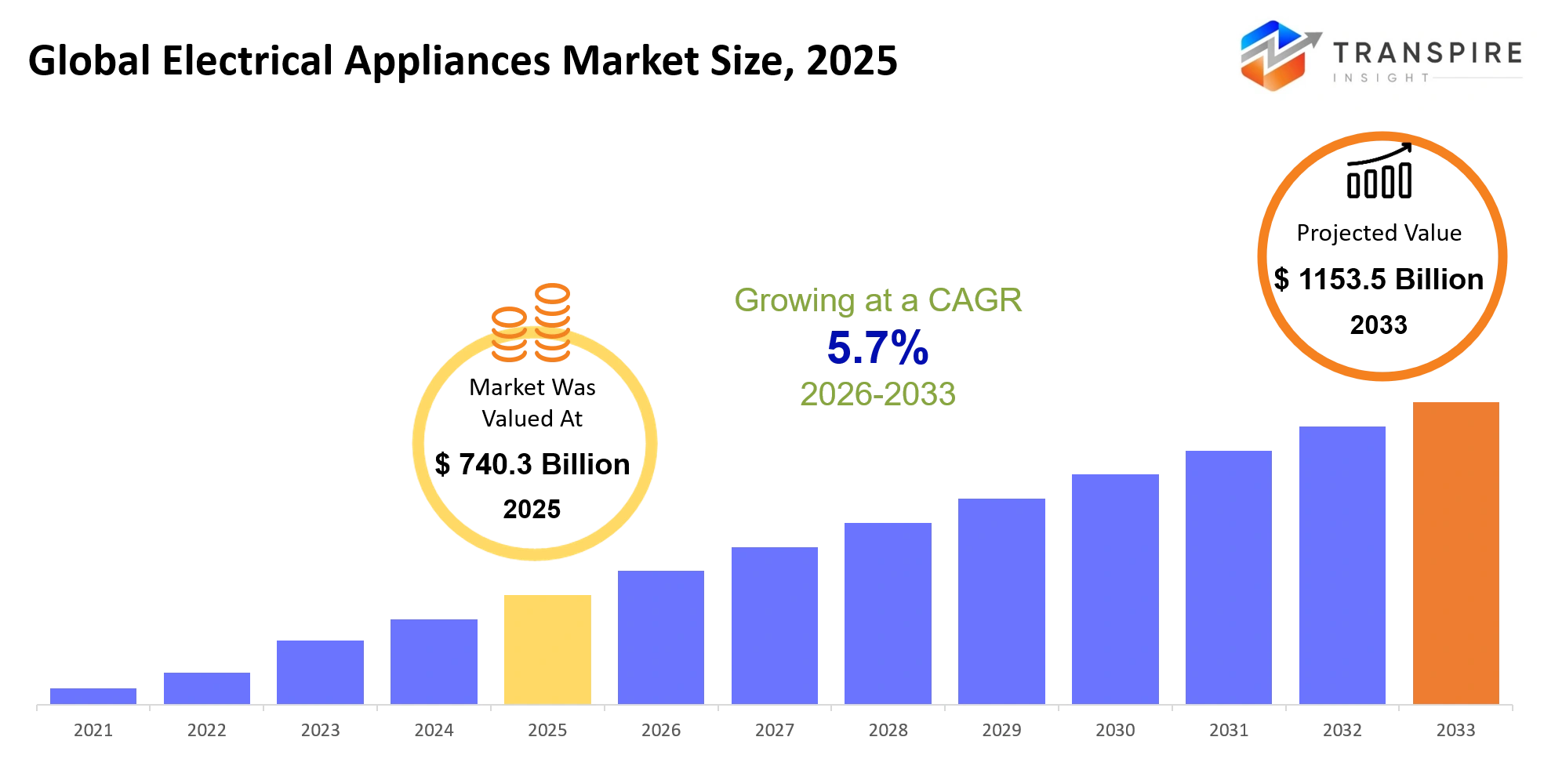
- Global Electrical Appliances Market Size 2025: USD 740.3 Billion
- Global Electrical Appliances Market 2033: USD 1153.5 Billion
- Global Electrical Appliances Market CAGR: 5.7%
- Global Electrical Appliances Market Segments: By Product (Kitchen Appliances, Home Care Appliances, Air Treatment Appliances, Personal Care Appliances, Laundry Appliances, Entertainment Appliances, Smart Appliances, Others); By Technology (Conventional, Energy Efficient, Smart Connected, AI-enabled, IoT-enabled, Sensor-based, Others); By Distribution Channel (Online, Hypermarkets, Specialty Stores, Brand Stores, Dealers, Others); By End User (Residential, Commercial, Industrial, Hospitality, Others); By Price Range (Economy, Mid-range, Premium, Luxury, Others).
Global Electrical Appliances Market Summary:
As per Transpire Insight Analysis, the Global Electrical Appliances Market size is estimated at USD 740.3 Billion in 2025 and is anticipated to reach USD 1153.5 Billion by 2033, growing at a CAGR of 5.7% from 2026 to 2033.
The global electrical appliances market is changing because people want products that are easy to use, energy-efficient, and compatible with other devices. People who buy appliances for their homes and businesses are getting rid of old ones and buying new ones that have advanced features, use less electricity, and work better. Companies that make appliances are producing products with smart technology and easy-to-use features, which makes them more valuable to buyers.
In the past few years, people have started buying appliances that can connect to the internet and work with other devices in their homes. This is because more people have homes, the government is making rules to save energy, and people are becoming more aware of how to live in a way that is good for the environment. The government is also helping by encouraging companies to make appliances that use energy and can connect to the internet. This is making companies invest in appliances that use the internet and artificial intelligence.
Another reason the electrical appliances market is growing is that people in countries that are getting richer are buying appliances for their homes. People are also replacing appliances with new ones that work better, are easier to take care of and save energy in the long run. This is making companies do research, make more products and sell them at different prices. Since people care about technology being able to connect to the internet and living in a way that is good for the environment, the electrical appliances market will probably keep growing for a long time, both for people who buy appliances for their homes and for businesses.
Key Market Insights
The global market of electrical appliances is growing as more consumers opt for intelligent, energy-efficient and interconnected devices. Innovations in the field of digital technology and sustainable manufacturing processes keep on shaping the product development and buying process.
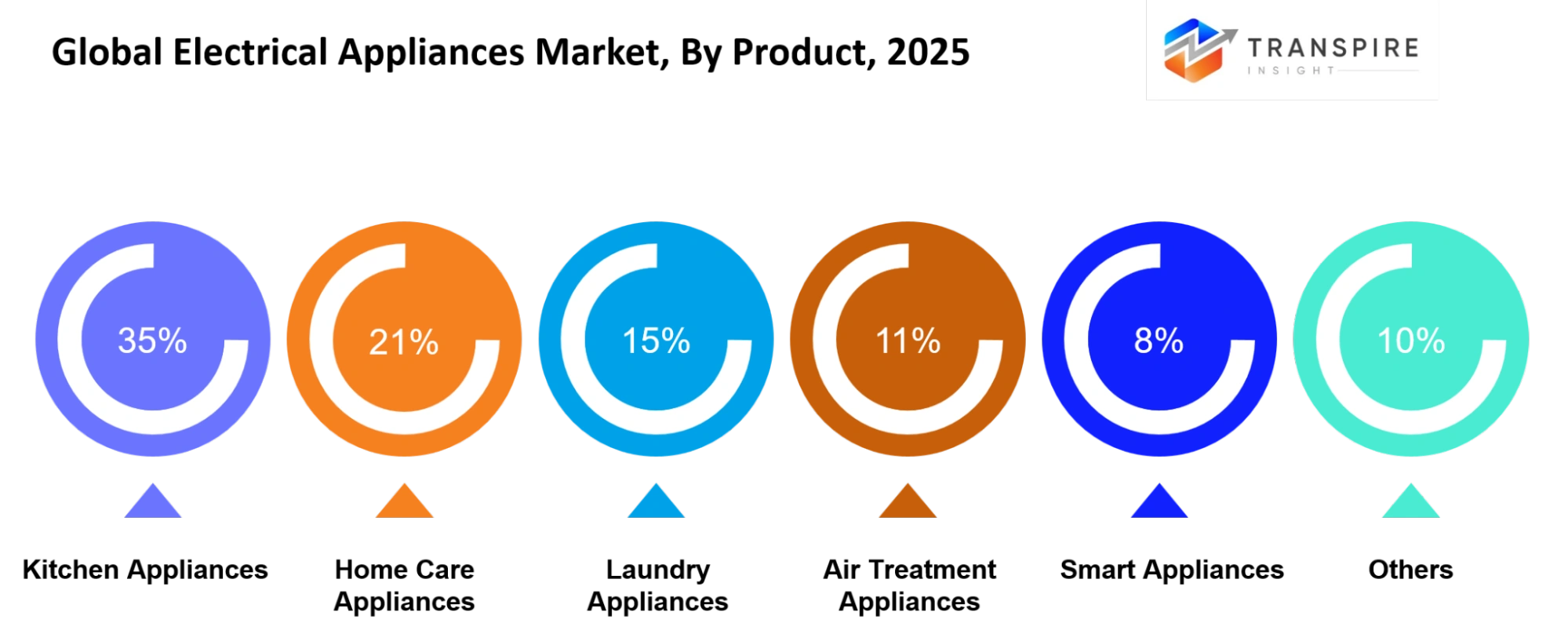
- Kitchen appliances occupy 35% of the market due to high demand for efficient and multifunctional kitchen appliances.
- Home care appliances make up 21% as there is increasing concern for household hygiene and automatic cleaning products.
- Laundry appliances have 15% of the share because companies are now working on efficient and water-saving washers.
- Air treatment appliances account for 11% of the share due to increased awareness of indoor air quality issues.
- Smart appliances have 8% of the market share and are the fastest-growing segment with 15.2% CAGR.
- Companies invest heavily in AI, IoT and sensors to increase the efficiency and ease of use of appliances.
- Online retailing and innovations in sustainable products help expand the client base worldwide.
What are the Key Drivers, Restraints, and Opportunities in the Global Electrical Appliances Market?
Drivers
The global market for electrical appliances is seeing steady growth on account of increased demand for efficient and technologically advanced products. With rising urbanisation, rising disposable incomes, and changing lifestyles, individuals and firms are increasingly buying newer gadgets that make their lives easier by being energy-efficient and high-performing. The introduction of government policies favouring energy efficiency and the proliferation of smart home systems have further boosted replacement activity, resulting in sustained market growth.
Restraints
Although there is an optimistic market trend, many barriers to growth remain. Premium and smart electrical appliances are relatively expensive to buy in price-sensitive markets. Additionally, changes in the cost of raw materials and manufacturing, along with logistics and shipping issues, continue to affect product manufacturing timelines and pricing. Also, device incompatibility and a lack of digital infrastructure in certain developing countries hinder adoption rates of smart electrical appliances.
Opportunities
The market offers huge potential for growth from the growing uptake of IoT-powered devices and appliances equipped with artificial intelligence. The manufacturers are spending on the development of smart home ecosystems, predictive maintenance capabilities, and energy management systems in line with the changing consumer demands. Emerging nations in the regions of Asia-Pacific, Latin America, and the Middle East are experiencing the growing requirement for advanced home appliances owing to the betterment in living standards and residential constructions.
What Has the Impact of Artificial Intelligence Been on the Global Electrical Appliances Market?
Artificial intelligence is one of the technologies that has impacted the global electrical appliances industry by making household and commercial appliances intelligent and efficient. The implementation of AI has been noticed in various kinds of appliances like refrigerators, washing machines, air conditioners, robotic vacuum cleaners, and kitchen appliances, which will automate their operation and make them function better.
Predictive functions of AI allow manufacturers to create a predictive maintenance system for their products. They can integrate AI-enabled sensors in the equipment, which will monitor its performance, notice abnormalities in its work, and alert the user about a potential malfunction. As a result, the costs related to repairing, the time spent on waiting for technical service specialists and possible replacement, as well as the lifespan of the product, can be increased significantly. However, there are some drawbacks to using AI in household appliances, which are related to higher prices of such products, worries regarding the privacy of the data collected from appliances, and incompatibility of the AI-enabled appliances with smart home systems. Nevertheless, ongoing developments of AI technology and reduced costs of hardware will increase the availability of intelligent electrical appliances. In January 2025, Samsung Electronics unveiled its “AI Home” concept at CES 2025 by launching AI-driven refrigerators, washing machines, ovens, and vacuum cleaners. The introduction of the AI Home concept boosted the use of smart home appliances.
Key Market Trends
The global electrical appliances industry is developing fast due to innovations, sustainability trends, and the integration of digital technology, which changes consumer demands. The manufacturers now place emphasis on intelligent appliance characteristics, energy efficiency, and high-quality products to improve their market position.
- Smart connectivity has become an integral part of the industry because more and more appliances can be controlled through mobile applications, voice assistants, and other remote means.
- The introduction of energy-efficient products is getting more popular among consumers who want to save on electricity bills and comply with regulations.
- IoT and AI solutions are introduced to appliances to perform predictive maintenance, automate work, and offer a personalised user experience.
- Recyclable materials and sustainable manufacturing are used by manufacturers to satisfy their sustainability requirements and changing demands of consumers.
- E-commerce channels are becoming more popular, allowing brands to sell their appliances to a larger number of consumers online.
- There is a growing need for premium appliances in households, which require higher energy performance, smart characteristics, and good design.
- Innovation activities in the R&D departments increase due to demand for intelligent appliances.
Global Electrical Appliances Market Segmentation
By product type
Kitchen appliances make up the biggest market share in the global market for electrical appliances at 35%, owing to high demand from consumers for refrigerators, microwaves, dishwashers, and other appliances used in cooking. Home care appliances make up 21%, whereas laundry appliances comprise 15% of the market, as consumers have become more inclined towards using appliances for cleaning their houses. Air treatment appliances make up 11% of the market as consumers have now started paying attention towards improving the air quality inside their homes. Smart appliances only make up 8% of the market but is the fastest growing category, which is increasing at a CAGR of 15.2%.
By technology type
Consumers are increasingly opting for appliances that require less energy consumption, have automatic controls, can be monitored remotely, and can perform predictive maintenance through artificial intelligence. This is resulting in a shift from traditional appliances to energy-efficient appliances.
By distribution channel
e-commerce channels are becoming popular because consumers find shopping online convenient and cheaper, with doorstep delivery facility provided. Hypermarkets, speciality stores, brand outlets, and authorised dealers have also played an important part in this market.
By end users
The residential segment is still the highest contributor as far as end users are concerned because of the growing use of more household appliances and smart homes. The commercial, industrial, and hospitality segments are also growing in terms of spending on energy-efficient appliances to boost efficiency and cut down maintenance costs.
By Price Range
As per price category, the mid-price category attracts the largest number of customers as it strikes the perfect balance between affordability and new-age innovations. The high-end appliances are gaining a lot of traction among customers who value technology and performance.
What are the Key Use Cases Driving the Global Electrical Appliances Market?
The largest use of electrical appliances is in the residential sector, wherein kitchen appliances account for the highest proportion of demand. Refrigerators, microwaves, dishwashers, and cooking appliances in general are now more frequently used by consumers to save time and conserve energy during daily chores. In addition to residential usage, commercial buildings like hotels, hospitals, restaurants, offices, and retail spaces are opting for state-of-the-art electrical appliances to ensure efficiency, hygienic conditions, and energy savings over the long run.
Another set of emerging use cases comes from smart homes and living environments. Appliances featuring AI and IoT technologies, which offer remote monitoring and voice control features, are increasingly gaining traction among customers.
|
Report Metrics |
Details |
|
Market size value in 2025 |
USD 740.3 Billion |
|
Market size value in 2026 |
USD 782.5 Billion |
|
Revenue forecast in 2033 |
USD 1153.5 Billion |
|
Growth rate |
CAGR of 5.7% from 2026 to 2033 |
|
Base year |
2025 |
|
Historical data |
2021 - 2024 |
|
Forecast period |
2026 - 2033 |
|
Report coverage |
Revenue forecast, competitive landscape, growth factors, and trends |
|
Regional scope |
United States; Canada; Mexico; United Kingdom; Germany; France; Italy; Spain; Denmark; Sweden; Norway; China; Japan; India; Australia; South Korea; Thailand; Brazil; Argentina; South Africa; Saudi Arabia; United Arab Emirates |
|
Key company profiled |
Samsung, LG, Whirlpool, Haier, Midea, Panasonic, Electrolux, Bosch, Philips, Hitachi, Sharp, Toshiba, GE Appliances, Bajaj Electricals, Havells. |
|
Customization scope |
Free report customization (country, regional & segment scope). Avail customized purchase options to meet your exact research needs. |
|
Report Segmentation |
By Product (Kitchen Appliances, Home Care Appliances, Air Treatment Appliances, Personal Care Appliances, Laundry Appliances, Entertainment Appliances, Smart Appliances, Others); By Technology (Conventional, Energy Efficient, Smart Connected, AI-enabled, IoT-enabled, Sensor-based, Others); By Distribution Channel (Online, Hypermarkets, Specialty Stores, Brand Stores, Dealers, Others); By End User (Residential, Commercial, Industrial, Hospitality, Others); By Price Range (Economy, Mid-range, Premium, Luxury, Others). |
Which Regions are Driving the Global Electrical Appliances Market Growth?
North America
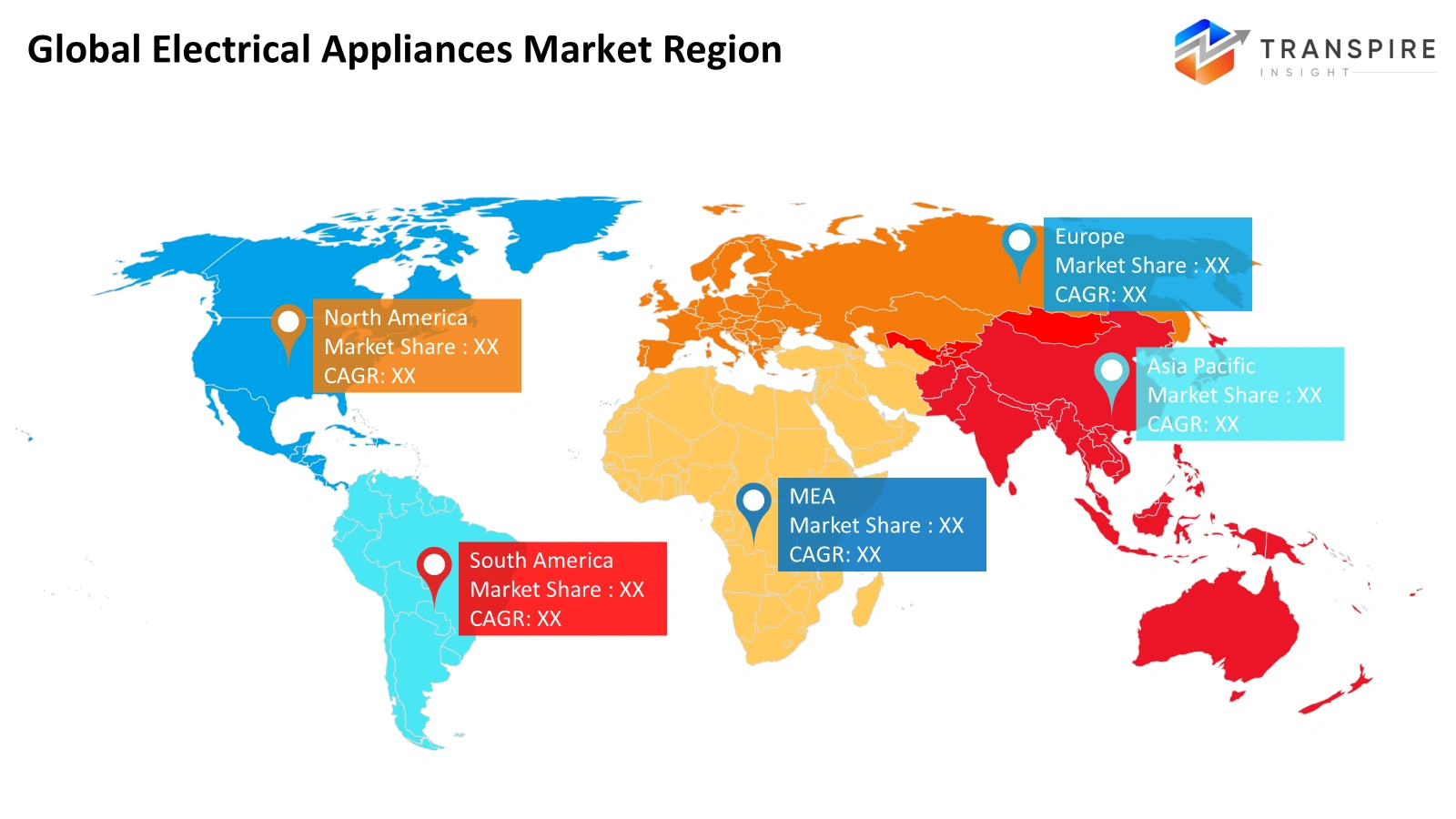
The North American market occupies nearly 23% of the total market due to the strong purchasing capacity of consumers and the availability of premium and smart appliances in the market. High demand for energy-efficient products, a well-developed infrastructure of smart homes, and constant introduction of innovative products lead to stable growth of the market. Main players consistently offer new models of AI-driven and connected appliances according to consumer needs.
Europe
The European market shares about 21% of the global market; however, it has high growth potential due to the strong orientation of this region towards sustainability and energy conservation. Consumers seek environmentally-friendly products with the ability to pass strict energy regulations. At the same time, Latin America, accounting for 6% of the market, demonstrates high growth rates of 12.7% and is forecasted to have the highest CAGR among others due to growing urbanisation and increasing income levels of households, as well as improved distribution channels. The Middle East and Africa, with 5% share, also experience growing demand for products.
Asia-Pacific
The Asia-Pacific region holds dominance in the international electrical appliance market, generating about 45% of total sales. It gains due advantage from its manufacturing strength, robust electronics supply chain, and increased expenditure on advanced home appliances by consumers. The rapid pace of urbanisation, increased disposable income, and growing construction activities in residential buildings fuel the demand for the products in nations like China, India, Japan, and South Korea. In June 2025, Samsung Electronics introduced its 2025 Bespoke AI home appliances in Asia, which include AI refrigerators, washing machines, and air conditioners. The introduction boosts the position of the region as a leader in connected and intelligent household appliances.
Who are the Key Players in the Global Electrical Appliances Marketand how do they Compete?
The electrical appliances market worldwide is very competitive as different organisations are engaging in innovations for improved products, energy efficiency, and smart solutions, as well as having an international distribution network to strengthen their market share. The competition among the companies is through constant investments in R&D, introduction of premium products, digitisation, and expansion to developing countries. Additionally, these organisations are improving the quality of their after-sales services as well as online selling channels.
Some of the main companies that compete in the market include Samsung Electronics, LG Electronics, Whirlpool Corporation, Haier Smart Home, and Midea Group. These companies compete in terms of continuous product innovation, smart home solutions, and a premium product portfolio. Also, they are expanding their manufacturing capacity and distribution network to increase their presence in both developed and developing countries. Also, some of the other major competitors include BSH Home Appliances, Panasonic Corporation, Electrolux AB, Arçelik A.Ş., and Sharp Corporation. In particular, these companies compete in terms of the sustainability of their products and energy-efficient appliances, as well as expanding their market in different regions around the world.
Global Electrical Appliances Market companies
- Samsung
- LG
- Whirlpool
- Haier
- Midea
- Panasonic
- Electrolux
- Bosch
- Philips,
- Hitachi
- Sharp
- Toshiba
- GE Appliances
- Bajaj Electricals
- Havells
Recent Development News
In April 2026, the Electrolux Group formed a strategic alliance with the Midea Group in North America. This partnership will be instrumental in fostering innovation in products, enhancing efficiency in production processes, and augmenting the range of electrical appliances in their respective portfolios.
Source: https://www.electroluxgroup.com
In July 2025, Reliance Retail acquired Kelvinator, which is a renowned brand in home appliances. This acquisition increased Reliance Retail's footprint in India’s rapidly growing market of consumer durables and electrical appliances.
Source: https://www.reuters.com
In May 2025, Bosch introduced their XXL Top Freezer refrigerator series in India in two sizes: 540L and 640L. It was an addition to the company’s range of premium refrigerators and fulfilled the need for high-capacity, energy-efficient home appliances among consumers.
Source: https://www.bosch-home.in
What Strategic Insights Define the Future of the Global Electrical Appliances Market?
The global electrical appliances market is anticipated to evolve due to constant innovations in smart technology, energy efficiency, and home ecosystem connectivity. In order to gain competitive advantages and capitalise on the needs of consumers, manufacturers will need to integrate artificial intelligence (AI), Internet of Things (IoT), and sustainable product development into their activities. Nevertheless, one hidden danger lies in the complicated structure of the global supply chain and changes in the prices of raw materials. On the other hand, rising demand from developing countries and the use of smart home devices provide an excellent opportunity for expansion of the market. The focus should be on improving research and development, digital distribution networks, and smart appliance development at relatively low cost.
Key Segmentations are:
By Product
- Kitchen Appliances
- Home Care Appliances
- Air Treatment Appliances
- Personal Care Appliances
- Laundry Appliances
- Entertainment Appliances
- Smart Appliances
By Technology
- Conventional
- Energy Efficient
- Smart Connected
- AI-enabled
- IoT-enabled
- Sensor-based
By Distribution Channe
- Online
- Hypermarkets
- Specialty Stores
- Brand Stores
- Dealers
By End User
- Residential
- Commercial
- Industrial
- Hospitality
By Price Range
- Economy
- Mid-range
- Premium
- Luxury
Regional Outlook
North America
- United States
- Canada
- Mexico
Europe
- Germany
- United Kingdom
- France
- Spain
- Italy
- Rest of Europe
Asia Pacific
- Japan
- China
- Australia & New Zealand
- South Korea
- India
- Rest of Asia Pacific
South America
- Brazil
- Argentina
- Rest of South America
Middle East & Africa
- Saudi Arabia
- United Arab Emirates
- South Africa
- Rest of the Middle East & Africa
Frequently Asked Questions
Find quick answers to common questions.
The global electrical appliances market size was valued at USD 740.3 Billion in 2025 and is poised to reach USD 1153.5 Billion by 2033, expanding at a 5.7%CAGR.
Key segments for the global electrical appliances market are By Product (Kitchen Appliances, Home Care Appliances, Air Treatment Appliances, Personal Care Appliances, Laundry Appliances, Entertainment Appliances, Smart Appliances, Others); By Technology (Conventional, Energy Efficient, Smart Connected, AI-enabled, IoT-enabled, Sensor-based, Others); By Distribution Channel (Online, Hypermarkets, Specialty Stores, Brand Stores, Dealers, Others); By End User (Residential, Commercial, Industrial, Hospitality, Others); By Price Range (Economy, Mid-range, Premium, Luxury, Others).
Growth is primarily driven by the main growth factors, which are increasing consumer demand for energy-efficient gadgets and smart appliances, increasing urbanization, rising income levels, fast housing construction, and use of smart home solutions.
The global market is led by major manufacturers, including Samsung, LG, Whirlpool, Haier, Midea, Panasonic, Electrolux, Bosch, Philips, Hitachi, Sharp, Toshiba, GE Appliances, Bajaj Electricals, Havells.
Asia Pacific contributes 45% to the world electrical appliances market because of various factors like fast urbanisation rates, increasing disposable income levels, increased production capacity, high consumer demands and the fact that most electrical appliance manufacturers operate in countries like China, India, Japan and South Korea.
Opportunities in the international electrical appliances industry comprise increasing demand for intelligent energy-efficient appliances, growth of luxury home appliances in developing countries, rise in e-commerce sales platforms, and increasing use of artificial intelligence and IoT in home appliances.
- Samsung
- LG
- Whirlpool
- Haier
- Midea
- Panasonic
- Electrolux
- Bosch
- Philips,
- Hitachi
- Sharp
- Toshiba
- GE Appliances
- Bajaj Electricals
- Havells
About the Authors

Avinash Kumar
I’m Avinash Kumar, a Senior Research Analyst at Transpire Insight, with expertise in the Electronics and Semiconductor and Energy & Power industry. My work focuses on analyzing emerging technologies, market trends, industry developments, and innovation across these sectors. I specialize in transforming complex technical and market insights into clear, research-backed content that helps professionals, businesses, and decision-makers stay informed. Through continuous industry research and data-driven analysis, I strive to deliver accurate, reliable, and practical perspectives on the latest advancements shaping the semiconductor and energy landscape.

Chakradhar Khansole
Chakradhar serves as the Research Director at Transpire Insight, bringing over 8 years of experience in technology, innovation, and strategic market intelligence. He specializes in transforming complex market data into actionable business insights that enable organizations to make informed, growth-oriented decisions. Recognized for his strategic vision and analytical expertise, Chakradhar leads high-impact research initiatives, delivering comprehensive market assessments, competitive intelligence, and forward-looking industry analysis.
Recently Published Reports
-
Apr 2026
Fiber Optic Faceplates Market
Fiber Optic Faceplates Market Size, Share & Analysis Report By Type (< 300 mm2, 300-350 mm2, and > 350 mm2, By Application (Night Vision, Holographic Imaging, Medical, and Others), and Geography (North America, Europe, Asia-Pacific, Middle East and Africa, South and Central America), 2021 - 2031
-
Apr 2026
High Temperature Superconductors Market
High Temperature Superconductors Market Size, Share & Analysis Report By Type (1G HTS, and 2G HTS), By Application (Power Cable, Fault Current Limiter, and Transformer), and Geography (North America, Europe, Asia-Pacific, Middle East and Africa, South and Central America), 2021 - 2031
-
Apr 2026
Industrial Plugs and Socket Market
Industrial Plugs and Socket Market Size, Share & Analysis Report By Type (Industrial Plugs, Industrial Sockets), By Current (Up to 32 A, 32 to 125 A, Above 125 A), By Protection (Dustproof and Splash Proof, Waterproof, Explosion Proof), By End User (Heavy Industries, Oil and Gas, Chemicals and Pharmaceuticals, Power Generation, Others), and Geography (North America, Europe, Asia-Pacific, Middle East and Africa, South and Central America), 2021 - 2031
-
Apr 2026
InGaAs Avalanche Photodiodes Market
InGaAs Avalanche Photodiodes Market Size, Share & Analysis Report By Type (1100 - 1700 nm, and 1000 - 1600 nm), By Application (Missile Warning System, Muzzle Flash Detection, Wafer Defect Inspection, Laser Rangefinders, and Others), and Geography (North America, Europe, Asia-Pacific, Middle East and Africa, South and Central America), 2021 - 2031