

Global Drylab Photo Printing Market Size & Forecast:
- Global Drylab Photo Printing Market Size 2025: USD 356.2 Million
- Global Drylab Photo Printing Market Size 2033: USD 563.1 Million
- Global Drylab Photo Printing Market CAGR: 5.96%
- Global Drylab Photo Printing Market Segments: By Product (Printers, Consumables, Software, Services, Others); By Technology (Dye Sublimation, Inkjet, Thermal, Others); By Application (Retail, Events, Studios, Commercial Printing, Others); By End User (Photo Labs, Retail Stores, Professionals, Others); By Format (Small, Medium, Large, Kiosk, Others).
Global Drylab Photo Printing Market Summary:
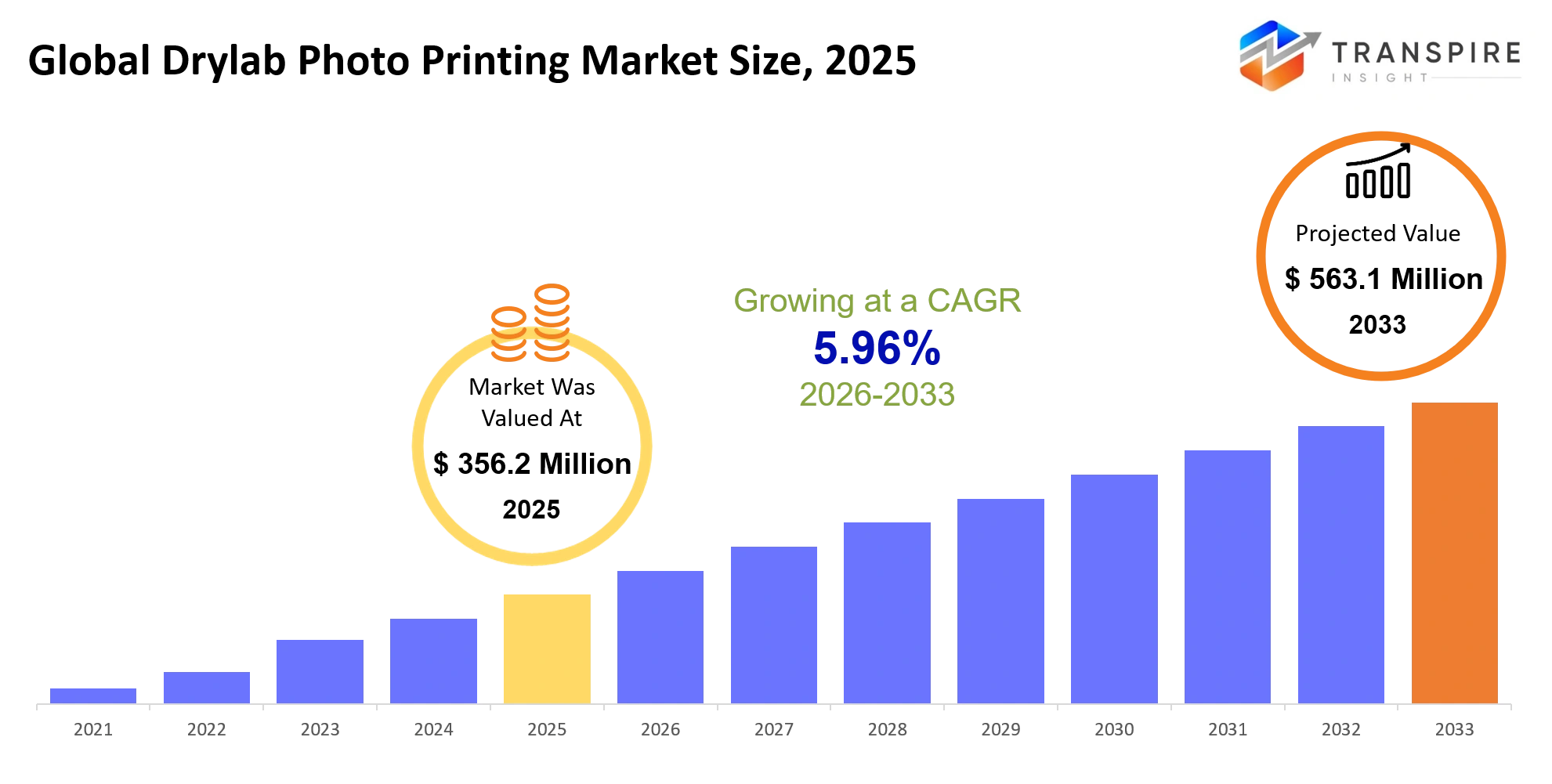
As per Transpire Insight Analysis, the Global Drylab Photo Printing Market size is estimated at USD 356.2 Million in 2025 and is anticipated to reach USD 563.1 Million by 2033, growing at a CAGR of 5.96% from 2026 to 2033.
This industry supplies the commercial digital minilabs, dye-sublimation hardware, and matching consumables used by retail hubs, event vendors, and portrait studios to output crisp physical photographs without dealing with toxic liquid developer chemistry. Over the last few years, a permanent structural shift has seen businesses replace bulky, water-dependent chemical "wet labs" with compact, software-driven dry printing setups to comply with strict municipal environmental disposal laws. The primary real-world driver for this momentum is the massive boom in smartphone-based event photography and instant mobile printing apps. Because event vendors and storefronts must now compress print turnaround windows down to just minutes while maintaining premium color accuracy, retail operators are aggressively investing in automated drylab systems to lock down profitable impulse sales on the spot.
Key Market Insights:
The global drylab photo printing market - has shifted from chemical-heavy mechanical minilabs to compact, eco-friendly digital hubs. Driven by strict urban environmental regulations and a consumer push for instant physical prints, commercial studios are replacing silver-halide wet processing with automated inkjet and dye-sublimation networks.
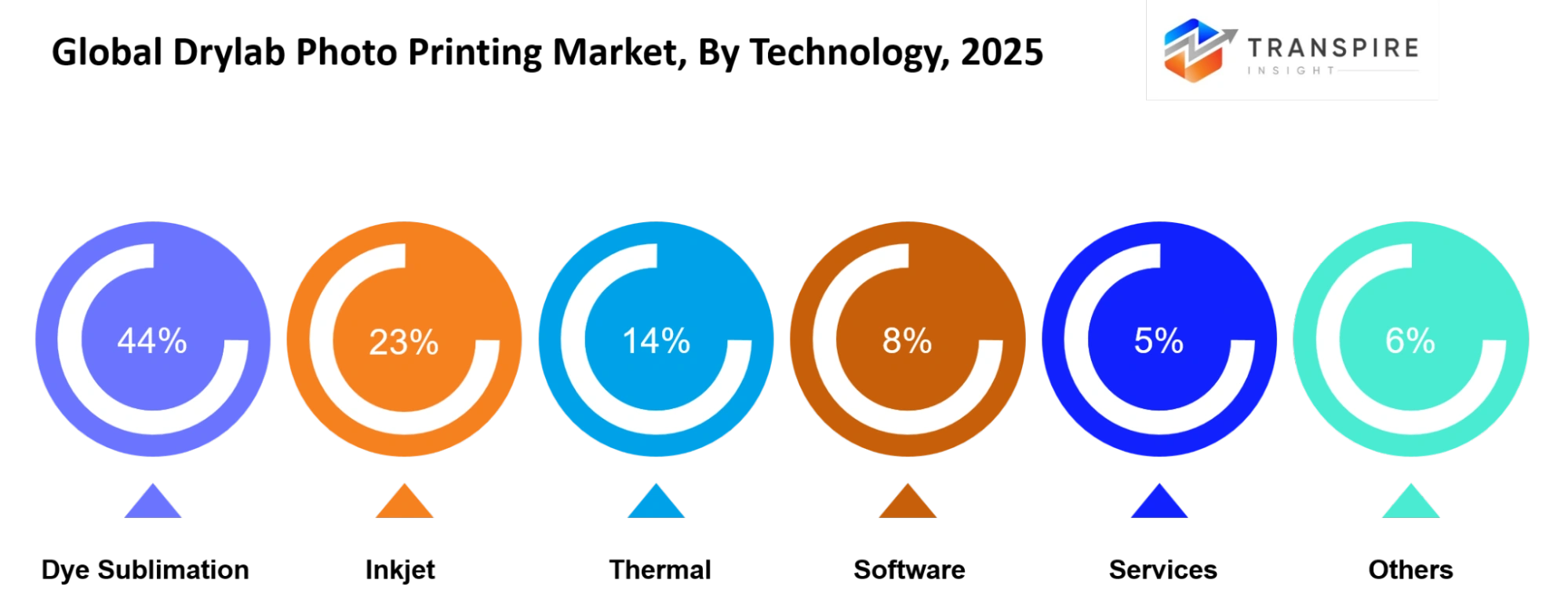
- Capturing 44% of market revenue, dye-sublimation acts as the industry's structural core; DNP launched its flagship DS620 with an internal "ribbon rollback" mechanism to maximize roll output and minimize consumable waste for mobile event operators.
- Accounting for 23% of total revenue, inkjet drylabs are surging due to demand for fine-art color gamuts; Epson integrated MicroPiezo printheads into its high-speed SureLab fleets to achieve museum-grade tonal transitions on diverse matte papers.
- Securing a steady 14% global footprint, thermal printing engines provide the backbone for high-speed commercial workflows; Citizen Systems upgraded its heavy-duty thermal printhead chassis to let retailers continuously output identity photos without overheating.
- Comprising 8% of the global market, software integrations are bridging the gap between smartphone files and instant prints; Kodak Alaris upgraded its kiosk software to help storefront operators automatically optimize low-resolution mobile files for immediate large-format outputs.
- Taking up 5% of industry procurement - professional services are pivoting toward cloud-connected preventative maintenance; Noritsu expanded its remote diagnostics to track ink levels and roll depletion, ensuring zero downtime for high-volume labs.
- Advancing at an exceptional 10.9% CAGR - event printing solutions represent the fastest-growing application corridor; HiTi engineered ultra-lightweight mobile printers to let roving event photographers deliver borderless, custom prints within ten seconds.
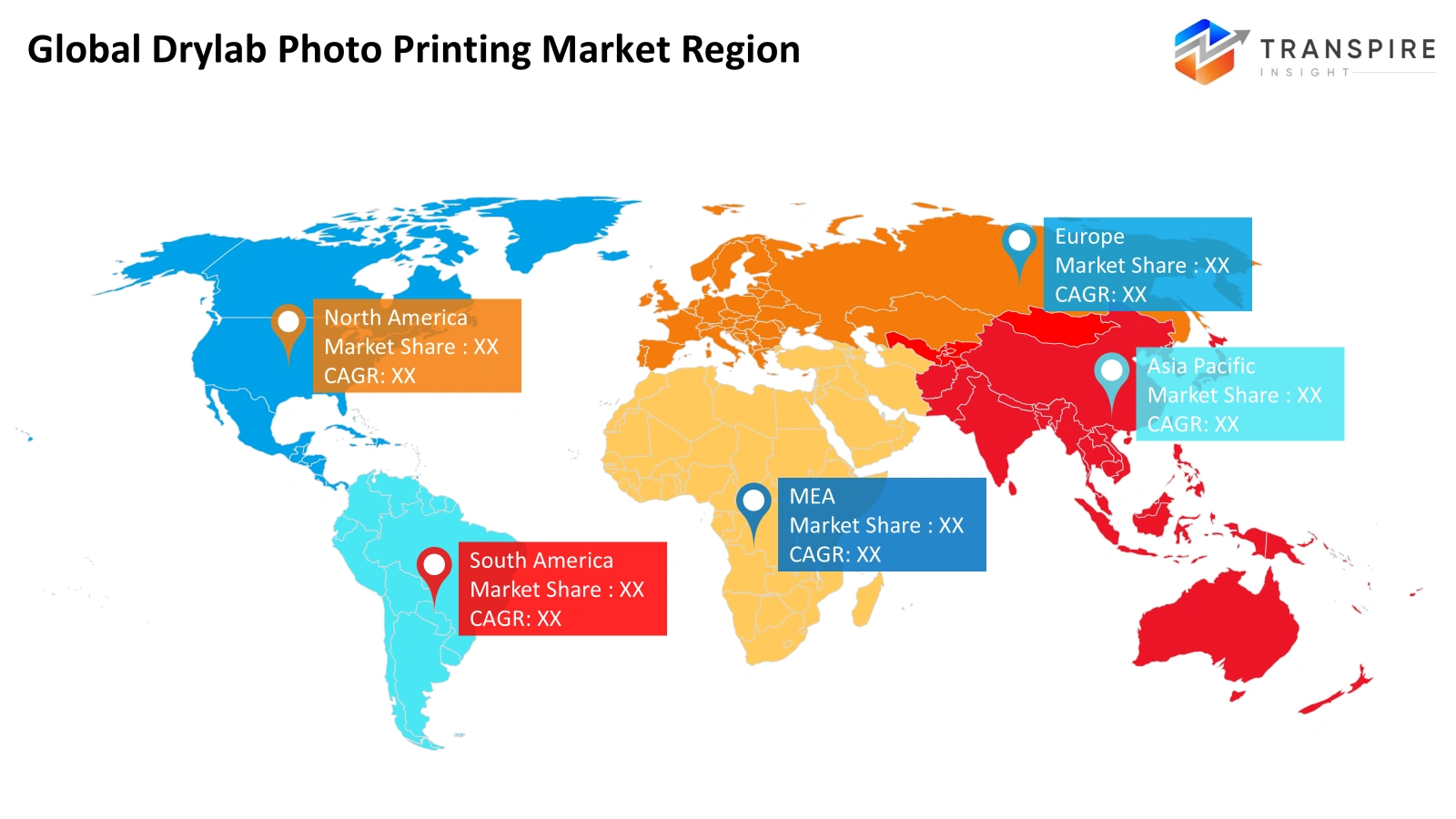
- Controlling the largest regional volume with a 35% market share, Asia-Pacific anchors high-volume retail printing; Fujifilm deployed its Frontier DX400 series with 250ml high-capacity ink bags to reduce structural consumable waste by 49%.
- Holding a dominant 30% revenue block, North America functions as a highly stable, compliance-insulated region; Canon introduced zero-chemical drylab hardware to help US retail chains easily comply with strict municipal hazardous fluid disposal bans.
- Anchoring a mature 25% share of global sales, Europe is riding a wave of premium, customized photo gifting; Mitsubishi Electric optimized its automated duplex print systems to help continental commercial labs instantly produce high-margin, double-sided calendar arrays.
- Surging ahead at a market-leading 11.8% CAGR, Latin America is the highest-velocity expansion territory; Kodak Alaris expanded its regional distribution partnerships to rapidly install modular, self-service print kiosks across expanding urban retail venues.
What are the Key Drivers, Restraints, and Opportunities in the Global Drylab Photo Printing Market?
Driver
The aggressive global enforcement of urban hazardous waste and chemical wastewater discharge regulations acts as the primary driver pushing retail photo labs toward dry, chemical-free production setups. This regulatory push has triggered a massive retirement of traditional silver-halide "wet labs," which rely on heavy water consumption and toxic developer chemistry. By migrating to digital inkjet or thermal drylab systems, retail chains and independent print venues completely eliminate local environmental compliance risks while slashing day-to-day utility expenses.
In February 2025, global printing pioneer Dai Nippon Printing Co., Ltd. (DNP) directly aligned with this market demand by establishing its new subsidiary, DNP Imagingcomm India Private Limited, which officially commenced operations in March 2026. This targeted expansion introduces a specialized sales, supply, and maintenance infrastructure to deploy its eco-friendly, dye-sublimation drylab photo printers and media across high-volume event, tourism, and wedding photography networks. [https://www.global.dnp/en/news/detail/2026/02/0204_20177874/]
Restraint
The high initial capital cost required to purchase specialized micro-piezo printheads or advanced dye-sublimation engines forms a rigid financial barrier for standalone micro-studios. This structural hurdle persists because the advanced engineering behind precision thermal printheads and specialized paper handling mechanisms keeps machinery costs high, forcing smaller independent operators to stay with legacy wet-chemistry gear despite increasing environmental overheads.
Opportunity
A major upcoming growth window lies in embedding automated self-service smartphone connectivity directly inside modular retail print kiosks across emerging urban centers. Delivering plug-and-play instant printing units that interact seamlessly with consumer mobile apps will unlock massive consumable volume sales within fast-growing commercial shopping centers.
What Has the Impact of Artificial Intelligence Been on the Global Drylab Photo Printing Market?
Artificial intelligence is fundamentally reshaping the drylab photo printing landscape by shifting quality control away from slow manual adjustments to automated, machine-driven correction. Instead of lab operators checking skin tones and contrast balances print-by-print, modern drylab systems utilize automated pre-press software to instantly analyze and correct low-resolution smartphone files before they hit the printhead.
On the retail floor, machine learning platforms drive immediate operational improvements. When a consumer uploads an unedited image to a digital kiosk, integrated AI algorithms automatically balance lighting exposures, sharpen facial features, and upscale image resolution in real time. This immediate pre-printing optimization drastically cuts down on costly user-error paper and ribbon waste while driving up order conversion speeds for high-volume retail locations. Furthermore, cloud-based diagnostic applications monitor hardware performance around the clock, evaluating color output consistency to predict printhead clogging or feed tracking errors before a physical breakdown halts production.
However, a persistent limitation stems from the deep integration and processing gap. Running complex image-parsing algorithms directly on older or lower-spec retail kiosk hardware often triggers severe interface latency, frustrating consumers during peak operational hours.
Key Market Trends:
Commercial micro-studios and retail venues are rapidly modernizing their fulfillment pipelines, shifting away from heavy chemical-based processing machinery toward compact, modular digital printing hardware. Driven by strict urban waste management regulations and an overwhelming shift toward smartphone-based media consumption, global print operators are abandoning legacy water-dependent systems to establish flexible, instant-fulfillment print arrays.
- Transitioning away from high-maintenance wet-chemistry setups, retail storefronts are installing specialized thermal and inkjet minilabs to eliminate complex daily chemical monitoring and plumbing dependencies.
- Moving past traditional single-size gloss sheets, photo labs are actively adopting multi-format roll-fed systems that let print operators shift from standard passport photos to panorama layouts on a single machine.
- Replacing older wired connection blocks, modern kiosk networks are universally integrating wireless, app-driven Bluetooth and Wi-Fi direct modules to allow customers to select and print photos straight from their personal mobile screens.
- Shifting away from standard dye-sublimation ribbons, commercial event photographers are embracing automated "ribbon rollback" systems that systematically recycle unused transfer sections to optimize per-print operating margins.
- Evolving beyond flat, two-dimensional media outputs, premium print houses are deploying specialized thick-ink inkjet drylabs to manufacture tactile, high-margin textured prints like custom canvas art and faux-metallic cards.
- Moving away from bulk, offline processing, event venues are expanding their use of lightweight, battery-powered portable drylab systems to print and deliver custom-bordered souvenirs to attendees right at the venue.
- Pivoting from manual color and alignment checks, high-volume commercial labs are installing inline optical sensors that systematically track and adjust nozzle alignment mid-print to guarantee continuous, zero-defect output.
- Ditching standard dye-based inks, professional studio lines are adopting advanced pigment-based ink formulas to protect physical photographs against early fading from atmospheric moisture and heavy UV exposure.
Global Drylab Photo Printing Market Segmentation
By Product
Printers and consumables hold the absolute largest revenue share in this market because commercial printing requires a continuous cycle of hardware acquisition followed by repeating media replenishment. Meanwhile, software integrations and remote services are expanding at the fastest rates, with software solutions rising fast to support cross-platform mobile connectivity. The unique growth logic behind this split is driven by operational efficiency; while a high-performance drylab printer establishes a shop's foundational capacity, the high-margin consumables like specialized paper rolls and dye-sublimation ribbons generate steady recurring revenue. Moving forward, the product mix will shift heavily toward cloud-connected, bundled ecosystems. Hardware manufacturers will increasingly bundle their printing systems with proprietary, AI-driven color calibration software and remote diagnostic subscriptions to lock in commercial accounts and secure multi-year material supply contracts.
By Technology
Dye-sublimation technology holds the commanding market position, securing 44% of total revenue due to its dominance in instant event and kiosk printing. Inkjet systems follow closely at 23%, while thermal printing engines capture 14%, with the remaining software, services, and niche components comprising 19% of the global layout. The distinct growth logic governing these technologies centers on the balance between printing speed and color depth. Dye-sublimation thrives on its immediate dry-to-touch speed and durable laminated overcoating, making it perfect for rapid, high-volume venues. Conversely, inkjet setups are growing rapidly among premium studios that prioritize wide color gamuts and museum-grade tonal transitions on varied fine-art papers. Future market landscapes will witness a dual-track technological evolution. Manufacturers will engineer hybrid dye-sublimation systems that mimic the deep color density of multi-ink jets while aggressively scaling up hyper-fast, low-waste inkjet heads to bridge the gap between studio quality and retail convenience.
By Application
Retail printing channels and event printing solutions act as the primary structural heavyweights of this industry, with event printing expanding at a market-leading 10.9% CAGR. Professional portrait studios and commercial mass-printing installations serve as highly stable, premium volume anchors. The underlying growth logic is driven by the rise of spontaneous, smartphone-driven media consumption. Because consumers now capture billions of temporary digital images daily, the commercial incentive is shifting toward immediate physical conversion at major public gatherings, theme parks, and transit hubs. Moving ahead, application success will require a major push toward decentralized production. Printing infrastructure will transition away from slow, centralized mass-processing labs toward agile, mobile event stations and retail instant-print arrays that capture high-margin impulsive purchases directly at the point of consumer engagement.
By End User
Photo labs and retail stores remain the dominant bulk consumers of hardware and media, while independent professional photographers and mobile event operators stand out as high-velocity growth groups. Growth across these segments depends entirely on fulfillment velocity, retail foot traffic, and equipment versatility. Large retail pharmacy chains and supermarket photo counters purchase substantial quantities of consumables to feed integrated, self-service customer printing stations, requiring ultra-reliable hardware to minimize maintenance downtime. On the flip side, professional event operators demand lightweight, highly mobile equipment that can survive rapid transit and continuous field operation. In the future, material and hardware suppliers must evolve from selling standalone equipment to delivering complete workflow systems. Success will hinge on deploying turnkey retail and event solutions where physical drylabs are seamlessly pre-configured with instant mobile pairing apps, automatic photo-book layout tools, and automated media tracking.
By Format
Small and medium print formats (like 4x6 and 6x8 inch sheets) alongside integrated kiosk formats control the highest volume share due to the global demand for standard snapshots, identification photos, and immediate retail prints. Meanwhile, large-format configurations and modular kiosk arrays are growing at the fastest rates to feed the booming personalized home decor and custom photobook market. The growth engine here is directly tied to retail footprint optimization and consumer convenience. Brick-and-mortar storefronts are rapidly adopting compact kiosk formats because they pack high-margin printing capabilities into minimal floor space without needing dedicated staff. Looking forward, format boundaries will become increasingly fluid. Drylab systems will shift toward multi-format, single-chassis designs that allow a retail operator or mobile vendor to dynamically switch from standard prints to panoramic banners and double-sided cards on a single machine without manually changing media rolls.
What are the Key Use Cases Driving the Global Drylab Photo Printing Market?
The absolute core use case of this market centers on immediate retail photo printing and instant snapshot production at large public events. Retail storefronts and tourist venues deploy dye-sublimation drylabs to quickly convert smartphone images into smudge-proof, 4x6 physical prints, capturing high-margin impulsive consumer purchases directly at the point of engagement.
Expanding applications are increasingly visible across professional portrait studios and commercial bookmaking hubs. Here, high-resolution inkjet drylabs are utilized to output premium, multi-format products like customized, double-sided photobooks, panoramic landscape spreads, and textured fine-art prints that require precise color fidelity and long-term archival resistance against atmospheric fading.
Emerging use cases are gaining strong traction in rapid self-service corporate ticketing, instant identity document processing, and medical imaging documentation. Medical facilities and administrative centers are actively adopting automated dry printing platforms to instantly produce sharp, fluid-free reference graphics and patient charts without environmental disposal bottlenecks.
|
Report Metrics |
Details |
|
Market size value in 2025 |
USD 356.2 Million |
|
Market size value in 2026 |
USD 375.5 Million |
|
Revenue forecast in 2033 |
USD 563.1 Million |
|
Growth rate |
CAGR of 5.96% from 2026 to 2033 |
|
Base year |
2025 |
|
Historical data |
2021 - 2024 |
|
Forecast period |
2026 - 2033 |
|
Report coverage |
Revenue forecast, competitive landscape, growth factors, and trends |
|
Regional scope |
United States; Canada; Mexico; United Kingdom; Germany; France; Italy; Spain; China; Japan; India; Australia; South Korea; Brazil; Argentina; South Africa; Saudi Arabia; United Arab Emirates. |
|
Key company profiled |
Fujifilm, Canon, Epson, DNP, Mitsubishi Electric, HiTi, Sinfonia, Kodak Alaris, Noritsu, Citizen Systems, Sony, HP, Xerox, Ricoh, Agfa |
|
Customization scope |
Free report customization (country, regional & segment scope). Avail customized purchase options to meet your exact research needs. |
|
Report Segmentation |
By Product (Printers, Consumables, Software, Services, Others); By Technology (Dye Sublimation, Inkjet, Thermal, Others); By Application (Retail, Events, Studios, Commercial Printing, Others); By End User (Photo Labs, Retail Stores, Professionals, Others); By Format (Small, Medium, Large, Kiosk, Others). |
Which Regions are Driving the Global Drylab Photo Printing Market Growth?
The Asia Pacific region maintains a commanding grip on the global drylab photo printing market, controlling 35% of total revenue. This undisputed dominance is heavily propelled by dense urban networks, a booming middle-class population, and an enormous commercial printing footprint spread across China, Japan, and India. Local photo studios and expanding retail photography channels require high-capacity, chemical-free production lines to process mass-scale, daily consumer printing requests. Consequently, the local infrastructure pivot away from wet-chemistry systems provides an aggressive volume driver for advanced digital printing ecosystems.
In June 2026, FUJIFILM India demonstrated this aggressive regional infrastructure footprint by launching its "Fujifilm Spectrum" India Tour, directly showcasing automated, compact dye-sublimation hardware lines like the ASK-400 alongside click-to-print networks to accelerate digital drylab adoption across massive consumer photography markets.
North America serves as a highly stable, predictable pillar for the market, anchoring its core demand across a solid 30% revenue block. Unlike Asian markets that rely on sheer consumer printing volume, the North American landscape is stabilized by a highly mature corporate gifting ecosystem and automated self-service retail operations. Strong commercial pharmacy chains and big-box store networks provide consumers with highly accessible, wireless print stations across every major city. This highly integrated retail infrastructure ensures that the market experiences steady, repeating media and consumable replacement cycles despite shifting global economic conditions.
In January 2026, digital imaging pioneer Epson directly strengthened this regional focus by introducing its Expression Photo wide-format wireless production system, incorporating high-speed 6-color Claria Photo HD ink processing to feed the rising demands of North American creative home studios and boutique print counters.
Latin America is expanding faster than any other global territory, propelled by an aggressive, structural transition away from legacy chemical processing toward mobile-driven on-site event printing. A historic reliance on expensive, centralized wet-chemistry processing labs is rapidly collapsing as regional operators shift toward lightweight, compact dye-sublimation hardware. This sweeping technological shift is heavily accelerated by a massive surge in local tourism, regional festivals, and social event photography that demands instant physical photo delivery. Looking ahead, the ultimate success of international brands in this high-velocity corridor depends entirely on establishing strong localized distribution agreements to supply modular, low-maintenance print units across expanding shopping venues.
Who are the Key Players in the Global Drylab Photo Printing Market and how do they Compete?
It's basically a tug-of-war among a tight circle of imaging giants whose real end-game isn't selling the actual printers—it's locking buyers into years of exclusive paper and ink contracts. They win accounts by convincing big pharmacy chains and event crews that switching to a dry minilab will permanently end their local chemical disposal and wastewater fines.
Epson plays the high-end quality angle. They throw their weight behind MicroPiezo tech and specialized pigment ink packs to hook serious portrait studios and fine-art labs that care about deep color matching and printing on weird, heavy matte papers. Instead of competing on cheap, throwaway kiosk units, they focus on placing large multi-format inkjet machines paired with remote cloud monitoring tools that alert corporate managers before a printhead clogs.
Fujifilm plays a completely different game, focusing on absolute speed and convenience. They own the retail footprint by dropping turnkey, self-service print stations into tourist spots and drugstores, using built-in software tweaks that fix blurry phone pics right at the screen. Their main growth playbook is all about volume—getting exclusive hardware placement deals with major retail networks to guarantee non-stop sales of their proprietary paper rolls and dye-sub ribbons.
Company List
- Fujifilm
- Canon
- Epson
- DNP
- Mitsubishi Electric
- HiTi
- Sinfonia
- Kodak Alaris
- Noritsu
- Citizen Systems
- Sony
- HP
- Xerox
- Ricoh
- Agfa
Recent Development News
In July 2025, Epson America, Inc. officially launched its professional-quality SureLab Greeting Cards media line designed directly for its double-sided drylab minilab printers. This product rollout allows commercial production houses and boutique print counters to easily output high-margin double-sided invitations and cards without manual cutting or trimming.
Source: https://news.epson.com
In December 2025, global dye-sublimation pioneer DNP Imagingcomm Asia appointed a new Managing Director to spearhead regional operations from its Malaysian corporate headquarters. This leadership change structurally drives the brand's localized expansion, optimizing logistics networks and technical services for its specialized instant thermal transfer print ribbons and drylab kiosks across Southeast Asia.
Source: https://asia-dnpribbons.com
In April 2026, software automation developer InsituaFX highlighted a major technology update for its BlueFX workflow builder, enabling the digital pooling and integration of up to 17 mixed drylab models under a singular automated cloud architecture. This capability allows expanding school and event photography operations to run synchronized multi-unit clusters to drastically reduce peak-season print bottlenecks.
Source: https://insituafx.com
What Strategic Insights Define the Future of the Global Drylab Photo Printing Market?
The market is rapidly heading toward decentralized, automated print hubs that integrate smartphone-to-kiosk APIs to capture spontaneous physical media sales. A hidden structural risk stems from the tightening of regional import tariffs on specialized printheads and proprietary dye-sublimation media substrates, which threatens to instantly compress profit margins for independent local lab operators. Conversely, an outstanding emerging opportunity lies in the luxury packaging and premium photo-merchandising sectors, where specialized thick-ink inkjet drylabs can easily manufacture high-margin tactile gifts like custom canvas pieces, double-sided greeting cards, and faux-metallic memory portfolios.
To stay highly competitive, manufacturers must move away from marketing hardware as isolated, standalone units. The winning strategic recommendation is to deploy complete ecosystem models—bundling low-waste, multi-format hardware setups with proprietary, AI-driven pre-press software suites to secure long-term media supply contracts and guarantee continuous commercial revenue.
Key Segmentations are:
By Product
- Printers
- Consumables
- Software
- Services
- Others
By Technology
- Dye Sublimation
- Inkjet
- Thermal
- Others
By Application
- Retail
- Events
- Studios
- Commercial Printing
- Others
By End User
- Photo Labs
- Retail Stores
- Professionals
- Others
By Format
- Small
- Medium
- Large
- Kiosk
- Others
Regional Outlook
North America
- United States
- Canada
- Mexico
Europe
- Germany
- United Kingdom
- France
- Spain
- Italy
- Rest of Europe
Asia Pacific
- Japan
- China
- Australia & New Zealand
- South Korea
- India
- Rest of Asia Pacific
South America
- Brazil
- Argentina
- Rest of South America
Middle East & Africa
- Saudi Arabia
- United Arab Emirates
- South Africa
- Rest of the Middle East & Africa
Frequently Asked Questions
Find quick answers to common questions.
The global drylab photo printing market size was valued at USD 356.2 Million in 2025 and is poised to reach USD 563.1 Million by 2033, expanding at a 5.96% CAGR.
Key segments for the global drylab photo printing market are Product (Printers, Consumables, Software, Services, Others), Technology (Dye Sublimation, Inkjet, Thermal, Others), Application (Retail, Events, Studios, Commercial Printing, Others), End User (Photo Labs, Retail Stores, Professionals, Others), and Format (Small, Medium, Large, Kiosk, Others).
Growth is primarily driven by strict urban environmental regulations restricting chemical wastewater disposal, the consumer push for instant high-margin physical prints at tourist locations, and the retirement of traditional silver-halide wet labs in favor of eco-friendly digital configurations.
The global market is led by major manufacturers including Fujifilm, Canon, Epson, DNP, Mitsubishi Electric, HiTi, Sinfonia, Kodak Alaris, Noritsu, Citizen Systems, Sony, HP, Xerox, Ricoh, and Agfa.
Asia Pacific controls a massive 35% market share, dominating global dynamics due to its dense urban footprints, soaring consumer demand for immediate retail print solutions, and the strong presence of major equipment manufacturers scaling up low-waste digital printing systems across China, Japan, and India.
Profitable commercial opportunities exist in embedding automated, plug-and-play self-service smartphone connectivity directly within retail kiosks, as well as expanding into luxury photo gifting by leveraging thick-ink inkjet drylabs to build textured canvas art, double-sided calendar arrays, and custom photobooks.
- Fujifilm
- Canon
- Epson
- DNP
- Mitsubishi Electric
- HiTi
- Sinfonia
- Kodak Alaris
- Noritsu
- Citizen Systems
- Sony
- HP
- Xerox
- Ricoh
- Agfa
About the Authors

Avinash Kumar
I’m Avinash Kumar, a Senior Research Analyst at Transpire Insight, with expertise in the Electronics and Semiconductor and Energy & Power industry. My work focuses on analyzing emerging technologies, market trends, industry developments, and innovation across these sectors. I specialize in transforming complex technical and market insights into clear, research-backed content that helps professionals, businesses, and decision-makers stay informed. Through continuous industry research and data-driven analysis, I strive to deliver accurate, reliable, and practical perspectives on the latest advancements shaping the semiconductor and energy landscape.

Chakradhar Khansole
Chakradhar serves as the Research Director at Transpire Insight, bringing over 8 years of experience in technology, innovation, and strategic market intelligence. He specializes in transforming complex market data into actionable business insights that enable organizations to make informed, growth-oriented decisions. Recognized for his strategic vision and analytical expertise, Chakradhar leads high-impact research initiatives, delivering comprehensive market assessments, competitive intelligence, and forward-looking industry analysis.
Recently Published Reports
-
Apr 2026
Fiber Optic Faceplates Market
Fiber Optic Faceplates Market Size, Share & Analysis Report By Type (< 300 mm2, 300-350 mm2, and > 350 mm2, By Application (Night Vision, Holographic Imaging, Medical, and Others), and Geography (North America, Europe, Asia-Pacific, Middle East and Africa, South and Central America), 2021 - 2031
-
Apr 2026
High Temperature Superconductors Market
High Temperature Superconductors Market Size, Share & Analysis Report By Type (1G HTS, and 2G HTS), By Application (Power Cable, Fault Current Limiter, and Transformer), and Geography (North America, Europe, Asia-Pacific, Middle East and Africa, South and Central America), 2021 - 2031
-
Apr 2026
Industrial Plugs and Socket Market
Industrial Plugs and Socket Market Size, Share & Analysis Report By Type (Industrial Plugs, Industrial Sockets), By Current (Up to 32 A, 32 to 125 A, Above 125 A), By Protection (Dustproof and Splash Proof, Waterproof, Explosion Proof), By End User (Heavy Industries, Oil and Gas, Chemicals and Pharmaceuticals, Power Generation, Others), and Geography (North America, Europe, Asia-Pacific, Middle East and Africa, South and Central America), 2021 - 2031
-
Apr 2026
InGaAs Avalanche Photodiodes Market
InGaAs Avalanche Photodiodes Market Size, Share & Analysis Report By Type (1100 - 1700 nm, and 1000 - 1600 nm), By Application (Missile Warning System, Muzzle Flash Detection, Wafer Defect Inspection, Laser Rangefinders, and Others), and Geography (North America, Europe, Asia-Pacific, Middle East and Africa, South and Central America), 2021 - 2031