

Global Digital PCR Market Size & Forecast:
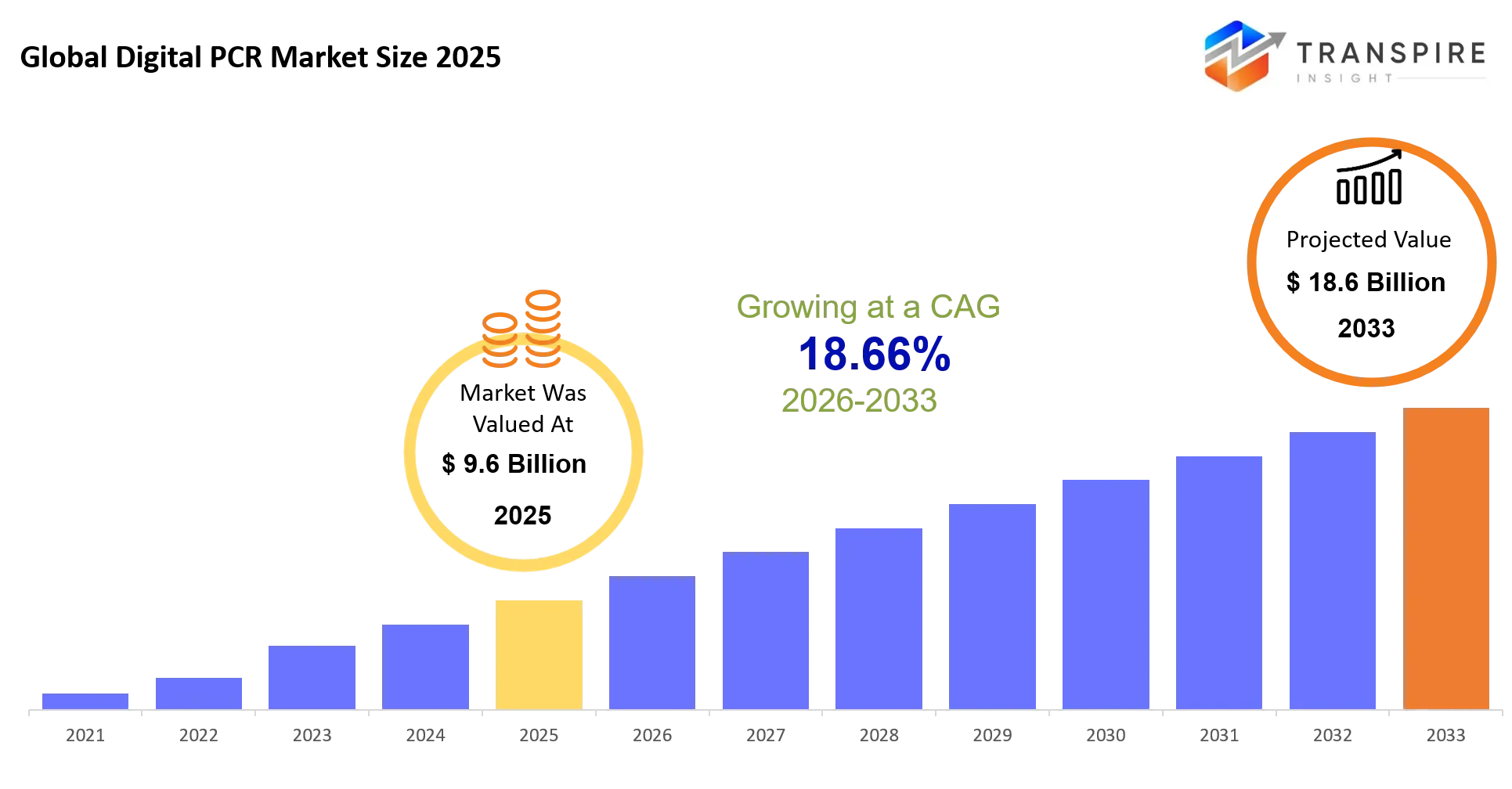
- Global Digital PCR Market Size 2025: USD 9.6 Billion
- Global Digital PCR Market Size 2033: USD 18.6 Billion
- Global Digital PCR Market CAGR: 18.66%
- Global Digital PCR Market Segments: By Product (Instruments, Reagents, Consumables, Software, Services, Others); By Technology (Droplet Digital PCR, Chip-based Digital PCR, BEAMing, Others); By Application (Oncology, Infectious Diseases, Genetic Testing, Research, Others); By End User (Hospitals, Diagnostic Labs, Pharma Companies, Academic Institutes, Others); By Deployment (Centralized, Point-of-Care, Others)
Global Digital PCR Market Summary:
As per Transpire Insight Analysis, the Global Digital PCR Market size is estimated at USD 9.6 Billion in 2025 and is anticipated to reach USD 18.6 Billion by 2033, growing at a CAGR of 18.66% from 2026 to 2033.
The digital PCR market has changed a lot in the past few years. Laboratories and healthcare providers are using PCR more and more because it is very good at detecting diseases and analysing genes. Digital PCR is really useful for detecting cancer, identifying infections, and running tests in clinics. This has made digital PCR a technology that people trust.
A big change is that more people are using digital PCR systems. These systems are better at giving results when the sample is very small. At the time, people are putting more money into researching liquid biopsies. This has made more people use tools to diagnose diseases in healthcare and life sciences.
All these things are making laboratories and research groups update their testing tools. This means more people are using PCR technology, and it is making the digital PCR market grow over time. The digital PCR market is going to keep growing because of this.
Key Market Insights:
The global digital PCR market is undergoing steady evolution due to advancements in precision and the availability of molecular diagnostics technologies. Innovation in the field, applications, and industry investments play a crucial role in evolving the market environment.
- Droplet Digital PCR makes up for 44% of the market as it is widely adopted because of its high analytical sensitivity, while manufacturers continue producing improved digital PCR platforms.
- Chip-based Digital PCR occupies 24% of the market and is becoming increasingly popular as laboratories look for miniaturised devices capable of performing accurate quantitation.
- Oncology applications account for 13% of the market due to the increasing importance of digital PCR technology in cancer biomarker research and precision medicine applications.
- Infectious diseases occupy 9% of the market due to the growing adoption of highly sensitive molecular diagnostics methods at healthcare facilities.
- The rest of the market (10%) is taken by genetic research and other speciality applications, thus widening the range of uses for the technology.
- Industry players are investing in the automation of the digital PCR workflow to increase laboratory productivity and improve the accuracy of tests.
- Integration of digital PCR and liquid biopsy research opens new opportunities for non-invasive disease tracking and patient-tailored treatments.
What are the Key Drivers, Restraints, and Opportunities in the Global Digital PCR Market?
Drivers
Precision diagnostics is one of the driving factors that support growth in the global market for digital PCR. Increased interest from healthcare organisations and research facilities in precise molecular tests for diagnosing ailments at early stages and monitoring results of treatment encourages the adoption of digital PCR systems as a more sensitive and reliable technique compared to traditional testing methods. Continuous adoption of advanced technologies in oncology, infectious disease testing, and genetics supports further technology adoption and creates new revenue opportunities for market players.
Restraints
High costs associated with the acquisition of digital PCR technologies and their laboratory installation are some of the obstacles preventing the adoption of digital PCR technology. Implementation of the necessary infrastructure and maintenance of sophisticated equipment requires substantial investment that many small labs and health care facilities do not have. The need for specially trained personnel is another long-term issue that hinders widespread adoption.
Opportunities
The increasing applications of liquid biopsy in diagnostics have led healthcare institutions to turn their attention towards non-invasive methods, which means that there will be an increase in the need for sensitive molecular analysis. With further technological development and growing interest in the use of liquid biopsy, there could be many growth prospects for digital PCR solution providers in the future.
What Has the Impact of Artificial Intelligence Been on the Global Digital PCR Market?
AI is making digital PCR workflow more efficient by allowing for automated data analysis and decreasing the amount of time necessary to analyse the results of complex tests. With the help of AI-powered software, laboratories are able to process a big volume of molecular data consistently, avoiding any possible human mistakes and thus increasing the accuracy of their testing. This is especially useful for oncology research, infectious disease testing, and genetics, since in all these cases, precision is crucial.
Moreover, the introduction of AI into the digital PCR technology allows for better prediction abilities by detecting certain data patterns that cannot be observed with the traditional approach to analysis. It allows optimising the process of experiments, improves performance and speeds up the biomarker discovery process. With the process of digitalisation of laboratories, AI-driven automation is helping with better management and use of resources. However, integrating AI with a digital PCR platform is complicated due to the high cost of implementation and difficulties of integrating advanced software with laboratory systems. Overcoming the mentioned challenges and increasing the accuracy of analytical processes will be important for further implementation of AI in digital PCR and the development of the digital PCR market worldwide.
Instance
In July 2025, Bio-Rad Laboratories launched a new generation of QX Continuum and QX700 Droplet Digital PCR systems with an innovative software that makes data interpretation simpler. Data analysis powered by AI technology is becoming increasingly helpful for labs to analyse large amounts of digital PCR data more effectively.
Key Market Trends:
Innovations in technology, an increase in the number of clinical applications, and an increased focus on molecular precision diagnostics will be the key trends defining the global market for digital PCR.
- There is an increased focus on investments in advanced testing solutions by laboratories, health care organisations, and research facilities.
- Digital PCR is gaining popularity in an increasing number of clinical and research applications due to the rising demand for molecular analysis with high sensitivity.
- Laboratories are moving towards automated testing processes to increase the efficiency of testing and ensure the stability of the testing process.
- The application of liquid biopsy techniques is expanding, motivating laboratories to implement digital PCR as a method for the detection and monitoring of diseases without invasive procedures.
- There is an increased focus on precision medicine by health care organisations, thus enhancing the importance of digital PCR for personalised medicine approaches.
- Diagnostic laboratories and research centres are cooperating closely with biotechnology companies to accelerate innovations and validation of technology.
Global Digital PCR MarketSegmentation
By Product Type
The market can be segmented based on Product Type into Instruments, Reagents & Consumables, Software, Services and Others. Instruments have been identified as the pillar of digital PCR usage because laboratories continue to equip themselves with advanced instruments. In addition, reagents & consumables provide continuous demand through regular testing. Software solutions are gaining significance in the field of digital PCR data analysis, while services include installation and maintenance. Continued investments in digital PCR solutions have been identified to play an increasing role in developing each of the product segments over the next few years.
By technology
droplet digital PCR is the dominant technology in the global market, accounting for 44% share in the global market owing to its high sensitivity, accurate quantification and wide acceptance in both clinical and research laboratories. Chip-based Digital PCR holds a share of 24% in the global market, and it keeps growing owing to its smaller size, operational efficiency and robust performance. Other digital PCR technologies are also contributing to the growth of the market as well.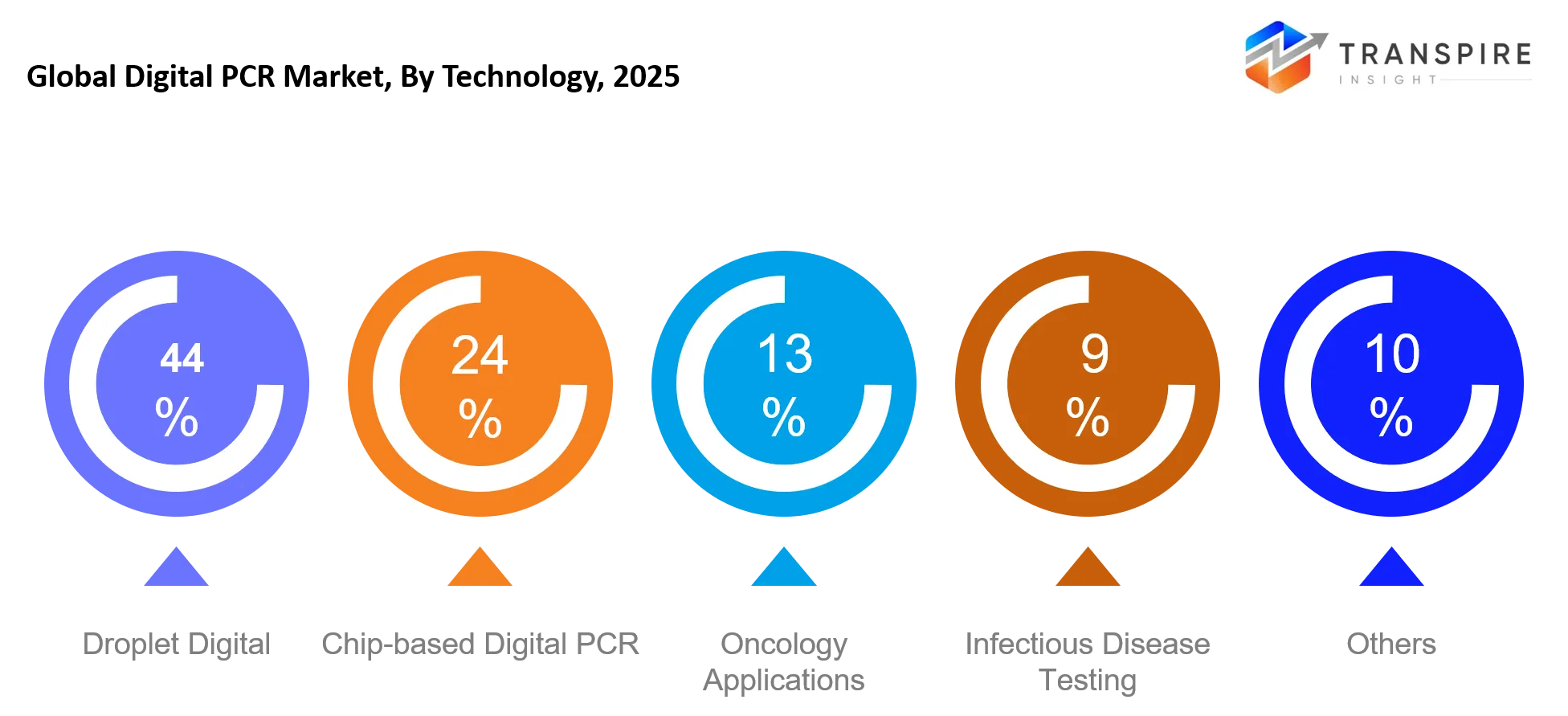
By Application
Oncology is the leading segment that holds 13% share of the market, thanks to the widespread adoption of digital PCR in detecting cancer biomarkers, mutations, and precision medicine. The testing of infectious diseases accounts for 9% of the market, attributed to the need for highly sensitive detection of pathogens and disease progression. Further genetic testing, research, and other specialised applications will continue to widen the scope of the market. On the other hand, liquid biopsy applications have emerged as the most promising area in terms of growth, witnessing 17.2% CAGR, owing to the increasing trend towards non-invasive diagnostics.
By End Users
Hospitals, diagnostic labs, pharmaceuticals, biotechnology firms, academic research institutions, and others are responsible for the growth of the market. Diagnostic laboratories and hospitals represent a major portion of the market, as there is an increase in the use of advanced molecular diagnostic technologies in everyday clinical diagnostics. Pharmaceutical firms are increasingly using digital PCR in drug discovery and biomarker research, while academic organisations facilitate innovations via continuous research and technology validation.
By Deployment
Market classification is based on Deployment, and this includes centralised, point-of-care, and others. Centralised laboratories remain dominant due to the presence of well-equipped infrastructure, expertise, and capacity to handle large volumes of tests. On the other hand, point-of-care deployment is gaining more recognition due to the need for fast and easy access to diagnostics. The increasing need for flexible testing options will fuel the adoption of these two deployment options.
What are the Key Use Cases Driving the Global Digital PCR Market?
Global Digital PCR is mainly used in the field of molecular diagnostics, where Droplet Digital PCR is employed to perform precise quantitative analyses of DNA and RNA. Due to its high sensitivity, digital PCR is a preferable tool for oncology studies, mutation analyses, and disease monitoring, which helps produce reliable results.
In addition to the traditional use, digital PCR is now used in infectious disease diagnostics, genetic research, pharmacology research, and biomarker validation. This technology enables researchers to identify low-copy-number genetic materials reliably, thus helping improve the diagnostic capabilities and perform advanced studies in the field of life sciences.
Future uses of digital PCR are related to the application in the field of liquid biopsy, which is becoming increasingly relevant as more noninvasive diagnostic methods become widely used.
|
Report Metrics |
Details |
|
Market size value in 2025 |
USD 9.6 Billion |
|
Market size value in 2026 |
USD 10.4 Billion |
|
Revenue forecast in 2033 |
USD 18.6 Billion |
|
Growth rate |
CAGR of 18.66% from 2026 to 2033 |
|
Base year |
2025 |
|
Historical data |
2021 - 2024 |
|
Forecast period |
2026 - 2033 |
|
Report coverage |
Revenue forecast, competitive landscape, growth factors, and trends |
|
Regional scope |
United States; Canada; Mexico; United Kingdom; Germany; France; Italy; Spain; Denmark; Sweden; Norway; China; Japan; India; Australia; South Korea; Thailand; Brazil; Argentina; South Africa; Saudi Arabia; United Arab Emirates |
|
Key company profiled |
Bio-Rad Laboratories, Thermo Fisher Scientific, QIAGEN, Standard BioTools, Agilent Technologies, JN Medsys, Merck, Danaher, Roche, Sysmex, Illumina, Takara Bio, BGI, Bioer Technology, Analytik Jena |
|
Customization scope |
Free report customization (country, regional & segment scope). Avail customized purchase options to meet your exact research needs. |
|
Report Segmentation |
By Product (Instruments, Reagents, Consumables, Software, Services, Others); By Technology (Droplet Digital PCR, Chip-based Digital PCR, BEAMing, Others); By Application (Oncology, Infectious Diseases, Genetic Testing, Research, Others); By End User (Hospitals, Diagnostic Labs, Pharma Companies, Academic Institutes, Others); By Deployment (Centralized, Point-of-Care, Others) |
Which Regions are Driving the Global Digital PCR Market Growth?
North America
The North American continent occupies the largest part of the global digital PCR market by accounting for 43% of the global market revenue. It takes this dominant market position on account of the highly developed healthcare system in the continent, high penetration of modern molecular diagnostic methods, as well as consistent investments in the development of life sciences research. The application of precision medicine in this region, combined with the availability of large biotechnology and diagnostic firms, contributes further to the market expansion and helps North America retain its market leadership.In February 2025, Bio-Rad Laboratories issued a binding offer to buy out Stilla Technologies, adding to its product line in digital PCR and extending its next-gen multiplex dPCR offerings. This transaction further cements the dominance of North America in advanced molecular diagnostics and life science research.
Europe
The European region accounts for 27% of the total global market. Steady growth in the market is ensured by consistent research and implementation of molecular diagnostics in clinical practice. Compared to North America, Europe features a more developed research environment and cooperation between healthcare facilities and academic institutions. In addition, the investment in the modernisation of laboratories and diagnostics contributes to the steady growth of the market.In February 2025, Stilla Technologies (France) finalised its acquisition by Bio-Rad Laboratories, facilitating wider distribution of its Naica digital PCR system and boosting digital PCR innovation in Europe.
Asia Pacific
The Asia Pacific region represents 22% of the overall digital PCR market share and is estimated to register the highest growth rate at a CAGR of 18.6%. Asia Pacific is witnessing rapid growth owing to high investment in the healthcare industry, better diagnostic facilities, and advanced technology in molecular diagnostics. Increasing research activities and better availability of diagnostic services have opened up a lot of opportunities for market players.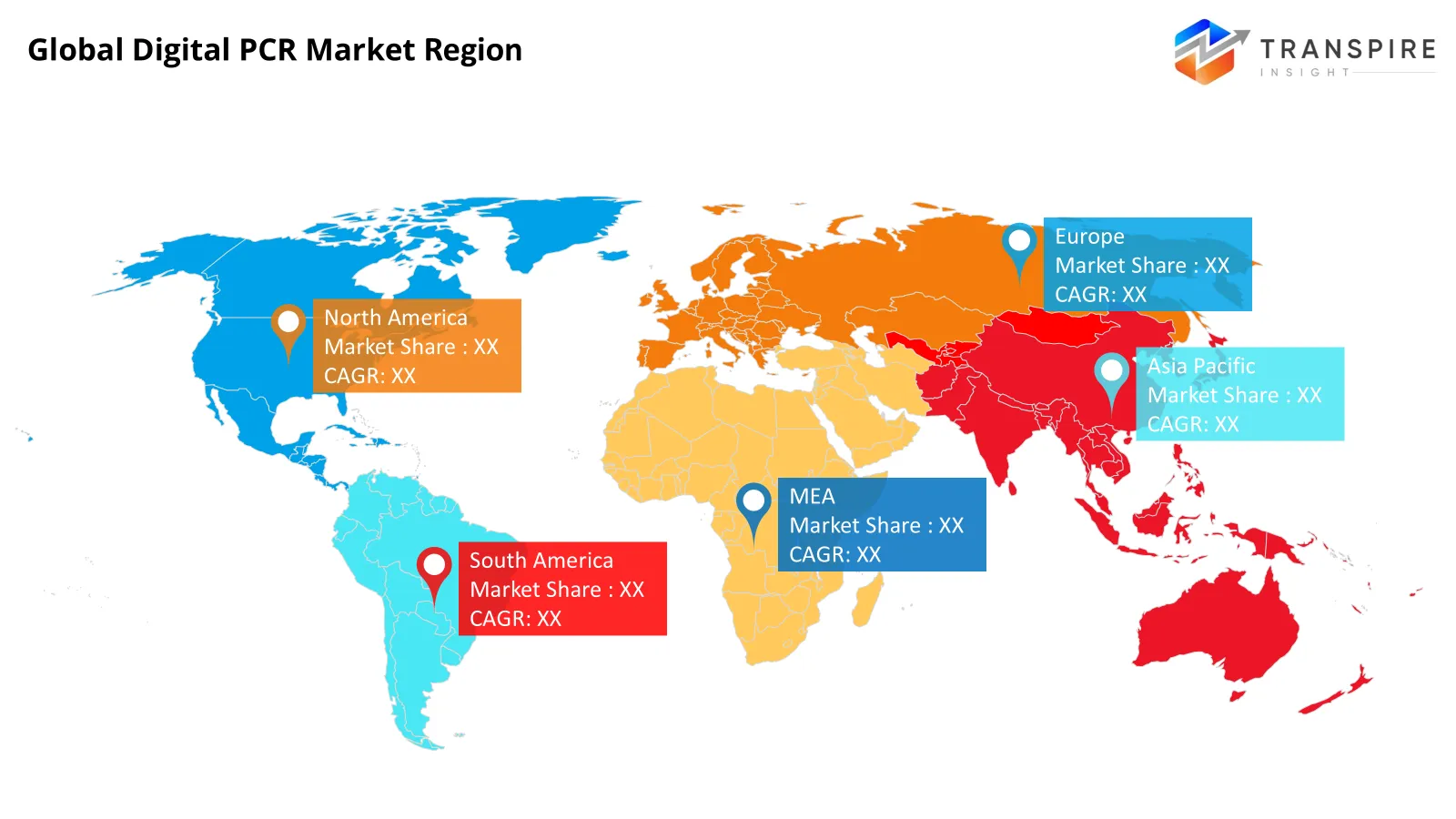
Who are the Key Players in the Global Digital PCR Marketand how do they Compete?
Competition in the digital PCR market across the world is fierce. Companies adopt innovative and technologically advanced digital PCR products and solutions in order to make their presence felt in the market. Competition in the market is due to advances in the technology of digital PCR products, workflows, software and assays. In addition, companies try to increase their presence in the market globally through collaborations, research partnerships and advanced molecular diagnostic technologies.
Innovation in the form of highly efficient digital PCR systems has helped companies distinguish themselves. Most companies have invested in automating workflows along with advanced software in order to streamline operations and make testing more efficient. Innovations in products have allowed companies to enhance their portfolios and support various applications such as oncology, infectious disease testing, genetic analysis and precision medicine.
Companies are using strategies such as the launch of new products, collaboration with health care organisations, expansion into new regions and research and development in order to reach out to a wider audience in the global market. In the future, companies that can innovate and operate efficiently and have effective distribution channels will continue to remain competitive.
Global Digital PCR Market companies
- Bio-Rad Laboratories
- Thermo Fisher Scientific
- QIAGEN
- Standard BioTools
- Agilent Technologies
- JN Medsys
- Merck
- Danaher
- Roche
- Sysmex
- Illumina
- Takara Bio
- BGI
- Bioer Technology
- Analytik Jena
Recent Development News
In February 2025, Bio-Rad Laboratories signed a deal for the acquisition of Stilla Technologies. With this acquisition, Bio-Rad will add to its digital PCR offerings through the integration of the next-generation digital PCR platform from Stilla.
In May 2025, QIAGEN signed an agreement with ID Solutions for the expansion of its digital PCR oncology research offering. This partnership will help in enhancing the use of digital PCR assays on the QIAcuity platform for oncology research.
What Strategic Insights Define the Future of the Global Digital PCR Market?
The global market of digital PCR is estimated to go towards greater market adoption driven by the need for highly precise molecular tests among healthcare providers, research organisations, and the pharmaceutical industry. The increase in usage of personalised medicine, liquid biopsy, and other technologies related to genetic analysis will promote the use of digital PCR both for diagnostic purposes and in scientific research. Innovations and laboratory automation are also expected to bring better efficiency and additional commercial opportunities.
A potential threat to the further development of digital PCR is the high initial investments in such technologies and complexities related to their integration into the laboratory infrastructure in healthcare facilities, which might limit market adoption in small healthcare organisations. However, on the other hand, there is an opportunity to develop market positions by addressing the rapidly growing needs for liquid biopsy applications.
In order to meet future market demands and maintain a competitive position in the market, the key activities that need to be taken by providers of digital PCR technologies include innovations and automation, partnerships with healthcare organisations, research institutes, and other players in the market.
By Product
- Instruments
- Reagents
- Consumables
- Software
- Services
By Technology
- Droplet Digital PCR
- Chip-based Digital PCR
- BEAMing
By Application
- Oncology
- nfectious Diseases
- Genetic Testing
- Research
By End User
- Hospitals
- Diagnostic Labs
- Pharma Companies
- Academic Institutes
By Deployment
- Centralized
- Point-of-Care
Regional Outlook
North America
- United States
- Canada
- Mexico
Europe
- Germany
- United Kingdom
- France
- Spain
- Italy
- Rest of Europe
Asia Pacific
- Japan
- China
- Australia & New Zealand
- South Korea
- India
- Rest of Asia Pacific
South America
- Brazil
- Argentina
- Rest of South America
Middle East & Africa
- Saudi Arabia
- United Arab Emirates
- South Africa
- Rest of the Middle East & Africa
Frequently Asked Questions
Find quick answers to common questions.
The Global Digital PCR Market size was valued at USD 9.6 Billion in 2025 and is poised to reach USD 18.6 Billion by 2033, expanding at a18.66% CAGR.
Key Segments for the Global Digital PCR Market are By Product (Instruments, Reagents, Consumables, Software, Services, Others); By Technology (Droplet Digital PCR, Chip-based Digital PCR, BEAMing, Others); By Application (Oncology, Infectious Diseases, Genetic Testing, Research, Others); By End User (Hospitals, Diagnostic Labs, Pharma Companies, Academic Institutes, Others); By Deployment (Centralized, Point-of-Care, Others).
Growth is primarily driven by the growth in this industry is mainly due to the increased occurrence of infectious diseases and cancer, the increased need for precise diagnosis, the increase in the use of liquid biopsy and genetic tests, continuous improvement in the PCR technologies, increased investments in genomics research, and the increased use of digital PCR technology.
The Global Market is led by Major Manufacturers including Bio-Rad Laboratories, Thermo Fisher Scientific, QIAGEN, Standard BioTools, Agilent Technologies, JN Medsys, Merck, Danaher, Roche, Sysmex, Illumina, Takara Bio, BGI, Bioer Technology, Analytik Jen.
The North American Region constitutes 43% of the total Global Market of Digital PCR owing to the well-developed healthcare infrastructure, presence of top-notch companies in biotechnology and diagnostics, investments in genomics and molecular diagnostics, usage of precision medicine and favourable government funding in the region.
Commercial possibilities within the international digital PCR market include growing applications in oncology diagnostics, high demands for liquid biopsy and precision medicine, higher use for infectious disease testing, adoption in cell and gene therapy studies, and increased investments in clinical diagnostics and pharmaceutical R&D in emerging nations.
- Bio-Rad Laboratories
- Thermo Fisher Scientific
- QIAGEN
- Standard BioTools
- Agilent Technologies
- JN Medsys
- Merck
- Danaher
- Roche
- Sysmex
- Illumina
- Takara Bio
- BGI
- Bioer Technology
- Analytik Jena
About the Authors

Mayur Shinde
I am Mayur Shinde, a Senior Research Analyst at Transpire Insight, specializing in the Automotive & Transportation and Information & Communication Technology (ICT) Industry. My work focuses on analyzing emerging market trends, technological advancements, competitive landscapes, and industry developments to deliver accurate, data-driven insights. I am passionate about transforming complex market information into clear, actionable content that helps businesses, professionals, and decision-makers stay informed and make confident strategic decisions.

Chakradhar Khansole
Chakradhar serves as the Research Director at Transpire Insight, bringing over 8 years of experience in technology, innovation, and strategic market intelligence. He specializes in transforming complex market data into actionable business insights that enable organizations to make informed, growth-oriented decisions. Recognized for his strategic vision and analytical expertise, Chakradhar leads high-impact research initiatives, delivering comprehensive market assessments, competitive intelligence, and forward-looking industry analysis.
Recently Published Reports
-
Apr 2026
3D Optical Profiler Market
3D Optical Profiler Market Size, Share & Analysis Report By Type (Desktop 3D Optical Profiler, and Portable 3D Optical Profiler), By Technology (Confocal Technology, and White Light Interference), By End-Use Industry (Manufacturing, Research Institutions, Automotive, Aerospace and Defense, Medical Devices, and Other), and Geography (North America, Europe, Asia-Pacific, Middle East and Africa, South and Central America), 2021 - 2031
-
Apr 2026
Depth Sensor Market
Depth Sensor Market Size, Share & Analysis Report By Type (Infrared Depth Sensors, Time-of-Flight (ToF) Sensors, Stereo Vision Sensors, Structured Light Sensors, Ultrasonic Depth Sensors), By Application (Automotive, Robotics, Gaming, Consumer Electronics, Industrial Automation, Healthcare, Security & Surveillance, Others), By End Users (Automotive Manufacturers, Consumer Electronics Companies, Healthcare Providers, Industrial Companies, Security Agencies, Gaming Companies, Robotics Companies, Others), and Geography (North America, Europe, Asia-Pacific, Middle East and Africa, South and Central America), 2021 – 2031
-
Apr 2026
Digital Manufacturing Market
Digital Manufacturing Market Size, Share & Analysis Report By Component (Hardware, Software, and Services), By Technology (Robotics, 3D Printing, Internet of Things (IoT), and Others), By Application (Automotive and Transportation, Aerospace and Defense, Consumer Electronics, Industrial Machinery, and Others), By Process Type (Computer-Based Designing, Computer-Based Simulation, Computer 3D Visualization, Analytics, and Others), and Geography (North America, Europe, Asia-Pacific, Middle East and Africa, South and Central America), 2021 – 2031
-
Apr 2026
Digital Visa Services Market
Digital Visa Services Market Size, Share & Analysis Report By Type (Individual Travelers, Group Travelers), By Application (Tourism, Business Travel, Others), and Geography (North America, Europe, Asia-Pacific, Middle East and Africa, South and Central America), 2021 – 2031