
United Kingdom Business Intelligence Software Market Summary
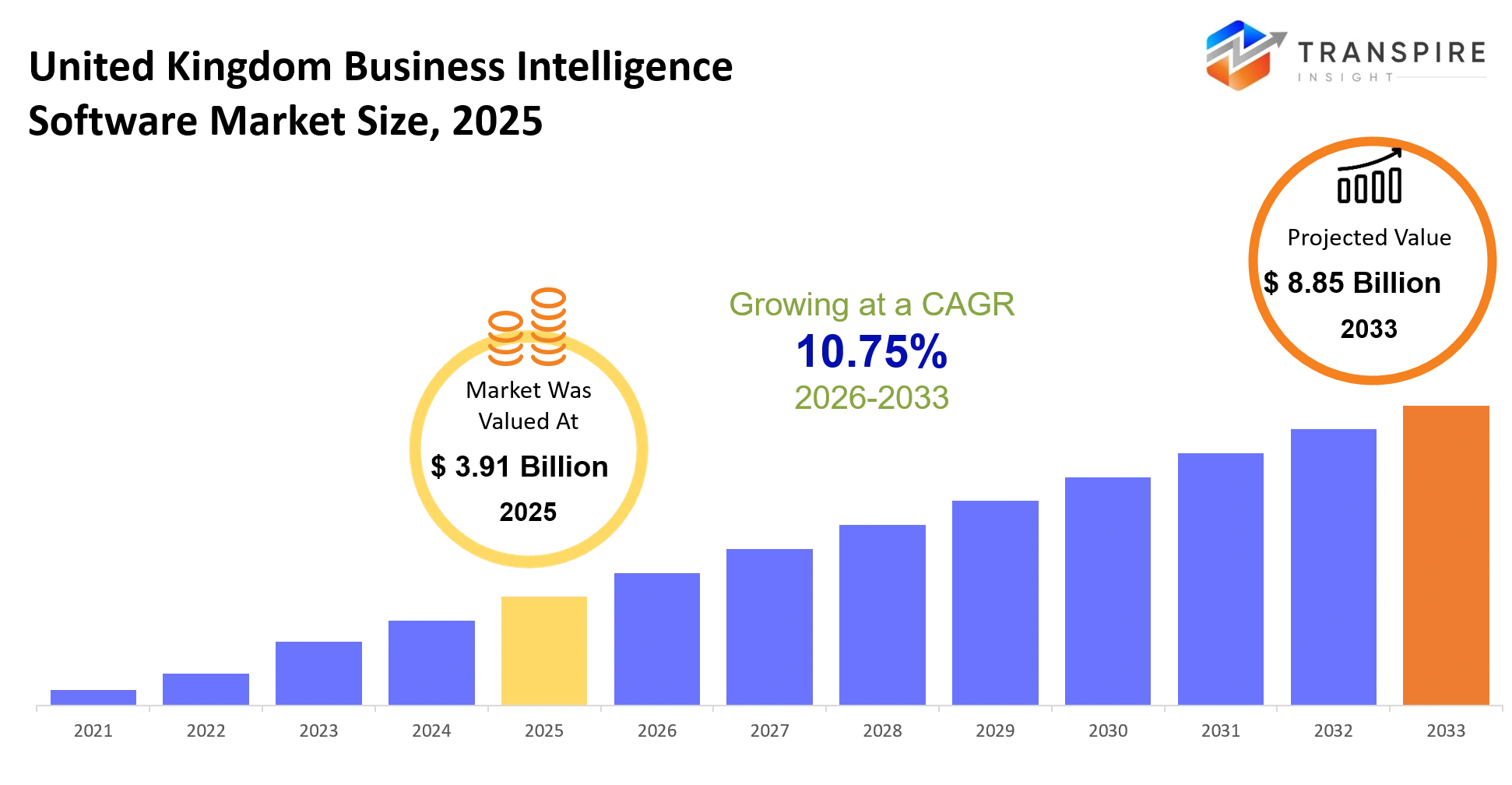
As per Transpire Insight Analysis the United Kingdom Business Intelligence Software Market size is estimated at USD 3.91 Billion in 2025 and is anticipated to reach USD 8.85 Billion by 2033, growing at a CAGR of 10.75% from 2026 to 2033.
Business intelligence software, helps UK organisations turn operational, financial, customer, and supply chain data into decisions that can improve efficiency, lower costs, and make planning faster. In practice manufacturers use it to keep tabs on production performance, retailers use it to optimize inventory as well as pricing, while financial institutions track risk, and also customer behaviour, all via unified dashboards, instead of those separate spreadsheets and reports that nobody really wants to maintain.
Over the last three to five years, the market has moved away from the old style reporting platforms to cloud-based AI-enabled analytics that provide real-time insights across business functions. That change pushed companies to modernise their legacy data environments, and bring together information from different enterprise systems into one decision making framework, which sounds simple but is rarely neat.
Then COVID-19 sped everything up , because it showed the weaknesses of manual reporting when supply chains were disrupted and demand started shifting fast. Businesses needed ongoing visibility into operations , so they put more money into scalable analytics platforms. And now, as organisations keep digitising workflows, and producing larger volumes of operational data, business intelligence software is really becoming a core enterprise capability , not just some supporting tool. This is driving adoption across big enterprises and mid-sized businesses too, and it’s also creating recurring revenue opportunities from software and services.
United Kingdom Business Intelligence Software Market Size & Forecast:
- United Kingdom Business Intelligence Software Market Size 2025: USD 3.91 Billion
- Expected Market Value 2033: USD 8.85 Billion
- Forecast CAGR: 10.75%
- Leading region in 2025: England
- Fastest Growing region: Scotland
- Key Profile: Microsoft, SAP, Oracle, IBM, Salesforce (Tableau), Qlik, SAS Institute, MicroStrategy, TIBCO Software, Domo, Sisense, Zoho, Yellowfin BI, Looker (Google), Information Builders
Key Market Insights
- In 2025, England pretty much dominated the United Kingdom Business Intelligence Software Market, sitting at around 82% market share, mainly backed by heavy, concentrated spend on enterprise technology and a lot of financial services investment .
- Scotland is expected to grow the quickest across the forecast period, kinda because digital transformation programmes are rolling out more widely, especially within public services , energy, and advanced manufacturing too.
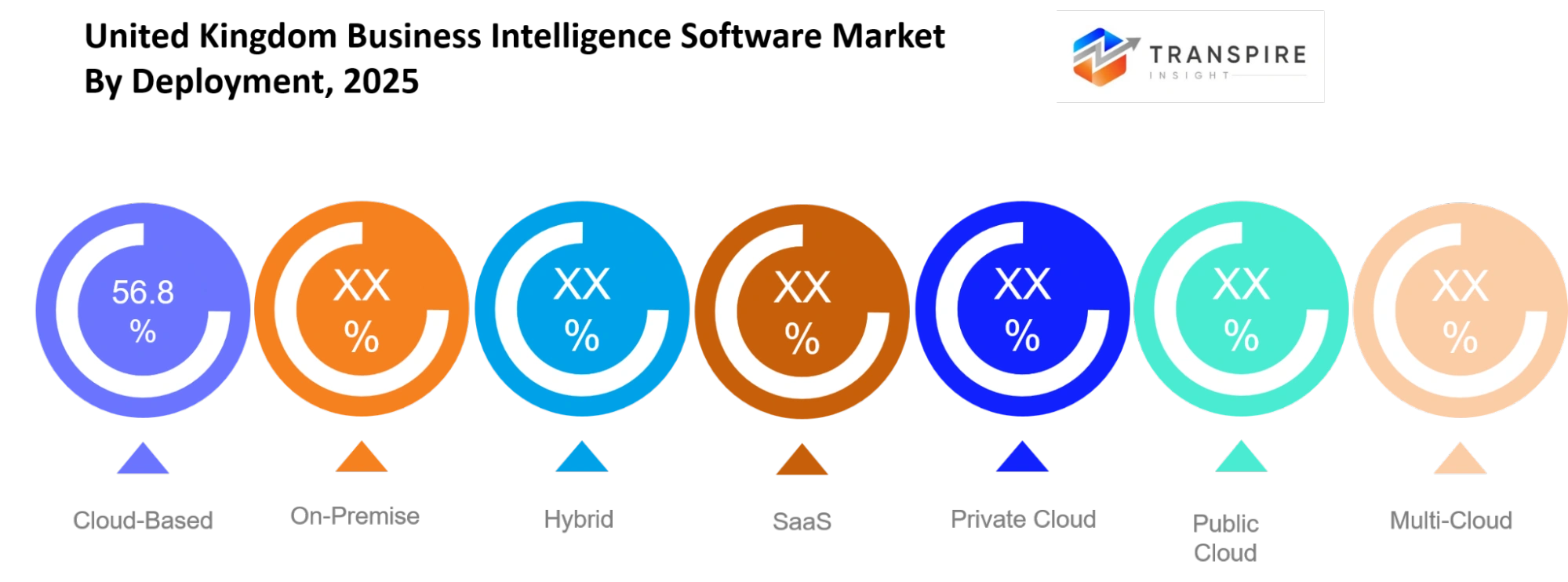
- On the product side, cloud-based business intelligence platforms led the way, with close to 64% market share in 2025. Organisations seemed to really lean into scalable rollouts, and subscription-style software arrangements, more than anything else.
- Professional and managed analytics services stayed in second place for market share, since enterprises pushed harder on data migration, governance efforts, and bigger enterprise integration work.
- AI powered analytics platforms are forecast to clock the fastest growth through 2032. The idea is that companies want to automate reporting , forecasting , and decision-support tasks across daily business operations.
- When you look at applications, financial services held the biggest slice, roughly 28% market share in 2025, driven by fraud monitoring, regulatory reporting, and customer intelligence projects .
- For application growth, supply chain and operations analytics should keep being the fastest-growing zone, since companies try to boost resilience while at the same time improving inventory performance, or at least that’s the idea.
- In 2025, Large enterprises took up about 69% of the market share . And this mostly happens because complicated data ecosystems really need enterprise-wide analytics and governance, not some kind of piecemeal setups that feel a bit patched.
- On the other hand, small and medium-sized enterprises are showing up as the fastest-growing end-user segment, which is kind of the trend to watch.
- Lower costs for cloud deployment are helping software feel more reachable , and implementation speed is improving, so more orgs are moving in.
What are the Key Drivers, Restraints, and Opportunities in the United Kingdom Business Intelligence Software Market?
The main growth driver is enterprise digital transformation, basically pushed by cloud migration and AI adoption, or well, that’s what most teams say. With cloud infrastructure rolling out broadly and with stricter data governance rules, organisations have been more likely to swap out fragmented reporting setups for integrated analytics platforms. Those unified dashboards help with faster decisions, they also improve financial planning, and they cut down operational inefficiencies, at least in theory. When access to trusted business data gets faster, it supports wider deployment across finance, operations, sales, and supply chain functions too. In the end, the transition usually boosts software subscriptions, implementation services, and longer term platform revenue.
The biggest structural restraint though, is how complicated it is to integrate legacy systems into modern analytics environments. A bunch of organisations still keep disconnected databases running along with customized enterprise software that was put together over decades. But to swap these systems out, or even only tie them together, you suddenly need real money , specialist know-how, and timelines that tend to drag on. If projects get delayed then enterprise-wide rollout gets postponed, and near-term software revenue kind of gets suppressed. From the Transpire Insight review of regional procurement announcements and launch schedules, supply chain concentration stays the primary execution risk. Plus, limited availability of experienced data engineers and integration specialists slows things down further, especially for mid-sized organisations that don’t have as many internal resources.
The best long-term chance really seems to be generative AI paired with those kind of industry specific analytics platforms, not just, you know, a single tool sitting there. In financial services , healthcare, manufacturing and retail, teams keep pouring money into predictive intelligence plus natural language data exploration. Organisations are moving toward embedded analytics right in the day to day operational software, rather than treating it like a separate reporting tool. And that change opens doors for software vendors, implementation partners and cloud providers, to grow recurring revenue, while also enabling more advanced decision automation across the United Kingdom.
What Has the Impact of Artificial Intelligence Been on the United Kingdom Business Intelligence Software Market?
Artificial intelligence has, kinda, transformed business intelligence software by moving analytics away from old fashioned retrospective reporting toward automated real time decision support. These days modern platforms use AI to handle data preparation, anomaly detection, compliance monitoring, and even dashboard generation, so there’s less manual drudgery and reporting stays more consistent across the whole enterprise. Also natural language interfaces kinda mean business people can ask about pretty complicated datasets without needing advanced technical know-how , and that helps adoption to spread beyond only specialist analytics teams, which is the key part.
Machine learning models are now being used for stuff like demand forecasting, customer behaviour analysis, financial risk assessment, inventory optimization, and predictive maintenance across both manufacturing and logistics, basically everything that moves and expects patterns.In practice, this lets organisations spot operational disturbances before they impact performance, and that improves planning accuracy, plus allocation of resources. When enterprises roll out AI enabled analytics they usually notice faster reporting cycles, less operational costs, and better productivity because automated workflows,plus a continuous look at how the business is performing, kind of keeps things on track.
Still, despite the perks, integration is a big bottleneck. A lot of organisations keep relying on separate legacy systems, and those can carry data that is inconsistent or incomplete. On top of that, high implementation costs, governance requirements that are genuinely complex, and data quality issues all drag down AI accuracy and stretch out the time to go live. So successful adoption depends, not just on advanced algorithms but also on modern data architecture, clear governance structures, and ongoing investment in enterprise data quality.
Key Market Trends
- Since 2023, generative AI has moved analytics platforms toward conversational reporting , and more automated insight creation, so less reliance on specialist data analysts. Not totally overnight but yeah, the shift is noticeable.
- Cloud native deployments surpassed the older on premise style in a lot of enterprise initiatives by 2025 too, mostly because scalability got better, and subscription pricing started making deployments feel more flexible.
- Around that same time, data governance funding really strengthened. Stricter compliance expectations pushed organisations to up their game on data quality, lineage, and keep enterprise wide reporting consistent, y’know.
- Embedded analytics also moved ahead quickly from 2024 into 2026, since vendors began placing business intelligence straight inside ERP and customer management systems, which made it feel more like part of the process rather than something separate. Then it became more of a default feature rather than some extra add-on.
- Self service analytics adoption went up because the interfaces got more intuitive , and non technical staff could assemble dashboards without too much IT involvement. Which honestly reduced the friction.
- In financial services and retail, predictive analytics spend increased after volatile market conditions showed how valuable real-time operational intelligence actually is. The “right now” kind of visibility.
- Microsoft, SAP, Oracle, IBM, and Qlik then intensified their AI funding between 2024 and 2026, focusing on stronger automation, forecasting, and enterprise data integration abilities.
- Hybrid cloud architecture gained momentum because regulated industries wanted operational flexibility , but also had stricter data residency and cybersecurity requirements. So they balanced it.
- Finally, data fabric and data mesh strategies became more like enterprise priorities, helping organisations link distributed information sources , while also cutting down analytics bottlenecks.
United Kingdom Business Intelligence Software Market Segmentation
By Component :
Software still seems to hold the leading position, because organizations keep investing in analytics platforms that support reporting forecasting, visualization, and data-led planning. Cloud-native solutions, AI enabled analytics, and subscription licensing models have kinda boosted software adoption across financial services, retail, manufacturing, and healthcare. Ongoing feature updates and flexible deployment options also will nudge teams toward longer term platform usage. Software additionally brings in recurring revenue via regular upgrades, plus adding more analytics capabilities.
Services take up a big slice too, since enterprises often need help during implementation, and even during day-to-day operations. Consulting services, in particular, help shape analytics strategies, while integration services connect business intelligence platforms with whatever existing enterprise systems they already have. Then support and maintenance improve system performance, and overall dependability after go-live. Managed services, training services, and other specialized offerings help organizations raise user adoption and stretch the long term value from their analytics investment.
By Deployment :
Cloud based deployment keeps leading the market, because organizations kinda look for adaptable infrastructure with lower initial spend, plus quicker time to implement. Subscription pricing gives companies a way to grow their analytics capabilities, without the big capital outlays. Also, continuous software upgrades, and remote access, tend to boost operational efficiency. Cloud adoption will likely keep staying strong as digital transformation efforts continue across many industries.
On premise deployment still works well for some organizations, mainly when they have tighter security and compliance needs, like in regulated sectors. Hybrid setups are also growing, since teams try to mix their existing infrastructure with cloud services to gain more flexibility. Meanwhile , SaaS keeps getting more traction because it simplifies management and makes operating costs feel more predictable. Private cloud, public cloud, multi cloud, and other deployment styles cover different operational realities and regulatory expectations in enterprise environments.
By Function :
Reporting and querying still seem like the biggest functional chunk, mostly because solid business reporting backs up the day to day operational calls and regulatory compliance. At the same time dashboard, and visualization tools kind of smooth out messy information, via interactive displays that give management better visibility, sort of at a glance. Companies depend on all that for financial reporting, operational monitoring, and exec level decision making. Demand will probably stay strong as enterprises want quicker access to trustworthy business information, not just in theory but in practice.
Then there’s predictive analytics which feels like the fastest growing side, since artificial intelligence and machine learning boost forecasting. On top of that, self service business intelligence helps staff make reports without constantly leaning on technical teams. Data discovery and performance management, plus embedded business intelligence, keep spreading as organizations plug analytics directly into their business applications. Some other specialized functions also show up to meet industry specific operational requirements and help with more advanced decisions.
By Enterprise Size :
Large enterprises rack up the highest revenue since the whole, more complex operations can churn out substantial business data that needs advanced analytics platforms. Enterprise-wide reporting, governance, and performance management keep driving continued investment into sophisticated software solutions , if you will. Also, big orgs usually assign higher technology budgets for digital transformation initiatives. Those long-term analytics plans tend to lock in recurring software and service revenue, not just one-time wins.
Medium enterprises are still steadily expanding adoption too, mainly because cloud deployment cuts down implementation costs and reduces technical complexity. Small enterprises, on the other hand, are increasingly turning toward subscription-based solutions which makes things more affordable and easier to scale. Government organizations, startups, educational institutions , and various other users continue putting money into analytics in order to improve operational effectiveness and planning. Overall wider accessibility should help adoption across organizations of different sizes, more smoothly.
By End User :
BFSI still shows up as the top end-user segment because financial institutions rely on advanced analytics for spotting fraud, regulatory reporting, customer insights, and risk management, it’s kind of the whole backbone. Healthcare organizations also push harder on analytics capabilities, so they can better manage patients and do smoother operational planning. Retail businesses, meanwhile, lean on business intelligence to fine-tune pricing, handle inventory with more control, and improve customer engagement, bit-by-bit. Manufacturing companies apply analytics to boost production efficiency and keep supply chain performance steadier.
IT and telecom organizations keep expanding analytics investments to track network performance, and also to uphold customer service quality. Government agencies are rolling out business intelligence platforms more and more, for policy planning and public service delivery. Energy and utilities firms use predictive analytics along with real-time reporting to improve asset management and operational monitoring. Other industries keep moving toward advanced analytics as digital transformation turns into a core business priority, like it’s not optional anymore.
What are the Key Use Cases Driving the United Kingdom Business Intelligence Software Market?
The biggest use case really shows up in banking, financial services, and insurance, where business intelligence software helps with regulatory reporting , fraud monitoring, financial planning, and that ongoing customer performance kind of analysis. Big financial institutions often buy enterprise analytics platforms because day to day decisions lean on accurate , real time data coming from a bunch of different systems. Good reporting also makes compliance easier to handle, plus it tends to raise operational efficiency overall
Healthcare providers are also moving into analytics at a faster pace, mainly for clinical resource planning , patient flow management, and operational performance measurement. At the same time, manufacturing companies are putting more money into advanced dashboards to help with production scheduling, keep an eye on equipment performance, and analyse supply chain disruptions. Retail businesses increasingly turn to analytics to optimise inventory, interpret purchasing behaviour, and improve pricing decisions across both physical and digital sales channels
Then there are the emerging things, like embedded analytics inside enterprise applications , and AI assisted natural language querying so business users can ask questions without needing technical expertise. Government organisations are testing predictive analytics to improve public service planning and budget allocation , while energy and utilities companies look at real time operational intelligence to back infrastructure management and regulatory reporting. These applications are expected to broaden their commercial adoption over the forecast period
|
Report Metrics |
Details |
|
Market size value in 2025 |
USD 3.91 Billion |
|
Market size value in 2026 |
USD 4.33 Billion |
|
Revenue forecast in 2033 |
USD 8.85 Billion |
|
Growth rate |
CAGR of 10.75% from 2026 to 2033 |
|
Base year |
2025 |
|
Historical data |
2021 - 2024 |
|
Forecast period |
2026 - 2033 |
|
Report coverage |
Revenue forecast, competitive landscape, growth factors, and trends |
|
Regional scope |
United Kingdom (England, Scotland, Wales, Northern Ireland) |
|
Key company profiled |
Microsoft, SAP, Oracle, IBM, Salesforce (Tableau), Qlik, SAS Institute, MicroStrategy, TIBCO Software, Domo, Sisense, Zoho, Yellowfin BI, Looker (Google), Information Builders . |
|
Customization scope |
Free report customization (country, regional & segment scope). Avail customized purchase options to meet your exact research needs. |
|
Report Segmentation |
By Component (Software, Services, Consulting Services, Integration Services, Support & Maintenance, Managed Services, Training Services, Others); By Deployment (Cloud-Based, On-Premise, Hybrid, SaaS, Private Cloud, Public Cloud, Multi-Cloud, Others); By Function (Reporting & Querying, Dashboard & Visualization, Predictive Analytics, Self-Service BI, Data Discovery, Performance Management, Embedded BI, Others); By Enterprise Size (Large Enterprises, Medium Enterprises, Small Enterprises, Government Organizations, Startups, Educational Institutions, Others); By End User (BFSI, Healthcare, Retail, Manufacturing, IT & Telecom, Government, Energy & Utilities, Others) |
Which Regions are Driving the United Kingdom Business Intelligence Software Market Growth?
England racked up roughly 82% of the market in 2025 , so yeah it’s basically the main regional driver. A mix of strong digital transformation policies, pretty mature cloud infrastructure, and even tighter data governance rules has nudged many organizations to roll out enterprise analytics platforms across both private and public services. In London you get this dense cluster of software vendors, cloud providers, banks, tech partners , and consulting firms that help speed up deployment and keep innovation moving. Going forward, more spending on artificial intelligence, enterprise cloud migration, and advanced data management should keep England in front through the forecast period, more or less.
Scotland looks a bit different in structure, in the sense that its expansion is more about investment that’s tailored to specific sectors, instead of just having corporate headquarters concentrated in one place. Financial services, energy, higher education, and life sciences keep putting money into analytics to tighten operational planning , and to strengthen regulatory compliance. With steady public funding aimed at digital innovation, plus fairly consistent enterprise technology budgets, Scotland ends up with procurement patterns for software that are more predictable across multiple industries. That balanced setup makes Scotland a dependable source for recurring software revenue and implementation , at least in practice.
Wales is expected to see the quickest expansion between 2026 and 2033, mainly because digital infrastructure spending keeps rising , and industrial modernisation programmes roll out more broadly across manufacturing and public services. Lately, investments around smart manufacturing, cloud uptake, and digital public-sector initiatives have quietly boosted demand for scalable analytics platforms. Also, small and medium-sized enterprises are moving toward subscription - based business intelligence solutions, since setup or implementation costs are feeling more manageable.
All of this builds momentum into quite solid openings for software vendors, cloud service providers, and implementation partners, especially those looking to expand into up-and-coming regional markets through the forecast period.
Who are the Key Players in the United Kingdom Business Intelligence Software Market and How Do They Compete?
Competition is sort of moderately consolidated, with global enterprise software providers rubbing shoulders with specialised analytics vendors and the implementation partners, all of them aiming for the same budgets. In practice, the battle is less about price and more about technology innovation, artificial intelligence capabilities, cloud deployment, and enterprise integration services. The established software firms keep pushing product portfolios forward via ongoing innovation, but the specialists tend to stand out by doing faster implementation, using more flexible deployment models, and offering analytics that feel tuned for specific industries.
Microsoft, for example, keeps growing adoption by steadily enhancing Power BI with artificial intelligence, plus deeper Microsoft Fabric integration, and also strong compatibility with existing enterprise productivity platforms. Salesforce differentiates by leaning into embedded analytics and AI-driven customer intelligence, it plugs straight into customer relationship management workflows and stays there. SAP takes a different angle, it focuses on enterprise-wide data integration by linking analytics with business applications, so organizations can make decisions using operational and financial information from one unified environment, rather than stitching things together later.
Oracle competes by pairing autonomous database technology with cloud analytics, basically helping organisations boost performance while also cutting down the administrative burden. IBM, meanwhile, strengthens its position through watsonx and hybrid cloud capabilities, which are designed to support advanced data governance and broader enterprise artificial intelligence initiatives. Qlik keeps expanding through cloud-native analytics, data integration, and strategic partnerships that make access to trusted business data feel simpler, so organizations can roll out analytics more efficiently across multiple business functions.
Company List
- Microsoft
- SAP
- Oracle
- IBM
- Salesforce (Tableau)
- Qlik
- SAS Institute
- MicroStrategy
- TIBCO Software
- Domo
- Sisense
- Zoho
- Yellowfin BI
- Looker (Google)
- Information Builders
Recent Development News
In April 2026, Microsoft introduced Database Hub and Fabric IQ for Microsoft Fabric at FabCon 2026. The launch expanded AI-powered business intelligence with unified data management, natural language querying, and semantic capabilities that strengthen enterprise analytics deployments. Source https://www.itpro.com/
In November 2025, SAP and Microsoft expanded their strategic partnership by launching SAP Business Data Cloud Connect for Microsoft Fabric. The integration enables zero-copy sharing of SAP data with Microsoft Fabric, improving enterprise analytics, AI readiness, and business intelligence capabilities for joint customers. Sourcehttps://news.sap.com/
What Strategic Insights Define the Future of the United Kingdom Business Intelligence Software Market?
Over the next five to seven years, the United Kingdom Business Intelligence Software Market is set to drift toward “smarter” decision platforms that bundle business intelligence, artificial intelligence, automation and unified data management , all inside one enterprise setting. And yeah, this path seems to be pushed by more and more company spending on data architectures that can handle real-time analytics, keep things aligned with regulatory compliance, and help deliver quicker operational choices across several business teams at once.
There is also a sort of quieter risk , one that often goes unnoticed: relying too heavily on a small set of hyperscale cloud providers and enterprise software vendors. That kind of dependence can squeeze pricing flexibility, slow down interoperability, and even turn implementation into a bottleneck for customers who just want things to go live without major delays.
At the same time, a strong opportunity is forming. Industry-specific AI analytics platforms for healthcare, financial services, and advanced manufacturing are starting to show up, and in those cases the regulatory and operational needs are pretty demanding. So a tailored approach matters more than generic software that tries to fit everyone. Market players, if they want to benefit, should probably focus on open integration capabilities, building vertical partnerships, and deploying scalable AI services that cut down deployment complexity. In the end this can support long-term customer retention and recurring revenue, which is the part everyone cares about.
United Kingdom Business Intelligence Software Market Report Segmentation
By Component
- Software
- Services
- Consulting Services
- Integration Services
- Support & Maintenance
- Managed Services
- Training Services
By Deployment
- Cloud-Based
- On-Premise
- Hybrid
- SaaS
- Private Cloud
- Public Cloud
- Multi-Cloud
By Function
- Reporting & Querying,
- Dashboard & Visualization
- Predictive Analytics
- Self-Service BI
- Data Discovery
- Performance Management
- Embedded BI
By Enterprise Size
- Large Enterprises
- Medium Enterprises
- Small Enterprises
- Government Organizations
- Startups
- Educational Institutions
By End User
- BFSI
- Healthcare
- Retail
- Manufacturing
- IT & Telecom
- Government
- Energy & Utilities
Frequently Asked Questions
Find quick answers to common questions.
The expected United Kingdom Business Intelligence Software Market size for the market will be USD 8.85 Billion in 2033.
Key segments for the United Kingdom Business Intelligence Software Market are By Component (Software, Services, Consulting Services, Integration Services, Support & Maintenance, Managed Services, Training Services, Others); By Deployment (Cloud-Based, On-Premise, Hybrid, SaaS, Private Cloud, Public Cloud, Multi-Cloud, Others); By Function (Reporting & Querying, Dashboard & Visualization, Predictive Analytics, Self-Service BI, Data Discovery, Performance Management, Embedded BI, Others); By Enterprise Size (Large Enterprises, Medium Enterprises, Small Enterprises, Government Organizations, Startups, Educational Institutions, Others); By End User (BFSI, Healthcare, Retail, Manufacturing, IT & Telecom, Government, Energy & Utilities, Others).
Major United Kingdom Business Intelligence Software Market players are Microsoft, SAP, Oracle, IBM, Salesforce (Tableau), Qlik, SAS Institute, MicroStrategy, TIBCO Software, Domo, Sisense, Zoho, Yellowfin BI, Looker (Google), Information Builders.
The United Kingdom Business Intelligence Software Market size is USD 3.91 Billion in 2025.
The United Kingdom Business Intelligence Software Market CAGR is 10.75% from 2026 to 2033.
- Microsoft
- SAP
- Oracle
- IBM
- Salesforce (Tableau)
- Qlik
- SAS Institute
- MicroStrategy
- TIBCO Software
- Domo
- Sisense
- Zoho
- Yellowfin BI
- Looker (Google)
- Information Builders
About the Authors

Mayur Shinde
I am Mayur Shinde, a Senior Research Analyst at Transpire Insight, specializing in the Automotive & Transportation and Information & Communication Technology (ICT) Industry. My work focuses on analyzing emerging market trends, technological advancements, competitive landscapes, and industry developments to deliver accurate, data-driven insights. I am passionate about transforming complex market information into clear, actionable content that helps businesses, professionals, and decision-makers stay informed and make confident strategic decisions.

Chakradhar Khansole
Chakradhar serves as the Research Director at Transpire Insight, bringing over 8 years of experience in technology, innovation, and strategic market intelligence. He specializes in transforming complex market data into actionable business insights that enable organizations to make informed, growth-oriented decisions. Recognized for his strategic vision and analytical expertise, Chakradhar leads high-impact research initiatives, delivering comprehensive market assessments, competitive intelligence, and forward-looking industry analysis.
Recently Published Reports
-
Apr 2026
3D Optical Profiler Market
3D Optical Profiler Market Size, Share & Analysis Report By Type (Desktop 3D Optical Profiler, and Portable 3D Optical Profiler), By Technology (Confocal Technology, and White Light Interference), By End-Use Industry (Manufacturing, Research Institutions, Automotive, Aerospace and Defense, Medical Devices, and Other), and Geography (North America, Europe, Asia-Pacific, Middle East and Africa, South and Central America), 2021 - 2031
-
Apr 2026
Depth Sensor Market
Depth Sensor Market Size, Share & Analysis Report By Type (Infrared Depth Sensors, Time-of-Flight (ToF) Sensors, Stereo Vision Sensors, Structured Light Sensors, Ultrasonic Depth Sensors), By Application (Automotive, Robotics, Gaming, Consumer Electronics, Industrial Automation, Healthcare, Security & Surveillance, Others), By End Users (Automotive Manufacturers, Consumer Electronics Companies, Healthcare Providers, Industrial Companies, Security Agencies, Gaming Companies, Robotics Companies, Others), and Geography (North America, Europe, Asia-Pacific, Middle East and Africa, South and Central America), 2021 – 2031
-
Apr 2026
Digital Manufacturing Market
Digital Manufacturing Market Size, Share & Analysis Report By Component (Hardware, Software, and Services), By Technology (Robotics, 3D Printing, Internet of Things (IoT), and Others), By Application (Automotive and Transportation, Aerospace and Defense, Consumer Electronics, Industrial Machinery, and Others), By Process Type (Computer-Based Designing, Computer-Based Simulation, Computer 3D Visualization, Analytics, and Others), and Geography (North America, Europe, Asia-Pacific, Middle East and Africa, South and Central America), 2021 – 2031
-
Apr 2026
Digital Visa Services Market
Digital Visa Services Market Size, Share & Analysis Report By Type (Individual Travelers, Group Travelers), By Application (Tourism, Business Travel, Others), and Geography (North America, Europe, Asia-Pacific, Middle East and Africa, South and Central America), 2021 – 2031