

Global Pharmacy Automation Market Size & Forecast:
- Global Pharmacy Automation Market Size 2025: USD 6.4 Billion
- Global Pharmacy Automation Market Size 2033: USD 11.5 Billion
- Global Pharmacy Automation Market CAGR: 7.57%
- Global Pharmacy Automation Market Segments: By Product (Automated Dispensing Systems, Packaging Systems, Storage Systems, Compounding Systems, Tabletop Counters, Labeling Systems, Workflow Software, Others); By End User (Retail Pharmacies, Hospital Pharmacies, Mail-order Pharmacies, Others); By Application (Drug Dispensing, Packaging, Inventory Management, Compounding, Others); By Deployment (On-premise, Cloud, Hybrid, Others); By Component (Hardware, Software, Services, Others)

Global Pharmacy Automation Market Summary:
As per Transpire Insight Analysis, the Global Pharmacy Automation Market size is estimated at USD 6.4 Billion in 2025 and is anticipated to reach USD 11.5 Billion by 2033, growing at a CAGR of 7.57% from 2026 to 2033.
Global Pharmacy Automation Market is revolutionizing the way medication is dispensed, packaged, stored and stocked from labour-intensive manual ways of dispensing to smarter automated processes to enhance efficiency, speed, and regulatory compliance in hospitals, retail pharmacies, pharmacies and fulfilment centres. The last 5 years have witnessed a high rise in investments for automation in the healthcare sector due to growing concern about the increased pressure from prescription volume, complexity of specialized medication and shortages of the labour force. An important structural transition in this market is moving from basic dispensing solutions to an all-integrated pharmacy system. This interconnected ecosystem typically combines the dispensing robot with other tools and also links with EHR and cloud-based platforms, inventory data, and analytics. The quick scale-up of centralized fulfilment pharmacy centres. Large pharmacy and hospital chains have been rapidly developing their central fulfilment pharmacies to process ever-growing prescription volumes, which include a high-speed dispensing robot with highly integrated inventory management capabilities.
Key Global Pharmacy Automation Market Insights:
The pharmacy automation market is evolving from a single-dispensing system to a digitally connected medicine management system, with software intelligence playing a greater role in the value of operations. The future of competitive advantage is integrated automation platforms, including robotics, cloud functionality, and predictive analytics, all designed to boost pharmacy productivity.
· The largest segment is still Automated Dispensing Systems (39)%, with BD and Omnicell introducing AI-driven automated dispensing cabinets with real-time medication tracking.
· Packaging Systems (20%) are progressing with automated unit-dose packaging, while ScriptPro is advancing packaging technologies for compliance.
· As Swisslog Healthcare integrates the robotic storage system with hospital logistics platforms, Storage Systems (14%) have become intelligent inventory hubs.
· Precision preparation technologies are driving Compounding Systems (10%), and ARxIUM is increasing sterile workflow automation.
· The rise of cloud-connected pharmacy management ecosystems by Oracle Health and Cerner is driving the growth of Cloud-based Workflow Software (14.8% CAGR).
· As McKesson and Baxter add automation to medication delivery and supply chain optimization, hospital pharmacies remain top contenders for end-user uptake.
· Retail pharmacy companies are expanding centralized prescription dispensing, and Parata Systems and Capsa Healthcare drive high-volume dispensing productivity.
· AI's predictive inventory, barcode scanning and robotic dispensing have taken over from manual work in medicine handling, paving the way for data-driven, scalable healthcare operations.
What are the Key Drivers, Restraints, and Opportunities in the Global Pharmacy Automation Market?
Driver:
The strongest driver is increasing prescription volumes and the chronic technician shortage. The increased complexity of filling prescriptions is the result of a growing elderly population, growing chronic diseases, and the wider use of specialty drugs, it explains. As these trends continue, more pharmacies in hospitals and pharmacy chains are adopting automated systems for dispensing, packaging, prescription verification and inventory management, all of which boost accuracy, prescription efficiency and throughput time while minimizing medication waste and ultimately lowering operational costs and boosting capital return rates.
In April 2026, BD (Becton, Dickinson and Company) launched the BD® Pyxis™ Pro Dispensing Solution and BD® Incada™ Connected Care Platform in Europe. This next-generation medication management setup integrates advanced mechanical automation with AI-driven point-of-care insights.
Restraint:
The cost of implementation and systems integration. Pharmacies implementing robotics need their system to work flawlessly with EMR, the hospital information system, all the required cybersecurity protocols, robots, and must also meet regulatory approval. So, as one may expect, the bulk of independent pharmacies or smaller facilities will put off the modernization until such times as they can afford workflow re-engineering, system updates, maintenance costs, and staff training.
Opportunity:
The cloud pharmacy solutions, combined with AI-empowered centralized operations, are powering future growth. Cloud workflows provide remote access to pharmacy operations and support the consolidation of a diverse set of pharmacy functions across multiple facilities to provide more opportunities for automation to mid-tier healthcare customers. Meanwhile, investment in digital hospital expansion across the APAC region and the Middle East, enhanced by AI-assisted drug verification, AI-powered prediction to better manage drug inventory, will enable expansion opportunities with greater benefits to the pharmaceutical supply chain.
In April 2026, Omnicell showcased the accelerating deployment momentum of its Titan XT automated dispensing system powered by the cloud-native OmniSphere platform. This hardware and software combination unifies multi-facility operations by linking physical hardware to cloud-based predictive AI algorithms.
What Has the Impact of Artificial Intelligence Been on the Global Pharmacy Automation Market?
These advances have also introduced intelligent decision-making beyond merely counting medication and dispensing prescriptions, where complex algorithms of artificial intelligence systems monitor prescription trends, inventory levels, medication consumption patterns, and predicted demand patterns to predict potential medication shortages before they happen and create inventory level ordering. The system helps to strengthen prescription integrity by learning patterns of doses, interactions, duplicate doses, and abnormal dispensing activity that a pharmacist needs to check the orders of patients. Other areas where artificial intelligence is streamlining pharmacy operations include creating efficient employee schedules, improving prioritization of the workflow of prescriptions, and better usage of space. Bar code validation of prescribed medication, as well as machine vision on robotic pharmacy automation, helps to improve machine reading. In addition, intelligent maintenance functions anticipate failure on automation equipment to minimize time and expense. The utilization of artificial intelligence is lagging as a result of the prohibitive cost of implementing and connecting the systems.
In February 2026, RedSail Technologies acquired PrimeRx, a prominent provider of innovative pharmacy management software solutions. This strategic acquisition expands RedSail's comprehensive healthcare software network to approximately 16,000 pharmacies nationwide, streamlining clinical and financial inventory data entry into an interconnected ecosystem.
Key Global Pharmacy Automation Market Trends:
This is a transformation in the pharmacy automation world that's moving beyond equipment deployment to complete, connected, intelligence-driven medication management ecosystems.
- Hospital pharmacies are moving from standalone dispensing machines to digital solutions that connect inventory, prescription, verification and dispensing processes.
- Pharmacy management platforms have moved from trial to enterprise-wide rollouts, with multi-site coordination and remote management for their use.
- Computer vision is now widely being used in robotic dispensing systems to identify medications in real-time and to automatically verify their quality.
- Prescription fulfilment centres are still growing, with pharmacy chains aiming to become more efficient and consistent in processing prescriptions.
- Predictive inventory analytics tools have moved beyond just reporting on past inventory to forecasting and replenishment using prescription trends and seasonal demand.
- Automation platforms that are interoperable and can connect with electronic medical records and clinical decision-support systems are becoming a major focus in healthcare.
- Investment in automation has moved from the goal of “labour saving” to “medication tracking, regulatory compliance and patient safety performance metrics.”
- Vendors are offering increasingly modular solutions with automation that enable pharmacies to add functionality as they go, rather than having to do everything at once.
Global Pharmacy Automation Market Segmentation
By Product:
With automated dispensing systems generating 39% of the revenues, accuracy of dispensing, processing speed, and workflow efficiency have proved to be their key benefits. Packaging systems generated 20% revenue due to the increasing requirement for unit-dose packaging and compliance labels. The increasing necessity for inventory management solutions, such as intelligent storage systems, has generated 14% revenue. The demand for personalized medications has fueled 10% revenue for the compound systems, and 17% of the remaining revenues come from other automation solutions, which are designed to support a pharmacy's workflow and operations.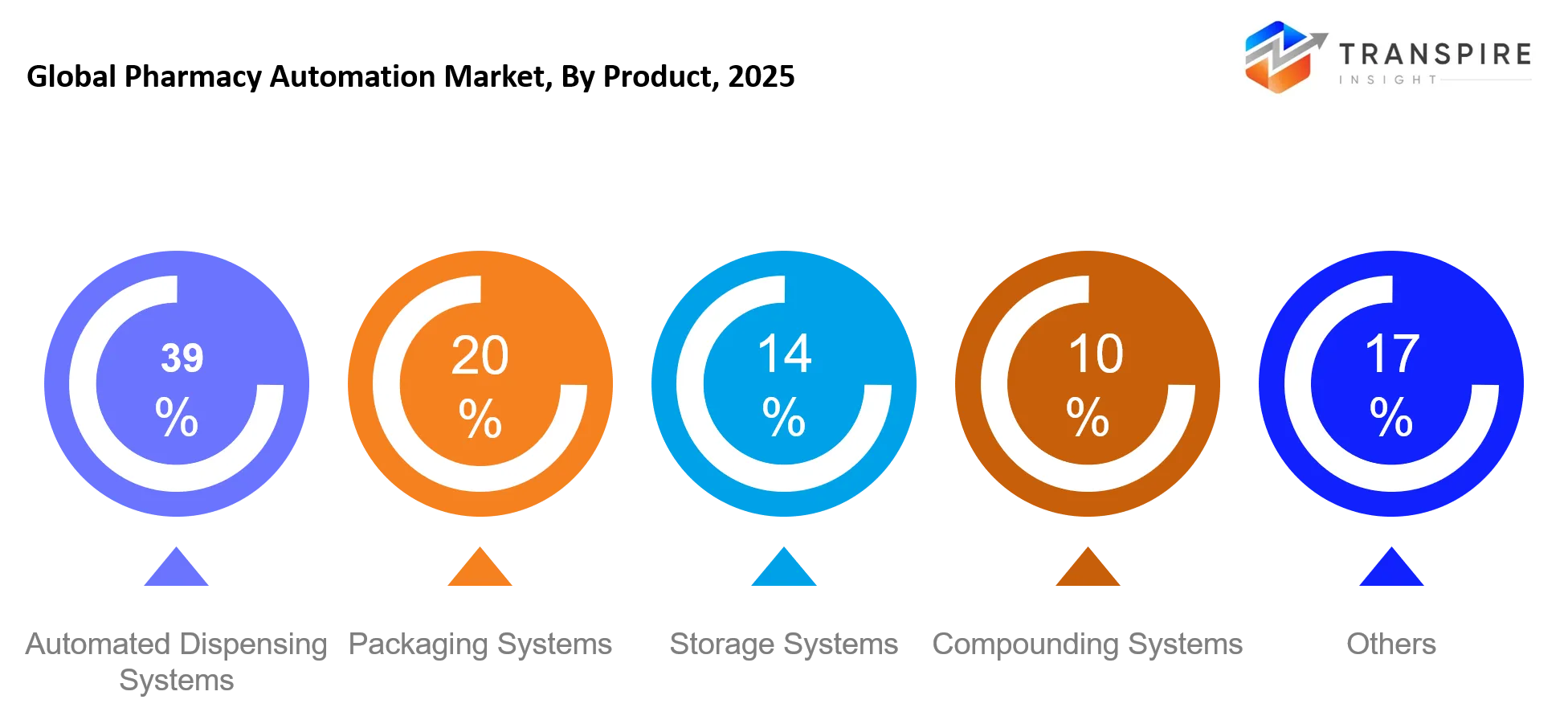
By End-User:
Hospital pharmacies remain the largest contributors owing to high prescription volumes, stringent medication safety requirements, and substantial capital investments in automation infrastructure. Retail pharmacy chains are strengthening their market presence through centralized fulfilment centres, whereas long-term care facilities and mail-order pharmacies are expected to witness sustained growth as healthcare systems increasingly adopt connected, technology-driven medication management models.
By Application:
Inpatient pharmacy produces the largest revenues in the sector since it deals with complex prescription fulfilment and sustained medication management for ongoing care, in contrast to inpatient and outpatient pharmacy operations, which are quicker to adopt e-prescribing, automatic refills, and omnichannel capabilities.
By Deployment:
On-Premise Solution dominated the market with a high market share owing to stringent healthcare regulations that encourage data security and system governance. Workflow Software in Cloud, on the other hand, the market is anticipated to grow at the fastest rate of CAGR 14.8% due to the rise in unified management, remote monitoring features and scalability for multiple locations.
By Component:
Hardware represents the largest revenue contributor due to widespread deployment of robotic dispensing, packaging, and storage equipment, while software is expanding rapidly through AI-enabled workflow management and analytics. Services are gaining importance with installation, maintenance, and training support, whereas others continue to strengthen integrated pharmacy automation ecosystems.
What are the Key Use Cases Driving the Global Pharmacy Automation Market?
The largest market application of pharmacy automation technology is high-volume pharmacy automation for hospitals, delivering enhanced prescription accuracy and quicker turnaround times for medication, increasing inventory efficiency and promoting constant inpatient care management.
Pharmacy automation is steadily permeating retail, outpatient, and central pharmacy settings. Packaging and inventory of prescriptions have reached unprecedented levels of automation, with in-package robotics, on-demand verification, and cloud computing-based workflows yielding faster turnaround, reduced operating expenses and improved traceability among dispersed pharmacies.
Emerging pharmacy automation applications and use cases include AI-powered prescription validation, personalized prescription compounding, prescriptive ordering, and remote pharmacy operations management that provide support for specialty pharmacies, nursing homes and the ever-increasing need for telepharmacy services.
|
Report Metrics |
Details |
|
Market size value in 2025 |
USD 6.4 Billion |
|
Market size value in 2026 |
USD 6.9 Billion |
|
Revenue forecast in 2033 |
USD 11.5 Billion |
|
Growth rate |
CAGR of 7.57% from 2026 to 2033 |
|
Base year |
2025 |
|
Historical data |
2021 - 2024 |
|
Forecast period |
2026 - 2033 |
|
Report coverage |
Revenue forecast, competitive landscape, growth factors, and trends |
|
Regional scope |
United States; Canada; Mexico; United Kingdom; Germany; France; Italy; Spain; Denmark; Sweden; Norway; China; Japan; India; Australia; South Korea; Thailand; Brazil; Argentina; South Africa; Saudi Arabia; United Arab Emirates |
|
Key company profiled |
BD, Omnicell, Swisslog Healthcare, Capsa Healthcare, ScriptPro, ARxIUM, Talyst, Yuyama, Parata Systems, Cerner, Oracle Health, Baxter, McKesson, TouchPoint Medical, Pearson Medical. |
|
Customization scope |
Free report customization (country, regional & segment scope). Avail customized purchase options to meet your exact research needs. |
|
Report Segmentation |
By Product (Automated Dispensing Systems, Packaging Systems, Storage Systems, Compounding Systems, Tabletop Counters, Labeling Systems, Workflow Software, Others); By End User (Retail Pharmacies, Hospital Pharmacies, Mail-order Pharmacies, Others); By Application (Drug Dispensing, Packaging, Inventory Management, Compounding, Others); By Deployment (On-premise, Cloud, Hybrid, Others); By Component (Hardware, Software, Services, Others) |
Which Regions are Driving the Global Pharmacy Automation Market Growth?
North America represents 42% of the market thanks to a well-developed healthcare infrastructure, high healthcare spending and high adoption of the digital pharmacy model. Because of solid regulatory quality standards for medication safety, automatic dispensing systems are increasingly purchased. Large health systems and retail pharmacy chains are also investing heavily to modernize pharmacies with the latest generation of robots and artificial intelligence-based platforms in the pharmacy process. Furthermore, local technology players constantly provide new solutions, cementing North America’s position at the top of the market.
In June 2026, Capsa Healthcare executed a strategic acquisition of The Harloff Company. This initiative expands Capsa's medical mobility and specialized clinical workflow portfolio across the region. The integration provides advanced medication management hardware alongside their existing high-volume robotic dispensing platforms to modernize physical infrastructure.
Europe represents 28% of the market and maintains steady expansion through well-established public healthcare systems and strict pharmaceutical quality regulations. Compared with North America, growth is more policy-driven, emphasizing medication traceability, standardized pharmacy operations, and patient safety initiatives. Hospital modernization programs and workforce shortages continue to support automation investments. Cross-border healthcare collaboration also strengthens technology standardization across regional markets.
In April 2026, Becton, Dickinson and Company (BD) announced a major product launch introducing the BD Pyxis Pro Dispensing Solution and BD Incada Connected Care Platform directly into the European market. This system uses AWS European Sovereign Cloud infrastructure to support localized digital compliance.
Asia Pacific the Largest Growing Market 22% of market share, is expected to show robust growth of 16.1% CAGR. Hospitals’ increasing construction speed and digitalization in the healthcare industry have driven considerable growth in automation investment for many emerging countries. Increased drug prescription rate and government-supported smart hospital initiatives will offer further deployment growth avenues. Healthcare infrastructure augmentation in the future will make the segment a powerful long-term driver for growth, while the Middle East and Africa region and Latin America hold a market share of 4% each.
In June 2026, Deenova, leading a strategic healthcare consortium alongside [Becton Dickinson Italia] and GPI, formally deployed an integrated interoperable automation and traceability system at the Fondazione IRCCS Ca' Granda Ospedale Maggiore Policlinico di Milano. This technology initiative connects clinical data infrastructure with automated hardware devices.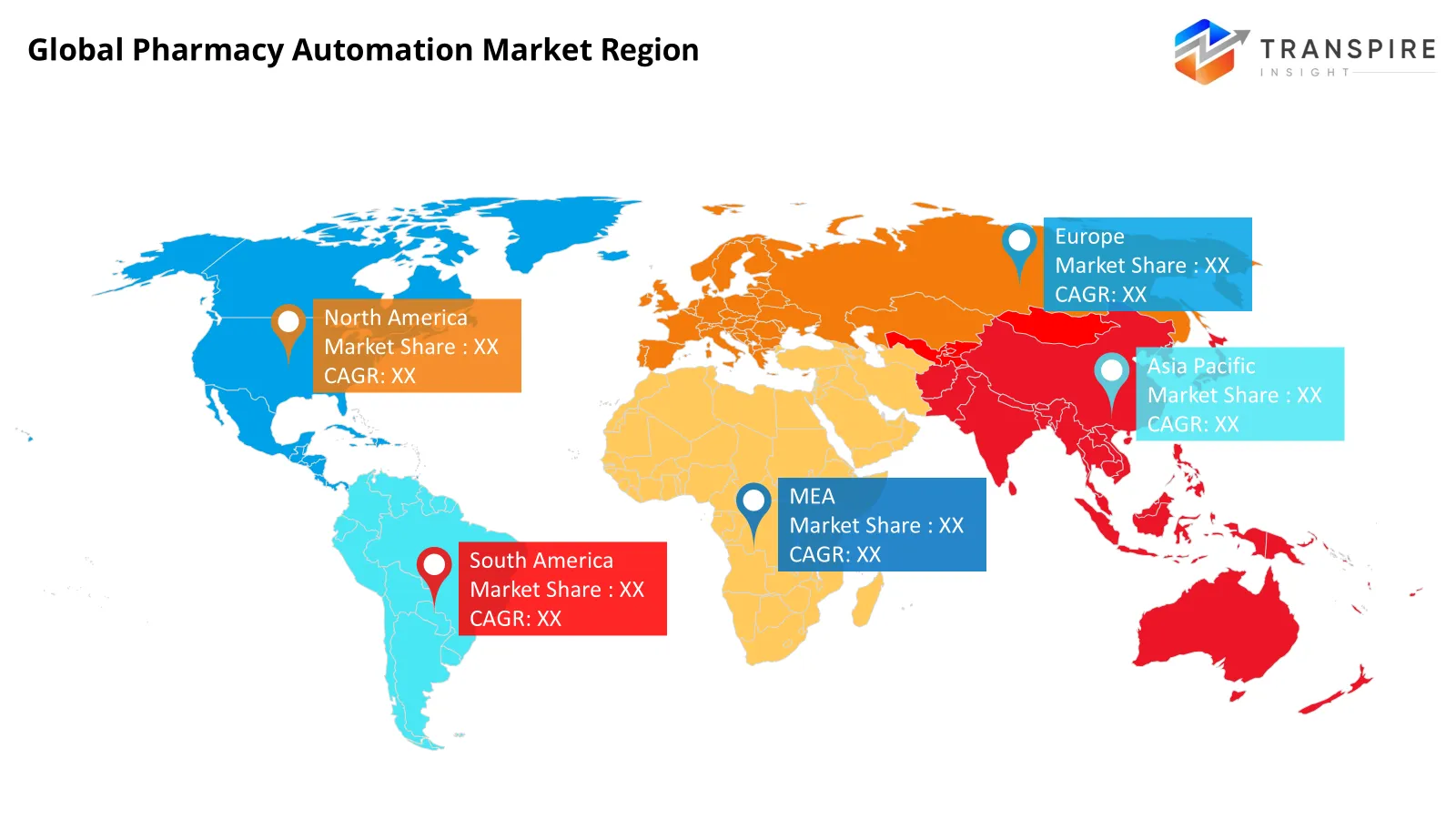
Who are the Key Players in the Global Pharmacy Automation Market and how do they Compete?
The Global Pharmacy Automation Market competition will increasingly take place within integrated automation platforms, interoperable workflows, and long-term services, rather than hardware sales. Vendors are competing by integrating automation robotics cloud, AI-driven analytics, and healthcare system integration to enhance medication safety and pharmacy workflows.
BD differentiates its solution based on its wide ecosystem of medication management. Omnicell emphasizes autonomous pharmacy platforms and SaaS services. Swisslog Healthcare is focusing its automation efforts on integrating robotic logistics solutions. Capsa Healthcare competes with modular workflow automation. ScriptPro bolsters its automated robotic prescription dispensation, while ARxIUM is focusing on automated compounding and centralized pharmacy operations. Talyst competes based on its capabilities in hospital inventory optimization, and Yuyama uses its advanced dispensing equipment to compete across Asia. Parata Systems is focused on high-volume retail pharmacy automation, while Cerner and Oracle Health are enabling integration of pharmacy workflows into the larger healthcare IT systems. Baxter integrates medication preparation with automation, and McKesson uses its pharmaceutical distribution expertise to differentiate. Touchpoint Medical competes based on medication delivery automation, while Pearson Medical’s efforts are concentrated on its barcoding and medication packaging technologies.
Key Players are:
- BD
- Omnicell
- Swisslog Healthcare
- Capsa Healthcare
- ScriptPro
- ARxIUM
- Talyst
- Yuyama
- Parata Systems
- Cerner
- Oracle Health
- Baxter
- McKesson
- TouchPoint Medical
- Pearson Medical
Recent Development News
- In January 2026, Morrison launched Fillex, a new national automated pharmacy infrastructure platform. Backed by the Morrison Value Add II middle-market infrastructure fund, this platform introduces centralized, open-access automated prescription fulfillment services designed to help retail pharmacies, grocery chains, e-commerce providers, and health systems efficiently scale logistics.
- In May 2026, Swisslog Healthcare entered a strategic partnership with Elemeno Health to deploy just-in-time microlearning solutions across hospital pharmacies in North America. This operational integration provides frontline clinical staff with on-demand digital training and troubleshooting tools for Swisslog's advanced robotics, including its PillPick®, BoxPicker®, and Allegro automated medication packaging and dispensing systems.
What Strategic Insights Define the Future of the Global Pharmacy Automation Market?
The automation market in pharmacies continues to trend towards integrated, intelligent medication management solutions platforms that, through the synergy of software, robotics and AI, will drive operational efficiencies. Future competition in the pharmacy space will likely hinge not so much on the deployment of individual automation products, but on integrated systems platforms where prescription dispensing, inventory control, medication validation and patient data become interconnected in ways that enhance care. Yet, there's a looming risk in a fractured digital architecture, with existing, less interoperable pharmacy systems having the potential to impede integration efforts and undermine potential automation ROI. Meanwhile, some long-term opportunities emerge, including cloud-based pharmacy networks, AI-powered validation, and centralized medication dispensing centers, especially as key emerging markets prioritize smart hospital facilities.
Key Segmentations are:
By Product
- Automated Dispensing Systems
- Packaging Systems
- Storage Systems
- Compounding Systems
- Tabletop Counters
- Labelling Systems
- Workflow Software
- Others
By End User
- Retail Pharmacies
- Hospital Pharmacies
- Mail-order Pharmacies
- Others
By Application
- Drug Dispensing
- Packaging
- Inventory Management
- Compounding
- Others
By Deployment
- On-premise
- Cloud
- Hybrid
- Others
By Component
- Hardware
- Software
- Services
- Others.
Regional Outlook
North America
- United States
- Canada
- Mexico
Europe
- Germany
- United Kingdom
- France
- Spain
- Italy
- Rest of Europe
Asia Pacific
- Japan
- China
- Australia & New Zealand
- South Korea
- India
- Rest of Asia Pacific
South America
- Brazil
- Argentina
- Rest of South America
Middle East & Africa
- Saudi Arabia
- United Arab Emirates
- South Africa
- Rest of the Middle East & Africa
Frequently Asked Questions
Find quick answers to common questions.
The Global Pharmacy Automation Market size was valued at USD 6.4 Billion in 2025 and is poised to reach USD 11.5 Billion by 2033, expanding at a 7.57% CAGR.
Key Segments for the Global Pharmacy Automation Market are By Product (Automated Dispensing Systems, Packaging Systems, Storage Systems, Compounding Systems, Tabletop Counters, Labeling Systems, Workflow Software, Others); By End User (Retail Pharmacies, Hospital Pharmacies, Mail-order Pharmacies, Others); By Application (Drug Dispensing, Packaging, Inventory Management, Compounding, Others); By Deployment (On-premise, Cloud, Hybrid, Others); By Component (Hardware, Software, Services, Others).
Growth is primarily driven by rising prescription volumes, healthcare workforce shortages, increasing medication safety requirements, and expanding adoption of AI-enabled pharmacy automation solutions.
The Global Pharmacy Automation Market is led by major manufacturers, including BD, Omnicell, Swisslog Healthcare, Capsa Healthcare, ScriptPro, ARxIUM, Talyst, Yuyama, Parata Systems, Cerner, Oracle Health, Baxter, McKesson, TouchPoint Medical, and Pearson Medical.
North America, holding 42% of the global market, dominates through advanced healthcare infrastructure, high automation investments, supportive regulatory standards, and widespread adoption of digital pharmacy technologies.
Commercial opportunities are expanding through cloud-based pharmacy platforms, AI-powered medication management, centralized pharmacy fulfillment centers, and smart hospital investments across emerging markets.
- BD
- Omnicell
- Swisslog Healthcare
- Capsa Healthcare
- ScriptPro
- ARxIUM
- Talyst
- Yuyama
- Parata Systems
- Cerner
- Oracle Health
- Baxter
- McKesson
- TouchPoint Medical
- Pearson Medical
About the Authors

Mayur Shinde
I am Mayur Shinde, a Senior Research Analyst at Transpire Insight, specializing in the Automotive & Transportation and Information & Communication Technology (ICT) Industry. My work focuses on analyzing emerging market trends, technological advancements, competitive landscapes, and industry developments to deliver accurate, data-driven insights. I am passionate about transforming complex market information into clear, actionable content that helps businesses, professionals, and decision-makers stay informed and make confident strategic decisions.

Chakradhar Khansole
Chakradhar serves as the Research Director at Transpire Insight, bringing over 8 years of experience in technology, innovation, and strategic market intelligence. He specializes in transforming complex market data into actionable business insights that enable organizations to make informed, growth-oriented decisions. Recognized for his strategic vision and analytical expertise, Chakradhar leads high-impact research initiatives, delivering comprehensive market assessments, competitive intelligence, and forward-looking industry analysis.
Recently Published Reports
-
Apr 2026
3D Optical Profiler Market
3D Optical Profiler Market Size, Share & Analysis Report By Type (Desktop 3D Optical Profiler, and Portable 3D Optical Profiler), By Technology (Confocal Technology, and White Light Interference), By End-Use Industry (Manufacturing, Research Institutions, Automotive, Aerospace and Defense, Medical Devices, and Other), and Geography (North America, Europe, Asia-Pacific, Middle East and Africa, South and Central America), 2021 - 2031
-
Apr 2026
Depth Sensor Market
Depth Sensor Market Size, Share & Analysis Report By Type (Infrared Depth Sensors, Time-of-Flight (ToF) Sensors, Stereo Vision Sensors, Structured Light Sensors, Ultrasonic Depth Sensors), By Application (Automotive, Robotics, Gaming, Consumer Electronics, Industrial Automation, Healthcare, Security & Surveillance, Others), By End Users (Automotive Manufacturers, Consumer Electronics Companies, Healthcare Providers, Industrial Companies, Security Agencies, Gaming Companies, Robotics Companies, Others), and Geography (North America, Europe, Asia-Pacific, Middle East and Africa, South and Central America), 2021 – 2031
-
Apr 2026
Digital Manufacturing Market
Digital Manufacturing Market Size, Share & Analysis Report By Component (Hardware, Software, and Services), By Technology (Robotics, 3D Printing, Internet of Things (IoT), and Others), By Application (Automotive and Transportation, Aerospace and Defense, Consumer Electronics, Industrial Machinery, and Others), By Process Type (Computer-Based Designing, Computer-Based Simulation, Computer 3D Visualization, Analytics, and Others), and Geography (North America, Europe, Asia-Pacific, Middle East and Africa, South and Central America), 2021 – 2031
-
Apr 2026
Digital Visa Services Market
Digital Visa Services Market Size, Share & Analysis Report By Type (Individual Travelers, Group Travelers), By Application (Tourism, Business Travel, Others), and Geography (North America, Europe, Asia-Pacific, Middle East and Africa, South and Central America), 2021 – 2031