

Asia Pacific Robotic Process Automation Market Size & Forecast:
- Asia Pacific Robotic Process Automation Market Size 2025: USD 1.07 Billion
- Asia Pacific Robotic Process Automation Market Size 2033: USD 9.566 Billion
- Asia Pacific Robotic Process Automation Market CAGR: 31.50%
- Asia Pacific Robotic Process Automation Market Segments: By Component (Software, Services, Consulting, Implementation Services, Training Services, Maintenance Services, Managed Services, Others); By Deployment (Cloud-Based, On-Premise, Hybrid, SaaS, Private Cloud, Public Cloud, Multi-Cloud, Others); By Process (Finance & Accounting Automation, HR Automation, Customer Service Automation, Supply Chain Automation, IT Operations Automation, Sales & Marketing Automation, Claims Processing, Others); By Enterprise Size (Large Enterprises, Medium Enterprises, Small Enterprises, Government Organizations, Startups, Public Sector Enterprises, Educational Institutions, Others); By End User (BFSI, Healthcare, IT & Telecom, Manufacturing, Retail & E-commerce, Government, Transportation & Logistics, Others)
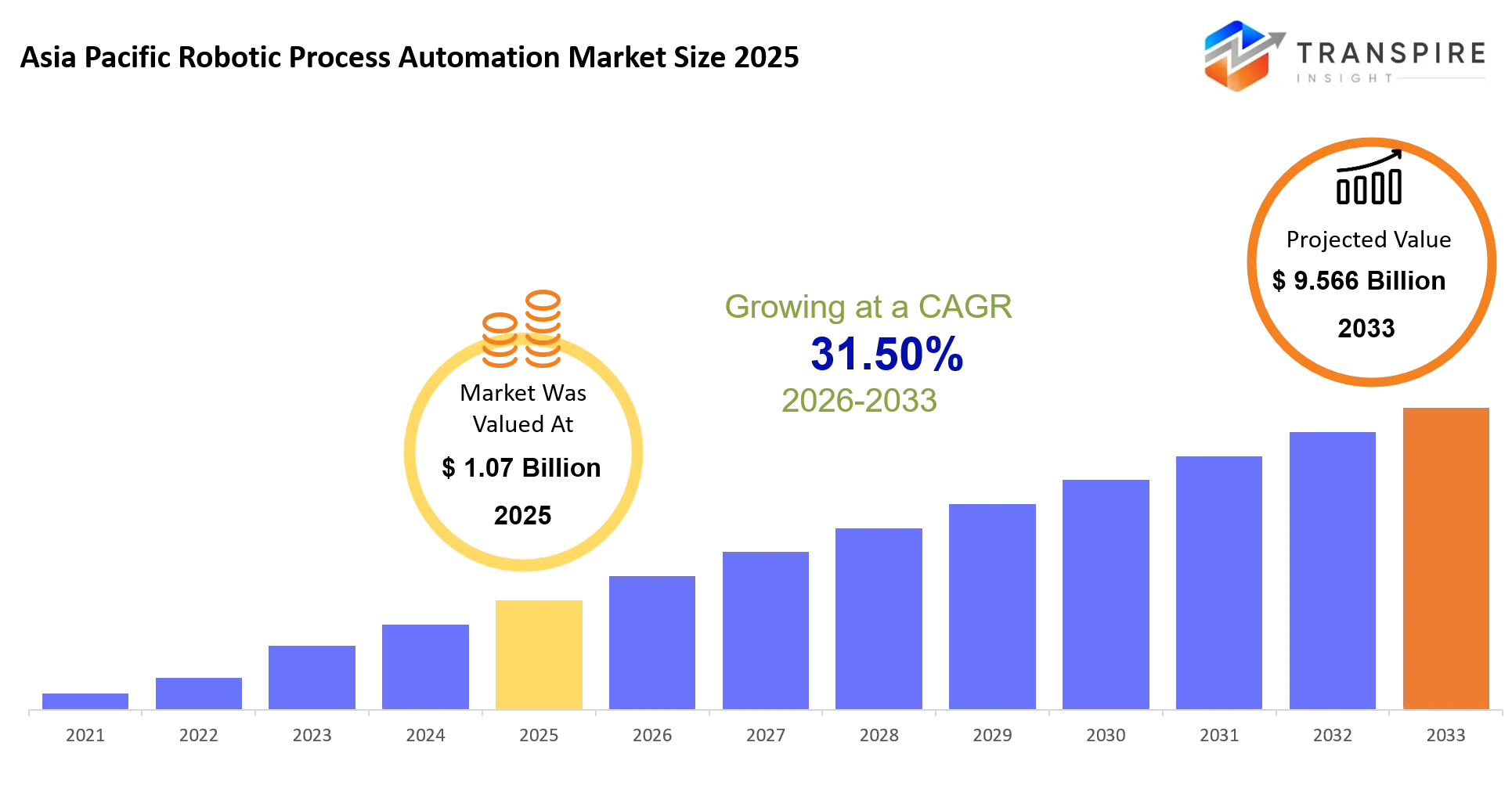
Asia Pacific Robotic Process Automation Market Summary
The Asia Pacific Robotic Process Automation Market was valued at USD 1.07 Billion in 2025. It is forecast to reach USD 9.566 Billion by 2033. That is a CAGR of 31.50% over the period.
In the Asia Pacific Robotic Process Automation , RPA market, organizations are basically trying to automate those repetitive, rule- driven business cycles like invoice handling, claims management employee onboarding, customer support and compliance updates. Instead of doing everything by hand, enterprises use software bots to step in, which tends to shorten processing time , reduce mistakes made by people, and make operations more scalable. Over the last five years, things have moved a bit from simple standalone task automation toward something more “intelligent”, so we can say AI powered automation. This approach weaves robotic process automation together with machine learning, optical character recognition, and conversational AI. The whole COVID-19 pandemic thing kind of sped up the digital shift, and that acceleration pushed cloud adoption, plus remote operations forward so companies started automating back office activities earlier than they had in some earlier roadmaps. Now, across banking , manufacturing, healthcare, telecommunications, and public services, teams are chasing productivity wins and labor optimization, so RPA rollouts are kind of stepping out from only pilot stages and moving into broader enterprise programs, and that does create more money from software licensing, cloud subscriptions, consulting, and also managed services throughout the region.
Key Market Insights
- The Asia Pacific Robotic Process Automation Market is expected to hit about USD 9.566 billion by 2033, showing how enterprises keep putting money into automation in most big economies.
- China stayed on top with roughly 34% market share in 2025, mostly because of wide digital transformation initiatives across manufacturing and financial services.
- India should end up as the fastest growing market by 2033, backed by a broader push in IT services, Global Capability Centers, and corporate cloud migration, not just one single driver.
- In 2025 cloud-based RPA made up nearly 62% of deployments , while hybrid setups actually saw the quickest take up across enterprises.
- Finance and Accounting Automation still leads the process side, holding around 29% of revenue share, then Customer Service Automation comes next, fairly close in momentum.
- Looking ahead, IT Operations Automation is likely to expand the quickest through the forecast period as AI enabled observability and incident management keep getting adopted more and more.
- For end users, BFSI brought in about 31% of regional revenue in 2025, and healthcare also emerged as one of the quicker moving industries.
- More companies are now bundling generative AI, OCR, and process mining with RPA , and that combination cuts manual handling time by something like 40–70% for document heavy workflows.
- Major vendors like UiPath, Automation Anywhere, Microsoft, SS&C Blue Prism, IBM, and SAP continue to strengthen their positions regionally via AI innovation, targeted partnerships, and cloud native automation platforms.
- Overall the Asia Pacific Robotic Process Automation Market is moving ahead through localized data centers, industry specific automation templates, plus managed automation services meant to improve real enterprise adoption.
What are the Key Drivers, Restraints, and Opportunities in the Asia Pacific Robotic Process Automation Market?
The strongest growth catalyst i s the quick enterprise shift toward AI-enabled digital operations. Organizations across banking, insurance, manufacturing, telecommunications,and healthcare are dealing with continuing labor gaps, higher operating costs, and pressure to speed up customer replies. The broad move to cloud infrastructure, together with improvements in intelligent document processing and generative AI, has made enterprise automation a lot more scalable and more financially sensible. So, companies are pushing automation from a few isolated departments into organization-wide business processes, and that means more software subscriptions, more implementation services, and longer managed automation engagements.
The biggest structural obstacle still feels like wiring robotic process automation into legacy enterprise systems, and honestly that sounds harder than it should. A lot of organizations keep running decades-old ERP platforms, proprietary databases,and uneven workflows that need real customization before automation can even go live. That integration weight drags implementation schedules out longer, it bumps up consulting spend, and it slows the overall ability to scale automation. Small and medium-sized enterprises get hit especially hard, because they often have fewer skilled automation professionals and a thinner digital infrastructure, which ends up delaying broader market adoption too.
The next growth phase seems to point toward hyperautomation, where robotic process automation is paired with generative AI, process mining, machine learning , and intelligent decision engines. Countries like India, Singapore, Australia, and Japan are putting real money into AI experimentation and enterprise modernization, so the conditions are becoming more favorable for advanced automation to actually take off.
What Has the Impact of Artificial Intelligence Been on the Asia Pacific Robotic Process Automation Market?
Artificial intelligence has, in a major way, remade robotic process automation across Asia Pacific, by letting software bots do cognitive tasks rather than only rule-based routines. Lately automation platforms are blending machine learning with natural language processing, optical character recognition, and generative AI, so they can handle invoices, contracts, insurance claims, emails, and customer interactions with much better precision. Intelligent document processing, kind of quietly, pulls out both structured and unstructured information which cuts down on manual checking while also speeding up how fast transactions get done.
On top of that, machine learning models help with predictive strength by spotting workflow bottlenecks, estimating transaction volumes ahead of time, and suggesting process refinements before anything turns into a serious operational disruption. In manufacturing and logistics, AI-driven automation can forecast equipment maintenance timetables and inventory needs, which supports higher uptime while bringing maintenance expenses down. Financial institutions often pair AI-powered fraud detection with robotic process automation, so compliance monitoring improves and there are fewer needless false-positive investigations. A lot of companies mention operational cost reductions around 30–50%, process time improvements that go above 60%, and clear increases in employee productivity after they connect AI with enterprise automation platforms.
Even with all of that, broad rollout is still slowed by expensive integration work, plus uneven data quality across legacy enterprise systems. Many organizations still run fragmented IT setups where training data is incomplete, and incompatible software structures interfere with AI model accuracy, which then delays larger intelligent automation efforts.
Key Market Trends
- Between 2022 and 2026 , many Enterprises kinda shifted from standalone automation projects toward enterprise-wide intelligent automation platforms, which helped governance and also made operational scaling feel more manageable and less fragile.
- By 2025, cloud native deployments pushed past 60% for new implementations, and that in turn cut infrastructure costs while speeding up the software release cycles.
- Around 2025, Generative AI integration really went mainstream, so software bots started handling more intricate document processing as well as customer communication style tasks without as much hand-holding.
- In banking , institutions automated more than 70% of repetitive back office workflows in several leading regional markets, improving compliance outcomes while also boosting customer service efficiency.
- Manufacturers kept moving further too, adopting AI enabled process mining to spot workflow bottlenecks ahead of time, and then applying robotic process automation across production and procurement operations.
- Microsoft , UiPath , Automation Anywhere , IBM , and SS&C Blue Prism also expanded regional partnerships, in order to deliver industry specific automation platforms across Asia Pacific.
- Government digital transformation programs began to fold intelligent automation into tax administration, licensing, healthcare services, and citizen engagement portals more and more.
- A lot of organizations went beyond just labor cost reduction and started prioritizing automation for resilience , compliance , cybersecurity support, and business continuity planning.
- Low code automation platforms attracted wider usage from business users, and in a way that reduced the reliance on specialized software development teams.
- Finally, hyperautomation strategies—mixing robotic process automation with machine learning, process mining, and analytics—became the preferred model across large organizations, like the default approach.
Asia Pacific Robotic Process Automation Market Segmentation
By Component
The software segment, kinda quietly, forms the foundation of robotic process automation because it offers software bots plus workflow orchestration, analytics , artificial intelligence integration and centralized management tools . Services help make deployment work smoothly via consulting, implementation services, training services, maintenance services, managed services, and a few other specialized support activities that tend to improve long-term automation performance. Consulting steers organizations toward the business processes that make sense, helps them check the return on investment, and supports preparing automation roadmaps before any deployment begins. Implementation services then set up automation platforms, connect enterprise applications, and create governance frameworks that help keep operational consistency from drifting over time.
Training services build technical knowledge for developers , administrators and business users , so organizations can roll automation out more widely across several departments. Maintenance services handle software updates, troubleshooting , security improvements, and performance optimization so automation environments stay stable over time. Managed services let third-party specialists monitor, run, and refine automation platforms while also reducing internal resource needs . Other services show up as migration support, process assessment, licensing assistance, compliance advisory, and customized automation development that matches industry-specific operational requirements.
By Deployment
The software segment, kinda quietly, forms the foundation of robotic process automation because it offers software bots plus workflow orchestration, analytics , artificial intelligence integration and centralized management tools . Services help make deployment work smoothly via consulting, implementation services, training services, maintenance services, managed services, and a few other specialized support activities that tend to improve long-term automation performance. Consulting steers organizations toward the business processes that make sense, helps them check the return on investment, and supports preparing automation roadmaps before any deployment begins. Implementation services then set up automation platforms, connect enterprise applications, and create governance frameworks that help keep operational consistency from drifting over time.
Training services build technical knowledge for developers , administrators and business users , so organizations can roll automation out more widely across several departments. Maintenance services handle software updates, troubleshooting , security improvements, and performance optimization so automation environments stay stable over time. Managed services let third-party specialists monitor, run, and refine automation platforms while also reducing internal resource needs . Other services show up as migration support, process assessment, licensing assistance, compliance advisory, and customized automation development that matches industry-specific operational requirements.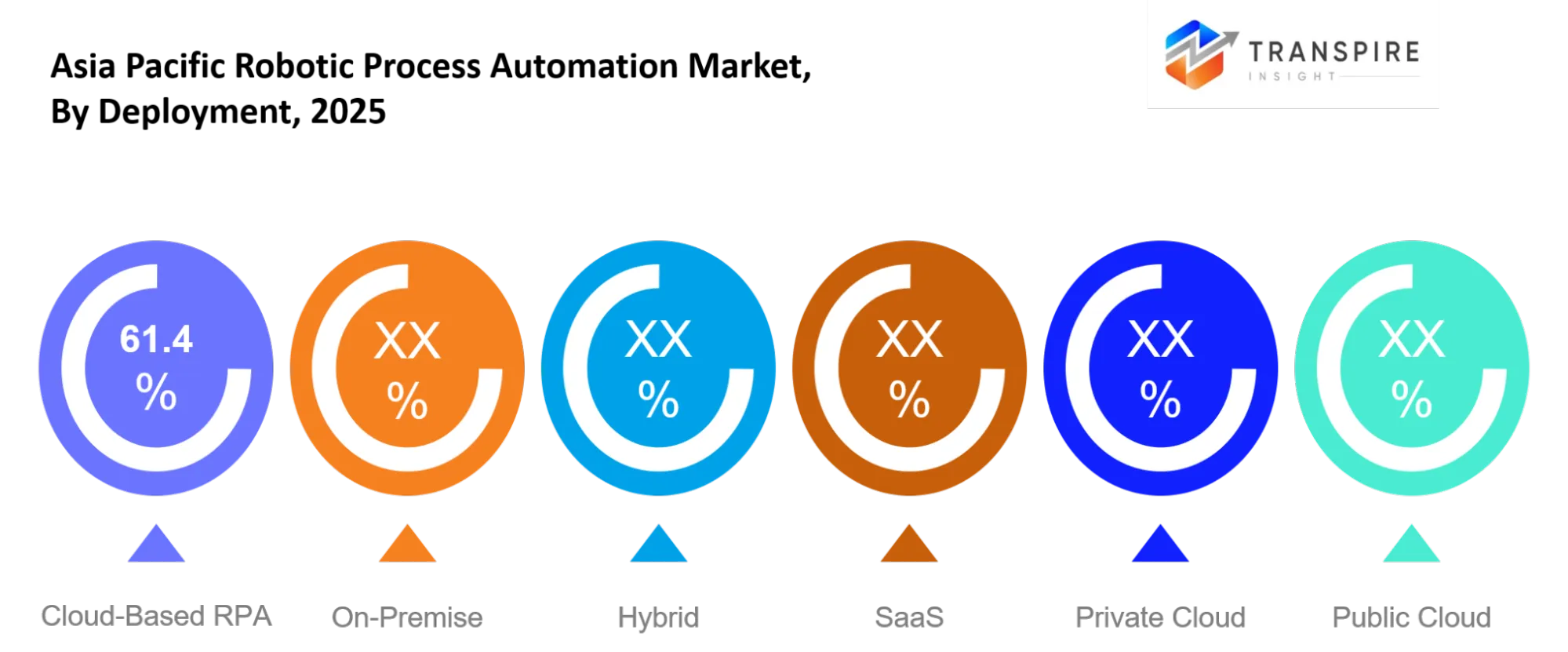
By Process
Finance & Accounting Automation helps drive adoption by smoothing invoice processing , payment reconciliation, expense oversight, financial reporting, and regulatory compliance work in a more straightforward way. HR Automation improves employee onboarding, payroll processing, attendance tracking, recruitment administration, and document verification, and it also eases the whole administrative burden. Customer Service Automation speeds up ticket triage, chatbot assistance, email handling, and customer request processing so the response quality tends to get better, even when things get busy. Supply Chain Automation upgrades procurement workflows, inventory control, order execution, logistics coordination, and supplier communication through automated business processes that keep moving.
IT Operations Automation strengthens infrastructure monitoring, incident response, software deployment, user account oversight, and ongoing system maintenance across enterprise environments. Sales & Marketing Automation backs lead generation, campaign management, customer engagement, sales reporting, and quotation processing with better operational efficiency overall. Claims Processing supports document validation, policy verification, fraud screening, and settlement workflows across insurance and financial organizations. Other process automation tools also cover procurement tasks, legal operations, compliance reporting, facility management, and administrative activities, all of which benefit from standardized digital workflows, sometimes sooner than expected.
By Enterprise Size
Large Enterprises make heavy investments in automation because those complicated business operations really need scalable workflow management across many departments and also different geographic locations. Medium Enterprises keep expanding their automation use, mostly to boost productivity, cut operational costs, and somehow match the pace of larger organizations via efficient digital processes. Small Enterprises increasingly choose subscription based automation platforms, since they tend to be cheaper to roll out and simpler to deploy, especially for routine administrative activities. Government Organizations are automating public administration, regulatory services, licensing, taxation, and citizen services at the same time, and they’re doing it while improving transparency and operational consistency.
Startups use automation platforms for repetitive business tasks, so internal teams can stay focused on innovation, customer acquisition and product development. Public Sector Enterprises improve operational efficiency by automating procurement, compliance oversight, finance, and human resource functions. Educational Institutions apply automation to student admissions, examination administration, payroll management, document processing, and academic record management too. Other enterprise groups adopt robotic process automation depending on operational complexity, regulatory obligations , workforce availability, and how strongly they prioritize digital transformation goals.
By End User
BFSI still looks like the biggest end user slice ,as financial institutions automate things like payment processing, loan administration compliance monitoring, customer onboarding, fraud detection, and reporting. Meanwhile, healthcare organizations roll out automation for patient registration, insurance verification, appointment scheduling, medical billing, and also electronic health record management, just to keep things moving. IT & Telecom companies tend to streamline service provisioning, network support, customer request management, and infrastructure monitoring by using intelligent automation platforms, not only “manual fixes”. In the manufacturing space, organizations automate procurement, inventory management, production scheduling, quality documentation, and supplier coordination, mostly to boost operational performance overall .
Retail & E-commerce businesses go further by accelerating order processing, inventory updates, customer support, product catalog management, and returns handling via automated workflows, which sounds simple but it helps a lot. Government agencies modernize administrative services, licensing, taxation, document verification, and citizen engagement through digital process automation, so paperwork gets less chaotic. Transportation & Logistics organizations improve shipment tracking, warehouse operations, customs documentation, route planning, and freight management with software-driven business processes ,and that usually means fewer delays.
Other end users such as energy, education, hospitality, media, professional services, and utility organizations are also jumping in, looking for better operational efficiency, regulatory compliance, and steadier service quality through business process automation.
What are the Key Use Cases Driving the Asia Pacific Robotic Process Automation Market?
Banking, financial services and insurance are still among the biggest users of robotic process automation because those high-volume processes need speed, accuracy and also regulatory compliance , you know. Financial institutions automate customer onboarding, loan processing, payment reconciliation , fraud screening and compliance reporting, so they cut down the manual grind while keeping processing more consistent. This set of activities tends to pull in the most software and service demand, since thousands of repetitive transactions happen every day, no pause.
In healthcare and manufacturing, automation has gone a bit beyond simple back office tasks. Hospitals automate insurance verification, patient registration and medical billing, while manufacturers streamline procurement, inventory control, production planning, and supplier paperwork. Even telecommunications providers have joined in, automating customer service requests and network support operations to improve response times, and to lower operational costs.
Lately, emerging use cases are shifting toward AI-assisted decision support and intelligent document handling. Enterprises are rolling out automation that’s powered by generative AI for contract analysis, procurement approvals and enterprise knowledge management, kinda like “thinking + filing” in one flow. Government agencies are also experimenting with autonomous workflow orchestration for digital citizen services , which is creating fresh opportunities for advanced automation platforms during the forecast period.
|
Report Metrics |
Details |
|
Market size value in 2025 |
USD 1.07 Billion |
|
Market size value in 2026 |
USD 1.407 Billion |
|
Revenue forecast in 2033 |
USD 9.566 Billion |
|
Growth rate |
CAGR of 31.50% from 2026 to 2033 |
|
Base year |
2025 |
|
Historical data |
2021 - 2024 |
|
Forecast period |
2026 - 2033 |
|
Report coverage |
Revenue forecast, competitive landscape, growth factors, and trends |
|
Regional scope |
United States; Canada; Mexico; United Kingdom; Germany; France; Italy; Spain; Denmark; Sweden; Norway; China; Japan; India; Australia; South Korea; Thailand; Brazil; Argentina; South Africa; Saudi Arabia; United Arab Emirates |
|
Key company profiled |
UiPath, Automation Anywhere, SS&C Blue Prism, Microsoft, IBM, SAP, NICE, Pegasystems, Appian, ServiceNow, WorkFusion, EdgeVerve Systems, Nintex, Kofax, Redwood Software |
|
Customization scope |
Free report customization (country, regional & segment scope). Avail customized purchase options to meet your exact research needs. |
|
Report Segmentation |
By Component (Software, Services, Consulting, Implementation Services, Training Services, Maintenance Services, Managed Services, Others); By Deployment (Cloud-Based, On-Premise, Hybrid, SaaS, Private Cloud, Public Cloud, Multi-Cloud, Others); By Process (Finance & Accounting Automation, HR Automation, Customer Service Automation, Supply Chain Automation, IT Operations Automation, Sales & Marketing Automation, Claims Processing, Others); By Enterprise Size (Large Enterprises, Medium Enterprises, Small Enterprises, Government Organizations, Startups, Public Sector Enterprises, Educational Institutions, Others); By End User (BFSI, Healthcare, IT & Telecom, Manufacturing, Retail & E-commerce, Government, Transportation & Logistics, Others) |
Which Regions are Driving the Asia Pacific Robotic Process Automation Market Growth?
China remains in the lead for the regional market, mostly because big enterprises keep pouring money into digital manufacturing, financial technology, and enterprise modernizatio n in a steady way. There are also national initiatives that back industrial automation and artificial intelligence, which pushes organizations to automate day to day business processes at larger scale, not just pilot levels. A solid domestic tech ecosystem helps a lot too, with cloud infrastructure providers on one side and software developers on the other, and it kind of speeds up how fast enterprises say yes to adoption. Add large manufacturing clusters and financial institutions into the mix, and you get dependable demand for intelligent automation solutions across several industries, almost continuously.
Japan comes next as the second biggest regional contributor, but its market expansion kinda takes a different route than China does. With workforce shortages showing up due to demographic changes, organizations tend to automate repetitive administrative work instead of trying to expand headcount. In Japan, financial institutions, manufacturers, and healthcare providers tend to prioritize dependable long-term automation investments, built on mature digital infrastructure. Corporate spending stays steady, and compliance standards are strict, so the demand for enterprise automation platforms feels more predictable than elsewhere.
India is forecasted to grow the quickest through 2033, largely due to fast cloud uptake, more Global Capability Centers, and accelerating digital transformation that changes what enterprises focus on. Government digital initiatives plus increased funding for artificial intelligence are encouraging companies to automate both customer-facing workflows and back-office operations. On top of that, the country has a huge IT services industry, which strengthens implementation capabilities, and also helps wider enterprise deployment.
Who are the Key Players in the Asia Pacific Robotic Process Automation Market and How Do They Compete?
Competition still looks moderately concentrated, with major enterprise software players going after each other mostly via tech innovation, artificial intelligence features, cloud integration, and industry focused automation offers rather than pure pricing. Lately, the whole fight has moved away from pretty standalone software bots, and more toward intelligent automation platforms that braid together robotic process automation, process mining, generative AI, analytics, and workflow orchestration. On top of that, vendors are growing consulting, implementation, and managed services , because they want better customer stickiness and to keep enterprise-scale deployments running smoothly.
UiPath stands out with AI powered enterprise orchestration, process mining, and a fairly wide suite of developer tools , which helps teams build complicated automation projects inside regulated industries. The company keeps expanding through strategic alliances too, including work with Microsoft for security automation, plus a broadened partnership with Deloitte aimed at delivering agentic ERP solutions. Automation Anywhere tends to emphasize cloud native automation along with agentic AI capabilities, letting organizations automate business processes using scalable enterprise platforms. Continued spending on AI agents and intelligent automation is also reinforcing its place with large enterprises.
Microsoft leans hard on the deep link between Power Automate, Microsoft 365, Azure, and enterprise security platforms , so automation becomes “natural” for companies already living inside the Microsoft ecosystem. IBM pairs automation with hybrid cloud, artificial intelligence, and business consulting, supporting enterprises as they modernize older environments while staying compliant with regulatory needs.
Company List
- UiPath
- Automation Anywhere
- SS&C Blue Prism
- Microsoft
- IBM
- SAP
- NICE
- Pegasystems
- Appian
- ServiceNow
- WorkFusion
- EdgeVerve Systems
- Nintex
- Kofax
- Redwood Software
Recent Development News
In March 2026, UiPath entered a strategic collaboration with Microsoft to launch security automation capabilities that integrate with Microsoft Defender and Microsoft Sentinel, strengthening enterprise security workflow automation and expanding agentic automation adoption.https://www.uipath.com
In March 2026, UiPath expanded a strategic alliance with Deloitte to launch the Agentic ERP offering, combining AI agents and robotic process automation to accelerate enterprise ERP modernization and business workflow automation.https://www.uipath.com
What Strategic Insights Define the Future of the Asia Pacific Robotic Process Automation Market?
The market seems to keep moving toward intelligent enterprise orchestration, where robotic process automation, generative AI, process mining, and decision intelligence end up acting like one unified platform not really separate, like before. And you know, this shift is mostly pushed by enterprise pressure for end-to-end workflow automation not just isolated task automation. Still, there is a smaller, less discussed risk too, where organizations become more and more dependent on a small handful of big platform vendors, and that can quietly raise switching costs, and also lead to technology lock-in when everything is already deeply wired into the same automation environment.
On the brighter side, there is an emerging opportunity that feels pretty important: AI-powered automation for government digital services and mid-sized enterprises, especially across India and Southeast Asia. Cloud adoption is still speeding up there, so the timing is good. In practice, companies should put money into open, interoperable automation platforms, with solid governance, security, and AI integration features, so they can expand later without getting trapped in one single technology ecosystem.
Asia Pacific Robotic Process Automation Market Report Segmentation
By Component
• Software
• Services
• Consulting
• Implementation Services
• Training Services
• Maintenance Services
• Managed Services
• Others
By Deployment
• Cloud-Based
• On-Premise
• Hybrid
• SaaS
• Private Cloud
• Public Cloud
• Multi-Cloud
• Others
By Process
• Finance & Accounting Automation
• HR Automation
• Customer Service Automation
• Supply Chain Automation
• IT Operations Automation
• Sales & Marketing Automation
• Claims Processing
• Others
By Enterprise Size
• Large Enterprises
• Medium Enterprises
• Small Enterprises
• Government Organizations
• Startups
• Public Sector Enterprises
• Educational Institutions
• Others
By End User
• BFSI
• Healthcare
• IT & Telecom
• Manufacturing
• Retail & E-commerce
• Government
• Transportation & Logistics
• Others
Frequently Asked Questions
Find quick answers to common questions.
The Expected Asia Pacific Robotic Process Automation Market size for the Market will be USD 9.566 Billion in 2033.
Key Segments for the Asia Pacific Robotic Process Automation Market are By Component (Software, Services, Consulting, Implementation Services, Training Services, Maintenance Services, Managed Services, Others); By Deployment (Cloud-Based, On-Premise, Hybrid, SaaS, Private Cloud, Public Cloud, Multi-Cloud, Others); By Process (Finance & Accounting Automation, HR Automation, Customer Service Automation, Supply Chain Automation, IT Operations Automation, Sales & Marketing Automation, Claims Processing, Others); By Enterprise Size (Large Enterprises, Medium Enterprises, Small Enterprises, Government Organizations, Startups, Public Sector Enterprises, Educational Institutions, Others); By End User (BFSI, Healthcare, IT & Telecom, Manufacturing, Retail & E-commerce, Government, Transportation & Logistics, Others).
Major Asia Pacific Robotic Process Automation Market players are UiPath, Automation Anywhere, SS&C Blue Prism, Microsoft, IBM, SAP, NICE, Pegasystems, Appian, ServiceNow, WorkFusion, EdgeVerve Systems, Nintex, Kofax, Redwood Software.
The Current Asia Pacific Robotic Process Automation Market size is USD 1.07 Billion in 2025.
The Asia Pacific Robotic Process Automation Market CAGR is 31.50% from 2026 to 2033.
- UiPath
- Automation Anywhere
- SS&C Blue Prism
- Microsoft
- IBM
- SAP
- NICE
- Pegasystems
- Appian
- ServiceNow
- WorkFusion
- EdgeVerve Systems
- Nintex
- Kofax
- Redwood Software
About the Authors

Mayur Shinde
I am Mayur Shinde, a Senior Research Analyst at Transpire Insight, specializing in the Automotive & Transportation and Information & Communication Technology (ICT) Industry. My work focuses on analyzing emerging market trends, technological advancements, competitive landscapes, and industry developments to deliver accurate, data-driven insights. I am passionate about transforming complex market information into clear, actionable content that helps businesses, professionals, and decision-makers stay informed and make confident strategic decisions.

Chakradhar Khansole
Chakradhar serves as the Research Director at Transpire Insight, bringing over 8 years of experience in technology, innovation, and strategic market intelligence. He specializes in transforming complex market data into actionable business insights that enable organizations to make informed, growth-oriented decisions. Recognized for his strategic vision and analytical expertise, Chakradhar leads high-impact research initiatives, delivering comprehensive market assessments, competitive intelligence, and forward-looking industry analysis.
Recently Published Reports
-
Apr 2026
3D Optical Profiler Market
3D Optical Profiler Market Size, Share & Analysis Report By Type (Desktop 3D Optical Profiler, and Portable 3D Optical Profiler), By Technology (Confocal Technology, and White Light Interference), By End-Use Industry (Manufacturing, Research Institutions, Automotive, Aerospace and Defense, Medical Devices, and Other), and Geography (North America, Europe, Asia-Pacific, Middle East and Africa, South and Central America), 2021 - 2031
-
Apr 2026
Depth Sensor Market
Depth Sensor Market Size, Share & Analysis Report By Type (Infrared Depth Sensors, Time-of-Flight (ToF) Sensors, Stereo Vision Sensors, Structured Light Sensors, Ultrasonic Depth Sensors), By Application (Automotive, Robotics, Gaming, Consumer Electronics, Industrial Automation, Healthcare, Security & Surveillance, Others), By End Users (Automotive Manufacturers, Consumer Electronics Companies, Healthcare Providers, Industrial Companies, Security Agencies, Gaming Companies, Robotics Companies, Others), and Geography (North America, Europe, Asia-Pacific, Middle East and Africa, South and Central America), 2021 – 2031
-
Apr 2026
Digital Manufacturing Market
Digital Manufacturing Market Size, Share & Analysis Report By Component (Hardware, Software, and Services), By Technology (Robotics, 3D Printing, Internet of Things (IoT), and Others), By Application (Automotive and Transportation, Aerospace and Defense, Consumer Electronics, Industrial Machinery, and Others), By Process Type (Computer-Based Designing, Computer-Based Simulation, Computer 3D Visualization, Analytics, and Others), and Geography (North America, Europe, Asia-Pacific, Middle East and Africa, South and Central America), 2021 – 2031
-
Apr 2026
Digital Visa Services Market
Digital Visa Services Market Size, Share & Analysis Report By Type (Individual Travelers, Group Travelers), By Application (Tourism, Business Travel, Others), and Geography (North America, Europe, Asia-Pacific, Middle East and Africa, South and Central America), 2021 – 2031