

Global Digital Out-of-home Advertising Market Size & Forecast:
- Global Digital Out-of-home Advertising Market Size 2025: USD 23.48 Billion
- Global Digital Out-of-home Advertising Market Size 2033: USD 53.71 Billion
- Global Digital Out-of-home Advertising Market CAGR: 10.9%
- Global Digital Out-of-home Advertising Market Segments: By Format (Billboards, Transit Displays, Street Furniture, Place-based Media, Retail Media, Interactive Displays, Video Walls, Others); By Technology (LED, LCD, Projection, Programmatic DOOH, AI Analytics, Others); By Application (Retail, Transportation, Entertainment, Healthcare, BFSI, Others); By End User (Advertisers, Agencies, Brands, Others); By Venue (Indoor, Outdoor, Transit Hubs, Malls, Others)

Global Digital Out-of-home Advertising Market Summary:
As per Transpire Insight Analysis, the Global Digital Out-of-home Advertising Market size is estimated at USD 23.48 Billion in 2025 and is anticipated to reach USD 53.71 Billion by 2033, growing at a CAGR of 10.9% from 2026 to 2033.
The Global Digital Out-of-home Advertising Market has changed a lot. It now uses data to help brands show ads on billboards in shopping malls, airports and other public places. These ads can be quickly scheduled from afar and tailored to the people seeing them, based on things like the weather, traffic and time of day.
This flexibility has made ads more effective. Helps advertisers get the most out of their spending. In recent years, the Market has moved away from simple digital displays and toward programmatic advertising. This type of advertising uses platforms to automate buying and managing ads. More people moving to cities, more money being spent on city tech, and better LED displays have all helped put more digital screens in public places.
The return of travel, shopping and events after the pandemic has meant more people are seeing ads. As advertisers look for ads that can be measured, targeted and changed in time, digital out-of-home advertising is becoming a key part of their overall advertising plans. This is helping the Market grow in both developing countries.
Key Market Insights:
Global Digital out-of-home advertising is evolving from traditional outdoor media as Marketers turn to automation, analytics, and dynamic ad serving to enhance their campaign results in several public places.
- The Digital Billboard accounts for 41% Market share and is backed by the installation of large-format LED displays and further expansions made by firms like JCDecuax, Clear Channel Outdoor, and Lamar Advertising.
- The Transit Displays segment is responsible for 20% Market share and is driven by higher footfalls in airports, metro stations, railway stations, and bus terminals, allowing brand exposure to massive urban crowds.
- Street Furniture segment generates 14% of total revenue as cities are deploying digital kiosks and intelligent bus shelters offering advertising alongside public service.
- The Place-based Media makes up 11% Market share with retail stores, malls, healthcare facilities, gyms, and entertainment destinations using digital displays to interact with customers in a targeted manner.
- The Programmatic DOOH is the fastest-growing category and is estimated to witness growth at a CAGR of 17.9% as advertisers move towards automated media purchasing, real-time campaign optimisation, and targeting by audience.
- The increasing use of 5G technology, high-definition LED screens, and real-time analysis has made it possible for advertisers to launch personalised campaigns that react immediately to user activity and surroundings.
- Sustainability is becoming an important aspect of competition, with media owners making use of energy-saving LED screens, remote content management, and intelligent power systems to cut down costs and achieve their environmental goals.
What are the Key Drivers, Restraints, and Opportunities in the Global Digital Out-of-home Advertising Market?
Drivers
The global DOOH advertising Market has experienced significant growth due to the growing need for efficient and data-driven solutions that provide tangible outcomes. The need to update campaign messages on the fly has made advertisers abandon traditional methods using non-digital outdoor ads in favour of digital displays that allow them to do so. The development of areas such as smart cities, high-resolution LED boards, and programmatic advertising has contributed greatly to the Market adoption. Also, recovery of such sectors as retail, public transport, tourism, and entertainment industries has significantly increased audience sizes, thus prompting advertisers to invest more in digital outdoor advertising solutions.
Restraints
Despite the positive outlook on the future of this Market, there are several challenges that affect the industry. Firstly, there is an issue with large capital expenditure related to the installation and maintenance of digital display infrastructures, that make it hard for small companies to enter the Market. Secondly, there is a difference in compliance requirements for outdoor advertising, zoning, and energy use that vary across the different countries and slow down the adoption in some of them.
Opportunities
There is huge growth potential in the Marketplace as programmatic DOOH, AI, and real-time audience analysis gain more adoption. More advertisers are looking for personalised campaigns where campaigns can react to location, climate, traffic patterns, and consumer behaviour. 5G, cloud-based content management systems, and smart city developments are projected to bring in new revenue opportunities, while the growth potentials offered by the developing countries in the Asia Pacific, Middle East, and Latin America regions remain strong.
What Has the Impact of Artificial Intelligence Been on the Global Digital Out-of-home Advertising Market?
AI technology has made substantial progress in increasing efficiency and effectiveness in the international digital out-of-home (DOOH) advertising Market through smart campaign design and automation, and real-time analysis of audiences. AI technology analyses information on the traffic flow, weather conditions, location and demographic profile of consumers and decides on what is the best ad that should be placed on a particular screen and at particular times to increase relevance of the campaign and audience engagement.
Predictive analytics can also be achieved through machine learning in terms of predicting audience flow, estimating the campaign performance and suggesting an optimal advertising schedule. The media owners are also using AI technology to automate their inventory management and optimise their screens' usage as well as simplify programmatic advertising deals. The use of computer vision and audience measurement technologies helps in assessing the viewer impressions and campaign engagement levels. However, even with the aforementioned benefits, there are certain limitations when using AI. The deployment of sophisticated analytics platforms demands substantial capital expenditures, proper data integrations, and technical know-how.
Privacy policies and data governance issues restrict the use of specific customer data for audience targeting purposes in certain geographic areas. Nevertheless, owing to ongoing improvements in artificial intelligence, cloud computing, and predictive analytics, personalisation of campaigns, as well as performance in advertising, will continue to grow in the DOOH space. In January 2025, T-Mobile US acquired Vistar Media, a company that uses AI for DOOH advertising. It is estimated that the acquisition was worth approximately USD 600 million. Vistar Media uses AI to ensure effective audience targeting and automated advertising in real time on more than 1.1 million digital screens. The company provides optimised campaigns with the use of AI technology.
Key Market Trends:
There is significant evolution taking place in the domain of digital out-of-home advertising, with more focus on the utilisation of data-driven advertising campaigns, automated media purchasing, and personalised engagements with the audience. The latest developments in digital display technology and real-time analytics are revolutionising brand consumer interaction through public places.
- Programmatic advertising has become a norm, making it possible for advertisers to make purchases of digital screen space in real time and optimise their campaigns based on the analysis of the audience.
- Artificial intelligence is optimising campaign performance with the help of automated content scheduling, predictive analytics of audience and dynamic advertisement placement.
- High-resolution LED screens have replaced traditional digital screens, bringing about better-quality visuals, increased energy efficiency and outdoor visibility.
- Retail and shopping malls are increasingly using interactive digital displays to engage their customers and launch location-based advertising campaigns.
- Smart city projects are facilitating the deployment of digital billboards, smart kiosks and intelligent transit displays for dual purposes of public and advertising communications.
- Integration with mobile devices is helping Marketers achieve omnichannel Marketing objectives, syncing up their digital out-of-home campaigns with apps, QR codes and social media.
Global Digital Out-of-home Advertising Market Segmentation
By format
The digital billboards continue to dominate the format share, as 41% of the worldwide Market size as a result of their wide availability in the form of deployment along highways, city centres, business areas, and transportation corridors. With the capabilities of displaying several advertisements at once, offering dynamic ad delivery options, and high audience visibility, the digital billboards have become the choice for advertisers looking for wider Market penetration. The transit displays form 20% of the Market because of the increasing number of people using airports, train stations, and metros. Street furniture accounts for 14% of the Market size because of smart bus shelters and digital kiosks becoming prevalent in many cities today. Place-based media accounts for 11% as a result of increasing number of installations in malls, retail shops, healthcare clinics, and entertainment centres.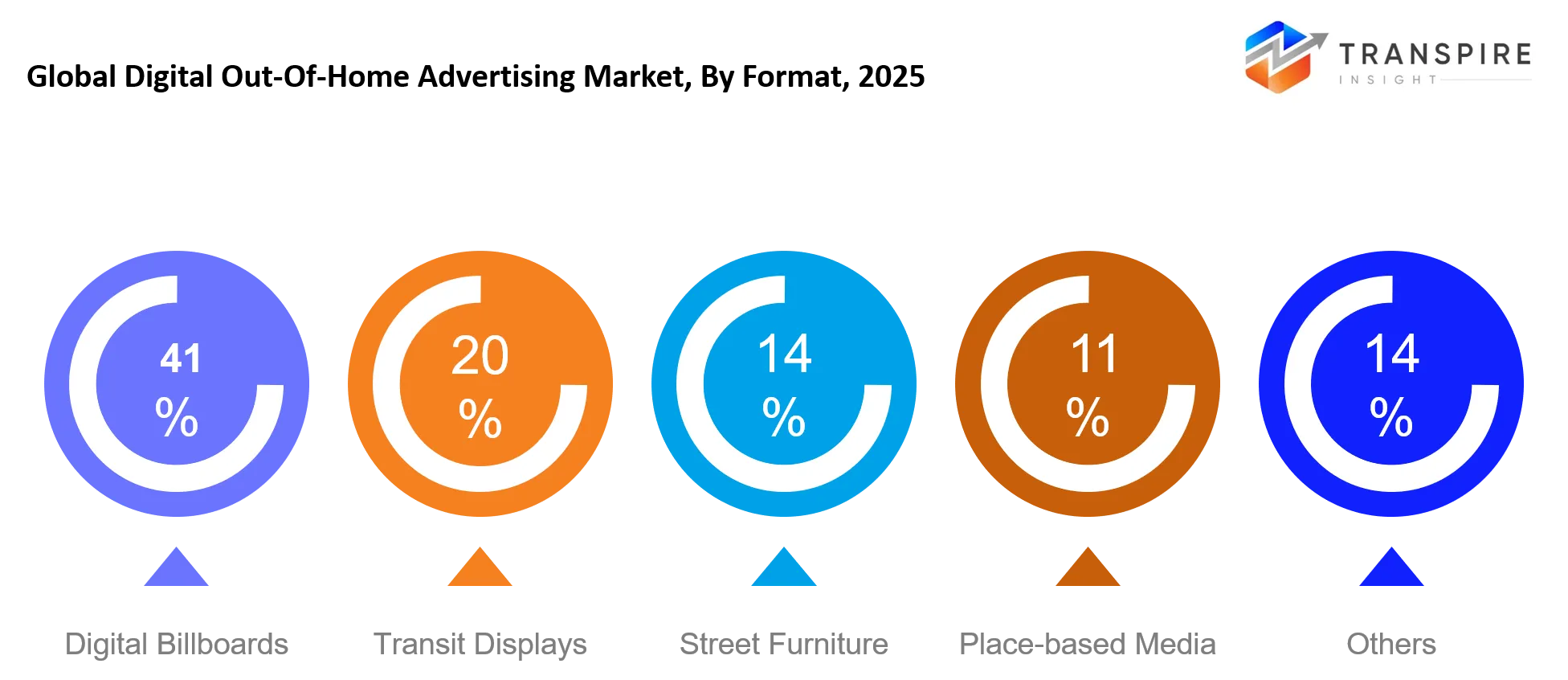
By Technology
LED screens will continue to hold dominance thanks to their bright display capability, durability, and reduced need for maintenance. In terms of technology, however, Programmatic DOOH is experiencing the most rapid growth at a CAGR of 17.9% due to the automation of the media buying process and campaign optimisation through audience information. Technologies such as artificial intelligence, cloud content management systems, and audience analytics are increasing the efficiency of campaigns through dynamic advertisement scheduling and predictive targeting.
By Application
Retail is still one of the primary application sectors where the brands make use of digital display screens for promoting their products, campaigns for the season, and personalised offers in the retail environment. Transportation is still another sector that shows a high demand for digital display screens in their airports, railway stations, bus depots, and even metros, as there is a large number of passengers who are constantly exposed to their advertisements. The same is true for entertainment, healthcare, finance, and many more business sectors.
By End User
The key end users of digital outdoor advertising continue to be the advertisers as they need more flexibility in managing their campaigns, tracking audience engagements, and increasing the ROI from their Marketing budgets. The advertising agencies are important players as they will manage the campaign planning, creative development, media planning, and optimise the performance of the campaigns through digital networks. Global brands are now starting to invest more in programmatic advertising and data-driven Marketing solutions to target their customers better.
By Venue
Outdoor locations are estimated to hold the highest Market share among digital display installations, since such locations have maximum visibility and reach out to a greater audience. Indoor locations that include shopping centres, office buildings, stores, airports, and amusement parks see steady growth in the installation of digital display solutions due to the growing emphasis by businesses on personalisation of customer experience. Digital displays in transit hubs and malls/corporate campuses see significant growth as well, owing to urban travel. With smart cities projects and advancements in display solutions technology, the future seems bright for digital display installations in all location types.
What are the Key Use Cases Driving the Global Digital Out-of-home Advertising Market?
The main use case for digital billboards is the leading position that they occupy in the global Market for digital out-of-home advertising. Various brands from retail, automotive, consumer goods, telecommunication, and entertainment sectors utilise such large screens in order to carry out their high-profile and visible campaigns in urban areas, on highways, and in commercial zones. The ability to change content in seconds and have several advertisers on one screen helps to make the billboard an effective tool of massive brand promotion.
However, besides outdoor advertising, digital screens find more and more uses in other places, such as transit hubs, shopping malls, airports, hospitals, corporate facilities, and educational institutions. In transit hubs and airports, the retailers can use screens for promotional activities or seasonal campaigns, whereas transport authorities utilise them to provide up-to-date information about transport, along with advertising. Banks, healthcare organisations, and hospitality businesses can also implement digital screens in their Marketing efforts.
Such emerging trends are driven by the fastest-growing technology segment, Programmatic DOOH. Advertisers combine various technologies such as artificial intelligence, audience analytics, mobile capabilities, and location services in order to provide personalised advertising according to behaviour, weather, traffic flow, and time of day of consumers.
|
Report Metrics |
Details |
|
Market size value in 2025 |
USD 23.48 Billion |
|
Market size value in 2026 |
USD 26.04 Billion |
|
Revenue forecast in 2033 |
USD 53.71 Billion |
|
Growth rate |
CAGR of 10.9% from 2026 to 2033 |
|
Base year |
2025 |
|
Historical data |
2021 - 2024 |
|
Forecast period |
2026 - 2033 |
|
Report coverage |
Revenue forecast, competitive landscape, growth factors, and trends |
|
Regional scope |
United States; Canada; Mexico; United Kingdom; Germany; France; Italy; Spain; Denmark; Sweden; Norway; China; Japan; India; Australia; South Korea; Thailand; Brazil; Argentina; South Africa; Saudi Arabia; United Arab Emirates |
|
Key company profiled |
JCDecaux, Clear Channel Outdoor, Lamar Advertising, OUTFRONT Media, Ströer, Global, Daktronics, Broadsign, oOh!media, Ocean Outdoor, Pattison Outdoor, Ayuda Media Systems, Vistar Media, Hivestack, Samsung Electronics |
|
Customization scope |
Free report customization (country, regional & segment scope). Avail customized purchase options to meet your exact research needs. |
|
Report Segmentation |
By Format (Billboards, Transit Displays, Street Furniture, Place-based Media, Retail Media, Interactive Displays, Video Walls, Others); By Technology (LED, LCD, Projection, Programmatic DOOH, AI Analytics, Others); By Application (Retail, Transportation, Entertainment, Healthcare, BFSI, Others); By End User (Advertisers, Agencies, Brands, Others); By Venue (Indoor, Outdoor, Transit Hubs, Malls, Others) |
Which Regions are Driving the Global Digital Out-of-home Advertising Market Growth?
North America
The digital out-of-home advertising Market in North America holds a dominant position in the global Market with a 38% Market share due to an established advertising ecosystem, the presence of digital billboards and programmatic advertising technology. Thanks to robust investments in smart city infrastructure, fast connectivity, and sophisticated audience measurement, campaigns are more efficient. Major media companies keep developing their premium digital display networks in metros, airports, shopping malls and transport hubs. Constant investments made by international brands into outdoor advertising based on data make North America the leader among regional Markets.In January 2025 , T-Mobile US acquired Vistar Media for around $600 million. The deal makes T-Mobile US even stronger in the advertising Market through an expansion of its services in programmatic digital out-of-home advertising on over one million screens in North America.
Europe
Europe occupies a 29% Market share of the global Market and ensures stable growth due to digital infrastructure, appropriate regulation, and investment in sustainable advertising technologies. Some countries of Europe like the UK, Germany, France, and the Netherlands, invest in digital street furniture, transit displays, and smart public information systems. Unlike North America, Europe pays more attention to energy-efficient display technology, urban development, and communication networks in the cities.In May 2025, JCDecux made investments in green street furniture in several European cities that combine the sustainability of the urban environment with digital advertising assets, making its environmentally friendly DOOH network even more efficient.
Asia Pacific
The Asia Pacific region comprises 24% of the world Market share and is the fastest-growing region at a CAGR of 19.2% over the forecast period. The high rate of urbanisation, smart cities' expansion, development of retail infrastructure, and higher expenditure on digital advertisements are driving the adoption of DOOH in China, India, Japan, South Korea, and Southeast Asia. With the increased number of smartphones and higher usage of programmatic advertising platforms, it is becoming increasingly necessary for brands to incorporate digital outdoor advertising as an omnichannel advertising solution. Asia Pacific is expected to generate huge opportunities due to investments made in intelligent transport and commercial systems.In August 2025, JCDecux India joined hands with VIOOH to launch its programmatic DOOH inventory in major Indian transport locations, such as airports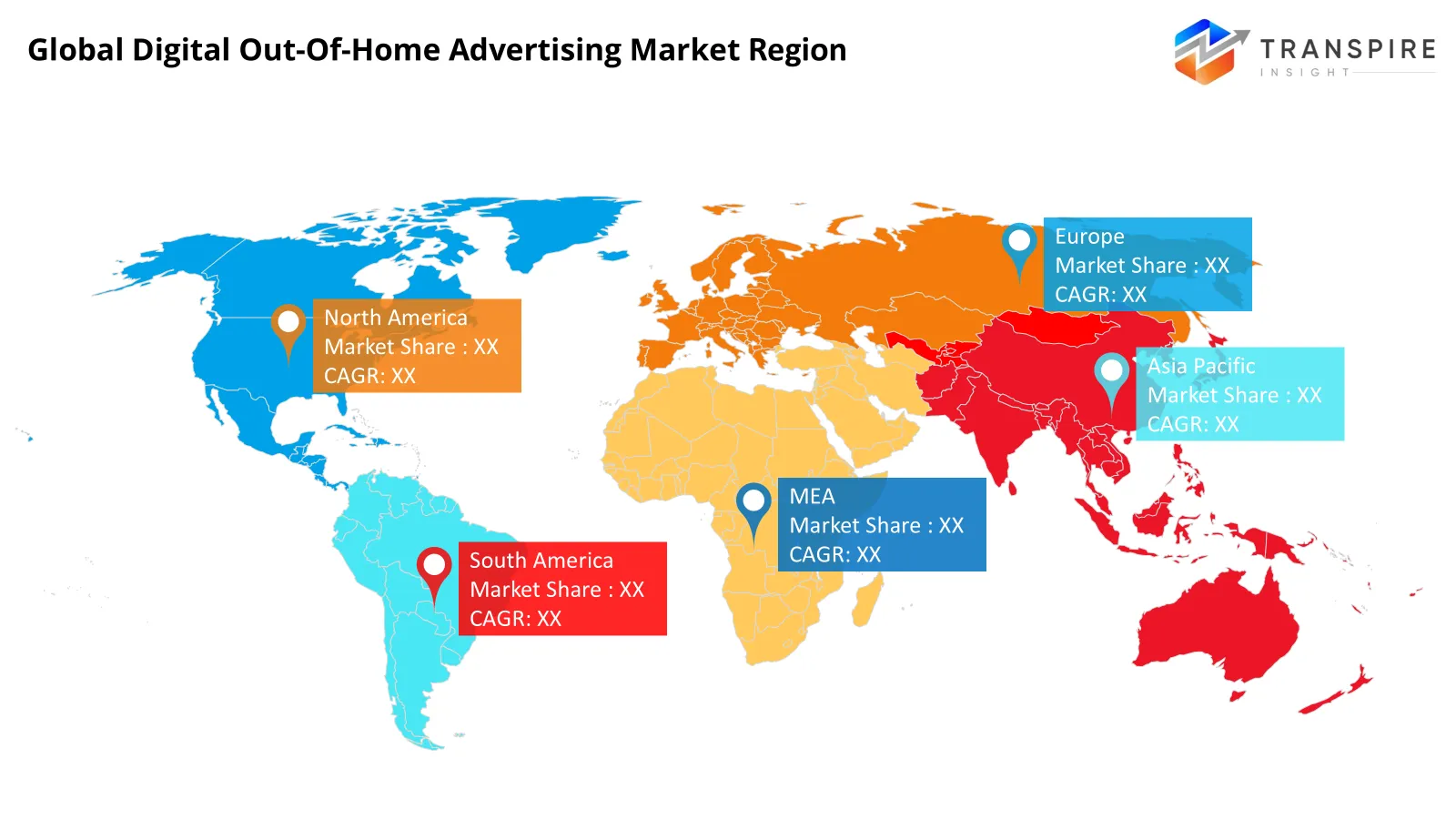
Who are the Key Players in the Global Digital Out-of-home Advertising Marketand how do they Compete?
The global DOOH advertising Market is extremely competitive with foreign media companies, digital display makers, and advertising technology companies concentrating on network growth, programmatic, and data-driven advertising solutions. The competition is mainly about the provision of measureable campaigns performance, growing premium advertising spots, and artificial intelligence integrated with audience analytics. Market players are also boosting their Market power via mergers, collaborations, and investments in smart cities technologies.
JCDecux, Clear Channel Outdoor, and Lamar Advertising are consistently improving their competitive standing by rolling out their digital billboard networks in major metropolises, airports, transport centres, and retail venues. They are pursuing premium advertising spots, programmatic media buying, and audience analytics tools, helping brands to maximise the performance of their campaigns. They are also working on energy-efficient LED display screens and cloud-based content management systems.
Global Digital Out-of-home Advertising Market companies
- JCDecaux
- Clear Channel Outdoor
- Lamar Advertising
- OUTFRONT Media
- Ströer
- Global
- Daktronics
- Broadsign
- oOh!media
- Ocean Outdoor,
- Pattison Outdoor,
- Ayuda Media Systems
- Vistar Media
- Hivestack
- Samsung Electronics
Recent Development News
In January 2025, T-Mobile US completed the acquisition of Vistar Media in approximately USD 600 million. This acquisition will enhance the advertising services of T-Mobile through the addition of capabilities in digital out-of-home advertising and programmatic media buying on over a million digital screens
In November 2025, Broadsign acquired Place Exchange to augment its global programmatic DOOH platform. The acquisition enables enhanced automated media buying capabilities, improved access to high-end digital inventory and improved campaign measurement capabilities for advertisers and publishers.
In June 2026, the Out of Home Advertising Association of America announced new industry performance data wherein the United States out-of-home advertising revenues were at USD 2.12 Billion in Q1 2026. The continuous growth is due to growing spending in digital out-of-home advertising backed by increased demand from advertisers and digital display networks.
What Strategic Insights Define the Future of the Global Digital Out-of-home Advertising Market?
The global digital out-of-home (DOOH) advertising Market is expected to enter into an environment of a highly interconnected and data-intensive ecosystem, whereby artificial intelligence, programmatic advertising and real-time audience analytics will drive campaign implementation. With growing demand for measurement and personalised campaigns, investments in smart displays, cloud-based management of content and omnichannel Marketing systems are expected to increase in developed and developing countries.
One of the less visible risks in this context is the need for large capital expenditure in order to implement digital displays and new privacy regulations that can limit audience data collection and targeted advertisements. On the other hand, increased development of smart cities, 5G connectivity and intelligent transportation networks creates great potential for expanding advertising footprint in the Market.
By paying attention to artificial intelligence-based campaign optimisation, sustainable LED technology, strategic alliances, and programmatic DOOH solutions, companies will have competitive advantages over their competitors. By concentrating on high-growth regions, growing premium digital display networks and measurable advertising performance, companies will continue pursuing their strategies in the evolving Global Digital Out-of-home Advertising Market.
By Format
- Billboards
- Transit Displays
- Street Furniture
- Place-based Media
- Retail Media,
- Interactive Displays
- Video Walls
By Technology
- LED,
- LCD
- Projection
- Programmatic DOOH
- AI Analytics
By Application
- Retail
- Transportation
- Entertainment
- Healthcare
- BFSI
By End User
- Advertisers
- Agencies
- Brands
- By Venue
- Indoor
- Outdoor
- Transit Hubs
- Mall
Regional Outlook
North America
- United States
- Canada
- Mexico
Europe
- Germany
- United Kingdom
- France
- Spain
- Italy
- Rest of Europe
Asia Pacific
- Japan
- China
- Australia & New Zealand
- South Korea
- India
- Rest of Asia Pacific
South America
- Brazil
- Argentina
- Rest of South America
Middle East & Africa
- Saudi Arabia
- United Arab Emirates
- South Africa
- Rest of the Middle East & Africa
Frequently Asked Questions
Find quick answers to common questions.
The Global Digital Out-of-home Advertising Market size was valued at USD 23.48 Billion in 2025 and is poised to reach USD 53.71 Billion by 2033, expanding at a 10.9% CAGR.
Key Segments for the Global Digital Out-of-home Advertising Market are By Format (Billboards, Transit Displays, Street Furniture, Place-based Media, Retail Media, Interactive Displays, Video Walls, Others); By Technology (LED, LCD, Projection, Programmatic DOOH, AI Analytics, Others); By Application (Retail, Transportation, Entertainment, Healthcare, BFSI, Others); By End User (Advertisers, Agencies, Brands, Others); By Venue (Indoor, Outdoor, Transit Hubs, Malls, Others).
Growth is primarily driven by Growth will be Mainly attributed to increased adoption of digital displays, demand for programmatic ads, improvements in artificial intelligence and analytics, development of smart cities, and investments in targeted and real-time outdoor advertising initiatives.
The Global Market is led by major manufacturers including JCDecaux, Clear Channel Outdoor, Lamar Advertising, OUTFRONT Media, Ströer, Global, Daktronics, Broadsign, oOh!media, Ocean Outdoor, Pattison Outdoor, Ayuda Media Systems, Vistar Media, Hivestack, and Samsung Electronics.
North America holds 38% of the world’s DOOH advertising Market share due to extensive use of digital displays, substantial investment in advertisements, programmatic DOOH ad solutions adoption, and presence of media and technological giants that keep on innovating within the industry.
Opportunities for commercial gain within the DOOH advertising industry at a global level include the development of programmatic advertising, the incorporation of artificial intelligence and audience analytics, the growth of smart city infrastructure, and the rise of digital transit advertising.
- JCDecaux
- Clear Channel Outdoor
- Lamar Advertising
- OUTFRONT Media
- Ströer
- Global
- Daktronics
- Broadsign
- oOh!media
- Ocean Outdoor,
- Pattison Outdoor,
- Ayuda Media Systems
- Vistar Media
- Hivestack
- Samsung Electronics
About the Authors

Mayur Shinde
I am Mayur Shinde, a Senior Research Analyst at Transpire Insight, specializing in the Automotive & Transportation and Information & Communication Technology (ICT) Industry. My work focuses on analyzing emerging market trends, technological advancements, competitive landscapes, and industry developments to deliver accurate, data-driven insights. I am passionate about transforming complex market information into clear, actionable content that helps businesses, professionals, and decision-makers stay informed and make confident strategic decisions.

Chakradhar Khansole
Chakradhar serves as the Research Director at Transpire Insight, bringing over 8 years of experience in technology, innovation, and strategic market intelligence. He specializes in transforming complex market data into actionable business insights that enable organizations to make informed, growth-oriented decisions. Recognized for his strategic vision and analytical expertise, Chakradhar leads high-impact research initiatives, delivering comprehensive market assessments, competitive intelligence, and forward-looking industry analysis.
Recently Published Reports
-
Apr 2026
3D Optical Profiler Market
3D Optical Profiler Market Size, Share & Analysis Report By Type (Desktop 3D Optical Profiler, and Portable 3D Optical Profiler), By Technology (Confocal Technology, and White Light Interference), By End-Use Industry (Manufacturing, Research Institutions, Automotive, Aerospace and Defense, Medical Devices, and Other), and Geography (North America, Europe, Asia-Pacific, Middle East and Africa, South and Central America), 2021 - 2031
-
Apr 2026
Depth Sensor Market
Depth Sensor Market Size, Share & Analysis Report By Type (Infrared Depth Sensors, Time-of-Flight (ToF) Sensors, Stereo Vision Sensors, Structured Light Sensors, Ultrasonic Depth Sensors), By Application (Automotive, Robotics, Gaming, Consumer Electronics, Industrial Automation, Healthcare, Security & Surveillance, Others), By End Users (Automotive Manufacturers, Consumer Electronics Companies, Healthcare Providers, Industrial Companies, Security Agencies, Gaming Companies, Robotics Companies, Others), and Geography (North America, Europe, Asia-Pacific, Middle East and Africa, South and Central America), 2021 – 2031
-
Apr 2026
Digital Manufacturing Market
Digital Manufacturing Market Size, Share & Analysis Report By Component (Hardware, Software, and Services), By Technology (Robotics, 3D Printing, Internet of Things (IoT), and Others), By Application (Automotive and Transportation, Aerospace and Defense, Consumer Electronics, Industrial Machinery, and Others), By Process Type (Computer-Based Designing, Computer-Based Simulation, Computer 3D Visualization, Analytics, and Others), and Geography (North America, Europe, Asia-Pacific, Middle East and Africa, South and Central America), 2021 – 2031
-
Apr 2026
Digital Visa Services Market
Digital Visa Services Market Size, Share & Analysis Report By Type (Individual Travelers, Group Travelers), By Application (Tourism, Business Travel, Others), and Geography (North America, Europe, Asia-Pacific, Middle East and Africa, South and Central America), 2021 – 2031