
Asia Pacific Smart Advertising Market Size & Forecast:
- Asia Pacific Smart Advertising Market Size 2025: USD 34.16 Billion
- Asia Pacific Smart Advertising Market Size 2033: USD 95.41 Billion
- Asia Pacific Smart Advertising Market CAGR: 13.70%
- Asia Pacific Smart Advertising Market Segments: By Technology (AI Advertising, Programmatic Advertising, AR Advertising, Location-Based Advertising, Interactive Advertising, Predictive Advertising, Contextual Advertising, Others); By Platform (Mobile, Desktop, Connected TV, Digital Out-of-Home, Social Media, Search Engines, Gaming Platforms, Others); By Ad Format (Display Ads, Video Ads, Native Ads, Search Ads, Social Ads, Audio Ads, Interactive Ads, Others); By End User (Retail, BFSI, Automotive, Media & Entertainment, Healthcare, Travel, Telecom, Others)
Asia Pacific Smart Advertising Market Summary
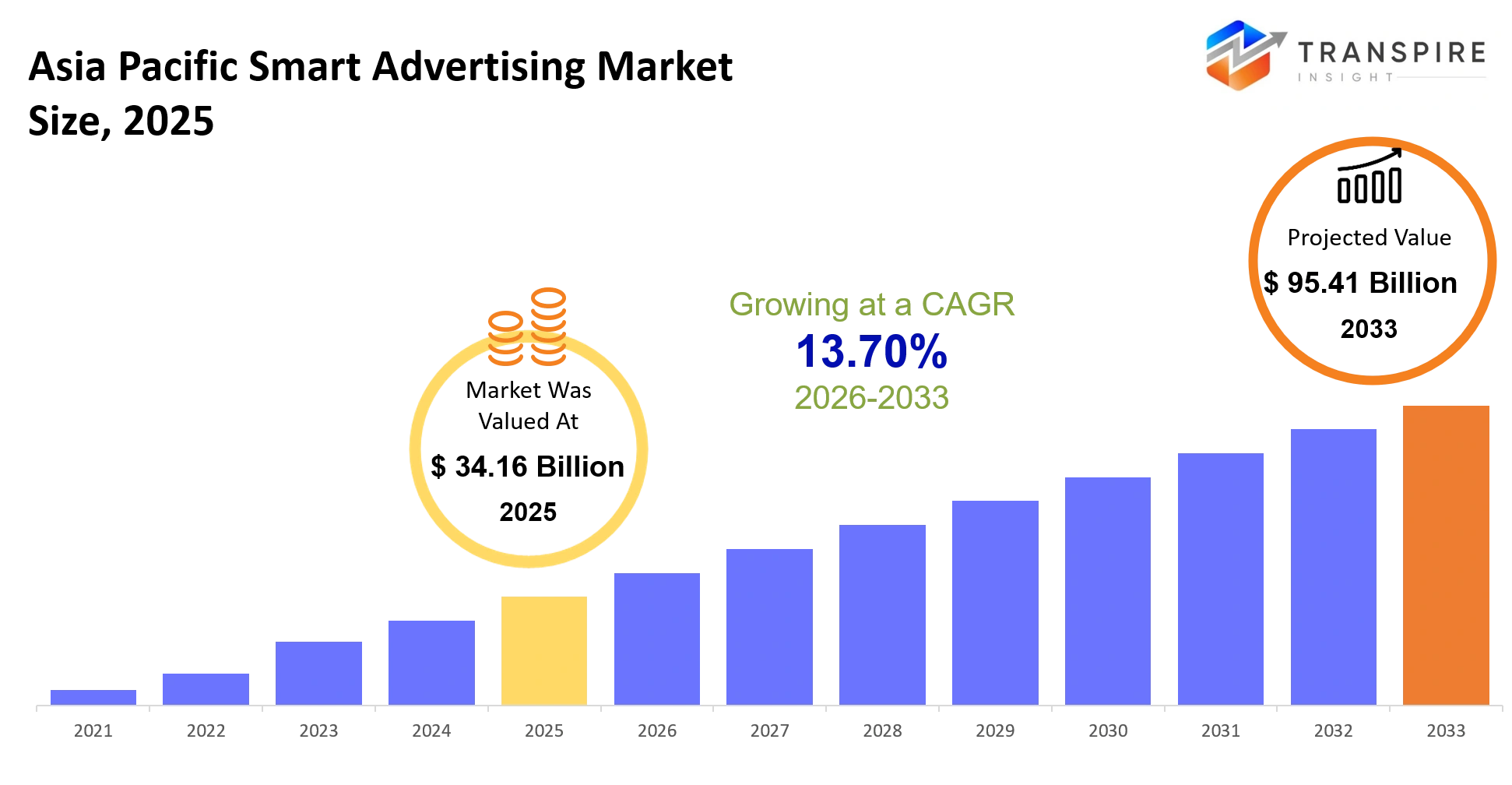
The Asia Pacific Smart Advertising Market was valued at USD 34.16 Billion in 2025. It is forecast to reach USD 95.41 Billion by 2033. That is a CAGR of 13.70% over the period.
The Asia Pacific Smart Advertising Market provides a solution for businesses to reach audience segments with tailored messages through digital out-of-home media displays on shopping mall directories, store windows, transportation systems and public spaces by dynamicizing content according to behavior, location and current environment. It solves a centuries old problem of inefficient advertising expenditure, substituting static campaigns for measurable and adjustable real time campaigns. Over the last five years the entire market shifted structurally away from legacy digital signage systems into fully integrated AI driven, programmable advertising infrastructure that utilizes analytics, sensors and cloud based platforms. The Covid-19 pandemic was a key accelerant, pushing adoption in contactless retail, e-commerce and multi-channel marketing efforts and because the consumer journey split across both physical and digital domains, advertisers increasingly sought accuracy and measurable ROI thusforcing venue owners and retailers to upgrade advertising systems and generating new ongoing revenue.
Key Market Insights
- China leads the regional market by holding nearly 40% of the share in 2025. Extensive digital signage networks and mega smart city projects lead this domination.
- India will witness the fastest market growth from 2025-2032 as a result of the increasing rate of urbanization, proliferation of retail outlets, and increasing investments in the connected advertisement ecosystem.
- Digital signage accounted for the major segment of the market in 2025 by holding above 45% of the total market share with wide deployment across retail outlets and transit.
- Programmatic digital out-of-home advertising occupied the second biggest segment in the market. Advertisers look for measurable campaign outcomes and automation of media purchase.
- AI enabled advertising platforms are projected to grow at the fastest rate until 2032.Predictive analytics and real-time campaign optimization play a major role in the growth of this segment.
- Retail applications commanded about 35% of the total share in the market for 2025 with increasing integration of smart displays with customer engagement and loyalty programs.
- Transportation and transit advertising emerged as the fastest-growing application in the market owing to the increase in metro networks and smart mobility projects in various regions.
- Large enterprises hold the dominant share of the end-user category with above 55% of the total market share in 2025 as they hold a higher advertising budget along with advanced analytical capabilities.
- Small and medium enterprises are anticipated to be the fastest growing category of the end-user. Deployment and maintenance costs are brought down due to cloud based advertising solutions.
- Brands enhance their competitive edge through AI enabled displays, collaborations, geographical expansion, cloud technology, and sophisticated audience measurement mechanisms.
What are the Key Drivers, Restraints, and Opportunities in the Asia Pacific Smart Advertising Market?
The Asia Pacific Smart Advertising Market is mainly fueled by the rise of data-driven marketing enabled by technologies such as artificial intelligence and programmatic advertising. Brands are expecting demonstrable results from campaigns over the old concept of mass marketing, a change spurred by growing e-commerce ecosystems and the implementation of an omnichannel retail strategy post pandemic. Real-time insight into consumer behavior allows brands to adjust their campaigns, improve campaign conversion rates, and spend advertising dollars more efficiently on intelligent systems, which directly fuels more advertising dollars to be spent and recurring revenue for technology companies.
The major structural limitation on the market, by far, comes in the form of data privacy regulations and the lack of universal standards across various Asian markets. Each Asian country follows a different regime regarding the acquisition, storage and targeted use of consumer data. This requires companies to develop bespoke compliance strategies for each market which increases costs, delays deployments in cross-border settings and causes a deferral of new investment by smaller businesses who are unable to sustain the legal and financial implications.
Future stages of growth are most likely to be in the form of smart city ecosystems and networked public spaces. Governments throughout India, Southeast Asia and China continue to invest in intelligent traffic systems, public surveillance and other digital public infrastructure, creating new venues for interactive advertising using artificial intelligence, 5G and real-time data analytics that will connect brands to the target consumer in a way that is contextual and measurable.
What Has the Impact of Artificial Intelligence Been on the Asia Pacific Smart Advertising Market?
AI is revolutionizing the operation of smart advertising services throughout Asia Pacific. Real-time analyses of data regarding audience demographics, locations, weather and consumer activity enable AI-powered systems to automate audience identification, content scheduling and campaign optimization. It is now a dynamic process with no more fixed ad campaigns-intelligent systems adjust messaging in real-time according to audience profiles and engagement, boosting campaign performance while cutting media waste.
ML models further add predictive capacity by forecasting audience traffic and evaluating potential campaign outcomes as well as optimal targeting times and venues for content distribution. These can therefore help operators raise advertising ROI and engagement levels while maximizing screen utilization in retail, airports and transit stations. Computer vision, cloud computing and 5G are improving operational efficiency with ease of centralized campaign management and content delivery across a large network of displays.
Challenges in AI implementation exist due to high integration costs, disparate data sources and diverging privacy regulations across markets in Asia Pacific. These hurdles prove especially daunting to smaller advertisers that do not possess sophisticated analytics capabilities.
Key Market Trends
- Digital OOH budgets are increasingly shifting from the old way of planning campaigns by hand to programmatic buying since 2020 and the figures reflect this change; they're putting more than 30% of budgets into digital OOH for automated, real time purchasing.
- From being a "pilot" product, AI audience analytics will become part of mainstream adoption after 2021, allowing retailers to tailor advertisements to different demographics or foot-traffic levels in real time.
- Retailers started blending "smart" advertising into the omni-channel retail experience after 2021 by syncing loyalty apps with e-commerce capabilities and in-store experiences.
- China has consolidated its dominant position with huge smart city projects since 2022 that increased its reach and connection between shopping centers, transportation hubs and city streets with connected displays.
- Privacy rules became even tighter after 2021 and advertising groups decreased their usage of third party cookies and are pushing further the development of first party customer data solutions.
- The transportation sector became more involved in exploiting the existing digital infrastructure and airports and metro-lines switched to static billboards with interactive displays and "smart" ad screens powered by AI from 2021.
- Samsung, LG and NEC focused on their respective software, cloud services and data analysis systems as display technology competition moved from hardware to ecosystem performance after 2021.
- Marketers and advertisers now use computer vision and location intelligence technologies to make ads more specific and efficient by targeting consumers with customized advertisements in areas of high foot traffic, therefore diminishing wasted advertising.
- In 2023, sustainability became an aspect of purchase that led display manufacturers to promote energy-saving solutions with longer operational lifecycles.
Asia Pacific Smart Advertising Market Segmentation
By Technology:
AI Advertising uses the power of machine learning and data analysis to serve targeted ads based on consumer behavior and interest. Programmatic Advertising uses automated software platforms for ads buying and placement to increase campaign efficiency and targeting effectiveness. AR Advertising involves superimposing digital elements onto the physical world to provide an engaging experience for customers.
Location-Based Advertising uses signals from the GPS, Wi-Fi and mobile to target ads based on customer’s geographic locations. Interactive Advertising allows customers to interact with advertisements using clickable advertisements, games or surveys to stimulate higher engagement. Predictive Advertising helps anticipate what the customers will do based on the past and real time data while Contextual Advertising delivers ads based on what customers are consuming. Another technology is the voice-based advertising and blockchain enabled advertising system are also garnering attention within the Asia Pacific Smart Advertising Market.
By Platform:
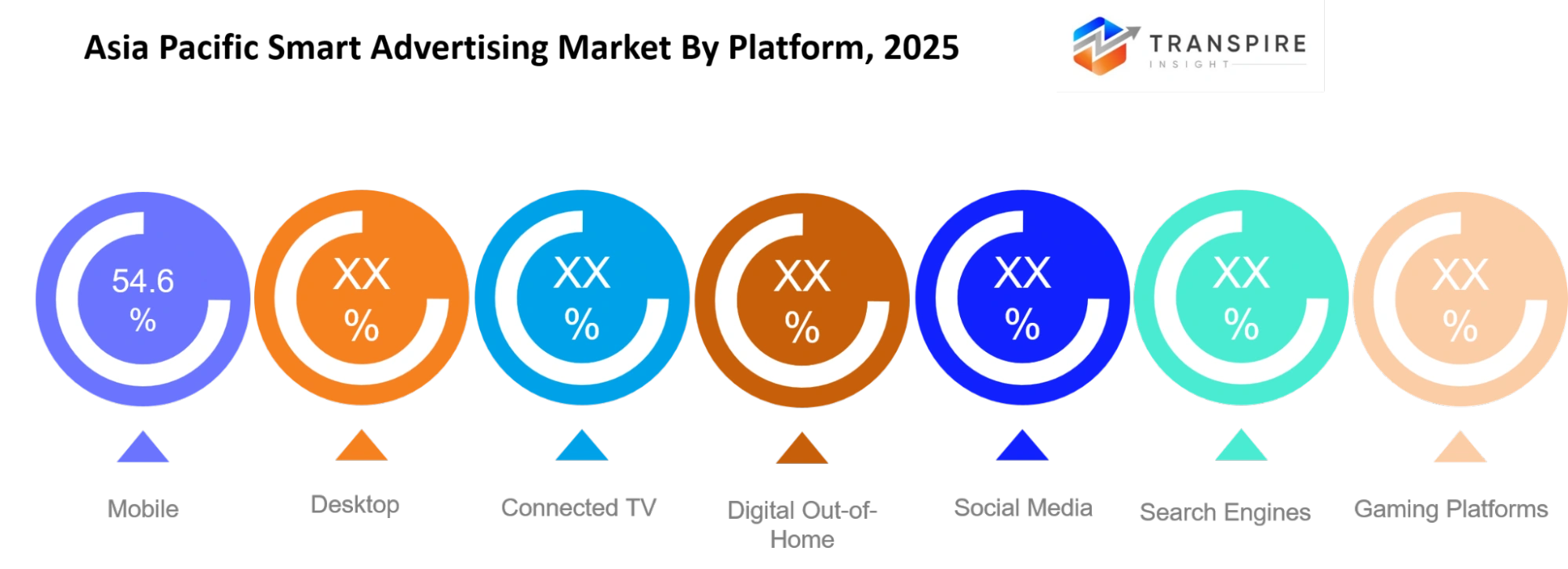
Mobile devices serve advertising campaigns delivered to the smartphones and tablet devices where brand owners can connect to customers during their routine activities. Desktop are advertising campaigns that are delivered through the computers and laptop devices across websites, online services and mobile applications. Connected TV is advertising delivered to internet enabled televisions and stream services where targeted advertising with enhanced audience measurement capabilities can be targeted.
Digital Out-of-Home advertising are carried on the smart billboard, digital kiosk, screen delivered on public spaces. Social media is a platform where advertisers connect to consumers through the social network applications for targeted campaign and interaction based advertising. Search engines provide ads through the search intent of consumers. Gaming platforms can utilize in-game ads or brand experience and integrated promotions to engage customers while smart wearable and connected devices continue to support new advertising concepts.
By Ad Format:
Display Ads are visual advertisements in the form of banners, images, and graphics displayed on the website and mobile apps. Video Ads present advertising content in the form of short or long videos used to attract customers and drive higher engagement. Native ads are a blend of surrounding media to provide a less interruptive and engaging advertisement experience.
Search ads display advertising content on search results and target ads based on customer's search term and surfing habits. Social ads are for social media applications and they encourage interactions of customers with a variety of features such as comments, likes and shares. Audio ads present advertisements through the podcasts, music streaming apps, and digital radio services. Interactive ads allow active audience engagement and more display ads come in the form of Sponsored Content, Influencer-driven campaigns to shape ad industries.
By End User:
The retail industry utilizes the smart advertising solution to attract the shoppers and market the products and the overall customer experience across both physical stores and online shops. BFSI organizations adopt sophisticated advertising technologies in order to market financial services and specific customer segmentations. Auto companies make use of smart advertising to demonstrate automobile's features and to influence the purchase decision with interactive digital content.
Media & Entertainment industries use the targeted ads to showcase the films, streaming services, events, and digital content through different channels. The healthcare industry utilizes smart advertising to convey the message for healthcare services, wellness plans and patient education. The travel industry uses smart advertising for destinations and deals while telecom industries market their connectivity services and digital products. Other end-users for the advertising market include education industry, real estate industry and consumer goods industry who are continuously increasing their investment on advertising in Asia Pacific Smart Advertising market.
What are the Key Use Cases Driving the Asia Pacific Smart Advertising Market?
Retail is one of the dominant use cases in the Asia Pacific Smart Advertising Market where marketers apply AI driven in-store displays, mobile advertisement campaigns and programmatic platform to deliver customized marketing campaigns at both retail stores and shopping malls. High demand in this use case is due to necessity of retailers to have accountable customer engagement, optimizing marketing campaign in real time and integrating physical stores with online business models.
The growth of investment in smart advertising is evident by not only retailers, financial institutions and media enterprises are adopting smart advertising more significantly. Banks are applying predictive and geo targeted marketing campaigns to promote financial products to the targeted consumer groups. Media and entertainment companies have integrated advertising within the connected TV and social media platforms in order to increase audience targeting and ad campaign ROIs.
Newer applications such as smart city advertising and in-game advertising are emerging as well. Authorities and cities are deploying interactive digital display networks in the public transport facilities. Furthermore, game companies are expected to find new avenues to generate revenue through immersive and brand integrations within the gaming universe.
|
Report Metrics |
Details |
|
Market size value in 2025 |
USD 34.16 Billion |
|
Market size value in 2026 |
USD 38.84 Billion |
|
Revenue forecast in 2033 |
USD 95.41 Billion |
|
Growth rate |
CAGR of 13.70% from 2026 to 2033 |
|
Base year |
2025 |
|
Historical data |
2021 - 2024 |
|
Forecast period |
2026 - 2033 |
|
Report coverage |
Revenue forecast, competitive landscape, growth factors, and trends |
|
Regional scope |
Asia Pacific (India, China, Japan, Australia, South Korea, Rest of Asia Pacific) |
|
Key company profiled |
Google, Meta, Amazon Ads, Alibaba, Tencent Ads, Baidu, Adobe, The Trade Desk, Criteo, PubMatic, Magnite, InMobi, Samsung Ads, Yahoo Advertising, X Ads |
|
Customization scope |
Free report customization (country, regional & segment scope). Avail customized purchase options to meet your exact research needs. |
|
Report Segmentation |
By Technology (AI Advertising, Programmatic Advertising, AR Advertising, Location-Based Advertising, Interactive Advertising, Predictive Advertising, Contextual Advertising, Others); By Platform (Mobile, Desktop, Connected TV, Digital Out-of-Home, Social Media, Search Engines, Gaming Platforms, Others); By Ad Format (Display Ads, Video Ads, Native Ads, Search Ads, Social Ads, Audio Ads, Interactive Ads, Others); By End User (Retail, BFSI, Automotive, Media & Entertainment, Healthcare, Travel, Telecom, Others) |
Which Regions are Driving the Asia Pacific Smart Advertising Market Growth?
China stands as the largest market within Asia Pacific Smart Advertising Market owing to investments made into digital infrastructure, smart city initiatives and telecommunication networks. Major retail chains, transport hubs, commercial hubs are actively using AI enabled displays and programmatic advertising to engage with customers. Favorable policies by the government towards digital transformation and 5G spread are fueling the growth of real time advertising across the market. The ecosystem is strengthened by the presence of numerous display manufacturers, software vendors, and data analysis companies.
Japan holds the second largest market and is following an alternate path of growth driven by consistency, quality of technology and long term investment. Enterprises in Japan are more interested in high value advertisement solutions that have precision targeting capabilities coupled with stable consumer analysis, than quick expansion. Purchasing power, matured retail network, steady adoption of connected TV and DOOH media are fueling the market revenue. The market remains robust even during unfavorable economic conditions.
The Indian market is the fastest growing and is reshaping the advertising across industries through its rapid urbanization, expanded retail network, and accelerated digital transformation efforts. Easy access to the internet, rising smartphone adoption have increased adoption of mobile and location based advertisements by brands. Smart city initiatives and large scale public digital infrastructure in the country will further present opportunities for interactive advertising in transport and commercial centers. Market growth in India will provide for ample opportunities to technology vendors and investors between 2026 and 2033.
Who are the Key Players in the Asia Pacific Smart Advertising Market and How Do They Compete?
The Asia Pacific Smart Advertising Market's competition level is moderate to concentrated where technology innovation and integrated service capability determine relative competitive position. Established electronics & displays manufacturers defend their position via investment in research, software-centric competitors provide a new approach into smart advertising via AI technology.Competition is based on intelligent content management, customer analysis, cloud connectivity, and campaign personalization at all channels to create efficiency at advertisement delivery.
Samsung Electronics leverages technology innovation by combining the display capability of high-resolution display screens with analytics and cloud-based intelligent advertising. Such technology allows advertisers to manage advertising across thousands of displays, while the display is self-learning and updating display content in real time. LG Electronics differentiate itself on its commercial display products and services that deliver the advantages in energy saving, simple and flexible installation, as well as compatibility with existing digital display at store or transit. Continued investment in Smart city and regional alliance with the electronics manufacturers and software vendors will enhance the market presence in Asia Pacific.
NEC Corporation focuses on its facial recognition technology, customer measurement and intelligent analytics, while also investing on data analytic capability that improves the efficiency of target marketing and insight generation. Sony Group Corporation focuses on the immersive view through the application of its high-quality display screen with the connected media device, also establishing business collaborations with the retail, broadcaster and digital service vendors to create a combined advertising platform that integrates hardware, software and data analysis.
Company List
- Meta
- Amazon Ads
- Alibaba
- Tencent Ads
- Baidu
- Adobe
- The Trade Desk
- Criteo
- PubMatic
- Magnite
- InMobi
- Samsung Ads
- Yahoo Advertising
- X Ads
Recent Development News
In January 2026, Samsung Electronics launched the 13-inch Samsung Color E-Paper display. The product introduced ultra-low-power digital signage with bio-resin materials, providing retailers and advertisers with a sustainable alternative to printed promotional materials while expanding smart display applications across commercial environments.
Source https://news.samsung.com/
In February 2026, Teads entered a partnership with Samsung Ads to launch connected TV home screen display and video advertising across key Asia Pacific markets. The collaboration expanded programmatic advertising opportunities in markets including Malaysia, Thailand, Indonesia, Vietnam, Hong Kong, Taiwan, and the Philippines, supporting wider adoption of data-driven advertising formats. Source https://iabseaindia.com/
What Strategic Insights Define the Future of the Asia Pacific Smart Advertising Market?
The Asia Pacific Smart Advertising Market will shift to an intelligence-first ecosystem whereby advertising decisions are automated, predictive and will span across physical and digital environments. This is being driven by a convergence of AI, first-party consumer data and connectivity infrastructure, enabling advertisers to optimise campaigns in a continuous loop rather than periodical adjustments. Ownership of audience intelligence and data analytics will become crucial over the next five to seven years, rather than owned screens, to drive competitive advantage.
The often-underlooked danger is the potential for concentration to form around a few dominant technology platforms and data environments. Given the stricter data privacy regulations sweeping across Asia Pacific, this could be a threat to small advertisers, limiting access to quality consumer data and to a degree, hinder their innovative capacity and advertising effectiveness.
However, there's a significant opportunity developing using generative AI for dynamic ad creation within smart cities; a particular interest can be found in India and Southeast Asia. Market participants are advised to make an early investment into AI powered ad creative and analytics platforms and establish strategic partnerships with telecommunication carriers and city infrastructure companies to ensure long-term market share.\
Asia Pacific Smart Advertising Market Report Segmentation
By Technology
- AI Advertising
- Programmatic Advertising
- AR Advertising
- Location-Based Advertising
- Interactive Advertising
- Predictive Advertising
- Contextual Advertising
By Platform
- Mobile
- Desktop
- Connected TV
- Digital Out-of-Home
- Social Media
- Search Engines
- Gaming Platforms
By Ad Format
- Display Ads
- Video Ads
- Native Ads
- Search Ads
- Social Ads
- Audio Ads
- Interactive Ads
By End User
- Retail
- BFSI
- Automotive
- Media & Entertainment
- Healthcare
- Travel
- Telecom
Frequently Asked Questions
Find quick answers to common questions.
The Asia Pacific Smart Advertising Market size is USD 95.41 Billion in 2033.
Key segments for the Asia Pacific Smart Advertising Market are By Technology (AI Advertising, Programmatic Advertising, AR Advertising, Location-Based Advertising, Interactive Advertising, Predictive Advertising, Contextual Advertising, Others); By Platform (Mobile, Desktop, Connected TV, Digital Out-of-Home, Social Media, Search Engines, Gaming Platforms, Others); By Ad Format (Display Ads, Video Ads, Native Ads, Search Ads, Social Ads, Audio Ads, Interactive Ads, Others); By End User (Retail, BFSI, Automotive, Media & Entertainment, Healthcare, Travel, Telecom, Others).
Major Asia Pacific Smart Advertising Market players are Google, Meta, Amazon Ads, Alibaba, Tencent Ads, Baidu, Adobe, The Trade Desk, Criteo, PubMatic, Magnite, InMobi, Samsung Ads, Yahoo Advertising, X Ads.
The Asia Pacific Smart Advertising Market size is USD 34.16 Billion in 2025.
The Asia Pacific Smart Advertising Market CAGR is 13.70% from 2026 to 2033.
- Meta
- Amazon Ads
- Alibaba
- Tencent Ads
- Baidu
- Adobe
- The Trade Desk
- Criteo
- PubMatic
- Magnite
- InMobi
- Samsung Ads
- Yahoo Advertising
- X Ads
About the Authors

Mayur Shinde
I am Mayur Shinde, a Senior Research Analyst at Transpire Insight, specializing in the Automotive & Transportation and Information & Communication Technology (ICT) Industry. My work focuses on analyzing emerging market trends, technological advancements, competitive landscapes, and industry developments to deliver accurate, data-driven insights. I am passionate about transforming complex market information into clear, actionable content that helps businesses, professionals, and decision-makers stay informed and make confident strategic decisions.

Chakradhar Khansole
Chakradhar serves as the Research Director at Transpire Insight, bringing over 8 years of experience in technology, innovation, and strategic market intelligence. He specializes in transforming complex market data into actionable business insights that enable organizations to make informed, growth-oriented decisions. Recognized for his strategic vision and analytical expertise, Chakradhar leads high-impact research initiatives, delivering comprehensive market assessments, competitive intelligence, and forward-looking industry analysis.
Recently Published Reports
-
Apr 2026
3D Optical Profiler Market
3D Optical Profiler Market Size, Share & Analysis Report By Type (Desktop 3D Optical Profiler, and Portable 3D Optical Profiler), By Technology (Confocal Technology, and White Light Interference), By End-Use Industry (Manufacturing, Research Institutions, Automotive, Aerospace and Defense, Medical Devices, and Other), and Geography (North America, Europe, Asia-Pacific, Middle East and Africa, South and Central America), 2021 - 2031
-
Apr 2026
Depth Sensor Market
Depth Sensor Market Size, Share & Analysis Report By Type (Infrared Depth Sensors, Time-of-Flight (ToF) Sensors, Stereo Vision Sensors, Structured Light Sensors, Ultrasonic Depth Sensors), By Application (Automotive, Robotics, Gaming, Consumer Electronics, Industrial Automation, Healthcare, Security & Surveillance, Others), By End Users (Automotive Manufacturers, Consumer Electronics Companies, Healthcare Providers, Industrial Companies, Security Agencies, Gaming Companies, Robotics Companies, Others), and Geography (North America, Europe, Asia-Pacific, Middle East and Africa, South and Central America), 2021 – 2031
-
Apr 2026
Digital Manufacturing Market
Digital Manufacturing Market Size, Share & Analysis Report By Component (Hardware, Software, and Services), By Technology (Robotics, 3D Printing, Internet of Things (IoT), and Others), By Application (Automotive and Transportation, Aerospace and Defense, Consumer Electronics, Industrial Machinery, and Others), By Process Type (Computer-Based Designing, Computer-Based Simulation, Computer 3D Visualization, Analytics, and Others), and Geography (North America, Europe, Asia-Pacific, Middle East and Africa, South and Central America), 2021 – 2031
-
Apr 2026
Digital Visa Services Market
Digital Visa Services Market Size, Share & Analysis Report By Type (Individual Travelers, Group Travelers), By Application (Tourism, Business Travel, Others), and Geography (North America, Europe, Asia-Pacific, Middle East and Africa, South and Central America), 2021 – 2031