

Asia Pacific Cloud Advertising Market Size & Forecast:
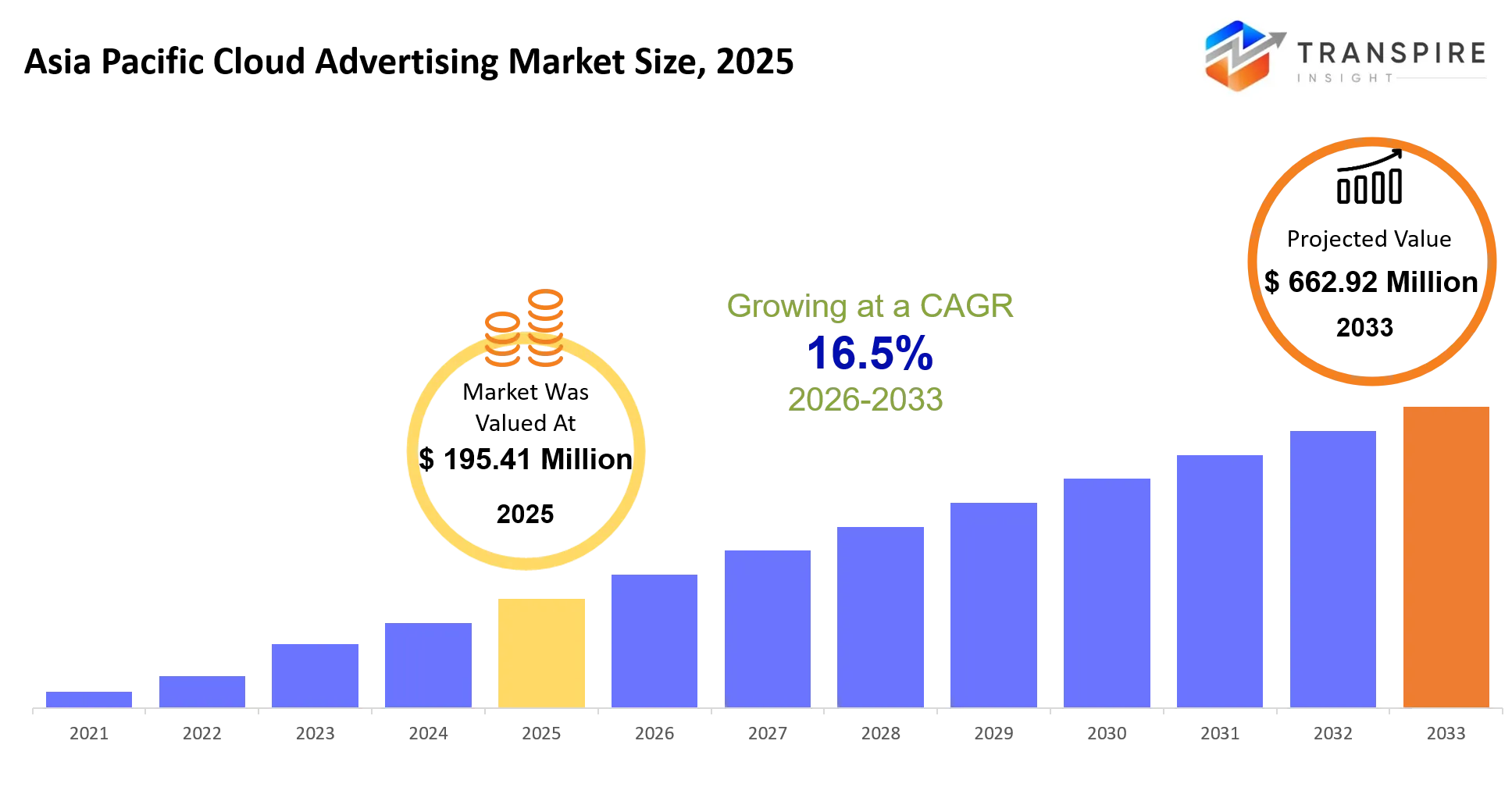
- Asia Pacific Cloud Advertising Market Size 2025: USD 195.41 Million
- Asia Pacific Cloud Advertising Market Size 2033: USD 662.92 Million
- Asia Pacific Cloud Advertising Market CAGR: 16.5%
- Asia Pacific Cloud Advertising Market Segments: By Advertising Type (Search, Display, Video, Social Media, Native, Mobile, Programmatic, Others) By Deployment Model (Public Cloud, Private Cloud, Hybrid Cloud, Multi-Cloud, SaaS, PaaS, IaaS, Others) By Enterprise Size (Large, Medium, Small, Startups, Agencies, E-commerce, Media Companies, Others) By Industry Vertical (Retail, BFSI, Media, Healthcare, Automotive, Travel, Education, Others)
To learn more about this report,  Download Free Sample Report
Asia Pacific Cloud Advertising Market Summary
The Asia Pacific Cloud Advertising Market was valued at USD 195.41 billion in 2025. It is forecast to reach USD 662.92 billion by 2033. That is a CAGR of 16.5% over the period.
The Asia Pacific Cloud Advertising Market helps companies to plan, purchase, deliver and then finetune digital ad campaigns using cloud based tools that pretty much link advertisers with people across search engines, social media, video streaming services, websites and mobile apps. In real life these platforms help organizations juggle massive amounts of ad related information, run campaign execution more or less automatically and monitor outcomes while things are happening across multiple channels.
Over the last three to five years the market looks like it went through a more noticeable structural shift, from manual campaign management to AI powered programmatic ads and cloud native marketing environments. One key moment was the pandemic era surge in digital commerce and online media watching, which in turn sort of made digital customer interaction expand in a durable way across the region. Because consumers ended up being online longer, advertisers pulled budgets away from more traditional media and moved them toward analytics driven digital channels. That rebalancing then increased demand for scalable cloud infrastructure that can process audience insights, enable individualized messaging and support real time bidding, so platform providers and advertising technology vendors in Asia Pacific could capture better revenue chances.
Key Market Insights
- China is leading in the Asia Pacific Cloud Advertising Market with around 35 to 40 percent market share in 2025. This is because it has a digital advertising system.
- India is growing fast in this market and is expected to keep growing until 2030. This is happening because more people are getting internet access most consumers are using phones first and small and medium-sized businesses are starting to use digital tools.
- Southeast Asia is getting a share of this market. This is because e-commerce platforms and digital businesses are spending more on ads.
- Japan and South Korea are also players, in this market. They have cloud systems and use AI to make advertising better.
- Programmatic advertising platforms are the part of this market. They make up 30 to 35 percent of the markets income. This is because they can buy ads automatically.
- Social media advertising is the biggest part of this market. It is doing well because people are engaging a lot on channels.
- AI-powered advertising analytics and optimization tools are expected to grow the fastest in the coming years.
- Cloud-based campaign management platforms are also growing. This is because companies want to control their advertising operations from one place.
- Digital marketing and campaign management is still the use of this market. It makes up around 40 percent of the market.
- Personalized customer engagement applications are becoming popular quickly. This is because companies are using data to understand their audiences.
What are the Key Drivers, Restraints, and Opportunities in the Asia Pacific Cloud Advertising Market?
The main force pushing the Asia Pacific Cloud Advertising Market ahead is the rapid uptake of AI driven programmatic ads plus cloud native marketing tools. It kind of gathered momentum as digital commerce kept spreading across China, India, Southeast Asia, and a whole set of other nearby markets. Along the way, it churned out massive amounts of consumer information that older advertising setups just could not manage in a clean, steady manner. With cloud based tools, advertisers can run real time bidding, do audience grouping, and fine tune campaigns continuously, at a very large scale, so they can lift conversions and squeeze better marketing efficiency out of the same overall spend. And because companies are putting more of their ad budgets into trackable digital channels, cloud advertising vendors usually benefit from heavier platform usage, reliable subscription income, plus added data analytics services.
Still, data privacy rules, and this patchwork style of digital governance frameworks, are likely the biggest structural hurdle. Across the Asia Pacific region, different countries roll out different expectations for how data is collected, stored, moved across borders, and even how consent is obtained from consumers. Advertisers rarely operate only inside one jurisdiction, so compliance turns into a long slog that requires meaningful spending on legal review, technical adjustments, and daily operations. This piece also cannot be solved quickly, because the regulations keep shifting in different directions from one market to the next. As a result you get slower platform rollouts, higher compliance costs, and then less campaign efficiency for cross-border efforts, which ends up limiting revenue growth for advertisers too, as well as for technology providers.
A big opportunity sits in the move toward generative AI plus first-party data ad strategies, you know, that kind of shift. Lately third-party cookies keep getting less effective, and brands are turning toward AI-driven customer intelligence platforms that use owned, consumer data. In places like India and Southeast Asia, the growth looks especially appealing. There, expanding digital ecosystems and more cloud infrastructure investments seem to make it easier for more advanced advertising technologies to take off. Overall this kind of transition could open up a fresh wave of platform adoption, and also premium service revenues, which is kind of the point.
What Has the Impact of Artificial Intelligence Been on the Asia Pacific Cloud Advertising Market?
Artificial intelligence and, uh, more advanced digital technologies are kind of basically shifting how cloud ad platforms do their work across the Asia Pacific area. Lately, advertisers tend to lean on AI so it handles a lot of the campaign management chores that used to require human, manual effort, like audience targeting, bid optimization, budget distribution, or even content personalization. And with cloud-based ad systems in place they can crunch millions of user interactions in real time, then adjust the campaign controls automatically, trying for better engagement results, and also stronger conversion performance.
Also, machine learning models are making predictive abilities much sharper across the broader digital advertising world. These models can forecast customer behavior, calculate conversion likelihood, estimate how efficient ad spend might be, and even surface high-value audience groups before any campaign is actually started. When they look at older campaign information and patterns of consumer interaction, predictive methods support marketers in fine tuning media spending, while also lowering customer acquisition costs. A lot of enterprises say they see better click through rates, stronger conversion outcomes, and improved return on advertising spend, largely due to AI powered optimization engines.
Operationally, AI kinda helps with quicker decision making, it also eases the whole campaign management workload, and it can minimize wasted advertising spend, while making marketing efficiency better across several digital channels. On top of that, real time analytics platforms help reinforce compliance with privacy rules that keep changing, by tracking how data is used and how consent management is handled.
Still, even with those upsides, there’s a big downside left: the cost and complexity involved in getting AI models to work alongside fragmented customer data systems. A lot of organizations keep running into data quality hiccups, uneven or inconsistent datasets, and regulatory constraints that end up lowering model accuracy. And that can also slow down the rollout of advanced advertising technologies, at least at a larger scale.
Key Market Trends
- Since 2021 companies have been shifting their ad budgets from media to online platforms. This is because online platforms can show results in time.
- AI tools for bidding and targeting audiences got really popular among advertisers between 2022 and 2025.
- Advertisers are now using their customer data more. This is because changes in browser privacy are making it harder to track people with third-party tools.
- Google, Meta and Amazon Ads have added AI features. These features help automate ad campaigns. This means marketing teams do not have to do much work to optimize them.
- Retail and e-commerce companies have invested a lot in ad platforms since 2023. They want to get customers and see how well their ads work.
- Managing ads across channels like search, social media, video and mobile apps is more important. Brands want to run campaigns in a way.
- India and Southeast Asia are now markets for expansion. Online shopping and mobile internet use have grown a lot. This has drawn in advertisers.
- Advertisers want platforms with real-time analytics. They want to see how their campaigns are doing and what they get back from their ad spending.
- Changes in rules in China, India, Singapore and elsewhere have made companies improve privacy and get peoples consent for advertising.
- After 2022 we have seen partnerships, between cloud providers and ad tech companies. This has allowed for integration of AI analytics, customer data and campaign automation systems.
Asia Pacific Cloud Advertising Market Segmentation
By Advertising Type:
Search advertising still keeps a pretty strong grip, since many businesses are really putting emphasis on performance based customer acquisition, you know, the kind that can be measured. Lately, AI driven keyword optimization, plus audience matching and campaign automation have made things faster in a way that feels more efficient across most digital ad efforts. It’s also getting solid adoption in retail, e commerce, financial services, and technology firms so revenue keeps moving at a steady pace. And as more people use mobile search platforms, companies are investing even more into this particular advertising space, sort of doubling down.
Meanwhile, display advertising stays important, not just for the obvious brand visibility but also for ongoing customer engagement across websites, apps, and different digital media channels. Video advertising has been picking up speed, because streaming content is consumed more and short form digital media is basically everywhere now. Social media advertising keeps drawing a lot of spend, mainly because of wide audience reach, plus targeting tools that are genuinely advanced. Native, mobile, and programmatic advertising solutions are also spreading, as organizations chase more personalized customer experiences, along with automated campaign management across a bunch of channels at once.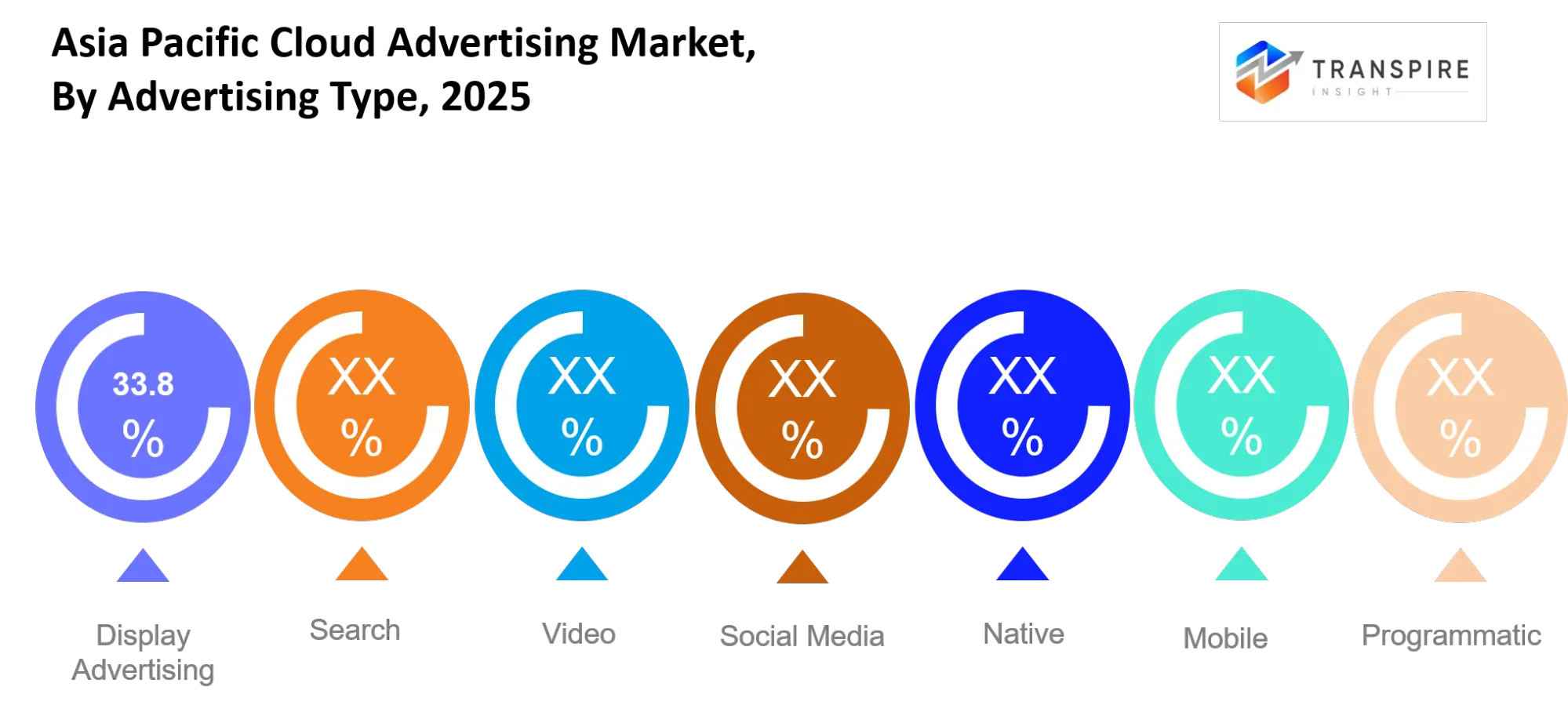
To learn more about this report, Download Free Sample Report
By Deployment Model:
Public cloud deployment keeps a bit of a leading position because of scalability, cost efficiency, and it’s simpler to roll out for advertising operations, so you know it just works smoother. With cloud based infrastructure, businesses can deal with huge piles of campaign data ,and still get real time analytics as well as audience targeting. That kind of flexible resource allocation has basically pushed adoption forward among organizations that manage complicated digital marketing tasks. Ongoing funding from big cloud providers has made platforms run better and also more accessible overall.
Private cloud solutions still matter a lot though, especially for teams working with sensitive customer information and those that need to stick to strict regulatory requirements. Hybrid cloud adoption keeps growing, because enterprises want to get a balance between security, elasticity, and day to day operational efficiency. Multi cloud strategies have also gathered more attention, since companies want to lower dependence on just one provider, while boosting resilience and staying steadier during disruptions. Meanwhile SaaS, PaaS, and IaaS models keep supporting different advertising technology needs across industries, depending on what each organization is trying to do.
By Enterprise Size:
Large enterprises take up a pretty big chunk of spending, mostly because their marketing budgets are extensive, and the advertising needs get pretty involved too. Lately, advanced analytics, AI based optimization tools, and cross channel campaign management platforms have sort of turned into must have pieces of their enterprise advertising plan. There’s also a strong focus on grabbing new customers and keeping brand positioning consistent , so they keep putting money into cloud based advertising technologies. On top of that, linking these systems to customer relationship management setups and data analytics platforms helps justify adoption, and it actually makes it easier to run everything.
Small and medium sized enterprises, meanwhile, are starting to participate more, as cloud solutions become more affordable and easier to reach. Subscription style pricing has lowered the hurdles tied to technology deployment and ongoing upkeep costs. As digital commerce keeps expanding , even smaller companies are more willing to invest in performance driven advertising tools. They tend to like the simplified campaign management features and automation abilities, because those improvements have sped up adoption across this group.
By Industry Vertical:
Retail and e-commerce kinda sit at the top as a major industry vertical, mainly because they’re so tied to digital customer acquisition , plus online sales growth is still moving. Lately, real-time campaign tuning and personalized ad placements have turned into key methods, not just to lift conversion rates but also help keep customers longer. And with competition among online retailers getting more intense, companies end up putting more money into cloud advertising platforms. So yeah, data driven marketing approaches are still steering how budgets get allocated across the whole sector.
At the same time , financial services , telecom , media , healthcare, and tech are pushing cloud advertising too. Things like customer engagement efforts, digital modernization programs and the steady shift toward online service channels all add up to bigger investment across these spaces. Media firms in particular often lean on sharper audience profiling and content promotion abilities, so they can stretch their visibility as far as possible. If this keeps spreading across many industries , it should back up ongoing market growth and help future innovation keep happening.
What are the Key Use Cases Driving the Asia Pacific Cloud Advertising Market?
The main reason people start adopting cloud advertising platforms is , basically, digital campaign handling and performance marketing. Retail, e-commerce, and consumer brands lean on these platforms to run big advertising efforts across search engines, social media networks, and even online marketplaces. With real-time fine-tuning, audience pinpointing, and something you can actually measure like return on ad spend, this kind of setup becomes the biggest engine of market demand.
There are also other applications picking up speed, especially in financial services and telecommunications, where the cost to acquire a customer and retention levels end up shaping profitability. Cloud-based advertising tools help with more tailored promotions, sorting customers into groups, and coordinating cross channel engagement. Media and entertainment groups meanwhile use these platforms to boost how content gets promoted and how far audiences spread across digital routes, not just one channel.
More new patterns are showing up too, like AI generated advertising materials and predictive mapping of the customer journey. Many advanced cloud platforms are starting to back automated creative building, adaptive content personalization, and forward looking campaign preparation. And as first-party data strategies become more important, these platforms should open up fresh growth opportunities across the regional digital advertising world, you know.
|
Report Metrics |
Details |
|
Market size value in 2025 |
USD 195.41 Billion |
|
Market size value in 2026 |
USD 227.65 Billion |
|
Revenue forecast in 2033 |
USD 662.92 Billion |
|
Growth rate |
CAGR of 16.5% from 2026 to 2033 |
|
Base year |
2025 |
|
Historical data |
2021 - 2024 |
|
Forecast period |
2026 - 2033 |
|
Report coverage |
Revenue forecast, competitive landscape, growth factors, and trends |
|
Regional scope |
Asia Pacific |
|
Key company profiled |
Google, Microsoft, Amazon Ads, Meta, Alibaba Cloud, Tencent Cloud, Baidu, Adobe, Oracle, Salesforce, SAP, IBM, The Trade Desk, Criteo, HubSpot |
|
Customization scope |
Free report customization (country, regional & segment scope). Avail customized purchase options to meet your exact research needs. |
|
Report Segmentation |
By Advertising Type (Search, Display, Video, Social Media, Native, Mobile, Programmatic, Others) By Deployment Model (Public Cloud, Private Cloud, Hybrid Cloud, Multi-Cloud, SaaS, PaaS, IaaS, Others) By Enterprise Size (Large, Medium, Small, Startups, Agencies, E-commerce, Media Companies, Others) By Industry Vertical (Retail, BFSI, Media, Healthcare, Automotive, Travel, Education, Others) |
Which Regions are Driving the Asia Pacific Cloud Advertising Market Growth?
China is leading the Asia Pacific Cloud Advertising Market, basically because the digital economy is huge, the cloud infrastructure is solid and the online advertising setup is very well matured, like really. Big tech firms have already put together integrated platforms that mix ad placements, data analytics, artificial intelligence, plus cloud services, so it ends up being a nice base for the top position. On top of that, government backing for digital transformation, together with continued spending on data centers, has made the everyday environment easier for cloud based advertising options. There is also this well established group of advertisers agencies, e-commerce platforms, and tech providers that keeps the regional edge going, more or less.
Japan comes in as the next biggest contributor, and it looks different than China in how it approaches things, more or less through stability, smooth operations, and a long term commitment to adopting newer tech. Many major enterprises keep funding digital marketing platforms in a steady way, often as part of wider modernization plans for their overall business. Strong corporate governance practices also help, and so does dependable technology infrastructure, which together support the steady rollout of cloud advertising solutions in multiple industries. This more careful style helps create predictable revenue, and it makes Japan a dependable place for vendors, and service providers that want less drama in the market.
India’s becoming the fastest moving market, mostly because rapid digitalization , wider internet reach, and more frequent mobile commerce activity are changing how advertising budgets get allocated. At the same time, the recent uplift in digital payment adoption , more people joining online retail, and ongoing cloud technology investment is basically speeding up the pivot toward data-driven ad platforms. Companies across different sectors are also leaning on cloud-based tools to connect with consumers via personalized outreach, and campaigns that are easier to track and measure. In the 2026 to 2033 period, this same momentum should open up meaningful chances for platform providers, technology partners , and investors who want exposure to these fast-growing digital advertising markets.
Who are the Key Players in the Asia Pacific Cloud Advertising Market and How Do They Compete?
Competition in the Asia Pacific Cloud Advertising Market is sort of moderately concentrated, in the sense that a handful of global technology companies still end up owning a decent chunk of the digital advertising infrastructure while regional providers keep pushing, using local know-how and more specialized services. In practice, the tech muscle is kind of the main fight now, especially around artificial intelligence, audience analytics, campaign automation, and cross-channel advertising management, i mean it’s mostly capabilities. Incumbent firms tend to defend their position via tight ecosystem integration plus large-scale data processing, but newer players often go after something narrower, like niche advertising technologies and regional tailoring. At the same time there’s more competition popping up around privacy-compliant advertising solutions, because the rules are getting more complicated across the Asia Pacific.
Google stands out because it weaves search advertising with cloud services, analytics tools, and AI-based campaign optimization. It keeps investing in machine learning, so advertisers can automate bidding, audience selection, and even performance measurement, all at scale. Meta leans harder into social media advertising and it does that using a huge amount of consumer engagement data across its own platforms. Its advanced audience segmentation, along with automated creative delivery, helps advertisers lift results in consumer markets that are, frankly, pretty crowded.
Amazon Ads seems to have really solidified its spot by blending ad tools with commerce-based consumer intel, so brands can tie what’s happening in ads to actual buying behavior, kind of end-to-end. Microsoft’s play is more like pulling through enterprise software ecosystems , its cloud setup , plus those pro audience networks, which gives business oriented advertisers a clearer value story. Meanwhile, Alibaba Cloud leans on its strong regional footing and the pretty tight links to digital commerce platforms across Asia , so advertisers can run more localised campaigns and tap into online markets that are growing fast. And yeah, across the board , strategic moves around AI , data analytics and regional partnerships are still shaping who wins, and how, over time.
Company Key Market Players
- Microsoft
- Amazon Ads
- Meta
- Alibaba Cloud
- Tencent Cloud
- Baidu
- Adobe
- Oracle
- Salesforce
- SAP
- IBM
- The Trade Desk
- Criteo
- HubSpot
Recent Development News
"In April 2026, Microsoft Advertising launched AI Visibility within Microsoft Clarity and introduced Universal Commerce Protocol capabilities in Microsoft Merchant Center. The update helps advertisers understand how AI systems surface products and content, strengthening campaign optimization as AI-driven search and shopping environments expand. [https://about.ads.microsoft.com
"In June 2026, Pinterest entered a $4 billion cloud services partnership with Amazon Web Services (AWS) extending through 2031. The agreement strengthens Pinterest's AI and advertising capabilities through expanded cloud infrastructure and advanced computing resources, supporting more sophisticated ad personalization and campaign performance tools. [https://www.reuters.com
What Strategic Insights Define the Future of the Asia Pacific Cloud Advertising Market?
Over the next five to seven years, the Asia Pacific Cloud Advertising Market is expected to drift toward pretty automated, AI-native advertising ecosystems where campaign planning, audience targeting, content generation, and performance tuning run inside integrated cloud platforms. The main push for this change is the rising flood of digital interactions and first-party data, which basically makes real-time decision-making and predictive analytics a must-have capability, not a nice-to-have extra thing. And as ad budgets become more and more tied to measurable performance, tech providers that can show clear business impact will end up taking a bigger slice of spend.
There’s also a less obvious risk in how concentrated the market can get around a small cluster of technology ecosystems. If advertisers and agencies lean too heavily on a limited set of cloud and ad platforms, it could let dominant vendors gain more pricing leverage while at the same time lowering flexibility for everyone else. Still, even with that, there’s a newer opening forming, especially around AI-powered commerce advertising in India and Southeast Asia, where digital payments keep spreading and online retail activity continues to grow, basically at speed.
Market participants should probably focus on investing in privacy-compliant AI solutions along with first-party data infrastructure. The organizations that manage to build independent data assets, and not lean so hard on third-party identifiers, will generally be in a stronger spot when regulations tighten, and advertising technologies keep evolving.
Asia Pacific Cloud Advertising Market Report Segmentation
By Advertising Type
- Search
- Display
- Video
- Social Media
- Native
- Mobile
- Programmatic
- Others
By Deployment Model
- Public Cloud
- Private Cloud
- Hybrid Cloud
- Multi-Cloud
- SaaS
- PaaS
- IaaS
- Others
By Enterprise Size
- Large Enterprises
- Medium Enterprises
- Small Enterprises
- Startups
- Agencies
- E-commerce Companies
- Media Companies
- Others
By Industry Vertical
- Retail
- BFSI
- Media & Entertainment
- Healthcare
- Automotive
- Travel & Hospitality
- Education
- Others
Frequently Asked Questions
Find quick answers to common questions.
The Expected Asia Pacific Cloud Advertising Market size for the Market will be USD 662.92 Billion in 2033.
Key Segments for the Asia Pacific Cloud Advertising Market are Type By Advertising Type (Search, Display, Video, Social Media, Native, Mobile, Programmatic, Others) By Deployment Model (Public Cloud, Private Cloud, Hybrid Cloud, Multi-Cloud, SaaS, PaaS, IaaS, Others) By Enterprise Size (Large, Medium, Small, Startups, Agencies, E-commerce, Media Companies, Others) By Industry Vertical (Retail, BFSI, Media, Healthcare, Automotive, Travel, Education, Others).
Major Asia Pacific Cloud Advertising Market players are Google, Microsoft, Amazon Ads, Meta, Alibaba Cloud, Tencent Cloud, Baidu, Adobe, Oracle, Salesforce, SAP, IBM, The Trade Desk, Criteo, HubSpot.
The Current Asia Pacific Cloud Advertising Market size is USD 195.41 Million in 2025.
The Asia Pacific Cloud Advertising Market CAGR is 16.5% from 2026 to 2033.
- Microsoft
- Amazon Ads
- Meta
- Alibaba Cloud
- Tencent Cloud
- Baidu
- Adobe
- Oracle
- Salesforce
- SAP
- IBM
- The Trade Desk
- Criteo
- HubSpot
About the Authors

Mayur Shinde
I am Mayur Shinde, a Senior Research Analyst at Transpire Insight, specializing in the Automotive & Transportation and Information & Communication Technology (ICT) Industry. My work focuses on analyzing emerging market trends, technological advancements, competitive landscapes, and industry developments to deliver accurate, data-driven insights. I am passionate about transforming complex market information into clear, actionable content that helps businesses, professionals, and decision-makers stay informed and make confident strategic decisions.

Chakradhar Khansole
Chakradhar serves as the Research Director at Transpire Insight, bringing over 8 years of experience in technology, innovation, and strategic market intelligence. He specializes in transforming complex market data into actionable business insights that enable organizations to make informed, growth-oriented decisions. Recognized for his strategic vision and analytical expertise, Chakradhar leads high-impact research initiatives, delivering comprehensive market assessments, competitive intelligence, and forward-looking industry analysis.
Recently Published Reports
-
Apr 2026
3D Optical Profiler Market
3D Optical Profiler Market Size, Share & Analysis Report By Type (Desktop 3D Optical Profiler, and Portable 3D Optical Profiler), By Technology (Confocal Technology, and White Light Interference), By End-Use Industry (Manufacturing, Research Institutions, Automotive, Aerospace and Defense, Medical Devices, and Other), and Geography (North America, Europe, Asia-Pacific, Middle East and Africa, South and Central America), 2021 - 2031
-
Apr 2026
Depth Sensor Market
Depth Sensor Market Size, Share & Analysis Report By Type (Infrared Depth Sensors, Time-of-Flight (ToF) Sensors, Stereo Vision Sensors, Structured Light Sensors, Ultrasonic Depth Sensors), By Application (Automotive, Robotics, Gaming, Consumer Electronics, Industrial Automation, Healthcare, Security & Surveillance, Others), By End Users (Automotive Manufacturers, Consumer Electronics Companies, Healthcare Providers, Industrial Companies, Security Agencies, Gaming Companies, Robotics Companies, Others), and Geography (North America, Europe, Asia-Pacific, Middle East and Africa, South and Central America), 2021 – 2031
-
Apr 2026
Digital Manufacturing Market
Digital Manufacturing Market Size, Share & Analysis Report By Component (Hardware, Software, and Services), By Technology (Robotics, 3D Printing, Internet of Things (IoT), and Others), By Application (Automotive and Transportation, Aerospace and Defense, Consumer Electronics, Industrial Machinery, and Others), By Process Type (Computer-Based Designing, Computer-Based Simulation, Computer 3D Visualization, Analytics, and Others), and Geography (North America, Europe, Asia-Pacific, Middle East and Africa, South and Central America), 2021 – 2031
-
Apr 2026
Digital Visa Services Market
Digital Visa Services Market Size, Share & Analysis Report By Type (Individual Travelers, Group Travelers), By Application (Tourism, Business Travel, Others), and Geography (North America, Europe, Asia-Pacific, Middle East and Africa, South and Central America), 2021 – 2031