
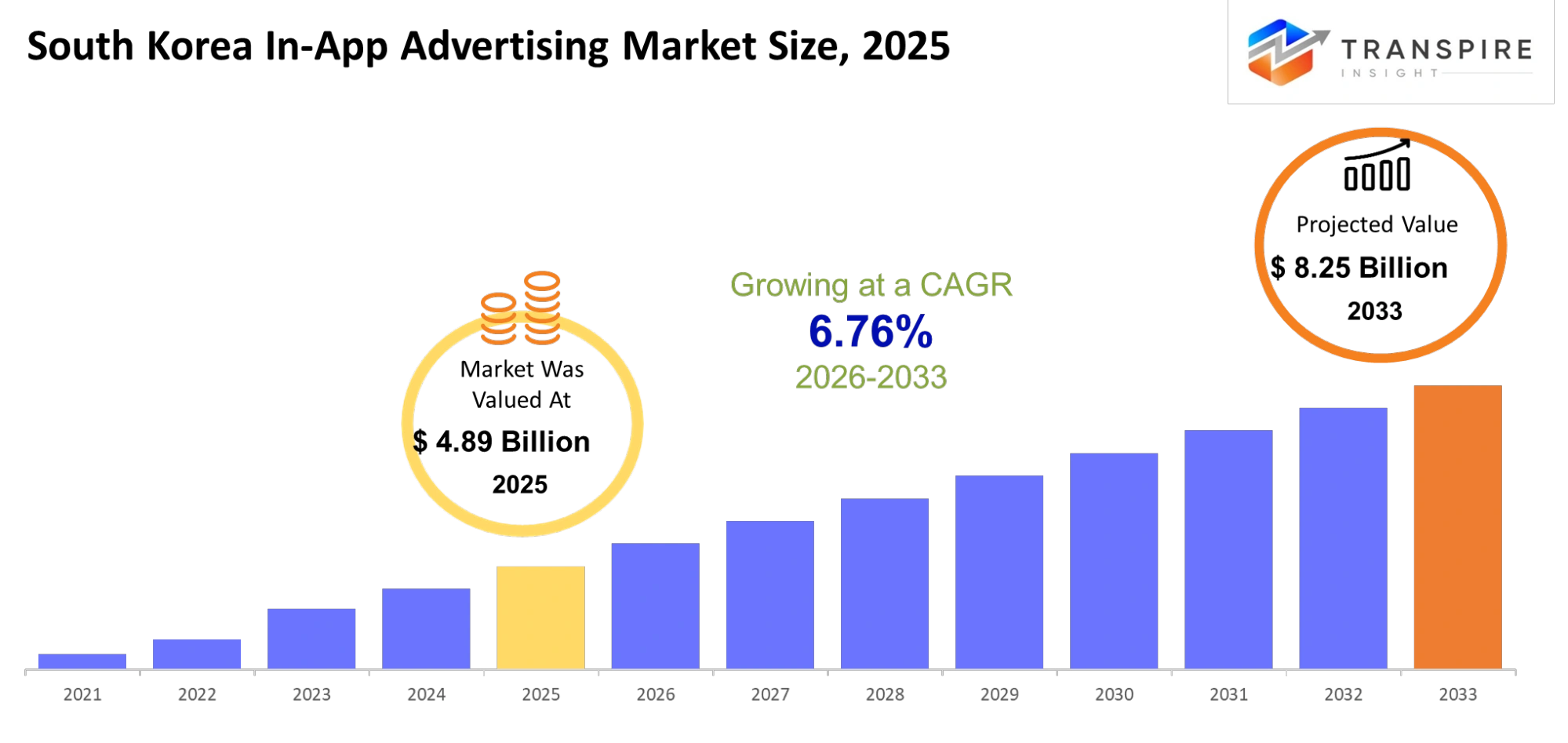
South Korea In-App Advertising Market Size & Forecast:
- South Korea In-App Advertising Market Size 2025: USD 4.89 Billion
- South Korea In-App Advertising Market Size 2033: USD 8.25 Billion
- South Korea In-App Advertising Market CAGR: 6.76%
- South Korea In-App Advertising Market Segments: By Type (Banner Ads, Video Ads, Native Ads, Interstitial Ads, Rewarded Ads, Others); By Application (Gaming, E-commerce, Social Media, Entertainment, Utility Apps, Others); By End-User (Advertisers, App Developers, Enterprises, SMEs, Agencies, Others); By Platform (Android, iOS, Web Apps, Hybrid Apps, OTT Apps, Others)
To learn more about this report,  Download Free Sample Report
South Korea In-App Advertising Market Summary:
The South Korea In-App Advertising Market size is estimated at USD 4.89 Billion in 2025 and is anticipated to reach USD 8.25 Billion by 2033, growing at a CAGR of 6.76% from 2026 to 2033.
The digital advertising field will continue to develop new methods for brands to reach audiences who primarily use mobile devices. The combination of fast internet access and high smartphone usage creates higher standards for advertising mobile applications. Advertisers need to create content formats which fit seamlessly into app experiences because users now prefer short videos and gaming and social media platforms. Businesses will achieve better user targeting through data-driven methods which enable advanced personalized experiences but they require complete user data disclosure because of new privacy regulations. Marketers can run their advertising campaigns faster through artificial intelligence and programmatic advertising technology which helps them identify their ideal target audiences. Interactive formats which combine rewarded advertisements with immersive visual content will attract younger users. The rising need for continuous online digital experiences compels advertisers to balance their creative work with privacy protection measures which allow them to demonstrate effective results.
What Has the Impact of Artificial Intelligence Been on the South Korea In-App Advertising Market?
The South Korean In-App Advertising Market experiences rapid changes because businesses now use artificial intelligence for data analysis and user targeting and performance optimization. The AI system in South Korean In-App Advertising Market environments conducts market research and real-time data analysis because it processes extensive user behavior data with high accuracy. Companies use machine learning and predictive analytics to identify micro-trends which helps them create better audience segments and predict future demand. This system enables marketers to make rapid data-based decisions which result in increased return on investment for their marketing campaigns.
The South Korean In-App Advertising Market uses artificial intelligence to improve operational efficiency through its ability to automate processes and create efficient work procedures. Businesses use automated bidding systems together with dynamic ad placements and personalized content delivery systems to increase engagement without needing to manually operate these systems. Businesses use AI-powered demand forecasting and trend prediction systems to detect upcoming consumer preference changes which enables them to modify their marketing strategies at the appropriate time. The organization achieves better production results through automated systems which create efficient production workflows while synchronizing advertising expenses with inventory levels and customer demand patterns to decrease operational expenses.
AI enables South Korean In-App Advertising Market businesses to create unique customer experiences at scale which leads to higher market innovation and business growth. Brands can use user intent and behavior data together with contextual information to create personalized advertising experiences which lead to higher customer conversion rates and better customer retention. The South Korean In-App Advertising Market uses artificial intelligence to develop its strategies which makes businesses more flexible and competitive while they grow in a data-driven digital environment.
Key Market Trends & Insights:
- The Seoul metropolitan area controls 45 percent of South Korea's in-app advertising market, which will generate this market share in 2025 because people in the Seoul area consume digital content at elevated rates.
- The Busan area together with new urban centers represents the most rapidly developing areas, which will experience growth that exceeds 14 percent compound annual growth rate between 2025 and 2030.
- The South Korean in-app advertising market receives 40 percent of its display ad inventory because mobile app users watch these advertisements.
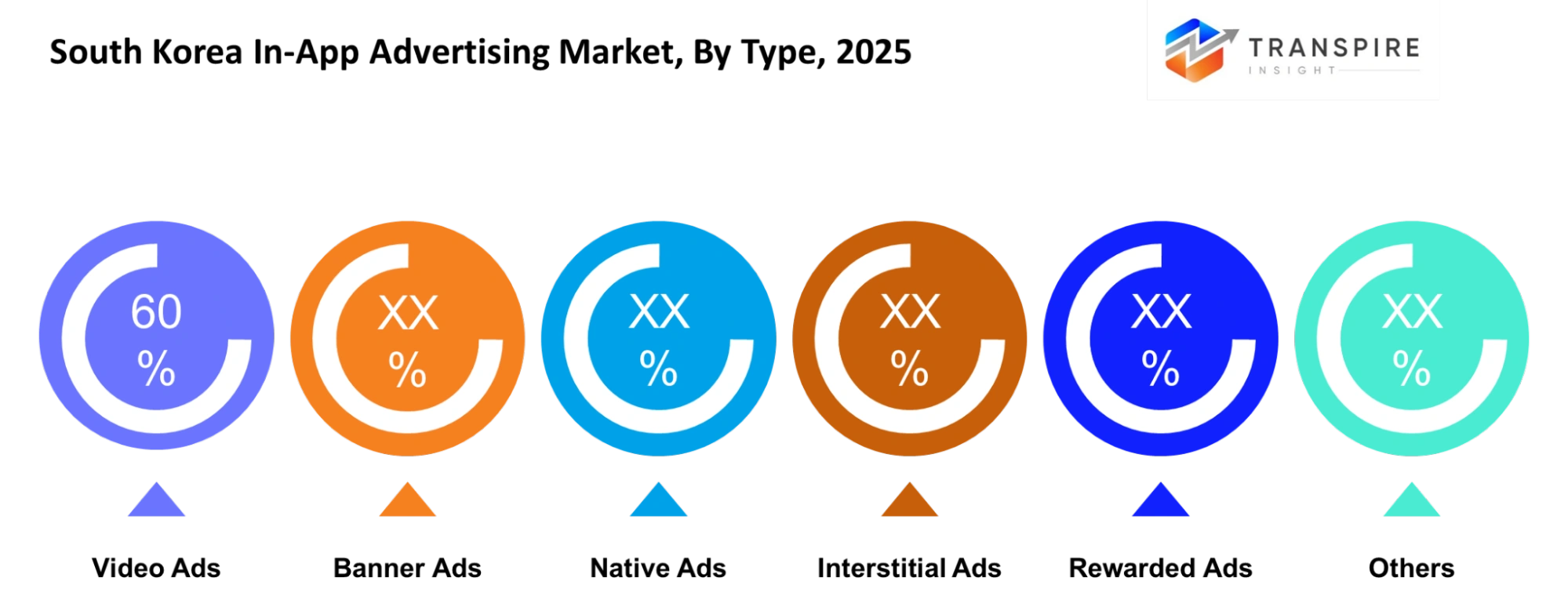
- The second-largest market segment of video advertising controls 30 percent of the market because more users watch content through over-the-top platforms and gaming applications.
- Native advertising exists as the fastest developing market segment because it will grow at a 15 percent compound annual growth rate until 2030 through its ability to integrate into user experiences and achieve better conversion results.
- The gaming application market will receive more than 35 percent of its share in 2025 because users who play games at high levels spend money on virtual items and use in-app purchasing systems.
- The e-commerce application segment drives the fastest market growth because the industry expects to achieve 16 percent compound annual growth rate during the period of rising mobile shopping adoption.
- The South Korean in-app advertising market functions as a major platform for retail and e-commerce companies which control 38 percent of the market in 2025 through their active digital promotional campaigns.
- Digital financial services adoption drives the BFSI and fintech industries to expand their workforce needs at an annual growth rate of 13 percent.
- The development of new technologies such as smart automation tools and real-time bidding systems enables organizations to gain market advantages while they enhance their advertising operations.
South Korea In-App Advertising Market Segmentation
By Type:
The research study uses six different advertising categories which include Banner Ads Video Ads Native Ads Interstitial Ads Rewarded Ads and other advertising types. The simple design of banner ads enables them to reach almost all audiences while video ads create better engagement through their visual storytelling method. The native ads will display within application content to create improved user experience. Users will experience interstitial and rewarded ads as interactive elements which enhance their gameplay experience through gaming environments.
To learn more about this report, Download Free Sample Report
By Application:
Gaming applications will generate strong ad demand due to high user activity and in-app purchases. The mobile shopping trend will drive e-commerce applications to grow according to rising mobile shopping rates. Social media and entertainment platforms will maintain steady growth, while utility apps will create niche opportunities for targeted advertising. The advertising industry will become the largest business sector when digital marketing strategies become the main focus of marketing campaigns.
By End-User:
The advertising industry will become the largest business sector when digital marketing strategies become the main focus of marketing campaigns. App developers will depend on ad revenue for monetization. Mobile audiences will become more accessible to enterprises and SMEs through their increasing participation because agencies will deliver campaign management and optimization services. Enterprises and SMEs will increase participation to reach mobile audiences, while agencies will provide campaign management and optimization services.
By Platform:
Android platforms will dominate the market because of their extensive user base and economical devices. The iOS platform generates significant revenue through its high-end users. Web and hybrid applications enable users to access multiple platforms, while OTT applications create new advertising possibilities through their streaming content delivery.
What are the Main Challenges for the South Korea In-App Advertising Market Growth?
The South Korea In-App Advertising Market faces ongoing operational and technical difficulties because its platforms rely on real-time bidding systems and their data-intensive advertisement delivery networks. The combination of performance bottlenecks and ad serving delays and ad exchange integration problems leads to decreased efficiency in campaigns. The South Korea In-App Advertising Market experiences operational difficulties because advertisers need to deliver personalized advertising content to millions of users which creates system instability during times of high user activity.
The South Korea In-App Advertising Market faces commercialization obstacles because data protection regulations and compliance standards control the methods used to collect and handle user information. The strict user privacy requirements and consent regulations force advertisers and platforms to spend more money on meeting compliance standards. The South Korea In-App Advertising Market faces operational challenges which result in delayed product introductions and reduced revenue growth for smaller businesses that encounter expensive campaign setup procedures and time-consuming approval requirements.
The South Korea In-App Advertising Market expansion faces additional obstacles because smaller companies struggle with restricted access to modern advertising solutions and qualified digital marketing professionals. The optimization process experiences delays because organizations lack essential analytics integration infrastructure and basic AI systems. The South Korea In-App Advertising Market faces two major obstacles because ad-tech solutions have limited funding and businesses lack access to advanced systems which results in decreased market efficiency and hampers growth in new market segments.
The combination of market competition and pricing pressure introduces fresh risks which arise from the aggressive competition between global platforms and local competitors who fight for advertising expenditures. The advertising industry faces uncertainty because of rapid technological shifts which have emerged from privacy-first advertising and cookie-free tracking systems. The South Korean In-App Advertising Market faces long-term growth challenges which will persist until both innovation and regulatory adaptation develop at an equal pace.
Regional Insights
The South Korea In-App Advertising Market shows its main growth through the major urban centers, which have high digital usage and smartphone usage among their residents. The most populated area in South Korea will lead because it has many people and advanced internet systems and numerous technology businesses. After Seoul, Busan and Incheon will begin their rise because mobile commerce has increased and advertisers now engage more with digital platforms.
The In-App Advertising Market in South Korea will experience its strongest growth through advertising activities in Seoul because advertisers target profitable customer groups who require premium advertising positions. Better targeting abilities and higher engagement achieved through advanced 5G networks and improved app usage. The revenue distribution between regions will show major differences because metropolitan areas will generate the highest earnings while smaller provinces experience slower digital growth.
The South Korea In-App Advertising Market in Busan will grow continuously because tourists use apps and retailers adopt digital technology. The Incheon area will gain from digital platforms that support logistics and trade, which will help utility and service apps increase their advertising visibility. The distribution of digital advertising across the nation will improve through time, but the process will be slow because many areas have weak digital systems and few advertisers present.
Recent Development News
- In March 2026, Apple announced expansion of its advertising ecosystem, including plans to introduce ads in Apple Maps and strengthen business tools for advertisers. The change reflects a strategic shift toward services-led growth, with stronger competition expected in mobile and in-app ad placements within the South Korea In-App Advertising Market. https://www.theverge.com
- In April 2026, Apple expanded its App Store advertising inventory across international regions, increasing ad slots in search results and boosting monetization for app discovery placements. This development is expected to intensify competition for premium in-app visibility across the South Korea In-App Advertising Market, especially in high-value mobile segments. https://www.reuters.com
|
Report Metrics |
Details |
|
Market size value in 2025 |
USD 4.89 Billion |
|
Market size value in 2026 |
USD 5.22 Billion |
|
Revenue forecast in 2033 |
USD 8.25 Billion |
|
Growth rate |
CAGR of 6.76% from 2026 to 2033 |
|
Base year |
2025 |
|
Historical data |
2021 - 2024 |
|
Forecast period |
2026 - 2033 |
|
Report coverage |
Revenue forecast, competitive landscape, growth factors, and trends |
|
Regional scope |
South Korea |
|
Key company profiled |
Google, Meta, Apple, Amazon, TikTok, Unity Ads, AppLovin, IronSource, Chartboost, InMobi, Vungle, Snap, Twitter, Tencent, Baidu |
|
Customization scope |
Free report customization (country, regional & segment scope). Avail customized purchase options to meet your exact research needs. |
|
Report Segmentation |
By Type (Banner Ads, Video Ads, Native Ads, Interstitial Ads, Rewarded Ads, Others); By Application (Gaming, E-commerce, Social Media, Entertainment, Utility Apps, Others); By End-User (Advertisers, App Developers, Enterprises, SMEs, Agencies, Others); By Platform (Android, iOS, Web Apps, Hybrid Apps, OTT Apps, Others) |
How Can New Companies Establish a Strong Foothold in the South Korea In-App Advertising Market?
New companies entering the South Korea In-App Advertising Market will need a clear focus on niche targeting and strong data-driven positioning to compete with established players. The project requires successful execution of all three parts to achieve complete success. The South Korea In-App Advertising Market enables startups to build their business through AI audience segmentation and predictive analytics which help them improve campaign efficiency while decreasing unnecessary advertising expenses.
Asian companies need to establish partnerships with app developers for their operations in South Korea's In-App Advertising Market. Advertisers can establish consistent advertising inventory by partnering with mid-sized gaming studios and fintech applications and lifestyle platforms. Moloco shows that machine learning-based advertising systems can help startups to acquire new users while Beusable demonstrates how user behavior analytics can optimize mobile advertising placement.
The South Korea In-App Advertising Market will maintain its technological edge through real-time bidding systems and smart automation and privacy-based targeting methods. The use of lightweight SDKs together with fast-loading ad formats will enable companies to create better user experiences which will result in increased customer retention. The combination of strong cloud infrastructure integration with AI tools will enable operational processes to run more smoothly while multiple app categories gain better performance capabilities.
The South Korea In-App Advertising Market will achieve success through ongoing product innovation together with its ability to adapt to changes in consumer preferences. Companies that align their advertising methods with current market developments and mobile usage patterns and regional content preferences will achieve better market position and continuous business growth.
Key South Korea In-App Advertising Market Company Insights
The South Korea In-App Advertising Market will maintain more competitive dynamics because global advertising technology companies and domestic digital platforms will continue to compete with each other. Advanced AI technology and extensive user data access will enable established companies to maintain their positions. New entrants must establish themselves in competitive markets by developing distinct capabilities that deliver superior targeting results and cost-effective advertising solutions and bring better advertising results.
South Korea In-App Advertising Market experiences intense competition because companies need to spend more money on automated systems and predictive analysis tools. Google Meta Platforms Kakao Corp and Naver Corporation will maintain their market dominance because they control extensive ecosystem resources while advertisers trust their platforms. Smaller companies will focus on niche app categories and performance-based models to survive in a highly price-sensitive environment.
The South Korean In-App Advertising market will experience business growth through innovative smart bidding systems and artificial intelligence-based personalized advertising solutions. Local players will strengthen their advantage by understanding regional user behavior better than global competitors. Strategic partnerships with mobile apps, gaming platforms, and e-commerce services will remain key to building stable market presence and long-term advertiser relationships.
Company List
- Meta
- Apple
- Amazon
- TikTo
- Unity Ad
- AppLovi
- IronSource
- Chartboost
- InMobi
- Vungle
- Snap
- Tencent
- Baidu
What are the Key Use-Cases Driving the Growth of the South Korea In-App Advertising Market?
The South Korean In-App Advertising Market expands because mobile gaming developers monetize their games through in-app advertisements which help them acquire new users and keep existing users. Gaming platforms use rewarded video ads together with interstitial formats to boost player engagement while maintaining uninterrupted gameplay. This use-case maintains its dominant position in the South Korean In-App Advertising Market because high smartphone usage and strong gaming culture create ongoing needs for mobile advertising that targets specific audiences.
E-commerce personalization functions as another major use case which develops the South Korean In-App Advertising Market because brands employ in-app advertisements to lead users toward completing their purchases in real time. Retail applications use AI-powered recommendation systems along with behavioral targeting to show users relevant products which help increase their buying chances. The South Korean In-App Advertising Market benefits from this method because it directly connects advertising impressions to actual sales results which helps businesses increase their revenue particularly in mobile shopping environments.
The South Korean In-App Advertising Market now sees healthcare and fintech applications adopt in-app advertising which promotes wellness services and insurance products and digital payment solutions. These sectors achieve their goals through precise audience segmentation and predictive analytics which help them identify users with high purchasing intent. The South Korean In-App Advertising Market will experience continuous growth and innovation through these use cases which enable digital ecosystems to expand in capacity.
South Korea In-App Advertising Market Report Segmentation
By Type
- Banner Ads
- Video Ads
- Native Ads
- Interstitial Ad
- Rewarded Ads
- Other
By Application
- Gaming
- E-commerce
- Social Media
- Entertainment
- Utility Apps
- Others
By End-User
- Advertisers
- App Developers
- Enterprises
- SMEs
- Agencies
- Others
By Platform
- Android
- iOS
- Web Apps
- Hybrid Apps
- OTT Apps
- Other
Frequently Asked Questions
Find quick answers to common questions.
The approximate South Korea In-App Advertising Market size for the market will be USD 8.25 Billion in 2033.
Key segments for the South Korea In-App Advertising Market are By Type (Banner Ads, Video Ads, Native Ads, Interstitial Ads, Rewarded Ads, Others); By Application (Gaming, E-commerce, Social Media, Entertainment, Utility Apps, Others); By End-User (Advertisers, App Developers, Enterprises, SMEs, Agencies, Others); By Platform (Android, iOS, Web Apps, Hybrid Apps, OTT Apps, Others).
Major South Korea In-App Advertising Market players are Google, Meta, Apple, Amazon, TikTok, Unity Ads, AppLovin, IronSource, Chartboost, InMobi, Vungle, Snap, Twitter, Tencent, Baidu.
The South Korea In-App Advertising Market size is USD 4.89 Billion in 2025.
The South Korea In-App Advertising Market CAGR is 6.76%.
- Meta
- Apple
- Amazon
- TikTo
- Unity Ad
- AppLovi
- IronSource
- Chartboost
- InMobi
- Vungle
- Snap
- Tencent
- Baidu
Recently Published Reports
-
Dec 2024
3D Optical Profiler Market
3D Optical Profiler Market Size, Share & Analysis Report By Type (Desktop 3D Optical Profiler, and Portable 3D Optical Profiler), By Technology (Confocal Technology, and White Light Interference), By End-Use Industry (Manufacturing, Research Institutions, Automotive, Aerospace and Defense, Medical Devices, and Other), and Geography (North America, Europe, Asia-Pacific, Middle East and Africa, South and Central America), 2021 - 2031
-
Feb 2025
Depth Sensor Market
Depth Sensor Market Size, Share & Analysis Report By Type (Infrared Depth Sensors, Time-of-Flight (ToF) Sensors, Stereo Vision Sensors, Structured Light Sensors, Ultrasonic Depth Sensors), By Application (Automotive, Robotics, Gaming, Consumer Electronics, Industrial Automation, Healthcare, Security & Surveillance, Others), By End Users (Automotive Manufacturers, Consumer Electronics Companies, Healthcare Providers, Industrial Companies, Security Agencies, Gaming Companies, Robotics Companies, Others), and Geography (North America, Europe, Asia-Pacific, Middle East and Africa, South and Central America), 2021 – 2031
-
Feb 2025
Digital Manufacturing Market
Digital Manufacturing Market Size, Share & Analysis Report By Component (Hardware, Software, and Services), By Technology (Robotics, 3D Printing, Internet of Things (IoT), and Others), By Application (Automotive and Transportation, Aerospace and Defense, Consumer Electronics, Industrial Machinery, and Others), By Process Type (Computer-Based Designing, Computer-Based Simulation, Computer 3D Visualization, Analytics, and Others), and Geography (North America, Europe, Asia-Pacific, Middle East and Africa, South and Central America), 2021 – 2031
-
Feb 2025
Digital Visa Services Market
Digital Visa Services Market Size, Share & Analysis Report By Type (Individual Travelers, Group Travelers), By Application (Tourism, Business Travel, Others), and Geography (North America, Europe, Asia-Pacific, Middle East and Africa, South and Central America), 2021 – 2031