
Asia Pacific Location-based Advertising Market Size & Forecast:
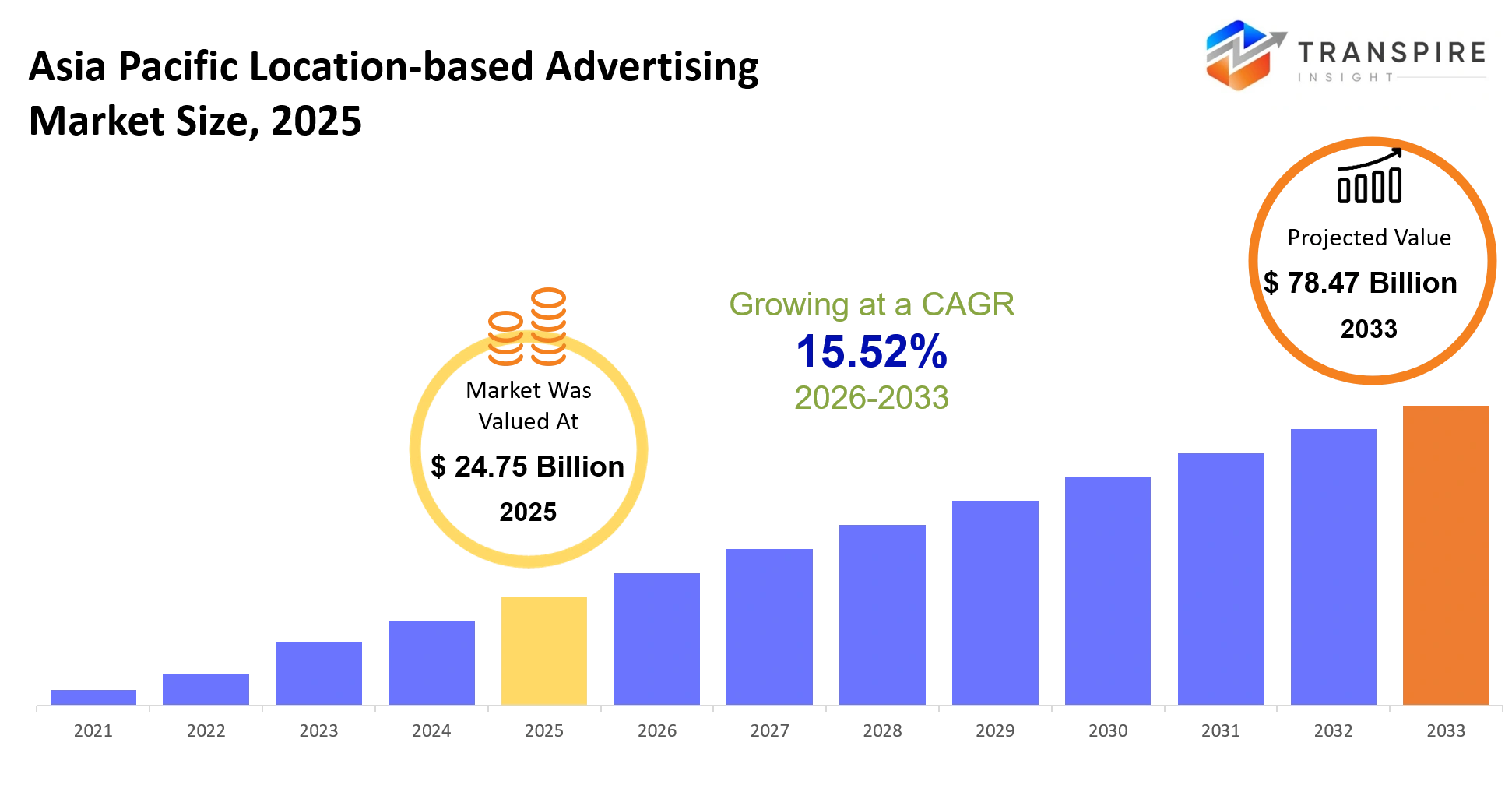
- Asia Pacific Location-based Advertising Market Size 2025: USD 24.75 Billion
- Asia Pacific Location-based Advertising Market Size 2033: USD 78.47 Billion
- Asia Pacific Location-based Advertising Market CAGR:15.52%
- Asia Pacific Location-based Advertising Market Segments: By Technology (Geofencing, Beacon Technology, GPS-based Advertising, Wi‑Fi Marketing, NFC Advertising, Bluetooth Advertising, Proximity Marketing, Others); By Platform (Mobile Applications, Social Media Platforms, Search Engines, Navigation Apps, Connected TV, Digital Billboards, Retail Apps, Others); By Application (Retail Promotions, Event Marketing, Travel & Tourism, Restaurant Advertising, Real Estate Marketing, Automotive Marketing, Entertainment Promotions, Others); By End User (Retail, Hospitality, Travel & Tourism, Automotive, BFSI, Healthcare, Media & Entertainment, Others)
Asia Pacific Location-based Advertising Market Summary
The Asia Pacific Location-based Advertising Market was valued at USD 24.75 billion in 2025. It is forecast to reach USD 78.47 billion by 2033. That is a CAGR of 15.52% over the period.
Location-based advertising is a way for businesses to figure out what people do on the internet and what they do every day. For example retailers and restaurants and shopping centers use location information to show people ads when they're near their stores. They also use it to show ads when people are in areas where they like to shop. This makes the ads more interesting to people. Get them to go to the stores. Location-based advertising also gives businesses a way to see how well their ads are working and how people are moving around in the city. It helps businesses understand what people like to do and where they like to go so they can make ads and get more people to visit their stores. Location-based advertising is a help to businesses because it gives them a way to make ads that are just right, for the people who see them.
Over the few years things have changed a lot in the marketing world. Businesses used to target people based on demographics but now they are being more careful with peoples privacy and using data that they get directly from their customers like the location-based advertising data. There are also rules about how businesses can collect and use location information so they have had to get more creative, with their marketing strategies. At the time more and more people are shopping on their phones and using digital payments so businesses are looking for ways to measure how well their location-based advertising ads are working in the real world.
The reason location-based advertising is growing much is that it helps businesses see exactly how their ads are affecting what people do. They can see how many people are visiting their stores, how engaged they are, or whether they are actually buying things. As technology gets better at understanding who people are where they are, location-based advertising is becoming a more powerful tool for businesses to find new customers and measure how well their ads are working. This is creating opportunities for businesses to make money in the digital marketing world.
Key Market Insights
- The Asia Pacific Location-based Advertising Market is more and more controlled by East Asia. In 2025 East Asia made up over 45% of the market.
- Southeast Asia grew fast between 2022 and now. More people are using commerce and spending more on digital ads.
- Ads on apps took over 40% of the market in 2025. This is because people keep using the apps and the ads can use real-time location info.
- Geofencing got stronger between 2021 and 2025. Retailers can now see how many people visit their stores after seeing an ad and they can make their ads work better.
- Retail ads are still the part of the market making up around 35%. This is because retailers want to know how many people come to their stores after seeing an ad.
- Ads that target people in a specific area using artificial intelligence are going to grow really fast until 2033. This is because they can reach the people and make them more engaged.
- medium-sized businesses started using location-based ads more, over 20% since 2022. This is because it's now easier for them to run their ad campaigns.
- Big companies like Google, Meta, Tencent, Alibaba and InMobi are investing more in using AI to understand their audiences. This helps them stay competitive in the Asia Pacific Location-based Advertising Market.
- Since 2023 advertisers have been using their data more and more. This is because of privacy rules and because they can't rely on outside tracking tech as much.
- Companies that provide location intelligence and media networks are working together more. This creates opportunities for growth and makes more money for the market.
What are the Key Drivers, Restraints, and Opportunities in the Asia Pacific Location-based Advertising Market?
Drivers
The main thing that is changing the Asia Pacific Location-based Advertising Market is that people are using their phones to shop and companies are using data to get customers. A lot of people have smartphones. They use them all the time. They pay for things with their phones. Buy stuff from apps on their phones. This gives companies a lot of information about the Asia Pacific Location-based Advertising Market and where people are doing.The Asia Pacific Location-based Advertising Market is using technology like geofencing and special sensors to figure out when someone is near a store. The Asia Pacific Location-based Advertising Market is also using computer programs that can look at a lot of data to find out who people are and what they like. This means companies in the Asia Pacific Location-based Advertising Market can show ads to people based on where they go, not who they are.This is helping companies in the Asia Pacific Location-based Advertising Market get more people to buy things and it makes their ads work better. The Asia Pacific Location-based Advertising Market is getting popular. Stores and restaurants want to spend money on these kinds of ads because they are working well for the Asia Pacific Location-based Advertising Market.
Restraints
The biggest problem is that the government is making rules to protect people's information on the internet. This means companies have to get permission from people before they can use their information and phone companies are not letting companies see where people are as much. This is a problem because companies have to spend a lot of money and time to follow these rules and make sure they are doing things right. This hurts companies because they do not have as much money so they cannot show ads that are as good and this can slow down their business and mean they do not make as much money.
Opportunities
There is a chance for companies to make more money by combining information about what people buy in stores with special maps that can show where people are. Stores are using information they get from their websites and from people shopping in their stores to make ads that are just right for each person. Computer programs that can understand where people are and what they like can help companies figure out if their ads are working, make their ads better and show people ads that're just right for them on their phones, computers and in stores. As companies get better at doing this, Asia Pacific Location-based Advertising will become a way for companies to understand their business and make more money and this will help them compete with other companies.
What Has the Impact of Artificial Intelligence Been on the Asia Pacific Location-based Advertising Market?
Artificial intelligence and advanced digital technologies are changing the Location-based Advertising Market in Asia Pacific. They help advertisers find, target and engage with consumers in time. AI platforms automate tasks like audience segmentation, campaign bidding and ad delivery. They use location signals from mobile devices and apps to do this.These systems analyze how consumers move, visit stores and engage with ads. This reduces work and improves targeting accuracy.
Big advertising platforms use automated engines to allocate budgets to locations and audiences that're more likely to convert.Machine learning models make predictions about foot traffic, purchase intent and campaign response rates. Retailers and brands use these models to estimate periods, optimize promotions and improve customer acquisition. Predictive analytics can identify consumer groups. This helps advertisers reduce wasted impressions and improve return on ad spend.AI-supported location campaigns often deliver engagement rates and lower customer acquisition costs. This is compared to demographic targeting methods.
However there are limitations. Data availability and privacy compliance are concerns. Stricter consent rules, limited tracking access and fragmented data ecosystems can limit model accuracy. Advanced geospatial analytics platforms can be costly to integrate. This creates barriers for advertisers and slows adoption. Despite this the benefits are clear.
Key Market Trends
- Since 2022 advertisers have started to use information from their websites and apps. They are not using data from companies like they used to.
- Google and Meta are getting better at using information to help advertisers. They want to target the people. This is happening between 2023 and 2025. Even though there are now ways to track what Google and Meta users do online advertisers are still finding ways to reach people. Google and Meta are helping them do that.
- Retail media networks became a thing in advertising. They help connect what people buy in stores with what they do making it easier to see how well ads are working.
- More and more retailers started using geofencing after 2021. This helps them see how many people visit their stores after seeing an ad, which's more helpful than just counting how many people see the ad.
- With more people using wallets and digital payments advertisers can now see how well their ads work by linking where people see ads with what they buy.
- Advertisers started using information to predict what people will do rather than just grouping people into categories. This helps them make their ads better over time.
- Since 2023 businesses like restaurants and shopping centers have spent money on ads that target people who're nearby.
- Companies like InMobi, Near, Foursquare and GroundTruth are working closely with retailers. This helps them use location data and see how well their ads are working.
- Advertisers are now using channels, like mobile social media and TV to reach people. This helps them see the picture of how people interact with their ads.
- There is a demand for platforms that help advertisers use location data in a way that protects people's privacy. Companies that offer this are doing well.
Asia Pacific Location-based Advertising Market Segmentation
By Technology:
Geofencing is really popular with advertisers. They want to send messages to customers when they're near certain places. Retail centers, shopping districts and entertainment venues use boundaries to send notifications and offers. GPS-based advertising is also growing because more people have smartphones and location accuracy is better. Businesses want to target audiences in time so they invest in technologies that help them do that.Beacon technology is great for places. It helps track customers' locations. Makes interactions more personal. Wi-Fi marketing is used in spaces to gather data on customer behavior and offer localized deals. NFC advertising lets customers engage quickly with a tap. Bluetooth advertising and proximity marketing help businesses reach customers with content when they are nearby.Companies are investing more in data-driven advertising. This means they are combining location technologies to make campaigns more accurate and effective. The Others segment includes solutions that support special use cases and drive innovation. Advances in connectivity and analytics will keep improving technology categories.
By Platform:
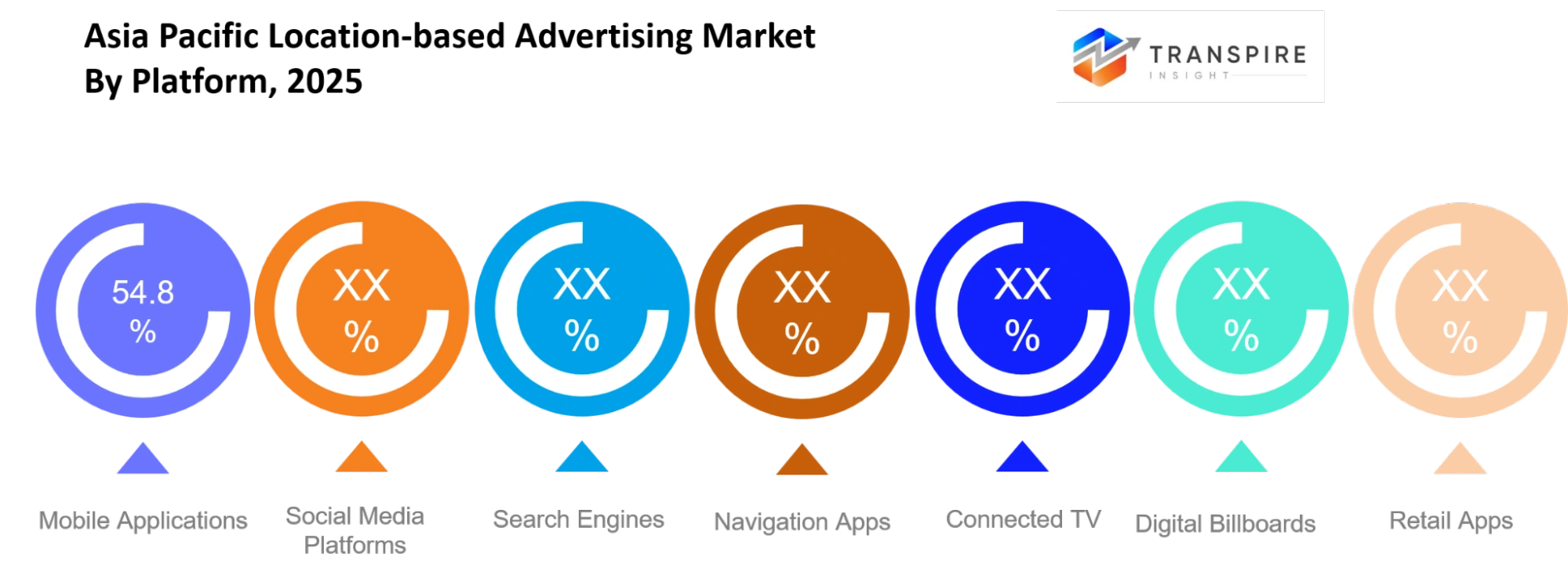
Mobile applications are really important. A lot of people use their smartphones to look at things that're near them. Businesses make apps to give people deals and rewards when they are in a certain area. Social media platforms are also very useful. They look at where people're what they like and show them things that might interest them. Search engines help businesses advertise. They show people things that they might be looking for. Navigation apps are great for advertising. People use them when they are traveling or going to work. Connected TV is getting more popular. Advertisers like it because they can show people videos and target them at the time. Digital billboards are getting better. They can show people things that're relevant to what is happening around them. Retail apps are growing in popularity. Businesses want to have a relationship with their customers and give them a shopping experience. When businesses combine loyalty programs with location-based messaging they can keep their customers coming. There are platforms that help with advertising in special ways. As technology keeps changing the way we use these platforms will change too.
By Application:
Businesses use location-based advertising for promotions. They want people to come into their stores and buy things from their stores. This helps businesses get customers into their stores.Location-aware campaigns are a help to retailers because they can talk to their customers who are near their stores. Event marketing is getting really big now. People who put on events use targeting to get the audience for their events.Travel and tourism businesses are using location-based advertising a lot now. They tell people about places to visit and hotels and other things that travelers might want to see. Restaurants also benefit from location intelligence. They can advertise to people who're near their restaurant.Real estate businesses use location-based advertising to show people houses and apartments that might be a fit for them. Car companies use location data to promote their cars and dealerships. Entertainment businesses use location-based strategies to get people to come to their events.As people want to have experiences businesses have to get better at advertising their businesses. There are uses for location-based advertising that are just starting to happen now. As more people use technology there will be opportunities for location-based advertising to help businesses, like these businesses.
By End User:
Retail businesses are some of the users of location-based advertising. They want to get customers, get people to come into their stores and make more sales. They use location intelligence to make shopping fun and personal. Hotels and other hospitality businesses promote their hotels and local experiences to customers. Travel and tourism businesses use location-based campaigns to get people to visit their destinations. Car companies use location data to promote their cars in areas. Banks and other financial businesses use location-driven strategies to promote their services. Healthcare businesses use advertising to get people to know about their services. Media and entertainment companies benefit from targeting. They promote their events and experiences to the people. As people want personalized communication businesses will invest more in advertising. There are industries that are just starting to use location-based advertising to talk to their customers. As technology gets better more businesses will start to use location-based advertising.
What are the Key Use Cases Driving the Asia Pacific Location-based Advertising Market?
The Asia Pacific Location-based Advertising Market is really about getting new customers for retail businesses. Companies use something called location intelligence to get people who're nearby to come into their stores and to get them to buy things. This works by sending them promotions at the right time. There is a lot of competition between retailers and people want to have a shopping experience that's just for them so businesses are spending more money on location-based advertising.The travel and tourism industry, as well as hotels and restaurants are using location-based advertising to get people to visit specific places. Car companies are also using it to advertise their cars and get people to visit dealerships. This helps businesses talk to people who're in certain places and get them to buy things.
Some new ways of using location-based advertising are being developed in the healthcare and banking industries. For example hospitals and banks can use location-based advertising to tell people about their services and where they are located. Movie and music companies are also using it to advertise their events and get people to watch their content. As companies get better at using data and artificial intelligence location-based advertising will become more effective, over time.
|
Report Metrics |
Details |
|
Market size value in 2025 |
USD 24.75 Billion |
|
Market size value in 2026 |
USD 28.59 Billion |
|
Revenue forecast in 2033 |
USD 78.47 Billion |
|
Growth rate |
CAGR of 15.52% from 2026 to 2033 |
|
Base year |
2025 |
|
Historical data |
2021 - 2024 |
|
Forecast period |
2026 - 2033 |
|
Report coverage |
Revenue forecast, competitive landscape, growth factors, and trends |
|
Regional scope |
Asia Pacific |
|
Key company profiled |
Google, Meta, Apple, Baidu, Tencent, Alibaba, InMobi, Near, Foursquare, Blis, Radar, GroundTruth, Huawei Ads, Samsung Ads, X Corp |
|
Customization scope |
Free report customization (country, regional & segment scope). Avail customized purchase options to meet your exact research needs. |
|
Report Segmentation |
By Technology (Geofencing, Beacon Technology, GPS-based Advertising, Wi‑Fi Marketing, NFC Advertising, Bluetooth Advertising, Proximity Marketing, Others); By Platform (Mobile Applications, Social Media Platforms, Search Engines, Navigation Apps, Connected TV, Digital Billboards, Retail Apps, Others); By Application (Retail Promotions, Event Marketing, Travel & Tourism, Restaurant Advertising, Real Estate Marketing, Automotive Marketing, Entertainment Promotions, Others); By End User (Retail, Hospitality, Travel & Tourism, Automotive, BFSI, Healthcare, Media & Entertainment, Others) |
Which Regions are Driving the Asia Pacific Location-based Advertising Market Growth?
East Asia leads the market due to strong digital infrastructure, high smartphone penetration, and supportive data-driven advertising ecosystems. Large urban populations create dense consumer clusters that improve the effectiveness of location-targeted campaigns. Major technology platforms, advanced mobile payment networks, and widespread adoption of retail applications strengthen advertising performance across the region. Continuous investment in artificial intelligence, analytics, and connected consumer services sustains regional leadership.
Oceania contributes a reliable share of market revenue through stable economic conditions and consistent adoption of digital marketing technologies. Compared with East Asia, growth relies less on scale and more on mature advertising practices and predictable spending patterns. Businesses across retail, hospitality, and media sectors continue to invest in targeted customer engagement strategies. Clear regulatory frameworks and steady digital transformation support long-term market stability.
South Asia represents the fastest-growing region as expanding internet access and rapid smartphone adoption bring millions of new users into digital ecosystems. Growing investments in mobile commerce, navigation applications, and location-enabled services have significantly increased advertiser interest. Businesses are shifting marketing budgets toward personalized campaigns that can reach consumers in real time and at specific locations. This momentum creates attractive opportunities for technology providers, advertising platforms, and investors throughout the 2026–2033 period.
Who are the Key Players in the Asia Pacific Location-based Advertising Market and How Do They Compete?
The competitive landscape remains moderately consolidated, with major digital advertising platforms competing alongside specialized location intelligence providers. Competition centers primarily on technology capabilities, data accuracy, audience segmentation, and the ability to deliver measurable campaign outcomes. Large platform operators continue to defend market share through integrated advertising ecosystems, while newer firms focus on advanced analytics, privacy-focused solutions, and industry-specific targeting services. Growing demand for personalized consumer engagement has increased pressure on companies to improve real-time location insights and cross-channel campaign performance.
Google differentiates itself through deep integration of search, maps, mobile operating systems, and advertising services that create highly detailed location-based audience insights. Expansion continues through artificial intelligence enhancements and broader integration of location signals across advertising products. Meta Platforms focuses on combining geographic data with behavioral and social engagement information, enabling advertisers to build highly targeted campaigns across multiple digital touchpoints. Continuous investment in machine learning tools strengthens campaign optimization and audience reach capabilities.
Foursquare specializes in location intelligence and attribution solutions that help brands measure real-world consumer visits resulting from advertising campaigns. Strong expertise in location data analytics provides differentiation from broader advertising platforms. Near concentrates on audience intelligence and omnichannel targeting, using large-scale location datasets to improve campaign precision for enterprise clients. InMarket emphasizes proximity-based marketing and consumer intent signals, expanding through partnerships with retailers and brands seeking stronger connections between digital advertising exposure and in-store purchasing behavior.
Company List
- Meta
- Apple
- Baidu
- Tencent
- Alibaba
- InMobi
- Near
- Foursquare
- Blis
- Radar
- GroundTruth
- Huawei Ads
- Samsung Ads
- X Corp
Recent Development News
In April 2026, InMobi launched InMobi Ad Experiences. The new omnichannel advertising solution combines first-party data from the Glance platform with programmatic advertising capabilities, helping brands improve audience engagement and campaign performance across multiple screens. https://finance.yahoo.com
In April 2026, PadSquad entered a partnership with Cuebiq. The collaboration integrates Cuebiq’s privacy-safe foot traffic measurement technology into PadSquad’s advertising platform, allowing marketers to connect digital campaign exposure with real-world store visitation and improve advertising attribution. https://www.globenewswire.com
In January 2026, digitalAudience entered a partnership with Spotzi. The agreement combines privacy-safe audience activation with AI-driven location intelligence, enabling advertisers to run cross-border out-of-home to digital retargeting campaigns and strengthen location-based advertising effectiveness across international markets.https://digitalaudience.io
What Strategic Insights Define the Future of the Asia Pacific Location-based Advertising Market?
The Asia Pacific Location-based Advertising Market is moving toward highly automated, context-aware advertising ecosystems where artificial intelligence, real-time location intelligence, and first-party data integration will shape campaign execution. Future growth will depend less on simple geographic targeting and more on predictive audience engagement that connects consumer intent, movement patterns, and purchasing behavior across multiple digital channels. This shift will create stronger demand for platforms capable of delivering measurable business outcomes rather than basic advertising reach.
A less visible risk comes from increasing dependence on a limited number of mobile operating systems, digital platforms, and location data providers. Changes in privacy standards, data-sharing policies, or platform access rules could reduce targeting precision and increase customer acquisition costs. At the same time, an emerging opportunity is developing around privacy-preserving location intelligence solutions that use anonymized data and advanced analytics to meet regulatory expectations while maintaining campaign effectiveness.
Market participants should prioritize investment in first-party data capabilities and strategic partnerships with analytics providers. This approach will improve resilience against regulatory changes while creating stronger long-term competitive differentiation.
Asia Pacific Location-based Advertising Market Report Segmentation
By Technology
- Geofencing
- Beacon Technology
- GPS-based Advertising
- Wi-Fi Marketing
- NFC Advertising
- Bluetooth Advertising
- Proximity Marketing
- Others
By Platform
- Mobile Applications
- Social Media Platforms
- Search Engines
- Navigation Apps
- Connected TV
- Digital Billboards
- Retail Apps
- Others
By Application
- Retail Promotions
- Event Marketing
- Travel & Tourism
- Restaurant Advertising
- Real Estate Marketing
- Automotive Marketing
- Entertainment Promotions
- Others
By End User
- Retail
- Hospitality
- Travel & Tourism
- Automotive
- BFSI
- Healthcare
- Media & Entertainment
- Others
Frequently Asked Questions
Find quick answers to common questions.
The expected Asia Pacific Location-based Advertising Market size for the market will be USD 78.47 Billion in 2033.
Key segments for the Asia Pacific Location-based Advertising Market are Type By Technology (Geofencing, Beacon Technology, GPS-based Advertising, Wi‑Fi Marketing, NFC Advertising, Bluetooth Advertising, Proximity Marketing, Others); By Platform (Mobile Applications, Social Media Platforms, Search Engines, Navigation Apps, Connected TV, Digital Billboards, Retail Apps, Others); By Application (Retail Promotions, Event Marketing, Travel & Tourism, Restaurant Advertising, Real Estate Marketing, Automotive Marketing, Entertainment Promotions, Others); By End User (Retail, Hospitality, Travel & Tourism, Automotive, BFSI, Healthcare, Media & Entertainment, Others).
Major Asia Pacific Location-based Advertising Market players are Google, Meta, Apple, Baidu, Tencent, Alibaba, InMobi, Near, Foursquare, Blis, Radar, GroundTruth, Huawei Ads, Samsung Ads, X Corp.
The Asia Pacific Location-based Advertising Market size is USD 24.75 Billion in 2025.
The Asia Pacific Location-based Advertising Market CAGR is 15.52% from 2026 to 2033.
- Meta
- Apple
- Baidu
- Tencent
- Alibaba
- InMobi
- Near
- Foursquare
- Blis
- Radar
- GroundTruth
- Huawei Ads
- Samsung Ads
- X Corp
About the Authors

Mayur Shinde
I am Mayur Shinde, a Senior Research Analyst at Transpire Insight, specializing in the Automotive & Transportation and Information & Communication Technology (ICT) Industry. My work focuses on analyzing emerging market trends, technological advancements, competitive landscapes, and industry developments to deliver accurate, data-driven insights. I am passionate about transforming complex market information into clear, actionable content that helps businesses, professionals, and decision-makers stay informed and make confident strategic decisions.

Chakradhar Khansole
Chakradhar serves as the Research Director at Transpire Insight, bringing over 8 years of experience in technology, innovation, and strategic market intelligence. He specializes in transforming complex market data into actionable business insights that enable organizations to make informed, growth-oriented decisions. Recognized for his strategic vision and analytical expertise, Chakradhar leads high-impact research initiatives, delivering comprehensive market assessments, competitive intelligence, and forward-looking industry analysis.
Recently Published Reports
-
Apr 2026
3D Optical Profiler Market
3D Optical Profiler Market Size, Share & Analysis Report By Type (Desktop 3D Optical Profiler, and Portable 3D Optical Profiler), By Technology (Confocal Technology, and White Light Interference), By End-Use Industry (Manufacturing, Research Institutions, Automotive, Aerospace and Defense, Medical Devices, and Other), and Geography (North America, Europe, Asia-Pacific, Middle East and Africa, South and Central America), 2021 - 2031
-
Apr 2026
Depth Sensor Market
Depth Sensor Market Size, Share & Analysis Report By Type (Infrared Depth Sensors, Time-of-Flight (ToF) Sensors, Stereo Vision Sensors, Structured Light Sensors, Ultrasonic Depth Sensors), By Application (Automotive, Robotics, Gaming, Consumer Electronics, Industrial Automation, Healthcare, Security & Surveillance, Others), By End Users (Automotive Manufacturers, Consumer Electronics Companies, Healthcare Providers, Industrial Companies, Security Agencies, Gaming Companies, Robotics Companies, Others), and Geography (North America, Europe, Asia-Pacific, Middle East and Africa, South and Central America), 2021 – 2031
-
Apr 2026
Digital Manufacturing Market
Digital Manufacturing Market Size, Share & Analysis Report By Component (Hardware, Software, and Services), By Technology (Robotics, 3D Printing, Internet of Things (IoT), and Others), By Application (Automotive and Transportation, Aerospace and Defense, Consumer Electronics, Industrial Machinery, and Others), By Process Type (Computer-Based Designing, Computer-Based Simulation, Computer 3D Visualization, Analytics, and Others), and Geography (North America, Europe, Asia-Pacific, Middle East and Africa, South and Central America), 2021 – 2031
-
Apr 2026
Digital Visa Services Market
Digital Visa Services Market Size, Share & Analysis Report By Type (Individual Travelers, Group Travelers), By Application (Tourism, Business Travel, Others), and Geography (North America, Europe, Asia-Pacific, Middle East and Africa, South and Central America), 2021 – 2031