

Global Business Email Market Summary
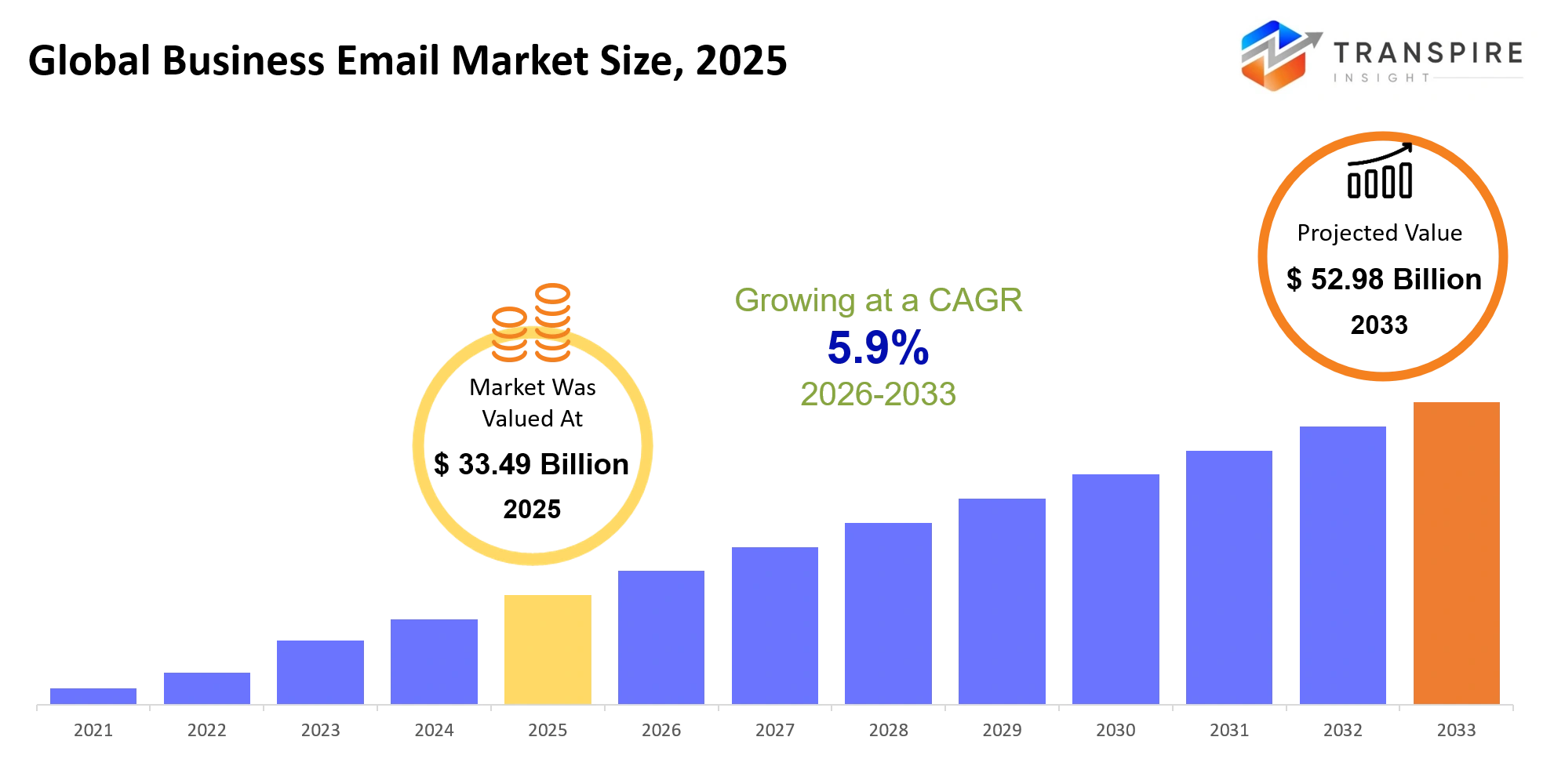
As per Transpire Insight Analysis, The Global Business Email Market size is estimated at USD 33.49 Billion in 2025 and is anticipated to reach USD 52.98 Billion by 2033, growing at a CAGR of 5.9% from 2026 to 2033.
The global business email market provides secure, enterprise-grade electronic communication networks that serve as the primary operational identity and compliance ledger for corporate workflows. Over the past three to five years, widespread remote work mandates and escalating corporate cyber-attacks have forced the market away from legacy, static on-premise mail servers toward dynamic, cloud-native communication hubs. A major structural shift has been the rapid integration of automated zero-trust authentication protocols directly into active mail routing pipelines. Fueled by the real-world trigger of highly sophisticated, AI-generated business email compromise (BEC) and phishing campaigns, enterprise networks are aggressively investing in smart mail architectures. As corporations replace legacy security gateways with continuous, machine-learning-driven threat detection layers, this defensive modernization acts as the primary catalyst driving long-term platform subscription revenues.
Global Business Email Market Size & Forecast
- Global Market Size 2025: USD 33.49 Billion
- Expected Market Value (2033): USD 52.98 Billion
- Forecast CAGR (2026–2033): 5.9%
- Leading Region in 2025: North America
- Fastest Growing Region: Asia Pacific
- Key Company Profiles: Microsoft, Google Workspace, Zoho Mail, Proton Mail, IceWarp, OpenText, Zimbra, Amazon WorkMail, Rackspace Technology, Proofpoint, Mimecast, Cisco, Barracuda Networks, IBM, VMware.
Key Global Business Email Market Insights
The business email market is changing from standalone messaging inboxes to intelligent, unified productivity ecosystems backed by automated zero-trust protocols and edge cloud structures. Advanced security, native workplace collaboration integrations, and adaptive AI defense layers across centralized communications channels are the key to competitive advantage.
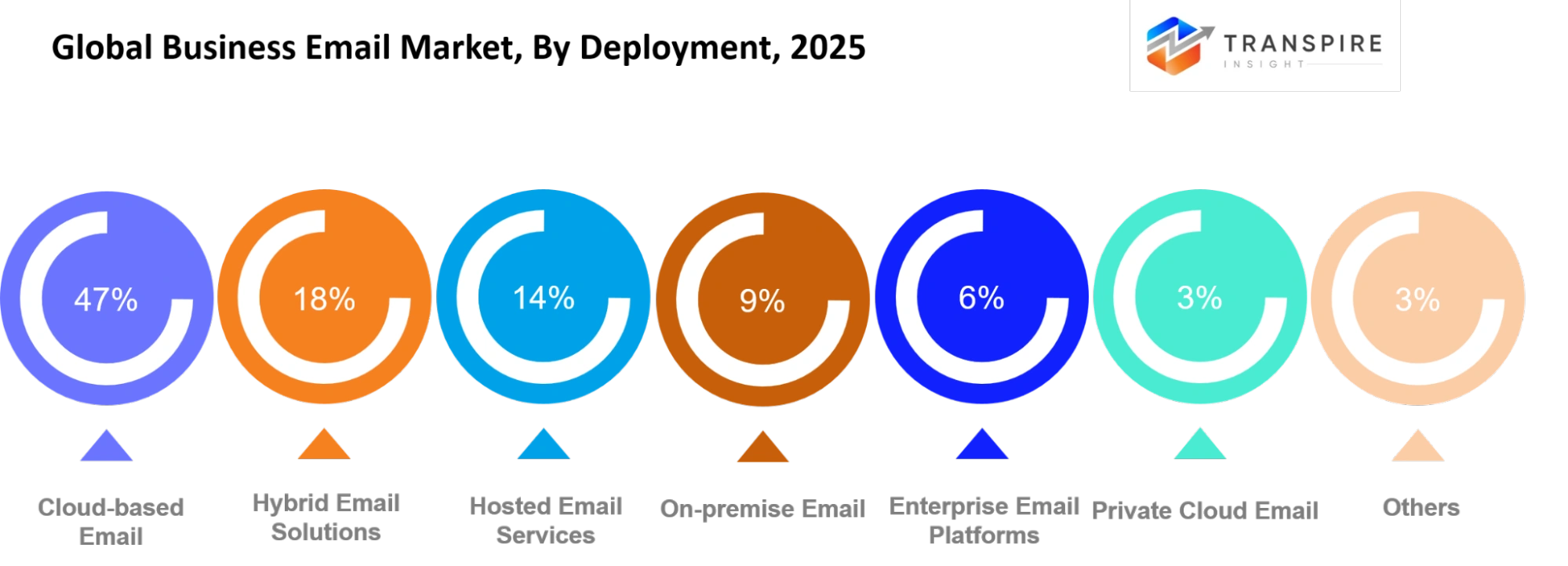
- Microsoft and Google Workspace are driving intelligent enterprise productivity suites, with Cloud-based Email capturing a dominant 47% market share.
- North America accounts for 43% of global demand, bolstered by Proofpoint and Mimecast deploying automated cloud defenses to mitigate targeted business email compromise attacks.
- Europe accounts for 26% of the market, where Proton Mail and IceWarp are accelerating client migrations toward sovereign, end-to-end encrypted hybrid configurations to comply with strict regional data mandates.
- Asia Pacific represents 23% of total volume, with Zoho Mail expanding local data localization infrastructures to lead the region's rapid expansion at a market-leading 20.1% CAGR.
- Cisco and Barracuda Networks are accelerating automated zero-trust authentication, driving the AI-powered Email Security segment at an explosive 18.7% CAGR.
- Hybrid Email Solutions capture an 18% market share as IBM and VMware deliver seamless active-directory synchronization tools for complex, multi-tenant corporate deployments.
- Hosted Email Services account for 14% of the industry footprint, as Rackspace Technology and OpenText refine managed mail migration pathways for mid-market commercial operations.
- On-premise Email holds a 9% market share, with Zimbra and Amazon WorkMail supporting legacy financial structures that require fully isolated physical hardware arrays to safeguard proprietary records.
- Enterprise Email Platforms hold 6% of global volume, as technology vendors implement advanced multi-cloud configurations to prevent massive single-point-of-failure communication blackouts.
What Are the Key Drivers, Restraints, and Opportunities in the Global Business Email Market?
Driver
The business email market expansion is heavily propelled by the severe escalation of automated, multi-vector phishing and business email compromise (BEC) campaigns—forcing organizations to modernize traditional static communication infrastructure. Relying on legacy email filters that depend on basic keyword blocks or static signatures has left enterprises highly vulnerable to AI-generated deceptive lures, triggering massive financial leakages and corporate data breaches. This commercial challenge has triggered a wholesale transition toward intelligent, cloud-based communication environments that natively integrate automated zero-trust protocols and real-time behavioral analysis. This industry-wide strategic redirection drives massive subscription tier upgrades and platform license expansion revenues, as global corporate operators migrate entire user bases to unified suites with integrated, continuous threat detection layers.
In June 2026, technology and productivity multinational Microsoft officially rolled out a global packaging and commercial suite update that systematically bundles advanced email and link security defenses directly into its core Microsoft 365 plans. This operational shift embeds Microsoft Defender for Office 365 Plan 1—incorporating features like Safe Links, Safe Attachments, and anti-phishing capabilities—straight into standard enterprise plans like E3, while expanding URL time-of-click protection across lower-tier business subscriptions. By utilizing these native, built-in cloud security grids to neutralize malicious links at the exact moment of consumer interaction, the architecture allows corporate IT departments to significantly improve threat isolation while simplifying their security tool sprawl. [https://www.microsoft.com/en-us/licensing/news/2026-m365-packaging-pricing-updates]
Restraint
Severe tool sprawl complexity and fragmented cross-channel data visibility gaps act as a major structural barrier holding back frictionless platform management. As enterprise security administrators purchase dozens of distinct security layers to patch emerging digital communication channels, they create highly complex environments that hinder real-time threat correlation and exhaust IT analysts via alert fatigue. This operational friction persists because email security platforms often operate in silos from endpoint detection or human resource directories, allowing malicious insiders and external attackers to exploit delayed coordination seams during employee offboarding or network changes.
Opportunity
The most lucrative growth window lies in the deep deployment of API-first, context-aware artificial intelligence security modules integrated directly into unified collaboration and cloud-based email frameworks. Shifting away from rigid, mail-flow-altering secure email gateways (SEGs) allows next-generation software architectures to analyze internal communication habits and sequence patterns seamlessly. This structural transition unlocks highly profitable, high-margin recurring software revenues, enabling enterprise vendors to deliver automated containment actions, link isolation, and instant data loss prevention (DLP) policy propagation that natively adapts to complex global regulatory frameworks.
What Has the Impact of Artificial Intelligence Been on the Global Business Email Market?
Artificial intelligence is completely reinventing the business email market, shifting standard messaging workflows away from static, boundary-based gateway filters toward autonomous, identity-aware communication fabrics. Instead of requiring IT administrators to manually configure rigid blocklists based on known malicious domains, email providers deploy deep transformer-based machine learning networks to instantly analyze natural language sentiment and dynamically intercept anomalous communication behaviors.
Inside high-velocity corporate environments, built-in AI architectures drive major operational improvements through predictive threat modeling and automated administrative triage. These algorithms continuously evaluate localized writing baselines, historical employee communication patterns, and sign-in metadata, predicting exactly which inbound messages contain zero-day social engineering vectors or hidden credential harvesting links. By executing real-time content analysis directly inside active mailboxes, the system automatically quarantines compromised threads and neutralizes malicious data payloads before an employee can interact with the message.
However, a serious operational limitation persists around localized context validation and the rise of indirect prompt injection attacks against email-integrated productivity agents. Automated language processing engines operate on semantic parsing models, creating a major integration hurdle where sophisticated text arrays hidden within an email body can manipulate an active AI assistant into executing unauthorized data exfiltration or misrouting sensitive internal documentation.
In May 2026, enterprise cybersecurity leader Proofpoint demonstrated this operational pivot by launching its updated Active Exploits Protection framework and introducing the Proofpoint 365 Total Protection platform across North American commercial networks. This architecture embeds deep predictive models directly into active cloud messaging layers, executing automated threat prioritization based on hundreds of millions of daily email interactions. By pairing real-world exploit intelligence with automated mailbox containment loops, the deployment enables managed service providers and enterprise clients to stop machine-speed phishing surges before public tracking frameworks can log the vulnerability. [https://www.proofpoint.com/us/newsroom/press-releases/proofpoint-introduces-active-exploits-protection-help-organizations]
Key Market Insights
The business email market is changing from standalone messaging inboxes to intelligent, unified productivity ecosystems backed by automated zero-trust protocols and edge cloud structures. Advanced security, native workplace collaboration integrations, and adaptive AI defense layers across centralized communications channels are the key to competitive advantage.
- Locking down a dominant 47% market share, Cloud-based Email leads the deployment matrix, with Microsoft and Google Workspace expanding their intelligent, high-velocity enterprise productivity suites to bundle native workplace collaboration tools.
- Expanding at a market-accelerating standalone CAGR of 18.7%, AI-powered Email Security dominates security-type growth as major corporations transition from static secure email gateways to dynamic machine learning layers that intercept look-alike impersonation attempts.
- Capturing a dominant 43% of total global revenue, North America functions as the largest geographic market, backed by massive enterprise operations and the rapid deployment of automated cloud defenses by industry leaders like Proofpoint and Mimecast to mitigate business email compromise.
- Holding a stable 26% market slice, Europe drives high regulatory compliance and data sovereignty optimization, pushing secure messaging brands like Proton Mail and IceWarp to accelerate corporate client migrations toward sovereign, end-to-end encrypted hybrid configurations.
- Pacing market growth with a massive regional CAGR of 20.1%, the Asia Pacific theater acts as the fastest-growing territory, fueled by rapid corporate modernization, soaring mobile-first employee bases, and vendors like Zoho Mail aggressively expanding local data center infrastructures.
- Securing an 18% share of total industry volume, Hybrid Email Solutions remain an essential bridge for highly regulated sectors, prompting innovators like IBM and VMware to deliver seamless, multi-tenant active-directory synchronization tools that cross-connect legacy infrastructure.
- Representing 14% of the deployment footprint, Hosted Email Services face steady adoption across mid-market commercial operations as managed services specialists like Rackspace Technology and OpenText refine turnkey email migration pathways.
- Accounting for a targeted 9% slice of the market footprint, On-premise Email supports mission-critical defense and financial segments, where software providers like Zimbra and Amazon WorkMail maintain fully isolated physical hardware arrays to safeguard proprietary records.
- Claiming an integrated 6% market presence, Enterprise Email Platforms represent a core configuration layer for multi-brand conglomerates, where infrastructure vendors implement advanced multi-cloud synchronization nodes to eliminate single-point-of-failure communication blackouts.
Global Business Email Market Segmentation
By Deployment
Cloud-based Email anchors this segment, holding a dominant 47% share of total industry revenue, while Hybrid Email Solutions follow as the second-largest pillar at 18%. Hosted Email Services and On-premise Email command 14% and 9% shares respectively, with Enterprise Email Platforms securing 6%, and Private Cloud alongside Multi-cloud Email configurations capturing the remaining 6% of the market. This baseline division persists because global enterprise networks fundamentally require flexible, low-overhead communication infrastructure to support distributed workforces without incurring the massive capital expense of physical hardware. Cloud-based variants retain their peak market position because large corporate ecosystems require instantaneous provisioning, predictable subscription models, and seamless native scaling to support multi-tenant user directories. Meanwhile, Hybrid Email Solutions are expanding rapidly as highly stable sub-segments because highly regulated financial and defense networks require a bridge that combines the agility of cloud workflows with isolated, on-premise hardware arrays to safeguard sensitive records. Moving forward, isolated communication silos will fully dissolve into unified multi-cloud architectures. Leading platform providers will focus heavily on deploying highly secure cloud frameworks that guarantee data sovereignty and zero-downtime availability across distinct regional cloud nodes.
By Organization Size
Large Enterprises serve as the primary financial anchor of the market, capturing the largest portion of global subscription volume, while Small Enterprises and Startups represent the fastest-growing buyer pipelines. This distribution is tied directly to corporate headcount metrics, where large-scale multinational corporations demand thousands of dedicated enterprise seats backed by complex data governance, global compliance policies, and complex active-directory structures. Large Enterprises maintain their high market share because their expansive organizational matrices require comprehensive, centralized administrative consoles to manage deep security auditing, multi-brand routing, and cross-border digital collaboration policies. However, the Small Enterprises and Startups segments are growing at an accelerated clip because the sudden availability of subscription-based, turnkey productivity suites allows small business operators to deploy professional domain identities and enterprise-grade tools with zero upfront IT infrastructure investments. Moving forward, organization-size adaptability will shift past rigid license tiers. Market dominance will belong to software providers who design modular, adaptive administration portals that allow scaling businesses to dynamically add advanced data loss prevention and archiving layers on demand without migrating core message boxes.
By Industry
The BFSI (Banking, Financial Services, and Insurance) vertical leads the market with a commanding share of global industry volume, driven by high-velocity transactional correspondence and stringent financial compliance regulations. Concurrently, IT & Telecom and Healthcare entities are rising as highly active, fast-growing secondary buyer channels. The underlying market logic is dictated by the specific security and operational profiles of these sectors, where financial institutes demand airtight cryptographic validation and healthcare nodes face strict legal mandates regarding patient information handling. BFSI corporations deploy enterprise platforms featuring automated email encryption and advanced data loss prevention to maintain continuous compliance over regulatory audits, whereas IT & Telecom entities leverage multi-cloud setups to maintain 24/7 uptime during global network fluctuations. Looking ahead, competitive advantages among platform vendors will depend heavily on vertical-specific compliance integrations. Long-term profitability will belong to software providers that seamlessly mesh email platforms with localized regulatory frameworks, allowing medical, legal, and financial enterprises to automate real-time message retention and access auditing in lockstep with regional data laws.
By Application
Internal Communication functions as the absolute financial anchor of the industry, capturing the largest slice of the revenue footprint due to its widespread status as the primary operating system for daily corporate task coordination. Meanwhile, Email Security and Workflow Automation represent the fastest-growing operational application segments. The market dynamic relies on workplace digitization; the overwhelming majority of daily corporate tasks, approvals, and scheduling run through email networks, making Internal Communication the baseline infrastructure investment for any modern enterprise. These standard messaging systems maximize employee connectivity without requiring the extensive custom development of third-party internal apps. Conversely, the Email Security segment is expanding at an explosive standalone CAGR of 18.7% because massive corporate ecosystems face an unprecedented volume of sophisticated, AI-driven social engineering campaigns that bypass traditional network perimeters. Looking ahead, the structural dividing line between application models will depend on cross-platform automation. Scalable market success will belong to communications providers who integrate context-aware AI agents that autonomously execute complex business workflows, parse documentation, and trigger enterprise system actions directly inside the inbox interface.
By Security Type
Spam Protection and Email Encryption rule this segment, maintaining a dominant market position, while Threat Protection and Data Loss Prevention follow as critical engineering sub-categories. Simultaneously, AI-powered Security stands out as the fastest-growing technological frontier, expanding at a market-leading CAGR of 18.7%. This structural alignment persists because the primary objective of modern IT infrastructure is the complete mitigation of business email compromise (BEC) and unauthorized credential harvesting attacks. Spam Protection and static Secure Gateways lead by volume because they compress basic volumetric filtering and known-malicious URL blocks into high-velocity routing sequences. Meanwhile, the AI-powered Security category is growing swiftly because modern enterprises require micro-second natural language processing to detect anomalous linguistic patterns and look-alike executive impersonations that lack malicious links or attachments. Moving forward, security boundaries will completely unify under smart zero-trust identity layers. Rather than treating threat detection as a static gateway check, next-generation email security frameworks will continuously analyze continuous behavioral metadata and session token flags to automatically quarantine compromised accounts before data exfiltration occurs.
What Key Use Cases Driving the Global Business Email Market?
The primary use case centers on high-volume cloud email deployment within enterprise and BFSI corridors - where organizations leverage centralized cloud-based email to manage daily workforce communications. This operational model relies on uniform, inline digital identities to synchronize multi-tenant user directories, giving large corporate infrastructures a reliable, compliant communication framework to process millions of critical internal and external transactions daily without experiencing system downtime.
Beyond baseline messaging - expanding applications focus heavily on automated, zero-trust account isolation and AI-powered email security inside heavily regulated sectors like healthcare and finance. Driven by the severe escalation of deceptive phishing and multi-vector business email compromise attacks, IT administrators leverage API-first security layers to instantly evaluate linguistic baselines and flag look-alike impersonation attempts, neutralizing data leaks in real-time.
Emerging use cases are shifting toward generative AI inbox management and automated workflow execution within smart digital workspaces. As modern business networks scale up fully automated, cyber-physical collaboration frameworks, they combine deep natural language processing tools with context-aware productivity sidekicks to summarize multi-message threads and securely trigger backend CRM or billing actions straight from the user interface.
|
Report Metrics |
Details |
|
Market size value in 2025 |
USD 33.49 Bn |
|
Market size value in 2026 |
USD 35.46 Bn |
|
Revenue forecast in 2033 |
USD 52.98 Bn |
|
Growth rate |
CAGR of 5.9% from 2026 to 2033 |
|
Base year |
2025 |
|
Historical data |
2021 - 2024 |
|
Forecast period |
2026 - 2033 |
|
Report coverage |
Revenue forecast, competitive landscape, growth factors, and trends |
|
Regional scope |
United States; Canada; Mexico; United Kingdom; Germany; France; Italy; Spain; Denmark; Sweden; Norway; China; Japan; India; Australia; South Korea; Thailand; Brazil; Argentina; South Africa; Saudi Arabia; United Arab Emirates |
|
Key company profiled |
Microsoft, Google Workspace, Zoho Mail, Proton Mail, IceWarp, OpenText, Zimbra, Amazon WorkMail, Rackspace Technology, Proofpoint, Mimecast, Cisco, Barracuda Networks, IBM, VMware. |
|
Customization scope |
Free report customization (country, regional & segment scope). Avail customized purchase options to meet your exact research needs. |
|
Report Segmentation |
By Deployment (Cloud-based Email, On-premise Email, Hybrid Email Solutions, Hosted Email Services, Private Cloud Email, Multi-cloud Email, Enterprise Email Platforms, Others); By Organization Size (Large Enterprises, Medium Enterprises, Small Enterprises, Startups, Government Organizations, Educational Institutions, Non-profit Organizations, Others); By Industry (BFSI, IT & Telecom, Healthcare, Retail & E-commerce, Manufacturing, Government, Education, Others); By Application (Internal Communication, Customer Communication, Marketing Campaigns, Collaboration, Document Sharing, Email Security, Workflow Automation, Others); By Security Type (Spam Protection, Email Encryption, Threat Protection, Data Loss Prevention, Multi-factor Authentication, Secure Gateways, AI-powered Security, Others). |
Which Regions are Driving the Global Business Email Market Growth?
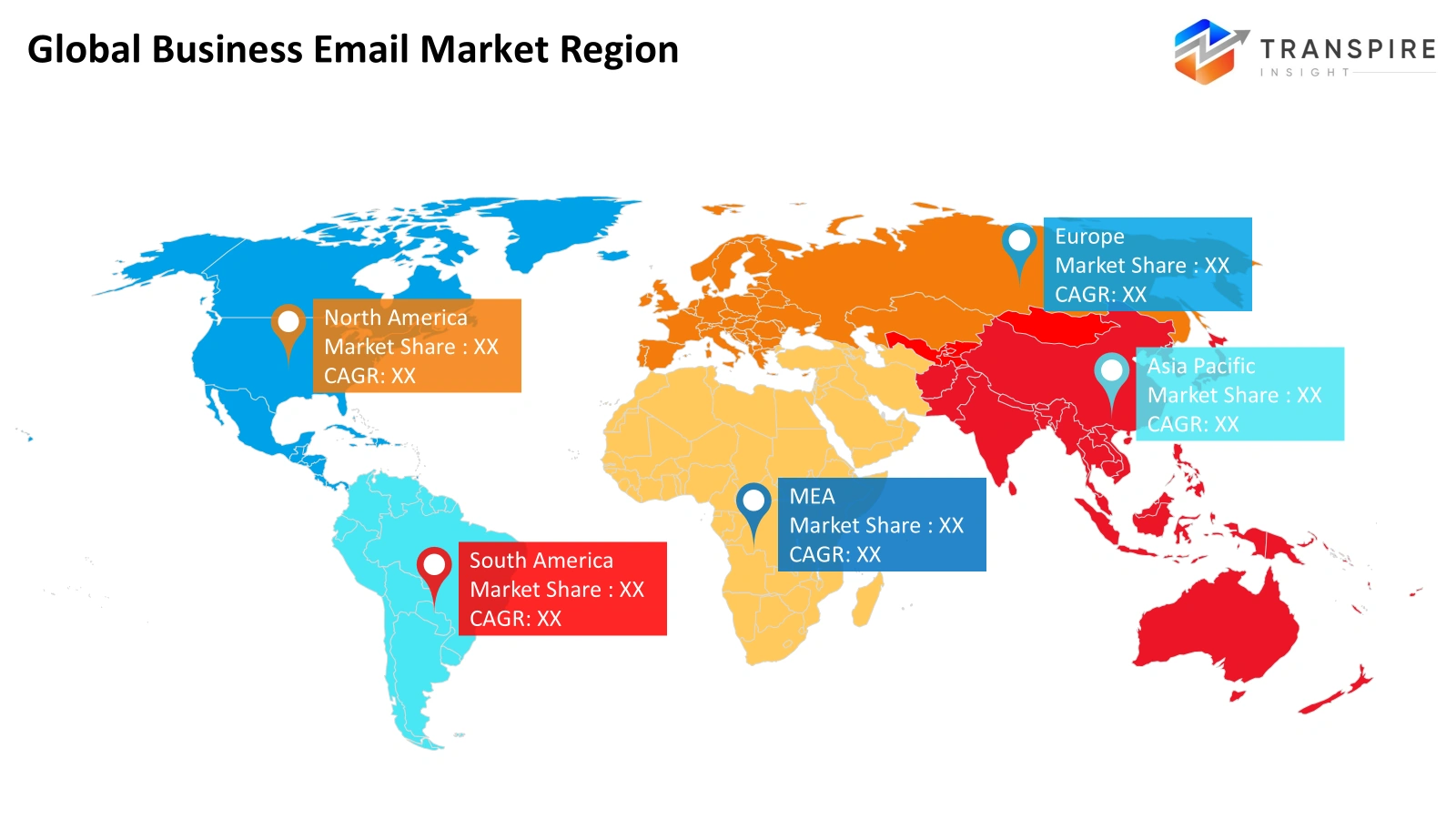
North America dominates the global landscape by securing a commanding 43% revenue share, a position driven by the dense concentration of multinational corporations and early, widespread migration to cloud-native productivity suites. The regional ecosystem is heavily supported by stringent regulatory frameworks such as HIPAA and the CCPA, alongside a high corporate prioritization of defense budgets to counter sophisticated business email compromise. This mature software-as-a-service market continues to grow as large enterprises systematically upgrade their baseline inbox seats to advanced enterprise tiers that feature native identity security.
In June 2026, tech leader Google officially announced the general availability of Device Bound Session Credentials (DBSC) in its Google Workspace admin console for Windows users. This deployment provides advanced token security directly inside core cloud messaging infrastructure, allowing North American enterprises to automatically prevent post-authentication account takeovers and mitigate sessions-hijacking risks across distributed workforce networks. [https://knowledge.workspace.google.com]
Europe maintains a highly stable secondary position with a 26% market share, trailing North America's volume but leading in the architectural shift toward sovereign, privacy-centric infrastructures. The regional stability factors are anchored directly to strict enforcement of GDPR mandates and local digital sovereignty frameworks, which legally penalize standard transnational public cloud routing. This compliance landscape forces local corporate entities and public-sector operations to rely heavily on hybrid architectures and localized private cloud data hubs. Consequently, European enterprises are aggressively investing in messaging providers that can ensure localized data storage and fully auditable data localization.
In June 2026, enterprise risk management provider Mimecast officially expanded its European infrastructure footprint by appointing a new Chief Executive Officer to accelerate the deployment of its unified human, data, and AI risk platform. This system integrates advanced data compliance and localized communication governance across regional cloud networks to assist multinational clients in maintaining strict compliance over complex communications data. [https://emailexpert.com]
Asia Pacific operates as the fastest-growing territory in the global market, expanding at a rapid regional CAGR of 20.1% as its massive small-to-medium enterprise ecosystem transitions from legacy, consumer-grade mail handles to formal, custom-domain corporate accounts. What changed recently is the widespread enforcement of national data protection laws, such as India's DPDPA, combined with a dramatic surge in mobile-first digital workspace deployments across burgeoning commercial hubs. Future commercial opportunities in this region center on the adoption of budget-conscious, ad-free SaaS productivity environments that offer localized language interfaces and native support for localized transactional message formats.
In April 2026, technology consultancy Searce was officially named the 2026 Google Cloud Workplace AI Transformation Partner of the Year for APAC following extensive deployments of Gemini-first cloud collaboration frameworks across the region. The firm successfully orchestrated massive workplace migrations, embedding advanced natural language processing tools directly into active enterprise messaging suites for large regional banks and e-commerce leaders. This systemic deployment enables APAC organizations to shift from standard email task automation to self-orchestrating, context-aware corporate workflows. [https://www.searce.com]
Who Are the Key Players in the Global Business Email Market and How Do They Compete?
Market competition centers on a structural clash between massive productivity ecosystems and agile - privacy-centric messaging networks. Rather than contesting raw mailbox capacity alone, enterprise platform builders capture market share by securing maximum uptime, proving advanced zero-trust inline domain validation, and engineering seamless data migration tools to prevent communication disruptions.
Microsoft and Google Workspace lead via horizontal innovation strategies that unify business email inside comprehensive, cloud-grounded workplace suites. They differentiate their core platforms by anchoring generative AI tools directly inside the mailbox layout to summarize multi-message threads, draft text, and automate inbox workflows under strict single-tenant compliance guidelines. Their geographic expansion relies on upselling highly secure identity governance and advanced data-loss prevention tiers to their pre-existing global cloud infrastructure bases.
Conversely, Zoho Mail and Proton Mail win by deploying highly focused niche strategies built for cost-efficiency or absolute data privacy. Zoho Mail captures expanding small-to-medium enterprise pipelines by pairing budget-friendly, ad-free business email hosting with native connections across a broad suite of back-office software utilities. Meanwhile, Proton Mail stands out through zero-knowledge, end-to-end cryptographic infrastructure, capturing heavily regulated legal, healthcare, and government agencies that require an absolute alternative to standard public cloud data routing.
Company List
- Microsoft
- Google Workspace
- Zoho Mail
- Proton Mail
- IceWarp
- OpenText
- Zimbra
- Amazon WorkMail
- Rackspace Technology
- Proofpoint
- Mimecast
- Cisco
- Barracuda Networks
- IBM
- VMware
Recent Development News
In December 2025, enterprise communication protection leader Proofpoint officially finalized its acquisition of cloud security provider Hornetsecurity. This transaction expands the organization’s global leadership in human-centric digital message defense while rapidly deepening its managed service provider (MSP) product pipelines to deliver enterprise-grade email compliance solutions to the global small and mid-size business sector.
Source: https://www.proofpoint-total-protection.com
In April 2026, information security provider Mimecast announced the end-of-life framework for its standalone Web Security DNS filtering architecture to be finalized by August 2026. This strategic product redirection allows the vendor to concentrate capital investments on its core operational strengths in multi-tenant human risk management, corporate communication governance, and AI-driven business email threat isolation.
Source: https://mimecastsupport.zendesk.com
In May 2026, the Proofpoint MSP Platform business unit officially launched its specialized AI Governance Playbook alongside the introduction of the Proofpoint 365 Total Protection platform for North American commercial networks. This product launch establishes a unified, AI-powered security framework built to integrate directly with Microsoft 365 applications, enabling channel distributors and small-business IT administrators to automatically track and neutralize advanced social engineering risks.
Source: https://www.proofpoint-total-protection.com
What Strategic Insights Define the Future of the Global Business Email Market?
The business email market is heading toward a unified era of context-aware communication ecosystems where traditional, isolated message delivery fully merges with adaptive zero-trust identity layers. This structural evolution shifts corporate networks away from managing static gateway configurations toward deploying automated, continuous behavioral analysis frameworks that evaluate relationship metadata and conversational sentiment in real time.
However, a major hidden risk lies in indirect prompt injection vulnerabilities targetting email-integrated artificial intelligence productivity agents. As organizations hook generative AI assistants directly into active corporate mailboxes to automate internal messaging triage and data processing, cleverly structured malicious text strings hidden within incoming email bodies can hijack the underlying language models to execute unauthorized data exfiltration or misroute internal corporate records.
An emerging opportunity is unfolding around the deep integration of API-first, identity-based communication security directly within unified cloud workspaces. Software vendors can leverage these inline application interfaces to seamlessly extract intent-driven natural language processing indicators, closing the security gap by automating threat containment and isolating session token anomalies before a user-directed account takeover can spread across interconnected cloud systems.
To win long-term, technology executives must transition away from treating business email as a standalone text application. Engineering departments should pivot toward embedding native domain authentication protocols like BIMI alongside continuous linguistic profiling engines directly into broader enterprise security operations center pipelines, converting standard corporate communication infrastructure into a proactive, threat-isolated defense layer that stops zero-day social engineering campaigns at machine speed.
Key Segmentations are:
By Deployment
- Cloud-based Email
- On-premise Email
- Hybrid Email Solutions
- Hosted Email Services
- Private Cloud Email
- Multi-cloud Email
- Enterprise Email Platforms
- Others
By Organization Size
- Large Enterprises
- Medium Enterprises
- Small Enterprises
- Startups
- Government Organizations
- Educational Institutions
- Non-profit Organizations
- Others
By Industry
- BFSI
- IT & Telecom
- Healthcare
- Retail & E-commerce
- Manufacturing
- Government
- Education
- Others
By Application
- Internal Communication
- Customer Communication
- Marketing Campaigns
- Collaboration
- Document Sharing
- Email Security
- Workflow Automation
- Others
By Security Type
- Spam Protection
- Email Encryption
- Threat Protection
- Data Loss Prevention
- Multi-factor Authentication
- Secure Gateways
- AI-powered Security
- Others
Regional Outlook
North America
- United States
- Canada
- Mexico
Europe
- Germany
- United Kingdom
- France
- Spain
- Italy
- Rest of Europe
Asia Pacific
- Japan
- China
- Australia & New Zealand
- South Korea
- India
- Rest of Asia Pacific
South America
- Brazil
- Argentina
- Rest of South America
Middle East & Africa
- Saudi Arabia
- United Arab Emirates
- South Africa
- Rest of the Middle East & Africa
Frequently Asked Questions
Find quick answers to common questions.
The global business email market size was valued at USD 33.49 Billion in 2025 and is poised to reach USD 52.98 Billion by 2033, expanding at a 5.9% CAGR.
Key segments for the global business email market are By Deployment (Cloud-based Email, On-premise Email, Hybrid Email Solutions, Hosted Email Services, Private Cloud Email, Multi-cloud Email, Enterprise Email Platforms, Others); By Organization Size (Large Enterprises, Medium Enterprises, Small Enterprises, Startups, Government Organizations, Educational Institutions, Non-profit Organizations, Others); By Industry (BFSI, IT & Telecom, Healthcare, Retail & E-commerce, Manufacturing, Government, Education, Others); By Application (Internal Communication, Customer Communication, Marketing Campaigns, Collaboration, Document Sharing, Email Security, Workflow Automation, Others); By Security Type (Spam Protection, Email Encryption, Threat Protection, Data Loss Prevention, Multi-factor Authentication, Secure Gateways, AI-powered Security, Others).
Growth is primarily driven by the severe escalation of automated, multi-vector phishing and business email compromise (BEC) campaigns, forcing modern enterprises to transition away from legacy, static filtering gateways toward unified cloud communication environments backed by inline zero-trust protocols and real-time behavioral text analysis.
The global market is led by major manufacturers including Microsoft, Google Workspace, Zoho Mail, Proton Mail, IceWarp, OpenText, Zimbra, Amazon WorkMail, Rackspace Technology, Proofpoint, Mimecast, Cisco, Barracuda Networks, IBM, and VMware.
North America holds a dominant 43% share of total global revenue, anchoring the industry through its high concentration of large multinational corporations, aggressive migration timelines toward advanced cloud-native collaboration suites, and strict regional regulatory mandates like HIPAA and CCPA that demand sophisticated identity security layers.
Lucrative opportunities exist around the deep deployment of API-first, context-aware artificial intelligence security modules integrated directly into cloud folders to extract intent-driven natural language indicators, which automates threat containment and stops session token anomalies before an account takeover can spread.
- Microsoft
- Google Workspace
- Zoho Mail
- Proton Mail
- IceWarp
- OpenText
- Zimbra
- Amazon WorkMail
- Rackspace Technology
- Proofpoint
- Mimecast
- Cisco
- Barracuda Networks
- IBM
- VMware
About the Authors

Mayur Shinde
I am Mayur Shinde, a Senior Research Analyst at Transpire Insight, specializing in the Automotive & Transportation and Information & Communication Technology (ICT) Industry. My work focuses on analyzing emerging market trends, technological advancements, competitive landscapes, and industry developments to deliver accurate, data-driven insights. I am passionate about transforming complex market information into clear, actionable content that helps businesses, professionals, and decision-makers stay informed and make confident strategic decisions.

Chakradhar Khansole
Chakradhar serves as the Research Director at Transpire Insight, bringing over 8 years of experience in technology, innovation, and strategic market intelligence. He specializes in transforming complex market data into actionable business insights that enable organizations to make informed, growth-oriented decisions. Recognized for his strategic vision and analytical expertise, Chakradhar leads high-impact research initiatives, delivering comprehensive market assessments, competitive intelligence, and forward-looking industry analysis.
Recently Published Reports
-
Apr 2026
3D Optical Profiler Market
3D Optical Profiler Market Size, Share & Analysis Report By Type (Desktop 3D Optical Profiler, and Portable 3D Optical Profiler), By Technology (Confocal Technology, and White Light Interference), By End-Use Industry (Manufacturing, Research Institutions, Automotive, Aerospace and Defense, Medical Devices, and Other), and Geography (North America, Europe, Asia-Pacific, Middle East and Africa, South and Central America), 2021 - 2031
-
Apr 2026
Depth Sensor Market
Depth Sensor Market Size, Share & Analysis Report By Type (Infrared Depth Sensors, Time-of-Flight (ToF) Sensors, Stereo Vision Sensors, Structured Light Sensors, Ultrasonic Depth Sensors), By Application (Automotive, Robotics, Gaming, Consumer Electronics, Industrial Automation, Healthcare, Security & Surveillance, Others), By End Users (Automotive Manufacturers, Consumer Electronics Companies, Healthcare Providers, Industrial Companies, Security Agencies, Gaming Companies, Robotics Companies, Others), and Geography (North America, Europe, Asia-Pacific, Middle East and Africa, South and Central America), 2021 – 2031
-
Apr 2026
Digital Manufacturing Market
Digital Manufacturing Market Size, Share & Analysis Report By Component (Hardware, Software, and Services), By Technology (Robotics, 3D Printing, Internet of Things (IoT), and Others), By Application (Automotive and Transportation, Aerospace and Defense, Consumer Electronics, Industrial Machinery, and Others), By Process Type (Computer-Based Designing, Computer-Based Simulation, Computer 3D Visualization, Analytics, and Others), and Geography (North America, Europe, Asia-Pacific, Middle East and Africa, South and Central America), 2021 – 2031
-
Apr 2026
Digital Visa Services Market
Digital Visa Services Market Size, Share & Analysis Report By Type (Individual Travelers, Group Travelers), By Application (Tourism, Business Travel, Others), and Geography (North America, Europe, Asia-Pacific, Middle East and Africa, South and Central America), 2021 – 2031