
Asia Pacific Next-generation Firewall Market Size & Forecast:
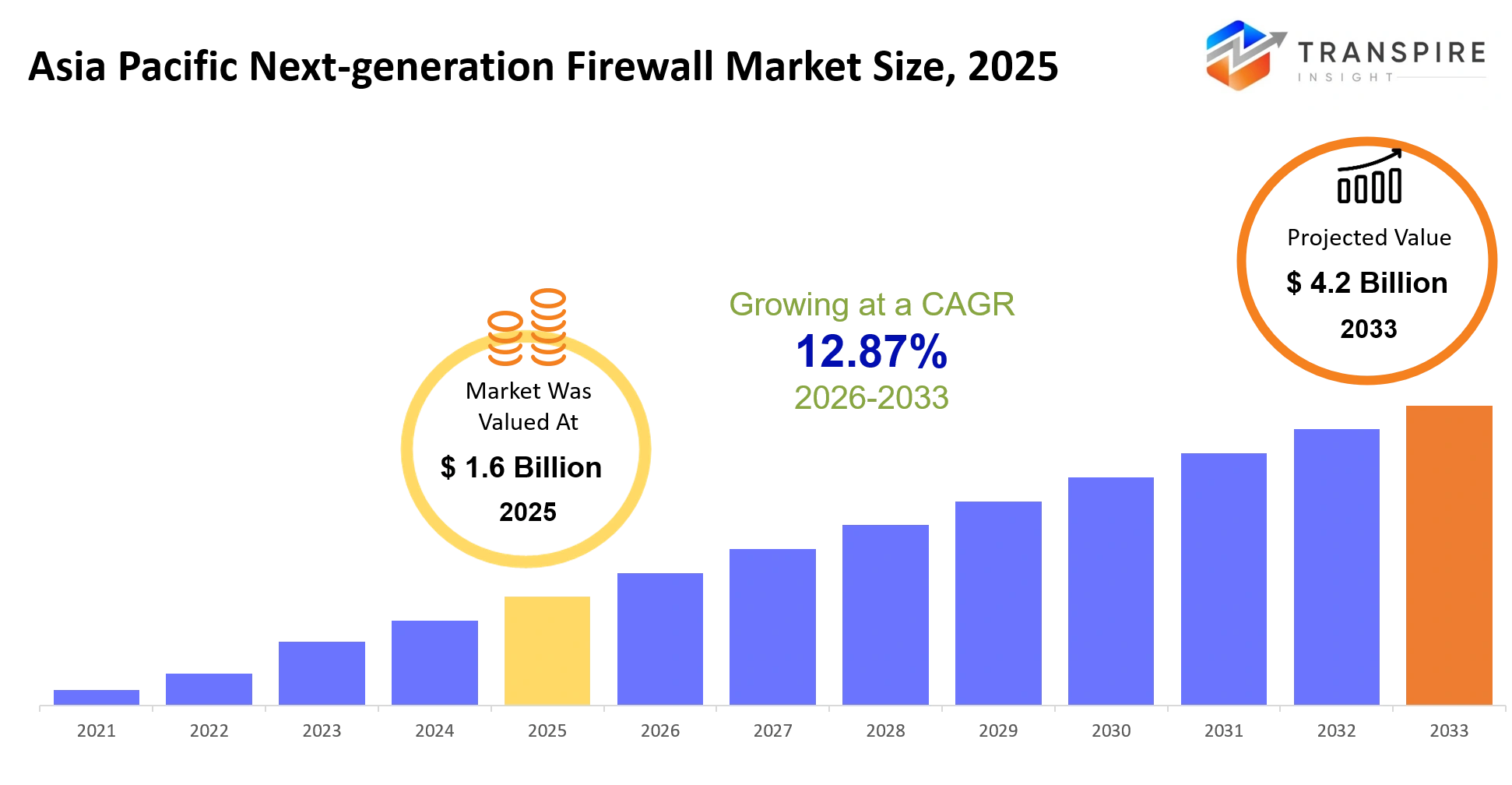
- Asia Pacific Next-generation Firewall Market Size 2025: USD 1.6 Billion
- Asia Pacific Next-generation Firewall Market Size 2033: USD 4.2 Billion
- Asia Pacific Next-generation Firewall Market CAGR: 12.87%
- Asia Pacific Next-generation Firewall Market Segments: By Component (Hardware, Software, Virtual Appliances, Cloud Firewalls, Threat Intelligence, Security Services, Management Platforms, Others); By Deployment (Cloud, On-Premise, Hybrid, Private Cloud, Multi-Cloud, SaaS Security, Edge Security, Others); By Application (Network Security, Data Center Security, Cloud Security, Branch Security, Remote Workforce Security, OT Security, Zero Trust Security, Others); By End User (BFSI, Government, Healthcare, IT & Telecom, Retail, Manufacturing, Education, Others).
Asia Pacific Next-generation Firewall Market Summary
The Asia Pacific Next-generation Firewall Market was valued at USD 1.6 Billion in 2025. It is forecast to reach USD 4.2 Billion by 2033. That is a CAGR of 12.87% over the period.
The Asia Pacific Next-generation Firewall Market underpins digital trust across enterprises, factories, financial institutions, telecom networks, and government systems by inspecting, filtering, and controlling data traffic before cyber threats can disrupt operations. In practice, these platforms help organizations secure cloud applications, remote employees, industrial control systems, and interconnected supply chains that traditional perimeter security can no longer protect effectively.
Over the last three to five years, the market has undergone a structural shift from hardware-centric security deployments to cloud delivered and AI assisted security architectures. Organizations now prioritize unified visibility across hybrid environments instead of managing separate security tools. A major trigger was the surge in ransomware attacks and state sponsored cyber incidents following regional geopolitical tensions, which exposed vulnerabilities across critical infrastructure and cross border digital ecosystems.
This change is reshaping spending patterns. Enterprises are allocating larger cybersecurity budgets toward integrated firewall platforms because fragmented security systems increase operational complexity and response times. As digital transformation expands across Asia Pacific, firewall vendors are generating new revenue streams through subscription based services, threat intelligence integration, and security management automation.
Key Market Insights
- China dominates the Asia Pacific Next-generation Firewall Market with approximately 32% to 35% market share in 2025 due to extensive enterprise digitization initiatives.
- India is the fastest-growing country through 2032, supported by data localization policies and rapid adoption of cloud-based technologies.
- Japan holds a significant share because enterprises prioritize zero-trust frameworks to modernize legacy infrastructure.
- Southeast Asia is emerging as a strategic growth hub as SMEs accelerate investments in digital security infrastructure.
- Hardware-integrated next-generation firewalls lead with nearly 40% market share in 2025, particularly across manufacturing, telecom, and government sectors.
- Cloud-delivered firewall services represent the second-largest segment due to increasing multi-cloud deployment strategies.
- Firewall-as-a-Service (FWaaS) is the fastest-growing segment from 2026 to 2032 because organizations prefer scalable subscription models.
- Security management platforms are gaining adoption as enterprises consolidate multiple cybersecurity tools.
- Enterprise network security dominates with approximately 38% market share in 2025 due to hybrid workforce security requirements.
- Cloud application security is the fastest-growing application as businesses migrate critical workloads to cloud environments.
What are the Key Drivers, Restraints, and Opportunities in the Asia Pacific Next-generation Firewall Market?
The primary force accelerating the Asia Pacific Next-generation Firewall Market is the rapid convergence of cloud computing, remote work, and digital infrastructure modernization. Enterprises can no longer secure operations through traditional perimeter-based security because employees, applications, and data now operate across multiple environments simultaneously. Government cybersecurity mandates in countries such as India, Singapore, Australia, and Japan have further accelerated investment decisions. This shift is directly translating into higher revenues for vendors as organizations replace standalone security products with integrated firewall platforms that offer application visibility, threat intelligence, and centralized management under subscription-based models.
The biggest barrier limiting market growth is the shortage of skilled cybersecurity professionals capable of managing increasingly complex security environments. This challenge is structural because educational systems and workforce development programs cannot close the talent gap quickly enough. Many small and medium enterprises struggle to deploy advanced firewall systems due to operational complexity and limited internal expertise. As a result, organizations postpone upgrades, underutilize existing platforms, or continue relying on outdated security infrastructure, which suppresses potential market revenue.
A major opportunity lies in securing industrial operational technology environments across emerging Asian economies. Manufacturing facilities, energy utilities, ports, and logistics operators are rapidly connecting industrial assets to digital networks. Countries such as India, Vietnam, and Indonesia are investing heavily in smart factories, creating demand for specialized firewalls designed for industrial control systems. Vendors that integrate AI-driven threat detection with operational technology security capabilities will be well positioned to capture the next wave of market expansion.
What Has the Impact of Artificial Intelligence Been on the Asia Pacific Next-generation Firewall Market?
Artificial intelligence and advanced digital technologies are transforming the Asia Pacific Next-generation Firewall Market by shifting cybersecurity operations from reactive defense to autonomous threat prevention. Enterprises are increasingly using AI to automate traffic inspection, policy management, threat prioritization, and security incident response across hybrid cloud environments. Modern firewall platforms can automatically identify abnormal user behavior, block suspicious network activity, and update security rules without requiring constant manual intervention.
Machine learning models are also strengthening predictive capabilities. Security teams use behavioral analytics to forecast potential attack paths, detect ransomware indicators before execution, and identify vulnerabilities that could expose critical assets. These predictive engines continuously learn from billions of network events, enabling organizations to anticipate threats rather than responding after a breach occurs.
Operational improvements are becoming increasingly measurable. AI-powered firewall deployments can reduce security investigation times by 40% to 60%, improve threat detection accuracy, and lower operational costs by consolidating multiple security tools into a unified platform. Automated policy enforcement also helps organizations maintain regulatory compliance across geographically distributed operations.
However, AI adoption still faces a major limitation. Integrating AI-driven security platforms with legacy infrastructure remains expensive and technically complex, particularly for small and medium enterprises that lack skilled cybersecurity professionals and sufficient historical data to train advanced security models effectively.
Key Market Trends
- Since 2021, enterprises have shifted from hardware-centric deployments toward hybrid and cloud-delivered firewalls to secure multi-cloud environments more efficiently.
- Ransomware incidents targeting critical infrastructure after 2022 accelerated firewall modernization projects across government, energy, and manufacturing sectors.
- Organizations increasingly prefer unified security platforms over multiple point solutions, reducing operational complexity and improving threat visibility.
- India, Singapore, and Australia have strengthened cybersecurity regulations since 2022, prompting faster adoption among regulated industries.
- AI-powered threat detection capabilities have become standard purchasing criteria, replacing traditional signature-based security approaches.
- Manufacturing companies have expanded firewall deployments to operational technology environments as Industry 4.0 adoption intensifies.
- Firewall-as-a-Service adoption has accelerated since 2023 because enterprises want scalable security without large upfront hardware investments.
- Vendors including Palo Alto Networks, Fortinet, Cisco, and Check Point have expanded regional cloud infrastructure to improve latency and compliance requirements.
- Small and medium enterprises increasingly rely on managed security providers because cybersecurity talent shortages continue across Asia Pacific.
- Buyers now evaluate cybersecurity vendors based on platform integration capabilities rather than standalone firewall performance alone.
Asia Pacific Next-generation Firewall Market Segmentation
By Component:
The component landscape shows a clear movement toward integrated security platforms instead of isolated tools. Hardware solutions continue to support organizations that require dedicated network protection for large facilities and critical operations. Software platforms gain attention because software deployment supports faster updates and flexible security policies. Threat intelligence services strengthen overall protection by identifying suspicious activity before cyber incidents spread across networks.
Management platforms and security services create additional value by reducing operational complexity. Many organizations combine firewall protection, analytics, and centralized monitoring inside one ecosystem. Cloud security tools also strengthen component demand because business applications now operate across multiple digital environments. Vendor strategies increasingly focus on unified security architectures that simplify administration and improve response speed without increasing workforce pressure.
By Deployment:
Cloud deployment has become a major priority because digital workloads continue shifting away from traditional data centers. Organizations select cloud security models to support remote operations, application scalability, and faster implementation timelines. Multi cloud environments also create stronger demand for centralized security visibility. Private cloud infrastructure remains important for sectors with strict compliance requirements.
On premises deployment continues to hold value for government agencies, financial institutions, and large industrial facilities. Hybrid deployment models receive growing attention because hybrid structures balance security control with operational flexibility. SaaS security platforms also expand across enterprises that manage distributed workforces. Edge security deployment gains traction as connected devices and industrial networks increase throughout Asia Pacific economies.
By Application:
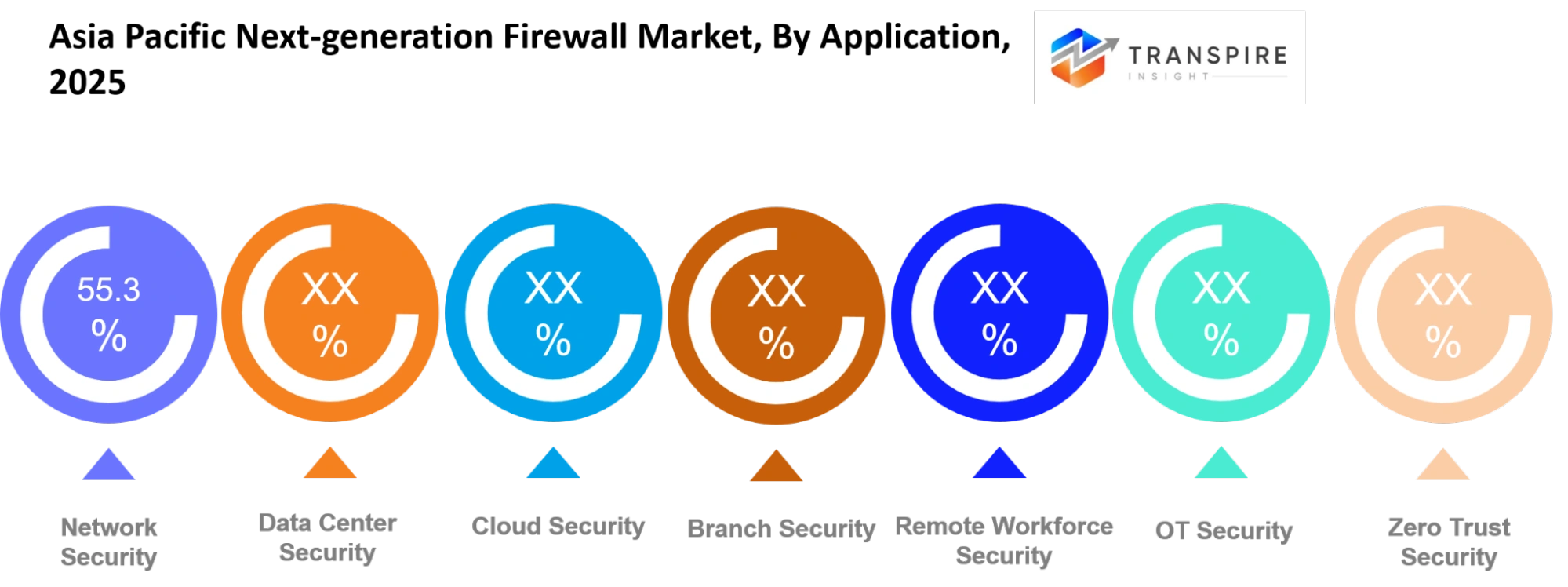
Network security remains the largest application area because organizations manage increasing volumes of sensitive information. Application awareness, encrypted traffic inspection, and threat prevention capabilities now influence purchasing decisions. Business operations depend on uninterrupted digital connectivity, making advanced protection essential for operational continuity. Stronger security requirements also reshape investment priorities across several industries.
Cloud application protection records steady expansion because enterprises migrate customer data and business functions into cloud environments. Data center security also gains importance as regional digital infrastructure expands. Industrial application security attracts investment because manufacturing systems require protection from operational disruption. Remote workforce security has transformed from a temporary requirement into a permanent business priority.
By End User:
Banking, financial services, and insurance organizations remain leading adopters because financial networks face constant cyber threats. Regulatory requirements also encourage long term investment in advanced protection systems. Manufacturing companies expand security budgets as production facilities become more connected. Digital transformation programs create additional opportunities across large enterprises.
Healthcare organizations increase adoption because connected medical systems contain valuable data assets. Government agencies strengthen cybersecurity strategies to protect public infrastructure and essential services. Retail and telecommunications companies also expand security capabilities to secure customer transactions and communication networks. Long term adoption patterns now depend on operational resilience, regulatory compliance, and centralized security management rather than traditional perimeter protection alone.
What are the Key Use Cases Driving the Asia Pacific Next-generation Firewall Market?
The primary use case driving adoption is enterprise network security across banking, telecommunications, government, and large corporate environments. These organizations manage vast amounts of sensitive data and distributed digital assets, making continuous traffic inspection and threat prevention essential. Hybrid work models and multi-cloud operations have further increased deployment requirements.
Expanding applications include industrial network protection and cloud workload security. Manufacturing companies use advanced firewalls to secure operational technology systems connected through Industry 4.0 initiatives, while healthcare providers protect electronic health records and connected medical devices from cyberattacks.
Emerging use cases include securing artificial intelligence workloads and protecting edge computing environments. Smart city projects, autonomous industrial systems, and 5G-enabled infrastructure are creating new security requirements. These applications remain in early stages but will become more important as digital ecosystems expand across Asia Pacific economies.
|
Report Metrics |
Details |
|
Market size value in 2025 |
USD 1.6 Billion |
|
Market size value in 2026 |
USD 1.8 Billion |
|
Revenue forecast in 2033 |
USD 4.2 Billion |
|
Growth rate |
CAGR of 12.87% from 2026 to 2033 |
|
Base year |
2025 |
|
Historical data |
2021 - 2024 |
|
Forecast period |
2026 - 2033 |
|
Report coverage |
Revenue forecast, competitive landscape, growth factors, and trends |
|
Regional scope |
Asia Pacific |
|
Key company profiled |
Palo Alto Networks, Fortinet, Check Point, Cisco, Juniper Networks, Sophos, SonicWall, WatchGuard, Barracuda, Forcepoint, Huawei, Hillstone Networks, Sangfor, Zscaler, Netskope. |
|
Customization scope |
Free report customization (country, regional & segment scope). Avail customized purchase options to meet your exact research needs. |
|
Report Segmentation |
By Component (Hardware, Software, Virtual Appliances, Cloud Firewalls, Threat Intelligence, Security Services, Management Platforms, Others); By Deployment (Cloud, On-Premise, Hybrid, Private Cloud, Multi-Cloud, SaaS Security, Edge Security, Others); By Application (Network Security, Data Center Security, Cloud Security, Branch Security, Remote Workforce Security, OT Security, Zero Trust Security, Others); By End User (BFSI, Government, Healthcare, IT & Telecom, Retail, Manufacturing, Education, Others). |
Which Regions are Driving the Asia Pacific Next-generation Firewall Market Growth?
China leads the Asia Pacific Next-generation Firewall Market because of its large digital economy, strong domestic cybersecurity ecosystem, and extensive investments in cloud infrastructure. National cybersecurity regulations and data protection requirements have encouraged enterprises to strengthen network security architectures across finance, manufacturing, telecommunications, and government sectors. Large technology companies and hyperscale data center operators also create a strong foundation for sustained deployment activity. This combination of policy support, local technology capabilities, and enterprise digitalization continues to reinforce China's market leadership.
Japan represents a stable contributor for different reasons than China. Mature enterprises focus on modernizing legacy systems while maintaining high operational reliability and strict security standards. Consistent investment from financial institutions, industrial manufacturers, and telecommunications providers supports steady revenue generation. Organizations in Japan prioritize long-term security resilience and gradual technology upgrades rather than rapid expansion cycles.
India is the fastest-growing market because digital public infrastructure, cloud adoption, and data localization initiatives have accelerated in recent years. Government programs supporting digital transformation and expanding data center investments have created new cybersecurity requirements across industries. Rapid growth among small and medium enterprises is also widening the customer base for advanced firewall solutions. This momentum will create attractive opportunities for vendors, managed security providers, and investors between 2026 and 2033 as organizations continue strengthening cybersecurity capabilities.
Who are the Key Players in the Asia Pacific Next-generation Firewall Market and How Do They Compete?
Competition in the Asia Pacific Next-generation Firewall Market is moderately consolidated, with global cybersecurity vendors controlling a significant portion of enterprise deployments while regional specialists compete in specific countries and customer segments. Technology capability has become the primary basis of competition, replacing traditional price-based differentiation. Buyers increasingly evaluate vendors based on cloud integration, AI-powered threat detection, unified security management, and the ability to secure hybrid environments. Established companies continue to defend market share, but cloud-native security providers are creating competitive pressure by offering flexible subscription models.
Palo Alto Networks differentiates itself through platform consolidation by integrating firewall security, zero trust access, and AI-driven threat intelligence into a single ecosystem. Expansion efforts focus on partnerships with cloud providers and investments in regional cloud infrastructure. Fortinet uses a performance-driven strategy supported by custom security processing units that help organizations secure high-volume network environments efficiently. Cisco leverages existing enterprise networking relationships by combining network infrastructure and cybersecurity under centralized management platforms.
Check Point Software Technologies focuses on prevention-first security models that prioritize blocking attacks before network compromise occurs. Strong compliance capabilities make the company attractive to highly regulated sectors. Zscaler follows a cloud-native strategy that removes dependence on traditional perimeter security architectures. Regional expansion efforts from these companies increasingly target India, Southeast Asia, and fast-growing digital economies where cloud adoption, data center investments, and cybersecurity regulations continue to accelerate.
Company List
- Palo Alto Networks
- Fortinet
- Check Point
- Cisco
- Juniper Networks
- Sophos
- SonicWall
- WatchGuard
- Barracuda
- Forcepoint
- Huawei
- Hillstone Networks
- Sangfor
- Zscaler
- Netskope
Recent Development News
"In March 2026, Palo Alto Networks launched Prisma AIRS 3.0. The platform introduced end to end security for agentic AI systems and strengthened enterprise cybersecurity capabilities that increasingly integrate with next-generation firewall ecosystems across Asia Pacific.
Source: https://www.paloaltonetworks.com
"In April 2026, Palo Alto Networks announced the acquisition of Koi. The acquisition expanded endpoint and AI security capabilities, helping enterprises unify identity, endpoint, and network protection within broader cybersecurity platforms.
Source: https://www.paloaltonetworks.com
"In May 2026, Fortinet expanded the FortiGate G Series and introduced new secure networking capabilities for AI environments. The launch strengthened firewall performance for data centers and enterprise edge environments while supporting organizations deploying AI workloads at scale.
Source: https://www.fortinet.com
What Strategic Insights Define the Future of the Asia Pacific Next-generation Firewall Market?
Over the next five to seven years, the Asia Pacific Next-generation Firewall Market will move beyond traditional network security and evolve into an intelligent security orchestration layer that protects users, applications, devices, and artificial intelligence workloads simultaneously. This structural shift will be driven by the convergence of AI adoption, sovereign cloud policies, industrial digitalization, and stricter data governance requirements. Buyers will increasingly favor unified platforms that combine firewall protection, zero trust access, threat intelligence, and automated response capabilities instead of purchasing multiple standalone products.
One hidden risk lies in market concentration around a small group of global vendors. Heavy dependence on a few cybersecurity ecosystems could create pricing pressure, vendor lock-in challenges, and slower innovation flexibility for enterprises that require customized security architectures. This risk may become more visible as governments strengthen digital sovereignty policies.
An emerging opportunity is developing in industrial operational technology security across India, Vietnam, and Indonesia, where smart manufacturing investments continue to accelerate. Market participants should establish specialized operational technology security partnerships and invest in localized managed security services because future competitive advantage will depend on industry-specific expertise rather than generic firewall capabilities alone.
Asia Pacific Next-generation Firewall Market Report Segmentation
By Component
- Hardware
- Software
- Virtual Appliances
- Cloud Firewalls
- Threat Intelligence
- Security Services
- Management Platforms
- Others
By Deployment
- Cloud
- On-Premise
- Hybrid
- Private Cloud
- Multi-Cloud
- SaaS Security
- Edge Security
- Others
By Application
- Network Security
- Data Center Security
- Cloud Security
- Branch Security
- Remote Workforce Security
- OT Security
- Zero Trust Security
- Others
By End User
- BFSI
- Government
- Healthcare
- IT & Telecom
- Retail
- Manufacturing
- Education
- Others
Frequently Asked Questions
Find quick answers to common questions.
The expected Asia Pacific Next-generation Firewall Market size for the market will be USD 4.2 Billion in 2033.
Key segments for the Asia Pacific Next-generation Firewall Market are By Component (Hardware, Software, Virtual Appliances, Cloud Firewalls, Threat Intelligence, Security Services, Management Platforms, Others); By Deployment (Cloud, On-Premise, Hybrid, Private Cloud, Multi-Cloud, SaaS Security, Edge Security, Others); By Application (Network Security, Data Center Security, Cloud Security, Branch Security, Remote Workforce Security, OT Security, Zero Trust Security, Others); By End User (BFSI, Government, Healthcare, IT & Telecom, Retail, Manufacturing, Education, Others).
Major Asia Pacific Next-generation Firewall Market players are Palo Alto Networks, Fortinet, Check Point, Cisco, Juniper Networks, Sophos, SonicWall, WatchGuard, Barracuda, Forcepoint, Huawei, Hillstone Networks, Sangfor, Zscaler, Netskope.
The Asia Pacific Next-generation Firewall Market size is USD 1.6 Billion in 2025.
The Asia Pacific Next-generation Firewall Market CAGR is 12.87% from 2026 to 2033.
- Palo Alto Networks
- Fortinet
- Check Point
- Cisco
- Juniper Networks
- Sophos
- SonicWall
- WatchGuard
- Barracuda
- Forcepoint
- Huawei
- Hillstone Networks
- Sangfor
- Zscaler
- Netskope
About the Authors

Mayur Shinde
I am Mayur Shinde, a Senior Research Analyst at Transpire Insight, specializing in the Automotive & Transportation and Information & Communication Technology (ICT) Industry. My work focuses on analyzing emerging market trends, technological advancements, competitive landscapes, and industry developments to deliver accurate, data-driven insights. I am passionate about transforming complex market information into clear, actionable content that helps businesses, professionals, and decision-makers stay informed and make confident strategic decisions.

Chakradhar Khansole
Chakradhar serves as the Research Director at Transpire Insight, bringing over 8 years of experience in technology, innovation, and strategic market intelligence. He specializes in transforming complex market data into actionable business insights that enable organizations to make informed, growth-oriented decisions. Recognized for his strategic vision and analytical expertise, Chakradhar leads high-impact research initiatives, delivering comprehensive market assessments, competitive intelligence, and forward-looking industry analysis.
Recently Published Reports
-
Apr 2026
3D Optical Profiler Market
3D Optical Profiler Market Size, Share & Analysis Report By Type (Desktop 3D Optical Profiler, and Portable 3D Optical Profiler), By Technology (Confocal Technology, and White Light Interference), By End-Use Industry (Manufacturing, Research Institutions, Automotive, Aerospace and Defense, Medical Devices, and Other), and Geography (North America, Europe, Asia-Pacific, Middle East and Africa, South and Central America), 2021 - 2031
-
Apr 2026
Depth Sensor Market
Depth Sensor Market Size, Share & Analysis Report By Type (Infrared Depth Sensors, Time-of-Flight (ToF) Sensors, Stereo Vision Sensors, Structured Light Sensors, Ultrasonic Depth Sensors), By Application (Automotive, Robotics, Gaming, Consumer Electronics, Industrial Automation, Healthcare, Security & Surveillance, Others), By End Users (Automotive Manufacturers, Consumer Electronics Companies, Healthcare Providers, Industrial Companies, Security Agencies, Gaming Companies, Robotics Companies, Others), and Geography (North America, Europe, Asia-Pacific, Middle East and Africa, South and Central America), 2021 – 2031
-
Apr 2026
Digital Manufacturing Market
Digital Manufacturing Market Size, Share & Analysis Report By Component (Hardware, Software, and Services), By Technology (Robotics, 3D Printing, Internet of Things (IoT), and Others), By Application (Automotive and Transportation, Aerospace and Defense, Consumer Electronics, Industrial Machinery, and Others), By Process Type (Computer-Based Designing, Computer-Based Simulation, Computer 3D Visualization, Analytics, and Others), and Geography (North America, Europe, Asia-Pacific, Middle East and Africa, South and Central America), 2021 – 2031
-
Apr 2026
Digital Visa Services Market
Digital Visa Services Market Size, Share & Analysis Report By Type (Individual Travelers, Group Travelers), By Application (Tourism, Business Travel, Others), and Geography (North America, Europe, Asia-Pacific, Middle East and Africa, South and Central America), 2021 – 2031