
Global Automotive Semiconductor Test Equipment Market Size & Forecast:
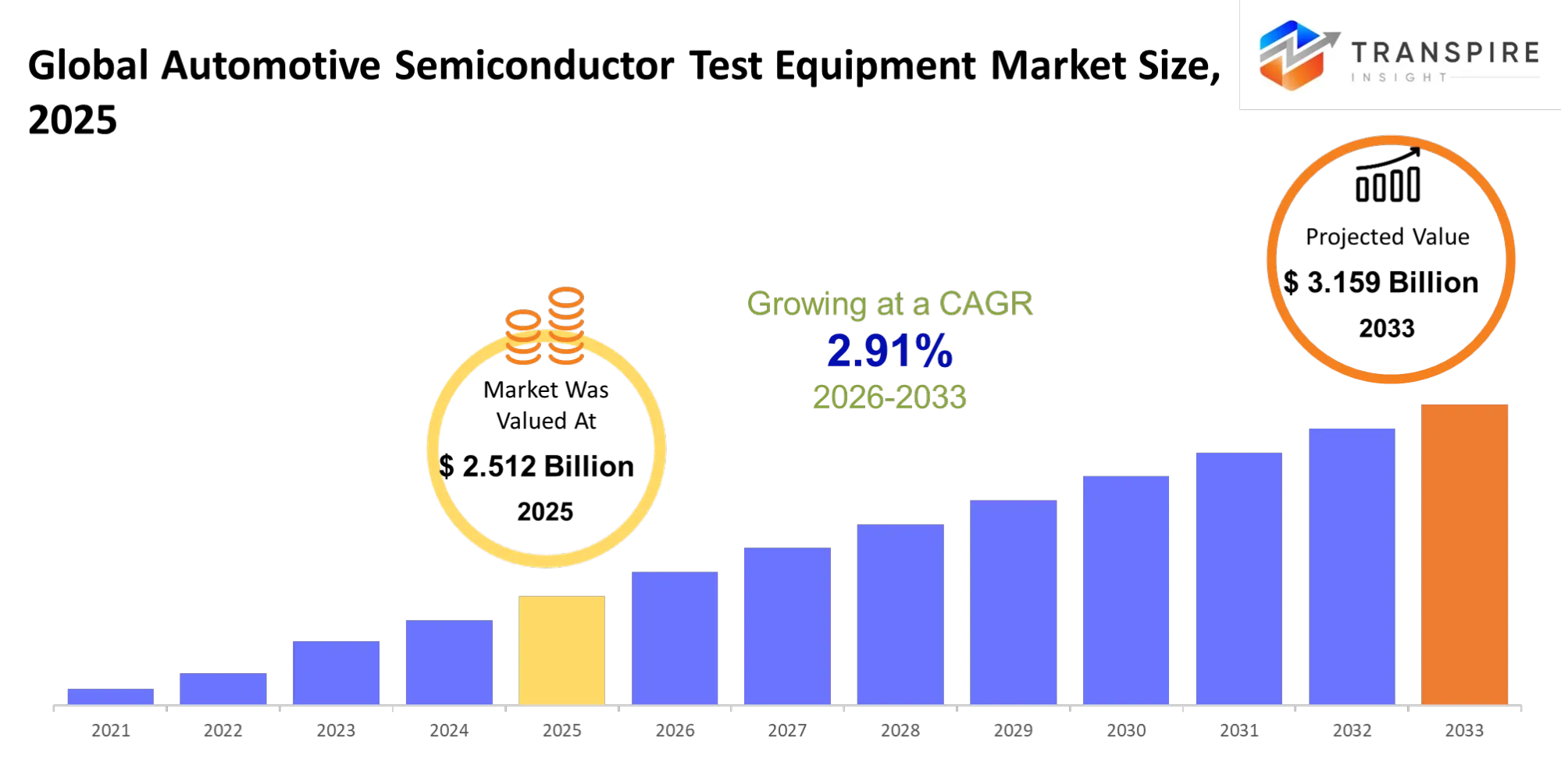
- Global Automotive Semiconductor Test Equipment Market Size 2025: USD 2.512 Billion
- Global Automotive Semiconductor Test Equipment Market Size 2033: USD 3.159 Billion
- Global Automotive Semiconductor Test Equipment Market CAGR: 2.91%
- Global Automotive Semiconductor Test Equipment Market Segments: By Type (Wafer Test Equipment, Final Test Equipment, Burn-in Test Systems, Automated Test Equipment, Functional Test Systems, Memory Test Equipment, Others); By Application (Passenger Vehicle Electronics, EV Semiconductor Testing, ADAS Systems, Powertrain Electronics, Infotainment Systems, Others); By End-User (Automotive OEMs, Semiconductor Manufacturers, Electronics Testing Companies, Others); By Technology (AI-assisted Testing Systems, Automated Robotics Testing, IoT-enabled Test Platforms, Hybrid Test Systems, Others)
Global Automotive Semiconductor Test Equipment Market Summary:
The Global Automotive Semiconductor Test Equipment Market size is estimated at USD 2.512 billion in 2025 and is anticipated to reach USD 3.159 billion by 2033, growing at a CAGR of 2.91% from 2026 to 2033. This market provides the tools, jigs, and automated equipment that put chips under stress before they're placed inside a vehicle to make sure a power module doesn't fail on the highway or a radar processor performs well at −40°C. It is located where the output of the fabrication line meets the assembly line of the vehicles.
The structural change occurred when ISO 26262 functional-safety requirements became contractual requirements. The concept of automotive electrification, in its essence, elevated functional-safety test standards, requiring car makers to ask for certified test data, rather than batch sampling, from suppliers. The trigger was real-world, specifically in 2021-22, with the chip shortage forcing OEMs who had loosened up validation protocols to see their chips being found defective with their deep in production cars, pushing the investments needed to pour into end-of-line testing infrastructure.
More than 46% of the growth comes from EV power modules, inverters, and battery management ICs that run at voltages and temperatures that legacy test benches were never designed to withstand. An increased number of chips per vehicle equals increased test cycles and thus increased capital expenditure.
Key Market Insights:
The Global Automotive Semiconductor Test Equipment Market is growing rapidly.
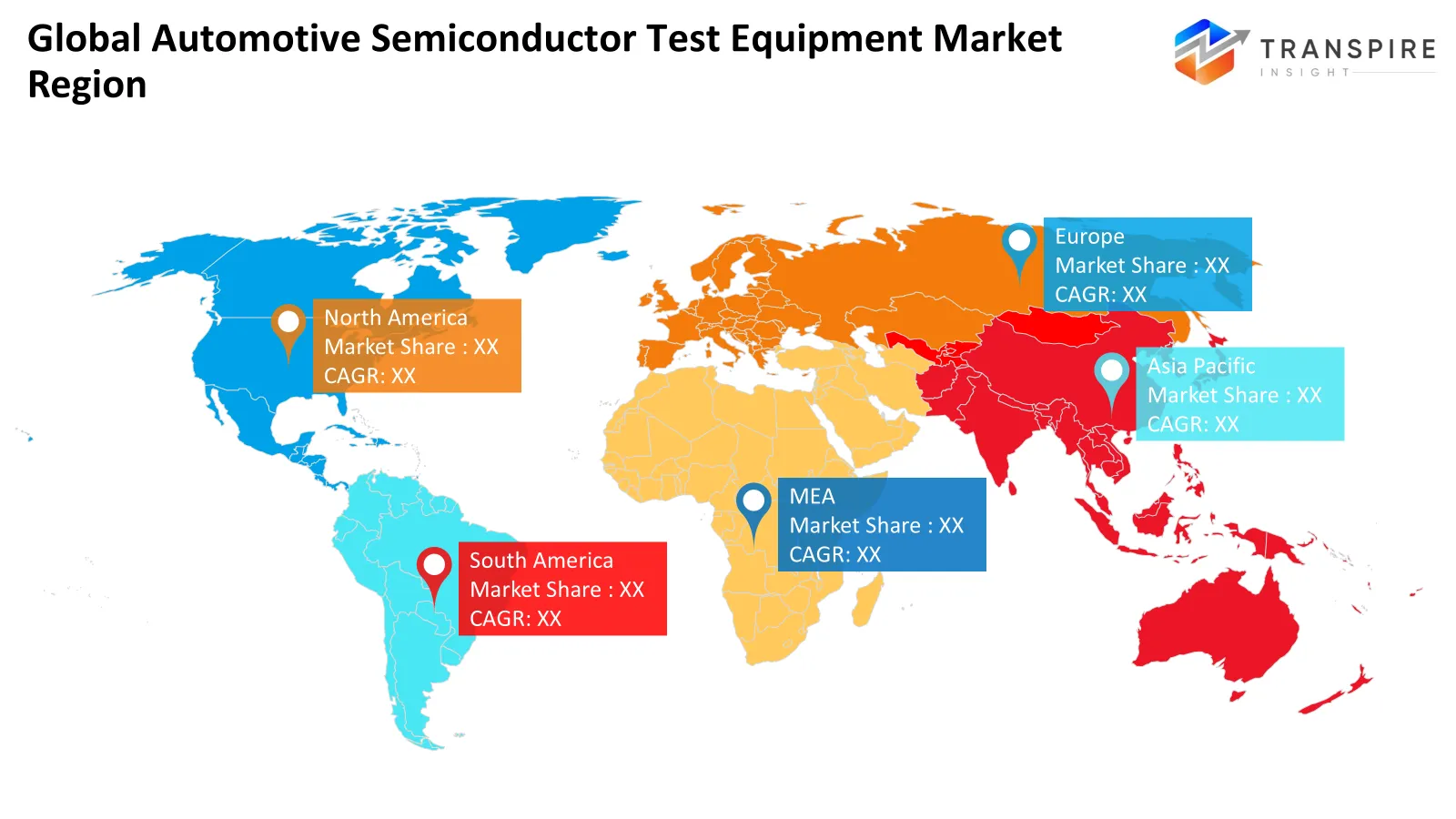
- North America is the fastest-growing region with a CAGR of 13.7%.
- North America has 27% of the market share.
- Europe has 22% of the market share.
- Asia Pacific is the dominating region with 43% of the market share.
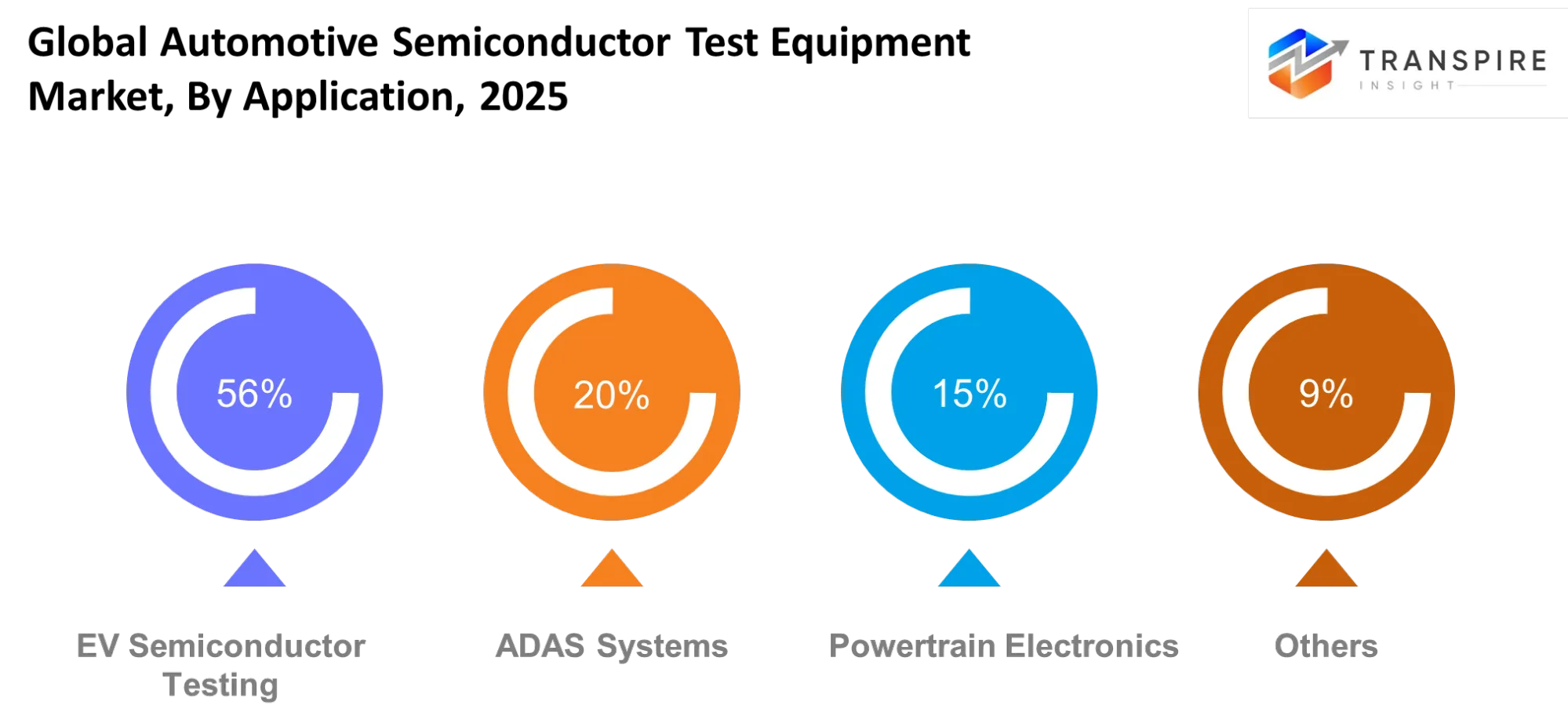
- EV Semiconductor Testing is the dominating segment with 56% of market share.
- ADAS Systems has 20% market share.
- ROW consist 8% pf the Global Automotive Semiconductor Test Equipment Market.
What are the Key Drivers, Restraints, and Opportunities in the Global Automotive Semiconductor Test Equipment Market?
Drivers
Four forces are pushing this market forward: EV power chips (SiC and GaN) that demand high-voltage dynamic testing, dense ADAS sensor architectures requiring zero-defect SoC validation, complex chiplet packaging mandating wafer-level "known-good-die" checks, and ISO 26262 functional safety mandates enforcing ASIL-rated stress testing across every automotive component. Teradyne launched the Omnyx manufacturing test platform. It is used for PCB assemblies and sub-assemblies, enhancing AI and automotive electronics testing with integrated structural and functional test capabilities. In March 2026, Teradyne launched the Omnyx manufacturing test platform for PCB assemblies and sub-assemblies, enhancing AI and automotive electronics testing with integrated structural and functional test capabilities.
Restraints
There are a few restraints also in this market. Firstly, the price of advanced ATE platforms ranges from $2 million to $8 million per test cell, which is too much for most Tier-2 suppliers and smaller laboratories to consider before they even begin. Second, the need for a skill gap is a genuine and persistent need. It's very hard to find engineers who have the expertise to work with the high frequencies of RF circuits and the high-voltage power electronics, and the complex digital logic in the same position, which slows down the development process.
Opportunities
Three openings are highlighted. The use of physical chip testing with a cloud-based digital twin model is underutilized with X-in-the-Loop frameworks. Measurable yield improvements can be gained by using AI-native ATE that adjusts test sequences as they run, identifying outlier chips that are not identified by fixed-limit testing. Meanwhile, the global push for semiconductor sovereignty with the US and European CHIPS Acts is creating new regional fabs from scratch that require new testing ecosystems to be constructed.
What Has the Impact of Artificial Intelligence Been on the Global Automotive Semiconductor Test Equipment Market?
Artificial Intelligence has revolutionized the automotive semiconductor test equipment industry from a manual, inflexible process to a highly dynamic and self-optimizing process. Adaptive testing is actively fueled by AI. Machine learning algorithms are used to automatically modify test flows based on real-time data, rather than running the same sequences on all chips, which takes a long time. This removes the duplicate tests on healthy wafers and reduces anomalies, thereby reducing test cycles by up to 15%.
AI models are more advanced than previous fabrication information to deliver precision predictive maintenance and failure forecasting. AI identifies outlier patterns early, before the semiconductor is physically packaged, to maximize yield. This change significantly lowers the operation cost, false positive rate, and guarantees the zero-defect reliability required by functional safety standards in the automotive industry.
Teradyne's acquisition of TestInsight strengthens its AI-based semiconductor test automation and validation software capabilities to support advanced semiconductor applications such as automotive electronics. The acquisition will enhance defect detection accuracy, accelerate testing processes, minimize manual involvement, and increase reliability in the production of automotive semiconductors. In April 2026, Teradyne acquired TestInsight to expand AI-powered semiconductor test automation and validation software capabilities for advanced semiconductor applications, including automotive electronics.
Key Market Trends:
- The manual semiconductor inspection and fault-detection processes are increasingly replaced by AI-driven test automation processes.
- In an effort to get the production cycle time more efficient, automotive chipmaker companies are getting an increasing number of chips to be tested in parallel.
- Power semiconductor reliability and thermal stress testing continue to be a growing demand with the expansion of EVs.There is a constant need for power semiconductor reliability and thermal stress testing with the expansion of EVs.
- The requirements for high-precision sensor and processor validation equipment are being driven by advanced driver-assistance systems.
- Predictive analytics is increasingly becoming part of semiconductor testing systems to optimize equipment maintenance in real-time.
- Manufacturers move towards modular and scalable test systems for multi-chip automotive architectures.
- The growing demand for next-generation optoelectronic testing solutions is driven by silicon photonics and AI accelerators.
- As part of the validation of automotive semiconductors during testing, cybersecurity is more and more becoming a top priority.
- With the cloud-connected testing environment, remote diagnostics, monitoring, and production data management are slowly getting better.
- Energy-efficient semiconductor test equipment is growing in popularity in companies to save operation and manufacturing costs.
Global Automotive Semiconductor Test Equipment Market Segmentation
By Type
Automated Test Equipment (ATE) is the major product class in this area, and is the backbone workhorse needed to handle multi-site, high-throughput logic and mixed-signal validation of complex vehicle electronics. Wafer Test Equipment is becoming the fastest-growing segment to deliver optimal packaging yields with the critical need for early-stage defect screening in advanced-node architectures. Other specialized diagnostic systems make up the rest of this technical group, including Final Test Equipment, Burn-in Test Systems, Functional Test Systems, Memory Test Equipment, and others.
By Application
No other company produces such a large proportion of such tests as EV Semiconductor Testing, which benefits from the worldwide growth in EV powertrains, where silicon carbide (SiC) and gallium nitride (GaN) power semiconductors are being tested to extremely high-voltage levels. Mirroring the fast-advancing autonomous driving industry, ADAS Systems is the fastest-growing application segment with 20% market share, as demanding validation is necessary for the dense radar, LiDAR, and imaging SoC components. Powertrain Electronics accounts for 15% of the remaining marketplace application volume, while the other auxiliary categories (including Infotainment Systems) make up 9%.
By End-User
The end-user market segment is accounted for by the largest share of capital equipment spending, with a major share being held by the Semiconductor Manufacturers. As foundries and Integrated Device Manufacturers (IDMs) increase their production to meet the structural shortage of automotive components, Semiconductor Manufacturers are the primary end-user. Electronics Testing Companies (OSATs included) have become the fastest-growing buyer group, due to the growing trend of decentralized and localized chip supply chains and outsourcing, as they quickly expand high-volume verification pipelines in the process. Automotive OEMs play a direct role in the rest of the markets' transactional footprint, as do smaller independent regional validation laboratories.
By Technology
Hybrid Test Systems currently maintains structural dominance within this category, leveraging modular architecture to simultaneously run legacy analog and complex high-frequency digital testing routines on integrated automotive platforms. Propelled by the urgent mandate for zero-defect yield optimization, AI-assisted Testing Systems represent the fastest-growing technology segment, accelerating at an aggressive CAGR of 14.8% due to their adaptive testing loops and predictive maintenance algorithms. The rest of the technology landscape is comprised of Automated Robotics Testing, IoT-enabled Test Platforms, and traditional static hardware platforms.
What are the Key Use Cases Driving the Global Automotive Semiconductor Test Equipment Market?
Directly, the main use case spurring this market is the power electronics validation for electric vehicles, which directly requires high-voltage power electronics test setups for silicon carbide (SiC) and gallium nitride (GaN) devices. The equipment needs to undergo rigorous dynamic thermal and electrical stress testing to ensure that components such as the inverter, onboard charger, and battery management system can withstand huge energy throughput without missing a beat.
Expanding applications are propelled by safety-critical autonomous systems, where multi-sensor configurations require automated testers capable of analyzing vast bandwidth. Test cells must process dense radar, LiDAR, and imaging system-on-chip architectures to verify real-time, low-latency target classification under diverse simulation environments, meeting strict functional safety standards before final integration.
Emerging use cases focus on system-level validation for software-defined vehicles using centralized computing platforms. This requires testing equipment that handles intricate mixed-signal processing and high-speed memory arrays, ensuring that vehicle microcontrollers can securely manage over-the-air updates and cloud connectivity without compromising on-road operations.
Report Metrics
|
Report Metrics |
Details |
|
Market size value in 2025 |
USD 2.512 Billion |
|
Market size value in 2026 |
USD 2.585 Billion |
|
Revenue forecast in 2033 |
USD 3.159 Billion |
|
Growth rate |
CAGR of 2.91% from 2026 to 2033 |
|
Base year |
2025 |
|
Historical data |
2021 - 2024 |
|
Forecast period |
2026 - 2033 |
|
Report coverage |
Revenue forecast, competitive landscape, growth factors, and trends |
|
Regional scope |
United States; Canada; Mexico; United Kingdom; Germany; France; Italy; Spain; Denmark; Sweden; Norway; China; Japan; India; Australia; South Korea; Thailand; Brazil; Argentina; South Africa; Saudi Arabia; United Arab Emirates |
|
Key company profiled |
Advantest, Teradyne, Cohu, Chroma ATE, National Instruments, SPEA, Keysight Technologies, Rohde & Schwarz, Aemulus, Astronics Test Systems, Xcerra, Marvin Test Solutions, FormFactor, TESEC, EXICON. |
|
Customization scope |
Free report customization (country, regional & segment scope). Avail customized purchase options to meet your exact research needs. |
|
Report Segmentation |
By Type (Wafer Test Equipment, Final Test Equipment, Burn-in Test Systems, Automated Test Equipment, Functional Test Systems, Memory Test Equipment, Others); By Application (Passenger Vehicle Electronics, EV Semiconductor Testing, ADAS Systems, Powertrain Electronics, Infotainment Systems, Others); By End-User (Automotive OEMs, Semiconductor Manufacturers, Electronics Testing Companies, Others); By Technology (AI-assisted Testing Systems, Automated Robotics Testing, IoT-enabled Test Platforms, Hybrid Test Systems, Others). |
Which Regions are Driving the Global Automotive Semiconductor Test Equipment Market Growth?
Asia-Pacific leads the market with 43% share of the market. They are not by chance but because of the structure of the overall situation. Countries such as China, Taiwan, Japan, and South Korea not only have the largest number of foundries, but also the largest number of integrated device manufacturers (IDMs) in the world, so the amount of chips produced requires a correspondingly intense testing infrastructure. This has been supported by the direct capital investments by governments around the region for semiconductor parks, tax incentives, and subsidies for the construction of fabs on this scale, which no other region has matched. One of the leading companies in Asia-Pacific is Advantest, TESEC, and Shibaura Mechatronics. In Asia-Pacific, Advantest recently introduced the Pin Scale 5000B digital test solution to the V93000 EXA Scale platform, enhancing the automotive semiconductor test performance and scalability of the V93000 EXA Scale digital test solution. The growth is significant for the Asia Pacific region as it improves the advanced semiconductor testing infrastructure, aids in the increased manufacturing of EVs and AI chips, and aids in quicker, more precise validation of automotive semiconductor products in manufacturing hubs across the region. In April 2026, Advantest introduced the Pin Scale 5000B digital test solution for its V93000 EXA Scale platform, improving automotive semiconductor and AI chip testing performance and scalability.
North America is the second region with a CAGR of 13.7%, as well as the fastest growth region. That total of some $39 billion to build new fabrication plants in the CHIPS and Science Act is now beginning to manifest itself in physical plants, though, as stated, only $2 billion was earmarked for mature semiconductors that are vital to the automotive and manufacturing sectors. TSMC's first Arizona fabrication facility started production on N4 process technology during Q4 2024, and the second fabrication facility construction is expected to be completed during 2025, leading to immediate demand for co-located testing capability. Teradyne, Inc., FormFactor, Inc., and Astronics Test Systems are some of the prominent companies. By introducing the Omnyx manufacturing test platform in North America, Teradyne enhanced the region's automotive semiconductor testing capabilities, further advancing the AI-driven defect detection, PCB and chip validation, and production downtime reduction solutions. It also helped in meeting the demand for EV and autonomous vehicle manufacturing, with faster, more accurate, and scalable semiconductor testing operations.
Who are the Key Players in the Global Automotive Semiconductor Test Equipment Market and how do they Compete?
The Global Automotive Semiconductor Test Equipment Market is highly competitive, with growing demand for sophisticated automotive chips in various applications such as EVs, ADAS, infotainment systems, and autonomous driving. Businesses are competing based on technology innovation, fast and automated testing, low-cost platforms, and tailored solutions for automotive semiconductor OEMs. Investments in AI-powered test automation, accuracy validation, and scalable testing architectures are also increasing in the market, as it adapts to handle complex semiconductor designs and higher safety standards in the automotive sector.
Competition between Advantest and Teradyne is largely driven by innovation-oriented strategies, such as providing high-performance automated test equipment for advanced automotive processors and AI-powered chips. Cohu and Chroma ATE are dedicated to integrated testing and inspection solutions designed to enhance semiconductor reliability and production efficiency.
National Instruments, Keysight Technologies, and Rohde & Schwarz highlight precision measurement technologies and flexible test validation platforms for automotive electronics.
SPEA, Aemulus, and TESEC compete for niche, cost-effective semiconductor testing solutions for particular automotive applications. Astronics Test Systems, Marvin Test Solutions, and EXICON specialize in customized and specialized testing systems for reliability and electronic validation. Meanwhile, FormFactor and Xcerra beef up competition with advanced probe technologies, wafer-level testing, and semiconductor performance optimization strategies.
Global Automotive Semiconductor Test Equipment Market Companies:
- Advantest
- Teradyne
- Cohu
- Chroma ATE
- National Instruments
- SPEA
- Keysight Technologies
- Rohde & Schwarz
- Aemulus
- Astronics Test Systems
- Xcerra
- Marvin Test Solutions
- FormFactor
- TESEC
- EXICON
Recent Development News
In January 2026, Teradyne and MultiLane formed a joint venture to develop AI data-center and high-speed semiconductor testing solutions, strengthening next-generation automotive and AI chip validation capabilities.
(Source- https://www.investing.com)
In April 2026, Teradyne expanded AI-driven semiconductor testing capabilities through its acquisition of TestInsight, strengthening automated validation software and reducing automotive chip testing time-to-market.
(Source- https://www.teradyne.com)
What Strategic Insights Define the Future of the Global Automotive Semiconductor Test Equipment Market?
The Global Automotive Semiconductor Test Equipment Market is in transition from hardware validation to a software-based, integrated diagnostic ecosystem. Historical differences between wafer-level, package-level, and system-level validation are diminishing as vehicles move to centralized, high-performance computing (HPC) nodes. Testers now have to test multiple domains at once, testing high-voltage power devices and low-voltage, ultra-high-frequency logic components.
One of the largest opportunities currently developing is the Test-as-a-Service (TaaS) business model that can be combined with Cloud-Based Digital Twins. Edge-to-cloud feedback loops enable continuous live diagnostic analytics flow back to the virtual vehicle twins, providing real-time test and adaptive redesign loops for automotive OEMs, while the equipment vendors stream live diagnostics back to the virtual vehicle twins.
Equipment companies need to shift investment from a conventional hardware expansion strategy to creating their own AI data analytics platforms. They should focus on strategic acquisition of specialized software companies to embed predictive pattern recognition and adaptive test sequencing right into their ATE architecture.
Global Automotive Semiconductor Test Equipment Market Segmentation:
By Type
- Wafer Test Equipment
- Final Test Equipment
- Burn-in Test Systems
- Automated Test Equipment
- Functional Test Systems
- Memory Test Equipment
- Others
By Application
- Passenger Vehicle Electronics
- EV Semiconductor Testing
- ADAS Systems
- Powertrain Electronics
- Infotainment Systems
- Others
By End-User
- Automotive OEMs
- Semiconductor Manufacturers
- Electronics Testing Companies
- Others
By Technology
- AI-assisted Testing Systems
- Automated Robotics Testing
- IoT-enabled Test Platforms
- Hybrid Test Systems
- Others
Regional Outlook
North America
- United States
- Canada
- Mexico
Europe
- Germany
- United Kingdom
- France
- Spain
- Italy
- Rest of Europe
Asia Pacific
- Japan
- China
- Australia & New Zealand
- South Korea
- India
- Rest of Asia Pacific
South America
- Brazil
- Argentina
- Rest of South America
Middle East & Africa
- Saudi Arabia
- United Arab Emirates
- South Africa
- Rest of the Middle East & Africa
Frequently Asked Questions
Find quick answers to common questions.
The Global Automotive Semiconductor Test Equipment Market size was valued at USD 2.512 billion in 2025 and is poised to reach USD 3.159 billion by 2033, expanding at a 2.91% CAGR.
Key segments for the Global Automotive Semiconductor Test Equipment Market are By Type (Wafer Test Equipment, Final Test Equipment, Burn-in Test Systems, Automated Test Equipment, Functional Test Systems, Memory Test Equipment, Others); By Application (Passenger Vehicle Electronics, EV Semiconductor Testing, ADAS Systems, Powertrain Electronics, Infotainment Systems, Others); By End-User (Automotive OEMs, Semiconductor Manufacturers, Electronics Testing Companies, Others); By Technology (AI-assisted Testing Systems, Automated Robotics Testing, IoT-enabled Test Platforms, Hybrid Test Systems, Others).
The Global Automotive Semiconductor Test Equipment Market growth is primarily driven by EV electrification and power semis, ADAS and autonomous driving multi-sensor architectures, a radical rise in semiconductor complexity (Chiplets & 2.5D/3D Stacking), and zero-defect mandates and functional safety.
The Global Automotive Semiconductor Test Equipment Market is led by major manufacturers, such as Advantest, Teradyne, Cohu, Chroma ATE, National Instruments, SPEA, Keysight Technologies, Rohde & Schwarz, Aemulus, Astronics Test Systems, Xcerra, Marvin Test Solutions, FormFactor, TESEC, and EXICON.
Asia Pacific holds 43% of the Global Automotive Semiconductor Test Equipment Market, driven by strong semiconductor manufacturing, rising EV production, expanding automotive electronics demand, and major investments in AI and chip testing infrastructure across China, Japan, South Korea, and Taiwan.
Commercial opportunities in the Global Automotive Semiconductor Test Equipment Market include AI-native automated test equipment, X-in-the-Loop testing frameworks integrated with digital twins, and new semiconductor testing infrastructure demand driven by the US and European CHIPS Acts and regional fab expansion.
- Advantest
- Teradyne
- Cohu
- Chroma ATE
- National Instruments
- SPEA
- Keysight Technologies
- Rohde & Schwarz
- Aemulus
- Astronics Test Systems
- Xcerra
- Marvin Test Solutions
- FormFactor
- TESEC
- EXICON
About the Authors

Mayur Shinde
I am Mayur Shinde, a Senior Research Analyst at Transpire Insight, specializing in the Automotive & Transportation and Information & Communication Technology (ICT) Industry. My work focuses on analyzing emerging market trends, technological advancements, competitive landscapes, and industry developments to deliver accurate, data-driven insights. I am passionate about transforming complex market information into clear, actionable content that helps businesses, professionals, and decision-makers stay informed and make confident strategic decisions.

Chakradhar Khansole
Chakradhar serves as the Research Director at Transpire Insight, bringing over 8 years of experience in technology, innovation, and strategic market intelligence. He specializes in transforming complex market data into actionable business insights that enable organizations to make informed, growth-oriented decisions. Recognized for his strategic vision and analytical expertise, Chakradhar leads high-impact research initiatives, delivering comprehensive market assessments, competitive intelligence, and forward-looking industry analysis.
Recently Published Reports
-
Apr 2026
ATV & UTV Market
ATV & UTV Market Size, Share & Analysis Report By Type (ATV, and UTV), By Variants (Less Than 400 CC, 400 CC To 800 CC, and More Than 800 CC), and Geography (North America, Europe, Asia-Pacific, Middle East and Africa, South and Central America), 2021 - 2031
-
Apr 2026
Automotive Central Gateway Module Market
Automotive Central Gateway Module Market Size, Share & Analysis Report By Type (Ethernet Central Gateway Module, CAN Central Gateway Module, LIN Central Gateway Module, and FlexRay), By Application (Powertrain Control, Body Control, Infotainment System, Advanced Driver Assistance Systems (ADAS), and Others), By End User (Passenger Vehicles, and Commercial Vehicles), and Geography (North America, Europe, Asia-Pacific, Middle East and Africa, South and Central America), 2021 - 2031
-
Apr 2026
Automotive Engine Oil Filter Market
Automotive Engine Oil Filter Market Size, Share & Analysis Report By Filter Type (Fuel Filter, Engine Oil Filter, Hydraulic Oil Filter, and Others), By Filter Media (Cellulose, Synthetic, and Micro), By Sales Channel (OEMs, and Aftermarket), By Vehicle Type (Passenger Cars, Light Commercial Vehicles, Heavy Duty Trucks, Buses and Coaches, and Off-road Vehicles), and Geography (North America, Europe, Asia-Pacific, Middle East and Africa, South and Central America), 2021 - 2031
-
Apr 2026
Automotive Parts Aluminium Die Casting Market
Automotive Parts Aluminium Die Casting Market Size, Share & Analysis Report By Production Process (Pressure Die Casting, Vacuum Die Casting, Squeeze Die Casting, Gravity Die Casting), By Application (Body Parts, Engine Parts, Transmission Parts, Battery And Related Components, Other Application Types), and Geography (North America, Europe, Asia-Pacific, Middle East and Africa, South and Central America), 2021 - 2031
Our Clients



