

Europe Automotive Semiconductor Market Size & Forecast:
- Europe Automotive Semiconductor Market Size 2025: USD 15.49. Billion
- Europe Automotive Semiconductor Market Size 2033: USD 35.79 Billion
- Europe Automotive Semiconductor Market CAGR: 11.02%
- Europe Automotive Semiconductor Market Segments: By Component (Processors, Sensors, Memory Devices, Analog ICs, Discrete Power Devices, Others); By Vehicle Type (Passenger Vehicles, Commercial Vehicles, Electric Vehicles, Others); By Application (ADAS, Powertrain, Infotainment, Safety Systems, Body Electronics, Others); By Propulsion (ICE, Hybrid, Electric, Others); By Distribution Channel (OEM, Aftermarket, Others); By Technology (Node Below 10nm, 10–28nm, Above 28nm, Others)
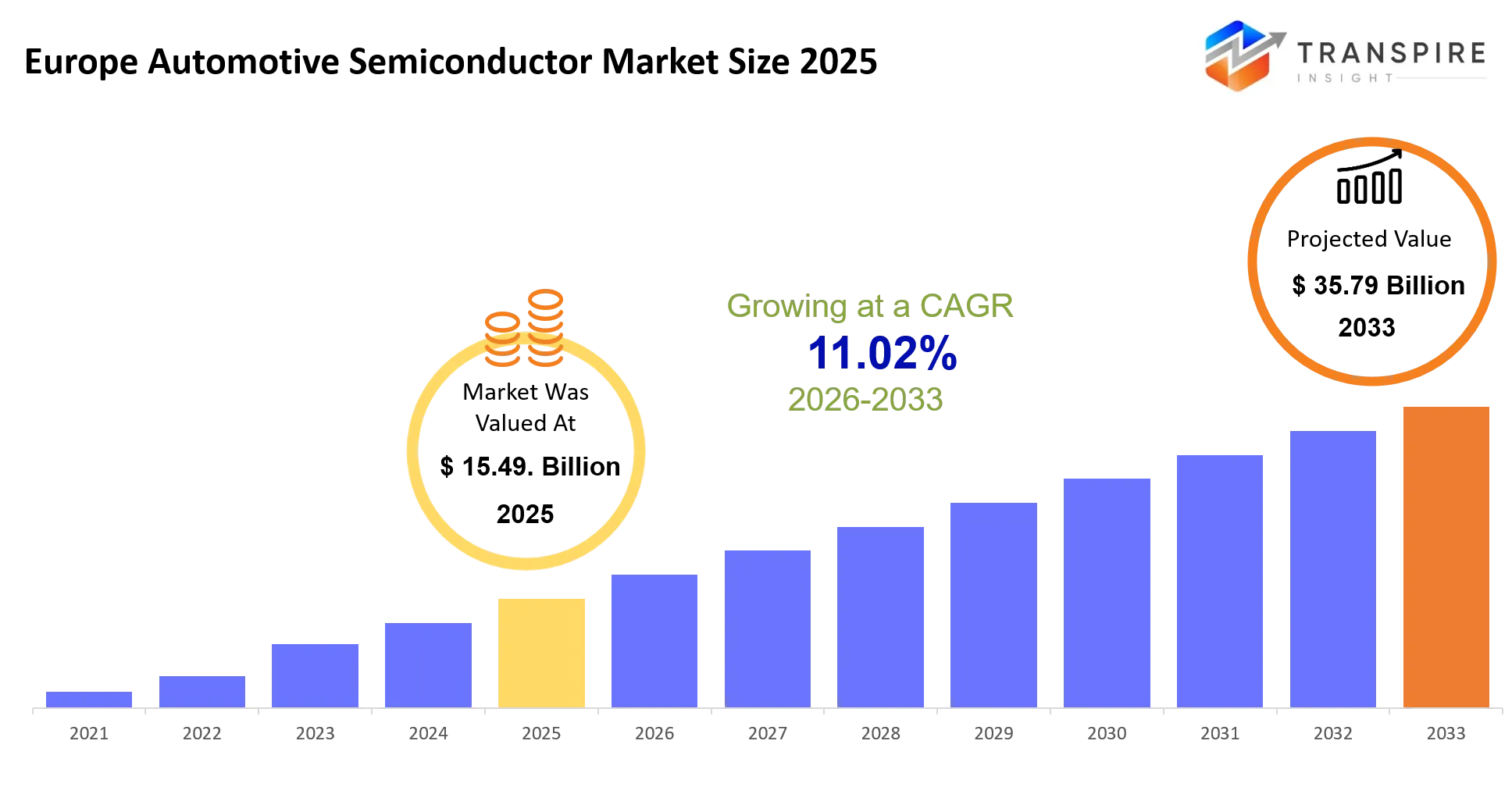
Europe Automotive Semiconductor Market Summary
The Europe Automotive Semiconductor Market was valued at USD 15.49. billion in 2025. It is forecast to reach USD 35.79 billion by 2033. That is a CAGR of 11.02% over the period.
The Europe Automotive Semiconductor Market is really important for the intelligence in modern vehicles. This means it helps with things like driver assistance and powertrain control. It also helps with battery management and infotainment.. It even helps vehicles talk to everything around them.In terms these components figure out how well vehicles can process the data they get from sensors. They also help manage how much energy vehicles use and make sure they are safe. This is especially important for systems that are defined by software. The demand for these components is directly linked to how complicated electric and connected vehicles are.. This demand is rising in European automotive manufacturing hubs.
Over the last few years there has been a big change in the way vehicles are made. They are becoming more electric. Are using software to define how they work. This change happened faster because of a shortage of semiconductors and problems with supply chains in 2021 and 2022. This showed that automakers were too dependent on companies for chips. So they started making long-term agreements to get chips. I tried to get them from local sources. As a result semiconductors are being used more in vehicle platforms. This means that each vehicle is using semiconductors and this is making the relationship between suppliers and automakers stronger.
This change is making the Europe Automotive Semiconductor Market grow. Higher-performance chips are being used in vehicles and autonomous systems. These chips are replacing mechanical controls. Now people are looking for semiconductors that're reliable and use less energy. They also need to be able to process a lot of information. This is making the adoption of semiconductor technologies happen faster in Europe’s automotive ecosystem. The Europe Automotive Semiconductor Market is really important for this.
Key Market Insights
- The Europe Automotive Semiconductor Market changed a lot after 2022. Now people want chips that're good for electric vehicles. They need high-performance power and control semiconductors.
- Between 2023 and 2025 the number of semiconductors in each vehicle went up by 35%. This is because people want driver assistance systems and better infotainment systems in their cars.
- In 2025 Western Europe was the market with over 40% share. This is because Germany and France have a lot of car factories.
- Eastern Europe is growing really fast until 2030. This is because car companies are moving their factories there to save money and make cars.
- Microcontrollers and power semiconductors are still the important parts. They are used in vehicles to control the power and the battery.
- The advanced driver assistance systems are growing fast. This is because governments are making rules to make cars safer.
- Most semiconductors are used in passenger vehicles.. Commercial electric vehicle fleets are also growing really fast.
- Car companies are making long-term agreements with semiconductor companies to make sure they have chips. They do not want to run out of chips and stop making cars.
- Some big companies like Infineon, NXP Semiconductors, STMicroelectronics, Texas Instruments and Bosch are making chips for electric vehicles. They are working with companies to make the best chips.
- To be successful semiconductor companies need to make chips that use energy that are smaller and are very reliable. They need to meet the standards of the automotive industry. The Europe Automotive Semiconductor Market needs these chips to keep growing.
What are the Key Drivers, Restraints, and Opportunities in the Europe Automotive Semiconductor Market?
Drivers
The Europe Automotive Semiconductor Market is mainly driven by the fact that people want software-defined vehicles. This is happening because the European Union has rules about emissions and car companies have promised to stop making cars with internal combustion engines in the coming years. As a result the Europe Automotive Semiconductor Market needs semiconductors for each vehicle. Electric and connected vehicles require chips for power management, sensing and computing. This change is good for the Europe Automotive Semiconductor Market because it means that semiconductor components are worth more.
Restraints
One big problem is that semiconductor supply chains are not very strong. Most semiconductors are made outside of Europe, which can cause problems when demand is high. This can slow down car manufacturing. Mean that car companies and chip suppliers do not make as much money as they could. It also takes a long time to make special chips for cars, which makes it harder to meet demand.
Opportunity
There is an opportunity for the European Automotive Semiconductor Market to make semiconductors in Europe. The European government is supporting this idea and investing in factories. Programs that help make special chips for cars are becoming more popular. This could reduce problems with supply chains. Allow for faster innovation. It could also mean that semiconductor developers and European car companies work together closely over time. The Europe Automotive Semiconductor Market could benefit from this change.
What Has the Impact of Artificial Intelligence Been on the Europe Automotive Semiconductor Market?
Europe's automotive semiconductor ecosystem is changing a lot because of intelligence and advanced digital technologies. These technologies are making design, production and vehicle optimization a lot smarter. Artificial intelligence is being used more and more in semiconductor manufacturing lines to make wafer inspection, defect detection and process calibration better. This reduces the need for people to get involved and makes production more consistent.In systems intelligent chipsets are being used to control advanced driver assistance systems and energy management functions in real time. This makes vehicles more responsive and safer. Artificial intelligence is also being used to make vehicles smarter.
Artificial intelligence and machine learning are used for maintenance and performance optimization in systems. These models look at sensor data from drivetrains, battery systems and onboard electronics to predict when parts might fail. This helps prevent failures and has led to some improvements. Vehicles are not breaking down much, they are using energy more efficiently and they are meeting regulatory standards better.
There is still a big problem. It is very expensive to add intelligence to semiconductor solutions in old automotive systems. Many manufacturers are having trouble making vehicle electronics work with advanced artificial intelligence computing requirements. This is slowing down the use of intelligence in the automotive industry especially among smaller suppliers. Despite this there is a growing need for high-performance semiconductor systems in Europe's automotive industry. Artificial intelligence and semiconductor systems are very important for the future of the industry.
Key Market Trends
- The Europe Automotive Semiconductor Market changed after 2022. It now focuses more on semiconductors for vehicles. This shift increased the need for power and control chip systems.
- The number of semiconductors per vehicle went up by 35% from 2023 to 2025. This rise is because of advanced driver-assistance systems and connectivity features.
- Western Europe still had over 40% of the market in 2025. This is because many car makers are based there and they have research and development systems for semiconductors.
- Eastern Europe started doing semiconductor assembly after 2024. They did this to save money by moving production
- Car makers made long-term agreements for chips to increase by over 25% after 2023. They did this to avoid problems with supply chains.
- Systems that help drivers like ADAS grew the fastest. This is because the EU has rules about vehicle safety and automation.
- Microcontrollers and power semiconductors are now used for vehicles and managing batteries. They used to be used for things.
- Companies like Infineon NXP Semiconductors, STMicroelectronics, Texas Instruments and Bosch are working more on chips for vehicles from 2024.
- Using AI to design chips and make them has improved production. It has reduced the number of chips made.
- After there were shortages, car makers started getting chips from suppliers and from different regions. This helps prevent problems with supply chains.
Europe Automotive Semiconductor Market Segmentation
By Component
The Europe Automotive Semiconductor Market is divided into parts like processors, sensors, memory devices, analog ICs, discrete power devices and others. Processors and discrete power devices are in demand because of the growing number of electric vehicles and the need for better computing in cars. Sensors are also becoming more popular as cars need to collect data in time to be safe and to navigate.Analog ICs and memory devices are very important for making sure cars use power efficiently and can store data. The growth in these areas is because cars are getting more complex and need semiconductors to work properly.
By Vehicle Type
The market has types of vehicles like passenger vehicles, commercial vehicles, electric vehicles and others. Passenger vehicles are part of the market because they are made in large numbers and have many digital features like infotainment and driver assistance systems. Electric vehicles are growing the fastest because they need semiconductors to manage batteries and power.Commercial vehicles are also growing steadily as more companies switch to vehicles and automate their logistics. This helps companies work efficiently, use less fuel and make their vehicles safer.
By Application
The main areas where semiconductors are used are ADAS, powertrain, infotainment, safety systems, body electronics and others. ADAS is growing the fastest because of safety rules that require cars to have advanced sensing and computing technologies. Powertrain applications are also changing rapidly because of the shift to vehicles and the need for better energy management.Infotainment and safety systems are getting more advanced with vehicle technologies and the ability to process data in real time. Body electronics are also growing steadily as manufacturers add automated features to cars.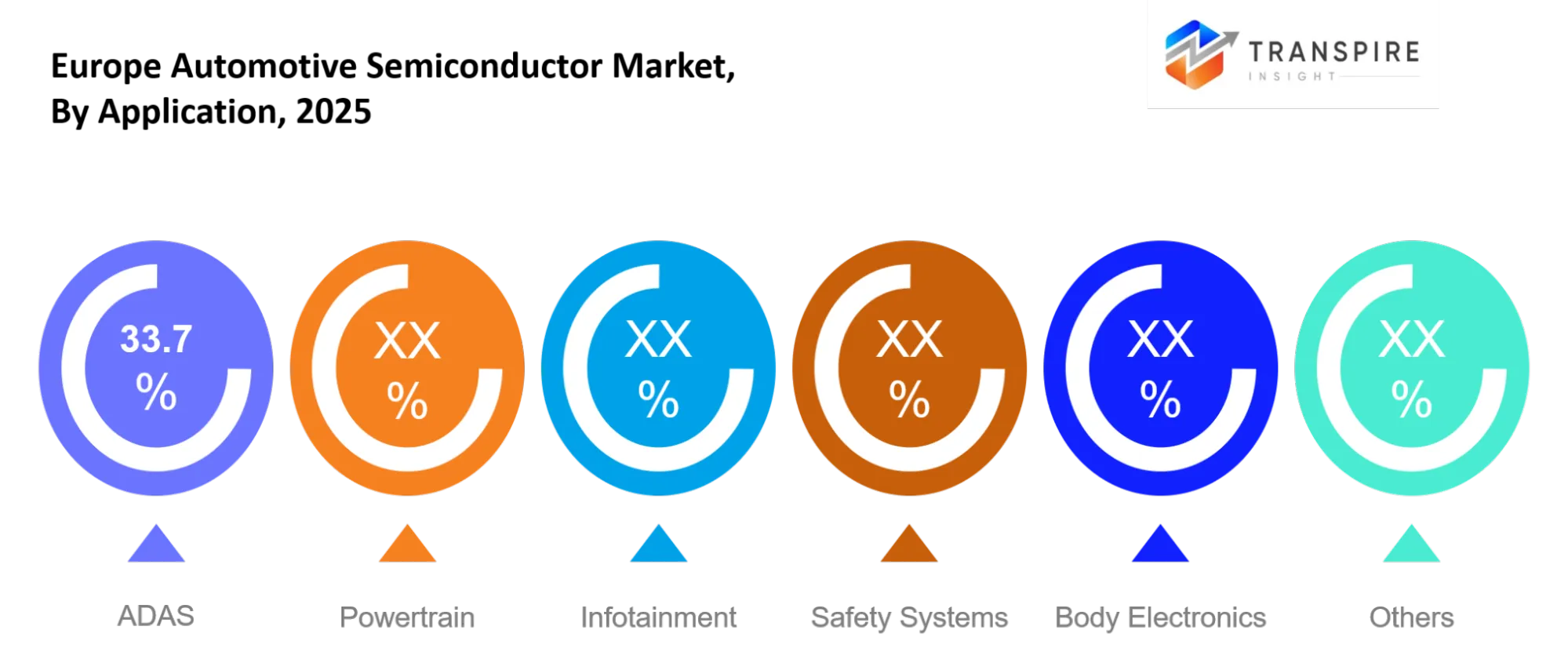
By Propulsion
The market is divided into types of propulsion systems like ICE, hybrid, electric and others. Electric propulsion systems are growing the fastest because of support for reducing emissions and the increasing adoption of electric vehicles in Europe. These systems need semiconductors to convert energy, manage batteries and control motors.Hybrid vehicles are also important as they combine electric systems making them more complex. ICE vehicles are decreasing in popularity. Still make up a significant part of the market for traditional automotive electronic systems.
By Distribution Channel
The distribution channels include OEM, aftermarket and others. OEM channels are the part of the market because semiconductors are integrated into cars during manufacturing making sure they work properly. There is collaboration between semiconductor suppliers and car manufacturers which supports this.The aftermarket segment is growing as cars get more complex and need upgrades and replacements. The demand for semiconductor components in repair and upgrade applications is also driving growth in the aftermarket.
By Technology
The technology segmentation includes nodes below 10nm, 10–28nm above 28nm and others. Advanced nodes below 10nm are becoming more popular in high-performance computing applications like ADAS and autonomous driving systems. These technologies make processing more energy-efficient in modern cars.Mid-range nodes between 10–28nm are still widely used because they balance performance and cost. Above 28nm technologies are used for systems and applications where cost is a factor, like traditional automotive electronics and control modules.
What are the Key Use Cases Driving the Europe Automotive Semiconductor Market?
The Europe Automotive Semiconductor Market is mainly driven by things like driver assistance systems. These systems use sensors and processors and power devices to help make decisions in time for vehicle safety and automation. The Europe Automotive Semiconductor Market has a demand for these systems because of strict safety rules in Europe and because semi-autonomous features are being used more and more in passenger vehicles and premium automotive segments.
There are uses for the Europe Automotive Semiconductor Market too. For example electric vehicle power management and infotainment systems are being used often in both passenger vehicles and commercial vehicles. Battery control units and special power semiconductors that use energy are becoming more important as more people buy electric vehicles. Infotainment systems are also getting better. Making it easier for people to connect with each other and have a better experience inside their vehicles.
New uses for the Europe Automotive Semiconductor Market are coming out. These include driving systems and vehicle-to-everything communication technologies. These new systems are being used. Will be used more widely soon. They need chips that can process information quickly and handle a lot of data in real time. This helps vehicles, roads and cloud systems work together in time in Europe's connected mobility ecosystem. The Europe Automotive Semiconductor Market is important for all these systems.
|
Report Metrics |
Details |
|
Market size value in 2025 |
USD 15.49. Billion |
|
Market size value in 2026 |
USD 17.19. Billion |
|
Revenue forecast in 2033 |
USD 35.79 Billion |
|
Growth rate |
CAGR of 11.02% from 2026 to 2033 |
|
Base year |
2025 |
|
Historical data |
2021 - 2024 |
|
Forecast period |
2026 - 2033 |
|
Report coverage |
Revenue forecast, competitive landscape, growth factors, and trends |
|
Regional scope |
Europe (Germany, United Kingdom, France, Italy, Spain, Rest of Europe) |
|
Key company profiled |
Infineon Technologies, NXP Semiconductors, STMicroelectronics, Texas Instruments, Renesas Electronics, ON Semiconductor, Bosch, Qualcomm, Intel, Rohm Semiconductor, Microchip Technology, Analog Devices, Toshiba, Samsung Electronics, TSMC |
|
Customization scope |
Free report customization (country, regional & segment scope). Avail customized purchase options to meet your exact research needs. |
|
Report Segmentation |
By Component (Processors, Sensors, Memory Devices, Analog ICs, Discrete Power Devices, Others); By Vehicle Type (Passenger Vehicles, Commercial Vehicles, Electric Vehicles, Others); By Application (ADAS, Powertrain, Infotainment, Safety Systems, Body Electronics, Others); By Propulsion (ICE, Hybrid, Electric, Others); By Distribution Channel (OEM, Aftermarket, Others); By Technology (Node Below 10nm, 10–28nm, Above 28nm, Others) |
Which Regions are Driving the Europe Automotive Semiconductor Market Growth?
Western Europe leads the Europe Automotive Semiconductor Market due to its strong automotive manufacturing base, advanced semiconductor R&D ecosystem, and early adoption of electric and autonomous vehicle technologies. Countries such as Germany and France host major OEMs and Tier-1 suppliers that drive continuous demand for high-performance chips. Strong regulatory pressure on vehicle safety and emissions has also accelerated semiconductor integration across automotive platforms, supported by a well-established supply chain network.
Northern Europe represents a stable and innovation-focused contributor, driven by high digital maturity and strong commitment to sustainable mobility solutions. Unlike Western Europe’s scale advantage, this region relies on consistent investment in electric mobility infrastructure and advanced automotive software systems. Strong policy support for carbon neutrality and steady adoption of EV technologies ensure predictable semiconductor demand across passenger and commercial vehicle applications.
Eastern Europe is the fastest-growing region, supported by expanding automotive production hubs and increasing foreign investment in manufacturing facilities. Recent infrastructure upgrades and cost-efficient production advantages have attracted global automakers to relocate or expand operations in this region. Rising adoption of EV assembly and electronic component manufacturing will strengthen semiconductor demand further, making Eastern Europe a key growth hotspot for the 2026–2033 period.
Who are the Key Players in the Europe Automotive Semiconductor Market and How Do They Compete?
The Europe Automotive Semiconductor Market is moderately consolidated, with a few global semiconductor leaders holding significant influence while specialized players compete in high-value automotive-grade chip segments. Competition is intensifying as automotive OEMs demand higher reliability, energy efficiency, and AI-enabled processing capabilities. The primary basis of competition is technological innovation, particularly in power efficiency, advanced node manufacturing, and integration of AI-driven automotive computing systems rather than pricing alone.
Infineon Technologies focuses on automotive power semiconductors, especially for electric drivetrains and battery management systems. Its strength lies in deep integration with European OEMs and a strong portfolio of automotive-grade safety-certified chips, enabling it to secure long-term supply contracts. The company is expanding capacity through investments in advanced manufacturing facilities to support rising EV demand.NXP Semiconductors emphasizes vehicle connectivity and secure communication chips used in ADAS and V2X systems. Its differentiation comes from strong expertise in automotive networking and cybersecurity-enabled chip architectures. Expansion is driven by partnerships with automakers to support software-defined vehicle platforms.
STMicroelectronics strengthens its position through energy-efficient microcontrollers and power electronics designed for EV platforms. Its advantage lies in hybrid manufacturing capabilities across Europe and Asia, ensuring supply stability. Texas Instruments focuses on analog and embedded processing chips, expanding through automotive design collaborations and enhanced production scaling for EV applications. Bosch integrates semiconductor development within its automotive systems division, enabling tighter hardware-software integration and stronger control over vehicle electronics architecture.
Company List
- Renesas Electronics
- ON Semiconductor
- Bosch
- Qualcomm
- Intel
- Rohm Semiconductor
- Microchip Technology
- Analog Devices
- Toshiba
- Samsung Electronics
- TSMC
Recent Development News
In April 2026, Infineon Technologies confirmed strengthened leadership in the automotive semiconductor market, supported by rising demand for EV power electronics and microcontroller-based vehicle architectures. The company reported increased market share in automotive chips driven by software-defined vehicle adoption and advanced driver assistance systems integration. This development reinforces growing semiconductor content per vehicle, directly increasing revenue potential across electrified mobility platforms.
https://www.infineon.com
In July 2025, STMicroelectronics announced the acquisition of part of NXP Semiconductors’ sensor business to strengthen its automotive MEMS and safety sensing capabilities. The move enhances STMicroelectronics’ position in pressure, motion, and safety-critical sensing applications used in advanced driver assistance systems. This expansion improves its automotive-grade product mix and increases penetration in safety and electrification-focused vehicle platforms across Europe.https://www.reuters.com
What Strategic Insights Define the Future of the Europe Automotive Semiconductor Market?
The Europe Automotive Semiconductor Market is structurally moving toward high-performance, software-defined vehicle architectures where computing, sensing, and power management will dominate chip demand. This shift is being driven by rapid electrification of mobility, stricter EU safety and emissions regulations, and the integration of AI-based driving systems. As a result, semiconductor content per vehicle will continue rising, reshaping revenue distribution toward advanced power devices and domain-specific processors.
A key hidden risk is increasing dependency on highly specialized fabrication capacity concentrated outside Europe, which exposes the market to geopolitical supply shocks and allocation constraints during demand spikes. This structural imbalance may limit production flexibility even as demand for automotive-grade chips accelerates, creating volatility in vehicle manufacturing cycles.
An emerging opportunity lies in regional semiconductor manufacturing expansion supported by European policy initiatives aimed at strengthening domestic chip production. Investments in next-generation automotive fabs and silicon carbide capacity will enable tighter integration between OEMs and semiconductor suppliers. Market participants should prioritize long-term supply partnerships and localized production strategies to secure stable access to advanced automotive-grade components and reduce exposure to global supply chain disruptions over the forecast period.
Europe Automotive Semiconductor Market Report Segmentation
By Component
- Processors
- Sensors
- Memory Devices
- Analog ICs
- Discrete Power Devices
- Others
By Vehicle Type
- Passenger Vehicles
- Commercial Vehicles
- Electric Vehicles
- Hybrid Vehicles
- Others
By Application
- ADAS
- Powertrain Systems
- Infotainment Systems
- Safety Systems
- Body Electronics
- Others
By Propulsion Type
- Internal Combustion Engine (ICE)
- Hybrid Vehicles
- Electric Vehicles
- Others
By Technology Node
- Below 10nm
- 10–28nm
- Above 28nm
- Others
By Distribution Channel
- OEM
- Aftermarket
- Others
Frequently Asked Questions
Find quick answers to common questions.
The Expected Europe Automotive Semiconductor Market size for the Market will be USD 35.79 Billion in 2033.
Key Segments for the Europe Automotive Semiconductor Market are By Component (Processors, Sensors, Memory Devices, Analog ICs, Discrete Power Devices, Others); By Vehicle Type (Passenger Vehicles, Commercial Vehicles, Electric Vehicles, Others); By Application (ADAS, Powertrain, Infotainment, Safety Systems, Body Electronics, Others); By Propulsion (ICE, Hybrid, Electric, Others); By Distribution Channel (OEM, Aftermarket, Others); By Technology (Node Below 10nm, 10–28nm, Above 28nm, Others).
Major Europe Automotive Semiconductor Market Players are Infineon Technologies, NXP Semiconductors, STMicroelectronics, Texas Instruments, Renesas Electronics, ON Semiconductor, Bosch, Qualcomm, Intel, Rohm Semiconductor, Microchip Technology, Analog Devices, Toshiba, Samsung Electronics, TSMC.
The Europe Automotive Semiconductor Market size is USD 15.49. Billion in 2025.
The Europe Automotive Semiconductor Market CAGR is 11.02% from 2026 to 2033.
- Infineon Technologies
- NXP Semiconductors
- STMicroelectronics
- Texas Instruments
- Renesas Electronics
- ON Semiconductor
- Bosch
- Qualcomm
- Intel
- Rohm Semiconductor
- Microchip Technology
- Analog Devices
- Toshiba
- Samsung Electronics
- TSMC
About the Authors

Mayur Shinde
I am Mayur Shinde, a Senior Research Analyst at Transpire Insight, specializing in the Automotive & Transportation and Information & Communication Technology (ICT) Industry. My work focuses on analyzing emerging market trends, technological advancements, competitive landscapes, and industry developments to deliver accurate, data-driven insights. I am passionate about transforming complex market information into clear, actionable content that helps businesses, professionals, and decision-makers stay informed and make confident strategic decisions.

Chakradhar Khansole
Chakradhar serves as the Research Director at Transpire Insight, bringing over 8 years of experience in technology, innovation, and strategic market intelligence. He specializes in transforming complex market data into actionable business insights that enable organizations to make informed, growth-oriented decisions. Recognized for his strategic vision and analytical expertise, Chakradhar leads high-impact research initiatives, delivering comprehensive market assessments, competitive intelligence, and forward-looking industry analysis.
Recently Published Reports
-
Apr 2026
ATV & UTV Market
ATV & UTV Market Size, Share & Analysis Report By Type (ATV, and UTV), By Variants (Less Than 400 CC, 400 CC To 800 CC, and More Than 800 CC), and Geography (North America, Europe, Asia-Pacific, Middle East and Africa, South and Central America), 2021 - 2031
-
Apr 2026
Automotive Central Gateway Module Market
Automotive Central Gateway Module Market Size, Share & Analysis Report By Type (Ethernet Central Gateway Module, CAN Central Gateway Module, LIN Central Gateway Module, and FlexRay), By Application (Powertrain Control, Body Control, Infotainment System, Advanced Driver Assistance Systems (ADAS), and Others), By End User (Passenger Vehicles, and Commercial Vehicles), and Geography (North America, Europe, Asia-Pacific, Middle East and Africa, South and Central America), 2021 - 2031
-
Apr 2026
Automotive Engine Oil Filter Market
Automotive Engine Oil Filter Market Size, Share & Analysis Report By Filter Type (Fuel Filter, Engine Oil Filter, Hydraulic Oil Filter, and Others), By Filter Media (Cellulose, Synthetic, and Micro), By Sales Channel (OEMs, and Aftermarket), By Vehicle Type (Passenger Cars, Light Commercial Vehicles, Heavy Duty Trucks, Buses and Coaches, and Off-road Vehicles), and Geography (North America, Europe, Asia-Pacific, Middle East and Africa, South and Central America), 2021 - 2031
-
Apr 2026
Automotive Parts Aluminium Die Casting Market
Automotive Parts Aluminium Die Casting Market Size, Share & Analysis Report By Production Process (Pressure Die Casting, Vacuum Die Casting, Squeeze Die Casting, Gravity Die Casting), By Application (Body Parts, Engine Parts, Transmission Parts, Battery And Related Components, Other Application Types), and Geography (North America, Europe, Asia-Pacific, Middle East and Africa, South and Central America), 2021 - 2031
Our Clients



