
Global Automotive Seat Cover Textile Recycling Market Summary
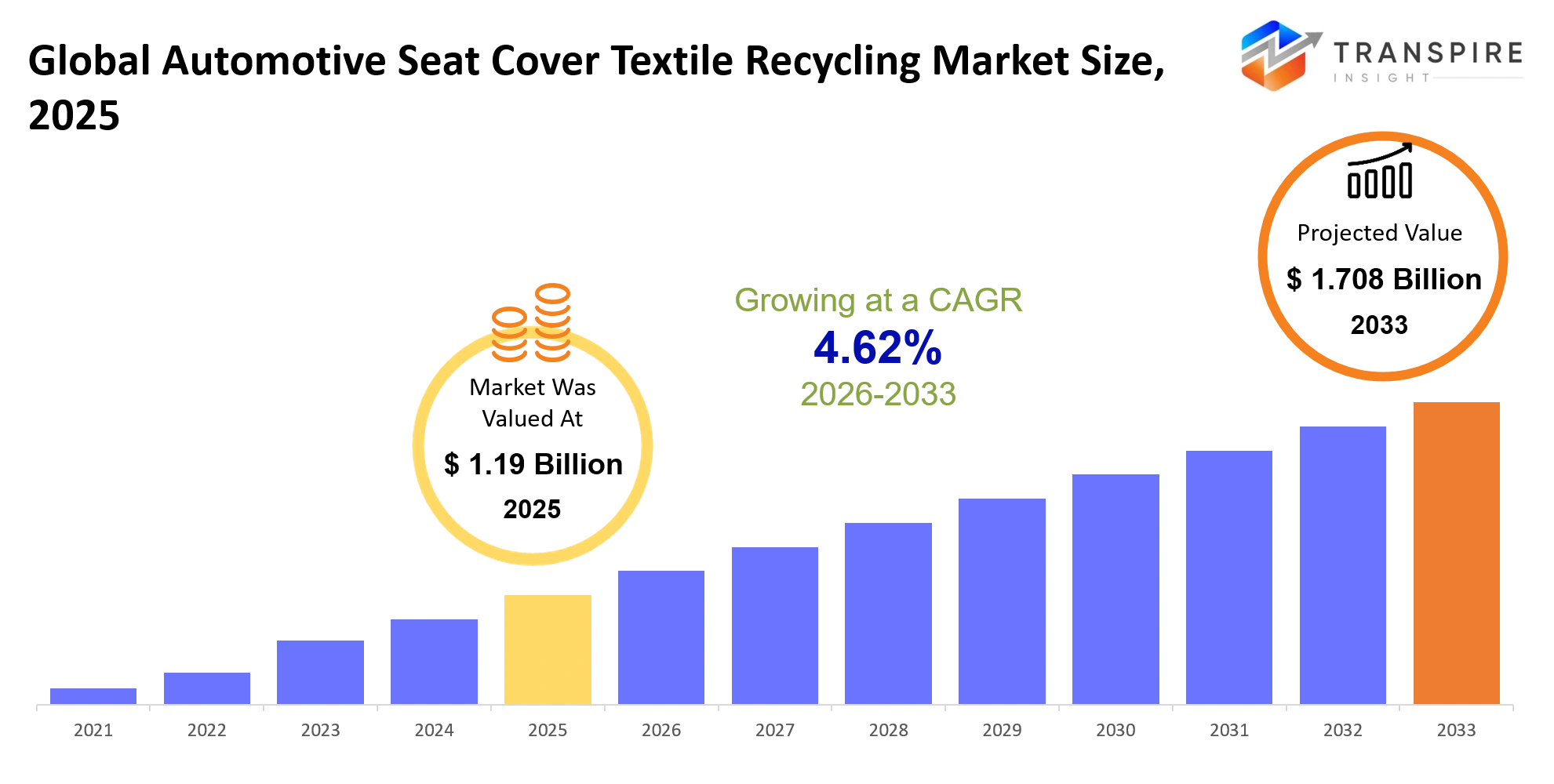
As per Transpire Insight Analysis, the Automotive Seat Cover Textile Recycling Market size is estimated at USD 1.19 Billion in 2025 and is anticipated to reach USD 1.708 Billion by 2033, growing at a CAGR of 4.62% from 2026 to 2033.
The automotive seat cover textile recycling market operates as a circular industrial ecosystem dedicated to reclaiming, shredding, and depolymerising worn vehicle fabrics - leather scraps, and production off-cuts to transform them back into high-performance interior components. Over the past three to five years, the industry has abandoned traditional low-value downcycling—which merely converted old seat foam and fibers into coarse insulation mats—to pioneer advanced chemical depolymerization setups capable of extracting virgin-grade polyester yarns. A major structural shift is being driven by the EU’s tight End-of-Life Vehicles (ELV) and Corporate Sustainability Reporting Directive (CSRD) mandates - which strictly penalize automotive manufacturers for raw landfill waste. This policy pressure creates a direct cause-and-effect growth loop: as automakers rush to validate closed-loop supply chains and slash vehicle Scope 3 emissions - tier-one interior suppliers are compelled to aggressively substitute virgin petroleum plastics with traceably recycled fiber textiles.
Global Automotive Seat Cover Textile Recycling Market Size & Forecast
- Global Market Size 2025: USD 1.19 Billion
- Expected Market Value (2033): USD 1.708 Billion
- Forecast CAGR (2026–2033): 4.62%
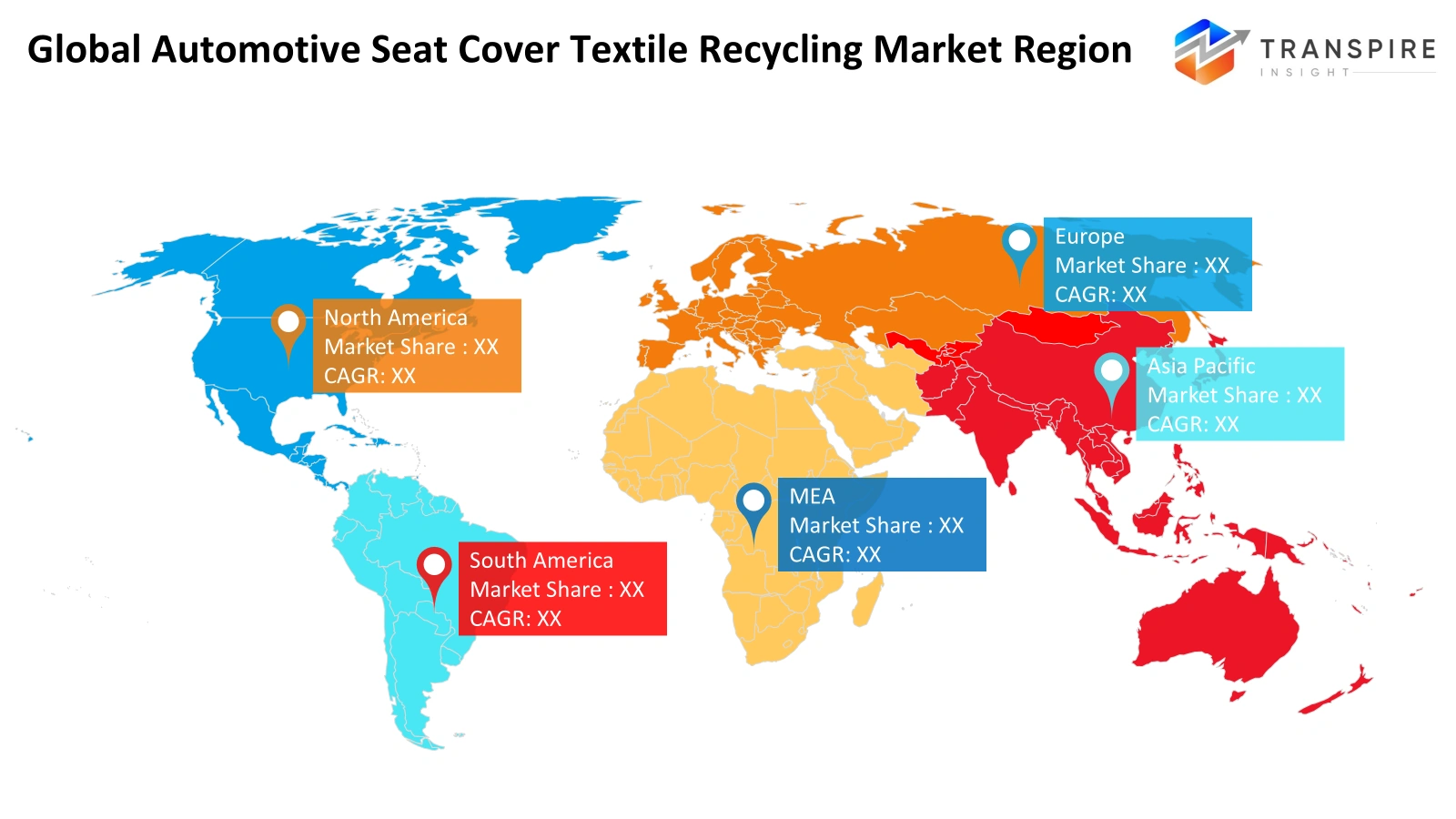
- Leading Region in 2025: Europe
- Fastest Growing Region: Asia Pacific
- Key Company Profiles: Autoneum, Lear Corporation, Adient, Toyota Boshoku, Forvia (Faurecia), Grupo Antolin, Sage Automotive Interiors, Seiren Co., Asahi Kasei, Indorama Ventures, Unifi Inc., Recover Textile Systems, BASF, Covestro, Teijin Limited.
Key Global Automotive Seat Cover Textile Recycling Market Insights
The automotive seat cover textile recycling space is undergoing a massive structural shift away from crude, low-value mechanical shredding toward highly advanced, closed-loop chemical depolymerization. As global automakers aggressively transition interior design baselines toward circular mono-materials, scaling AI-driven optical sorting nodes and embedding transparent traceability systems across the tier-one supply network have become the ultimate pillars for capturing long-term competitive advantage.
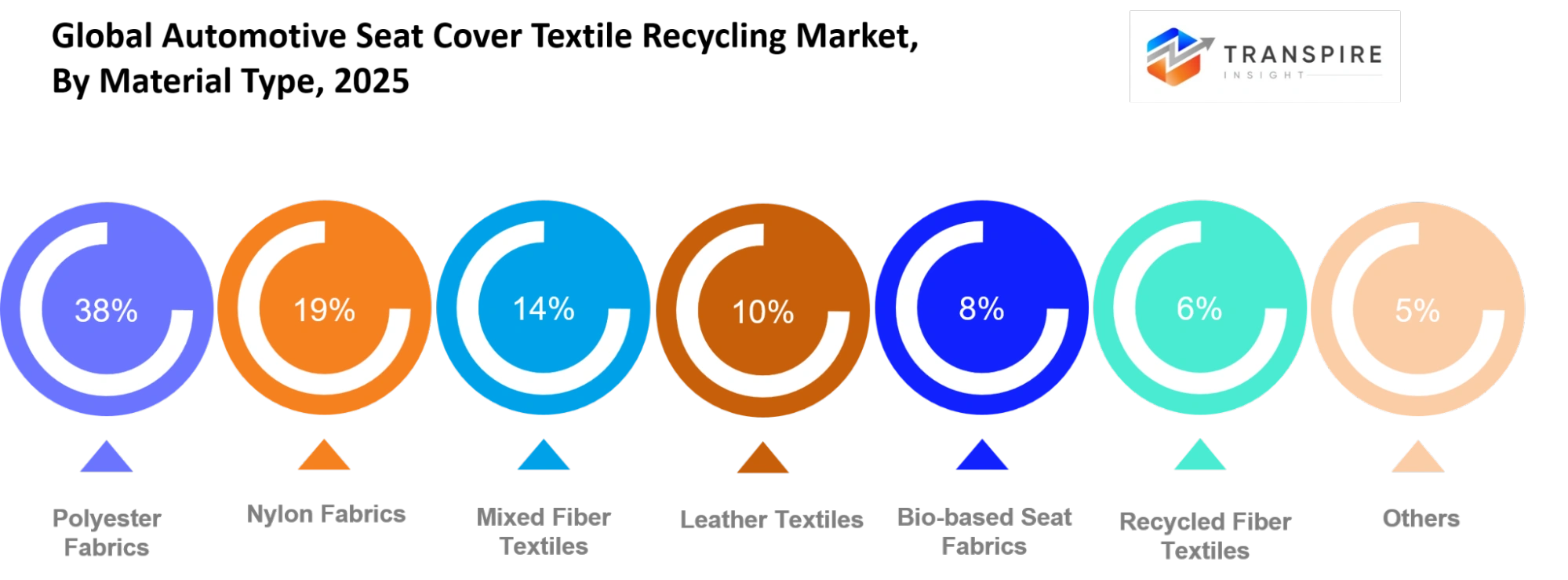
- Polyester Fabrics capture a commanding 38% market share - a dominant position that has driven Autoneum to push the envelope by engineering fully circular, latex-free needlepunch fabrics and tufted interior configurations designed to completely eliminate hard-to-separate multi-material composites.
- Europe accounts for 37% of total global demand - fueled by intensive co-development initiatives where tier-one leaders Adient and Forvia (Faurecia) are rapidly deploying short-loop recycling hubs to guarantee absolute, end-to-end material data transparency before tightening regional circular regulations hit the floor.
- Chemical Recycling functions as the primary technology engine for high-grade circularity, expanding at a market-leading 16.9% CAGR while materials giants BASF and Covestro pour heavy capital into state-of-the-art depolymerization plants that break down mixed post-consumer scrap into virgin-equivalent raw material intermediates.
- Asia Pacific anchors a significant 30% slice of global volume, with Toyota Boshoku and Seiren Co. actively scaling automated, high-throughput eco-fabric manufacturing platforms directly into high-volume electric vehicle assembly lines across regional trade corridors.
- Nylon Fabrics secure a stable 19% segment share, pushing forward-thinking fiber developers Indorama Ventures and Unifi Inc. to scale certified post-industrial nylon recovery setups that convert structural waste into high-tensile yarns built to withstand rigorous cabin friction testing.
- Mixed Fiber Textiles hold a 14% market footprint - a complex challenge that is forcing Recover Textile Systems to deploy proprietary mechanical defibering lines capable of untangling multi-material trim blends and seat belt scraps without snapping or degrading the core fibers.
- Leather Textiles represent 10% of the global matrix - prompting seat systems developer Lear Corporation and textile specialist Sage Automotive Interiors to rapidly expand premium, eco-certified synthetic and plant-derived leather substitutes to satisfy tightening corporate sustainability goals.
- Bio-based Seat Fabrics capture 8% of the industry revenue - driven by electronics and chemical pioneer Asahi Kasei actively partnering with bio-tech ventures to synthesize high-durability, plant-derived structural polymers optimized specifically for harsh automotive interior microclimates.
- Recycled Fiber Textiles round out the core layout at 6% - spearheaded by engineering giant Teijin Limited as they optimize closed-loop collection loops that systematically transform scrap fabric harvested from end-of-life vehicles directly into premium, showroom-ready cabin upholstery threads.
What Are the Key Drivers, Restraints, and Opportunities in the Global Automotive Seat Cover Textile Recycling Market?
Driver
Market growth is heavily propelled by strict international regulatory updates on end-of-life vehicle framework directives combined with intensive original equipment manufacturer (OEM) mandates to achieve closed-loop material transparency. Traditional mechanical shredding methods routinely downcycle automotive fabrics into coarse insulation mats, which ultimately fail to meet structural interior reuse specifications. This operational limitation triggered a widespread transition toward chemical recycling depolymerization plants capable of separating mixed polymer fibers back into pure, raw intermediates. Consequently, this deep material reclamation drives immense corporate adoption because it allows tier-one interior manufacturers to secure certified - showroom-ready recycled polyester yarns directly, satisfying high-velocity vehicle platform quotas while systematically slashing automotive Scope 3 supply chain carbon emissions.
In January 2026, leading global automotive seating developer Adient published its updated continuous circular design framework confirming that integrating traceably recycled polyester fibers directly into mass-production passenger car configurations acts as a vital regulatory compliance investment rather than a generic interior expense. The manufacturer's operational analysis demonstrates that utilizing chemical recovery loops successfully eliminates core material contamination issues—where adhesive backings and multi-layered foam laminates historically prevented single-stream textile processing. By proving that closed-loop fabrics maintain structural abrasion resistance over 50,000 cycles without expanding part weight, this industrial deployment showcases how global automotive brands are altering internal manufacturing budgets to secure circular, landfill-free interior supply chains. [https://www.adient.com/about-us/sustainability/]
Restraint
High technical purification barriers associated with separating complex elastomeric coatings and multi-layered polyurethane foams from base seat textiles act as a major structural barrier holding back mainstream mechanical processing scalability. Moving away from easy-to-recycle pure mono-materials requires recycling entities to invest heavily in advanced - chemical-intensive depolymerization setups or multi-stage AI-assisted optical sorting nodes. This friction persists because historical automotive seat construction relies on cross-linked polymer adhesives to laminate diverse textiles together, creating a complex multi-material mix that easily clogs standard extruder filtration systems and degrades recovered fiber tensile strength.
Opportunity
The most lucrative growth window lies in the widespread optimization of automated chemical recycling loops built explicitly to separate high-purity mono-material polyester textiles without degradation. Engineering specialized inline optical identification cells enables processing plants to sort post-consumer vehicle scrap with zero material cross-contamination. This technological pivot unlocks highly profitable contract opportunities—particularly across booming automotive manufacturing corridors in the Asia Pacific region—by allowing textile recyclers to help mass-market electric vehicle producers clear strict local plastic-reduction penalties and circular assembly target metrics effortlessly.
What Has the Impact of Artificial Intelligence Been on the Global Automotive Seat Cover Textile Recycling Market?
Artificial intelligence is fundamentally reshaping the automotive seat cover textile recycling market, moving post-consumer vehicle cabin recovery away from unpredictable manual disassembly lines toward automated, hyper-accurate fiber-sorting optimization loops. Instead of relying on plant operators to blindly interpret missing or faded physical material tags, modern processing facilities deploy advanced machine-learning computer-vision architectures paired with near-infrared (NIR) spectroscopy to identify polymer structural compositions right on the conveyor belt.
Inside industrial textile recovery hubs, advanced algorithmic models drive immense operational improvements through real-time multi-layered blend analysis and automated sorting singulation. By processing complex visual and spectral data streams simultaneously, these edge-AI networks calculate precise elastomeric and synthetic ratios, predicting feedstock compatibility before chemical depolymerization takes place. This predictive mechanism ensures high-purity polyester segregation while preventing catalyst contamination, effectively maximizing downstream recycling yields.
However, a serious operational limitation persists around complex multi-material lamination accuracy gaps and steep sensor integration costs. Separating structural textiles that are cross-linked with thick polyurethane foam backings creates an processing bottleneck, where internal adhesive occlusion can skew AI material classification readings.
In March 2026, AI-driven sorting developer Refiberd expanded its post-consumer material analysis infrastructure by deploying its automated textile-to-textile classification architecture at scale. This specialized software framework utilizes advanced hyperspectral imaging alongside trained deep-learning models to instantly identify complex fiber breakdowns. By actively flagging specific structural defects like severe fiber tearing or heavy resin contamination directly on the high-speed sorting line, the system allows automotive interior recyclers to quickly isolate high-purity synthetic feedstocks from complex vehicle cabin waste.
Key Market Trends
The automotive seat cover textile recycling market is shifting away from fragmented downcycling operations toward highly integrated, closed-loop industrial reprocessing networks. Driven by aggressive vehicle electrification timelines and severe original equipment manufacturer (OEM) mandates for single-stream material circularity, global automotive interior developers are systematically replacing multi-material cabin composites with clean, infinitely recyclable textile systems.
- Raw fiber procurement is transitioning from complex, oil-dependent virgin synthetics toward traceably certified recycled polyester (rPET) matrices to support cradle-to-cradle interior assembly lines.
- Interior engineering practices are moving far past multi-layer adhesive lamination to embrace fully integrated mono-material designs that can be ground down without chemical separation.
- Fabric backing architectures are shifting from rigid - cross-linked rubber coatings to adopt advanced - latex-free needlepunch and tufted structures that facilitate immediate mechanical breakdown.
- Sorting room methodologies are abandoning simple human visual selection to install high-speed near-infrared (NIR) and hyperspectral camera sorting cells that categorize fiber blends automatically by polymer ratio.
- Reclamation chemistry is transitioning from old-school thermal combustion to implement highly specialized chemical depolymerization setups that revert stained interior fabrics back into pure - virgin-grade monomers.
- Automotive design frameworks are moving away from mixed-material seat architectures to deploy completely unified, single-polymer seating assemblies where the fabric, foam, and structural threads share an identical chemical base.
- Supply chain tracing is shifting from static paper certifications to utilize secure - product-passport digital data streams that log recycled content transparently from post-consumer vehicles to the factory floor.
- Premium interior styling is transitioning from classic, high-emission animal leathers to adopt engineered, plant-derived bio-fabrics that offer identical premium haptics with an ultra-low carbon footprint.
- End-of-life vehicle dismantling is moving away from chaotic bulk crushing to integrate modular "design-for-disassembly" seat components featuring specialized - tool-free pull-tabs for rapid fabric stripping.
Global Automotive Seat Cover Textile Recycling Market Segmentation
By Material Type
Polyester Fabrics commands the largest share of market capital, holding a dominant 38% of global revenue due to its unmatched mechanical durability, extensive high-volume adoption across passenger vehicle platforms, and direct compatibility with continuous industrial depolymerization networks. Nylon Fabrics follows at 19%, Mixed Fiber Textiles holds 14%, Leather Textiles captures 10%, while Bio-based Seat Fabrics accounts for 8%. Recycled Fiber Textiles stands out at 6%, while other specialized or coated textile variants round out the remaining 5% of the industry footprint. This division is shaped by the strict operational balance between long-term interior abrasion resistance and end-of-life chemical processing safety. Polyester Fabrics maintains its peak position because global automotive manufacturers systematically address strict vehicle circularity metrics—where composite interior components must be easily unzipped or chemically separated—by shifting away from multi-polymer layers toward single-polymer polyester seating systems. Moving forward, material engineering will pivot toward mono-material optimization, forcing textile developers to replace traditional polyurethane laminates with fully recyclable, latex-free polyester spacer fabrics that deliver identical structural cushioning while ensuring the seat assembly melts down cleanly into pure monomer feedstocks.
By Recycling Process
Chemical Recycling serves as the primary financial engine of the operational matrix, expanding at an explosive - market-leading CAGR of 16.9% due to its unique ability to achieve true textile-to-textile circularity and its capacity to restore polymer chains at a molecular level without material downcycling. Mechanical Recycling follows as a key volume driver, Fiber Recovery and Closed-loop Recycling provide stable secondary volumes for localized manufacturing infrastructure - while Thermal Recovery, Hybrid Recycling - AI-assisted Sorting form specialized technical segments. The underlying growth logic relies on cross-material purity optimization and volatile adhesive removal, where tier-one supply networks demand recycled feedstocks that exactly replicate the strict color consistency, zero odor, and high tensile strength profiles of virgin petroleum resins. Chemical depolymerization processes maintain this peak strategic positioning because their molecular splitting mechanisms allow recycling plants to break down deeply soiled, adhesive-backed, or flame-retardant-treated automotive fabrics directly into high-purity monomer intermediates. Moving forward, industrial processing success will require the widespread adoption of automated, hybrid chemical recycling configurations, compelling processor networks to supply certified, ultra-pure recycled polyester chips that blend seamlessly into standard high-speed yarn extrusion and fabric spinning lines without causing line breaks.
By Vehicle Type
Passenger Cars functions as the undisputed anchor of this matrix, capturing a commanding portion of total industry volume due to massive global production scales, while Electric Vehicles stands out as the fastest-accelerating asset class driven by intensive eco-homologation and low-carbon design frameworks. SUVs alongside Commercial Vehicles hold a stable, heavy-duty secondary share, primarily serving long-lifecycle fleet transport, while Luxury Vehicles, Buses & Coaches, and Off-road Vehicles form highly specialized interior trim niches. This distribution pattern is driven by the global original equipment manufacturer (OEM) push for absolute lifecycle circularity and the elimination of heavy landfill waste streams. Passenger Cars leads because mass-market high-volume vehicle platforms are targeted directly by tightening regional end-of-life vehicle mandates that require a minimum percentage of post-consumer recycled content in all newly assembled plastic and textile components. Moving forward, vehicle application tech will focus heavily on modular interior layouts, pushing seat frame and interior designers to deliver integrated, snap-fit seating structures that isolate large textile sections from structural frames instantly during end-of-life vehicle dismantling.
By End User
Automotive OEMs and Tier-1 Suppliers function as the primary commercial drivers of this market, controlling a combined majority of total industry volume due to their direct ownership of new vehicle platform designs and strict component supply contracts. Recycling Companies and Textile Manufacturers follow closely as critical execution pillars that transform raw scrap back into high-performance interior threads, while Fleet Operators, Aftermarket Suppliers, and Sustainability Organizations represent specialized regulatory and validation touchpoints. This division is shaped by the macro transition away from linear automotive assembly toward closed-loop resource resilience, where securing high-quality recycled feedstock directly influences new vehicle validation and factory entry. OEMs and Tier-1 integrators lead the market position because upcoming green vehicle manufacturing mandates make traceable circular supply chains vital to protecting brand market access from steep regulatory carbon penalties. Moving forward, end-user strategies will focus heavily on digital material passports, forcing interior system suppliers to deploy secure tracking streams that log the exact origin and purity of recycled yarns from the dismantling yard directly onto the showroom floor.
By Application
Seat Covers commands the largest share of market capital, holding a dominant 34% of global revenue due to their substantial mass per vehicle and their natural compatibility with advanced textile recovery pathways. Interior Trim and Door Panels follow closely as active secondary layers, Headliners and Floor Carpets capture critical volume shares, while Insulation Materials and general Automotive Upholstery represent expanding technical niches. This division persists because car seat skins are exposed to extreme friction, sweat, and UV rays, requiring the highest tier of raw yarn purity to pass rigorous OEM durability validation tests. Seat Covers maintain their peak position because global styling studios can seamlessly substitute virgin fibers with chemically recycled yarns without altering existing loom hardware or compromising surface haptics. Moving forward, application strategies will pivot sharply toward integrated multi-functional textiles, enabling automated recycling plants to reprocess seat skins directly into high-performance NVH (noise, vibration, and harshness) soundproofing blankets or structural under-seat carpet backing tiles without compounding processing steps.
What Are the Global Key Use Cases Driving the Automotive Seat Cover Textile Recycling Market?
The dominant utilization of polyester fabrics is heavily driven by high-volume passenger car seat covers to satisfy global automotive original equipment manufacturer (OEM) circular production baselines. Tier-one seating integrators integrate these traceably recycled synthetic threads directly into high-output automated looming architectures - weaving the recycled fiber into premium upholstery layers that handle extreme cabin friction. This process systematically eliminates heavy landfill waste by transforming post-consumer materials back into virgin-equivalent structural fabrics.
Beyond primary seating components, expanding applications are highly visible across structural interior trim, door panels, and headliners. Global electric vehicle platforms deploy dense, non-woven recycled fiber blends within concealed vehicle layers to act as a highly effective sound insulation shield, lowering cabin acoustics without adding weight.
Emerging operational use cases are focusing on mono-material design frameworks and advanced closed-loop digital passport compliance. Premium electric vehicle programs utilize certified chemical depolymerization setups to break down mixed cabin textiles and foam backing together, yielding clean, un-contaminated monomer streams that satisfy extended producer responsibility mandates seamlessly.
|
Report Metrics |
Details |
|
Market size value in 2025 |
USD 1.19 Billion |
|
Market size value in 2026 |
USD 1.245 Billion |
|
Revenue forecast in 2033 |
USD 1.708 Billion |
|
Growth rate |
CAGR of 4.62% from 2026 to 2033 |
|
Base year |
2025 |
|
Historical data |
2021 - 2024 |
|
Forecast period |
2026 - 2033 |
|
Report coverage |
Revenue forecast, competitive landscape, growth factors, and trends |
|
Regional scope |
United States; Canada; Mexico; United Kingdom; Germany; France; Italy; Spain; Denmark; Sweden; Norway; China; Japan; India; Australia; South Korea; Thailand; Brazil; Argentina; South Africa; Saudi Arabia; United Arab Emirates |
|
Key company profiled |
Autoneum, Lear Corporation, Adient, Toyota Boshoku, Forvia (Faurecia), Grupo Antolin, Sage Automotive Interiors, Seiren Co., Asahi Kasei, Indorama Ventures, Unifi Inc., Recover Textile Systems, BASF, Covestro, Teijin Limited. |
|
Customization scope |
Free report customization (country, regional & segment scope). Avail customized purchase options to meet your exact research needs. |
|
Report Segmentation |
By Material Type (Polyester Fabrics, Nylon Fabrics, Leather Textiles, Vinyl Textiles, Mixed Fiber Textiles, Bio-based Seat Fabrics, Recycled Fiber Textiles, Others); By Recycling Process (Mechanical Recycling, Chemical Recycling, Fiber Recovery, Closed-loop Recycling, Thermal Recovery, Hybrid Recycling, AI-assisted Sorting, Others); By Vehicle Type (Passenger Cars, SUVs, Commercial Vehicles, Electric Vehicles, Luxury Vehicles, Buses & Coaches, Off-road Vehicles, Others); By End User (Automotive OEMs, Tier-1 Suppliers, Recycling Companies, Textile Manufacturers, Fleet Operators, Aftermarket Suppliers, Sustainability Organizations, Others); By Application (Seat Covers, Interior Trim, Door Panels, Headliners, Floor Carpets, Insulation Materials, Automotive Upholstery, Others). |
Which Regions are Driving the Global Automotive Seat Cover Textile Recycling Market Growth?
Europe maintains a commanding grip on the automotive seat cover textile recycling market, capturing a dominant 37% of all worldwide industry revenue. This geographic leadership is heavily driven by tight regional circular economy frameworks and aggressive end-of-life vehicle - (ELV) dismantling laws that force original equipment manufacturers to minimize industrial landfill waste. The regional ecosystem is structurally supported by a dense, highly specialized network of automotive interior giants like Adient and Forvia who are actively deploying localized material collection hubs. Consequently, transitioning away from multi-layer composite trims toward traceably certified, mono-material polyester cabin systems has become the standard operational baseline for European factory lines.
In June 2026, French automotive supplier Forvia Interiors expanded its structural sustainability footprint by integrating its premium interior styling know-how with Materi - Act's advanced recycled and circular materials engineering. This operational deployment focuses heavily on accelerating the volume of post-consumer plastics and reclaimed fibers used within premium automotive cabin assemblies. By processing locally harvested vehicle waste into certified, showroom-ready interior trim components, the company provides automakers with a dependable pathway to meet tightening European supply chain sustainability mandates. [https://www.textilemedia.com/mobiletex/latest-news/]
The Asia Pacific region serves as a highly active, high-volume secondary pillar for the global market, locking down an essential 30% share of total industry demand. While European expansion is propelled by rigid regulatory circularity codes and strict manufacturing penalties, Asian adoption is shaped by massive regional electric vehicle production scales and the rapid layout of high-throughput assembly lines. This regional market stability is structurally insulated by intensive long-term carbon neutrality blueprints from key Japanese and Chinese automotive conglomerates looking to secure resource resilience. To reduce dependency on foreign petroleum resins and manage manufacturing scrap efficiently, regional interior textilers steadily invest in large-scale mechanical defibering and fiber recovery networks.
In May 2026, interior space systems pioneer Toyota Boshoku Corporation showcased its advanced horizontal recycling framework at the Automotive Engineering Exposition - targeting the widespread resource circulation of end-of-life vehicle interior parts. The company's technical update details the systematic replacement of traditional multi-layer polyethylene laminates with advanced copolymerized polyester mono-materials across cabin surfaces. By enabling the direct mechanical and chemical reprocessing of production scrap into high-tensile recycled fiber threads - this framework reduces lifecycle cabin manufacturing carbon emissions by roughly 30%. [https://tech.toyota-boshoku.com/aee2026/global/]
North America has emerged as the fastest-growing territory globally, accelerating at a market-leading standalone compound growth rate while currently holding a 24% slice of global sales. This sudden structural shift is driven by aggressive corporate sustainability commitments, a rapid transformation of tier-one supplier procurement standards, and heavy investment in automated edge-sorting hardware across regional automotive hubs. Historically, regional manufacturing entities downcycled automotive textiles into low-grade industrial insulation or padding mats, but an intense push toward zero-waste factory metrics has forced the widespread adoption of advanced chemical depolymerization systems. Looking ahead, future manufacturing infrastructure development in this booming corridor relies heavily on deploying closed-loop synthetic fiber networks that feed pure recycled yarn directly back into high-volume seating programs.
In February 2026, leading global automotive seating developer Adient officially implemented its updated Global Supplier Standards Manual alongside its comprehensive Supplier Code of Conduct. This strategic validation framework mandates that all - tier-two raw material partners proactivly participate in EcoVadis sustainability screenings and provide transparent product carbon footprint metrics upon request. By enforcing strict traceability across its entire structural textile and molded foam supply chain - the corporate update positions Adient to eliminate landfill waste while securing high-purity recycled content for next-generation vehicle platforms. [https://adient.portal.covisint.com/assets/adient/documents/Supplier%20Expectations/Adient_SCOC_02-2026%20(1).pdf]
Who Are the Key Players in the Global Automotive Seat Cover Textile Recycling Market and How Do They Compete?
The global automotive seat cover textile recycling space functions as an intense industrial battleground between multi-billion-dollar tier-one automotive seating integrators - specialized technical textile manufacturers - and multinational chemical corporations. With global passenger car and electric vehicle platforms prioritizing strict mono-material validation - digital material tracking, and landfill-diversion metrics over legacy multi-layer downcycling, market participants compete on three primary fronts. These include engineering fully circular and adhesive-free cabin textiles - optimizing high-purity chemical depolymerization setups, and scaling dedicated circular supply contracts across high-volume automotive production corridors.
Autoneum operates an innovation-driven product strategy, positioning its cabin portfolio around high-performance acoustic and thermal insulation material science. The vendor differentiates its market presence by engineering advanced - fully recyclable mono-material needlepunch systems and latex-free polyester felt assemblies that can be ground down without chemical separation. The company expands its global automotive footprint by rolling out modular eco-efficiency recycling cells near major factory hubs - establishing short-loop production lines tailored to satisfy strict vehicle end-of-life framework standards.
Adient runs a highly optimized niche-focused strategy targeted squarely at original equipment manufacturers (OEMs) who demand traceable, closed-loop interior components to satisfy strict corporate Scope 3 emission limits. The manufacturer differentiates its market position by deploying its proprietary Evolution of Seating Systems Sustainability (ES³) framework - utilizing certified traceably recycled polyester threads that guarantee identical abrasion resistance to virgin synthetics. They expand their global operational footprint by establishing strict, multi-tier digital material passport compliance mandates across their supply chain network - securing long-term recurring material pipelines with international electric vehicle manufacturers.
Company List
- Autoneum
- Lear Corporation
- Adient
- Toyota Boshoku
- Forvia (Faurecia)
- Grupo Antolin
- Sage Automotive Interiors
- Seiren Co.
- Asahi Kasei
- Indorama Ventures
- Unifi Inc.
- Recover Textile Systems
- BASF
- Covestro
- Teijin Limited
Recent Development News
In March 2026, interior components manufacturer Autoneum formally expanded its circular engineering portfolio by deploying a highly advanced line of 100% recyclable mono-material carpets - polyester felt structural insulation systems. The product launch enables automotive original equipment manufacturers to substitute multi-layered - composite synthetic trims with single-polymer interior components that melt down cleanly without requiring auxiliary chemical separation loops.
Source: https://www.autoneum.com
In March 2026, automotive components pioneer Toyota Boshoku Corporation celebrated the official groundbreaking ceremony of its high-capacity third factory project at the Auric Bidkin Industrial Park in Maharashtra - India. This strategic geographic expansion targets the high-volume production of advanced interior space frameworks to satisfy booming regional electric vehicle and premium vehicle platform demands across major Asian trade corridors.
Source: https://www.shimz-global.com
In June 2026, global seating innovator Lear Corporation was honored at the Ford Supplier Awards & Summit by receiving the prestigious 2026 - Ford Supplier of the Year for Sustainability award. The recognition highlights Lear’s - extensive operational advancements in rolling out its certified ReNewKnit premium suede materials - which utilize 100% recycled plastic bottles and polyester yarns to completely replace traditional polyurethane foam-laminated cabin fabrics.
Source: https://www.lear.com/
What Strategic Insights Define the Future of the Global Automotive Seat Cover Textile Recycling Market?
The market is heading toward true horizontal textile-to-textile ecosystems, where post-consumer cabin waste transitions from downcycled padding mats into high-purity, showroom-ready fibers. A major hidden risk lies in "flame-retardant chemical occlusion." As advanced chemical depolymerization setups scale up, the unpredictable concentrations of heavy organophosphorus or halogenated compounds embedded within legacy vehicle seat foams and adhesives can poison chemical catalysts, leading to unexpected batch failures and volatile purification costs.
Conversely, an essential emerging opportunity is the development of deep mono-material thermoplastic composite integration. Structurally designing all-polyester seating architectures—where the skin, backing threads, and underlying cushions share a common polymer group—allows recycling plants to skip expensive mechanical delamination steps entirely.
Strategic recommendation - Platform developers must shift from providing basic mechanical sorting to delivering unified, closed-loop processing frameworks featuring inline near-infrared (NIR) purity validation. This pivot insulates tier-one suppliers from tightening regional circular quotas while maximizing feedstock consistency.
Key Segmentations are:
By Material Type
- Polyester Fabrics
- Nylon Fabrics
- Leather Textiles
- Vinyl Textiles
- Mixed Fiber Textiles
- Bio-based Seat Fabrics
- Recycled Fiber Textiles
- Others
By Recycling Process
- Mechanical Recycling
- Chemical Recycling
- Fiber Recovery
- Closed-loop Recycling
- Thermal Recovery
- Hybrid Recycling
- AI-assisted Sorting
- Others
By Vehicle Type
- Passenger Cars
- SUVs
- Commercial Vehicles
- Electric Vehicles
- Luxury Vehicles
- Buses & Coaches
- Off-road Vehicles
- Others
By End User
- Automotive OEMs
- Tier-1 Suppliers
- Recycling Companies
- Textile Manufacturers
- Fleet Operators
- Aftermarket Suppliers
- Sustainability Organizations
- Others
By Application
- Seat Covers
- Interior Trim
- Door Panels
- Headliners
- Floor Carpets
- Insulation Materials
- Automotive Upholstery
- Others
Regional Outlook
North America
- United States
- Canada
- Mexico
Europe
- Germany
- United Kingdom
- France
- Spain
- Italy
- Rest of Europe
Asia Pacific
- Japan
- China
- Australia & New Zealand
- South Korea
- India
- Rest of Asia Pacific
South America
- Brazil
- Argentina
- Rest of South America
Middle East & Africa
- Saudi Arabia
- United Arab Emirates
- South Africa
- Rest of the Middle East & Africa
Frequently Asked Questions
Find quick answers to common questions.
The global automotive seat cover textile recycling market size was estimated at USD 1.19 Billion in 2025 and is anticipated to reach USD 1.708 Billion by 2033, growing at a CAGR of 4.62% from 2026 to 2033.
Key segments for the market are Material Type (Polyester Fabrics, Nylon Fabrics, Leather Textiles, Vinyl Textiles, Mixed Fiber Textiles, Bio-based Seat Fabrics, Recycled Fiber Textiles, Others); Recycling Process (Mechanical Recycling, Chemical Recycling, Fiber Recovery, Closed-loop Recycling, Thermal Recovery, Hybrid Recycling, AI-assisted Sorting, Others); Vehicle Type (Passenger Cars, SUVs, Commercial Vehicles, Electric Vehicles, Luxury Vehicles, Buses & Coaches, Off-road Vehicles, Others); End User (Automotive OEMs, Tier-1 Suppliers, Recycling Companies, Textile Manufacturers, Fleet Operators, Aftermarket Suppliers, Sustainability Organizations, Others); and Application (Seat Covers, Interior Trim, Door Panels, Headliners, Floor Carpets, Insulation Materials, Automotive Upholstery, Others).
Growth is primarily driven by strict international regulatory updates on end-of-life vehicle (ELV) framework directives combined with intensive original equipment manufacturer (OEM) mandates to achieve closed-loop material transparency and satisfy rigorous Scope 3 supply chain carbon reduction quotas.
The global market is led by major manufacturers including Autoneum, Lear Corporation, Adient, Toyota Boshoku, Forvia (Faurecia), Grupo Antolin, Sage Automotive Interiors, Seiren Co., Asahi Kasei, Indorama Ventures, Unifi Inc., Recover Textile Systems, BASF, Covestro, and Teijin Limited.
Europe holds a dominant 37% share of global revenue, heavily influencing industry dynamics through aggressive regional circular economy laws, tight extended producer responsibility mandates, and localized tier-one supplier co-development hubs that force the immediate adoption of traceable, mono-material cabin fabrics.
Specialized market opportunities exist in the widespread optimization of automated chemical recycling loops built explicitly to separate high-purity mono-material polyester textiles without degradation, alongside the integration of inline optical identification cells that allow processing plants to sort post-consumer vehicle scrap with zero cross-contamination.
- Autoneum
- Lear Corporation
- Adient
- Toyota Boshoku
- Forvia (Faurecia)
- Grupo Antolin
- Sage Automotive Interiors
- Seiren Co.
- Asahi Kasei
- Indorama Ventures
- Unifi Inc.
- Recover Textile Systems
- BASF
- Covestro
- Teijin Limited
About the Authors

Mayur Shinde
I am Mayur Shinde, a Senior Research Analyst at Transpire Insight, specializing in the Automotive & Transportation and Information & Communication Technology (ICT) Industry. My work focuses on analyzing emerging market trends, technological advancements, competitive landscapes, and industry developments to deliver accurate, data-driven insights. I am passionate about transforming complex market information into clear, actionable content that helps businesses, professionals, and decision-makers stay informed and make confident strategic decisions.

Chakradhar Khansole
Chakradhar serves as the Research Director at Transpire Insight, bringing over 8 years of experience in technology, innovation, and strategic market intelligence. He specializes in transforming complex market data into actionable business insights that enable organizations to make informed, growth-oriented decisions. Recognized for his strategic vision and analytical expertise, Chakradhar leads high-impact research initiatives, delivering comprehensive market assessments, competitive intelligence, and forward-looking industry analysis.
Recently Published Reports
-
Apr 2026
ATV & UTV Market
ATV & UTV Market Size, Share & Analysis Report By Type (ATV, and UTV), By Variants (Less Than 400 CC, 400 CC To 800 CC, and More Than 800 CC), and Geography (North America, Europe, Asia-Pacific, Middle East and Africa, South and Central America), 2021 - 2031
-
Apr 2026
Automotive Central Gateway Module Market
Automotive Central Gateway Module Market Size, Share & Analysis Report By Type (Ethernet Central Gateway Module, CAN Central Gateway Module, LIN Central Gateway Module, and FlexRay), By Application (Powertrain Control, Body Control, Infotainment System, Advanced Driver Assistance Systems (ADAS), and Others), By End User (Passenger Vehicles, and Commercial Vehicles), and Geography (North America, Europe, Asia-Pacific, Middle East and Africa, South and Central America), 2021 - 2031
-
Apr 2026
Automotive Engine Oil Filter Market
Automotive Engine Oil Filter Market Size, Share & Analysis Report By Filter Type (Fuel Filter, Engine Oil Filter, Hydraulic Oil Filter, and Others), By Filter Media (Cellulose, Synthetic, and Micro), By Sales Channel (OEMs, and Aftermarket), By Vehicle Type (Passenger Cars, Light Commercial Vehicles, Heavy Duty Trucks, Buses and Coaches, and Off-road Vehicles), and Geography (North America, Europe, Asia-Pacific, Middle East and Africa, South and Central America), 2021 - 2031
-
Apr 2026
Automotive Parts Aluminium Die Casting Market
Automotive Parts Aluminium Die Casting Market Size, Share & Analysis Report By Production Process (Pressure Die Casting, Vacuum Die Casting, Squeeze Die Casting, Gravity Die Casting), By Application (Body Parts, Engine Parts, Transmission Parts, Battery And Related Components, Other Application Types), and Geography (North America, Europe, Asia-Pacific, Middle East and Africa, South and Central America), 2021 - 2031
Our Clients



