

Global Aircraft Insurance Market Size & Forecast:
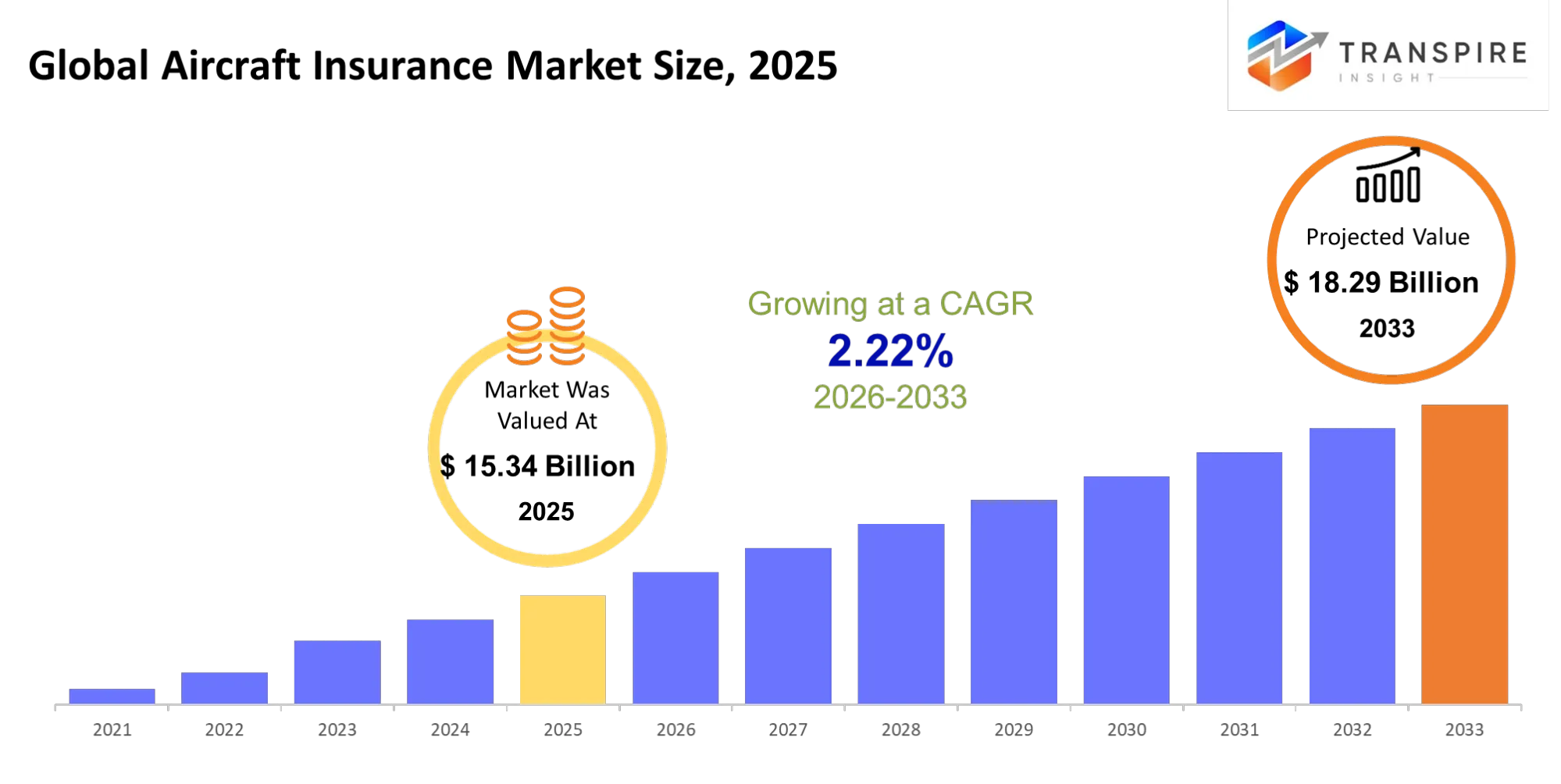
- Global Aircraft Insurance Market Size 2025: USD 15.34 billion
- Global Aircraft Insurance Market Size 2033: USD 18.29 billion
- Global Aircraft Insurance Market CAGR: 2.22%
- Global Aircraft Insurance Market Segments: Global Aircraft Insurance Market By Type (Hull Insurance, Liability Insurance, Passenger Liability Insurance, Cargo Insurance, Third-party Insurance, War Risk Insurance, Others); By Application (Commercial Aircraft, Private Jets, Cargo Aircraft, Military Aircraft, Helicopters, Others); By End-User (Airlines, Aircraft Leasing Companies, Government Aviation Authorities, Private Owners, Others); By Coverage (Comprehensive Coverage, Partial Coverage, Specialized Aviation Coverage, Others)
Global Aircraft Insurance Market Summary:
The Global Aircraft Insurance Market size is estimated at USD 15.34 billion in 2025 and is anticipated to reach USD 18.29 billion by 2033, growing at a CAGR of 2.22% from 2026 to 2033.
The Global Aircraft Insurance Market is really important for airlines and people who own aircraft and for companies that lease planes and provide aviation services. This market helps protect them from losing money when accidents happen or when they have to stop operating. It also helps when people make claims against them or when their aviation equipment gets damaged. The Global Aircraft Insurance Market has changed a lot over the past few years. This is because airlines are using technologies and they have more planes now. They are also getting better at figuring out what might go wrong.
One big change is that insurance companies are using computers to help them decide how much to charge for insurance. They use real-time information about how planes are being used and maintained to make these decisions. When people started travelling by air after the pandemic, airlines started using their planes more, and they needed better insurance. Now insurance companies are creating policies for airlines. As more people fly and airlines get planes, insurance companies are getting more business. This is because airlines need protection from accidents and other problems. The Global Aircraft Insurance Market is. It will keep growing because airlines need insurance to operate safely.
Key Market Insights:
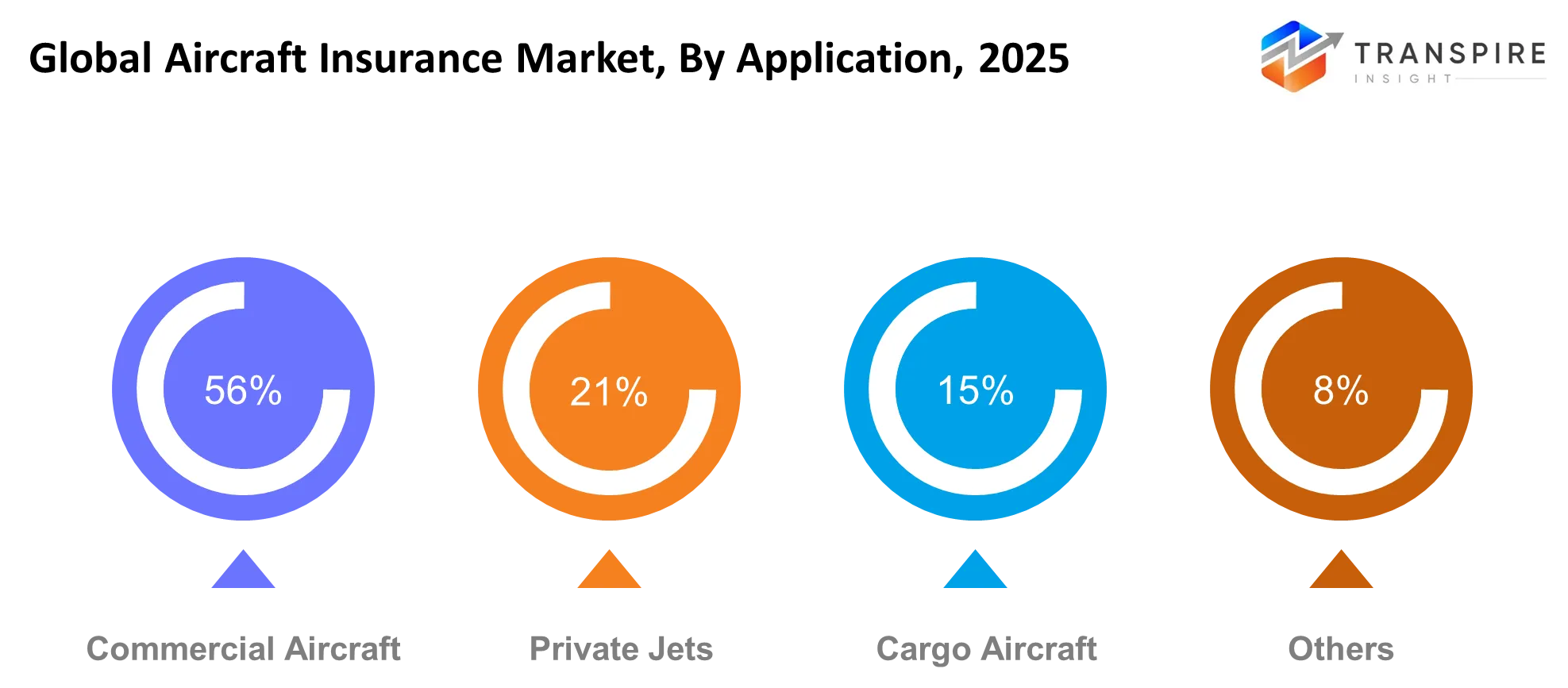
The commercial aviation segment dominates the aircraft insurance industry and contributes to 56% of the total revenue. The war risk insurance segment is witnessing strong growth, growing at a CAGR of 7.2%.
- The Commercial Aircraft segment accounts for a 56% market share. Insurers are increasing fleet coverages, whereas airlines are looking for enhanced risk protection.
- The Private Jets segment constitutes 21% of the market. Providers are developing customised insurance products for private jet aviation.
- The Cargo Aircraft segment accounts for 15% market share. Increased demand for cargo insurance products is anticipated.
- The Others segment is responsible for 8% of revenue share. Development of aviation insurance products continues.
- The Commercial Aircraft segment leads the market with 56% share. Companies are improving their underwriting process.
- The War Risk Insurance segment is witnessing rapid growth with a CAGR of 7.2%. Insurers are providing improved war risk coverage.
- The Private Jets and Cargo Aircraft segments collectively comprise 36% market share. Development of insurance products is gaining momentum.
What are the Key Drivers, Restraints, and Opportunities in the Global Aircraft Insurance Market?
Drivers
One of the significant drivers behind the growth witnessed in the market for aircraft insurance is the growing sophistication and costliness of today’s fleets. Airlines, freighters, and private aviation companies have opted to invest in new-generation planes that come fitted with advanced avionics and connectivity capabilities. Consequently, airlines have become increasingly susceptible to the risk factors associated with accidents and the malfunctioning of sophisticated equipment on board, leading to an increase in the scope and size of insurance policies. Furthermore, aircraft leasing practices have become common, requiring insurance as a condition precedent.
Restraints
Another critical limitation impacting the growth of the aviation insurance market is the inherent volatility of the insurance claims associated with this sector. Significant financial losses can occur due to aircraft incidents, repairs, legal issues, and compensation payments. The problem remains unsolved due to the high value of the risks, their hard-to-predict nature, and the difference in safety levels and regulations between regions. In this regard, premium rates tend to be raised, or the conditions of insurance policy subscription become harder, deterring potential clients.
Opportunity
One of the main opportunities available for market participants is the adoption of risk assessment solutions. The use of predictive analytics, telematic devices, artificial intelligence, and real-time tracking technology may allow them to make precise calculations and provide individualised insurance policies based on the analysed data. For instance, insurers using data about aircraft performance and maintenance history could offer pay-per-mile services. Investments in digital aviation infrastructure in such areas as Asia-Pacific and the Middle East are likely to boost revenue generation.
What Has the Impact of Artificial Intelligence Been on the Global Aircraft Insurance Market?
Artificial intelligence plays a key role in the development of the aviation insurance market by providing accurate risk assessments, effective underwriting operations, and efficient claims handling. Using AI-based programs, insurers are able to analyse information on aircraft operations, including maintenance logs, flight histories, and environmental factors that affect planes' safety.
AI provides reliable prediction abilities. In turn, detecting possible technical issues before they occur allows estimating the price and contributing to a higher level of preventive maintenance, which in turn leads to fewer claims in the future. Besides, AI provides increased operational efficiency through automated claims handling and fraud detection and helps insurers conduct continuous monitoring of risk and ensure faster and more precise customer interaction. The biggest obstacle in adopting artificial intelligence for aviation insurance is related to its high cost of implementation.
Instance
January 2026, Newgen rolled out its AI-enabled underwriting assistant designed specifically for speciality insurance lines, including aviation. This AI tool helps in carrying out real-time risk assessment and predictions along with automating the entire process of underwriting. By leveraging AI technology, the software allows companies to manage the risks associated with their aircraft in a better way.
Key Market Trends
Insurers in the aircraft sector are increasingly turning to a data-based approach to assessing risks as aircraft become more digitalised. The new developments in aviation, cybersecurity, and changes in aircraft fleets have been affecting the strategy employed by aviation insurers in providing coverage.
- Real-time information about flight operations and other related details is used in risk assessment and policy pricing.
- Usage-based insurance schemes are becoming more popular as they take into account the amount of flight time for each aircraft.
- Connected aircraft will lead to increased demand for digital risk monitoring techniques.
- Protection against cyberattacks is emerging as an important part of aviation insurance policies.
- Insurers are revising their underwriting approaches owing to advances in aircraft technologies.
- Insurance companies are partnering with aviation technology firms to enhance risk assessment.
- Aviation insurers are increasingly focusing on preventative risk management and support services.
- Specialised insurance policies are required due to the rise in drone flights and advanced air mobility.
- Environmental performance is emerging as a crucial factor when underwriting policies.
- Claims processing software is being developed to enhance efficiency in claims processing.
Global Aircraft Insurance Market Segmentation
By Type
The position occupied by hull insurance in the Global Aircraft Insurance Market is that of leader, considering that it protects against physical damages sustained as a consequence of accidents, natural hazards, and other incidents. Liability insurance and passenger liability insurance are indispensable types of coverage, given that there are rigorous regulations governing their use and a rising number of passengers travelling throughout the world. Cargo insurance also benefits from the expansion of air cargo activity, while third-party insurance continues to be a mandatory type of cover. War risk insurance represents the most dynamic segment, accounting for a CAGR of 7.2%. This segment is being driven by geopolitical risks and threats to security.
By Application
Commercial aircraft comprise the majority share in terms of the Global Aircraft Insurance Market, contributing approximately 56% to its revenue. This is attributed to large aircraft fleets, high utilisation rates, and a steady increase in commercial aviation flights all around the world. Business aircraft make up about 21% of the overall market, which reflects increased demand for luxury flight services owing to higher participation in business aviation activities. Cargo aircraft account for almost 15% of the market size as a result of increased growth in the logistics and e-commerce industry. Helicopters and other aircraft make up the rest of 8%.
By End Users
Airlines represent the major end users in the Global Aircraft Insurance Market due to their vast insurance demands, including fleet insurance, passenger insurance, etc. The second important end user includes aircraft leasing companies due to increased leasing of aircraft in the market as a percentage of the global aircraft fleet. Governments and armed forces have insurance needs for their own aviation-related operations, thus constituting another important end user group. The remaining end user category includes private individuals owning aircraft for various purposes such as business or recreation.
By Coverage
Comprehensive insurance coverage is by far the most dominant form of coverage due to its comprehensive nature and wide coverage range under a single contract. Partial insurance is still very popular among those interested in securing themselves from exposure at reduced rates. Aviation insurance that targets particular aspects of aviation is increasingly becoming popular as well in the face of emerging aviation risks. The next few years will see insurers offer more specialised products.
What are the Key Use Cases Driving the Global Aircraft Insurance Market?
The primary use case that drives the demand for insurance in aircraft is insurance for airline fleets. Airlines need insurance protection for their aircraft to avoid losses from accidents and other liabilities.
Another area where there is rising demand for aircraft insurance is the segments of business aviation, cargo flights, charters, and aircraft leasing. These industries also utilise insurance to secure themselves and mitigate risks. New areas of application for aircraft insurance include drones, advanced air mobility aircraft, and unique aerial applications. As more of these technologies emerge and become popular, insurance companies are developing new insurance plans for them.
|
Report Metrics |
Details |
|
Market size value in 2025 |
USD 15.34 Billion |
|
Market size value in 2026 |
USD 15.68 Billion |
|
Revenue forecast in 2033 |
USD 18.29 Billion |
|
Growth rate |
CAGR of 2.22% from 2026 to 2033 |
|
Base year |
2025 |
|
Historical data |
2021 - 2024 |
|
Forecast period |
2026 - 2033 |
|
Report coverage |
Revenue forecast, competitive landscape, growth factors, and trends |
|
Regional scope |
United States; Canada; Mexico; United Kingdom; Germany; France; Italy; Spain; Denmark; Sweden; Norway; China; Japan; India; Australia; South Korea; Thailand; Brazil; Argentina; South Africa; Saudi Arabia; United Arab Emirates |
|
Key company profiled |
AIG, Allianz, AXA XL, Marsh McLennan, Willis Towers Watson, Chubb, Munich Re, Zurich Insurance, Global Aerospace, Starr Insurance, Tokio Marine, Swiss Re, Berkshire Hathaway Specialty Insurance, Sompo International, HDI Global |
|
Customization scope |
Free report customization (country, regional & segment scope). Avail customized purchase options to meet your exact research needs. |
|
Report Segmentation |
By Type (Hull Insurance, Liability Insurance, Passenger Liability Insurance, Cargo Insurance, Third-party Insurance, War Risk Insurance, Others); By Application (Commercial Aircraft, Private Jets, Cargo Aircraft, Military Aircraft, Helicopters, Others); By End-User (Airlines, Aircraft Leasing Companies, Government Aviation Authorities, Private Owners, Others); By Coverage (Comprehensive Coverage, Partial Coverage, Specialized Aviation Coverage, Others) |
Which Regions are Driving the Global Aircraft Insurance Market Growth?
North America
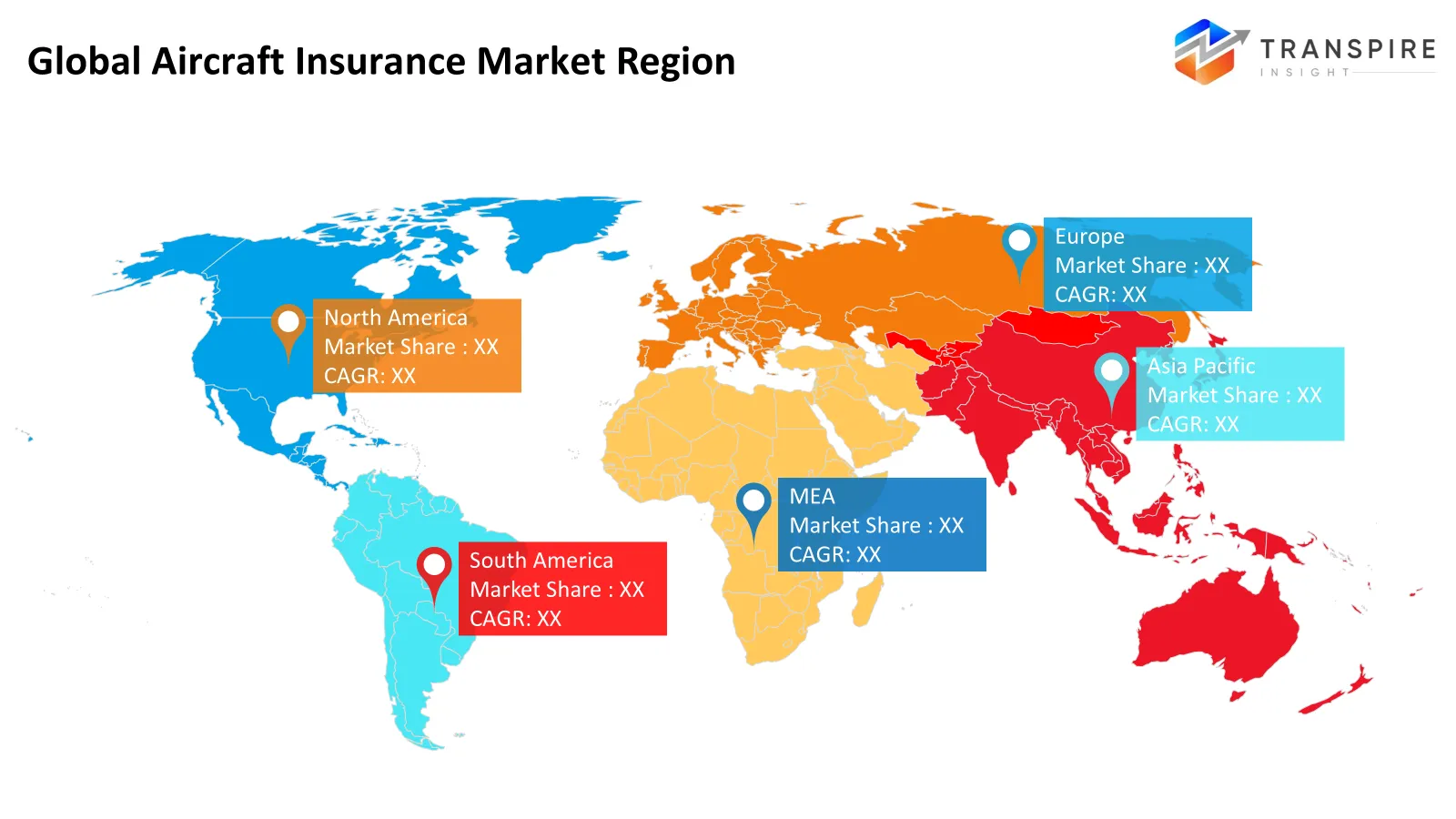
North America continues to dominate the Global Aircraft Insurance Market by generating about 41% of total revenues. North America's dominance in the Global Aircraft Insurance Market has been attributed to the high concentration of its huge commercial and business aviation fleet, thus increasing demand for aircraft insurance coverage. Additionally, the developed insurance industry, efficient airport facilities, and tight aviation regulations act as catalysts for growth in this market. Finally, the continuous development of aircraft technology, increased air cargo traffic, and high insurer involvement help reinforce North America as the leading Global Aircraft Insurance Market. North American airlines carried on with their fleet upgrading projects in 2025, leading to an increase in the aviation industry’s asset base and a corresponding need for insurance of aircraft.
Europe
Europe ranks second in terms of the aircraft insurance industry’s market share, accounting for about 29% of the industry’s revenues worldwide. Although it has not been able to surpass the size of the North American market, the European market is characterised by a well-developed aviation industry, considerable inter-aircraft traffic volumes, and a high level of regulatory oversight. The stability of the European market results from a high degree of regulatory compliance, sound risk management practices, and the presence of top manufacturers of aviation equipment.In December 2024, European airlines like Lufthansa Group also continued their fleet upgrades along with compliance with more stringent aviation regulations, which supported market growth within the insurance sector.
Middle East
The Middle East region is anticipated to become the fastest-growing region in terms of the Global Aircraft Insurance Market, growing at a CAGR of 8.1%. The fast-growing demand for aviation due to increased flights, huge investments in expansion of airports, as well as the strong influence of the airlines operating in the region, have contributed to the growth in demand for aircraft insurance. While in mature markets the demand depends on factors such as the size of the fleet as well as maturity in regulations, the demand in the Middle East is mainly dependent on the development of aviation infrastructure and high connectivity. In February 2025, Middle Eastern airlines like Emirates and Qatar Airways also increased their fleet and routes, while continuing with airport infrastructure expansions, thereby creating the need for aircraft insurance in the region.
Who are the Key Players in the Global Aircraft Insurance Market and how do they Compete?
The aircraft insurance business is highly competitive and revolves around underwriting experience, global operations, and specialised aviation insurance coverage. Competitors provide custom aircraft insurance coverage, efficient claims service, and risk management solutions to airlines, aircraft owners, and aerospace companies.
Some of these competitors include AIG, Allianz, AXA XL, Chubb, Zurich Insurance, Starr Insurance, and Tokio Marine. The competitors are known for their innovations and coverage services. They distinguish themselves by offering innovative aviation insurance services, efficient underwriting services, and global operations. Expansion plans of these companies involve extending aviation insurance services to emerging aviation markets. On the other hand, Marsh McLennan and Willis Towers Watson distinguish themselves with risk advisory and brokerage services, which enable their clients to get appropriate insurance services. Other competitors such as Munich Re, Swiss Re, Berkshire Hathaway Speciality Insurance, and Sompo International use financial strength and reinsurance capacity in competing. Expansion strategies among such competitors include partnerships and increasing participation in the aviation insurance market globally.
Global Aircraft Insurance Market Companies:
- AIG
- Allianz
- AXA XL
- Marsh McLennan
- Willis Towers Watson
- Chubb
- Munich Re
- Zurich Insurance
- Global Aerospace
- Starr Insurance
- Tokio Marine
- Swiss Re
- Berkshire Hathaway Specialty Insurance
- Sompo International
- HDI Global
Recent Development News
In December 2025, Mach 2 Underwriters released its market forecast regarding a definite change in premium prices. The company stated that due to a large loss year experienced by airlines in 2025, it will affect the reinsurance industry such that general aviation insurers will have to stop lowering their rates and begin raising them in 2026.
What Strategic Insights Define the Future of the Global Aircraft Insurance Market?
The aircraft insurance industry is gradually gravitating towards a risk selection-based approach that will be characterised by technological advancements. The complexity of aviation operations requires a high degree of analytical ability and predictive risk assessment, which should be supported by current operational data and other relevant factors.
The increased vulnerability of aircraft, airport infrastructures, and associated aviation networks to cybersecurity risks represents an additional factor that might trigger losses that cannot be effectively covered under conventional insurance programs. On the positive side, the proliferation of unmanned air vehicles, urban air mobility initiatives, and innovations within the aviation industry in general present opportunities to create customised insurance products. Insurance companies willing to benefit from the ongoing changes within the aviation industry need to focus on improving their underwriting procedures, gain expertise in cyber risks, and come up with innovative insurance solutions.
Global Aircraft Insurance Market Segmentation:
By Type
- Hull Insurance
- Liability Insurance
- Passenger Liability Insurance
- Cargo Insurance
- Third-party Insurance
- War Risk Insurance
By Application
- Commercial Aircraft
- Private Jets
- Cargo Aircraft
- Military Aircraft
- Helicopters
By End-User
- Airlines
- Aircraft Leasing Companies
- Government Aviation Authorities
- Private Owners
By Coverage
- Comprehensive Coverage
- Partial Coverage
- Specialized Aviation Coverage
Regional Outlook
North America
- United States
- Canada
- Mexico
Europe
- Germany
- United Kingdom
- France
- Spain
- Italy
- Rest of Europe
Asia Pacific
- Japan
- China
- Australia & New Zealand
- South Korea
- India
- Rest of Asia Pacific
South America
- Brazil
- Argentina
- Rest of South America
Middle East & Africa
- Saudi Arabia
- United Arab Emirates
- South Africa
- Rest of the Middle East & Africa
Frequently Asked Questions
Find quick answers to common questions.
The global Aircraft Insurance Market size was valued at USD 15.34 Billion in 2025 and is poised to reach USD 18.29 Billion by 2033, expanding at a 2.22% CAGR.
Key segments for the Global Aircraft Insurance Market are By Type (Hull Insurance, Liability Insurance, Passenger Liability Insurance, Cargo Insurance, Third-party Insurance, War Risk Insurance, Others); By Application (Commercial Aircraft, Private Jets, Cargo Aircraft, Military Aircraft, Helicopters, Others); By End-User (Airlines, Aircraft Leasing Companies, Government Aviation Authorities, Private Owners, Others); By Coverage (Comprehensive Coverage, Partial Coverage, Specialized Aviation Coverage, Others).
The global Aircraft Insurance Market is influenced by factors such as the increase in air traffic, the rise in the number of aircraft, high costs of aircraft, increasing aviation infrastructure, and awareness about risk management within the aviation industry.
The global market is led by major manufacturers including AIG, Allianz, AXA XL, Marsh McLennan, Willis Towers Watson, Chubb, Munich Re, Zurich Insurance, Global Aerospace, Starr Insurance, Tokio Marine, Swiss Re, Berkshire Hathaway Speciality Insurance, Sompo International, HDI Global.
North America holds 41% of the market share in the Global Aircraft Insurance Market. Factors that have contributed to the dominance include a large number of aviation fleets, a strong presence of the aerospace industry, stringent safety laws, and demand for insurance.
The Global Aircraft Insurance Market holds many chances owing to the expanding size of the worldwide aircraft fleet, an increased tendency towards private flight and drones, as well as an increasing number of passengers flying by air. The aforementioned tendencies stimulate the need for customised insurance, which allows carriers to extend their clientele.
- AIG
- Allianz
- AXA XL
- Marsh McLennan
- Willis Towers Watson
- Chubb
- Munich Re
- Zurich Insurance
- Global Aerospace
- Starr Insurance
- Tokio Marine
- Swiss Re
- Berkshire Hathaway Specialty Insurance
- Sompo International
- HDI Global
About the Authors

Tejashri Dhatrak
I am Tejashri Dhatrak, a Senior Research Analyst at Transpire Insight, specializing in the Aerospace and Defence sector. My work focuses on analyzing industry trends, defence technologies, market developments, and emerging innovations that shape the global aerospace and security landscape. At Transpire Insight, I research complex topics, evaluate credible sources, and transform technical insights into accurate, well-structured, and easy-to-understand content for industry professionals and decision-makers. My goal is to provide reliable, research-backed information that helps readers stay informed about defence capabilities, aerospace advancements, strategic developments, and the evolving dynamics of the global defence ecosystem.

Chakradhar Khansole
Chakradhar serves as the Research Director at Transpire Insight, bringing over 8 years of experience in technology, innovation, and strategic market intelligence. He specializes in transforming complex market data into actionable business insights that enable organizations to make informed, growth-oriented decisions. Recognized for his strategic vision and analytical expertise, Chakradhar leads high-impact research initiatives, delivering comprehensive market assessments, competitive intelligence, and forward-looking industry analysis.
Recently Published Reports
-
Apr 2026
Aerospace Fluoropolymers Market
Aerospace Fluoropolymers Market Size, Share & Analysis Report By Type (PTFE, FEP, PFA, ETFE, and Others), By Application (Electrical Insulation, Seals & Gaskets, Coatings, and Others), By End User (Commercial Aviation, Military Aviation, General Aviation, and Others), and Geography (North America, Europe, Asia-Pacific, Middle East and Africa, South and Central America), 2021 - 2031
-
Apr 2026
Airborne SATCOM System Market
Airborne SATCOM System Market Size, Share & Analysis Report By Type (SATCOM Terminals, Transceivers, Airborne Radio, Modems and Routers, SATCOM Radomes, and Other), By Application (Government and Defense and Commercial), and Geography (North America, Europe, Asia-Pacific, Middle East and Africa, South and Central America), 2021 – 2031
-
Apr 2026
Ship Leasing Market
Ship Leasing Market Size, Share & Analysis Report By Vessel Type (Container Ships, Bulk Carriers, Tankers, and Specialized Vessels), By Lease Duration (Short-Term Lease (Less than 1 year), Medium-Term Lease (1-5 years), and Long-Term Lease (More than 5 years)), By Lease Type (Bareboat Charter, Time Charter, Financial Lease, and Others), By End-User Industry (Oil and Gas, Manufacturing and Industrial, Automotive, Agriculture and Food, Retail and Consumer Goods, and Others), and Geography (North America, Europe, Asia-Pacific, Middle East and Africa, South and Central America), 2021 – 2031
-
Apr 2026
Thread Rolling Dies Market
Thread Rolling Dies Market Size, Share & Analysis Report By Type (Flat Thread Rolling Dies, Circular (Cylindrical) Dies, Tangential Thread Rolling Dies, Planetary Thread Rolling Dies, and Other Types), By Material Type (High-Speed Steel (HSS), Carbide, Tool Steel, Alloy Steel, and Other Specialized Alloys), By Distribution Channel (Direct Sales, Distributors and Dealers, and Online Platforms), By Application (Automotive Industry, Aerospace and Defense, Construction and Infrastructure, Industrial Machinery, Electronics and Electrical Components, Medical Devices, and Fastener Production), and Geography (North America, Europe, Asia-Pacific, Middle East and Africa, South and Central America), 2021 – 2031
Our Clients





