Asia Pacific Aircraft Survivability Equipment Market Size & Forecast:
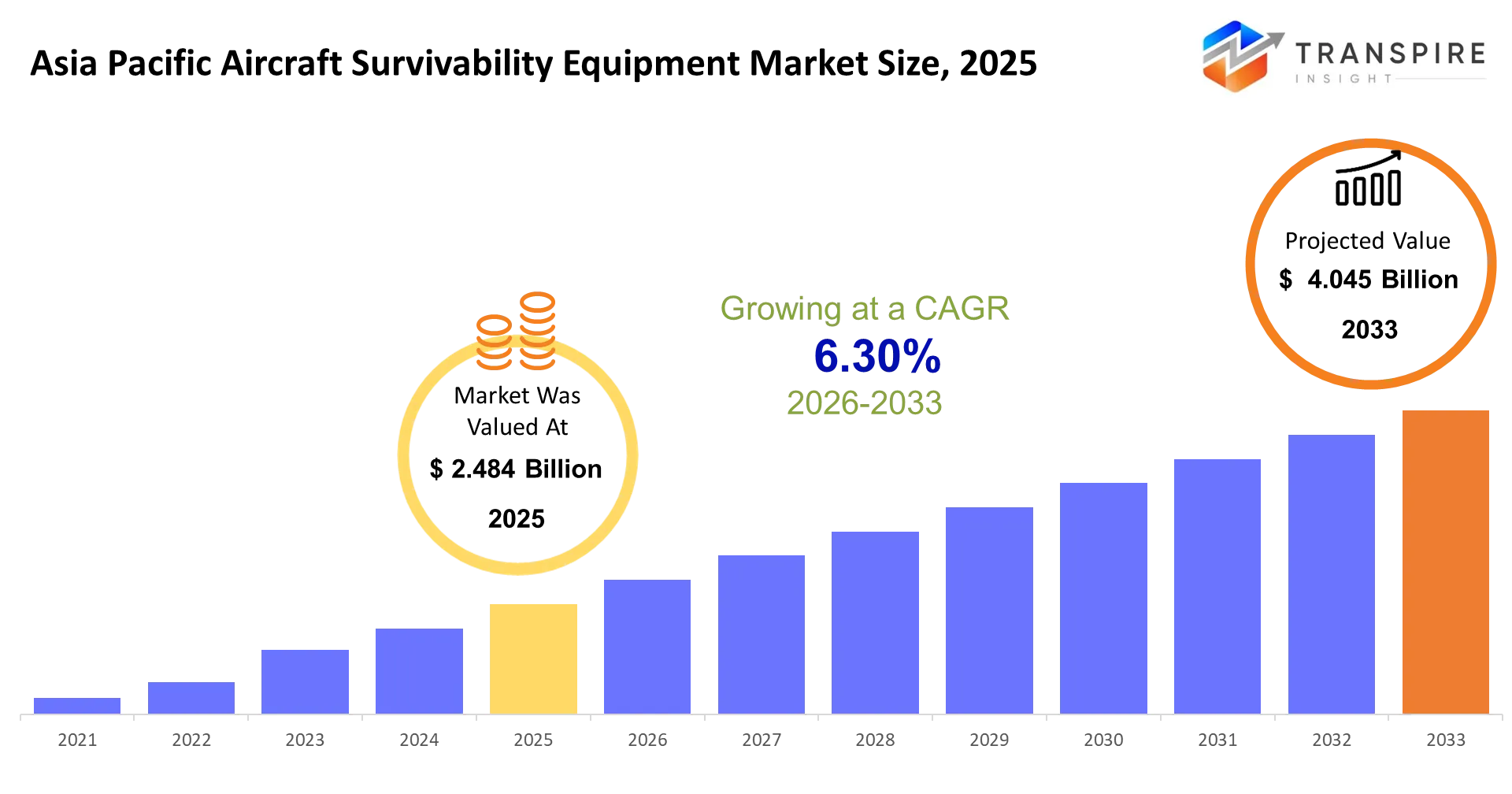
- Asia Pacific Aircraft Survivability Equipment Market Size 2025: USD 2.484 Billion
- Asia Pacific Aircraft Survivability Equipment Market Size 2033: USD 4.045 Billion
- Asia Pacific Aircraft Survivability Equipment Market CAGR: 6.30%
- Asia Pacific Aircraft Survivability Equipment Market Segments: By Type (Electronic Warfare Systems, Countermeasure Systems, Armor Systems, Others); By Application (Military Aircraft, UAVs, Helicopters, Transport Aircraft, Others); By End-User (Defense Organizations, Aircraft Manufacturers, Government, Aerospace Firms, Others); By Technology (Radar Warning Systems, Infrared Countermeasures, Missile Warning Systems, Others)
To learn more about this report,  Download Free Sample Report
Asia Pacific Aircraft Survivability Equipment Market Summary
The Asia Pacific Aircraft Survivability Equipment Market was valued at USD 2.484 Billion in 2025. It is forecast to reach USD 4.045 Billion by 2033. That is a CAGR of 6.30% over the period.
The Asia Pacific aircraft survivability equipment market provides support for military systems which enable aircraft to detect and evade enemy threats while enduring hostile attacks during their operational missions. The system includes two elements which enable aircraft to operate safely in contested airspace. The three systems have become essential because regional air forces need to conduct operations in growing complicated security situations.
The market has moved away from specific defensive hardware which protects individual platforms during the last three to five years after it adopted complete software-based survival systems which allow operators to monitor threats through multiple sensor networks. The transition accelerated after governments started to update their weapon systems because of increasing military activities in the South China Sea and rising security threats between international borders. The post-pandemic recovery period showed supply chain interruptions which revealed how much companies rely on foreign electronic parts leading them to develop their own production capabilities. The transition of procurement methods to focus on building enduring operational capabilities instead of short-term system upgrades has created stronger business prospects and consistent income for vendors who deliver systems with modular design and upgrade options.
Key Market Insights
- China controls the Asia Pacific Aircraft Survivability Equipment Market with its fighter modernization programs which will give the country a 34% market share in 2025.
- India will become the fastest-growing market in the region until 2031 because of its domestic defense production capacity and its rapid acquisition of airborne defense electronics.
- Japan maintains a large market presence because its electronic warfare system upgrades support the tactical aircraft operations of its military forces.
- Electronic countermeasure systems lead the market with approximately 38% share in 2025 due to broad deployment across combat aircraft.
- Radar warning receiver systems represent the second-largest segment, supported by multi-role fighter retrofit programs.
- The period between now and 2031 will see automated threat detection systems expand their market reach which will create missile approach warning systems as the most rapidly growing market segment.
- The military fixed-wing aircraft system establishes itself as the primary market solution since it will generate 52 percent of total market revenue during 2025.
- The demand for rotary-wing defense platforms has started to increase because military forces require these systems to protect their personnel during tactical operations.
- The air force defense agencies maintain their market leadership with a 61 percent share because they continue to invest in aircraft survivability solutions.
- The forecast period will see homeland security aviation units become the most rapidly expanding end-user segment.
What are the Key Drivers, Restraints, and Opportunities in the Asia Pacific Aircraft Survivability Equipment Market?
The primary factor driving growth in the Asia Pacific aircraft survivability equipment market operates because regional military aviation fleets undergo rapid modernization which results from increased geopolitical conflicts throughout the Indo-Pacific. Countries have started to invest more resources into developing advanced airborne protection systems because defense activities have increased across three areas, including the South China Sea, cross-border airspace surveillance operations, and expanded joint military exercises. The situation has developed into its current state because defense organizations have increased their spending since 2022, which applies to India, Japan, South Korea, and Australia. The procurement programs which focus on mission survival implementation have resulted in suppliers obtaining extended contracts, which include integrated radar warning receivers, missile approach warning systems, and electronic countermeasure suites, that enable them to forecast their revenue growth.
The most significant structural barrier is the complex dependence on high-performance semiconductor components, classified defense electronics, and export-controlled subsystems. The production process for aircraft survivability equipment requires multiple qualification cycles while meeting strict military interoperability standards, which causes longer timeframes for product development and restricts the options available to suppliers. Establishing independent semiconductor manufacturing and defense electronics certification systems requires extensive financial investment and specialized knowledge and needs lengthy time for regulatory processes to complete. The result is slower deployment schedules and deferred procurement spending.
The engineering of software-defined electronic warfare systems creates a valuable market opportunity for development. India and other nations are making substantial investments to develop their own mission systems which enable safe software updates through operational systems. The defense electronics industry will benefit from this model because it creates ongoing revenue streams while decreasing product lifecycle expenses.
What Has the Impact of Artificial Intelligence Been on the Asia Pacific Aircraft Survivability Equipment Market?
Artificial intelligence together with advanced digital technologies creates a new framework for aircraft safety systems throughout the Asia Pacific region because these technologies enable quicker and more flexible threat detection methods. The electronic warfare suites powered by artificial intelligence systems now perform automated signal classification through their ability to analyze vast quantities of radar and infrared information which enables onboard systems to identify hostile threats while differentiating between environmental noise and initiating countermeasures within milliseconds. The system automates tasks for pilots which results in better mission survival during intense combat situations.
Machine learning technology enables enhanced predictive capabilities for airborne defense electronic systems. Defense operators increasingly use algorithm-driven diagnostics to monitor radar warning receivers, missile approach warning systems, and electronic countermeasure pods for early signs of component degradation. The models predict subsystem failures which will occur before they disrupt operations, thereby enhancing fleet availability by 10 to 15 percent and decreasing costs for unplanned maintenance. Digital twin simulations enhance countermeasure deployment patterns which lead to greater fuel efficiency and operational endurance because they eliminate unnecessary system activation during standard patrol operations.
The primary obstacle for implementation remains the difficulty of combining different components. AI-enabled survivability platforms demand comprehensive flight testing together with secure processing systems and access to classified threat information. The majority of defense programs in the region do not possess sufficient data maturity and certification systems necessary to implement extensive operations, which prevents them from realizing their full technological potential.
Key Market Trends
- The military forces of India and South Korea developed their own defense subsystems after semiconductor shortages during 2022 demonstrated their dependence on imported defense electronics supply chains.
- The air forces of two countries reduced their procurement timelines between 2023 and 2025 because they wanted to make their legacy aircraft systems more survivable instead of acquiring new aircraft systems.
- BAE Systems and RTX Corporation developed new regional collaborations because governments established stricter domestic content standards for defense electronics purchasing.
- The use of AI-powered threat identification systems started in 2024, moving from testing phase to actual use, while achieving 15 percent reduction in false alarm detection.
- The market demand has shifted toward modular open-architecture systems because buyers want systems which enable them to operate multiple fighter and surveillance aircraft types.
- The military has established electronic warfare software updates as an essential procurement requirement since 2023 because they want to enhance their entire system capabilities instead of purchasing new hardware.
- Japan and Australia allocated more funds to research infrared suppression and adaptive jamming systems after they started monitoring regional airspace and handling contested airspace missions.
- The regulatory requirements for secure data protection have forced manufacturers to develop advanced cyber defense systems which they must implement in their electronic devices since 2024.
- The local defense industry has gained more control over avionics integration contracts because regional manufacturers now prefer to co-develop systems instead of licensed assembly.
Asia Pacific Aircraft Survivability Equipment Market Segmentation
By Type:
The electronic warfare systems segment dominates the Asia Pacific Aircraft Survivability Equipment Market because modern military fleets increase their investments for threat detection and electronic defense systems. The countries of this region develop their airborne defense systems to increase mission success against radar-guided and electronic attacks. The defense modernization programs now prioritize this segment because they focus on protection systems for aircraft defense needs.
Armed forces are implementing countermeasure systems to create solutions which disable incoming missile threats while enhancing their operational capabilities during dangerous missions. Aircraft in high-risk combat scenarios need armor systems which provide essential physical defense against direct threats. The market development process includes protective technologies from the other category which enable mission operations to continue while maintaining operational flexibility.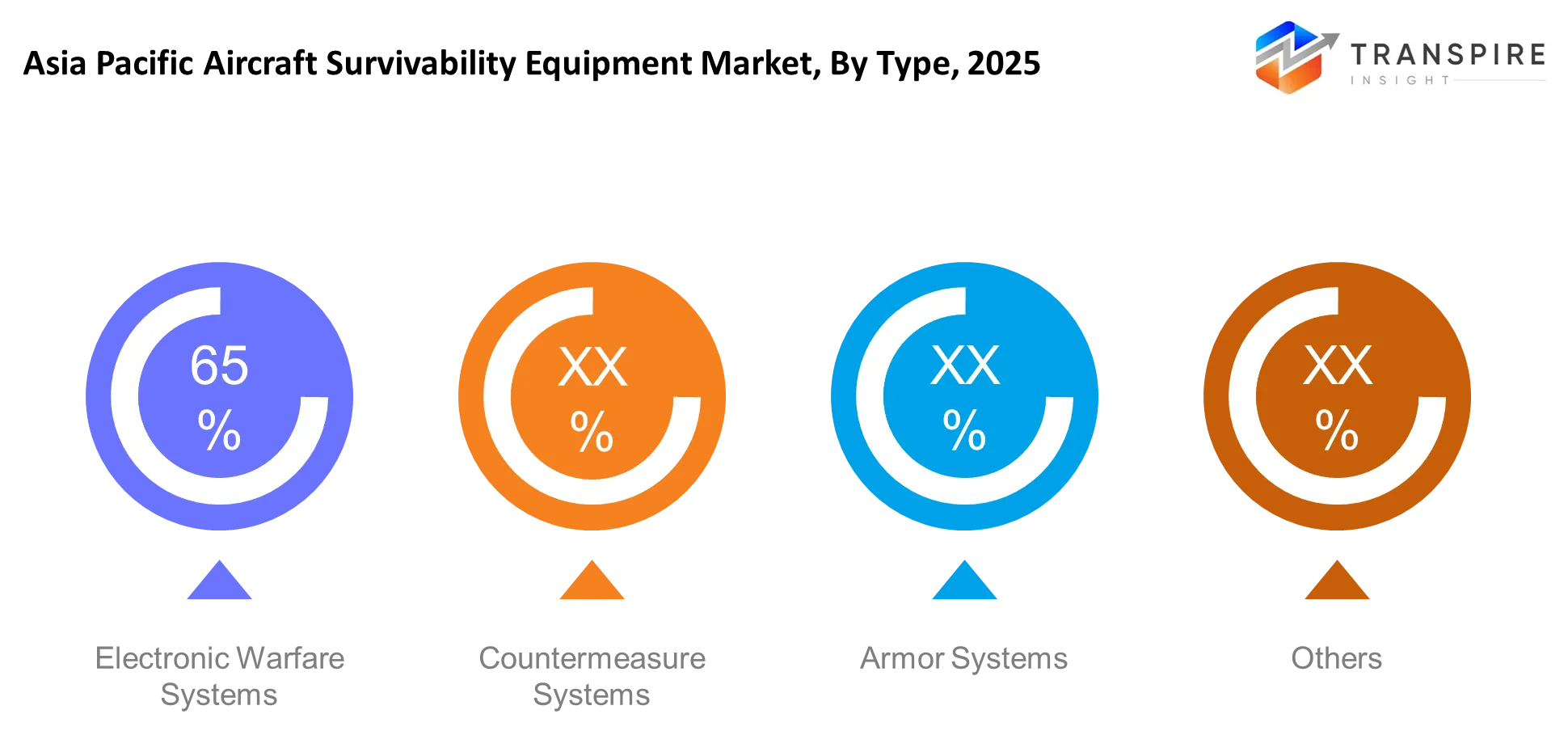
To learn more about this report, Download Free Sample Report
By Application:
The Asia Pacific Aircraft Survivability Equipment Market depends heavily on military aircraft because these planes serve multiple functions which include surveillance and tactical response and border security. The protection systems of fighter aircraft and surveillance planes need advanced technology to enable missions in complex operational environments. The defense sector maintains continuous upgrades which result in ongoing demand for this market segment.
UAVs are becoming a rapidly expanding application area as regional defense agencies deploy unmanned systems for intelligence and monitoring purposes. Helicopters also represent a key segment because of frequent use in transport and combat support roles. The transport aircraft category needs survivability solutions to protect personnel and equipment during secure operations, while the others category includes specialized equipment.
By End-User:
The Asia Pacific Aircraft Survivability Equipment Market depends on defense organizations which represent its main customer base because military modernization efforts continue across multiple regional nations. The military forces have increased their acquisition of advanced survival equipment because they need to protect their airspace while maintaining their operational capabilities. The defense sector maintains its purchasing strength because strategic defense planning and budget allocation processes create a continuous flow of acquisitions from this particular market segment.
The incorporation of survivability technologies from aircraft manufacturers into their next-generation aircraft designs provides a major contribution to aircraft defense capabilities. Defense procurement government agencies establish future market requirements through their contracts and development programs. Aerospace firms support innovation by creating advanced protective systems, while other end-users include research and testing institutions focused on strengthening aircraft defense capabilities.
By Technology:
The Asia Pacific Aircraft Survivability Equipment Market establishes radar warning systems as a vital technology segment because the market requires systems which provide early threat detection. The systems enable aircraft operators to detect hostile radar activities which they must respond to during their missions. The military aviation community adopts new detection technologies because they achieve faster detection times while providing precise system performance.
The introduction of advanced infrared countermeasures enables military programs to defend against missile attacks which use sophisticated targeting methods. The technologies enable aircraft to defend against infrared-guided missile strikes, which enhances their safety during operational missions. The missile warning systems function as vital systems which operate at high speed to provide immediate threat notifications, allowing users to execute defense procedures in a timely manner. The region depends on these technologies which serve as essential elements of current aircraft defense systems.
What are the Key Use Cases Driving the Asia Pacific Aircraft Survivability Equipment Market?
Frontline combat aviation remains the main application for aircraft survivability equipment because it operates through multi-role fighter aircraft which operate in contested airspace environments. The platforms which operate in active surveillance and tactical missions create maximum operational requirements because they need uninterrupted protection against three types of threats which include radar-guided missiles, infrared dangers, and sophisticated electronic attack systems.
The new applications of technology development continue to grow in both rotary-wing military aviation and maritime patrol aircraft operations. Naval aviation units are using advanced warning receivers together with countermeasure dispensers to create protective systems for helicopters which conduct anti-submarine warfare and coastal monitoring missions. The Intelligence, surveillance, and reconnaissance aircraft systems now create operational requirements for advanced defensive systems which protect their border control missions.
The first use case for defense systems shows how unmanned combat aerial systems and high-altitude long-endurance defense drones will use survivability technology integration. The defense agencies in the region will use autonomous aviation systems to operate their programs. The adaptive electronic protection systems which use automated threat response capabilities will see increased usage in strategic surveillance operations and electronic warfare support activities.
|
Report Metrics |
Details |
|
Market size value in 2025 |
USD 2.484 Billion |
|
Market size value in 2026 |
USD 2.637 Billion |
|
Revenue forecast in 2033 |
USD 4.045 Billion |
|
Growth rate |
CAGR of 6.30% from 2026 to 2033 |
|
Base year |
2025 |
|
Historical data |
2021 - 2024 |
|
Forecast period |
2026 - 2033 |
|
Report coverage |
Revenue forecast, competitive landscape, growth factors, and trends |
|
Regional scope |
Asia Pacific (India, China, Japan, Australia,South Korea, Rest of Asia Pacific) |
|
Key company profiled |
BAE Systems, Northrop Grumman, Raytheon, Lockheed Martin, Thales, Saab, Elbit Systems, L3Harris, Honeywell, Leonardo, Collins Aerospace, Airbus, Boeing, Rafael, MBDA |
|
Customization scope |
Free report customization (country, regional & segment scope). Avail customized purchase options to meet your exact research needs. |
|
Report Segmentation |
By Type (Electronic Warfare Systems, Countermeasure Systems, Armor Systems, Others); By Application (Military Aircraft, UAVs, Helicopters, Transport Aircraft, Others); By End-User (Defense Organizations, Aircraft Manufacturers, Government, Aerospace Firms, Others); By Technology (Radar Warning Systems, Infrared Countermeasures, Missile Warning Systems, Others) |
Which Regions are Driving the Asia Pacific Aircraft Survivability Equipment Market Growth?
The Asia Pacific aircraft survivability equipment market shows East Asia as its leading region since China, Japan and South Korea represent the largest portion of regional equipment purchases. The region maintains its leadership position because of its extensive defense industrial base which includes developed aerospace manufacturing facilities and its ongoing military modernization initiatives that receive government funding. The air combat readiness policies established by governments in this region include survivability upgrades which create ongoing demand for advanced warning systems and electronic countermeasure platforms. The market leadership of this organization remains intact because its mature supplier ecosystem depends on domestic electronics manufacturers and its established defense research institutions.
Australia leads Oceania as the region creates market stability through its unique contributions. The region adopts a procurement approach that differs from East Asia's procurement model which relies on large-scale equipment purchases by focusing on precise operational capabilities through selective yet highly advanced platform enhancements that support strategic partnership obligations. The defense procurement process establishes predictable revenue streams for suppliers through its stable defense expenditures and transparent procurement practices and its requirements for interoperability with allied forces. The Oceania region provides reliable support since operational system reliability and technical system sophistication determine procurement decisions more than fleet expansion needs.
The fastest-growing regional market in South Asia currently exists because of India's economic growth. The recent policy changes about indigenous defense production programs and fighter fleet modernization efforts created new possibilities for local survivability system development. The period after 2024 has brought about better market access because of increased funding dedicated to domestic avionics development and public-private defense partnerships. The upcoming growth between 2023 and 2033 provides market entrants and investors with strong potential because companies that back local manufacturing and software-defined electronic warfare systems will benefit from this period.
Who are the Key Players in the Asia Pacific Aircraft Survivability Equipment Market and How Do They Compete?
The Asia Pacific aircraft survivability equipment market maintains moderate consolidation because a small number of global defense electronics companies control most valuable contracts while regional system integrators build partnerships for local manufacturing. The market competes through technological innovation and software flexibility and adherence to military certification requirements instead of using price as the main competition element. Companies that operate in the market maintain their customer relationships through their implementation of artificial intelligence-based solutions and open-architecture systems and their ability to provide customers with continuous system upgrades. Regional defense manufacturers create new procurement methods by providing integration services that follow domestic defense industry requirements for sovereign control.
BAE Systems uses its expertise in electronic warfare systems to compete through its modular survivability suites that enable fast software updates to counter new threats. The company possesses a competitive advantage through its extensive operational track record which enables its systems to work with multiple allied air platforms used in international fleet modernization efforts. The company keeps growing its business through its strategic alliances with regional maintenance organizations and avionics support companies.
RTX Corporation uses its sensor fusion technology and adaptive missile warning systems to create solutions which enable fast threat assessment in complex danger scenarios. Leonardo S.p.A. develops small and lightweight countermeasure systems which function effectively on both rotary-wing and multi-role aircraft. Elbit Systems has gained traction through flexible co-development models with Asia Pacific defense agencies, enabling localized customization. The companies build their business operations by developing products which meet the requirements of indigenous fighter programs and software-defined warfare systems.
Company List
- BAE Systems
- Northrop Grumman
- Raytheon
- Lockheed Martin
- Thales
- Saab
- Elbit Systems
- L3Harris
- Honeywell
- Leonardo
- Collins Aerospace
- Airbus
- Boeing
- Rafael
- MBDA
Recent Development News
In January 2026, Elbit Systems secured funding of approximately $275 million through multi-year contracts to equip a helicopter platform in an Asia-Pacific country with advanced airborne electronic warfare suites and Mini-MUSIC DIRCM self-protection systems. The agreement establishes next-generation aircraft survivability technologies as essential equipment for local operations while satisfying Asia-Pacific requirements for integrated countermeasure systems that modernize rotary-wing aircraft. Source https://www.prnewswire.com/
In February 2026, BIRD Aerosystems established a partnership with a top regional defense firm after the company won a multi-million-dollar contract which included SPREOS DIRCM systems for a helicopter upgrade project. The agreement includes technology transfer and localized production which will develop domestic capabilities to manufacture survivability equipment throughout the regional aerospace defense supply chain.
Source https://www.aviation-defence-universe.com/
What Strategic Insights Define the Future of the Asia Pacific Aircraft Survivability Equipment Market?
The Asia Pacific market for aircraft survivability equipment will develop into software-defined network-centric protection systems that combine electronic warfare capabilities with cyber resilience and real-time threat identification systems through the next five to seven years. The airspace combat operations today require new countermeasure systems because existing static countermeasure systems fail to handle new radar and missile technologies which are currently developing. Organizations will start implementing their procurement methods by choosing digital systems which can be upgraded instead of using traditional hardware replacement methods.
The semiconductor market faces hidden dangers because it depends too much on specific companies which make advanced semiconductor products and special signal-processing components. The expansion of deployment schedules will experience major disruptions if export controls become stricter or if geopolitical conflicts in the region disrupt supply chain operations.
The development of aerial combat systems which can defend themselves from attacks creates new business opportunities for unmanned combat aerial platforms in India and South Korea because both countries are expanding their autonomous defense aviation programs. Market participants should dedicate their resources for future success by supporting development of open-architecture software systems through local partnerships. Companies which establish themselves as flexible technology partners will obtain the most valuable contracts throughout the extended future.
Asia Pacific Aircraft Survivability Equipment Market Report Segmentation
By Type
- Electronic Warfare Systems
- Countermeasure Systems
- Armor Systems
By Application
- Military Aircraft
- UAVs
- Helicopters
- Transport Aircraft
By End-User
- Defense Organizations
- Aircraft Manufacturers
- Government
- Aerospace Firms
By Technology
- Radar Warning Systems
- Infrared Countermeasures
- Missile Warning Systems
Frequently Asked Questions
Find quick answers to common questions.
The Asia Pacific Aircraft Survivability Equipment Market size is USD 4.045 Billion in 2033.
Key Segments for the Asia Pacific Aircraft Survivability Equipment Market are By Type (Electronic Warfare Systems, Countermeasure Systems, Armor Systems, Others); By Application (Military Aircraft, UAVs, Helicopters, Transport Aircraft, Others); By End-User (Defense Organizations, Aircraft Manufacturers, Government, Aerospace Firms, Others); By Technology (Radar Warning Systems, Infrared Countermeasures, Missile Warning Systems, Others).
Major Asia Pacific Aircraft Survivability Equipment Market Players are BAE Systems, Northrop Grumman, Raytheon, Lockheed Martin, Thales, Saab, Elbit Systems, L3Harris, Honeywell, Leonardo, Collins Aerospace, Airbus, Boeing, Rafael, MBDA.
The Current Asia Pacific Aircraft Survivability Equipment Market size is USD 2.484 Billion in 2025.
The Asia Pacific Aircraft Survivability Equipment Market CAGR is 6.30% from 2026 to 2033.
- BAE Systems
- Northrop Grumman
- Raytheon
- Lockheed Martin
- Thales
- Saab
- Elbit Systems
- L3Harris
- Honeywell
- Leonardo
- Collins Aerospace
- Airbus
- Boeing
- Rafael
- MBDA
Recently Published Reports
-
Apr 2026
Aerospace Fluoropolymers Market
Aerospace Fluoropolymers Market Size, Share & Analysis Report By Type (PTFE, FEP, PFA, ETFE, and Others), By Application (Electrical Insulation, Seals & Gaskets, Coatings, and Others), By End User (Commercial Aviation, Military Aviation, General Aviation, and Others), and Geography (North America, Europe, Asia-Pacific, Middle East and Africa, South and Central America), 2021 - 2031
-
Apr 2026
Airborne SATCOM System Market
Airborne SATCOM System Market Size, Share & Analysis Report By Type (SATCOM Terminals, Transceivers, Airborne Radio, Modems and Routers, SATCOM Radomes, and Other), By Application (Government and Defense and Commercial), and Geography (North America, Europe, Asia-Pacific, Middle East and Africa, South and Central America), 2021 – 2031
-
Apr 2026
Ship Leasing Market
Ship Leasing Market Size, Share & Analysis Report By Vessel Type (Container Ships, Bulk Carriers, Tankers, and Specialized Vessels), By Lease Duration (Short-Term Lease (Less than 1 year), Medium-Term Lease (1-5 years), and Long-Term Lease (More than 5 years)), By Lease Type (Bareboat Charter, Time Charter, Financial Lease, and Others), By End-User Industry (Oil and Gas, Manufacturing and Industrial, Automotive, Agriculture and Food, Retail and Consumer Goods, and Others), and Geography (North America, Europe, Asia-Pacific, Middle East and Africa, South and Central America), 2021 – 2031
-
Apr 2026
Thread Rolling Dies Market
Thread Rolling Dies Market Size, Share & Analysis Report By Type (Flat Thread Rolling Dies, Circular (Cylindrical) Dies, Tangential Thread Rolling Dies, Planetary Thread Rolling Dies, and Other Types), By Material Type (High-Speed Steel (HSS), Carbide, Tool Steel, Alloy Steel, and Other Specialized Alloys), By Distribution Channel (Direct Sales, Distributors and Dealers, and Online Platforms), By Application (Automotive Industry, Aerospace and Defense, Construction and Infrastructure, Industrial Machinery, Electronics and Electrical Components, Medical Devices, and Fastener Production), and Geography (North America, Europe, Asia-Pacific, Middle East and Africa, South and Central America), 2021 – 2031
Our Clients