
Europe Military Robot Market Size & Forecast:
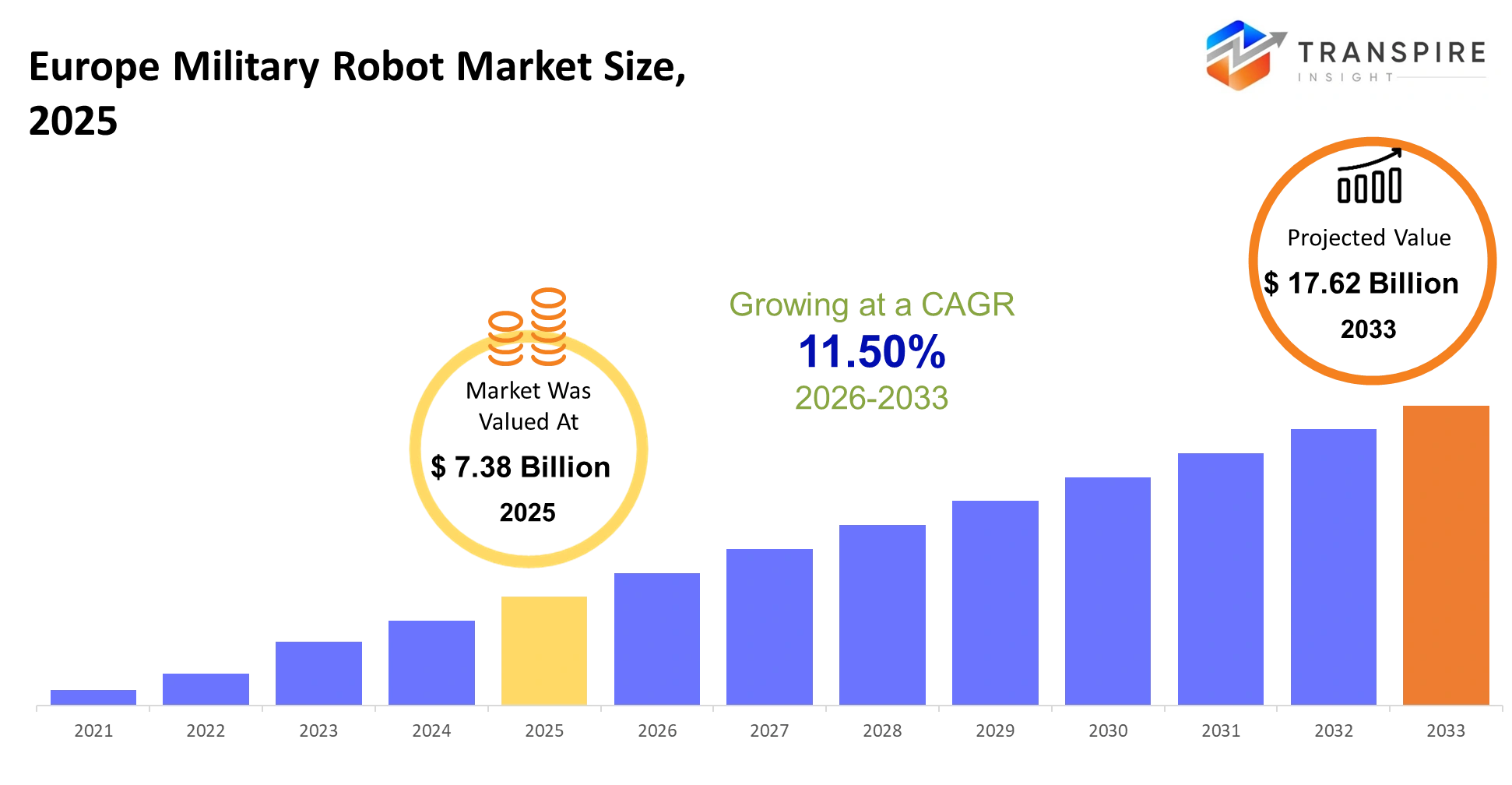
- Europe Military Robot Market Size 2025: USD 7.38 Billion
- Europe Military Robot Market Size 2033: USD 17.62 Billion
- Europe Military Robot Market CAGR: 11.50%
- Europe Military Robot Market Segments: By Type (Unmanned Ground Vehicles, Unmanned Aerial Vehicles, Naval Robots, Others); By Application (Surveillance, Combat Support, Logistics, Others); By End-User (Defense Forces, Government, Others); By Component (Hardware, Software, Services, Others)
To learn more about this report,  Download Free Sample Report
Europe Military Robot Market Summary
The Europe Military Robot Market was valued at USD 7.38 Billion in 2025. It is forecast to reach USD 17.62 Billion by 2033. That is a CAGR of 11.50% over the period.
European military forces use robotic systems to conduct surveillance and reconnaissance and explosive ordnance disposal and supply operations in dangerous zones while protecting their personnel from danger. The systems operate as three types of vehicles which include unmanned ground vehicles and aerial drones and hybrid platforms to enhance battlefield situational awareness while enabling defense forces to make quick decisions. The market has undergone a fundamental change during the past three to five years because artificial intelligence systems now enable businesses to operate autonomous machines which can track their location and work together with others during active operations. The conflicts between Russia and Ukraine created a situation which forced European countries to increase their drone and robotic systems acquisition while using these technologies for defense activities and deterrence purposes. The military adoption rate is increasing because governments now emphasize both force multiplication and soldier protection which results in greater defense budgets for unmanned systems and quicker deployment of these systems to NATO forces.
Key Market Insights
- The European Military Robot Market in 2025 sees Western Europe control almost 46% of the market share because of its high defense spending and its development of advanced robotic technologies.
- The military modernization programs in Eastern Europe combined with the Ukraine conflict procurement efforts make it the most rapidly expanding area between 2025 and 2032.
- The northern European region is implementing automated border surveillance systems together with systems for monitoring maritime defense operations.
- The Europe Military Robot Market identifies unmanned ground vehicles (UGVs) as its leading segment because they control approximately 38% of the market share in 2025, which makes them essential for both logistics operations and explosive materials disposal.
- The second-largest market share belongs to unmanned aerial vehicles (UAVs) because they enable extended reconnaissance and tactical intelligence operations.
- The market for autonomous swarm robotics will experience its most significant growth until 2032 because AI-driven battlefield coordination systems require this technology.
- The Europe Military Robot Market shows 41% market share for surveillance and reconnaissance purposes, which supply real-time intelligence to military operations.
- The application of explosive ordnance disposal services has expanded because it enables safe operations in dangerous combat situations.
- National security modernization programs make defense forces the primary user group, which controls more than 70% of defense spending.
- The naval and air defense forces now use robotic technologies to improve their mission range and operational effectiveness during complex operations.
What are the Key Drivers, Restraints, and Opportunities in the Europe Military Robot Market?
The Europe Military Robot Market is primarily driven by accelerated defense modernization following heightened geopolitical instability in Eastern Europe. The Russia–Ukraine conflict caused NATO-aligned nations to change their military strategy by adopting unmanned ground vehicles and autonomous aerial systems for surveillance and logistics and combat support purposes. Governments are currently focusing on force multiplication and soldier protection which has led to faster procurement processes and increased funding for AI-enabled robotics. The defense contractors have gained direct revenue benefits from autonomous platforms which defense agencies now use through long-term contracts instead of traditional manned system upgrades.
The primary obstacle to military robotics implementation in defense systems exists because defense systems need to integrate advanced military robotics into their current operational systems. Some European armed forces use outdated command-and-control systems which do not provide complete support for their autonomous platforms and AI-based coordination systems. The system needs to undergo system upgrades creates a structural limitation that decreases deployment speed while increasing operational expenses throughout the system's lifetime. The development of defense capabilities between regions creates an uneven pattern of adoption because smaller defense budgets find it hard to implement robotics solutions which leads to restricted revenue growth across Southern and Eastern Europe.
The expansion of AI-enabled swarm robotics together with cross-border EU defense funding initiatives creates a significant opportunity between the two fields. The European Defence Fund provides increasing support for collaborative robotics development projects between France and Germany and Italy. The development of autonomous decision-making algorithms enables multiple drones to operate together in actual combat situations.The European Military Robot Market will experience its next growth phase because funding and technology readiness will converge to enable deployment of border surveillance and tactical operations systems.
What Has the Impact of Artificial Intelligence Been on the Europe Military Robot Market?
The European Military Robot Market undergoes transformation through artificial intelligence and digital technologies which develop better operating capabilities and mission efficiency for unmanned defense systems and sea defense systems. AI-based automation currently performs three tasks which include real-time control system improvements and autonomous vehicle movement and unmanned ground and aerial and maritime system operations. Digital monitoring systems now extend their scope to monitor marine emission control systems which include scrubber performance systems and exhaust gas cleaning technologies that naval logistics vessels use. AI-enabled compliance dashboards track scrubber performance systems and exhaust gas cleaning technologies to ensure naval logistics vessels meet regulatory standards and operational requirements.
The development of machine learning models enables predictive maintenance for robotic systems which helps predict when equipment will fail and reduces power usage during extended missions. The models assist naval operations by predicting emissions and optimizing performance which leads to decreased unplanned interruptions and enhanced mission success. The operators observe that their systems now operate 20 to 30 percent more frequently while their maintenance requirements decreased, which leads to better operational productivity and reduced costs throughout the European Military Robot Market product lifespan.
The adoption process faces obstacles because of two main issues which include insufficient access to authentic battlefield data and ongoing connectivity problems in both remote and contested military zones.The defense infrastructure security requirements which need to be maintained during system integration with existing systems create difficulties which prevent complete implementation of the project.
Key Market Trends
- The defense procurement system started to acquire unmanned systems through fast tracking after 2022 because it rejected the established method of upgrading armored vehicles through extended upgrade periods.
- The military started using autonomous robotic systems that operate through artificial intelligence because their advanced navigation systems enable autonomous operation without requiring operators to control their movements.
- European NATO members expanded joint robotics programs, which improved cross-border operational ability through shared unmanned ground and aerial defense technology development since 2021.
- The military acquisition process moved towards modular robotic systems, which enable military forces to update their equipment through modular payload changes instead of complete system replacements.
- The market demand moved away from large single-unit systems, which operate independently, toward robotics systems that use swarm technology to provide both surveillance capabilities and operational flexibility.
- Rheinmetall AG and Thales Group increased their research and development spending on autonomous defense systems, which resulted in faster AI technology implementation across European armed forces.
- The supply chain systems of organizations expanded their operations after the 2020 disruptions, which enabled European manufacturers to establish local production facilities and reduce their dependence on defense materials from non-European Union countries.
- The development of regulatory frameworks established testing zones for autonomous systems, which allow unmanned military robotics to undergo testing in secure environments that simulate real field conditions.
- Naval and border security forces extended their drone monitoring operations by replacing old patrol systems with new autonomous solutions that provide ongoing monitoring capabilities.
- Defense contractors started to compete against each other because they needed to use artificial intelligence for product development, which extended their business operations beyond traditional military robotics development through hardware-based systems.
Europe Military Robot Market Segmentation
By Type:
The data you searched for exists in three categories which are Unmanned Ground Vehicles, Unmanned Aerial Vehicles and Naval Robots and other categories. The European defense robotics sector identifies Unmanned Ground Vehicles as its main robotic system because military forces use these robots to handle explosive materials and transport goods and conduct battlefield surveillance. The segment maintains its lead because NATO-aligned military forces purchase more products while soldier protection needs continue to rise. Unmanned Aerial Vehicles follow closely because they have proven their value for both surveillance and intelligence operations while naval robots exist as smaller systems that serve crucial functions in maritime surveillance.
Ground-based systems experience growth because they can operate in urban warfare settings and use modular payload systems. The expansion of UAV systems happens because these systems can operate at lower costs while delivering fast deployment capabilities which lead to operational benefits. The adoption of naval systems advances at a slow pace because their integration with existing naval fleets and their need to meet strict maritime operational standards require complex implementation.
The future will see swarm-enabled UAVs and hybrid ground platforms with autonomous navigation capabilities as the primary expansion areas. The developers will build systems which allow different operational environments to work together through unified aerial and ground control systems. Investors will direct their interest toward UAV research and development projects while procurement agencies boost their investments in modular ground robotics systems which enable multiple mission operations.
By Application:
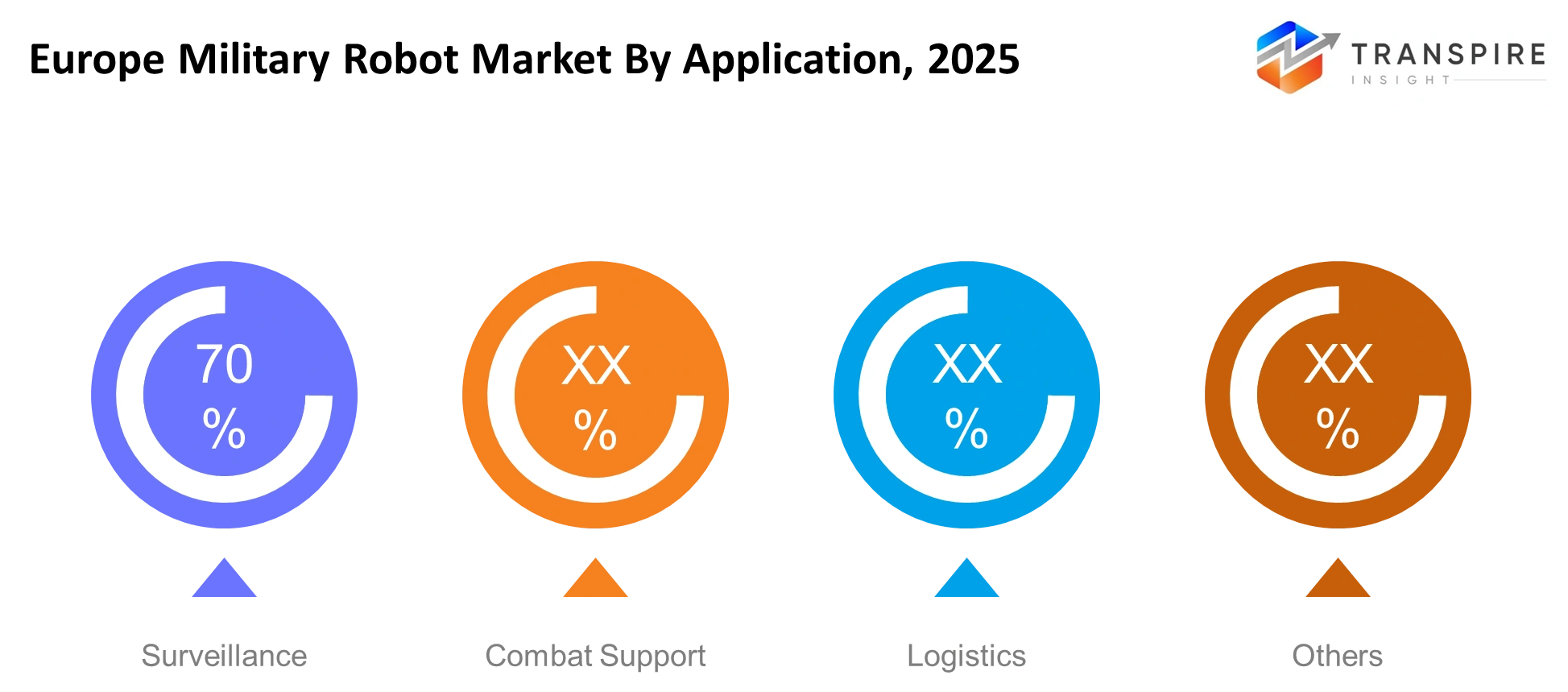
The research investigates the operational impact of different applications which include surveillance and combat support and logistics and additional applications. The demand for real-time battlefield intelligence which supports continuous border territory monitoring has made surveillance applications become the primary operational use of the system. The military organizations use robotic systems to provide front line combat assistance which makes combat support the second most used application after surveillance and defense operations now use logistics applications to automate their supply chain processes.
Surveillance operations expand because of the current global geopolitical situation which requires NATO forces to maintain constant situational awareness. The military needs to protect its personnel which has led to an increase in combat support system adoption whereas logistics robotics has gained advantages through its ability to move ammunition and supplies which occurs in dangerous situations.
Future development will create AI-powered surveillance systems which will automatically identify targets and monitor areas for extended time periods. The systems will enable combat support to function together with pilot teams while logistics robotics technology will become standard in self-driving convoy missions. Manufacturers will focus on multi-role systems that combine surveillance, mobility, and supply functions in a single platform.
To learn more about this report, Download Free Sample Report
By End-User:
The defense forces lead technology adoption because their military operations need equipment to use in active combat zones and because European military forces maintain ongoing equipment upgrade programs. Government agencies account for secondary demand, primarily focused on border control and internal security operations. Research institutions and specialized defense contractors represent the only two remaining groups who use defense products.
The defense sector demands NATO readiness initiatives which require additional funding for research into autonomous warfare systems that emerged after geopolitical conflicts. Government agencies adopt unmanned surveillance systems because they need these technologies to support homeland security operations and counter-terrorism missions. The existence of expensive procurement processes together with high costs for system integration results in low adoption rates among smaller companies.
Defense organizations will experience growth because their operational strategies require multi-domain operations. Governments plan to expand their acquisitions of autonomous monitoring technologies which will be used to monitor border security areas. The technology developers will create their product development plans according to defense standards which require professional-grade protection and secure data handling and vital operational dependability.
By Component:
The components of products which include hardware and software and services and other elements define their market segments. The hardware category contains the largest market share because organizations need to install physical robots together with their sensors and propulsion systems and their complete defense systems. Software solutions drive operational efficiency through their AI-based navigation systems together with control systems and data analytics capabilities. The demand for maintenance services and system integration services is growing because fleets are becoming more complicated to manage.
The military forces of Europe need hardware because they constantly replace existing equipment and they need to deploy advanced robotic systems. The market for software products who provide AI integration together with autonomous decision-making features will expand rapidly. The demand for services has increased because organizations need to manage their system lifecycles and update their legacy systems for better interoperability.
The future of robotics will move towards software-defined systems which enable users to enhance their robots through digital updates instead of needing hardware changes. The development of hardware will require systems which use less weight and less energy while companies that provide services will develop their capacity to deliver predictive maintenance solutions. The defense industry will move towards purchasing solutions which provide complete digital systems instead of buying isolated robotic systems.
What are the Key Use Cases Driving the Europe Military Robot Market?
Surveillance and reconnaissance remain the core use case driving demand in the Europe Military Robot Market, as defense forces prioritize real-time battlefield visibility and border monitoring. Unmanned aerial systems and ground robotics are widely used to protect soldiers while they gather information in dangerous locations.
The military forces and government security agencies use automated systems for combat support and logistics operations. Armed forces use robotic systems to move ammunition and provide medical evacuation assistance and secure their perimeter because they need unmanned ground vehicles to maintain their operations during battles.
The current use cases investigate how autonomous systems can develop swarm coordination capabilities and support electronic warfare operations for NATO modernization projects. Naval defense units are currently conducting tests on robotic systems which provide underwater surveillance capabilities and mine detection abilities while interest in multi-domain integration between air land and maritime defense systems continues to grow.
|
Report Metrics |
Details |
|
Market size value in 2025 |
USD 7.38 Billion |
|
Market size value in 2026 |
USD 8.226 Billion |
|
Revenue forecast in 2033 |
USD 17.62 Billion |
|
Growth rate |
CAGR of 11.50% from 2026 to 2033 |
|
Base year |
2025 |
|
Historical data |
2021 - 2024 |
|
Forecast period |
2026 - 2033 |
|
Report coverage |
Revenue forecast, competitive landscape, growth factors, and trends |
|
Regional scope |
Europe (Germany, United Kingdom, France, Italy, Spain, Rest of Europe) |
|
Key company profiled |
Lockheed Martin, Northrop Grumman, BAE Systems, General Dynamics, Thales, Saab, Elbit Systems, Rheinmetall, Leonardo, Boeing, Textron, QinetiQ, Kongsberg, L3Harris, AeroVironment |
|
Customization scope |
Free report customization (country, regional & segment scope). Avail customized purchase options to meet your exact research needs. |
|
Report Segmentation |
Which Regions are Driving the Europe Military Robot Market Growth?
The European Military Robot Market is led by Western Europe because of its advanced defense systems and its strong NATO military partnerships. Germany France and the United Kingdom operate large-scale procurement programs which receive funding from their defense budgets and their planned modernization strategies. The combination of strict regulatory frameworks with long-term defense planning requirements creates an environment which supports ongoing investment in unmanned systems. The existing defense contractor ecosystem together with research institutions and AI developers enables the region to develop robotic military platforms through rapid prototyping and deployment.
Northern Europe serves as a secondary region which maintains stability through its defense spending which shows regularity but only concentrates on specific areas. The region excludes Western Europe which uses large-scale procurement to acquire military assets as its core focus. Sweden Norway and Finland use unmanned surveillance and naval robotics to strengthen their border security operations which protect their territories from cold-weather conditions. The defense procurement process establishes a continuous demand pattern which maintains stable economic conditions for organizations.
Eastern Europe emerges as the fastest-growing region because of its military expansion efforts which countries implemented in response to increasing security threats after 2022. Poland and Romania have raised their defense budgets which has led to increased procurement of unmanned ground and aerial systems for fast deployment during combat situations. The combination of infrastructure upgrades and NATO-aligned capability programs has led to increased adoption of land-based defense systems.The region provides high-growth opportunities until 2033 which market entrants and investors can access because modern defense systems and affordable autonomous defense technology will continue to grow.
Who are the Key Players in the Europe Military Robot Market and How Do They Compete?
The Europe Military Robot Market displays a competitive structure that shows moderate consolidation because established defense contractors control most of the market yet specialized technology companies can still enter. The competition between companies depends on their ability to develop advanced autonomous systems which can operate in combat environments and meet NATO interoperability requirements instead of competing on price. Established companies maintain their market positions through their existing defense contracts and their deep ties to national military purchasing systems while new companies develop AI-based autonomous systems and modular robotic solutions. The ability of companies to deliver superior sensor fusion capabilities and command-and-control integration systems and multiple domain coordination solutions has established itself as the main competitive factor that separates suppliers in the market.
Rheinmetall AG develops ground-based unmanned systems and armored robotics solutions while using its strong position in German defense procurement programs to build its business. The company uses hybrid manned-unmanned combat platforms and rapid deployment logistics vehicles to create products that meet NATO battlefield modernization requirements. The company has expanded its operations through partnerships with European defense ministries and its increased research into autonomous battlefield mobility systems.
Thales Group develops AI-based command systems and secure defense electronic power systems which establish the company as a leading provider of battlefield communication solutions. The company achieves its advantages through its integrated sensor networks and encrypted communication systems which provide real-time control of robotic systems. BAE Systems enhances its capabilities through its development of advanced unmanned aerial systems and defense-grade autonomous software which the company maintains through its strong partnerships with UK military forces and its development of cross-domain robotics solutions.
Leonardo S.p.A. focuses on developing unmanned systems that operate in aerospace environments and specialize in surveillance and electronic warfare functions. The company differentiates itself through its dual-purpose technologies which provide support for both military operations and homeland security missions. Saab AB uses its Nordic defense knowledge to create durable unmanned systems which can function in extreme weather conditions while the company partners with defense organizations in Scandinavia and NATO procurement projects to expand its operations.
Company List
- Lockheed Martin
- Northrop Grumman
- BAE Systems
- General Dynamics
- Thales
- Saab
- Elbit Systems
- Rheinmetall
- Leonardo
- Boeing
- Textron
- QinetiQ
- Kongsberg
- L3Harris
- AeroVironment
Recent Development News
In December 2025, Saab AB entered advanced discussions with Airbus to co-develop unmanned fighter technologies supporting existing European combat aircraft programs. The collaboration reflects a shift toward hybrid manned-unmanned air systems and strengthens Europe’s autonomous air combat capability roadmap amid FCAS program uncertainty.https://www.reuters.com
In June 2025, Rheinmetall AG and U.S. defense technology firm Anduril announced a partnership to co-develop and produce advanced drones for European markets. The collaboration accelerates localized drone production and introduces rapidly deployable autonomous systems aligned with NATO modernization priorities following increased regional defense spending.https://www.reuters.com
What Strategic Insights Define the Future of the Europe Military Robot Market?
The Europe Military Robot Market is structurally moving toward software-defined autonomy, where battlefield advantage depends less on hardware scale and more on AI-driven coordination, sensor fusion, and interoperable unmanned ecosystems. This shift is being driven by NATO modernization programs and persistent geopolitical pressure, which are accelerating investment in multi-domain robotics across land, air, and maritime operations. Over the next 5 to 7 years, platforms will increasingly converge into networked autonomous fleets rather than isolated robotic units.
A less visible risk lies in overdependence on a small cluster of advanced defense suppliers for AI software and mission-critical autonomy stacks. This concentration creates vulnerability to supply bottlenecks, cybersecurity exposure, and export-control constraints that could slow deployment cycles across Europe. At the same time, uneven regulatory alignment between EU member states may delay cross-border deployment of fully autonomous systems.
An emerging opportunity is the rise of edge-deployed swarm intelligence systems integrated into border security and naval surveillance operations, particularly in Eastern Europe and the Baltic region. Companies that combine resilient offline AI processing with modular hardware design will gain early advantage. A key strategic move for market participants is to prioritize sovereign-ready architectures that comply with NATO standards while enabling rapid localization and multi-country deployment flexibility.
Europe Military Robot Market Report Segmentation
By Type
- Unmanned Ground Vehicles
- Unmanned Aerial Vehicles
- Naval Robots
- Others
By Application
- Surveillance
- Combat Support
- Logistics
- Others
By End-User
- Defense Forces
- Government
- Others
By Component
- Hardware
- Software
- Services
- Others
Frequently Asked Questions
Find quick answers to common questions.
The Europe Military Robot Market size is USD 17.62 Billion in 2033.
Key segments for the Europe Military Robot Market are By Type (Unmanned Ground Vehicles, Unmanned Aerial Vehicles, Naval Robots, Others); By Application (Surveillance, Combat Support, Logistics, Others); By End-User (Defense Forces, Government, Others); By Component (Hardware, Software, Services, Others).
Major Europe Military Robot Market players are Lockheed Martin, Northrop Grumman, BAE Systems, General Dynamics, Thales, Saab, Elbit Systems, Rheinmetall, Leonardo, Boeing, Textron, QinetiQ, Kongsberg, L3Harris, AeroVironment.
The Europe Military Robot Market size is USD 7.38 Billion in 2025.
The Europe Military Robot Market CAGR is 11.50% from 2026 to 2033.
- Lockheed Martin
- Northrop Grumman
- BAE Systems
- General Dynamics
- Thales
- Saab
- Elbit Systems
- Rheinmetall
- Leonardo
- Boeing
- Textron
- QinetiQ
- Kongsberg
- L3Harris
- AeroVironment
Recently Published Reports
-
Apr 2026
Aerospace Fluoropolymers Market
Aerospace Fluoropolymers Market Size, Share & Analysis Report By Type (PTFE, FEP, PFA, ETFE, and Others), By Application (Electrical Insulation, Seals & Gaskets, Coatings, and Others), By End User (Commercial Aviation, Military Aviation, General Aviation, and Others), and Geography (North America, Europe, Asia-Pacific, Middle East and Africa, South and Central America), 2021 - 2031
-
Apr 2026
Airborne SATCOM System Market
Airborne SATCOM System Market Size, Share & Analysis Report By Type (SATCOM Terminals, Transceivers, Airborne Radio, Modems and Routers, SATCOM Radomes, and Other), By Application (Government and Defense and Commercial), and Geography (North America, Europe, Asia-Pacific, Middle East and Africa, South and Central America), 2021 – 2031
-
Apr 2026
Ship Leasing Market
Ship Leasing Market Size, Share & Analysis Report By Vessel Type (Container Ships, Bulk Carriers, Tankers, and Specialized Vessels), By Lease Duration (Short-Term Lease (Less than 1 year), Medium-Term Lease (1-5 years), and Long-Term Lease (More than 5 years)), By Lease Type (Bareboat Charter, Time Charter, Financial Lease, and Others), By End-User Industry (Oil and Gas, Manufacturing and Industrial, Automotive, Agriculture and Food, Retail and Consumer Goods, and Others), and Geography (North America, Europe, Asia-Pacific, Middle East and Africa, South and Central America), 2021 – 2031
-
Apr 2026
Thread Rolling Dies Market
Thread Rolling Dies Market Size, Share & Analysis Report By Type (Flat Thread Rolling Dies, Circular (Cylindrical) Dies, Tangential Thread Rolling Dies, Planetary Thread Rolling Dies, and Other Types), By Material Type (High-Speed Steel (HSS), Carbide, Tool Steel, Alloy Steel, and Other Specialized Alloys), By Distribution Channel (Direct Sales, Distributors and Dealers, and Online Platforms), By Application (Automotive Industry, Aerospace and Defense, Construction and Infrastructure, Industrial Machinery, Electronics and Electrical Components, Medical Devices, and Fastener Production), and Geography (North America, Europe, Asia-Pacific, Middle East and Africa, South and Central America), 2021 – 2031
Our Clients