
Global Acid Resistant Pipe Market Size & Forecast:
- Global Acid Resistant Pipe Market Size 2025: USD 188.7 Billion
- Global Acid Resistant Pipe Market Size 2033: USD 266.2 Billion
- Global Acid Resistant Pipe Market CAGR: 4.40%
- Global Acid Resistant Pipe Market Segments: By Material (PTFE-lined Pipes, FRP Pipes, PVC Pipes, HDPE Pipes, Alloy Pipes, Ceramic-lined Pipes, Others); By Application (Chemical Processing, Water Treatment, Mining, Oil & Gas, Power Generation, Others); By End User (Chemical Industry, Industrial Manufacturing, Utilities, Mining Companies, Others); By Pipe Size (Below 2 Inch, 2–6 Inch, Above 6 Inch, Others); By Installation (New Installations, Replacement, Expansion Projects, Others).
Global Acid Resistant Pipe Market Summary:
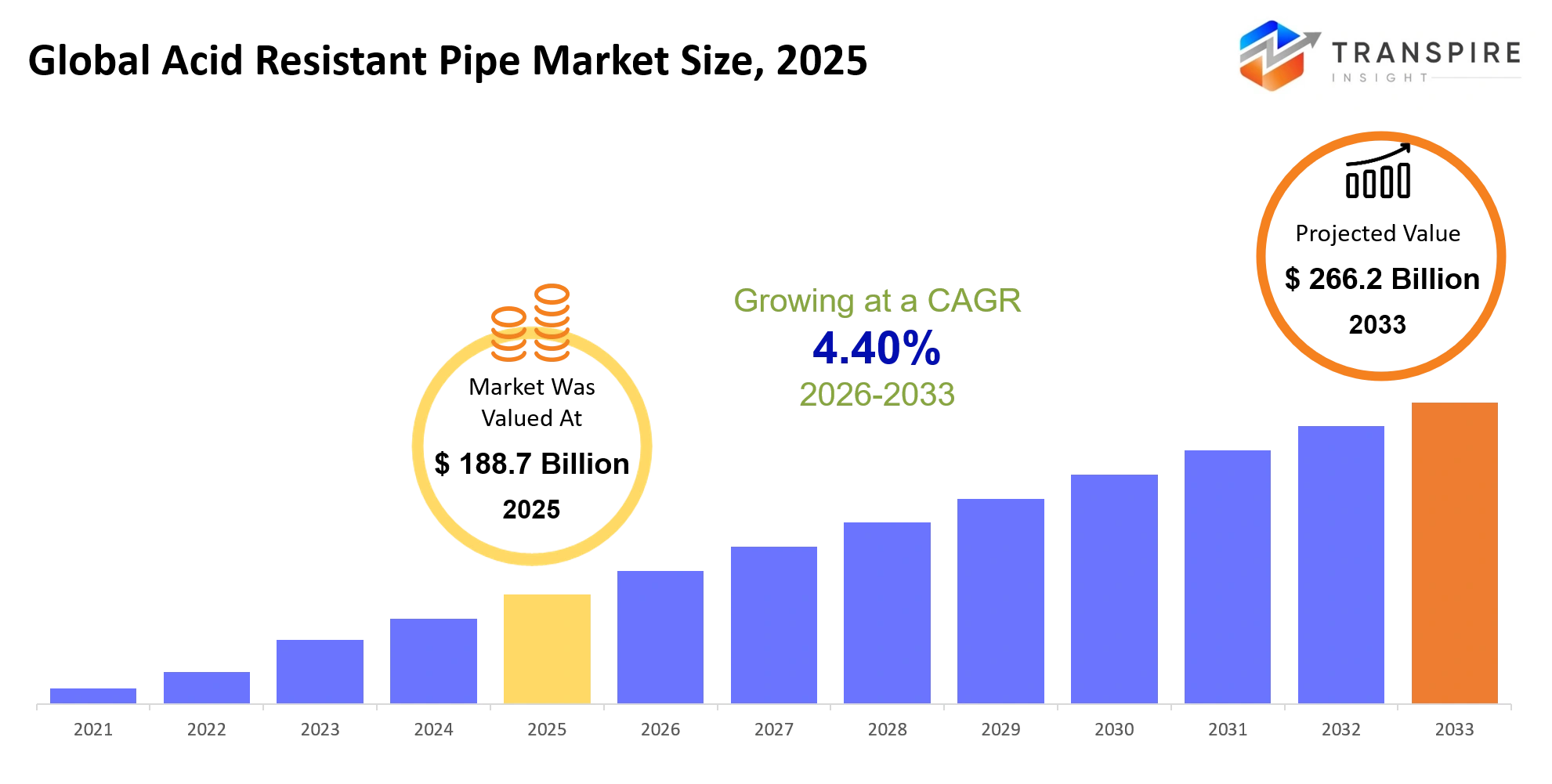
As per Transpire Insight Analysis, the Global Acid Resistant Pipe Market size is estimated at USD 188.7 Billion in 2025 and is anticipated to reach USD 266.2 Billion by 2033, growing at a CAGR of 4.40% from 2026 to 2033.
The global acid resistant pipe market assists industries in the safe handling of highly corrosive chemicals, acidic fluids, and corrosive process streams, preventing plant damage or process downtime. These pipes are extensively utilized in chemical production, mining operations, water and wastewater treatment plants, and other processing operations where typical metal pipes may corrode quickly. During the previous five years, market evolution toward innovative polymer-lined and composite pipe solutions, characterized by long service life and low maintenance expenditure, replaced market emphasis on traditional metallic corrosion-resistant alloys. Furthermore, engineered lining and fibre-reinforced composite technologies have gradually supplanted each other in structure. This has also been facilitated by expanded material utilization in manufacturing (battery raw material production, in particular), a trend bolstered by the rapidly accelerating EV manufacturing industry, acting as a real-world trigger by necessitating corrosion-resistant plant processes. Ageing pipelines are also increasingly replaced on a proactive basis, aided by sustained plant modernisations and more rigorous plant safety and reliability benchmarks.
Key Global Acid Resistant Pipe Market Insights:
The market is moving from corrosion prevention to optimising the lifecycle, with material engineering, digital monitoring and sustainability all playing a role in the procurement process. Industrial buyers are turning more and more to operational reliability, reduced maintenance costs, and regional supply resilience over the initial equipment costs.
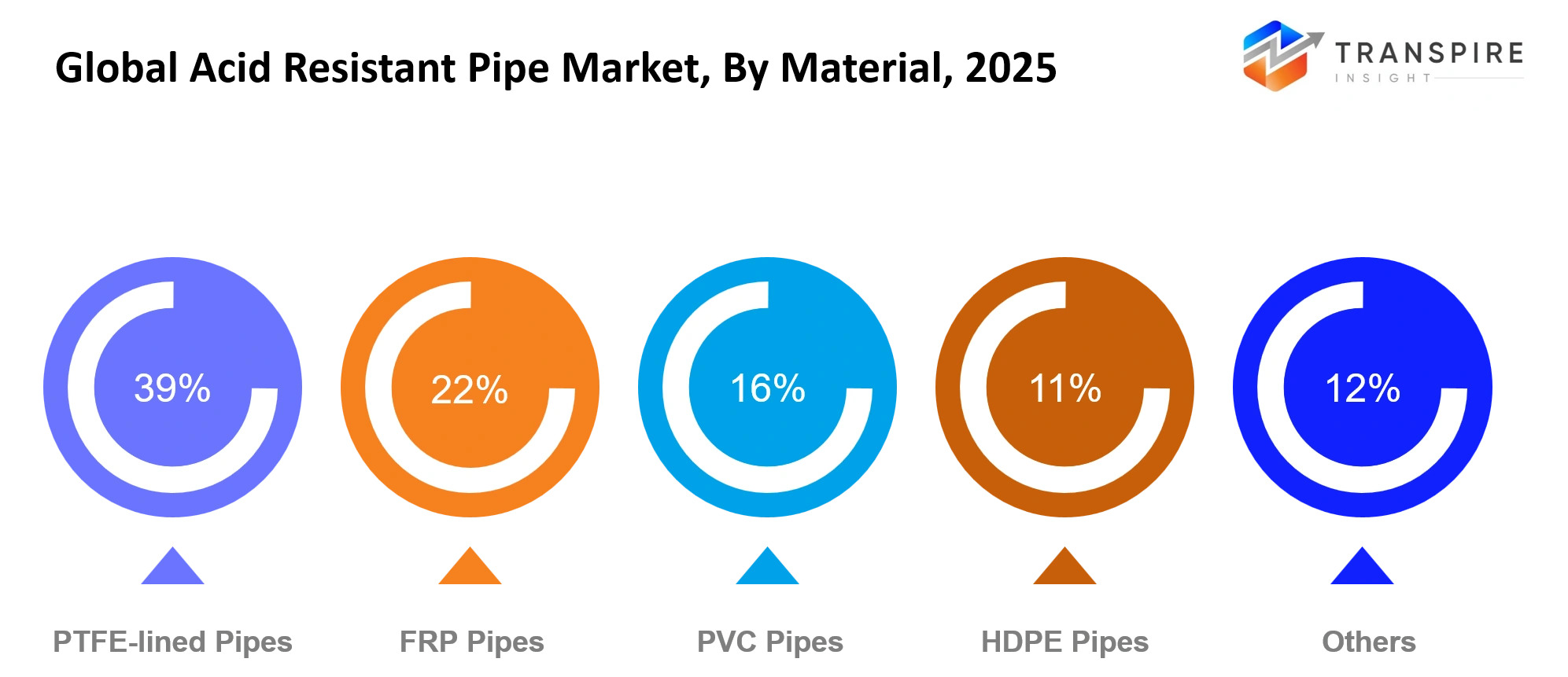
- PTFE-lined Pipes account for 39% of the share as AGRU continues to grow its high-purity fluoropolymer production for chemical processing applications.
- Asia Pacific's share of demand is 41%, as localised production for expanding industrial corridors has been bolstered by Astral Pipes.
- FRP Pipes registers the fastest 13.7% CAGR while Future Pipe Industries grows a lightweight composite solution for large process facilities.
- With precision-engineered corrosion-resistant flow systems and digital quality assurance, North America accounts for 24%.
- Europe represents 22%, with GF Piping Systems focused on the development of recyclable piping solutions in line with industry decarbonization goals.
- The Middle East & Africa is 8%, and regional EPC contractors are increasingly using modular corrosion-resistant piping for energy diversification projects.
- The new installation is still the main deployment, with Saint-Gobain developing engineered materials that lower the frequency of maintenance and lifecycle costs.
- The adoption of predictive asset management is accelerating, and manufacturers are adding smart inspection compatibility to ensure pipeline service lives and reliability.
What are the Key Drivers, Restraints, and Opportunities in the global acid-resistant pipe market?
Driver:
Modernization of the corrosive process infrastructure in chemical processing, mining, and industrial manufacturing plants is the primary source of this growth, driven by the increased spending on specialty chemicals, lithium processing, semiconductor chemicals and industrial wastewater treatment – where hostile process fluids need higher-durability pipe. Corrosion failures, process downtime, and maintenance costs encourage plant operators to substitute carbon steel process piping systems for corrosion-resistant options, which enhance plant life, reduce life-cycle costs, and boost compliance in the process product market.
In March 2026, Skipper Pipes partnered with Lubrizol to launch a national campaign for FlowSafe™ CPVC systems to address these needs. This collaboration empowers operators to securely transport aggressive process fluids.
Restraint:
The greatest disadvantage is the upfront expense to acquire acid-resistant products, coatings, and to pay for the certification of your installation professionals; this difficulty cannot be addressed by a simple repair job because a large number of old industrial sites are fitted for standard pipeline systems. The installation process alone adds time and cost to the industrial operation due to the special installation, knowledge, and testing required to comply.
Opportunity:
Another important growth area would be through increasing industrial investment into the rapidly expanding region of South East Asia, the Middle East, and Africa, where a range of new chemical plants, mines, and desalination plant projects are underway. The installation of cutting-edge composite solutions, including fibre-reinforced polymer (FRP) pipe or digitally controlled piping, can bring further benefits with higher uptime and reduced maintenance costs. An example would be in acid-resistant pipework where corrosion sensors and predictive analytics can help eliminate costly, unplanned plant outages.
In March 2026, Nature.com published research on automated robotic inspection and machine learning for pipeline corrosion detection. This enables continuous structural health monitoring, helping operators eliminate costly, unplanned plant outages.
What has the Impact of Artificial Intelligence Been on the Global Acid-resistant pipe Market?
To enhance the longevity and efficiency of acid-resistant piping systems, artificial intelligence is being deployed to improve how such systems are manufactured, monitored and managed. By examining pressure changes, flow behaviour, vibration data and corrosion sensor readings, AI-based predictive maintenance systems are being used to anticipate and detect liner degradation early-before costly failures and leaks can occur. Furthermore, machine learning is used by manufacturers to refine material compositions, control manufacturing processes, and conduct automated quality checks for greater product uniformity and improved longevity of linings. During installation and in-service life, engineers utilise AI-powered digital twin technologies to simulate chemical flow patterns and pressure loads and ensure the correct materials are chosen for each acid-resistant pipeline application-while minimising design errors. Automatic visual inspection systems, in turn, allow for enhanced defect identification during the manufacturing process. But integrating AI requires significant investments in industrial sensors, existing plant equipment, and appropriate digital infrastructure-areas where many facilities are not yet prepared for.
In March 2026, SLB (formerly Schlumberger) expanded its Digital Twin Initiatives to pair advanced physical AI with OptiSite Production Network Solutions, resulting in real-time predictive corrosion degradation modelling and a 34% boost in pipeline inspection efficiency. But integrating AI requires significant investments in industrial sensors and existing plant equipment.
Key Global Acid Resistant Pipe Market Trends:
The market is moving from simple corrosion protection to intelligent, light, and lifecycle-oriented solutions that enhance the productivity of industries. Procurement is no longer just based on the chemical resistance specification; more and more, it is based on technology integration and material innovation.
- Engineered composite piping systems are taking the place of metal systems to cut down on maintenance and installation weight—especially in industries.
- The PTFE lining technologies have grown into multi-layered systems that can handle more and more aggressive chemical formulations.
- Digital corrosion monitoring is slowly moving maintenance from scheduled inspections towards predictive asset management.
- Prefabricated pipe assemblies are in demand to reduce construction times for modular industrial plants.
- Leak-proof pipes with better sealing capabilities have been rapidly adopted due to environmental compliance.
- Pipeline replacement decisions have become more cost-focused, on lifecycle cost evaluation rather than on the purchase price.
- Mining companies are turning to abrasion- and acid-resistant hybrid piping solutions for managing chemically aggressive slurries.
- Buyers want shorter lead times, greater procurement flexibility, and localized manufacturing, and regional supply chains are growing.
Global Acid Resistant Pipe Market Segmentation
By Material:
PTFE-lined pipes dominate the market with a 39% share, thanks to excellent corrosion resistance against strong acids, high chemical inertness and durability in challenging applications. FRP pipes are the fastest-growing category with a 13.7% CAGR, capturing 22% of the market, driven by low weight, high mechanical strength, and installation savings. PVC pipes account for 16% and are widely used in affordable applications requiring corrosion resistance, and HDPE pipes represent 11% and are used in flexible, durable applications. Alloy, ceramic-lined, and other pipe types meet very niche processing demands.
By Application:
Chemical processing continues to be the primary application, as the continuous processing of harsh acids is a well-suited application requiring robust pipeline systems with good resistance to acid corrosion. Water treatment is second, as more capital investment continues for the treatment of industrial waste and in new desalination infrastructure. Mining continues to increasingly use acid-resistant pipe for slurry handling and mineral processing, and O&G and power generation continue to upgrade process piping systems for better overall reliability in an acidic service.
By End User:
The Chemicals Sector will continue to hold the top spots in this industry with ongoing demand for a continuous supply of highly sensitive chemicals. The Industrial Manufacturing will keep investing in robust process equipment, whereas the Utilities sector will enhance its adoption via water treatment renovations. Mining Companies are extending usage as more mineral extraction will be executed, and the rest of the industrial segments contribute to this demand.
By Pipe Size:
2–6-inch pipe provides the best solution for the largest systems since its ability to maximize flow rate with industrial versatility. Anything larger than 6 inches is usually for the bulk process industry, and below 2 inches is the choice for highly precise chemical handling and instrumentation.
By Installation:
The New Installations market sector remains the largest due to the increasing number of industrial projects that require a corrosion-resistant infrastructure at the earliest stage. Although Replacement Projects remain crucial due to pipeline life cycle issues, the Expansion Projects will continue to be drivers due to an increase in capacity at industrial processing facilities.
What are the Key Use Cases Driving the Global Acid-resistant Pipe Market?
Chemical processing remains the primary use in which concentrated acids, solvents, and active chemicals can be safely carried in corrosion-resistant piping in ongoing manufacturing. The dominance of PTFE-lined pipe is an indication of the need for extreme chemical resistance and long service life.
Water, mining, and other industrial facilities are turning to corrosion-resistant pipe to manage acidic wastewater, mineral slurries and reactive processing solutions, while mitigating plant downtime and protecting the environment.
The emerging markets for lithium refinement, semiconductor processing, hydrogen solutions, and battery materials processing demand new pipe technology that is resistant to a variety of challenging process chemistries, maintaining product purity and extending service life for long-term commercial opportunity.
|
Report Metrics |
Details |
|
Market size value in 2025 |
USD 188.7 Billion |
|
Market size value in 2026 |
USD 196.9 Billion |
|
Revenue forecast in 2033 |
USD 266.2 Billion |
|
Growth rate |
CAGR of 4.40% from 2026 to 2033 |
|
Base year |
2025 |
|
Historical data |
2021 - 2024 |
|
Forecast period |
2026 - 2033 |
|
Report coverage |
Revenue forecast, competitive landscape, growth factors, and trends |
|
Regional scope |
United States; Canada; Mexico; United Kingdom; Germany; France; Italy; Spain; Denmark; Sweden; Norway; China; Japan; India; Australia; South Korea; Thailand; Brazil; Argentina; South Africa; Saudi Arabia; United Arab Emirates |
|
Key company profiled |
AGRU, GF Piping Systems, FIP, Crane ChemPharma, Asahi Yukizai, Sekisui Chemical, Saint-Gobain, Future Pipe Industries, Piping Technology, Supreme Industries, Astral Pipes, Georg Fischer, Ashirvad Pipes, Charlotte Pipe, Simtech. |
|
Customization scope |
Free report customization (country, regional & segment scope). Avail customized purchase options to meet your exact research needs. |
|
Report Segmentation |
By Material (PTFE-lined Pipes, FRP Pipes, PVC Pipes, HDPE Pipes, Alloy Pipes, Ceramic-lined Pipes, Others); By Application (Chemical Processing, Water Treatment, Mining, Oil & Gas, Power Generation, Others); By End User (Chemical Industry, Industrial Manufacturing, Utilities, Mining Companies, Others); By Pipe Size (Below 2 Inch, 2–6 Inch, Above 6 Inch, Others); By Installation (New Installations, Replacement, Expansion Projects, Others). |
Which Regions are Driving the Global Acid-Resistant Pipe Market Growth?
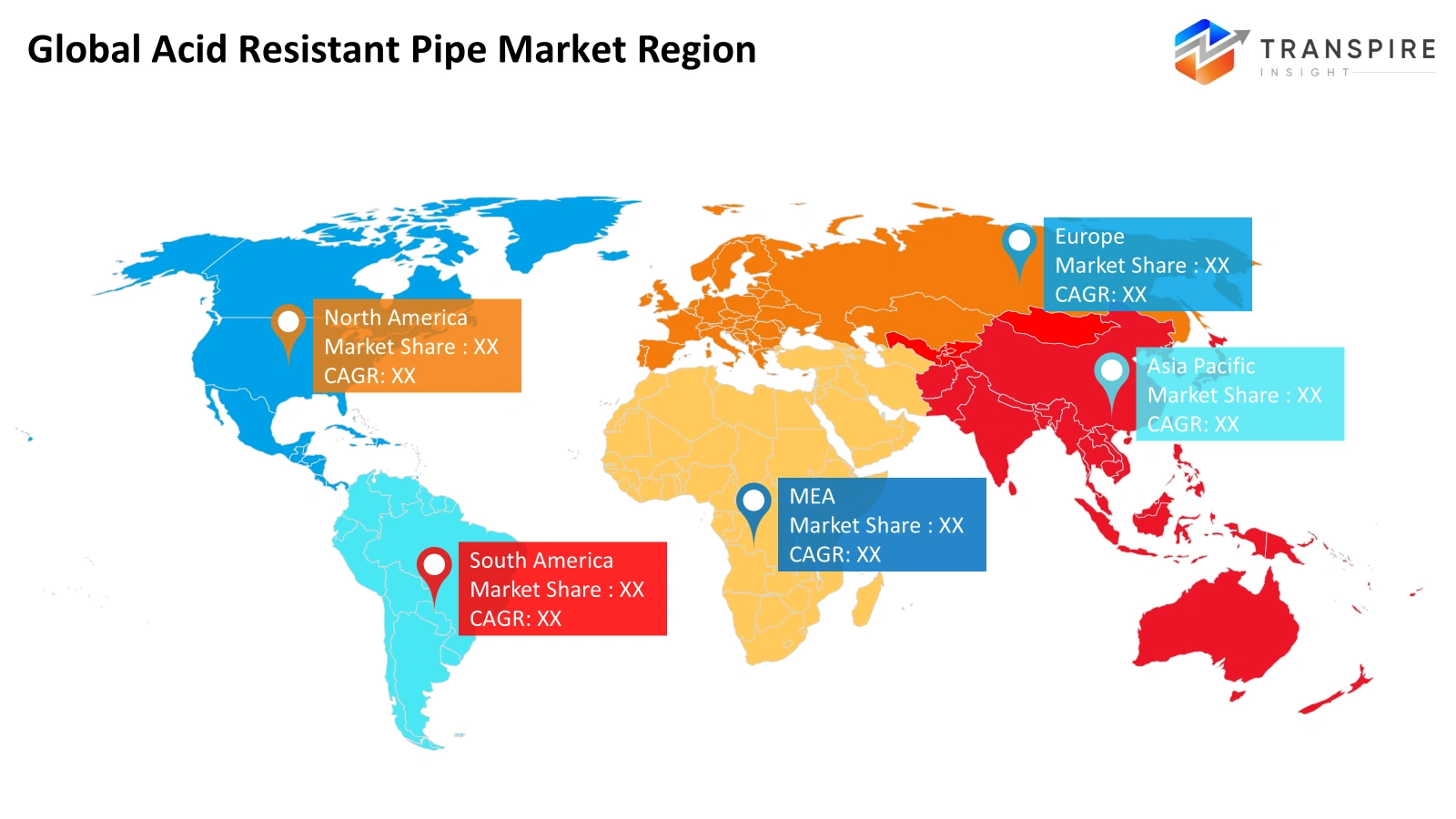
Asia Pacific region commands 41% market share and has consistently topped the regional market charts, driven by the growth in chemical manufacturing capacity, mining activities, and industrial infrastructure development. Favourable policies to support the speciality chemicals sector, electronics manufacturing & wastewater treatment drive strong, sustained growth for piping systems designed to resist corrosion. The integrated industrial zones, competitive manufacturing prices & growing focus on export manufacturing further build stronger regional supply chains. Continued investments in expanding capacity across China, India, Japan & Southeast Asia solidify long-term regional leadership.
Europe accounted for 22% of this regional demand based on its advanced industry base and replacement requirement rather than new greenfield plant construction. Operators have increasingly replaced old processing plants to enhance efficiency, plant security, environmental responsibility, and prevent failures. Demanding design regulations and an active preventive maintenance program have supported high-end consumption of acid-resistant grades. Growth in other segments, such as Specialty Chemicals and Pharmaceuticals, also supported regional stability. In March 2026, Novo Nordisk invested €432 million to expand its tablet-based medicine manufacturing plant in Athlone, Ireland. This retrofitting and facility upgrade will increase capacity for GLP-1 treatments and establish Ireland as an important hub for supplying global speciality pharmaceutical markets while enhancing environmental responsibility.
Middle East & Africa Middle East & Africa accounts for the fastest growing segment of the market and exhibits growth of 14.5% at a CAGR, constituting 8% of the total market. Increasing investment in the mining, desalination, petrochemicals, and diversification sectors is driving growth for corrosion-resistant infrastructure. The large number of mega-scale industrial projects and the rapid establishment of export-oriented processing units are shifting the trend of the procurement dynamics of the region, making it the largest region to consider for future capacity expansion.
In January 2026, ACWA Power acquired key desalination and power assets in Bahrain and Kuwait, strengthening regional infrastructure and lower-carbon water processing.
Who are the Key Players in the Global Acid Resistant Pipe Market and how do they compete?
The competitive landscape is driven by engineered material solutions, application-specific performance, proximity of manufacturing, and overall life-cycle value, not just pricing. Competitors continue to stand apart from each other through customized corrosion-resistant systems, rapid project execution, certified quality systems, and engineered technical expertise for tough industrial settings.
Within the highly demanding chemical space, AGRU, GF Piping Systems, FIP, Crane ChemPharma, and Asahi Yukizai battle for market share with innovative materials and high-performance polymer solutions. In the industrial sector, Sekisui Chemical excels in engineered composite solutions, and Saint-Gobain differentiates with premier engineered materials and process engineering expertise. Future Pipe Industries expands globally with major composite pipe manufacturing capacity, particularly impacting infrastructure and energy projects. Regional growth, diversified product portfolios, and customer-specific engineering solutions are cornerstones for Piping Technology, Supreme Industries, Astral Pipes, Georg Fischer, Ashirvad Pipes, Charlotte Pipe, and Simtech. Companies such as Astral, Georg Fischer, Ashirvad and Simtech utilise localised manufacturing, automated quality inspection and industry-focused consulting to optimise project delivery times. Developing partnerships with EPC and distribution partners in emerging industrial markets continues to be a focus.
Key players are:
- AGRU
- GF Piping Systems
- FIP
- Crane ChemPharma
- Asahi Yukizai
- Sekisui Chemical
- Saint-Gobain
- Future Pipe Industries
- Piping Technology
- Supreme Industries
- Astral Pipes
- Georg Fischer
- Ashirvad Pipes
- Charlotte Pipe,
- Simtech
Recent Development News on the Global Acid Resistant Pipe Market
In May 2026, Huayang Steel Pipe successfully delivered a bulk order of low-temperature acid-resistant pipes. This deployment supports the infrastructure needs of the oil and gas sector, enhancing corrosion resistance in highly corrosive environments.
Source: https://www.hy-steelpipe.com
In January 2026, Tenaris was officially awarded a major infrastructure supply contract to deliver line pipe, specialised casing, and advanced anti-corrosion coating services for Phase 3 of the Sakarya Gas Field Project in offshore Turkey.
Source: https://www.tenaris.com
What Strategic Insights Define the Future of the Global Acid-Resistant Pipe Market?
Markets are migrating towards intelligent, high-performance fluid systems which deliver improved corrosion protection, asset life cycle predictive maintenance, and improved life cycle value. Procurement is shifting from first cost to total cost of operation, which will favour manufacturers who deliver a full engineering solution, but there remains an underlying risk of pricing pressures driven by volatile fluoropolymers, speciality resin, and composite raw material costs, which could cause project postponements in heavy industrial applications. Counterbalancing the risk, there are new capital investments across battery materials, semiconductors, and hydrogen processing, and the rapidly developing use of industrial water reuse in new acid-resistant piping applications. The focus on smart (connected) products and services, as well as the modularisation of installation, will improve competitive positions. Building out the region, localizing the technical support structure, and providing customised engineered solutions to specific operating challenges and environments are critical.
Key Segmentations are:
By Material
- PTFE-lined Pipes
- FRP Pipes
- PVC Pipes
- HDPE Pipes
- Alloy Pipes
- Ceramic-lined Pipes
- Others
By Application
- Chemical Processing
- Water Treatment
- Mining
- Oil & Gas
- Power Generation
- Others
By End User
- Chemical Industry
- Industrial Manufacturing
- Utilities
- Mining Companies
- Others
By Pipe Size
- Below 2 Inch
- 2–6 Inch
- Above 6 Inch
- Others
By Installation
- New Installations
- Replacement
- Expansion Projects
- Others
Regional Outlook
North America
- United States
- Canada
- Mexico
Europe
- Germany
- United Kingdom
- France
- Spain
- Italy
- Rest of Europe
Asia Pacific
- Japan
- China
- Australia & New Zealand
- South Korea
- India
- Rest of Asia Pacific
South America
- Brazil
- Argentina
- Rest of South America
Middle East & Africa
- Saudi Arabia
- United Arab Emirates
- South Africa
- Rest of the Middle East & Africa
Frequently Asked Questions
Find quick answers to common questions.
The global acid-resistant pipe market size was valued at USD 188.7 Billion in 2025 and is poised to reach USD 266.2 Billion by 2033, expanding at a 4.40% CAGR.
Key segments for the global acid resistant pipe market are By Material (PTFE-lined Pipes, FRP Pipes, PVC Pipes, HDPE Pipes, Alloy Pipes, Ceramic-lined Pipes, Others); By Application (Chemical Processing, Water Treatment, Mining, Oil & Gas, Power Generation, Others); By End User (Chemical Industry, Industrial Manufacturing, Utilities, Mining Companies, Others); By Pipe Size (Below 2 Inch, 2–6 Inch, Above 6 Inch, Others); By Installation (New Installations, Replacement, Expansion Projects, Others).
Growth is primarily driven by expanding chemical processing capacity, industrial wastewater treatment projects, mining investments, and replacement of ageing pipelines with high-performance corrosion-resistant piping systems.
The global acid-resistant pipe market is led by major manufacturers, including AGRU, GF Piping Systems, FIP, Crane ChemPharma, Asahi Yukizai, Sekisui Chemical, Saint-Gobain, Future Pipe Industries, Piping Technology, Supreme Industries, Astral Pipes, Georg Fischer, Ashirvad Pipes, Charlotte Pipe, and Simtech.
Asia Pacific holds 41% of the global market, supported by strong chemical manufacturing, expanding industrial infrastructure, government-backed industrialisation, and rising investments in mining and water treatment facilities.
Commercial opportunities are emerging from battery material production, hydrogen processing, smart corrosion-monitoring technologies, FRP pipe adoption, and new industrial projects across the Middle East, Africa, and Southeast Asia.
- AGRU
- GF Piping Systems
- FIP
- Crane ChemPharma
- Asahi Yukizai
- Sekisui Chemical
- Saint-Gobain
- Future Pipe Industries
- Piping Technology
- Supreme Industries
- Astral Pipes
- Georg Fischer
- Ashirvad Pipes
- Charlotte Pipe,
- Simtech
About the Authors

Pankaj Ghogare Patil
I am Pankaj Ghogare Patil, a Senior Research Analyst at Transpire Insight, specializing in the Pharmaceutical, Chemicals & Materials, Healthcare IT, and Biotechnology industry. My expertise lies in conducting comprehensive market research, analyzing industry trends, evaluating competitive landscapes, and translating complex data into actionable insights. At Transpire Insight, I closely follow emerging technologies, regulatory developments, and market innovations to create accurate, well-researched, and informative content that helps businesses and professionals make informed decisions. I am committed to producing credible, evidence-based articles that reflect industry best practices while making technical topics accessible and valuable for a broad audience.

Chakradhar Khansole
Chakradhar serves as the Research Director at Transpire Insight, bringing over 8 years of experience in technology, innovation, and strategic market intelligence. He specializes in transforming complex market data into actionable business insights that enable organizations to make informed, growth-oriented decisions. Recognized for his strategic vision and analytical expertise, Chakradhar leads high-impact research initiatives, delivering comprehensive market assessments, competitive intelligence, and forward-looking industry analysis.
Recently Published Reports
-
May 2026
Healthcare Polymer Packaging Market
Healthcare Polymer Packaging Market Size, Share & Analysis Report By Packaging Type (Syringes, IV Bottles and Pouches, Clamshells, Blisters, Bottles & Jars, Containers, Tubes, IV Parental Packaging, Others), By Type (Regulated, Non-regulated), By Polymer Type (LDPE (Low-Density Polyethylene), HDPE (High-Density Polyethylene), Homo-polymer (Homo), Random Copolymer (Random), Block Copolymer (Block), PET, Polystyrene, Polyvinyl Chloride, Polyamide/EVOH, Others), and Geography (North America, Europe, Asia-Pacific, Middle East and Africa, South and Central America), 2021 - 2031
-
Apr 2026
Hydrophilic Tape (Waterstop) Market
Hydrophilic Tape (Waterstop) Market Size, Share & Analysis Report By Type (Bentonite-Based Hydrophilic Tape, Rubber-Based Hydrophilic Tape), By Application (Residential Buildings, Commercial Buildings, Infrastructure Projects), and Geography (North America, Europe, Asia-Pacific, Middle East and Africa, South and Central America), 2021 - 2031
-
Apr 2026
Metalens Market
Metalens Market Size, Share & Analysis Report By Type (Visible Light Metalens, and Infrared Metalens), By Application (Consumer Electronics, Automotive Electronics, Industrial, Medical, and Others), and Geography (North America, Europe, Asia-Pacific, Middle East and Africa, South and Central America), 2021 - 2031
-
Apr 2026
PBT Resin Market
PBT Resin Market Size, Share & Analysis Report By Type (Reinforced PBT Resin, Unreinforced PBT Resin), By Processing Method (Injection Molding, Extrusion, Blow Molding, Others), By End-User (Automotive, Electrical & Electronics, Consumer Appliances, Industrial Machinery, Medical Devices, Packaging, Others), and Geography (North America, Europe, Asia-Pacific, Middle East and Africa, South and Central America), 2021 - 2031