

Glass Bottles and Containers Market Summary:
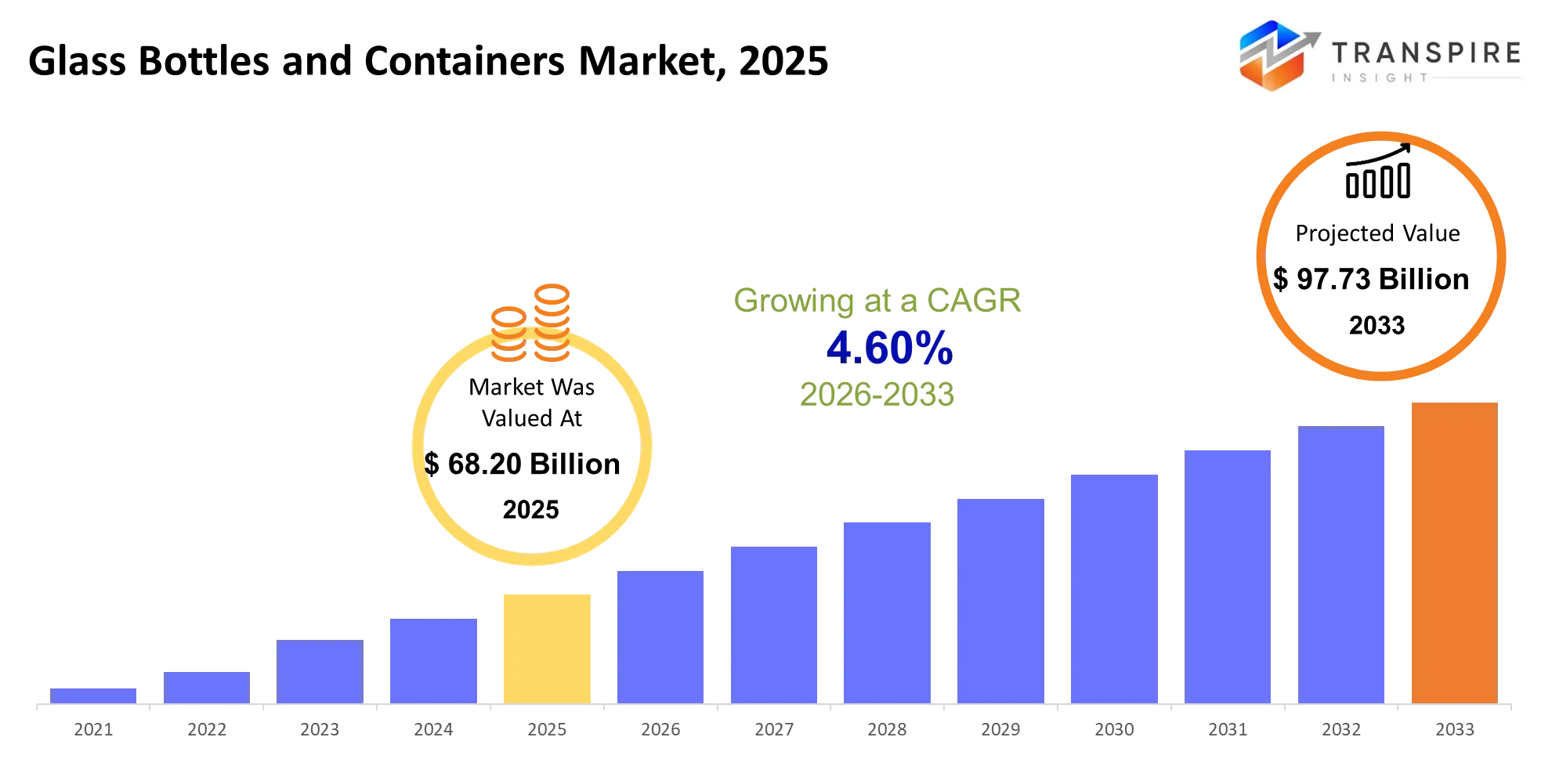
As per Transpire Insight, The Glass Bottles and Containers Market size is estimated at USD 68.20 billion in 2025 and is anticipated to reach USD 97.73 billion by 2033, growing at a CAGR of 4.60% from 2026 to 2033.
The glass bottles and containers market refers to hard, returnable packaging used in industries such as beverage, food, pharma, cosmetics, chemicals and household products, where shelf appeal, product integrity and recyclability are monetarily prioritised. Over the last 3-5 years, the market has shifted from aesthetic valuation towards a compliant circular-packaging option; this structural change is primarily attributed to the ascendancy of extended producer responsibility, regulations around recycled content and deposit-return schemes, which have made cullet supply and refillable design imperative to purchasing decisions. A recent driver has been Europe's Packaging and Packaging Waste Regulation along with plastic restrictions, which has driven major beverage and self-care brands to reconfigure their packaging baskets with glass. The observed growth occurs through a cause-and-effect sequence: tougher plastic legislation and a premiumisation phenomenon have increased brand appetites for inert, recyclable and customizable containers, which in turn has resulted in booking upticks for lightweight, high-cullet bottles and niche formats, thus aiding value growth despite higher logistics and energy prices.
Glass Bottles and Containers Market Size & Forecast:
- Market Size 2025: USD 68.20 Billion
- Expected Market Value (2033): USD 97.73 Billion
- Forecast CAGR (2026–2033): 4.60%
- Leading Region in 2025: North America
- Fastest Growing Region: Asia Pacific
- Key Company Profiles: Owens-Illinois, Ardagh Group, Verallia, Vidrala, BA Glass, Gerresheimer, Vetropack, Wiegand-Glas, Stoelzle Glass, AGI Glasspack, Hindustan National Glass, Piramal Glass, Nihon Yamamura Glass, Vitro, Consol Glass.
Key Glass Bottles and Containers Market Insights:
Glass packaging is transitioning from the supply of containers to the use of lower-carbon production, efficient design, and custom packaging solutions. Companies that integrate sustainability investments and dependable regional manufacturing and formats will be better equipped to safeguard their margins.
- North America accounts for 55.18% of volume, is well-established in curbside collection, and has corporate sustainability goals that lean towards high-cullet recipes.
- O-I Glass is progressing its modular furnace called MAGMA in Kentucky, which allows for capital cost efficiencies for capacity additions with reduced changeover downtime.
- After the implementation of the NextGen hybrid furnace, Ardagh achieved a 38% glass and service quality improvement in North America in September 2026.
- A hybrid furnace with up to 70% renewable electricity was installed at Verallia's factory, which reduced up to 55% CO2 emissions.
- Verallia's Campo Bom, Brazil, furnace provided the company with an additional 330 tonnes per day, which was aimed at the food and beverage market in South America.
- Vidrala's raw material content consists of 55.4% recycled glass, and it provides production, filling, and logistics services.
- Gerresheimer increases high-margin Type I borosilicate pharmaceutical packaging in response to the trend of growing demand for biologics and injectables.
- In 12 plants, BA Glass grows the number of containers produced by more than 12 billion per year and increases the use of cullet and the number of furnace operations using renewable energy.
- Pharmaceutical and beauty packaging are driving the growth in Asia Pacific, not volumes of commodity beverages, with a 4.76% CAGR.
What are the Key Drivers, Restraints, and Opportunities in the Glass Bottles and Containers Market?
Driver:
Sustainability commitments, premium beverage positioning, and packaging regulations are encouraging brands to reassess container materials. Glass offers product visibility, chemical stability, and established recycling infrastructure, making it attractive for beverages, food, and selected pharmaceutical applications. The EU’s Packaging and Packaging Waste Regulation, applicable from August 2026, strengthens the commercial importance of recyclable and reusable packaging design. This creates adoption opportunities for suppliers that can provide lightweight, customised bottles without compromising safety or durability. Premiumization also supports revenue through differentiated shapes, finishes, embossing, and brand-specific designs.
Restraint:
Glass remains energy- and logistics-intensive. Furnaces run continuously, virgin-material melting consumes substantial energy, and heavier packs raise freight costs and breakage risk. This persists because glass production is capital-intensive and geographically tied to plants, cullet networks, and mould inventories; producers cannot quickly reconfigure capacity when demand shifts between commodity beverages and premium or pharmaceutical formats.
Opportunity:
Lightweighting, furnace electrification, recycled-cullet optimisation, and returnable packaging systems are creating opportunities to improve manufacturing efficiency. European container lightweighting demonstrates progress in reducing material consumption without compromising performance. Investments in advanced forming technologies and regional refill infrastructure can further reduce transportation emissions, production costs, and resource requirements. These improvements also enable manufacturers to establish differentiated supply agreements with beverage brands, strengthen sustainability credentials, and improve competitiveness while addressing evolving environmental expectations and packaging requirements.
Driver Impact Analysis – Glass Bottles and Containers Market
|
Driver |
Relative Impact on Growth (%) |
Geographic Relevance |
Impact Timeline |
Demand Strength |
Growth Mechanism (5–10 words) |
Key Beneficiaries (5–10 words) |
Major Constraint (5–10 words) |
|
1. Rising Demand for Sustainable and Recyclable Packaging |
28% |
Europe, North America, Asia-Pacific |
Medium-term (2–4 years) |
High |
Plastic substitution and circular packaging initiatives increase glass adoption. |
Container glass manufacturers, recycling operators, sustainability-focused brands. |
High production emissions and limited recycled glass availability. |
|
2. Expanding Beverage Consumption and Premiumization |
25% |
Asia-Pacific, North America, Europe |
Short-term (≤2 years) |
High |
Beverage consumption and premium branding stimulate container demand. |
Beverage manufacturers, breweries, distilleries, premium packaging suppliers. |
Competition from lightweight plastic and aluminum alternatives. |
|
3. Pharmaceutical and Healthcare Packaging Expansion |
20% |
Asia-Pacific, North America, Europe |
Long-term (≥4 years) |
High |
Biologics, vaccines, and injectable medicines increase glass vial requirements. |
Pharmaceutical glass manufacturers, biotechnology companies, healthcare packaging suppliers. |
Strict qualification requirements and specialized manufacturing investment. |
|
4. Regulatory Pressure on Single-Use Plastics and Packaging Waste |
15% |
Europe, North America, Asia-Pacific |
Medium-term (2–4 years) |
High |
Packaging regulations accelerate substitution toward recyclable glass formats. |
Glass producers, packaging converters, compliance-focused consumer goods companies. |
Regulatory inconsistencies and glass collection infrastructure limitations. |
|
5. Technological Advancements in Lightweighting and Energy-Efficient Manufacturing |
12% |
Europe, North America, Asia-Pacific |
Long-term (≥4 years) |
Medium |
Lightweight designs and furnace modernization improve production economics. |
Glass manufacturers, furnace technology providers, industrial automation suppliers. |
High capital expenditure and furnace modernization downtime. |
|
Total |
100% |
— |
— |
— |
— |
— |
— |
What Has the Impact of Artificial Intelligence Been on the Glass Bottles and Containers Market?
AI is indeed maturing glass packaging from a fixed-process industry to a data-driven manufacturing industry. Machine-vision inspections of bottles and jars at line speed have been introduced that detect cracks, bubbles, dimensional faults, colour issues, and label errors prior to shipment, substantially reducing waste, recalls, and disputes. AI-based optimisation of furnace temperature and combustion, batch composition, and cullet ratios helps producers balance energy consumption with glass quality. Similarly, predictive models for vibration, temperature, and equipment data help forecast wear on moulds, failures of furnace components, and unscheduled downtime, allowing maintenance schedules to be planned ahead of severely costly disruptions. In the commercial world, demand-sensing tools can help producers tune production plans to seasonal soft drink launches, promotional sales volumes, and the rapid growth of SKUs.
The primary challenge faced to date has been integration. Many plants run older furnaces, inconsistent sensors, and disjointed enterprise resource planning (ERP) systems, making real-time deployment of robust AI models costly. Data quality is another issue, with false positives and false negatives possible from vision systems if lighting, bottle shape, or color recipes change. Human-in-the-loop approaches and multi-phase deployment are therefore critical.
In August 2026, Vetropack Group launched its digital twins project, using artificial intelligence, computer vision, and advanced robotics to create digital replicas of its thermal tempering furnaces and container testing machinery.
https://www.packaginginsights.com/news/ai-packaging-manufacturing-digital-twins-robotics.html
Key Glass Bottles and Containers Market Trends:
Glass packaging is becoming more than just a container, but a solution for a more sustainable manufacturing process. There is a growing need to balance design flexibility, operational efficiency, recyclability, and customer-specific performance in today's competitive landscape.
- Lightweight bottle design for reduction in material use without compromising strength and handling.
- More manufacturers are increasingly prioritizing recycled cullet in their sourcing strategies to achieve circularity and reduce use of virgin materials.
- AI-based inspection is moving the quality control process from manual sampling to high-speed, image-based defect detection.
- Distinctive shapes, embossing, and finishes are becoming a trend for premium beer brands to increase their shelf recognition.
- The relevance of refillable glass systems is increasing in areas where collection networks and reverse logistics can facilitate repeated circulation.
- Pharmaceutical packaging specifications are driving increased dimensional control, traceability, and custom container production.
- Energy efficiency, emissions reduction, and production stability are the main emphasis of furnace modernization.
- Packaging compliance is having a meaningful impact on the product design process, making manufacturers think about it earlier from a lifecycle, reuse, and recyclability perspective.
Glass Bottles and Containers Market Segmentation
Product Type:
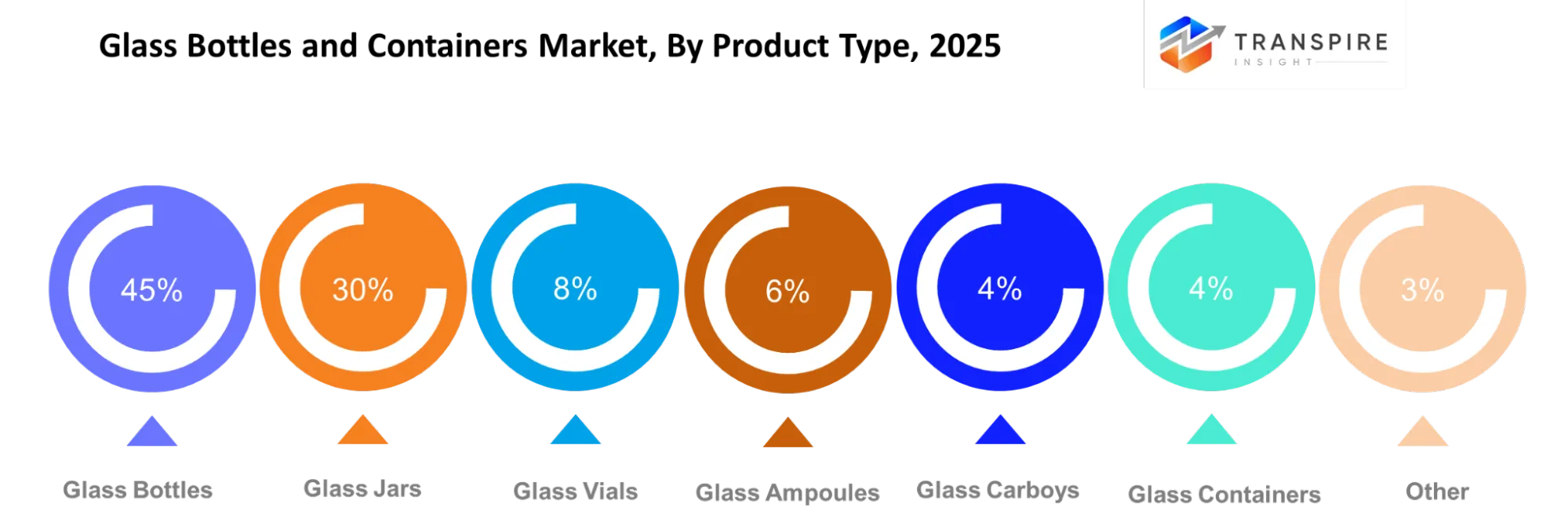
Bottled accounts for 45.0%, growth driven by alcoholic beverages, premium water, juices, and personal-care products. Glass bottles have found an advantage in effective branding, inertness, and refillability. Jars account for 30.0%, with food preservation, gourmet applications, and reusable household packaging as the major uses. Vials make up 8.0%, while ampoules make up 6.0%, with the demand generated by pharmaceutical requirements for sterility, breakage restriction, and regulatory compliance. Carboys total 4.0%, used for chemicals, laboratory liquids, and bulk beverages. Containers and Other account for 4.0% and 3.0%, respectively, and the future distribution of value is expected to shift to bottles, vials, and tailor-made premium containers rather than uniform bulk packaging.
End User:
Beverages dominate end-user demand at 64.02%, supported by wine, spirits, beer, and premium non-alcoholic drinks. Amber glass, growing at a 3.79% CAGR, benefits from light-sensitive beverage, pharmaceutical, and cosmetic applications. Food packaging provides stable volume through jars, sauces, and preserved products. Pharmaceuticals offer higher-value opportunities through vials and ampoules, while cosmetics favour premium containers and dropper bottles. Chemicals and household products maintain industrial demand but remain more sensitive to packaging costs and material substitution.
Color:
Clear/flint glass remains the preferred choice for product visibility, beverage presentation, and premium branding. Amber glass benefits from ultraviolet protection and compatibility with light-sensitive pharmaceutical and cosmetic formulations. Green glass retains strong relevance in wine and beer packaging, while brown glass supports selected food and medicinal applications. Blue and opaque glass are gaining attention in skincare and fragrance, where distinctive packaging strengthens brand recognition. Future colour selection will increasingly balance protection, recyclability, manufacturing efficiency, and visual differentiation.
Container Type:
Standard bottles maintain manufacturing scale and cost efficiency, while premium bottles generate value through distinctive designs and perceived product quality. Wide-mouth jars support convenient filling, storage, and reuse, whereas narrow-neck bottles enable controlled pouring. Dropper bottles benefit from skincare, cosmetics, and wellness applications. Pharmaceutical containers and speciality formats offer differentiation through precision manufacturing, validated processes, and stringent quality requirements. These characteristics help suppliers protect customer relationships and reduce exposure to commodity-driven pricing competition.
Capacity:
Below-50 mL containers serve serums, essential oils, and injectable products, while 50–250 mL formats accommodate spirits miniatures, personal care, and speciality beverages. The 251–500 mL and 501–1,000 mL ranges remain important for mainstream beverage and food packaging. Containers measuring 1–2 L and above 2 L serve bulk beverages, household storage, and selected industrial applications but face competition from lighter alternatives. Custom capacities offer brands flexibility for limited editions, differentiated products, and specialised customer requirements.
Application:
Alcoholic beverages remain a core application because glass preserves flavour characteristics and supports premium brand positioning. Non-alcoholic beverages are expanding through kombucha, cold brew, functional drinks, and premium water. Pharmaceutical packaging benefits from stringent safety, compatibility, and quality requirements, creating specialised opportunities for vials and ampoules. Cosmetics and personal care rely on distinctive glass formats to reinforce product positioning and improve presentation. Chemical and household applications provide recurring demand, although purchasing decisions remain sensitive to container costs, handling requirements, and alternative packaging materials.
What are the Key Use Cases Driving the Glass Bottles and Containers Market?
The core use case is premium beverage packaging, aligned with the beverages segment’s 64.02% share. Wine, spirits, craft beer, and functional drinks use glass to preserve taste, support branding, and meet refill or recycling expectations; custom bottles and amber formats increasingly command higher price points.
Expanding applications include gourmet food jars, premium sauces, cold-pressed juices, and personal-care packaging, where transparency, reusability, and tactile quality influence purchase decisions. Cosmetic brands are adopting dropper bottles and coloured glass to differentiate serums and fragrances.
Emerging use cases centre on circular systems: returnable beer and soft-drink bottles, high-cullet premium bottles, and pharmaceutical vials for biologics. These applications link glass demand to collection infrastructure, regulatory compliance, and higher-value product categories rather than simple volume replacement.
|
Report Metrics |
Details |
|
Market size value in 2025 |
USD 68.20 Billion |
|
Market size value in 2026 |
USD 71.34 Billion |
|
Revenue forecast in 2033 |
USD 97.73 Billion |
|
Growth rate |
CAGR of 4.60% from 2026 to 2033 |
|
Base year |
2025 |
|
Historical data |
2021 - 2024 |
|
Forecast period |
2026 - 2033 |
|
Report coverage |
Revenue forecast, competitive landscape, growth factors, and trends |
|
Regional scope |
United States; Canada; Mexico; United Kingdom; Germany; France; Italy; Spain; Denmark; Sweden; Norway; China; Japan; India; Australia; South Korea; Thailand; Brazil; Argentina; South Africa; Saudi Arabia; United Arab Emirates |
|
Key companies profiled |
Owens-Illinois, Ardagh Group, Verallia, Vidrala, BA Glass, Gerresheimer, Vetropack, Wiegand-Glas, Stoelzle Glass, AGI Glasspack, Hindustan National Glass, Piramal Glass, Nihon Yamamura Glass, Vitro, Consol Glass. |
|
Customization scope |
Free report customization (country, regional & segment scope). Avail customized purchase options to meet your exact research needs. |
|
Report Segmentation |
Product Type (Glass Bottles, Glass Jars, Glass Vials, Glass Ampoules, Glass Carboys, Glass Containers, Other); End User (Beverages, Food, Pharmaceuticals, Cosmetics & Personal Care, Chemicals, Household Products, Other); Color (Clear/Flint, Amber, Green, Blue, Brown, Opaque, Other); Container Type (Standard Bottles, Premium Bottles, Wide-Mouth Jars, Narrow-Neck Bottles, Dropper Bottles, Pharmaceutical Containers, Specialty Containers); Capacity (Below 50 mL, 50–250 mL, 251–500 mL, 501–1000 mL, 1–2 L, Above 2 L, Custom); Application (Alcoholic Beverages, Non-Alcoholic Beverages, Food Packaging, Pharmaceutical Packaging, Cosmetics, Chemical Packaging, Household Packaging) |
Which Regions are Driving the Glass Bottles and Containers Market Growth?
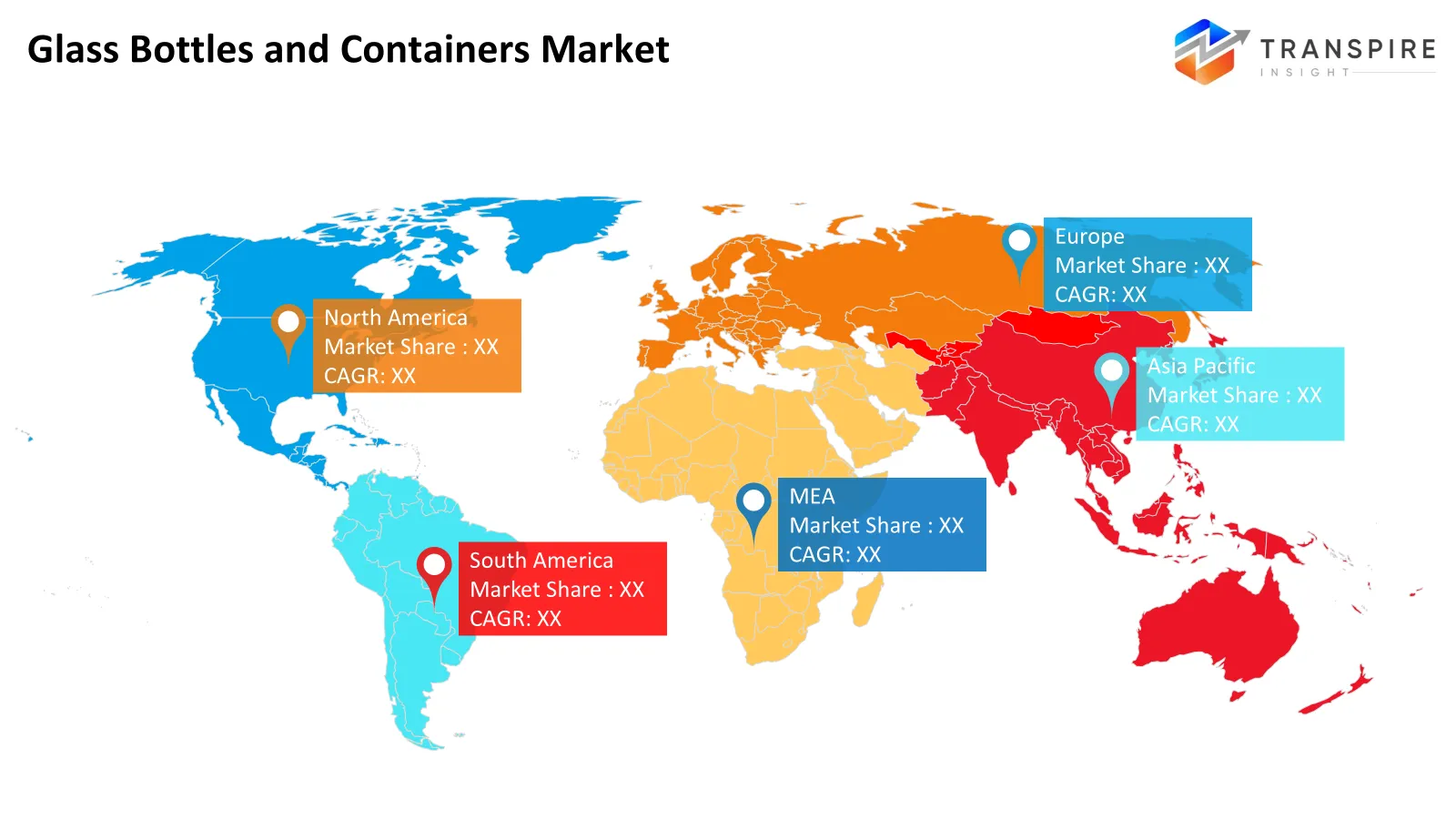
North America is the world's largest market for cullet at 55.18% of volume and benefits from a large mature beverage base, a strong market for craft alcohol, and mature curbside and commercial recycling programs. North America's advantage is not only scale, the abundant cullet provides the price advantaged opportunity for producers to lower the energy to melt and to meet customer commitments to recycled content. Policy support, including state mandates on plastics reduction and corporate ESG procurement, further benefits substitution of glass for the formable raw material. The region's ecosystem combines concentrated demand, robust collection infrastructure, and capital available for furnace upgrades.
In October 2026, Cardinal Glass Industries opened a dedicated manufacturing facility for its CLiC On-Demand Privacy Glass product line in Tomah, Wisconsin. This expansion added fully robotic production lines designed to scale up manufacturing capacity and reduce lead times for custom customer orders.
https://www.usglassmag.com/cardinal-glass-opens-new-privacy-glass-manufacturing-facility/
Europe accounts for 23.0% of the market and is positioned based on regulatory responsibility, heritage of premium drinks, and ability to decarbonise, not market size. Compared to North America, we operate under stricter packaging regulations and have evolved closed-loop collection systems enabling refillable bottles and high-cullet production. Europeans have a proven track record with wine, spirits, and food; established primary brands and customer contracts; and continued investment in hybrid, electric, and hydrogen-ready furnaces – our Zaragoza furnace that can switch to up to 70% electricity and so eliminate fossil energy – making decarbonisation an opportunity rather than a cost.
In September 2026, Moët Hennessy and Verallia launched a strategic research and development partnership to develop lighter, resource-efficient glass bottles without compromising strength.
https://www.verallia.com/en/communique-de-presse/moet-hennessy-partnership/
Asia Pacific is the most rapidly growing region with a 4.76% CAGR and accounts for 14.0% of demand. Demand in Asia Pacific has been shifting from throwaway beverage containers to specialist pharmaceutical vials and ampoules, and from costly cosmetics to designer food packaging, as quality standards improve and manufacturing within the region expands. Latin America makes up 4.5% of demand and is underpinned by beverage capacity expansion such as Verallia's Campo Bom furnace. Middle East & Africa (3.32%) offer a longer-term outlook based on further urbanisation and local food and beverage production, but the emergence of Asia Pacific as a source of higher-margin speciality demand is the key future growth opportunity.
In July 2026, Gerresheimer started operations at its new plant in Zhenjiang Dagang, China. This expansion doubles the company’s regional production capacity for primary packaging used with injectable pharmaceuticals, such as vials and ampoules, which directly matches the growing regional demand for localized, premium pharmaceutical-grade capacity.
Who are the Key Players in the Glass Bottles and Containers Market, and how do they compete?
Glass is a mildly concentrated industry, with O-I Glass, Verallia and Ardagh holding 55% of shipments, gaining purchasing, furnace & distribution advantages. Competition is based on diversification, decarbonised melting, cullet sharing, quality consistency & niche capability, rather than glass plant number. O-I Glass has a scale & efficiency approach with a 'MAGMA' modular furnace to scale up capacity with limited capex & less downtime. O-I's differentiation is its broad beverage coverage and its ability to duplicate proven technology in the Americas & Europe. Ardagh's differentiation is based on operational quality & material innovation; improving North American quality by 38% by 2026 & in a UK biofuel trial to displace natural gas for seven days. Verallia differentiates through its low-carbon innovation and fine beverage/food/spirits focus, with hybrid & hydrogen projects targeting 50-55% CO2 reduction. Vidrala & BA Glass focus on an integrated beverage supply chain and regional scale, with Vidrala incorporating 55.4% recycled glass. Gerresheimer, Stoelzle & Wiegand-Glas seek high-margin niches – pharma glass, luxury flacons & high-cullet hybrid furnace. Others such as Vitro, Consol, AGI Glasspack, Hindustan National Glass, Piramal Glass, Nihon Yamamura & Vetropack compete on geography, customer service & local-capacity advantage.
Key Players are:
- Owens-Illinois
- Ardagh Group
- Verallia
- Vidrala
- BA Glass
- Gerresheimer
- Vetropack
- Wiegand-Glas
- Stoelzle Glass
- AGI Glasspack
- Hindustan National Glass
- Piramal Glass
- Nihon Yamamura Glass
- Vitro
- Consol Glass
Glass Bottles and Containers Market — Enhanced Competitive Benchmarking
|
Company |
Est. Revenue Share Range |
Key Offerings |
Strategic Positioning |
Geographic Strength |
Technology Focus |
|
O-I Glass, Inc. |
Estimated 10–15% |
Beverage bottles, food jars, spirits bottles, pharmaceutical containers |
scale leadership with diversified beverage packaging |
North America, Europe, Latin America |
Lightweight glass, modular furnaces, advanced forming, cullet utilisation |
|
Ardagh Group – Glass Packaging |
Estimated 8–13% |
Beer bottles, spirits bottles, food jars, beverage containers |
Large-scale supplier emphasising customer partnerships and manufacturing efficiency |
Europe, North America, Latin America |
Furnace efficiency, lightweighting, recycled glass, manufacturing automation |
|
Verallia S.A. |
Estimated 7–11% |
Wine bottles, spirits bottles, food jars, beverage containers |
Sustainability-led differentiation and premium packaging innovation |
Europe, Latin America, Africa |
Recycled glass integration, lightweight design, furnace decarbonization |
|
Vidrala S.A. |
Estimated 3–6% |
Beer bottles, wine bottles, food containers, beverage packaging |
Regional scale leadership with operational efficiency and customer proximity |
Europe, Latin America |
Lightweight bottle engineering, furnace optimisation, recycled glass |
|
BA Glass |
Estimated 3–5% |
Beverage bottles, wine bottles, beer bottles, food jars |
European manufacturing scale with customised packaging solutions |
Europe, Africa |
Lightweighting, production automation, energy-efficient furnaces |
|
Gerresheimer AG |
Estimated 2–4% |
Pharmaceutical bottles, glass vials, cosmetic containers, speciality glass packaging |
Premium specialisation in regulated pharmaceutical and cosmetic packaging |
Europe, North America, Asia Pacific |
Type I borosilicate glass, precision forming, pharmaceutical quality control |
|
Vetropack Holding AG |
Estimated 2–4% |
Beer bottles, wine bottles, food jars, beverage containers |
Regional differentiation through flexible production and sustainability |
Europe, Eastern Europe |
Lightweight glass, recycled glass, energy-efficient production |
|
Şişecam |
Estimated 2–4% |
Beverage bottles, food containers, spirits bottles, speciality glass packaging |
Integrated glass manufacturing with regional expansion capabilities |
Europe, Middle East & Africa, Asia Pacific |
Furnace efficiency, recycled glass, advanced glass-forming processes |
|
Nihon Yamamura Glass Co., Ltd. |
Estimated 1–3% |
Beverage bottles, food jars, liquor bottles, glass packaging |
Japan-focused customer relationships and specialised container expertise |
Asia Pacific, particularly Japan |
Lightweight containers, precision forming, production efficiency |
|
Vitro, S.A.B. de C.V. |
Estimated 1–3% |
Beer bottles, beverage containers, food jars, glass packaging |
Americas-focused manufacturing and regional customer integration |
North America, Latin America |
Lightweight glass, recycled cullet, furnace efficiency |
Recent Development News
- In June 2026, Berlin Packaging acquired BlueSky, a UK-based packaging supplier specialising in glass, plastic, and metal packaging solutions. The acquisition strengthens Berlin Packaging’s European presence, expands its packaging portfolio, and enhances its customer reach across beverage, pharmaceutical, and personal care applications. https://berlinpackaging.eu/en-international/news/berlin-packaging-presence-in-UK-with-bluesky
- In September 2026, Verallia and Moët Hennessy announced a strategic research and development partnership to develop a new generation of glass packaging. The collaboration targets a 30–50% reduction in bottle weight while maintaining strength, supporting lightweight packaging innovation, resource efficiency, and glass manufacturing decarbonization. https://www.verallia.com/en/communique-de-presse/moet-hennessy-partnership/
- In April 2026, Ardagh Glass Packaging-North America launched a new 275 ml beverage bottle in collaboration with Fitz’s Bottling Company. The customized glass bottle supports beverage product differentiation, enhances shelf appeal, and expands packaging options for craft beverage producers. https://www.ardaghgroup.com/investors/news-events/press-releases/detail/260/ardagh-glass-packaging-launches-new-275ml-beverage-bottle-in-collaboration-with-fitzs-bottling-company
What Strategic Insights Define the Future of the Glass Bottles and Containers Market?
Market opportunities are currently bifurcated, with commodity beverage glass competing solely on cost, freight and access to cullet, and pharma, cosmetic and premium beverage competing primarily on technical specifications, design and validated low-carbon inputs. Although the risks need to be flagged for cullet availability, with rates likely to rise under tighter recycled content targets and capacity constrained before collection systems have developed, the upstream sourcing of high-quality cullet, and the reduction of emissions and supply chain exposures should be a strategic focus. By regionalising circular supply chains through the expansion of deposit-return schemes, local cullet processing and the deployment of hybrid or electric furnaces, substantial reduction in emissions and logistical supply chain risk can be achieved. Verallia's Zaragoza furnace, which uses up to 70% renewable electricity, clearly shows how decarbonization can become a competitive driver and market differentiator, and not simply a compliance obligation.
Key Segmentations are:
Product Type
- Glass Bottles
- Glass Jars
- Glass Vials
- Glass Ampoules
- Glass Carboys
- Glass Containers
- Other
End User
- Beverages
- Food
- Pharmaceuticals
- Cosmetics & Personal Care
- Chemicals
- Household Products
- Other
Color
- Clear/Flint
- Amber
- Green
- Blue
- Brown
- Opaque
- Other
Container Type
- Standard Bottles
- Premium Bottles
- Wide-Mouth Jars
- Narrow-Neck Bottles
- Dropper Bottles
- Pharmaceutical Containers
- Specialty Containers
Capacity
- Below 50 mL
- 50–250 mL
- 251–500 mL
- 501–1000 mL
- 1–2 L
- Above 2 L
- Custom
Application
- Alcoholic Beverages
- Non-Alcoholic Beverages
- Food Packaging
- Pharmaceutical Packaging
- Cosmetics
- Chemical Packaging
- Household Packaging
By Regional Analysis
North America
- US
- Canada
- Mexico
Europe
- Germany
- UK
- France
- Italy
- Spain
- Russia
- Rest of Europe
Asia Pacific
- China
- Japan
- India
- South Korea
- Australia
- Rest of Asia Pacific
South America
- Brazil
- Argentina
- Rest of South America
Middle East & Africa
- UAE
- Saudi Arabia
- Qatar
- South Africa
- Rest of the Middle East & Africa
Frequently Asked Questions
Find quick answers to common questions.
The glass bottles and containers market size was valued at USD 68.20 billion in 2025 and is poised to reach USD 97.73 billion by 2033, expanding at a 4.60% CAGR.
Key segments for the glass bottles and containers market are Product Type (Glass Bottles, Glass Jars, Glass Vials, Glass Ampoules, Glass Carboys, Glass Containers, Other); End User (Beverages, Food, Pharmaceuticals, Cosmetics & Personal Care, Chemicals, Household Products, Other); Color (Clear/Flint, Amber, Green, Blue, Brown, Opaque, Other); Container Type (Standard Bottles, Premium Bottles, Wide-Mouth Jars, Narrow-Neck Bottles, Dropper Bottles, Pharmaceutical Containers, Specialty Containers); Capacity (Below 50 mL, 50–250 mL, 251–500 mL, 501–1000 mL, 1–2 L, Above 2 L, Custom); Application (Alcoholic Beverages, Non-Alcoholic Beverages, Food Packaging, Pharmaceutical Packaging, Cosmetics, Chemical Packaging, Household Packaging).
Growth is primarily driven by rising demand for sustainable and recyclable packaging, increasing beverage consumption, premiumisation of wine and spirits, expansion of pharmaceutical packaging, growing preference for reusable glass containers, and stricter regulations on plastic packaging.
The glass bottles and containers market is led by major manufacturers including Owens-Illinois, Ardagh Group, Verallia, Vidrala, BA Glass, Gerresheimer, Vetropack, Wiegand-Glas, Stoelzle Glass, AGI Glasspack, Hindustan National Glass, Piramal Glass, Nihon Yamamura Glass, Vitro, Consol Glass.
North America holds 55.18% of the market, supported by strong beverage and food packaging demand, established manufacturing infrastructure, premium spirits consumption, pharmaceutical packaging requirements, and growing adoption of recyclable glass and sustainable packaging solutions.
Opportunities include lightweight glass packaging, recycled-content and high-cullet production, refillable bottle systems, premium customised packaging, pharmaceutical glass expansion, and low-carbon furnace technologies.
- Owens-Illinois
- Ardagh Group
- Verallia
- Vidrala
- BA Glass
- Gerresheimer
- Vetropack
- Wiegand-Glas
- Stoelzle Glass
- AGI Glasspack
- Hindustan National Glass
- Piramal Glass
- Nihon Yamamura Glass
- Vitro
- Consol Glass
About the Authors

Kartik bhong
I am Kartik Bhong, a Senior Research Analyst at Transpire Insight, specializing in the Packaging, Manufacturing, and Construction industry. My work focuses on analyzing market trends, emerging technologies, industry regulations, and competitive landscapes to deliver accurate, data-driven insights. I am passionate about transforming complex industry information into clear, practical content that helps businesses, professionals, and decision-makers stay informed and make confident strategic decisions. Through continuous research and a strong commitment to accuracy, I strive to create reliable, well-researched content that reflects the latest developments across these dynamic industries and supports the vision of Transpire Insight in delivering valuable market intelligence.

Chakradhar Khansole
Chakradhar serves as the Research Director at Transpire Insight, bringing over 8 years of experience in technology, innovation, and strategic market intelligence. He specializes in transforming complex market data into actionable business insights that enable organizations to make informed, growth-oriented decisions. Recognized for his strategic vision and analytical expertise, Chakradhar leads high-impact research initiatives, delivering comprehensive market assessments, competitive intelligence, and forward-looking industry analysis.
Recently Published Reports
-
Apr 2026
Pharmaceutical Cold Chain Packaging Market
Pharmaceutical Cold Chain Packaging Market By Material (Plastic,(Polyethylene (PE), Polypropylene (PP), Polyethylene Terephthalate (PET), Expanded Polystyrene (EPS), Polyurethane (PU),Others), Paper, Metal, Others), By Product (Small Boxes, Pallets, Large Sized Pallet Containers, Others), By End Use (Biopharmaceutical Companies, Clinical Research Organizations, Hospitals, Research Institutes, Logistics and Distribution Companies, Others)”, By Industry Analysis, Size, Share, Growth, Trends, and Forecasts 2026-2033
-
Apr 2026
Active & Intelligent Packaging Market
Active & Intelligent Packaging Market By Type (Active Packaging, Smart Packaging), By Material (Polymer-Based, Paper & Board-Based, Metal-Based, Glass-Based), By Technology (Time-Temperature Indicators, Freshness Indicators, RFID, Antimicrobial Packaging, Modified Atmosphere Packaging), By Application (Food & Beverages, Pharmaceutical, Cosmetics & Personal Care, Electronics & Consumer Goods, Others), By Industry Analysis, Size, Share, Growth, Trends, and Forecasts 2026-2033
-
Apr 2026
Biodegradable Cut Flower Packaging Market
Biodegradable Cut Flower Packaging Market By Material Type (Paper & Paperboard, Biodegradable Plastics, Natural Fibers, Molded Pulp, Others), By Product Type (Sleeves, Wraps, Boxes & Cartons, Bags & Pouches, Inserts & Holders), By Application (Roses, Carnations, Tulips, Chrysanthemums, Mixed Flowers, Others) and By Distribution Channel (Direct Sales, Distributors & Wholesalers, Online Channels), By Industry Analysis, Size, Share, Growth, Trends, and Forecasts 2026-2033
-
May 2026
Pharmaceutical Packaging Market
Pharmaceutical Packaging Market By Material Type (Plastic, Glass, Metal, Paper & Paperboard, Others), By Packaging Type (Bottles, Blister Packs, Vials, Ampoules, Pouches & Sachets, Others) and By End User (Hospitals & Clinics, Retail Pharmacies, Online Pharmacies, Pharmaceutical Manufacturers), By Industry Analysis, Size, Share, Growth, Trends, and Forecasts 2026-2033