
Germany Open Source ERP Solutions Market Summary
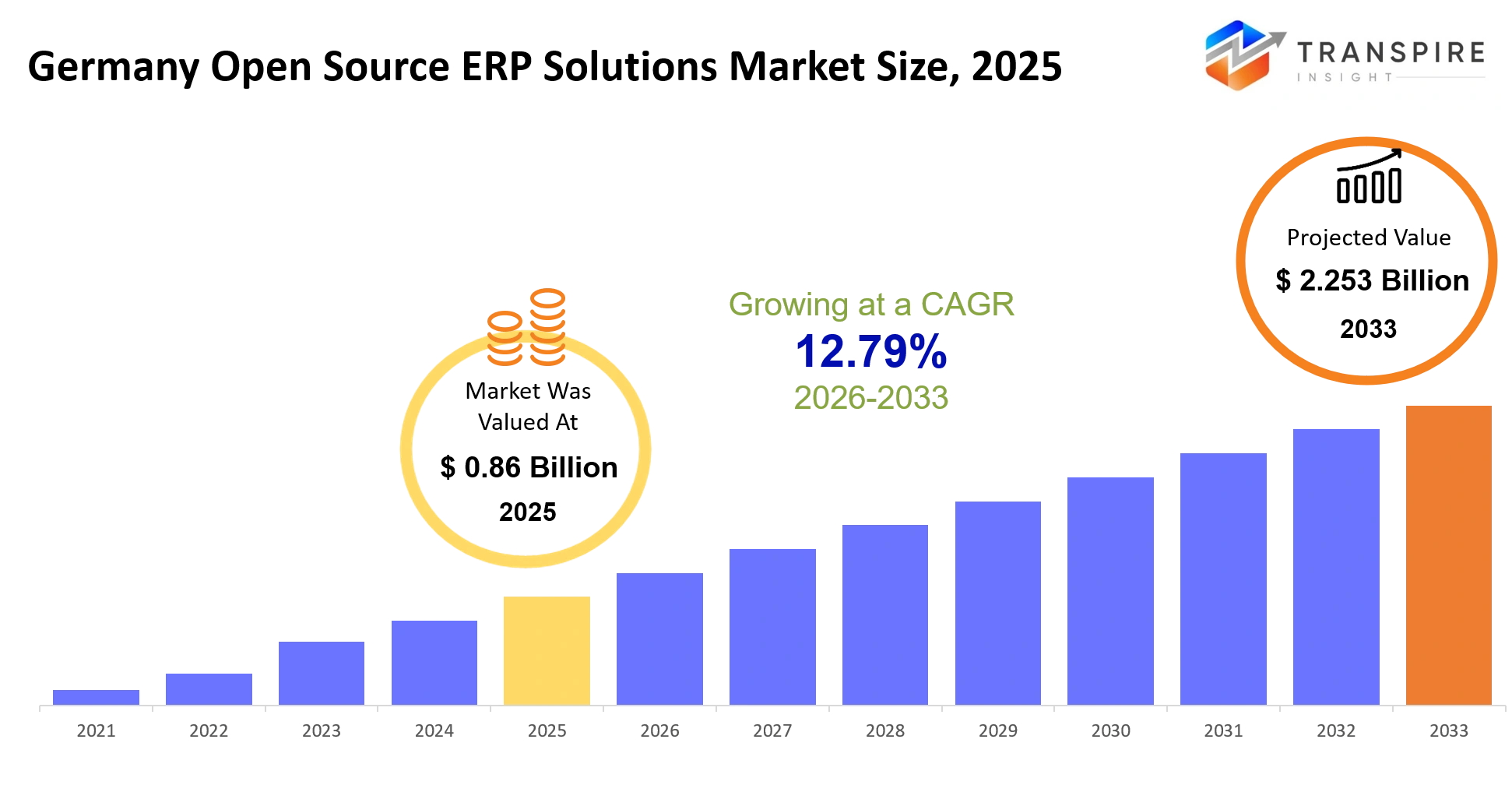
As per Transpire Insight Analysis the Germany Open Source ERP Solutions Market size is estimated at USD 0.86 Billion in 2025 and is anticipated to reach USD 2.253 Billion by 2033, growing at a CAGR of 12.79% from 2026 to 2033.
The Germany Open Source ERP Solutions Market, helps companies handle finance, procurement, production, inventory, human resources, and even day to day customer operations, with customizable enterprise software, without the heavy licensing fees you usually get from proprietary ERP platforms. In Germany , manufacturing firms , distributors, retailers, and service providers are gradually choosing open source ERP systems because they give better operational visibility, yet keep tighter control over their data and the software’s own customization. Over the last five years, this whole market has been moving, from on-premise setups to cloud-native and hybrid ERP environments, mainly because organizations modernized older IT infrastructure. Then COVID-19 hit and, it sped up digital transformation initiatives, while also revealing weak spots in scattered business systems, so many firms looked for more adaptable ERP options. Meanwhile, deeper integration with artificial intelligence, automation, analytics, and Industry 4.0 related technologies, is making processes run more smoothly and decisions feel clearer, which is pushing wider enterprise uptake. As implementation ecosystems become more mature and the ability to tailor solutions expands, providers are also earning more in services, not just one-time work, and they’re stacking it with ongoing cloud subscription revenues.
Germany Open Source ERP Solutions Market Size & Forecast:
- Germany Open Source ERP Solutions Market Size 2025: USD 0.86 Billion
- Expected Market Value 2033: USD 2.253 Billion
- Forecast CAGR: 12.79%
- Leading region in 2025:Southern Germany
- Fastest Growing region:Northern Germany
- Key Profile: Odoo, ERPNext, Dolibarr, Tryton, Apache OFBiz, Metasfresh, iDempiere, Axelor, ADempiere, Viindoo, Oracle, SAP, Microsoft, Infor, Acumatica.
Key Market Insights
- In Germany, Open Source ERP Solutions market leadership still feels strongest in Southern Germany, at about 38% of market revenue in 2025—mostly backed by manufacturing clusters and that ongoing digital industrial investment thing.
- Northern Germany is expected to grow the quickest up until 2033, with logistics modernization, smarter port infrastructure and cloud ERP rollouts spreading across SMEs, pushing the pace along.
- Cloud-based ERP software keeps taking the lead in deployments with nearly 46% market share in 2025, however hybrid deployments are the fastest-growing pattern, mostly because enterprises are modernizing older legacy infrastructure, bit by bit.
- Finance & Accounting also stays in front, holding around 27% share, while Supply Chain Management is seeing the strongest growth, driven by digital procurement plus inventory optimization efforts.
- Manufacturing firms add roughly 35% of total demand, meanwhile retail and healthcare organizations keep ramping up ERP spending through digital transformation programs. Odoo, ERPNext, SAP, Oracle, Microsoft, and Infor are all reinforcing their spots by using AI-enabled automation, cloud-native ERP features, and broader partner ecosystems.
- Also, strategic collaborations between ERP vendors and system integrators are effectively shortening those implementation timelines, and at the same time improving customization for German mid sized enterprises.
- AI-powered analytics, workflow automation, and predictive planning are gradually turning into standard product capabilities, and that helps boost customer retention plus recurring subscription revenue.
- Finally, open APIs and low-code development frameworks are speeding up third-party application integration , so enterprise platforms become more adaptable across different industries , without as much friction.
What are the Key Drivers, Restraints, and Opportunities in the Germany Open Source ERP Solutions Market?
The main driver behind market growth is Germany’s ongoing investment in industrial digitalization and those Industry 4.0 initiatives that everyone keeps talking about. In practice, manufacturers are moving away from disconnected older software, swapping in integrated ERP platforms that handle production planning, inventory control, procurement, and financial management all in one cohesive space. Also, the fast take-up of cloud infrastructure has eased deployment costs, and it lets teams push software updates sooner, plus it makes integration less annoying with analytics, automation, and even artificial intelligence tools. In the end, these changes raise operational efficiency and they open up repeat purchase or recurring revenue chances for software vendors and the implementation partners.
The biggest restraint still feels like ERP migration complexity when it comes to legacy enterprise systems. Large organizations often rely on heavily customized business processes, meaning they need tons of configuration, data migration, employee training, and careful connections to whatever software they already use. These structural headaches bump up implementation expenses and extend project schedules, which means the return on investment gets delayed. On top of that, there is a persistent shortage of experienced ERP consultants and open source integration specialists, so deployment speed tends to slow down in those complicated enterprise settings.
A meaningful opportunity shows up with AI-enabled cloud ERP platforms, especially built for Germany’s small and medium-sized enterprises. Their subscription approach is usually more affordable, there’s low-code customization, predictive analytics, and automated workflow management, so advanced ERP features become reachable for companies with limited IT capacity.
What Has the Impact of Artificial Intelligence Been on the Germany Open Source ERP Solutions Market?
Artificial intelligence is kinda reshaping enterprise resource planning, mostly by taking care of routine business routines and making operational decisions feel more sharper across finance, procurement, inventory management , manufacturing and customer relationship management. AI powered assistants are now handling invoice processing, purchase approvals, demand forecasting, and even document classification— so there is less manual effort, and the processing usually lands more accurately. In the background, machine learning models look at past sales, supplier results, production timetables and inventory patterns, then they help tune procurement planning and cut down on excess stock. Also, predictive maintenance that connects with Industry 4.0 sensors lets manufacturers keep equipment downtime lower, and boost production efficiency.
On top of that, advanced analytics improve things like financial forecasting, workforce planning, fraud detection, and customer service, by spotting operational patterns that older reporting methods often overlook, or just never see. Intelligent workflow automation helps companies speed up order processing, enhance supply chain visibility, and keep compliance aligned with German and European regulatory needs. All of this tends to raise productivity while trimming operating costs across both manufacturing and service industries.
Still, AI adoption has hurdles, and they are not small. Putting artificial intelligence into existing ERP systems can mean a lot of data cleaning, heavy system customization, and access to skilled technical support. Quite a few organizations keep running into inconsistent data quality, plus messy integration complexity, and that combo makes it hard to reach the full potential of AI enabled enterprise management platforms.
Key Market Trends
- Since 2022, cloud native ERP adoption has kinda sped up, with more than 60% of new implementations leaning toward cloud or hybrid environments so they can boost scalability and also cut down infrastructure costs a bit.
- German manufacturers, since 2023, have been doing more integration of AI driven forecasting and workflow automation , which helps production planning and tends to trim inventory holding expenses.
- Meanwhile, SMEs increasingly favor subscription based ERP models , letting organizations lower the initial capital outlay while still getting steady software updates, plus security upgrades and patches without waiting forever.
- Vendors like Odoo , ERPNext, SAP, Microsoft, and Oracle have also expanded their AI features and low code development tools since 2024, shortening timelines for rollout and in general improving day to day user productivity.
- Also, demand for industry specific ERP solutions has grown across automotive, machinery, healthcare, and logistics, because companies want workflows that actually fit , instead of relying on heavily customized legacy systems that were sort of… painful.
- At the same time, API first architectures have basically become the norm, making it easier to connect with CRM, e-commerce, IoT, and business intelligence platforms while supporting digital transformation goals across the board.
- Organizations are putting more weight on GDPR compliant hosting and cybersecurity , so secure cloud infrastructure ends up being a key purchasing criterion when enterprise software is chosen.
- And, open source ERP communities have expanded a lot, which means more certified implementation partners, third party extensions, and localized business modules for German enterprises.
- Finally, hybrid deployment strategies are getting more momentum, as big enterprises modernize legacy systems step by step , while still keeping operational continuity across multiple business units without major downtime.
Germany Open Source ERP Solutions Market Segmentation
By Component
ERP Software ends up taking the largest share, mostly because many organizations prefer an integrated platform, not just a bunch of separate tools, it lets them run finance, procurement, manufacturing, inventory, and customer operations all in one environment. In that same vein, Implementation Services and Consulting are still kind of must haves, they help with setting up workflows , migrating legacy data, and making sure enterprise processes match the actual operational needs, even when the teams are moving around. Support & Maintenance also keeps going strong, it drives steady recurring revenue via software updates, cybersecurity improvements, and help with regulatory compliance, that part never really slows down.
Cloud Services have been growing pretty fast too as enterprises switch to subscription-based infrastructure, which cuts back hardware spending while also improving scalability and making remote access more convenient. Training services stay relevant because ERP adoption is not really smooth unless employees know how to use it, plus you need change management across different business functions. Other offerings cover things like application customization, third-party integration, performance optimization, and managed administration, and those collectively help keep long-term customer relationships healthier.
By Deployment
Cloud based deployment shows up as the biggest implementation model, mostly because infrastructure costs are lower, deployment can happen fairly fast, and software updates keep flowing continuously. On-Premise solutions still work for organizations that want full infrastructure control , tighter security policies , or business processes that are very customized in practice. Hybrid deployment keeps getting more attention too, since it mixes operational flexibility with older enterprise investments they don’t want to throw away.
For SaaS platforms, software management becomes easier through subscription pricing, automatic upgrades , and generally less maintenance work. Private Cloud setups stay appealing for regulated industries, mainly for stronger data protection. Meanwhile Public Cloud adoption supports scalability for organizations that are growing. Beyond these, other deployment models exist and they help cover specialized operational needs , plus regulatory constraints, depending on the industry.
By Application
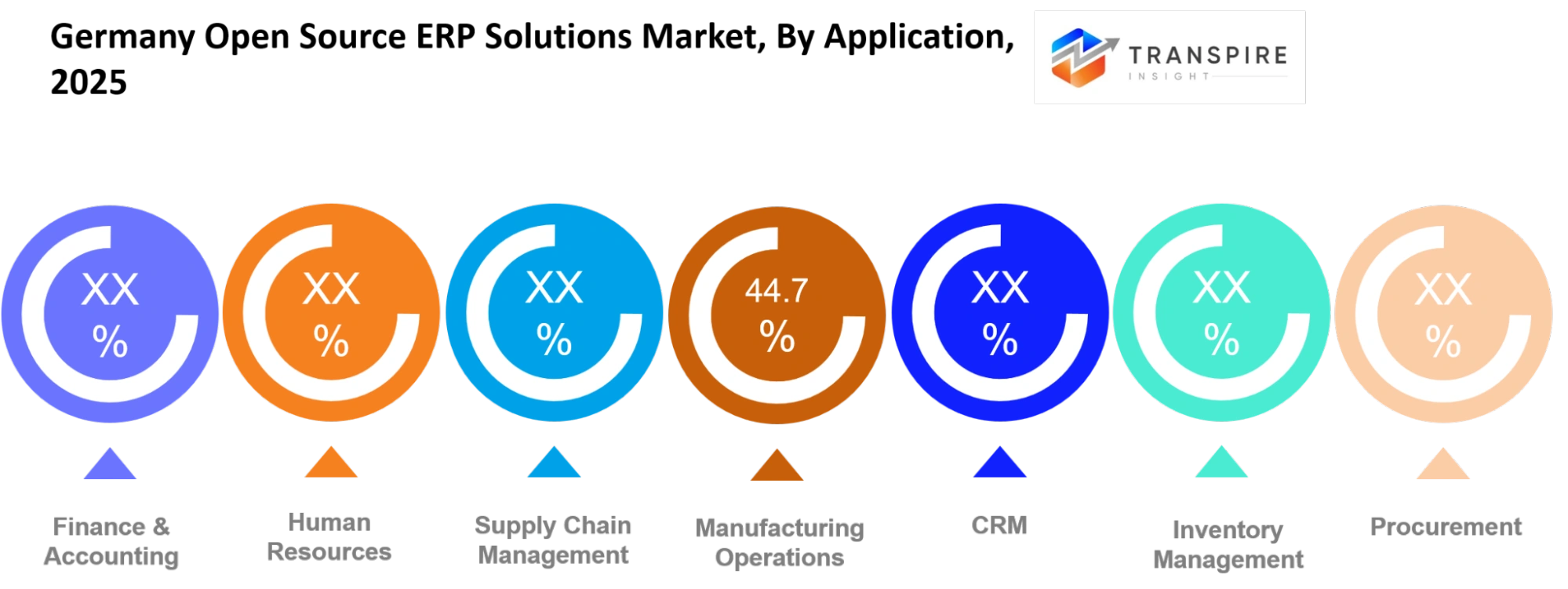
Finance and Accounting still kind of leads the pack, because organizations need correct financial reporting, budget setting, tax adherence, and transaction handling all together. Human Resources modules help smooth payroll, hiring, staffing roadmap planning, and employee performance management, so it does feel more coordinated. Supply Chain Management keeps growing too, mainly when companies push for stronger procurement visibility and better supplier cooperation.
Manufacturing Operations benefit from production sequencing, quality oversight, and resource planning tools, which end up lifting operational efficiency in practice. CRM apps boost customer interaction through a centralized approach to sales and service management, while Inventory Management helps keep stock levels ready and also supports warehouse operations. Procurement modules raise the purchasing efficiency, and then additional applications handle project management, compliance reporting, and business analytics.
By End User
Manufacturing contributes the highest revenue, because production intensive industries depend on integrated planning , inventory management and factory operations . Retail organizations, adopt enterprise software so that inventory , sales procurement and customer management stay synchronized across both physical and digital channels . Healthcare providers are increasingly rolling out ERP platforms to make procurement efficiency better, improve financial administration, and strengthen regulatory compliance .
IT & Telecom organizations use ERP systems for project management, service delivery , and resource allocation . Education institutions, enhance their financial administration and student related operations through integrated software platforms. Government agencies , BFSI organizations, and other industries keep expanding their ERP investments for operational transparency , regulatory compliance, and digital service delivery .
By Enterprise Size
Large Enterprises remain the biggest adopters, mostly because tricky day-to-day operations need integrated platforms that can handle multiple facilities, several subsidiaries , and international business moves. Medium Enterprises keep putting money into modern ERP solutions to raise competitiveness while also cutting down on operational complexity, which sounds simple but it really isn’t. Small Enterprises are increasingly choosing cloud-native options that lower implementation costs, and also make ongoing system management less headache.
SMEs are the fastest growing customer group, mainly due to affordable subscription pricing and software customization that is way easier to adapt. Startups tend to prefer ERP platforms that are flexible enough for quick expansion without putting much into new infrastructure. The other enterprise groups, they usually go for specialized solutions depending on operational size, regulatory constraints , and industry specific processes that matter most to them.
What are the Key Use Cases Driving the Germany Open Source ERP Solutions Market?
Manufacturing still ends up being the primary application, because integrated ERP platforms end up coordinating things like production planning, procurement, inventory control, financial management, and quality assurance inside one kind of unified operating setting. That centralized approach tends to make operations more efficient, cuts down on manual steps, and helps teams with better production scheduling even across complicated manufacturing facilities
Retail and healthcare organizations are also rolling out ERP more and more, mainly to sharpen inventory accuracy, improve supplier coordination, manage customers, and handle regulatory reporting in a cleaner way. Logistics providers are doing similar moves, they integrate enterprise software with warehouse and transportation systems, so fulfillment gets faster and supply chain visibility becomes stronger across broader national distribution networks .
Some newer use cases are showing up too, like AI-assisted business planning, predictive inventory optimization, and ESG reporting that gets baked directly into ERP platforms. Low-code workflow automation is getting traction alongside IoT-connected production monitoring, as enterprises prep for more intelligent operations and data-driven decisioning.
|
Report Metrics |
Details |
|
Market size value in 2025 |
USD 0.86 Billion |
|
Market size value in 2026 |
USD 0.97 Billion |
|
Revenue forecast in 2033 |
USD 2.253 Billion |
|
Growth rate |
CAGR of 12.79% from 2026 to 2033 |
|
Base year |
2025 |
|
Historical data |
2021 - 2024 |
|
Forecast period |
2026 - 2033 |
|
Report coverage |
Revenue forecast, competitive landscape, growth factors, and trends |
|
Regional scope |
Germany |
|
Key company profiled |
Odoo, ERPNext, Dolibarr, Tryton, Apache OFBiz, Metasfresh, iDempiere, Axelor, ADempiere, Viindoo, Oracle, SAP, Microsoft, Infor, Acumatica. |
|
Customization scope |
Free report customization (country, regional & segment scope). Avail customized purchase options to meet your exact research needs. |
|
Report Segmentation |
By Component (ERP Software, Implementation Services, Consulting, Support & Maintenance, Cloud Services, Training, Others); By Deployment (Cloud-Based, On-Premise, Hybrid, SaaS, Private Cloud, Public Cloud, Others); By Application (Finance & Accounting, Human Resources, Supply Chain Management, Manufacturing Operations, CRM, Inventory Management, Procurement, Others); By End User (Manufacturing, Retail, Healthcare, IT & Telecom, Education, Government, BFSI, Others); By Enterprise Size (Large Enterprises, Medium Enterprises, Small Enterprises, SMEs, Startups, Others). |
Which Regions are Driving the Germany Open Source ERP Solutions Market Growth?
Southern Germany stays kind of the main regional market, coming in at about 38% of total revenue in 2025. This area has a pretty solid cluster of automotive, machinery, industrial equipment and advanced manufacturing firms, and they keep funding digital production environments. Big business centers like Bavaria, and Baden-Württemberg, help maintain a mature setup of ERP vendors, system integrators, cloud providers and technology consultancies. Because Industry 4.0 programs keep getting renewed , and manufacturers show a high level of digital maturity, software take-up keeps going steadily, along with recurring implementation income.
Western Germany is next, also large, and it’s expected to remain the second-biggest contributor. It’s backed by a diversified industrial base, chemical production logistics operations and financial services too. But, unlike the south, momentum in the west comes more from enterprise modernization rather than pure manufacturing expansion. Most organizations are still switching out old ERP systems for cloud enabled options, in order to boost operational resilience, satisfy regulatory needs better and improve collaboration between sites. Add in strong digital infrastructure, plus fairly steady enterprise IT budgets, and you get reliable opportunities for software providers and implementation partners.
Northern and Eastern Germany are forecasted to grow the quickest, during the 2026–2033 window. There are major moves in logistics infrastructure, smart ports, renewable energy initiatives, plus a growing ring of technology startups, and that has sped up enterprise digitalization across the regions. Small and medium sized businesses, increasingly prefer cloud based ERP platforms, mainly because subscription pricing trims the upfront burden, and also makes scaling a lot easier.
Who are the Key Players in the Germany Open Source ERP Solutions Market and How Do They Compete?
The competitive environment mixes global enterprise software providers with specialized open source ERP developers, and in general it becomes kind of moderately fragmented. In the real competition, it’s more about cloud maturity, customization flexibility, AI integration, implementation capability, and long-term support services than it is just about software licensing. The open source side tries to win by pushing down ownership costs a bit, and offering broad adaptation options, while the big enterprise vendors lean on integrated digital ecosystems, more advanced analytics, and enterprise-level security standards.
Odoo keeps expanding, largely because of its modular ERP design, so organizations can roll out only the business functions they need, and then grow those applications later. ERPNext sets itself apart via simpler deployments, solid community help, and bundled business modules that tend to fit small and medium-sized enterprises. Metasfresh is more focused on manufacturing and wholesale distribution, and it gives flexible supply chain features, tuned to European business expectations in particular.
SAP improves its competitive stance by threading artificial intelligence, business analytics, and cloud-native ERP functions directly into day-to-day enterprise operations, plus it expands partnerships across Germany manufacturing networks. Microsoft grows its market coverage by pairing Dynamics 365 with Azure cloud services, adding AI tools, and enabling low-code creation through the Power Platform environment. Oracle continues to invest in autonomous database technology, AI-driven business automation, and cloud applications built for specific industries, which helps large enterprises run operations with better efficiency overall.
These different approaches let vendors compete across organizations that vary in size, industry needs, and how urgent their digital transformation priorities are, even when the value proposition is not only software alone.
Company List
- Odoo
- ERPNext
- Dolibarr
- Tryton
- Apache OFBiz
- Metasfresh
- iDempiere
- Axelor
- ADempiere
- Viindoo
- Oracle
- SAP
- Microsoft
- Infor
- Acumatica
Recent Development News
In February 2026, Odoo announced the launch of Odoo 20 with expanded artificial intelligence features, enhanced workflow automation, and improved financial management capabilities. The release strengthens enterprise productivity and supports broader adoption among manufacturing and service organizations.
Source: https://www.odoo.com
In October 2025, Microsoft introduced new AI-powered enhancements for Dynamics 365, expanding Copilot capabilities across finance, supply chain, and customer service applications. The update helps enterprises automate business processes and improve operational decision-making.
Source: https://news.microsoft.com
In March 2025, Oracle expanded Oracle Fusion Cloud Applications with new generative AI capabilities for finance, procurement, human resources, and supply chain management. The enhancements improve business automation while increasing productivity across enterprise operations.
Source: https://www.oracle.com
What Strategic Insights Define the Future of the Germany Open Source ERP Solutions Market?
The market is moving towards more intelligent, cloud-native enterprise platforms, that kind of blend open source flexibility with artificial intelligence, automation ,and advanced analytics. And yeah this structural shift is being driven by Germanys continued industrial digitalization, plus the modernization of legacy enterprise systems, and also the need for scalable software that keeps up with rapidly changing business operations. In the next five to seven years, vendors that can truly integrate AI, low-code development, and industry-specific features into open source platforms, are likely to grab a bigger portion of enterprise spending.
There’s also one less obvious risk, the growing shortage of skilled ERP implementation specialists. Even if software capabilities get better, limited technical expertise can still slow down deployments, push costs higher, and lower customer satisfaction, sometimes in ways that aren’t immediately visible. At the same time, there’s an emerging opportunity too, AI-enabled ERP solutions tailored for medium-sized manufacturers and logistics providers, looking for affordable digital transformation tools. Market participants should broaden their partner ecosystems, strengthen cloud service capabilities, and put money into industry-focused AI applications that actually deliver measurable operational value, while also reducing implementation complexity.
Germany Open Source ERP Solutions Market Report Segmentation
By Component
- ERP Software
- Implementation Services
- Consulting
- Support & Maintenance
- Cloud Services
- Training
- Others
By Deployment
- Cloud-Based
- On-Premise
- Hybrid
- SaaS
- Private Cloud
- Public Cloud
- Others
By Application
- Finance & Accounting
- Human Resources
- Supply Chain Management
- Manufacturing Operations
- CRM
- Inventory Management
- Procurement
- Others
By End User
- Manufacturing
- Retail
- Healthcare
- IT & Telecom
- Education
- Government
- BFSI
- Others
By Enterprise Size
- Large Enterprises
- Medium Enterprises
- Small Enterprises
- SMEs
- Startups
- Others
Frequently Asked Questions
Find quick answers to common questions.
The expected Germany Open Source ERP Solutions Market size for the market will be USD 2.253 Billion in 2033.
Key segments for the Germany Open Source ERP Solutions Market are By Component (ERP Software, Implementation Services, Consulting, Support & Maintenance, Cloud Services, Training, Others); By Deployment (Cloud-Based, On-Premise, Hybrid, SaaS, Private Cloud, Public Cloud, Others); By Application (Finance & Accounting, Human Resources, Supply Chain Management, Manufacturing Operations, CRM, Inventory Management, Procurement, Others); By End User (Manufacturing, Retail, Healthcare, IT & Telecom, Education, Government, BFSI, Others); By Enterprise Size (Large Enterprises, Medium Enterprises, Small Enterprises, SMEs, Startups, Others).
Major Germany Open Source ERP Solutions Market players are Odoo, ERPNext, Dolibarr, Tryton, Apache OFBiz, Metasfresh, iDempiere, Axelor, ADempiere, Viindoo, Oracle, SAP, Microsoft, Infor, Acumatica.
The Germany Open Source ERP Solutions Market size is USD 0.86 Billion in 2025.
The Germany Open Source ERP Solutions Market CAGR is 12.79% from 2026 to 2033.
- Odoo
- ERPNext
- Dolibarr
- Tryton
- Apache OFBiz
- Metasfresh
- iDempiere
- Axelor
- ADempiere
- Viindoo
- Oracle
- SAP
- Microsoft
- Infor
- Acumatica
About the Authors

Mayur Shinde
I am Mayur Shinde, a Senior Research Analyst at Transpire Insight, specializing in the Automotive & Transportation and Information & Communication Technology (ICT) Industry. My work focuses on analyzing emerging market trends, technological advancements, competitive landscapes, and industry developments to deliver accurate, data-driven insights. I am passionate about transforming complex market information into clear, actionable content that helps businesses, professionals, and decision-makers stay informed and make confident strategic decisions.

Chakradhar Khansole
Chakradhar serves as the Research Director at Transpire Insight, bringing over 8 years of experience in technology, innovation, and strategic market intelligence. He specializes in transforming complex market data into actionable business insights that enable organizations to make informed, growth-oriented decisions. Recognized for his strategic vision and analytical expertise, Chakradhar leads high-impact research initiatives, delivering comprehensive market assessments, competitive intelligence, and forward-looking industry analysis.
Recently Published Reports
-
Apr 2026
3D Optical Profiler Market
3D Optical Profiler Market Size, Share & Analysis Report By Type (Desktop 3D Optical Profiler, and Portable 3D Optical Profiler), By Technology (Confocal Technology, and White Light Interference), By End-Use Industry (Manufacturing, Research Institutions, Automotive, Aerospace and Defense, Medical Devices, and Other), and Geography (North America, Europe, Asia-Pacific, Middle East and Africa, South and Central America), 2021 - 2031
-
Apr 2026
Depth Sensor Market
Depth Sensor Market Size, Share & Analysis Report By Type (Infrared Depth Sensors, Time-of-Flight (ToF) Sensors, Stereo Vision Sensors, Structured Light Sensors, Ultrasonic Depth Sensors), By Application (Automotive, Robotics, Gaming, Consumer Electronics, Industrial Automation, Healthcare, Security & Surveillance, Others), By End Users (Automotive Manufacturers, Consumer Electronics Companies, Healthcare Providers, Industrial Companies, Security Agencies, Gaming Companies, Robotics Companies, Others), and Geography (North America, Europe, Asia-Pacific, Middle East and Africa, South and Central America), 2021 – 2031
-
Apr 2026
Digital Manufacturing Market
Digital Manufacturing Market Size, Share & Analysis Report By Component (Hardware, Software, and Services), By Technology (Robotics, 3D Printing, Internet of Things (IoT), and Others), By Application (Automotive and Transportation, Aerospace and Defense, Consumer Electronics, Industrial Machinery, and Others), By Process Type (Computer-Based Designing, Computer-Based Simulation, Computer 3D Visualization, Analytics, and Others), and Geography (North America, Europe, Asia-Pacific, Middle East and Africa, South and Central America), 2021 – 2031
-
Apr 2026
Digital Visa Services Market
Digital Visa Services Market Size, Share & Analysis Report By Type (Individual Travelers, Group Travelers), By Application (Tourism, Business Travel, Others), and Geography (North America, Europe, Asia-Pacific, Middle East and Africa, South and Central America), 2021 – 2031